I really enjoyed the privacy of this yurt campground. Nobody was camping in the area. Very quiet.


I really enjoyed the privacy of this yurt campground. Nobody was camping in the area. Very quiet.
Potholes State Park, WA, Yurt Camping Trip, Day 2
April 2025
Michael Delmer, April, Karen, and I
Potholes State Park, Eastern Central Washington State
Columbia National Wildlife Refuge
Columbia National Wildlife Refuge - Wikipedia
"Birdsong by day, coyote chorus by night. Dramatic cliffs and rimrock sit side-by-side with lakes, potholes, and marshes. Desert denizens and waterfowl sharing the same rugged landscape.
Comprising nearly 30,000 acres, Columbia National Wildlife Refuge is a scenic mixture of rugged cliffs, canyons, lakes, grasslands and sagebrush. The combination of lakes and surrounding irrigated croplands, combined with generally mild winters and the protection provided by the refuge, attracts large numbers of migrating and wintering mallards, Canada geese, tundra swans and other waterfowl."
Columbia National Wildlife Refuge is a scenic mixture of rugged cliffs, canyons, lakes, and sagebrush grasslands. Formed by fire, ice, floods, and volcanic tempest, carved by periods of extreme violence of natural forces, the refuge lies in the middle of the Drumheller Channeled Scablands of central Washington. The area reveals a rich geologic history highlighted by periods of dramatic activity, each playing a major role in shaping the land. The northern half of the refuge, south of Potholes Reservoir, is a rugged jumble of cliffs, canyons, lakes, and remnants of lava flows. This part of the Scablands, known as the Drumheller Channels, is the most spectacularly eroded area of its size in the world and was designated as a National Natural Landmark in 1986.
Moses Lake City, Washington, (27,000 Population)


4051.
Red Coals Pulse Like Distant Stars
The last light slips behind the ridge,
a thin ember of day still glowing.
Boots thud softly on the packed earth,
the air cooling with each step.
Evening begins before we notice.
A match flares against the breeze,
brief and stubborn in the dim.
Paper curls into orange petals,
logs shift as if waking.
Fire learns its shape slowly.
Smoke threads upward in loose spirals,
finding its own quiet route.
A kettle hums near the campfire coals,
steam rising like a soft prayer.
Night accepts our presence.
Tall trunks stand just beyond the glow,
their crowns lost to the dark.
The fire paints their bark in strokes
of copper, rust, and shadow.
Even giants enjoy a little warmth.
Voices soften as the flames steady,
words drifting like sparks.
Some tales are true, some nearly so,
all of them shaped by the night.
The campfire listens without judgment.
Logs collapse inward with a sigh,
a slow settling of heat and memory.
Red coals pulse like distant stars,
steady, patient, unhurried.
The night grows deeper around them.
The fire shrinks to a quiet glow,
its edges soft as worn cloth.
Ash gathers in pale drifts,
the remains of what kept us warm.
Nothing ends abruptly out here.
The final spark dims into silence,
leaving only the scent of smoke.
Stars settle into their places,
unbothered by our small rituals.
The forest closes gently around us.
I will be attending a Deep Dive Poetry Workshop on the poet William Stafford (1914-1993) conducted by John Sibley Williams. This Zoom workshop will be held online on April 30, 2026.
I will be attending The
Stafford Challenge 2026 Conference in Portland from June 18, 2026 until
June 21, 2026. This conference will be held at the Lewis and Clark College
campus. The conference has many noted teachers, poets, and scholars in
attendance. Our local Vancouver, WA, poet laurate, art’s leader, editor, and
teacher, Christopher Luna,
will be one of the teachers.
In 2026, I have been reading a lot of the poetry written by
William Stafford (1914-1993). He was a professor of English at Lewis and Clark
College in Portland, Oregon. He is one
of the best known poets from Oregon.
My preliminary observations about William Stafford’s
poetry:
1. Probably 70% of his poems fit on one page in a printed book. There are typically under 30 lines per page. A number of these poems are more in sonnet length to 20 lines per page. Each poem is titled. He tends to avoid longer lines with lots of syllables. Since I favor brief poems, his style of poetry appeals to me. His style is direct, plain, and succinct!
2.
He uses the Quintain form more often than any
other poet I have ever read. I research
quintains, pentastichs, tankas, cinquains, quintets, gogyohkas, wakas, commonplaces,
and onions.
3.
He enjoyed the outdoors in the Pacific Northwest.
He talked about camping, hiking, traveling, people, locales, plants, remote places, and enjoying
life outdoors with family and friends. Since I also share many similar interests
and write poetry
about our Pacific Bio-Region, his concise, plain, and soft spoken words resonated with me.
4.
His anti-war views and socio-political progressive
views were appealing.
He was a conscientious objector and worked in a federal camp. His philosophy was
aligned with my own views on Virtue Ethics.
5.
Many of his poems reflect Native American viewpoints,
storytelling, myths, and ways of speaking and writing. I have also studied and appreciate the literature
of Native Americans. Staccatos, repeats, chants, two world consciousness, temporal anomalies, bumpy logic, departures into animal/plant minds., mythical nexus, earthiness, insects, etc.
6. William Stafford’s style of writing benefits from the lack of obscure allusions, name dropping, radical metaphors and convoluted vocabulary, free verse rambling, Paris cliches and Big City shenanigans, and strange surrealistic oulipos Avant-guard sophisticated wordiness.
Here are the poetry books by William Stafford that I have read:
Stafford, William. The Way It Is:
New and Selected Poems. Graywolf, 1977, 1998, 268 pages. Paperback, VSCPL (My home poetry
research library.)
William Stafford. The Darkness Around Us is Deep. 1994, 160 pages. Selected Poems of William Stafford – An Award-Winning Poet's Works Chosen by Bestselling Author Robert Bly. VSCPL.

William Stafford. Allegiances. New Poems by William Stafford. Harper and Row, 1970, 82 pages. FVRL. (Fort Vancouver Regional Libraries)
William Stafford. Even in Small Places. Conference Press, 1996, 120 pages. FVRL.
William Stafford. The World Instead: The Early Poems of William Stafford 1937-1947. Edited with an introduction by Fred Merchant. Graywold Press, 2008, 149 pages. FVRL.
I have also read books of poetry by William Stafford’s son,
Kim Stafford, as follows:
Stafford, Kim (Date). As the Sky Begins to Change. By Kim Stafford. Red H2024, 135 pages. FVRL.
Kim Stafford. A Thousand Friends of Rain: New and Selected Poems 1976-1998. By Kim Stafford. Carnegie Mellon Press, 2005, 120 pages. FVRL.
Kim Stafford. Wild Honey, Tough Salt. By Kim Stafford. Red Hen Press, 2019, 111 pages. FVRL.
As for my own poetry research, and poetry writing in April of 2026:
Bundled Up: Quintains, Volume 7
Tick-Tock Tractatus Speaking of Time: The Poetic Investigations, Part 1.
Pulling Onions Speaking of Time, The Poetic Investigations, Part 2
Another Crop of Gardening Thoughts on Time, Part 2.1, TTT 12.6
Lyric Logic: How Modern American Poetry Reasons. By Johanna Winant. Columbia University Press, 2026, 261 pages, index, bibliography, notes. VSCPL. Reading in April, 2026.

Today, I pack my yurt camping gear into my Ford Escape SUV.
Remember: 16 hours of night time, 8 hours of daylight.
Tomorrow, I will drive up Oregon 30 from
Vancouver, Portland, Scappoose,
St. Helens, Ranier-Longview Bridge,
Clatskanie, Cathlamet Ferry, to Astoria.
Sightseeing and lunch in Astoria.
Over the 4 mile Astoria-Megler Bridge on Highway 101.
Arrive at Cape Disappointment State Park, near Ilwaco.
Check into my yurt at 4 pm, unload, relax, take a nap.
Remember: 16 hours of night time, 8 hours of daylight.
Reading, research, and study,
Monday evening to Thursday morning.
What paperback books will I bring?
Complete Poems of Emily Dickinson
I Sing the Salmon Home: Poems from Washington State
The Ode Less Travelled: Unlocking the Poet Within
message from the vessel in a dream
Cascadia Field Guide: Art, Ecology, Poetry
Each typical early January day,
at Cape Disappointment State Park,
Ilwaco, WA: Cool, Windy, Rain.
However, the current weather reports
predict dry cool weather until Friday
this week. Horray!
Remember: 16 hours of night time, 8 hours of daylight.
Indoors: Reading, Writing, Harmonica, String, Qigong
Bring:
Writing tablet, pencils
Books
Cellphone, Tablet, MP3
Photography gear
Kites
Fireplace Tools
Firewood, starters
Fishing gear bag, license
Electronic, lights bag
Medicine and cleaning bag
Food supplies
Eating cooking utensils box
Sleeping bag 6lb
Blankets, throws, towels
Clothing bag
Shoes bag
Wet and cold weather gear
Trash bags
Toiletries
Eyeglasses
Backpack and hiking gear
Water bottles, thermos, canteen
Wallet and credit cards
Gas in Ford, cleaned, oiled, ready to drive
Maps as needed
Cane, walking stick
String Figures Kit, Caroline Jayne
Harmonicas (C Low, A Low) + Book


Yurt Camping on the Northwest USA Coast:
Information, Tips, Locations, Photographs, Adventures, Camping
Four Days in Grayland:
Guides, Information, Tips, Cities, Camping in the Northwest USA Coast
Memories of Pacific Coast Places
Travels on US Highway 101 and 1
Docu-Poem by Michael P. Garofalo
Yurt Camping Locations on the Northwest USA Coast:
Pacific Beach State Park, Washington
Bay View State Park, Washington
Dosewallips State Park, Washington
Twin Harbors State Park, Washington
Grayland Beach State Park, Washington
Bay Center KOA, Washington
Cape Disappointment State Park, Washington
Fort Stevens State Park, Oregon
Nehalem Bay State Park, Oregon
Cape Lookout State Park, Oregon
Beverly Beach State Park, Oregon
South Beach State Park, Oregon
Sunset Bay State Park, Oregon
Bullards Beach State Park, Bandon, Oregon
Yurts at Nehalem Bay State Park:


The Fireplace Records, Chapter 28
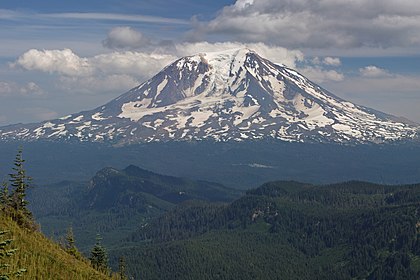
Comings and Goings Around Mt. Adams (Pahto)
Chang San-Feng Remembers Mount AdamsI met a sturdy young man, Frank, at a campground along the Klickitat River,
far below Mt. Adams. We talked for a good while at sunset.
He told me that he had met a fine fellow, a Mr. Chang San-Feng,
in the forest below Old Pahto; who had published a book of
poems and short essays. I later found a copy of that book
at Klindt's Bookstore in The Dalles. Here is one poem
from the book by Mr. Chang San-Feng:
"Ancient Mt. Adams glows in the last light,
winds whistling in the thick flowing firs.
Slithering snakes in the cracks of warm
lava beds. Dry skies: empty vastness.
A dusty camp near shallow Trout Lake, all
cooling in the darkening shadows.
Stellar Jays check my table
for crumbs. Nothing there to eat.
Both Presence and Absence wrapped
in Becoming. Just sit─ a mirror in the dim dusk.
Long stretches of not thinking just
listening. The mountains are speechless.
Turning on a flashlight reveals the tent's
thin armor. The beam pierces the walls.
The Tao unfolds itself─ moon rising
midnight. Sleeping away losses and fears.
Coyotes calling at first hour hunting
hungry. The hard ground gets colder.
The Yakima's named It "Pahto or Klickitat" many
centuries past. Thus It became something human,
Something Pointed Out, Something Named,
Something Talked About, slipping away from Presence.
Some man loudly snoring and a dog barks in a nearby tent
at second hour. My watch does not really embrace Time.
At third hour I awaken, sit up, nurturing
my liver. I smile, alone, in passing Darkness,
without Her but within Her,
the Valley Spirit Here and Now.
At fourth hour, Buddha-Mountains disintegrate, and slowly
drying racoon Buddha-Crap shrivels on Buddha-Poppy seeds.
In the distance, somewhere, out there,
Rising, rising into the black clouds, just-so,
Making Clouds Itself, As Is, and in no-mind,
the Transforming Pahto.
I suddenly remembered something Sifu Miao Zhang once told me:
"Master Yellow-Bitterroot Mountain asked me,
'What is the meaning of Old Pahto emerging in the West?'
I lifted my cane and placed it in my mouth, saying nothing.
Later, zany Zen liar that I am, I wrote:
"No minds, no dharmas. No-mind, much Dharma."
Daybreak crawls in earlier in June, Solstice
Coming, Growing more Sunbeams, Ch'i
Flowing over Everything awakening.
Dawn, we are the Light, everything appearing
pristine, startling, sudden brief jolt of Insight.
After the Awakening,
roll up the sleeping bag, take down the tent,
eat some cereal."
- Michael P. Garofalo, Vancouver, Washington, 2021
Comments, Sources
Life in the Mountains are the subject of over 55 Zen Koans.
Meetings with Master Chang San-Feng
Refer to my Cloud Hands Blog Posts on the topic of Koans/Stories.
Subject Index to 1,975 Zen Buddhist Koans
Zen Buddhist Koans: Indexes, Bibliography, Commentary, Information
Pulling Onions Over 1,043 One-line Sayings by Mike Garofalo
Chinese Chan Buddhist and Taoist Stories and Koans
The Fireplace Records By Michael P. Garofalo
For the past three months, Karen and I have been at home in Vancouver. We both had medical problems and surgeries. No travel during this period of 2023.
Karen and I plan to stay two nights in Pendleton, Oregon, in late April
Trip with Mick and April to Long Beach WA for clamming in May.
Karen and I plan to stay three nights at Quinault Lake, Washington, in May.
Here is a Cloud Hands Blog repost from September 2022. It was a trip to Cape Disappointment State Park for Yurt camping.
I was very surprised to find that the campground was full of trailers, RVs, large vans, small vans, trucks with campers, and a few folks in tents. Very overcast, foggy, and cool all day. I walked around all day in the Park and accumulated 10,945 Steps. Drizzling at times: rain expected on Wednesday.
I enjoyed practicing Taijiquan in a flat area along the North Jetty at the Mouth of the Columbia River. The North Jetty is nearly two miles long. A paved road leads halfway, and many sandy trails take you out to Benson Beach and the Park campgrounds. I made some decisions about my Taijiquan goals for 2023 and 2024.
Few stores were open in Port Ilwaco. I did enjoy browsing at "Time Enough Books" in Ilwaco. I purchased two excellent books about the Sea:
"The Sea and Civilization: A Maritime History of the World." By Lincoln Paine. Vintage Books, 2013, 744 pages, extensive notes, bibliography, and index. VSCL.
"Waves and Beaches: The Powerful Dynamics of Sea and Coast." By Willard Bascom and Kim McCoy. Patagonia, 1964 and 2020, 401 pages, index. VSCL.


Cape Disappointment State Park CR Camping, Yurts, Fishing, Trails Images
Cape Disappointment Lighthouse In operation since 1856.
Cape Disappointment Weather
Lewis and Clark Interpretative Center History Wikipedia
Discovery Bicycling and Walking Trail
Fort Canby State Park is the old name for Cape Disappointment State Park
"Cape Disappointment State Park (formerly Fort Canby State Park) is a public recreation area on Cape Disappointment, located southwest of Ilwaco, Washington, on the bottom end of Long Beach Peninsula, the northern headlands where the Columbia River meets the Pacific Ocean. The state park's 2,023 acres (819 ha) encompass a diverse landscape of old-growth forest, freshwater lakes, freshwater and saltwater marshes, and oceanside tidelands. Park sites include Fort Canby, the Lewis and Clark Interpretive Center, North Head Lighthouse, and Cape Disappointment Lighthouse.[2] Cape Disappointment is one of several state parks and sites in Washington and Oregon that are included in Lewis and Clark National Historical Park.[3]"
I have camped here twice.

Walked along the nearby Benson beach for the last time on this September trip.
Drizzling rain in the early morning. Rain expected today at the coast and inland.
Cleaned up my Yurt. Backed up all my belongings in my Ford Escape.
Breakfast at McDonald's in Long Beach. Checked out by 8:15 am.
Drive back to Longview from Ilwaco via Washington Highway 4. Always and interesting and beautiful drive home. 3 hour drive from Ilwaco to Vancouver.
Photos, notes, and information to follow later after 9/30.
Naselle
Naselle: Naselle River Images Store Gas Inland from the Columbia River. The Naselle River flows into the south end of Willapa Bay
Naselle Library TRLS
Naselle is about six miles east of the junction of US101 and WA4. Junction of US101 and WA4. Johnston's Landing. Along the wide Naselle River valley, and near the bridge over the Naselle River. The Naselle River flows into the south end of Willapa Bay. Parking near the bridge. 62 miles east of Exit 39/I5.
Fort Columbia Historical State Park South of Naselle
Megler-Astoria Bridge South of Naselle
Chinook Village
Junction of US101 and WA4. Johnston's Landing. Along the wide Naselle River valley, and near the bridge over the Naselle River.
The Naselle River flows into the south end of Willapa Bay. Parking near the bridge. 62 miles east of Exit 39/I5.
Junction of WA4 and WA401. Head south on WA401 if you want to get to the Ilwaco/Astoria Bridge.
Skamokava
Skamokawa Images Population: 150 people. Market.
The road WA4 turns inland from Skamokawa most of the way to Naselle. You will be driving through the forests of the Willapa Hills.
Evidence of logging is everywhere.
Vista Park Kayaking B&B Campground at Vista Park, yurts, boat ramp, playgrounds, yurts.
Skamokava Museum
Julia Butler Hansen National Wildlife Refuge Images Large refuge for deer. Viewing Station. Beautiful low areas inland. Access to the shores of the Columbia River. GMM 34.
Columbian White-Tailed Deer National Wildlife Refuge Viewing Station.
Gray's River Valley
Gray's River Covered Bridge Some beautiful small river valleys in these areas along WA4.
Deep River Images Boat Launch
Rosburg Population 416 Store
Four Days in Grayland by Michael P. Garofalo. Travels in Southwestern Coastal Washington State.
Campfires Smoking
I sit by my simple yurt by the sea,
and light a campfire at dawn,
against the cold,
and just be.
Sitka Spruce Forest
all around—
smoking campfire
on cold wet ground.

Do the pines daydream?
feeding logs
into the campfire flames.
Splitting dry kindling,
damp December day—
wind chimes tinkling.
Wet pine logs—
campfire smoke
in our eyes
Gathered around
the campfire's light—
very chilly night.
Crackling campfire
pops and sparks—
keeping ghosts away
Campfire embers,
fading reds—
time for bed.
Memories of Pacific Coast Places
Snapshots and Snippets
Highway 101 and 1
By Michael P. Garofalo
I was up at 4 am today. No rain last night and no gusty winds. Enjoyed daybreak coffee and cannabis on the cold Yurt porch. I figure the entire campground is 95% empty. My Circle B was empty but for me. I took a short walk to the beach.
Loaded up my Ford Escape and began the drive back to Vancouver. You must leave by 11 am. I drove home by US101 and WA4.
Lewis and Clark called the Columbia River bottom and lowland area between Vancouver and Longview the Wapato Valley because of the many wapato roots and camas bulbs harvested by the native Chinook people in the area.
With 14.5 hours of darkness each day, I had plenty of time to read. In the last three days I read the following books:
Chinookan Peoples of the Lower Columbia. Edited by Robert T. Boyd, Kenneth M. Amers, and Tony A. Johnson. University of Washington, 2015, 464 pages. VSCL. Maps, index, art, bibliography. Outstanding collection of articles.
Cathlapotle and its Inhabitants 1792-1860. By Robert Boyd. U.S. Fish and Wildlife Service, Portland, Oregon, 2011. Index, 209 pages, many maps and charts, place name index, detailed bibliography, art work. Fascinating study of native people living the area from For Vancouver to Ilwaco, on both sides of the lower Columbia River, as reported by persons living then. FVRL.
The Chinook Jargon and How to Use It: A Complete and Exhaustive Lexicon of the Trade Language. By George Coombs Shaw in 1909, Ranier Printing, Seattle. Franklin Classics, 2018, 65 pages. VSCL.
Mountain Home: The Wilderness Poetry of Ancient China. Translated by David Hinton. New Directions, 2005, 320 pages. VSCL.


