Showing posts with label Buddhism. Show all posts

Friday, June 05, 2026

The Staff Turned Into a Dragon and Swallowed the Universe


Blue Cliff Record, Case 60
Yunmen's Staff Turns Into a Dragon


"Yúnmén Wényan (864–949 CE), (雲門文偃; Japanese: Ummon Bun'en; also known in English as "Unmon", "Ummon Daishi", "Ummon Zenji")

Introduction 

"Engo's Introduction:  Buddhas and sentient beings are not, by nature, different.  Mountains, rivers, and your own self are all just the same.  Why should they be separation and constitute two worlds?  Even if you are well versed in Zen koans and know how to deal with them, if you stop then everything is spoiled.  If you do not stop, the whole world will be dissolved, with not a particle of it left behind.  Now tell me, what does it mean to be well versed in Zen koans?  See the following.

MAIN SUBJECT:  Ummon held out his staff and said to the assembled monks, "The staff has transformed itself into a dragon and swallowed up the universe!  Where are the mountains, the rivers, and the great world?"
Two Zen Classics: Mumonkan and Hekiganroku, Translated by Katsuki Sekida, 1977, p.

Commentary on Yunmen's Staff Turns Into a Dragon by Mike Garofalo

Zen Koans:  Bibliography, Index, Links, Commentary, Information

The Blue Cliff Record.  Translated by Thomas Cleary and J. C. Cleary.  Foreword by Taizan Maezumi Roshi.  Boston, Shambhala, 2005.  Glossary, biographies, bibliography, 648 pages.  ISBN: 9781590302323.  Case 60, p. 341-346.  "Yun Men's Staff Turns Into a Dragon."


Way of the Staff


Setchō's Verse 
"The staff has swallowed up the universe?
Don't say peach blossoms float on the waters.
The fish that gets it tail singed
May fail to grasp the mist and clouds.
The ones that lie with gills exposed
Need not loose heart.
My verse is done.
But do you really hear me?
Only be carefree!  Stand unwavering!
Why so bewhildered?
Seventy-two blows are not enough
I want to give you a hundred and fifty.
Setchō descended from the rostrum waving his staff. The whole crowd ran away."
Two Zen Classics: Mumonkan and Hekiganroku, Translated by Katsuki Sekida, 1977, p.


"A monk asked Kenpo, "The one road of Nirvana leads into the ten quarters. But where does it begin?" 
Kenpo raised his staff and traced a horizontal line in the air and said, "Here."
Disappointed, the monk went to Yunmen and asked him the same question.
Ummon held up his staff and said, "This staff leaps up to the 33rd heaven and hits the presiding deity on the nose,
then it dives down into the Eastern Sea where it hits the holy carp.
The carp becomes a dragon which then brings a flood of rain." 
List of Koans by Yunmen Wenyan  


Yunmen said, "A true person of the Way can speak fire without burning his mouth.  He can speak all day with moving his lips and teeth or uttering a word.  The entire day he just wears his clothes and eats his food, but never comes in contact with a single grain of rice or thread of cloth.
When we speak in this fashion it is jut the manner of our school.  It must be set forth like this to be realized.  But if you meet a true patch-robed monk of our school and try to reveal the essence through words, it will be a waste of time and effort.  Even if you get some great understanding by means of a single word you are still just dozing."
Zen's Chinese Heritage: The Masters and Their Teachings By Andy Ferguson, 2000, p. 262


Roshi Robert Baker Aitken
(1917-2010)
Roshi Aitken holds a ceremonial stick. 


Sunday, May 31, 2026

Treasury of the True Dharma Eye by Zen Master Dogen

Zen Master Eihei Dogen Zenji (1200-1253) 
Japanese founder of Soto Zen School Tradition.
Teacher, abbot, essayist, poet, Zen philosopher
His collected works are called The Treasury of the True Dharma Eye, Shobogenzo.

I first read Dogen's works in the book Moon in a Dewdrop translated by Kazuaki Tanahashi (1995, 368 pages); and in the book Rational Zen: the Mind of Dogen Zenji translated by Thomas Clearly (2001, 232 pages.)

I have read, studied, and adopted much from my study of Zen Buddhist literature since I was 14 years old.  I am a philosopher, but I have a interest in Taoism, and associated practices like some in Zen Buddhism.

Gudo Nishijima and Chodo Cross's four volume translation of the Treasury of the True Dharma Eye, Shobogenzo in 2021.

Unfortunately, the Kindle Version of Nishijima is very poor, and cheap ($7.00), so I purchased the paperback copies at $18.00 - $27.00 each.  

The new Kazuaki Tanahashi Kindle version of the Treasury of the True Dharm Eve, Shobogenco (2013, 1280 pages) is excellent, at a cost of $60.00.  The hardbound version is $75.00, very heavy, big, like a large family Bible on a coffee table.  So, I'll purchase one volume of Nishijima's translation per month at $25.00 each.  And, then get Tanahashi in the Kindle version as money permits.


Here is an 2008 Amazon review by by Ted Beriginer of Gudo Nishijima and Chodo Cross's four volume translation of the Treasury of the True Dharma Eye, Shobogenzo in 2021.


"If you have not read Books 1 through 4 of this translation of the 95 chapter edition of Shobogenzo, do it now! If you have read them, do it again!

Gudo Nishijima and Mike (Chodo) Cross's four volume translation of the 13th century Zen master Eihei Dogen's masterpiece marked the first English language translation of the entire 95 chapter version of Shobogenzo - The True Dharma-Eye Treasury (excepting the nearly useless translation by Kosen Nishiyama and John Stevens).

By opting for a more "literal" rather than "interpretive" rendition, the translators have realized a monumental achievement by furnishing English readers with a reliable text that is certain to be invaluable for generations.

This set is also packed with a wide selection of reference material, or "Aids to the Reader", including a translation of The Heart Sutra, Dogen's Fukanzazengi, and a generous selection of passages from the Lotus Sutra, Glossaries, a variety of tables offering data on everything from The Works of Dogen, to equivalents of Chinese/Japanese/Sanskrit/English.

The extensive footnotes, while occasionally offering some overly "interpretive" (read: sectarian), provide readers with a vast amount of supplemental information with lucid explanations concerning cultural context, alternate readings, sources for material quoted in the body of the text, biographical (historical and traditional) information on personages appearing in the text, and much more.


Book 1 - Table of Contents

[1] BENDOWA - A Talk about Pursuing the Truth

[2] MAKA-HANNYA-HARAMITSU - Maha-prajna-paramita

[3] GENJO-KOAN - The Realized Universe

[4] IKKA-NO-MYOJU - One Bright Pearl

[5] JU-UNDO-SHIKI - Rules for the Hall of Heavy Cloud

[6] SOKU-SHIN-ZE-BUTSU - Mind Here and Now Is Buddha

[7] SENJO - Washing

[8] RAIHAI-TOKUZUI - Prostrating to Attainment of the Marrow

[9] KEISEI-SANSHIKI - The Voices of the River-Valley and the Form of the Mountains

[10] SHOAKU-MAKUSA - Not Doing Wrongs

[11] UJI - Existence-Time

[12] KESA-KUDOKU - The Merit of the Kasaya

[13] DEN-E - The Transmission of the Robe

[14] SANSUIGYO - The Sutra of Mountains and Water

[15] BUSSO - The Buddhist Patriarchs

[16] SHISHO - The Certificate of Succession

[17] HOKKE-TEN-HOKKE - The Flower of Dharma Turns the Flower of Dharma

[18] SHIN-FUKATOKU - Mind Cannot Be Grasped [The former]

[19] SHIN-FUKATOKU - Mind Cannot Be Grasped [The latter]

[20] KOKYO - The Eternal Mirror

[21] KANKIN - Reading Sutras


Book 2 - Table of Contents

[22] BUSSHO - The Buddha-nature

[23] GYOBUTSU-YUIGI - The Dignified Behavior of Acting Buddha

[24] BUKKYO - The Buddha's Teaching

[25] JINZU - Mystical Power

[26] DAIGO - Great Realization

[27] ZAZENSHIN - A Needle for Zazen

[28] BUTSU-KOJO-NO-JI - The Matter of the Ascendant State of Buddha

[29] INMO - It

[30] GYOJI - [Pure] Conduct and Observance [of Precepts] - Parts 1 & 2

[31] KAI-IN-ZANMAI - Samadhi, State Like the Sea

[32] JUKI - Affirmation

[33] KANNON - Avalokitesvara

[34] ARAKAN - The Arhat

[35] HAKUJUSHI - Cedar Trees

[36] KOMYO - Brightness

[37] SHINJIN-GAKUDO - Learning the Truth with Body and Mind

[38] MUCHU-SETSUMU - Preaching a Dream in a Dream

[39] DOTOKU - Expressing the Truth

[40] GABYO - A Picture of Rice Cake

[41] ZENKI - All Functions


Book 3 - Table of Contents

[42] TSUKI - The Moon

[43] KUGE - Flowers in Space

[44] KOBUSSHIN - The Mind of Eternal Buddhas

[45] BODAISATTA-SHISHOBO - Four Elements of a Bodhisattva's Social Relations

[46] KATTO - The Complicated

[47] SANGAI-YUISHIN - The Triple World is Only the Mind

[48] SESSHIN-SESSHO - Expounding the Mind & Expounding the Nature

[49] BUTSUDO - The Buddhist Truth

[50] SHOHO-JISSO - All Dharmas are Real Form

[51] MITSUGO - Secret Talk

[52] BUKKYO - The Buddhist Sutras

[53] MUJO-SEPPO - The Non-Emotional Preaches the Dharma

[54] HOSSHO - The Dharma-nature

[55] DARANI - Dharani

[56] SENMEN - Washing the Face

[57] MENJU - The Face-to-Face Transmission

[58] ZAZENGI - The Standard Method of Zazen

[59] BAIKE - Plum Blossoms

[60] JUPPO - The Ten Directions

[61] KENBUTSU - Meeting Buddha

[62] HENSAN - Thorough Exploration

[63] GANZEI - Eyes

[64] KAJO - Everyday Life

[65] RYUGIN - The Moaning of Dragons

[66] SHUNJU - Spring and Autumn

[67] SOSHI-SAIRAI-NO-I - The Ancestral Master's Intention in Coming from the West

[68] UDONGE - The Udumbara Flower

[69] HOTSU-MUJOSHIN - Establishment of the Will to the Supreme

[70] HOTSU-BODAISHIN - Establishment of the Bodhi-mind

[71] NYORAI-ZENSHIN - The Whole Body of the Tathagata

[72] ZANMAI-O-ZANMAI - The Samadhi That Is King of Samadhis

[73] SANJUSHICHI-BON-BODAI-BUNBO - The Thirty-seven Auxiliary Bodhi Methods

[74] TEMBORIN - Turning the Dharma Wheel

[75] JISHO ZANMAI - Samadhi as Self Experience

[76] DAI SHUGYO - Great Practice

[77] KOKU - Space

[78] HATSU-U - The Patra

[79] ANGO - The Retreat

[80] TASHINTSU - The Power to Know Others' Minds

[81] O SAKU SENDABA - A King's Seeking of Saindhava

[82] JI-KUIN-MON - Sentences To Be Shown in the Kitchen Hall

[83] SHUKKE - Leaving Family Life

[84] SANJI-NO-GO - Karma in Three Times

[85] SHIME - The Four Horses

[86] SHUKKE-KUDOKU - The Merit of Leaving Family Life

[87] KUYO-SHOBUTSU - Serving Offerings to Buddhas

[88] KIE-SANBO - Taking Refuge in the Three Treasures

[89] SHINJIN-INGA - Deep Belief in Cause and Effect

[90] SHIZEN-BIKU - The Bhiksu in the Fourth Dhyana

[91] YUI-BUTSU-YO-BUTSU - Buddhas Alone, Together With Buddhas

[92] SHOJI - Life-and-Death

[93] DOSHIN - The Will to the Truth

[94] JUKAI - Receiving the Precepts

[95] HACHI-DAININGAKU - The Eight Truths of a Great Human Being

[Appendix 1] BUTSU-KOJO-NO-JI - The Matter of the Ascendant State of Buddha."


Wednesday, May 27, 2026

R. H. Blyth (1898-1964)

I first read R. H. Blyth from books borrowed from the Montebello Regional Library of the Los Angeles County Public Library System in 1961.  There is an excellent Asian-Pacific Resource Center at the Montebello Library.  I was much influenced by writers like Blyth, Suzuki, Watts, Reps, and Chinese/Japanese literature and classics I borrowed from the Montebello Library.  

I was attending Cantwell Catholic High School in Montebello from 1959-1963.  I walked and used local buses for transportation.  I lived in the Bandini barrio of East Los Angeles near the intersection of the Atlantic and Washington Boulevards.  

I later worked as a librarian, branch manager, regional and system audio-visual coordinator, and finally as the Regional Administrator of 22 libraries in the East Region, East San Gabriel Valley area.  I worked for the County Public Library from 1974-1998.  

I enjoyed Blyth's writings for their playful humor, sensitivity to nature, humanity, and insightful and quirky comparisons of literary and classical works.  


Reginald Horace Blyth (1898-1964)   
Bibliography, Biography, Links, Resources, Quotations, Comments, Influence, Zen, Haiku
Hypertext Notebook by Michael P. Garofalo


"These are some of the characteristics of the state of mind which the creation and appreciation of haiku demand: Selflessness, Loneliness, Grateful Acceptance, Wordlessness, Non-intellectuality, Contradictoriness, Humor, Freedom, Non-morality, Simplicity, Materiality, Love, and Courage."
- Haiku, Volume One, p. 154


"The love of nature is religion, and that religion is poetry; these three things are one thing. This is the unspoken creed of haiku poets."
- History of Haiku, Vol. One, Introduction, 8.5


"The object of our lives is to look at, listen to, touch, taste things. Without them, - these sticks, stones, feathers, shells, - there is no Deity."
- R. H. Blyth, Zen in English Literature and Oriental Classics, p. 144.


"The sun shines, snow falls, mountains rise and valleys sink, night deepens and pales into day, but it is only very seldom that we attend to such things ... When we are grasping the inexpressible meaning of these things, this is life, this is living. To do this twenty-four hours a day is the Way of Haiku. It is having life more abundantly."
- R. H. Blyth, Haiku, Volume One, p. 11


A repost from 2006.  

Saturday, May 16, 2026

Subject Indexes to The Sound of One Hand 148 Koans Collection

 The Sound Of One Hand (SOH)


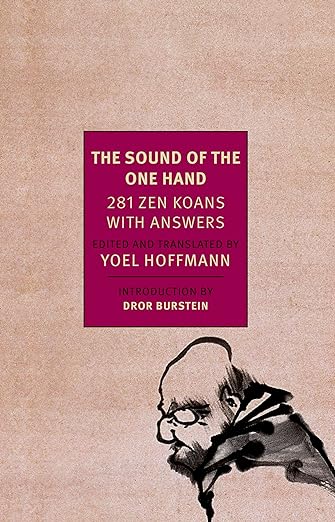
The Sound of One Hand: 281 Zen Koans with Answers. Translation, research and commentary by Joel Hoffmann. Introduction by Dror Burstein. NRYB, 2016, 304 pages. VSCL, Paperback.

There are 144 koan cases, starting on page 75. The full text for each case is followed by possible acceptable answers or responses to the koan. The first 74 pages are very brief questions and answers regarding 137 other cases, without the full text for each case. Therefore, the total cases discussed are 281 koan cases. I have indexed only 148 Cases.

Indexed by Michael P. Garofalo.

Subject Index to the Sound of One Hand 148 Koans. PDF, 10/26/2023, 30 pages.

Case Number List to the Sound of One Hand 148 Koans. PDF, 10/26/2023, 6 pages.

Case Title List to the Sound of One Hand 148 Koans. PDF, 10/26/2023, 6 pages.


Subject Index to 1,975 Zen Buddhist Koans
Indexing and webpage by Michael P. Garofalo.
578 pages, December 28, 2024, PDF


Buddhism: Bibliography, Links, Information, Resources
. Compiled by Michael P. Garofalo.


Taoism: Bibliography, Links, Resources, Information. Compiled by Michael P. Garofalo.


Wednesday, April 01, 2026

Eighteen Buddha Hands Qigong

Luohan Qigong, Lohan Qigong, Luohan Gong, Lohan Gong, 18 Buddha Hands

Shaolin Buddhist Qigong

Over the years, I have found many different versions of the 18 Buddha Hands Qigong or Luohan Qigong.  For example, last year, I read Stuart Alve Oson's "The Eighteen Lohan Skills: Traditional Shaolin Training Methods," Valley Spirit Arts, 2015.  

Resources, Lessons, History, Links, Bibliography, Notes, Research 
 http://www.egreenway.com/qigong/lohan.htm


 "One tradition is that the Buddhist teacher, Bodhidharma (448-527 CE), a famous Grand Master of Chan (Zen),introduced a set of 18 exercises to the Buddhist monks at the Shaolin Temple. These are known as the Eighteen Hands of the Lohan. This Shaolin Lohan Qigong (i.e., the art of the breath of the enlightened ones), "is an internal set of exercises for cultivating the "three treasures" of qi (vital energy), jing (essence), and shen (spirit)," according to Howard Choy. The Kung Fu master, Sifu Wong Kiew-Kit, referring to the Shaolin Wahnam style, says "the first eight Lohan Hands are the same as the eight exercises in a famous set of chi kung exercises called the Eight Pieces of Brocade." There are numerous versions,seated and standing, of Bodhiidharma's exercise sets - including the related "Tendon-Changing and Marrow-Washing" qigong set. Some versions of the 18 Lohan (Luohan) Hands have up to four levels, and scores of movement forms for qigong and martial purposes."
- Michael P. Garofalo, Eight Section Brocade


 For a comparison of some of the exercises in the Lohan Qigong with the Eight Section Brocade see my chart on the topic. 

 
 The Luohan Qigong includes a massage or patting training methods, and this is especially popular among Yin Fu Bagua enthusiasts. Master Xie Pei Qi has a DVD out on the topic. 


Monday, March 16, 2026

God's Own Eye

                 The Fireplace Records, Chapter 31


God's Own Eye


Master Seung Sahn liked to write short enigmatic mystical poems.  He once wrote:

"Who sees the All as nothingness,
as nothing all that is,
sees everything through God's own eye.
Enlightenment is this."  (WWSF #63)

"The God who is pure emptiness
is created as form,
becoming substance, light and darkness
the stillness and the storm."  (WWSF #64)

It is quite unusual, also rare, for a Zen Buddhist to refer to the Christian God to support his own mystical theological-philosophical views.  Although, belief in and references to supernatural beings of various kinds is quite common in popular-folk Buddhism. 

Emptiness, nothingness, or the void are common themes, concepts, tropes or cliches in Zen Buddhist Koans and discussions.

Maybe Master Seung Sahn was playing on the sentences from the German Christian mystic, Meister Eckhart, who once wrote: "To be full of things is to be empty of God.  To be empty of things is to be full of God. The eye with which I see God is the same eye with which God sees me."

Avalokiteshavara, a supernatural being, has a thousand hands with one eye in each hand.  Lin-Chi asked, "Which is the real eye?"  (IF 95)

The "Eye that grasps the Universe" is for Zhaozhou an Eye that is empty of defilement, free of attachments, untainted by conceptualizing, and beyond being and non-being. A clear-eyed neutral realistic objectivity--- seeing things as they are? (DSMS #291)

Yunyan contended that the Bodhisattva of Great Compassion had eyes and hands all over its' (his/her) body. Yes, we can "see" (understand/feel) our world with our hands, even with our eyes closed. (BOS #54)

Eyes, seeing, watching, observing, viewing, and overall vision are essential for surviving, learning, moving, and being-in-the-world. 

We love to use sight as a metaphor in poetry about spirituality.  Soren Kierkegaard wrote "All human speech about the spiritual is essentially metaphorical speech." Nietzsche said, "Truth is a mobile army of metaphors." 

The same Eye between God and a Person? 
Is it the same God between two million persons seeing in a spiritual way; or, are there two million Gods? How many eyes does God have? Is God blind in one eye like Sartre. Is God blind in two eyes like Ray Charles or Helen Keller? Does God have a Third Eye like yogi adepts? Is God nearsighted or far sighted and needs spiritual glasses? Are these two Transcendental Eyes looking through each other a pleasant fiction, a distorted double vision, an empty darkness, a blurred visual hallucination, an unfocused metaphor?

Now, really, does even a postulated God of Emptiness (God = Pure Emptiness) give birth to Substance, to Forms, to the realities of sunlight and darkness, man and woman, toads and ravens?  I am doubtful, even if obviously charmed. 

Maybe all this emptiness talk is just about negation. God was lonely, wanted to be creative, wanted to watch something, rejected being alone, and negated his present to create a future. So, It/He/She created ex nihilo the ordinary world. But, in this view, God is not emptiness; It/He/She is Something that rejected the emptiness of aloneness, negated his unpleasant solitude, and projected Somethings into existence. The Ten Thousand Things of Taoist ontology were born from the Dao embracing Change, rejecting and negating undifferentiated Nothingness.  

Ah ... the mysteries of ontology keep us wondering. I need a long walk!


Comments, Sources, Observations

Emptiness has little creative potency.
Somethings give birth to somethings.
Emptiness is not a metaphor for something.
Emptiness may make room for somethings to play.
"God" is maybe another metaphor, analogy, or acronym.
Emptiness is a lonely affair.

Emptiness is the subject of over 50 Zen Koans.

Meetings with Master Chang San-Feng 

Zen Master Raven

Sunyata, Emptiness, Void, Nothingness


Refer to my Cloud Hands Blog Posts on the topic of Koans/Stories. 

Subject Index to 1,975 Zen Buddhist Koans

Zen Buddhist Koans: Indexes, Bibliography, Commentary, Information


The Daodejing by Laozi

Pulling Onions  Over 1,043 One-line Sayings by Mike Garofalo

Chinese Chan Buddhist and Taoist Stories and Koans

The Fireplace Records  By Michael P. Garofalo


Or


Thursday, March 12, 2026

These Dear Friends of the Buddha Mind

 2675.

These Dear Friends of the Buddha Mind

          I never
     grasped emptiness
or hiked around Mt. Sumeru,
or patted Chao-chou's dog,
or teased Nansen's cat,

blocked the Bodhidharma's uppercut,
or slept in Han Shan's dirty hut,
or borrowed Wendy Johnson's garden rake
or rode the Ox through the Gateless Gate,
or solved any of Rinzai's riddles,

I never, ever
suffered the Great Doubt,
looked for sticks in Yun-men's crapper,
or broke Tassajara bread with Shunryu Suzuki,
or minded the flapping flag for Hui-neng the sage,

or heard Jiyu-Kennett move her whisk in Mt. Shasta's shade,
or chanted on Mt. Tamalpais with Whalen, Ginsberg and Snyder,
or saw Dogen's True Eye open just a little bit wider.
     I never did.
     Nope, never!

Not in 55 lifetimes.
               Yet, it seems like I did.
Yep, dayinanddayout,
appearances notwithstanding,
Reality appeared just So.

This I know:
Their Heritage
Is in my Heart,
Their Myths mine,
These Dear Friends of the Buddha Mind.


2676.


Poetry by Michael P. Garofalo

Quintains: Volumes 1 -6


Tuesday, March 10, 2026

Buddhist Understanding and Advice

Dharmapada Sutra


Verse 245 (18:245)
245. Life seems hard for one who ever seeks purity, is detached and humble, is pure and reflective. Narada 1959

245. But life is hard to live for a modest man, who always looks for what is pure, who is disinterested, quiet, spotless, and intelligent. Muller 1881

245. Life is hard for the modest, the lover of purity, the disinterested and simple and clean, the man of insight. Wagiswara 1912


Verse 24 (2:24) (II:24) 

The glory groweth Of one who is aroused and recollecting. Clean of deed, considerate in his doing. Restrained, righteous in life, and earnest.
- Edmunds 1902

Great grows the glory of him who is zealous in meditation, whose actions are pure and deliberate, whose life is calm and righteous and
full of vigor.   - Wagiswara 1912

The man who is strenuous, mindful, of pure conduct, and careful, who restrains himself, who acts after due deliberations and practices
Right Livelihood, becomes famous.   - Jung 2009

Energetic, alert, pure in deed, careful in action, self-controlled, living in accord with truth, the vigilant one will rise in repute.   - Cleary 1994

One who is energetic, mindful, pure in deed, considerate, self-controlled, right living shall arise in glory.   - Narada 1959

For the person of energy, thoughtfulness,
pure conduct, considerate action,
restraint, wholesome living, and diligence,
glory increases.   - Wallis 2007

If an earnest person has roused himself, if he is not forgetful, if his deeds are pure, if he acts with consideration, if he restrains himself,
and lives according to law, then his glory will increase.
- Muller 1881


Buddhism

Philosophy


Thursday, February 12, 2026

Forms are Full, Fullness begets Forms

Waves of Reflections at the Bandon Jetty

By Michael P. Garofalo

January 2023


The immense Oceans are undrinkable, and
in some ways unthinkable.  
No fresh water begets death, and 
Water is Life.

Words from the Heart Scripture went unsaid, and
the Bodhi Tree flourished in Life's Garden.  

Something evolves from Something Else, and
nothing evolves from nothing.

Beings emerge from Beings, and
emptiness disappears into emptiness.

"Nothing" is not a noun-thing, and
"Somethings" are dependent relationships.

Forms are Full, and
Fullness begets Forms.

Somethings created my body-mind, and
my body-mind created somethings.  

The Dao marries Yin-Yang, and
some of their step-children are Black Holes. 

Chaos is not emptiness, and
the Void provides Space for Somethings.

Somethings are transitory, ephemeral, and
They are Not empty illusions or unreal. 

Time is the crux of the matter, and
Somethings come and go, appear and disappear.  

"Nothing" is the absence of Something
we desire, and
not the presence of something.  

Somethings are Appearances, and
Appearances are Somethings.

Is or is not, true or false, real or unreal,
something or nothing, be Careful, and
sometimes choose the Middle Way of Maybe So.

Pointing to Nothing, and 
slogging through a muddy muddle of Mu.

Come Closer, Come Closer, and
Open the Door to Wonderous Beings.

Come Closer, Come Closer, and
Embrace Body-Mind-Spirit.
Cast off emptiness and the void.  

Gate Gate Parasamgate Bodhi Svaha, and
some Lotus plants died in a drought.  Oh No!

Words from the Heart went unsaid, and
the Bodhi Tree flourished in Life's Garden.  (5) 


Waves of Reflections at the Bandon Jetty
By Michael P. Garofalo
January 2023


Emptiness and Forms


Experiences of "emptiness" are often a case of not finding something we desire in the complex world of Somethings.  Something desired seems or is missing.  We want a drink of water and the glass is empty.  We wanted wheat, and a drought destroyed the wheat crop and brought nothing we wanted.


Saturday, January 31, 2026

The Three Treasures


Repost from December 17, 2023


The Three Treasures


My Body

Feelings, Emotions, Body-Self, Past-Present, Id-Ego,
Physical Health, Unconscious Dimensions, Breathing, 
Eating, Moving, Sleeping, Digesting, DNA, Sexuality,
Drinking, Vitality, Brain, Immediate Environment.

My Mind
Thoughts, Emotions, Experiences-Reflections, Ego, Goals
Past-Present-Future, Language Culture, Heart-Mind, Attitudes,
Beliefs, Opinions, Histories, Will, Hope, Memories, Spirit,
Brain-Body interactions with mundane environment.

My Actions
What I Do Today. My Behaviors and Character. 
Family Life.  Social and Community Interactions.  
Purposeful activity towards the Future.  Moral-Ethical Acts.
Practices, Exercises, Play.  
My employment or work.  


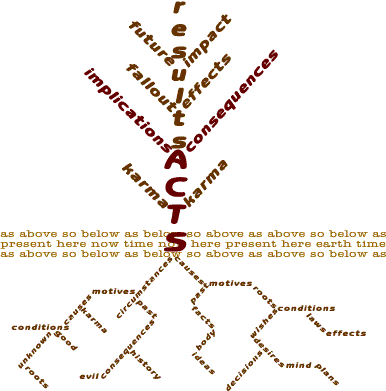
The Three Treasures are intertwined, integrated, interconnected, involved, and interwoven in some way all the time; all to the benefit of well-being and good health.  They can become disconnected and conflicting which produces poor bodily health, mental confusion, and useless, evil, or self-destructive acts.  Balance, clear purpose, and reflection are some essentials.  

We can separate these aspects of Being-In-The-World intellectually when reflecting; when Acting and Doing they are integrated.  

The Living Body is the foundation of Mind and the means of flourishing Actions.  Consciousness requires a Living Body.  

I don't find it scientifically plausible to accept notions of our having consciousness after death, having an invisible immortal soul, being ghostly beings, having immortal supernatural lives in fanciful heavens or hells, or other imaginary religious memes about our "after-lives."  

Qigong routines are intended to nourish, refresh, rejuvenate, and reenergize our Living Bodies.  Seeking immortality, spiritual rebirth, or special magical super-powers via Qigong, ascetism, or prayers do not seem reasonable to me.  Seeking and cultivating good health and longevity - Yes!  

- By Michael P. Garofalo,  9/2022


Cultivating Longevity (Yang Sheng Gong)

The Longevity Plan. By John D. Jay and Jane Ann Day, wth Matthew LaPlante. 2018, 304 pages. 1. Eat good food. 2. Master your mind-set. 3. Build your place in a positive community. 4. Be in motion. 5. Find your rhythm. 6. Make the most of your environment. 7. Proceed with purpose. John D. Jay, M.D., Cardiologist, Electro-physiologist.

Books by Tom Bisio      Books by Eva Wong       Books by Livia Kohn

Books by Ken Cohen     Books by Yang Jwing-Ming


Three Treasures - Wikipedia

"In long-established Chinese traditions, the "Three Treasures" are the essential energies sustaining human life:

  • Jing  "nutritive essence, essence; spirit, sperm, seed; extract; refined, perfected"
  • Qi  "breath, spirit; air, vapor; vitality, energy, force; vigor; attitude"
  • Shen  "spirit; soul, mind; god, deity; supernatural being"

This jing-qi-shen ordering is more commonly used than the variants qi-jing-shen and shen-qi-jing.

The Three Treasures or Three Jewels (ChinesepinyinsānbǎoWade–Gilessan-pao) are theoretical cornerstones in traditional Chinese medicine and practices such as neidanqigong, and tai chi. They are also known as jing, qi, and shen (Chinese精氣神pinyinjīng-qì-shénWade–Gilesching ch'i shen; "essence, breath, and spirit")."


"The Three Treasures or Three Jewels (ChinesepinyinsānbǎoWade–Gilessan-pao) are basic virtues in Taoism. Although the Tao Te Ching originally used sanbao to mean "compassion", "frugality", and "humility", the term was later used to translate the Three Jewels (BuddhaDharma, and Sangha) in Chinese Buddhism, and to mean the Three Treasures (jingqi, and shen) in Traditional Chinese Medicine."
Three Treasures in Taoism


Guarding the Three Treasures.  By Daniel P. Reid.  Simon, 1993, 484 pages.

The Three Treasures.  By Jong Kook Baik.  2019, 397 pages.