Wednesday, September 13, 2023

Emptiness is "A" Form


The Fireplace Records, Chapter 29


Emptiness is "A" Form


The short Heart Sutra is recited frequently in Zen Buddhist Temples and Churches.  It is a fundamental scripture of great importance to Buddhist philosophy and beliefs.

Emptiness, the Void, Nothing, Nothingness, Not Here, Not Present,
the Fecund Voidness of the Dao, etc. .... have kept Taoists and Zen Buddhists and Existentialists busy thinking for a long time. 

Sartre examined "Being and Nothingness" as did Heidegger.  Taoists reflected on how Emptiness Gives Birth to Everything.  The Empty Circle is an artistic rendering of the importance of the Void found on Zen altars and walls everywhere. 

Conditions of emptiness or the non-presence of Something or Other are obvious from the visual and tactile clues in our daily lives.  We know (see and feel) when the kitchen larder is empty, when a loved one disappears upon their death, when a classroom is empty of students, in the pitch black moonless night, when the music stops, when the cup is empty, when some words are insincere and empty of honesty, when a Nazi criminal is empty of empathy, when we empty our bowels, when our lives seem empty of achievements, or when viewing the vast empty sky from a mountain peak, etc.  As a child, we learn how to talk about empty candy jars, the absence of siblings or mothers and crying about being left alone, being scared of the dark, the loss of toys, the realization that Santa Claus is a fiction.  The Void is familiar to us, and, we must deal with it's conditions; but multiplicity, fullness, and the ten-thousand-things occupy most of our attention and concerns.   

ALL Forms (shapes, things, ideas, concepts, perceptions, etc.) are NOT emptiness or void. Situations and circumstances and times may change and some forms do disappear, but they are or were Present, Real, tangible, concrete, existents...  The transitoriness of things and events does not imply that they are empty or void in essence.  Just because circumstances/beings are not eternal, does not imply that they are empty, void of meaning, or unreal.

So, in my opinion, emptiness/void/nothing is indeed part of reality; but just one aspect of our experiences.  Emptiness is one form, "a" Form; not the source, nature, or reality of All Forms - as the Heart Sutra touts.

Some seem to speak of "emptiness" as a mode of perception--- seeing things as they are without conceptions or presuppositions.  Similar to phenomenological "bracketing" or epoche.  A kind of purified perception.  I doubt this can be accomplished--- we are "impure" and caught within a mental and perceptual web of previous experience and future intentionality. Even Zen Masters say that only a few, out of thousands, can achieve this level or dimension of awareness and awakening, i.e., being in a state of non-dual consciousness.

Yes, all objects/events/things exist now because of the existence of Everything Else, our environment, Webs, Inter-Dependence, the Inter-Being of interrelated causes and effects.  However, this does not imply that the Reality of Now is empty or grounded in Voidness; on the contrary, it is grounded in Plentitude, in Richness.

Even "empty space" outside the Air of Our Earth is Not Empty.  Particles/waves of energy flow through space from the Sun, and cosmic microwave background radiation is everywhere. Don't consider what we cannot see with our eyes as the only criterion of emptiness.  Even an empty barrel is full of air. 

Of course, the Heart Sutra says "There is No Wisdom, and There is No Attainment Whatsoever." But, if there is "No Wisdom" then the Sutra itself stumbles and trips on its own unwise feet and leaves us with fallen ideas, obvious doubts, and gives little support for standing beliefs. 

It could just be a matter of my action-method-somatic preferences.  I don't find useful or beneficial the dulling quiet stillness and pretending-empty- mind of long hours of Zazen. I prefer the joys of gardening, reading, walking, dancing, and enjoying the Fullness, Plentitude, Richness, Complexity, and Substantial Nature of our and my Reality and Experiences. [However, I need to be cautious about having a "sour grapes" attitude. Just because I cannot physically or psychologically tolerate sitting in zazen many days in a Zen Buddhist Sesshin Retreat, I should be careful of not scorning those who do so, or pooh-poohing the benefits derived thereof.]

"Oh, I love to climb a mountainAnd to reach the highest peak;But it doesn't thrill me half as much
As dancing cheek to cheek."


Comments, Sources, Observations:

Emptiness is the subject of over 50 Zen Koans.

Inter-Dependence, Webs, Inter-Being

Meetings with Master Chang San-Feng

Emptiness (Sunyata, Void, Nothingness, Inter-Dependent Arising)


Refer to my Cloud Hands Blog Posts on the topic of Koans/Stories. 

Subject Index to 1,975 Zen Buddhist Koans

Zen Buddhist Koans: Indexes, Bibliography, Commentary, Information


The Daodejing by Laozi

Pulling Onions  Over 1,043 One-line Sayings by Mike Garofalo

Chinese Chan Buddhist and Taoist Stories and Koans

The Fireplace Records  By Michael P. Garofalo


Or


 The Heart Sutra

"When the Bodhisattva Avalokitesvara
Was Discoursing in the Deep Prajna Paramita,
He Perceived That All Five Skandhas Are Empty.
Thus He Overcame All Ills and Suffering.
Oh, Sariputra, Form Does not Differ From the Void,
And the Void Does Not Differ From Form.
Form is Void and Void is Form;
The Same is True For Feelings,
Perceptions, Volitions and Consciousness.
Sariputra, the Characteristics of the
Voidness of All Dharmas
Are Non-Arising, Non-Ceasing, Non-Defiled,
Non-Pure, Non-Increasing, Non-Decreasing.
Therefore, in the Void There Are No Forms,
No Feelings, Perceptions, Volitions or Consciousness.
No Eye, Ear, Nose, Tongue, Body or Mind;
No Form, Sound, Smell, Taste, Touch or Mind Object;
No Realm of the Eye,
Until We Come to No realm of Consciousness.
No ignorance and Also No Ending of Ignorance,
Until We Come to No Old Age and Death and
No Ending of Old Age and Death.
Also, There is No Truth of Suffering,
Of the Cause of Suffering,
Of the Cessation of Suffering, Nor of the Path.
There is No Wisdom, and There is No Attainment Whatsoever.
Because There is Nothing to Be Attained,
The Bodhisattva Relying On Prajna Paramita Has
No Obstruction in His Mind.
Because There is No Obstruction, He Has no Fear,
And He passes Far Beyond Confused Imagination.
And Reaches Ultimate Nirvana.
The Buddhas of the Past, Present and Future,
By Relying on Prajna Paramita
Have Attained Supreme Enlightenment.
Therefore, the Prajna Paramita is the Great Magic Spell,
The Spell of Illumination, the Supreme Spell,
Which Can Truly Protect One From All Suffering Without Fail.
Therefore He Uttered the Spell of Prajnaparmita,
Saying 'Gate, Gate, Paragate, Parasamgate, Bodhi Svaha.' "

The Heart Sutra of Buddhism


The Heart Sutra (PDF Version) 

Green Way Wisdom - Zen Buddhist Poems and Scriptures

Emptiness (Sunyata, Void, Nothingness,Inter-Dependent Arising)

Tuesday, September 12, 2023

Falling Down, Then Sitting

I was cheerfully and energetically walking with my dog, Bruno, on Sunday morning (9/10).  The weather was cool and overcast, almost foggy. We both had spirit and liveliness in our quick walking pace. The evergreen pines were impressive borders to our morning jaunt, and many deciduous shrubs and trees added a few autumn colors to delight our views.  

Suddenly, a large black cat jumped out from some shrubs and scrambled directly in front of our path.  Bruno, predictably, lunged in pursuit of his longstanding DNA enemy. I gathered my strength and balance and controlled his aggressiveness via the leash. We walked another ten feet.  Then Bruno suddenly turned in front of me and ran into my legs. I quickly lost my balance and fell forward on to the asphalt street.

I injured my left knee, right hand, right shoulder, and overall sense of well-being.  Blood dripped from my hand and bruised knee. I slowly assessed the damage, and gradually returned to standing, supported by my cane.  We slowly and carefully walked back home.

Karen helped me bandage and treat my wounds.  I applied ice to my bruised knee. I rested and hoped for the best.

I had a scheduled a yurt camping trip to Pacific Beach State Park on the Southwestern Washington Pacific coast, from 9/11-9/14. I was quite disappointed that I could not go camping because of my leg injuries from the Sunday fall.  I lost the $150.00 I had spent on the Yurt reservations.

Now, for three days, I have been sitting, resting, doing some gentle massage and rehab movements for my bruised knee, icing, and reading.

Multiple injuries to my right hand, and arthritis, have resulted in permanent impairment, pain, and weakness in my dominant right hand. 

Injuries to my legs have resulted in fewer problems and more rapid recovery.  

I've been reading many books on 20th Century history.  I particularly enjoyed "The Existentialist Café: Freedom, Being, and Apricot Cocktails" by Sarah Bakewell. The extreme challenges and choices of Europeans living from 1910-1960 are very disturbing to read about. Bakewell tells the story via the lives of many French and German intellectuals of that era. Eric Hobsbawn's "The Age of Extremes: A History of the World, 1914-1991" chronicles the influences of socialism, fascism, communism, capitalism, and the devastating Wars, and the Cold War, during that time period. 


I had anticipated adding reports, photographs, and poems about my yurt camping trip to Pacific Beach after I returned on Thursday (9/14). 

In the remaining three months ahead in 2023, I have scheduled Yurt camping beach trips to Nehalem Bay, Grayland, and Cape Lookout. Each month, I yurt camp four days and three nights at a State Park along the ocean shores. Hopefully, I will be physically able to enjoy these local adventures and retreats to the Pacific Coast in 2023 and 2024.


Lake Quinault

Ocean Shores State Park

Memories of Pacific Coast Places: Highway 101 and 1

Reports from Yurt Camping Retreats at the Ocean from 2021

Yurt Camping


Monday, September 11, 2023

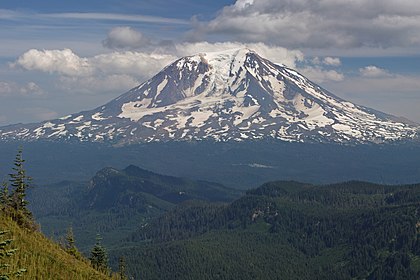
Chang Sang-Feng Remembers Mount Adams


The Fireplace Records, Chapter 28


Comings and Goings Around Mt. Adams (Pahto)

Chang San-Feng Remembers Mount Adams

I met a sturdy young man, Frank, at a campground along the Klickitat River,
far below Mt. Adams.  We talked for a good while at sunset.
He told me that he had met a fine fellow, a Mr. Chang San-Feng,
in the forest below Old Pahto; who had published a book of
poems and short essays.  I later found a copy of that book
at Klindt's Bookstore in The Dalles.  Here is one poem
from the book by Mr. Chang San-Feng:


"Ancient Mt. Adams glows in the last light,
winds whistling in the thick flowing firs. 

Slithering snakes in the cracks of warm
lava beds.  Dry skies: empty vastness.

A dusty camp near shallow Trout Lake, all
cooling in the darkening shadows.

Stellar Jays check my table
for crumbs.  Nothing there to eat.

Both Presence and Absence wrapped
in Becoming.  Just sit─ a mirror in the dim dusk.

Long stretches of not thinking just
listening.  The mountains are speechless.

Turning on a flashlight reveals the tent's
thin armor.  The beam pierces the walls.

The Tao unfolds itself─ moon rising
midnight.  Sleeping away losses and fears.

Coyotes calling at first hour hunting
hungry.  The hard ground gets colder.

The Yakima's named It "Pahto or Klickitat" many
centuries past.  Thus It became something human,
Something Pointed Out, Something Named,
Something Talked About, slipping away from Presence.

Some man loudly snoring and a dog barks in a nearby tent
at second hour.  My watch does not really embrace Time.

At third hour I awaken, sit up, nurturing
my liver.  I smile, alone, in passing Darkness,
without Her but within Her,
the Valley Spirit Here and Now.

At fourth hour, Buddha-Mountains disintegrate, and slowly
drying racoon Buddha-Crap shrivels on Buddha-Poppy seeds.  

In the distance, somewhere, out there,
Rising, rising into the black clouds, just-so,
Making Clouds Itself, As Is, and in no-mind,
the Transforming Pahto.

I suddenly remembered something Sifu Miao Zhang once told me:
"Master Yellow-Bitterroot Mountain asked me,
'What is the meaning of Old Pahto emerging in the West?'
I lifted my cane and placed it in my mouth, saying nothing.
Later, zany Zen liar that I am, I wrote:
"No minds, no dharmas.  No-mind, much Dharma."

Daybreak crawls in earlier in June, Solstice
Coming, Growing more Sunbeams, Ch'i
Flowing over Everything awakening.

Dawn, we are the Light, everything appearing
pristine, startling, sudden brief jolt of Insight.

After the Awakening,
roll up the sleeping bag, take down the tent,
eat some cereal."

- Michael P. Garofalo, Vancouver, Washington, 2021


Comments, Sources

Life in the Mountains are the subject of over 55 Zen Koans.

Meetings with Master Chang San-Feng 


Refer to my Cloud Hands Blog Posts on the topic of Koans/Stories. 

Subject Index to 1,975 Zen Buddhist Koans

Zen Buddhist Koans: Indexes, Bibliography, Commentary, Information


The Daodejing by Laozi

Pulling Onions  Over 1,043 One-line Sayings by Mike Garofalo

Chinese Chan Buddhist and Taoist Stories and Koans


The Fireplace Records By Michael P. Garofalo


Sunday, September 10, 2023

Lucid Dreaming

 "The brain is wider than the sky,
For, put them side by side,
The one the other will contain
With ease, and you beside."
- Emily Dickinson 


Lucid Dreaming: A Concise Guide to Awakening in Your Dreams and in Your Life.  By Stephen La Berge, Ph.D.  Sounds True, 2004, 2009, 75 pages, audio CD.  FVRL.

As soon as you awaken, stay very still, and try to recall your dream.

Record your dreams in a dream journal, or audio recording.

Before you go to sleep: Resolve to remember your dreams; Set an intention to remember your dreams; Look forward to remembering your dreams.

Try to distinguish, clarify, understand, differentiate between when you are awake and when you are asleep.

There may be times when you think you are awake but you are dreaming. 

Make sure you get enough sleep.

Dreams occur in 90 minute intervals.  

My Fitbit wrist watch records: Total time asleep, Time awake during nighttime when you suppose you are sleeping, REM sleep time, Light sleep time and Deep sleep time.  Acknowledge that there are different phases and dimensions of sleep.

When dreaming, try to acknowledge to yourself that you are dreaming.

Don't use recreational drugs three hours before sleeping.

Make sure you are hydrated with adequate amounts of water.

Make sure your bed and room temperature is comfortable.


Saturday, September 09, 2023

When Was Chaos Born?

The Fireplace Records, Chapter 27


When Was Chaos Born?


Everything gave birth, at some time, to Chaos.
Sometimes, some events give birth to Chaos.
Chaos sometimes gives birth to Order.
Sometimes, just about Anything Happens, including Chaos.
Cancer is a Form of Chaos.
Chaotic Thinking often Occurs.
Chaos sometimes reforms into Order.
Fires can often be Controlled, sometimes are Chaotic.
Chaos can be Destructive or just Ugly.
Chaos can have a bigger statistical Face of Order.
Escaping from Disaster is a Chaotic Affair.
There can be Beauty in Chaotic Patterns.
Chaos is not Empty.
Excessive Busy-ness is rather Chaotic.
Ignorance calls it Chaos, Insight calls it Complexity.

Changsheng asks, "What about the time of primordial chaos,
before any differentiation?"
Lingyun Zhiqin answers, "A pillar conceives."  (ENT 14)

Disorderly. Random. Uncertain. Chaotic.
Can't differentiate, can't answer.
The sub-atomic understory of a "pillar" is rather chaotic.
Nonsense can be rather chaotic jabber.
"Don't Know" is sometimes acceptable,
   but "Why We Don't Know" is a better answer.
Metaphors may make us smile, but they are weak-kneed.
We conceive and chatter about the meanings and uses of a "pillar."
Primordial Causes, First Causes ... are evasive.

Comments, Sources

Refer to Entangling Vines Case 14.

Refer to my Cloud Hands Blog Posts on the topic of Koans/Stories. 

The Daodejing by Laozi

Pulling Onions  Over 1,043 One-line Sayings by Mike Garofalo

Chinese Chan Buddhist and Taoist Stories and Koans


The Fireplace Records of the Wudang Mountain Temple Library By Michael P. Garofalo


Friday, September 08, 2023

Aging Well

Aging Well


"Ten Ways to Inspire People to Keep Fit:  Be a role model; make fitness fun; be both active and productive; make workouts short and sweet; extol the benefits; train for a charity event together; set short-term goals; offer to be a workout partner; use inspirational music; don't preach, lecture or nag. "
-  American Council on Exercise  


“There is a fountain of youth: it is your mind, your talents, the creativity you bring to your life and the lives of people you love. When you learn to tap this source, you will truly have defeated age.”
-  Sophia Loren  


"So far as motivational status is concerned, healthy people have sufficiently gratified their basic needs for safety, belongingness, love, respect and self-esteem so that they are motivated primarily by trends to self-actualization (defined as ongoing actualization of potentials, capacitates and talents, as fulfillment of mission (or call, fate, destiny, or vocation), as a fuller knowledge of, and acceptance of, the person's own intrinsic nature, as an unceasing trend toward unity, integration or synergy within the person. .. These healthy people are there defined by describing their clinically observed characteristics.  These are:
1.  Superior perception of reality.
2.  Increased acceptance of self, of others and of nature.
3.  Increased spontaneity.
4.  Increase in problem-centering.
5.  Increased detachment and desire for privacy.
6.  Increased autonomy, and resistance to enculturation.
7.  Greater freshness of appreciation, and richness of emotional reaction.
8.  Higher frequency of peak experiences.
9.  Increased identification with the human species.
10.  Changed and improved interpersonal relations.
11.  More democratic character structure.
12.  Greatly increased creativeness.
13.  Certain changes in the value system."
-  Toward a Psychology of Being.   Abraham Maslow.  New Jersey, Van Nostrand, 1962.  3rd Edition, Wiley, 1998.  320 pages.  ISBN: 0471293091. pp.23-24


Thursday, September 07, 2023

Many and One

 "For the Eastern mystic, all things and events perceived by the senses are interrelated, connected and are but different aspects or manifestations of the same ultimate reality.  Our tendency to divide the perceived world into individual and separate things and to experience ourselves as isolated egos in this world is seen as an illusion which comes from our measuring and categorizing mentally.  It is called avidya, or ignorance, in Buddhist philosophy and is seen as the sate of a disturbed mind which has to be overcome:

    'When the mind is disturbed, the multiplicity of things is produced, but when the mind is quieted, the multiplicity of things disappears.'

    Although the various schools of Eastern mysticism differ in many details, they all emphasize the basic unity of the universe which is the central feature of their teachings.  The highest aim for their followers - whether they are Hindus, Buddhists or Taoists - is to become aware of the unity and mutual interdependence of all things, to transcend the notion of an isolated individual self and to identify themselves with the ultimate reality.  The emergence of this awareness - known as 'enlightenment'- is not only an intellectual act but is an experience which involves the whole person and is religious in its ultimate nature.  For this reason, most Easter philosophies are essentially religious philosophies."
-  Fritjof Capra, The Tao of Physics, 25th Anniversary Edition, p. 24  

 Nature Mysticism


"A callused palm and dirty fingernails precede a Green Thumb.
Complexity is closer to the Truth. 
Sitting in a garden and doing nothing is high art everywhere.
Does a plum tree with no fruit have Buddha Nature?   Whack!!   
The only Zen you'll find flowering in the garden is the Zen you bring there each day. 
Dearly respect the lifestyle of worms.   
All enlightened beings are enchanted by water.
Becoming invisible to oneself is one pure act of gardening.
Priapus, lively and naughty, aroused and outlandish, is the Duende de el Jardin.
Inside the gardener is the spirit of the garden outside.
Gardening is a kind of deadheading - keeping us from going to seed.   
The joyful gardener is evidence of an incarnation. 
One purpose of a garden is to stop time.
Leafing is the practice of seeds.
Good weather all the week, but come the weekend the weather stinks. 
Springtime for birth, Summertime for growth; and all Seasons for dying.
Ripening grapes in the summer sun - reason enough to plod ahead. 
Springtime flows in our veins.  
Beauty is the Mistress, the gardener Her salve. 
A soul is colored Spring green.  
When the Divine knocks, don't send a prophet to the door. 
Winter does not turn into Summer; ash does not turn into firewood - on the chopping block of time. 
Fresh fruit from the tree - sweet summertime! 
Gardens are demanding pets. 
Shade was the first shelter. 
One spring and one summer to know life's hope; one autumn and one winter to know life's fate. 
Somehow, someway, everything gets eaten up, someday. 
Relax and be still around the bees. 
Paradise and shade are close relatives on a summer day. 
Absolutes squirm beneath realities. 

The spiders, grasshoppers, mantis, and moth larva are all back:  the summer crowd has returned!
To garden is to open your heart to the sky."
-  Michael P. Garofalo, Pulling Onions

Wednesday, September 06, 2023

Daodejing Chapter 41 Tao Te Ching


Tao Te Ching by Lao Tzu  
Chapter 41

"When a superior scholar hears of Reason he endeavors to practice it.
When an average scholar hears of Reason he will sometimes keep it and sometimes lose it.

When an inferior scholar hears of Reason he will greatly ridicule it.
Were it not thus ridiculed, it would as Reason be insufficient.
Therefore the poet says:
"The Reason--enlightened seem dark and black,
The Reason--advanced seem going back,
The Reason--straight-levelled seem rugged and slack.
"The high in virtue resemble a vale,
The purely white in shame must quail,
The staunchest virtue seems to fail.
"The solidest virtue seems not alert,
The purest chastity seems pervert,
The greatest square will rightness desert.
"The largest vessel is not yet complete,
The loudest sound is not speech replete,
The greatest form has no shape concrete."
Reason so long as it remains latent is unnamable.
Yet Reason alone is good for imparting and completing."
-  Translated by D.T. Suzuki and Paul Carus, 1913, Chapter 41


"When the lofty hear of Way
they devote themselves.
When the common hear of Way
they wonder if it's real or not.
And when the lowly hear of Way
they laugh out loud.
Without that laughter, it wouldn't be Way.
Hence the abiding proverbs:
Luminous Way seems dark.
Advancing Way seems retreating.
Formless Way seems manifold.
High Integrity seems low-lying.
Great whiteness seems tarnished.
Abounding Integrity seems lacking.
Abiding Integrity seems missing.
True essence seems protean.
The great square has no corners,
and the great implement completes nothing.
The great voice sounds faint,
and the great image has no shape.
Way remains hidden and nameless,
but it alone nourishes and brings to completion."
-  Translated by David Hinton, 2020, Chapter 41  


"When the man of highest capacities hears Tao
He does his best to put it into practice.
When the man of middling capacity hears Tao
He is in two minds about it.
When the man of low capacity hears Tao
He laughs loudly at it.
If he did not laugh, it would not be worth the name of Tao.
Therefore the proverb has it:
“The way out into the light often looks dark,
The way that goes ahead often looks as if it went back.”
The way that is least hilly often looks as if it went up and down,
The “power” that is really loftiest looks like an abyss,
What is sheerest white looks blurred.
The “power” that is most sufficing looks inadequate,
The “power” that stands firmest looks flimsy.
What is in its natural, pure state looks faded;
The largest square has no corners,
The greatest vessel takes the longest to finish,
Great music has the faintest notes,
The Great From is without shape.
For Tao is hidden and nameless.
Yet Tao alone supports all things and brings them to fulfillment."
-  Translated by Arthur Waley, 1934, Chapter 41


"When great scholars heard of Tao, they diligently followed it.
When mediocre scholars heard of Tao, sometimes they kept it, sometimes they lost it.
When inferior scholars heard of Tao, they laughed at it.
Whether they laugh or whether they follow, Tao remains active.
Therefore the poets have said:
Brightness of Tao seems to be dark,
Progress in Tao seems going back,
The aim of Tao seems confused.
The highest Tao seems lowliest,
Great purity seems full of shame,
The fullest Teh seems incomplete.
Teachers of Teh have lost their zeal
And certain Truth appears to change.
A great square with inner angles,
A great vase unfinished,
A great voice never heard,
A great Image with inner form.
Tao is hid within its Name,
But by Tao the Masters bless,
And all things bring to perfectness."
-  Translated by Isabella Mears, 1916, Chapter 41


上士聞道, 勤而行之.
中士聞道, 若存若亡, 下士聞道, 大笑之. 
不笑不足以為道. 
故建言有之, 明道若昧.
進道若退.
夷道.
若纇
???.
上德若谷.
太白若辱.

廣德若不足.
建德若偷.
質真若渝.
大方無隅. 
大器晚成.
大音希聲.
大象無形.
道隱無名. 
夫唯道, 善貸且成. 
-  Chinese characters, Tao Te Ching, Chapter 41


shang shih wên tao, ch'in erh hsing chih.
chung shih wén tao, jo ts'un jo wang, hsia shih wên tao, ta hsiao chih.
pu hsiao pu tsu yi wei tao.
ku chien yen chê chih.
ming tao jo mei.
chin tao.
jo t'ui yi tao jo lei.
shang tê jo ku.
ta pai jo ju.
kuang tê jo pu tsu.
chien tê jo t'ou.
chih chên jo yü.
ta fang wu yü.  
ta ch'i wan ch'eng.
ta yin hsi shêng.
ta hsiang wu hsing.
tao yin wu ming.
fu wei tao shan tai ch'ieh ch'êng.
-  Wade-Giles Romanization, Tao Te Ching, Chapter 41  


"Scholars of the highest class, when they hear about the Tao, earnestly carry it into practice.
Scholars of the middle class, when they have heard about it, seem now to keep it and now to lose it.
Scholars of the lowest class, when they have heard about it, laugh greatly at it.
If it were not laughed at, it would not be fit to be the Tao.
Therefore the sentence-makers have thus expressed themselves:
'The Tao, when brightest seen, seems light to lack;
Who progress in it makes, seems drawing back;
Its even way is like a rugged track.
Its highest virtue from the vale doth rise;
Its greatest beauty seems to offend the eyes;
And he has most whose lot the least supplies.
Its firmest virtue seems but poor and low;
Its solid truth seems change to undergo;
Its largest square doth yet no corner show
A vessel great, it is the slowest made;
Loud is its sound, but never word it said;
A semblance great, the shadow of a shade.'
The Tao is hidden, and has no name; but it is the Tao which is skilful at imparting
to all things what they need and making them complete."
-  Translated by James Legge, 1891, Chapter 41  


"When superior people hear of the Way, they carry it out with diligence.
When middling people hear of the way, it sometimes seems to be there, sometimes not.
When lesser people hear of the Way, they ridicule it greatly.
If they didn't laugh at it, it wouldn't be the Way.
So there are constructive sayings on this: The Way of illumination seems dark, the Way of advancement seems retiring, the Way of equality seems to categorize; higher virtue seems empty, greater purity seems ignominious, broad virtue seems insufficient,
constructive virtue seems careless.
Simple honesty seems changeable, great range has no boundaries, great vessels are finished late; the great sound has a rarefied tone, the great image has no form, the Way hides in namelessness.
Only the Way can enhance and perfect."
-  Translated by Thomas Cleary, 1991, Chapter 41  


"Los estudiantes sabios escuchan al Tao
y lo practican diligentemente.
Los estudiantes mediocres escuchan al Tao
y lo abandonan una y otra vez.
Los estudiantes vulgares escuchan al Tao
y se ríen de él.
Si gente como esa no se riera,
el Tao no sería lo que es.
En consecuencia se dice que:
El pasado brillante parece empañado.
Progresar parece retroceder.
El modo fácil parece arduo.
La mayor Virtud parece vacía.
La gran pureza parece sombría.
La Virtud más sana parece inadecuada.
La fuerza de la Virtud parece frágil.
La Virtud real parece irreal.
El perfecto cuadrado parece sin ángulos.
Los grandes talentos maduran tarde.
Las notas más agudas son difíciles de oír.
Las más grandes formas no tienen forma.
El Tao es oculto y sin nombre.
Sólo el Tao alimenta y
logra que todo se realice."
-  Translation from Wikisource, 2013, Capitulo 41


"The true student hears of the Tao; he is diligent and practices it.
The average student hear of it; sometimes he appears to be attentive, then again he is inattentive.
The half hearted student hears of it; he loudly derides it.
If it did not provoke ridicule it would not be worthy of the name Tao.
Again there are those whose only care is phraseology.
The brilliancy of the Tao is an obscurity;
the advance of the Tao is a retreat;
the equality of the Tao is an inequality;
the higher energy is as cosmic space;
the greatest purity is as uncleanness;
the widest virtue is as if insufficient;
established virtue is as if furtive;
the truest essence is as imperfection;
the most perfect square is cornerless;
the largest vessel is last completed;
the loudest sound has fewest tones;
the grandest conception is formless.
The Tao is concealed and nameless,
yet it is the Tao alone which excels in imparting and completing."
-  Translated by C. Spurgeon Medhurst, 1905, Chapter 41  


A typical webpage created by Mike Garofalo for each one of the 81 Chapters (Verses, Sections) of the Tao Te Ching (Daodejing) by Lao Tzu (Laozi) includes over 25 different English language translations or interpolations for that Chapter, 5 Spanish language translations for that Chapter, the Chinese characters for that Chapter, the Wade-Giles and Hanyu Pinyin transliterations (Romanization) of the Mandarin Chinese words for that Chapter, and 2 German and 1 French translation of that Chapter.  Each webpage includes a Google Translate option menu for reading the entire webpage in many other languages.  Each webpage for each one of the 81 Chapters of the Tao Te Ching [246 CE Wang Bi version] includes extensive indexing by key words, phrases, and terms (concordance) for that Chapter in English, Spanish, and the Wade-Giles Romanization.  Each webpage on a Chapter of the Daodejing includes recommended reading in books and websites, a detailed bibliography, some commentary, links, research leads, translator sources, and other resources for that Chapter.  

     A Top Tier online free resource for English and Spanish readers, researchers, Daoist devotees, scholars, students, fans and fellow travelers on the Way. 


Saturday, September 02, 2023

Nurturing Our Inner Garden

Repost from October, 2017:

Today, I finally unboxed and shelved all of my books about the Tao Te Ching and Taoism.  Also, I planted two one gallon rhodendrons in my back yard.  Progress and hope!

"The secret of the Tao Te Ching is its idea of Tao, modeled on the life of a plant.  Just as a living plant is tender and yielding (Chapter 76), so is Tao weak and yielding (Chapter 40).  With plants the hidden roots support the visible leaves and flowers, which return to the roots upon perishing (Chapter 16).  Likewise, Tao is the hidden root (Chapter 6), the non-being from which all beings spring (Chapter 40 and Chapter 21) and to which all beings return (Chapter 34).  The life of a plant is conditioned by seasonal rotation.  So is the movement of Tao in four stages: great (summer), disappearing (fall), far away (winter), and return (spring) (Chapter 25).  In the same way does the Taoist model spiritual life after a plant.  A living plant is tender and pliant, whole a dead plant is stiff and hard (Chapter 76); one who is with the Tao is also tender and pliant, while one who departs from the Tao is stiff and hard.  The plant kingdom is a quiet kingdom (Chapter 16) that sleeps in beauty; Taoist quietude is the spiritual condition for regeneration.  A plant grows at its own pace.  One must not, like the farmer in the Mencius (2A.2), help the growth of the corn stalks by pulling them up.  In the same way the Taoist allows events to unfold according to their inner rhythms; he acts by non-action (wu-wei), which is acting with, not against, the inner rhythms of things.  A plant is always renewing itself; the Taoist celebrates perpetual childhood (Chapter 55)."

- Ellen M. Chen, Tao Te Ching: A New Translation and Commentary. Paragon House, 1998. Detailed glossary, index, bibliography, notes, 274 pages. The above quote is from page 41. (I have found this book very useful.)


Son (Michael) and Father (Mike)
Two Gardeners in Vancouver, Washington, June 12, 2017
Backdrop of Western Red Cedar, Sitka Spruce, Firs, Maple, Green Lawn


In a sunny spot for a vegetable garden.
On the east corner of Michael and April's lot.
April, Michael and Karen all worked on this garden.
June 12, 2017


Spirituality and Gardening

Nature Mysticism


"The first act of awe, when man was struck with the beauty or wonder of Nature, was the first spiritual experience."
-  Henryk Skolimowski   


"A little too abstract, a little too wise,
It is time for us to kiss the earth again,
It is time to let the leaves rain from the skies,
Let the rich life run to the roots again."
-  Robinson Jeffers


"In the assemblies of the enlightened ones there have been many cases of mastering the Way bringing forth the heart of plants and trees; this is what awakening the mind for enlightenment is like.  The fifth patriarch of Zen was once a pine-planting wayfarer; Rinzai worked on planting cedars and pines on Mount Obaku.   ...  Working with plants, trees, fences and walls, if they practice sincerely they will attain enlightenment." 
-  Dogen Zenji, Japanese Zen Buddhist Grand Master , Awakening the Unsurpassed Mind, #31 


"Gardening helps us realize somatically, viscerally, the laws of growth and gradual unfolding.  We can't pull the plants up to make them grow, but we can help facilitate and midwife their blooming, each in his own way, time, and proper season.  I have learned a little about patience and humility from my gardens.  It's so obviously not something I'm doing that creates this miracle!  I also like to reflect upon and appreciate the exquisitely, evanescent, transitory, and poignant nature of things in the garden.  If you love the Dharma, you have to farm it. Go to a garden.  Just stand in it.  Breathe in the air, the fragrances, the light, the temperature, the music of the different plants, insects, birds, worms, caterpillars, grasshoppers, and butterflies.  Inhale the prana (cosmic energy) of all the abundantly growing things.  Recharge your inner batteries.  This is the joy of natural meditation."
-  Lama Surya Das, Awakening to the Sacred, 1999


Monday, August 28, 2023

Walking: Thy Lasting Youth Defends

“Of all the causes which conspire to render the life of a man short and miserable, none have greater influence than the want of proper exercise.”
-  Dr. William Buchan, 18th Century Scottish physician

 “Exercise thy lasting youth defends.”
-  John Gay, British poet

“Resting is rusting.”
-  Helen Hayes


"Exercise may do more than keep a healthy brain fit: New research suggests working up a good sweat may also offer some help once memory starts to slide- and even improve life for people with Alzheimer’s.  The effects were modest, but a series of studies reported Thursday found vigorous workouts by people with mild memory impairment decreased levels of a warped protein linked to risk of later Alzheimer’s — and improved quality of life for people who already were in early stages of the disease.  “Regular aerobic exercise could be a fountain of youth for the brain,” said cognitive neuroscientist Laura Baker of Wake Forest School of Medicine in North Carolina, who reported some of the research at the Alzheimer’s Association International Conference.  Doctors have long advised that people keep active as they get older. Exercise is good for the heart, which in turn is good for the brain. Lots of research shows physical activity can improve cognition in healthy older people, potentially lowering their risk of developing dementia.  How much exercise? In studies from North Carolina, Denmark and Canada, people got 45 minutes to an hour of aerobic exercise three or four times a week, compared to seniors who stuck with their usual schedule."
Exercise is Good for the Brain

"The street curves in and out, up and down
in great waves of asphalt;
at night the granite tomb is noisy with starlings
like the creaking of many axles;
only the tired walker know how much there is to climb,
how the sidewalk curves into the cold wind."
-   Charles Reznikoff, Walking and Watching

"Thoughts come clearly while one walks."
-   Thomas Mann

"Happy is the man who has acquired the love of walking for its own sake!"
-   W.J. Holland


 Walking: Quotes, Sayings, Poems, Information.  Compiled by Mike Garofalo.


Thursday, August 24, 2023

Stand on One Leg

Repost from 2017:

"The Taichi Classics say that the proper root is in the foot.  A beginner can develop root by simply spending three to five minutes, morning and night, standing fully on a single leg.  Alternate legs and gradually increase the time as you sink lower.  This 'bitter work' not only develops a root, it stimulates the cardiovascular system, with benefits the brain.  It is essential that your ch'i sinks to the tan-t'ien, both feet adhere to the floor, and you exert absolutely no force.  When practicing this Standing Posture, you may assist your balance by lightly touching a chair or table with the middle and index fingers.  After a while us only the middle finger.  When you can stand unassisted, you my choose either the Lift Hands Posture or Playing the Guitar Posture to continue your practice.  Do not fear bitter work.  If you do you will never progress."

-  Professor Cheng Man-ch'ing, New Method of Taichi Ch'uan Self-Cultivation, 1965, 1999, p. 11  


Practitioners might also do the Golden Rooster Stands on One Leg Posture or the White Stork Spreads Its Wings Posture.

Standing on one leg, holding static poses, is also a common practice in Hatha Yoga, e.g., Tree Pose, Vriksasana. 

Standing Meditation

You stand on one leg.  You can hold the arms in a variety of positions.  I suppose you could even hold weights in the hands.  You can hold the lifted leg in a variety of positions.  There are many possibilities for different static postures. You could use a cane or staff to help with balance.  You "can develop root by simply spending three to five minutes, morning and night, standing fully on a single leg."  

Effectively Using Rooting, Sinking, Centered, and Vertical Forces in Taijiquan


Effectively Using Rotating, Spiraling, Spinning, and Circular Forces in Taijiquan


Hatha Yoga has many effective balancing postures (Asanas)


Friday, August 11, 2023

Program for Healthy Aging


A Twelve-Point Program for Healthy Aging

"1.  Eat an anti-inflammatory diet.
2.  Use dietary supplements wisely to support the body's defenses and natural healing power.
3.  Use preventive medicine intelligently: know your risks of age-related disease, get appropriate diagnostic and screening
tests and immunizations, and treat problems (like elevated blood pressure and cholesterol) in their early stages.
4.  Get regular physical activity throughout life. 
5.  Get adequate rest and sleep.
6.  Learn and practice methods of stress protection. 
7.  Exercise your mind as well as your body. 
8.  Maintain social and intellectual connections as you go through life. 
9.  Be flexible in mind and body: learn to adapt to losses and let go of behaviors no longer appropriate for your age.
10.  Think about and try to discover for yourself the benefits of aging. 
11.  Do not deny the reality of aging or put energy into trying to stop it.  Use the experience of aging as a stimulus
for spiritual awakening and growth. 
12.  Keep an ongoing record of the lessons you learn, the wisdom you gain, and the values you hold.  At critical points in
your life, read this over, add to it, revise it, and share it with people you care about." 


-  Andrew Weil, Healthy Aging: A Lifelong Guide to Your Physical and Spiritual Well-Being, 2005.

How to Live a Good Life: Advice from Wise Persons

Aging Well, Senior Citizens

Repost from 2019

Tuesday, August 08, 2023

Nature and Psychology


Wild Comfort: The Solace of Nature. By Kathleen Dean Moore. Trumpter, 2010, 195 pages. Philosophy Professor at Oregon State University. FVRL.


Awe and Wonder. Compiled by Michael P. Garofalo.


Holdfast: At Home in the Natural World. By Kathleen Dean Moore. FVRL.


Nature Mysticism. Compiled by Michael P. Garofalo.


Riverwalking: Reflections on Moving Water. By Kathleen Dean Moore.  FVRL.


Naturalism. Compiled by Michael P. Garofalo.


The Spirit of Gardening. Compiled by Michael P. Garofalo.


How to Live a Good Life: Advice from Wise and Respected Persons. Compiled by Michael P. Garofalo.