Sunday, January 16, 2022

Cathlapotle House, Ridgefield, Washington

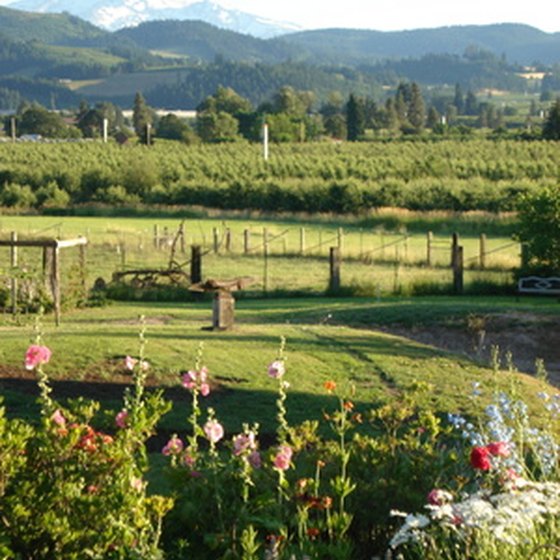
 About 15 miles north of my home in Vancouver, Washington, is the small town of Ridgefield.  It sits on a bluff above lowlands, bottomlands, lakes, sloughs, ponds, and swamps adjacent to the Columbia River.  The wetlands area is now part of the Ridgefield National Wildlife Refuge.  It is part of the "Wapato Valley" named by Lewis and Clark.  

In the 1990's Professor James Ames, Archeologist, Portland State University, led an excavation of the Indian ruins near Ridgefield in the bottomlands.  In 2005, as part of the Lewis and Clark Bicentennial Celebration, a replica of a Native Indian cedar plank longhouse was constructed near Ridgefield on the Refuge.  


The Chinook and Cowlitz River and Lewis River Peoples all lived in this area for 1,500 years.  They all build wood houses, in which to smoke and store food, keep dry and warm, work, and socialize.  They all fished, hunted, and foraged in an environment rich in resources.  

The Chinook were traders and people speaking dialects of the Chinook language, or using a Chinook trading language and sign language, were active in trading goods from Ilwaco to The Dalles.  Canoes were in everyday use by all people living along the Columbia River.     


Ridgefield City   Images     Population 4,700   The small town is on a bluff above the lowlands by the Columbia River. 

Ridgefield - Chinook House  Cathlapotle Plankhouse   

Cathlapotle and its Inhabitants 1792-1860.  By Robert Boyd.  U.S. Fish and Wildlife Service, Portland, Oregon, 2011.  Index, 209 pages, many maps and charts, place name index, detailed bibliography, art work.  FVRL.  Fascinating study of native people living the area from For Vancouver to Ilwaco, on both sides of the lower Columbia River.  I believe there is also one plankhouse reconstructed at Fort Stevens State Park in Oregon.  I visited Native American plankhouses and shelters in Northern California at Patrick's Point State Park. 

Ridgefield National Wildlife Refuge, Ridgefield, Clark County   This large refuge includes an auto tour through the wetlands, sloughs, bogs, and lowlands along the Columbia River.  A few trails from this road are open only in the summer.  Many birds winter here.  A second area of the refuge consists of a walking path over the railroad, a reconstructed Chinoon style plankhouse, and many walking trails through these lowlands (soaked in winter). 

Ridgefield History

Ridgefield Visitors Guide

Ridgefield Library FVRL

Ridgefield Shopping 

Ridgefield Recreation

Ridgefield Information and Travel

Ridgefield Marina    On a slough of the Columbia.  Kayak rentals, small boat launch, mooring, picnic tables, fishing, restrooms, parking lot. 

Blog Posts to the Cloud Hands Blog by Mike Garofalo regarding travel adventures in Washington State.


The Chinook Indians: Traders of the Lower Columbia River.  Robert H. Ruby and John A. Brown.  University of Oklahoma Press, 1988, 372 pages, index.  VSCL, FVRL. 

Chinookan Peoples of the Lower Columbia.  Edited by Robert T. Boyd, Kenneth M. Ames, and Tony A. Johnson.  University of Washington, 2015, 464 pages.  VSCL.  Outstanding collection of articles.  First Choice!! 

Peoples of the Northwest Coast: Their Archaeology and Prehistory.  By Kenneth M. Ames.  Thames and Hudson, 1999, 288 pages.  FVRL.

Cathlapotle and its Inhabitants 1792-1860.  By Robert Boyd.  U.S. Fish and Wildlife Service, Portland, Oregon, 2011.  Index, 209 pages, many maps and charts, place name index, detailed bibliography, art work.  FVRL.  Fascinating study of native people living the area from For Vancouver to Ilwaco, on both sides of the lower Columbia River.  

Willapa Bay Area Information 

Lower Columbia River: Ilwaco to Washougal 

Northwest Oregon: Astoria to Cape Disappointment

Chinook Indian Nation  "The Chinook Indian Nation is made up of the five western-most Chinookan speaking tribes at the mouth of the Columbia River.  Our nearly 70-year-old constitution codifies who we are and identifies our five constituent tribes – the Clatsop and Cathlamet (Kathlamet) of present-day Oregon and the Lower Chinook, Wahkiakum (Waukikum) and Willapa (Weelappa) of what is now Washington State."  Not federally recognized. 

Chinookan Peoples


The Northwest Coast: Or, Three Years' Residence in Washington Territory.  He lived in Willapa Harbor from 1849-1851.  By James Gilchrist Swan.  Adesite Press, 2017, 448 pages.  FVRL. 

"James Gilchrist Swan wrote an amazingly interesting and detailed account of his years in Willipa Harbor. The origin of some modern place names, I.e., Tokeland became very clear, for example. His treatise on the nature of Native Americans is especially significant, as is his description of their languages.  I especially liked his analysis of how the Hudson Bay Company's strategy to get along with the native people was compared with Governor Stevens' botched treaty proposition along the banks of the Chehalis.  Swan was an interesting man in his own right: pioneer, scientist, Indian agent, teacher, revenue agent, probate judge, cultural and natural historian and adventurer. He is buried in an unpretentious grave in Port Townsend, Washington." 

"In November 1852 James Swan moved to the Olympic Peninsula of Washington Territory. Fascinated by the Indian communities he encountered, Swan spent the remainder of his life studying their art, material culture, and history. The author of several books, he became the Smithsonian Institution's principal agent in the Northwest, collecting natural history and ethnographic objects from Gray's Harbor through the Alaskan panhandle. He lived among the Makah Indians of Neah Bay where he taught school and was among the first Americans to visit the Haida villages of the Queen Charlotte Islands."

Swan Among the Indians: Life of James G. Swan (1818-1900).  By Lucille McDonald.  Binfords and Mort, Portland, 1972.  Index, 233 pages.  FVRL. 

Coast Country: A History of Southwest Washington.  By Lucile McDonald.  Long Beach, Midway Printery, 1989.  Index, 183 pages.  TRLS. 

The Historical and Regional Geography of the Willapa Bay Area, Washington.  By Jean Hazeltine.  South Bend, 1956, 308 pages.  FVRL

Shoalwater Willapa.  By Douglas Allen.  Snoose Peak Publishing, South Bend, WA, 2004.  Index, notes, sources, 286 pages.  TRLS.  


Chinook Resilience: Heritage and Cultural Revitalization on the Lower Columbia River.  By Jon D. Daehnke.  Foreword by Tony A. Johnson.  University of Washington, 2017, 233 pages, index, bibliography, notes.  FVRL.  Interesting discussion of evidence for the distribution of Chinook speaking people, and the history of the people in the area.  A long and detailed discussion of the creation of the Cathlapotle House in Ridgefield. 

Chinook Texts.  Collected by Franz Boas.  1984.  Includes myths, beliefs, customs, tales, and historical tales as told by the Chinookan people. 

Columbia River: The Astoria Odyssey.  By Penttila Bryan.  Frank Amato, 2004, 96 pages. 

Chinook Art, Contemporary     Chinook Design Art Products: Hats   Bags

Chinook Merchandise

Chinookan Art Style


Saturday, January 15, 2022

Winter Gardening Projects

A Repost from 2014:

Karen and I have been very busy this week with home improvement projects and winter garden chores. 
We drained the west pond and removed cattails, berry vines, and other "weeds."  We removed dead cypress trees along the edge of the pond.  This was very tiring work for us.
We are planting two new rows of trees in our orchard.  We are planting potted trees (gifts from Cathy Goodin), and bare root trees.  I am laying down drip lines for all the new trees in the orchard.  We will also prune and fertilize all existing trees.  We will paint all the trunks white, and spray. 

Weeding: Quotes, Sayings, Facts

Working in the Garden: Quotes, Poems, Sayings


Friday, January 07, 2022

A Peach of a Surprise

A repost from 2012:  

This past week, I reread the Bhagavad Gita (translated by Eknath Easwaran) and The Upanishads (translated by Swami Prabhavananda).  I first read these important works in 1963.  These classic spiritual texts from India, written down in Sanskrit between 1200 and 400 BCE, are essential reading for Yogis.  
In many ways, realizing Brahman depends upon good actions and selfless service (Karma yoga), concentration and meditation, study of scriptures (Jhana yoga), heartfelt love and devotion (Bhakti yoga), guidance from a worthy and wise teacher (Guru), the healthy development of the body and calmness and evenness of mind (Hatha yoga), worship and rituals, faith, and to some extent, and a bit of luck or Grace.   
 
"Now the secret is that the other eventually turns out to be you.  The element of surprise in life is when suddenly you find the thing most alien turns out to be yourself.  Go out at night and look at the stars and realize that they are millions and billions of miles away, vast conflagrations far out in space.  You can lie back and look at that and say, "Well, surely I hardly matter.  I am just a tiny little speck aboard this weird spotted bit of dust called earth, and all that was going on out there billions of years before I was born and will still be going on out there billions of years after I die."  Nothing seems stranger to you that that, or more different from you, yet there comes a point, if you watch long enough, when you will say, "Why that's me!"  It is the other that is the condition of your being yourself, as the back is the condition of being the front, and when you know that, you know you never die."
Alan Watts, Swimming Headless, 1966

I first heard Alan Watts speak at California State University at Los Angeles in 1966.  I had read The Way of Zen and Beat Zen and Square Zen while in high school in 1962.  I was also well versed in the books on Zen, Buddhism, and Japanese culture by Professor D. T. Suzuki. 
Mr. Watts was a charming and engaging public speaker.  He made us laugh and he made us think. 

In 1966, I was then an undergraduate majoring in Philosophy at CSULA, and working 30 hours per week at the City of Commerce Public Library.   Since then, I've read all of the books by Alan Watts, and have listened to audiotapes of his lectures and radio broadcasts.  He was definitely an intellectual and lifestyle influence in my life.  


For me, the "realization" or "surprise" comes while gazing at our garden, working and tending our garden, thinking about gardening, and eating from our garden.  Within these experiences are myriad levels of meaning and complexity: ordinary human level, metaphorical, imaginative, microscopic, molecular, atomic, subatomic ...  This spot of earth where I live has been here for millions of years and will continue long after I die.  We animals and plants come and go, interdependent, interrelated, inter-being, a changing manifestation of the Here-Now, a snapshot of the divine realm.    

This peach, these peppers,
These grapes, these tomatoes
Will all soon become me.
Such a tasty fact.
I am That and That is Me. 
Bless the gardens!
Bless the gardeners!

Bless the kitchens!
Bless the cooks!  
Bless the food! 
-  Mike Garofalo, Pulling Onions


"Out of Brahman, who is the Self, came ether; out of ether, air; out of air, fire; out of fire, water; out of water, earth; out of earth, vegetation; out of vegetation, food; out of food, the body of man.  The body of man, composed of the essence of food, is the physical sheath of the Self.  From food are born all creatures, which live upon food and after death return to food.  Food is the chief of all things.  It is therefore said to be the medicine of all diseases of the the body.  Those who worship food as Brahman gain all material objects.  From food are born all beings which, being born, grow by food.  All beings feed upon foot, and, when they die, food feeds upon them."
Taittiriya Upanishad, p.59


"The sages of the Upanishads teach that Brahman is the ultimate essence of material phenomena (including the original identity of the human self) that cannot be seen or heard but whose nature can be known through the development of self-knowledge (atma jana).  According to Advaita, a liberated human being (jivanmukta) has realised Brahman as his or her own true self (see atman)."  - Brahman

Peach trees and peaches have a special place in my heart.  I carefully tend the peach trees in our orchard, but a bountiful crop is often just a gift, grace, luck. 

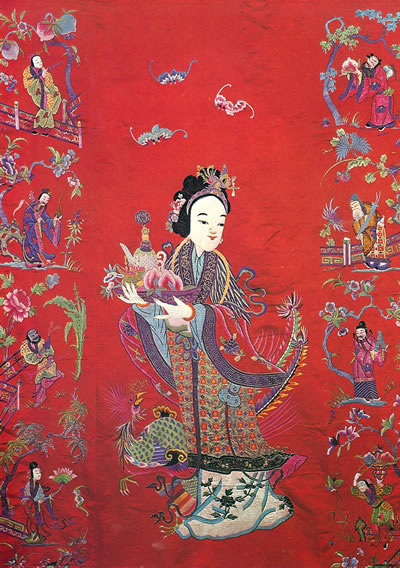
"In China, the peach was said to be consumed by the immortals due to its mystic virtue of conferring longevity on all who ate them. The divinity Yu Huang, also called the Jade Emperor, and his mother called Xi Wangmu also known as Queen Mother of the West, ensured the gods' everlasting existence by feeding them the peaches of immortality. The immortals residing in the palace of Xi Wangmu were said to celebrate an extravagant banquet called the Pantao Hui or "The Feast of Peaches". The immortals waited six thousand years before gathering for this magnificent feast; the peach tree put forth leaves once every thousand years and it required another three thousand years for the fruit to ripen. Ivory statues depicting Xi Wangmu's attendants often held three peaches. The peach often plays an important part in Chinese tradition and is symbolic of long life. One example is in the peach-gathering story of Zhang Daoling, who many say is the true founder of Taoism. Elder Zhang Guo, one of the Chinese Eight Immortals, is often depicted carrying a Peach of Immortality." - Wikipedia

Peaches are native to China and introduced to Persia via the Silk Road before Christian times.

Xi Wang Mu, Queen Mother of the West, keeps the Immortals fed with the Sacred Peaches.  "No one knows Her beginning, no one knows Her end."

Ripening Peaches: Taoist Studies and Practices


Xi Wangmu, Braham, the Divine, the Supreme Universal Spirit, the Unmanifested and Manifested, the Absolute, the Everlasting, the Shining, Everything, Food for Life, God ...

AUM, OM  ...  Shanti, Shanti, Shanti.  

Such a tasty peach!!  


Saturday, January 01, 2022

Tao Te Ching by Lao Tzu, Chapter 60

Daodejing, Laozi
Chapter 60 


"Governing a large state is like boiling a small fish.
When the empire is ruled in accordance with the way,
The spirits lose their potencies.
Or rather, it is not that they lose their potencies,
But that, though they have their potencies, they do not harm the people.
It is not only they who, having their potencies, do not harm the people,
The sage, also, does not harm the people.
As neither does any harm, each attributes the merit to the other."
-  Translated by D. C. Lau, 1963, Chapter 60  


"The state should be governed as we cook small fish, without much business.
Bringing the Tao to the governing of the Kingdom will give rest to the shades of the dead.
Not that the Spirits will be inactive, but they will cease to trouble the people.
But what is of more importance, the wise ruler of the people will not hurt them.
And in so far as they do not interfere with one another, their influences conspire to the general good!"
-  Translated by Walter Gorn Old, 1904, Chapter 60 


"Rule a great state in the way one would fry little fish,
Without gutting or scraping, consider the good of the whole,
Let the empire be ruled in accord with the rule of the Tao
And the spirits of those who are gone will not seek to control.
 
Not only not seek, but spirits will harm not the people,
Not only not harm, but, because of the rule of the sage,
Who harms not, these twain, not seeking to injure each other,
Will therefore in virtue together unite and engage."
-  Translated by Isaac Winter Heysinger, 1903, Chapter 60


治大國若烹小鮮. 
以道蒞天下, 其鬼不神.
非其鬼不神.
其神不傷人.
非其神不傷人.
聖人亦不傷人. 
夫兩不相傷.
故德交歸焉. 
-  Chinese characters, Tao Te Ching, Chapter 60  


zhi da guo ruo peng xiao xian.
yi dao li tian xia, qi gui bu shen.
fei qi gui bu shen.
qi shen bu shang ren.
fei qi shen bu shang ren.
sheng ren yi bu shang ren.
fu liang bu xiang shang.
gu de jiao gui yan.
-  Pinyin Romanization, Daodejing, Chapter 60 


"Governing a large country
is like frying small fish.
Too much poking spoils the meat.
When the Tao is used to govern the world
then evil will lose its power to harm the people.
Not that evil will no longer exist,
but only because it has lost its power.
Just as evil can lose its ability to harm,
the Master shuns the use of violence.
If you give evil nothing to oppose,
then virtue will return by itself."
-  Translated by J. H. McDonald, 1996, Chapter 60  


"Governing a great state,
Is like cooking small fish.
If you rule the world by Tao,
The ghosts (kuei) will lose their spiritual (shen) power.
Not that the ghosts lose their spiritual power,
But their spiritual power will not harm the people.
Not that their spiritual power will not harm the people,
But neither does the sage harm the people.
Since both are harmless,
Te flows back and forth [without impediment]."
-  Translated by Ellen M. Chen, Chapter 60  


"Se debe gobernar un gran Estado
tal como se fríen los pececillos, con cuidado
para que no se desentrañen.
Si se gobernara el mundo con el Tao,
el mal no tendría poder.
No porque el mal careciera de poder,
sino porque éste no dañaría a los hombres.
El mal no dañaría a los hombres,
y tampoco el sabio los dañaría.
Si no se atacaran mutuamente, unirían sus Energías
y así ambos aumentarían su Poder."
-  Translation from Wikisource, 2013, Tao Te Ching, Capítulo 60


"Ruling a large kingdom is indeed like cooking small fish.
They who by Tao all that is under heaven
Did not let an evil spirit within them display its powers.
Nay, it was not only that the evil spirit did not display its powers;
Neither was the Sage's good spirit used to the hurt of other men.
Nor was it only that his good spirit was not used to harm other men,
The Sage himself was thus saved from harm.
And so, each being saved from harm,
Their “powers” could converge towards a common end."
-  Translated by Arthur Waley, 1934, Chapter 60  


Chapter and Thematic Index (Concordance) to the Tao Te Ching


Taoism: A Selected Reading List 


Friday, December 31, 2021

Four Days in Grayland


Part I: Southwestern Washington

Grays Harbor, Willapa Bay, Long Beach Peninsula, Lower Columbia River
A Traveler's Hypertext Notebooks, Guides, and Resources


Part II: Grayland Beach
A Beach Camper's Hypertext Notebook,
Studies, Readings, Activities, Seasons, and Tips 


Part III: Doing and Seeing
   
Photographs, Blog Posts, and Reports from 2021-2022  


Part IV: Reflections of Beachcombers
   
Poetry, Short Essays, Commentary, Quotations   


Southwestern Washington


Grays Harbor
 

Willapa Bay
 

Long Beach Peninsula
 

Lower Columbia River, North Side, from Ilwaco East to Washougal


Olympia south to Vancouver, Interstate 5 Corridor
 

Native Americans in the Area


Northwest Coastal Oregon: Astoria to Cape Lookout


Four Days in Grayland Homepage


Alphabetical Index to Four Days in Grayland


Aberdeen

Boating, Charter Tours  (Westport, Ilwaco, Aberdeen, Astoria)

Agate Hunting, Coastal Geology, Rock Hounding  

Beachcombing

Beach Driving  

Beach Picnics

Berries, Cranberries, Wild Berries, Berry Foraging 

Bibliography - General Information for Traveler's and Campers

Bibliography, Information, Reading, Resources

Bicycling  

Bird Watching 

Blog Reports of Monthly Yurt Camping Trips

Boat Usage, Kayaking, Canoeing

Camping in Yurts

Camping Notebooks

Canoeing and Kayaking 

Cape Disappointment

Centralia 

Chelais 

Chinook

Chinook Indians

Clam Digging

Cloud Hands Blog

Columbia River from Ilwaco to Vancouver

Cranberries, Wild Berries, Berry Foraging 

Day Picnics and Day Camping at the Beach  

Driftwood Gathering, Beachcombing, Agate Hunting

Driving on the Beach in Washington

Facebook of Michael P. Garofalo

Fishing

Food and Seafood

Four Days in Grayland Homepage   

Four Days in Grayland Photographs and Blog Posts (Most Recent First) 

Geology Coastal, Rock Hounding, Agate Hunting

Grays Harbor

Grayland Beach

Green Way Research Hypertext Notebooks of Michael P. Garofalo 

Hiking Quotations, Sayings, Poems

Hiking Trails

Hoquaim

Ilwaco

Indians, Native Peoples in the Area

Information, Bibliography, Reading, Resources

Intertidal Ocean Shores

Jetty Fishing

Kayaking and Canoeing 

Kite Flying

Libraries

Long Beach City

Logging and Timber Mills Industry

Long Beach Peninsula

Longview 

Lower Columbia River from Ilwaco to Vancouver

Marinas and Docks: Westport, Tokeland, South Bend, and Ilwaco

Michael P. Garofalo Biography

Months and Seasons Activities

Mushrooms Foraging  

Naselle River 

Native Peoples in the Area

Native Peoples - Bibliography

Ocean Park

Ocean Shores

Oysters

Photographs of Monthly Yurt Camping Trips

Pier Fishing

Raymond

Reading, Information, Bibliography, Resources

Reading, Bibliography - General Information

Reports of Monthly Yurt Camping Trips

Rock Hounding, Agate Hunting, Coastal Geology 

Seafood and Food

Sea Shell Gathering, Beachcombing, Agate Hunting, High Tide Debris

Seaside Nature Studies

Seaside Picnics and Day Camps

Seasonal Events

Seasons and Months Activities

South Bend

Southwestern Washington - Travel

Surf Fishing

Swimming, Boogie Boarding, and Surfing  

Timber Industry

Trails and Paths

Videos from some Yurt Camping Trips

Walking Trails

Walking Quotations, Sayings, Poems

Washington - Southwestern - Travel  

Westport

Wild Berries, Berry Foraging, Cranberries 

Willapa Bay

Willapa Bay - Bibliography, Resources, Reading

Yurt Camping

Yurt Camping Reports


Thursday, December 30, 2021

Open a New Door


“The name, given to the month of ‘January’, is derived from the ancient Roman name ‘Janus’ who presided over the gate to the new year. He was revered as the ‘God of Gateways’, ‘of Doorways’ and ‘of the Journey.’ Janus protected the ‘Gate of Heaven’, known as the ‘Lord of Beginnings’, is associated with the ‘Goddess Juno-Janus’, and often symbolized by an image of a face that looks forwards and backwards at the same time. This symbolism can easily be associated with the month known by many as the start of a new year which brings new opportunities. We cast out the old and welcome in the new. It is the time when many reflect on events of the previous year and often resolve to redress or improve some aspect of daily life or personal philosophy.”
- Mysitcal World Wide Web


"New Year ceremonies are designed to get rid of the past and to welcome the future. January is named after the Etruscan word janua which means door."
- New Year's Customs

"The Old Year has gone. Let the dead past bury its own dead. The New Year has taken possession of the clock of time. All hail the duties and possibilities of the coming twelve months!"
- Edward Payson Powell

January: Quotes, Poems, Lore, Sayings, Garden Chores


Sunday, December 26, 2021

Mt. Adams, Washington


Repost from 10/2018.

Karen drove our old 2003 Ford Explorer from Vancouver east along Route 14 on the north side of the Columbia River all the way to Bingen.  We climbed up a hill to visit the town of White Salmon, and then drove north on Route 141 to Trout Lake.  From Trout Lake to Glenwood.  Then south down through the Conboy Lake Refuge to BZ Corner.  Over the bridge to Hood River, then hone to Vancouver via Interstate 84.  We left around 9:30 am and returned home at 5 pm.

Spectacular views of trees and shrubs with autumn colors to the leaves intermixed or at the edges of conifers.  The many clear views of the 12,300 foot Mt. Adams from the valleys around Trout Lake and Glenwood were very dramatic. 

The views on the drive east and west through the Columbia River Gorge National Scenic Area were, as always, very beautiful, inspiring, and grand.  


Others Have Shared Photographs of the areas near White Salmon, Washington.
The town is high up on a hill on the north side of the Columbia River
directly across from the City of Hood River.  Many dramatic views
looking south towards Mt. Hood and Oregon.


Views of Mount Hood


Image result for white salmon washington


Image result for white salmon washington

Sunday, December 19, 2021

Heathen Holidays


Holiday by Madonna, 1983

"If we took a holiday

Took some time to celebrate
Just one day out of life
It would be
It would be so nice
Everybody spread the word
We're gonna have a celebration
All across the world
In every nation
It's time for the good times
Forget about the bad times, oh yeah
One day to come together to release the pressure
We need a holiday
If we took a holiday
Took some time to celebrate (come on let's celebrate)
Just one day out of life (holiday)
It would be
It would be so nice
You can turn this world around
And bring back all of those happy days
Put your troubles down
It's time to celebrate
Let love shine
And we will find
A way to come together
Can make things better
We need a holiday ..."


Young women and men dancing, bouncy, carefree, juvenile, lively, celebrating.  

Thursday, December 16, 2021

Return to Wapato Valley

 I was up at 4 am today.  No rain last night and no gusty winds.  Enjoyed daybreak coffee and cannabis on the cold Yurt porch.  I figure the entire campground is 95% empty.  My Circle B was empty but for me.  I took a short walk to the beach.

Loaded up my Ford Escape and began the drive back to Vancouver.  You must leave by 11 am.  I drove home by US101 and WA4.  

Lewis and Clark called the Columbia River bottom and lowland area between Vancouver and Longview the Wapato Valley because of the many wapato roots and camas bulbs harvested by the native Chinook people in the area.  


With 14.5 hours of darkness each day, I had plenty of time to read.  In the last three days I read the following books:

Chinookan Peoples of the Lower Columbia.  Edited by Robert T. Boyd, Kenneth M. Amers, and Tony A. Johnson.  University of Washington, 2015, 464 pages.  VSCL.  Maps, index, art, bibliography.  Outstanding collection of articles.

Cathlapotle and its Inhabitants 1792-1860.  By Robert Boyd.  U.S. Fish and Wildlife Service, Portland, Oregon, 2011.  Index, 209 pages, many maps and charts, place name index, detailed bibliography, art work.  Fascinating study of native people living the area from For Vancouver to Ilwaco, on both sides of the lower Columbia River, as reported by persons living then.  FVRL. 

The Chinook Jargon and How to Use It: A Complete and Exhaustive Lexicon of the Trade Language.  By George Coombs Shaw in 1909, Ranier Printing, Seattle.  Franklin Classics, 2018, 65 pages.  VSCL. 

Mountain Home: The Wilderness Poetry of Ancient China.  Translated by David Hinton.  New Directions, 2005, 320 pages.  VSCL.  


Wednesday, December 15, 2021

Seaside Days of Late Autumn


The California Gulls and brown seagulls
gather by my parked car seeking a
food handout from me.  It feels like 30F
with gusty winds, intermittent drizzle.


A short drive northeast from Seaview is the 
southeast side of Willapa Bay.  Then on to the
Naselle River and bridge on US101.
Beautiful county in the Willapa Bay National
Wildlife Refuge.  


The Columbia River at Baker's Bay.
Rough river on a late autumn day.


Nobody in the campground but me.


Lots of rain, day and night, all
during this trip until Wednesday night.


Seaview 

Seaview Information   South of Long Beach. 

42 Cafe and Bistro    Depot Restaurant

Sportsmens Cannery

Long Beach Peninsula Visitors Bureau and Information in Seaview

Seaview - Wikipedia

Discovery Bicycling and Walking Trail


Long Beach City

Long Beach   Population 1,390.  WB.  Long Beach 29 mile Peninsula with wide sandy beaches facing the Pacific. 

Long Beach WB   Images   Travel   Lodging, shops, restaurants, rentals.  Long Beach's 8 mile Discovery Bicycling Trail

Long Beach Peninsula     Images

Long Beach Peninsula Visitors Bureau and Information   Videos on Facebook

Long Beach Peninsula.  By Nancy L. Hobbs and Donella J. Lucero.  Arcadia, 2005, 130 pages.  History, photographs. 

Long Beach Travel Opportunities

Long Beach:  Cranberry Museum and Gift Shop

Shopping on the Long Beach Peninsula

Friends of the Willapa Bay National Wildlife Refuge

Discovery Bicycling and Walking Trail

Food:  Benson's By the Beach   Breakfast     Lunch    Dinner   Crab Pot

Visitor Information     Tourist Information

Ocean Park Timberland Library

Long Beach - Chinook Indian People