Friday, October 31, 2025

Skeletons Don't Stand Up

                  The Fireplace Records, Chapter 32


Skeleton's Don't Stand Up


One September day, I was enjoying my morning walk in the Kith of my suburban neighborhood. It was late in the month, nearing Mabon, the Autumnal Equinox.  I passed a home where Halloween decorations were set up attractively in the front yard. There were plastic skeletons, pumpkins, a scythe, ghouls, gravestones, and wee-folk statues, etc. Flimsy ghosts hung from ropes.  I stopped and stared for awhile.

The skeleton was propped up so as to be standing with one arm upraised. I pondered this position.  Real skeletons are always the final remains of lying down dead animals; they don't stand up and wave to us.

Are our Halloween characters and symbols a way of challenging death, spitting on our fears, laughing in the face of death, making fun of death; or, honoring the dying and dead?

We imagine and invent all kinds of scary monsters: ghosts, ghouls, demons, devils, Big Foots, UFO aliens, gremlins ... We pretend they exist, we search for them, we fear them.  We also delight in being safely afraid as with horror films and with televised specials about vampires, the walking-dead, devils, and hundreds of X-Files searches. We fear death and destruction, and delight in inventions and fictions that represent that outcome. Real threats like cancer, heart disease, earthquakes, floods, landslides, famines, and wildfires seldom have a projected Face, and are not often personified nowadays. The ancient Pagans did have many gods and goddesses that personified nature's destructive forces. Some Christians nowadays often say that God caused a flood or disaster because American society tolerates homosexuals or atheists and, therefore, everyone deserves punishment. 

There are not many Zen Koans dealing with scary supernatural beings.  Just a few: a monk reincarnated as a fox (GB 2), a monstrous serpent in a cave (SAM 37, SAM 24), an evil underworld badger (SAM 47), a hearth spirit (OM 31), an turtle-nosed snake (ZE 34), a blood-sucking toad (SAM 34), a doppelganger nun (GB 35), demons (OM 3, OM 15). Sometimes, a Zen priest is called to exorcise the evil creature, but they don't seem willing to get involved. 

The Zen Masters often play along with folk superstitious, like Father Don Manuel in Miguel de Unamuno's novella "Saint Manuel Bueno, Martyr." The priest plays the role of a Catholic believer so as to reduce the suffering and provide some harmless contentment for his appreciative and adoring peasant parishioners. But Father Don Manuel does not really believe in an after-life, Catholic dogmas, or supernatural beings. Like the Buddha, reducing suffering is the primary goal of his actions in the world.


Comments, Sources, Observations

Our primitive fears of the darkness of the night often breeds imaginary creatures.
X-Files actors often find themselves with flashlights in the dark.
Fictions are often fun, but still fictions.
Some people believe that Harry Potter is a real person, existing.
Pretending is essential to Play.

Subject Index to 1,975 Zen Buddhist Koans  Look under the subject headings of "supernatural beings," "demons," or "snakes."

Meetings with Master Chang San-Feng 

One Old Taoist Druid's Journey  Plenty of Animal Spirits and Wee-Folk Discussed.


Refer to my Cloud Hands Blog Posts on the topic of Koans/Stories. 

Subject Index to 1,975 Zen Buddhist Koans

Zen Buddhist Koans: Indexes, Bibliography, Commentary, Information


The Daodejing by Laozi

Pulling Onions  Over 1,043 One-line Sayings by Mike Garofalo

Chinese Chan Buddhist and Taoist Stories and Koans

The Fireplace Records  By Michael P. Garofalo


More like a UFO Alien than a Skeleton
You get the idea: darkness, fear, evil


Thursday, October 30, 2025

Sean and Alicia Flinn: 25th Wedding Anniversary

Our daughter, Alicia June Garofalo Flinn has been married for 25 years to Sean Flinn.
They raised two daughters. They are respected by friends and family. They have enjoyed
a comfortable and interesting lifestyle.

Alicia and Sean have lived near Karen and I since 2017. Are homes are only 8 miles apart. We both live in the unincorporated areas of Clark County (population 570,000), Washington.

To celebrate, Karen and I gave the couple an engraved hardwood cutting board and an external hard disk drive with 50,000 photographs from our family collection.


Preparing for Halloween


Here is how our front porch looked when decorated for Halloween Day.  
We decorated our home in Red Bluff, California, from 1998-2017.  
Notice the five spherical white spectral (ghostly) visitors coming to "trick or treat" at our front door.    

"To all the ancient ones from their houses, the Old Ones from above and below. In this time the Gods of the Earth touch our feet, bare upon the ground. Spirits of the Air whisper in our hair and chill our bodies,  and from the dark portions watch and wait the Faery Folk that they may join the circle and leave their track upon the ground. It is the time of the waning year. Winter is upon us. The corn is golden in the winnow heaps. Rains will soon wash sleep into the life-bringing Earth. We are not without fear, we are not without sorrow...Before us are all the signs of Death: the ear of corn is no more green and life is not in it. The Earth is cold and no more will grasses spring jubilant. The Sun but glances upon his sister, the earth..... It is so....Even now....But here also are the signs of life, the eternal promise given to our people. In the death of the corn there is the seed--which is both food for the season of Death and the Beacon which will signal green-growing time and life returning. In the cold of the Earth there is but sleep wherein She will awaken refreshed and renewed, her journey into the Dark Lands ended. And where the Sun journeys he gains new vigor and potency; that in the spring, his blessings shall come ever young!"
-  Two Samhain Rituals, Compost Coveners, 1980 


"Tonight as the barrier between the two realms grows thin,
Spirits walk amongst us, once again.
They be family friends and foes,
Pets and wildlife, fishes and crows.
But be we still mindful of the Wee Folke at play,
Elves, fey, brownies, and sidhe.
Some to trick, some to treat,

Some to purposely misguide our feet.
 
Stay we on the paths we know
 
As planting sacred apples we go.
This Feast I shall leave on my doorstep all night.
In my window one candle shall burn bright,
To help my loved ones find their way
As they travel this eve, and this night, until day.
Bless my offering, both Lady and Lord
Of breads and fruits, greens and gourd."
-  Akasha, Samhain Ritual  


The entrance to our front driveway in Red Bluff featured a seasonal display that Karen prepared from 1998-2017. 
Karen is petting our cat, King Tut, in the early morning hours. 

We now (2020) live in Vancouver, Washington.  


Wednesday, October 29, 2025

Halloween Pumpkin Carving


We enjoyed a pumpkin carving party with 9 people this last Sunday.  Karen had made chili beans, cornbread, and chocolate cake for the party.  We have done this for four years in Vancouver.


Halloween, October 31st, Welsh Samhain, All Hallows Eve, Day of the Dead     
Summer's End, Hallowmas, All Saint's Day, Shadow Fest, Martinmas, Old Hallowmas, Nut Crack Night
Beginning of the Winter/Dark Season, Otherworld Borders Day, Ancestors' Night, Hallowed Evening
Winter Nights, The Last Harvest, Feast of the Apples, Great Rite, New Year's Day for Witches, Day for the Ancestors
Día de los Muertos (Day of the Dead) in Mexico, and in many other Hispanic and Catholic Cultures
A Day to Remember and Honor Dead Relatives and all the Ancestors and the Great Traditions 
1st Celebration in the NeoPagan Holy Day Annual Cycle or Wiccan Wheel of the Year 


"The eve of the New Year or Oidhche Shamhna was a gap in time. Thus, the spirits from the Otherworld could enter into our world. Rituals on Oidhche Shamhna include providing hospitality to the dead ancestors. They welcomed the dead with food and drink and left the windows and doors of their homes open for the dead to enter. But all spirits from the Otherworld were not good; there were evil spirits too. To keep evil spirits away from their home, they carved images of spirit-guardians onto turnips and placed them at the doors of their homes. As part of the festivities young people wore strange costumes and moved around the village, pretending to be dead spirits visiting from the Otherworld. The Celts believed that on the eve of New Year not only did the boundary between this world and the Otherworld dissolve, but the structure of society dissolved too. Boys and girls would dress up as members of the opposite sex and play pranks on the elders."
-   Celtic New Year  


"Perhaps the most famous icon of the holiday is the jack-o-lantern.  Various authorities attribute it to either Scottish or Irish origin.  However, it seems clear that it was used as a lantern by people who traveled the road this night, the scary face to frighten away spirits or faeries who might otherwise lead one astray.  Set on porches and in windows, they cast the same spell of protection over the household.  (The American pumpkin seems to have forever superseded the European gourd as the jack-o-lantern of choice.)  Bobbing for apples may well represent the remnants of a Pagan 'baptism' rite called a 'seining', according to some writers.  The water-filled tub is a latter-day Cauldron of Regeneration, into which the novice's head is immersed.  The fact that the participant in this folk game was usually blindfolded with hands tied behind the back also puts one in mind of a traditional Craft initiation ceremony."
-   Mike Nichols, All Hallow's Eve


Tuesday, October 28, 2025

B. K. S. Iyengar and Yoga


Iyengar, B.K.S.  1918-2014 Yogacharya Iyengar

The renowned Yoga Grand Master (Yogacharya) B. K. S. Iyengar was born in Bellur, Karnataka, India on December 14, 1918; and died at the age of 96 on August 20, 2014..  He has taught in Pune, India, since 1936; and all around the world.  "Bellur Krishnamachar Sundararaja Iyengar, (B. K. S. Iyengar)  is the founder of Iyengar Yoga. He is considered one of the foremost yoga teachers in the world and has been practicing and teaching yoga for more than 75 years. He has written many books on yoga practice and philosophy, and is best known for his books Light on YogaLight on Pranayama, and Light on the Yoga Sutras of Patanjali.  Iyengar yoga classes are offered throughout the world, and it is believed that millions of students practice Iyengar Yoga." 


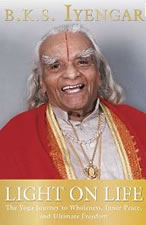
Light on Life: The Yoga Journey to Wholeness, Inner Peace, and Ultimate Freedom  By B.K.S. Iyengar.  With John J. Evans and Douglas Abrams.  Rodale Books, 2005.  Index, 282 pages.  ISBN: 1594862486.  VSCL. 


Light on Prānāyāma: The Yogic Art of Breathing  By B.K.S. Iyengar.  Introduction by Yehudi Menuhin.  New York, Crossroad Pub. Co., 2012.  Originally published in 1985 in English.  Index, glossary, appendices, 296 pages.  ISBN: 9780824506865.  VSCL.


Light on the Yoga Sutras of Patanjali.   By B. K. S. Iyengar.  Foreword by Yehudi Menuhin.  London, Thorsons, 1993.  Index, 337 pages.  ISBN: 1855382253.  VSCL. 


Light on Yoga: Yoga Dipika.   
B.K.S. Iyengar.  New York, Schocken Books, 1966, Revised Edition 1977, 1979.  Glossary, index, 544 pages.  ISBN: 0805210318.   Subtitle: Yoga Dipika.  I own the revised paperback edition, 1979.  VSCL.   

 
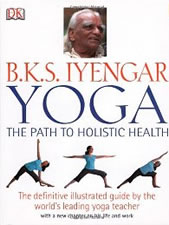
Yoga: The Path to Holistic Health  By B.K.S. Iyengar.  London, Dorling Kindersley, 2001.  Index, glossary, appendices, 415 pages.  ISBN: 0789471655.  
Lavishly illustrated compendium of essential poses, routines, prop use, and yoga routines to help specific health problems.  VSCL.   


Books by "Iyengar Yoga" Teachers


Yoga: The Iyengar Way.  By Mira Silva and Shyam Mehta.  New York, Alfred A. Knopf, 1995.  Index, appendices, 192 pages.  ISBN: 0679722874.  A very good reference tool for the study and practice of yoga poses.  VSCL. 


Iyengar Yoga Institute of San Francisco


Monday, October 27, 2025

Low Tide at Heceta

Low Tide at Heceta

By Mike Garofalo

At the Edges of the West
Highway 101 and 1
Northwest Pacific Coast

Four Days in Grayland

25 Steps and Beyond: Collected Works

Hecate in Mythology

Best Tidepools in Oregon

Heceta Head Lighthouse

"Heceta Head was a spot of frequent fishing and hunting by the American Indian tribes that populated the area. Heceta Head is part of the Siuslaw traditional lands, known in their language as ɫtúwɪs. They hunted sea lions in the area and gathered sea bird eggs from the offshore rocks. It was also the site of a legend—the Animal People built a great stone wall, which is now the cliffs, and tricked the Grizzly Bear brothers to their deaths there. In 1888, white settlers moved into the area and claimed 164 acres of the surrounding land."

25 Steps and Beyond:
The Collected Works of Mike Garofalo


Photos from the Internet and Facebook:


Seashore Life of the Northern Pacific Coast: An Illustrated Guide to Northern California, Oregon, Washington, and British Columbia.  By Eugene N. Kozloff.  University of Washington, 1983, 378 pages.  A technical scientific presentation.


The New Beachcomber's Guide to the Pacific Northwest.  By J. Duane Sept. Harbor Publishing, 2019, 416 pages.

Seashore of the Pacific Northwest.  By Ian Sheldon.  Lone Pine, 1998, 192 pages.


The Sound of the Sea: Seashells and the Fate of the Oceans.  By Cynthia Barnett.  W.W. Norton, 2021, 432 pages.


  • Acorn and Gooseneck Barnacles
  • Limpets
  • California Mussels
  • Hermit Crabs
  • Chitons
  • Sea Stars (more commonly known as Starfish)
  • Sea Cucumbers
  • Anemones
  • Sea Slugs
  • Turban Snails
  • Purple Sea Urchins
  • Various Fish Species
  • Purple Shore Crabs
  • Kelp and Sea Palms


Sunday, October 26, 2025

Tao Te Ching, Chapter 81


Daodejing
 by Laozi

Chapter 81


"Truth has no need for fine words;
Fine words may not be true words.
The man of Tao does not try to convince by argument:
He who argues is not a man of Tao.
Wisdom does not consist in knowing everything;
The know-alls do not know the Tao.
The Sage does not hoard. The more he spends himself for others, the more he enriches himself.
The more he fives, the more he gains.
For the Tao of Heaven penetrates all things but harms none.
This, too, is the Tao of the Sage, who acts without contending."
-  Translated by Herman Ould, 1946, Chapter 81  


"Words born of the mind are not true
True words are not born of the mind
Those who have virtue do not look for faults
Those who look for faults have no virtue
Those who come to know it do not rely on learning
Those who rely on learning do not come to know it
The Sage sees the world as an expansion of his own self
So what need has he to accumulate things?
By giving to others he gains more and more
By serving others he receives everything
Heaven gives and all things turn out for the best
The Sage lives, and all things go as Tao goes all things move as the wind blows"
-  Translated by Jonathan Star, 2001, Chapter 81


Sincere words are not fine; fine words are not sincere.
Those who are skilled in the Tao do not dispute about it; the disputatious are not skilled in it.
Those who know the Tao are not extensively learned; the extensively learned do not know it.
The sage does not accumulate for himself.
The more that he expends for others, the more does he possess of his own;
The more that he gives to others, the more does he have himself.
With all the sharpness of the Way of Heaven, it injures not;
Wth all the doing in the way of the sage he does not strive."
-  Translated by James Legge, 1891, Chapter 81  


"True words are not fine-sounding;
Fine-sounding words are not true.
A good man does not argue;
he who argues is not a good man.
The wise one does not know many things;
He who knows many things is not wise.
The Sage does not accumulate for himself.
He lives for other people,
And grows richer himself;
He gives to other people,
And has greater abundance.
The Tao of Heaven
Blesses, but does not harm.
The Way of the Sage
Accomplishes, but does not contend."
-  Translated by Lin Yutang, 1955, Chapter 81


信言不美.
美言不信.
善者不辯.
辯者不善.
知者不博.
博者不知.
聖人不積.
既以為人己愈有.
既以與人己愈多.
天之道利而不害.
聖人之道為而不爭.
-  Chinese characters, Tao Te Ching, Chapter 81


xin yan bu mei.
mei yan bu xin.
shan zhe bu bian.
bian zhe bu shan.
zhi zhe bu bo,
bo zhe bu zhi.
sheng ren bu ji.
ji yi wei ren ji yu you.
ji yi yu ren ji yu duo.
tian zhi dao li er bu hai.
sheng ren zhi dao wei er bu zheng.
-  Pinyin Romanization, Daodejing, Chapter 81


"Sincere words are not fine,
Fine words are not sincere,
The Faithful friend will stick to the end,
But the flatterer tickles the ear.
The skillful do not debate,
Debaters lack in skill,
For truth is found by looking around,
And words are weapons of ill.
The knowing are not most learned,
The most learned do not know,
For knowledge is grown from thought alone,
While learning from others must grow.
The sage lays up no treasure,
No hoard of goods or gold,
For they who keep a store-house deep,
A constant watch must hold.
The more he works for others
The more he works for his own,
For it grows by use, is lost by abuse,
And he gathers by what he has sown.
The more he gives away,
The more does he have himself,
For thought's a thing that from thought will spring,
Which is quite the reverse of pelf.
The Way of Heaven is sharp,
But it never will cut nor wound,
For they who swim with the flowing stream
Will ever be safe and sound.
T'is the way of the sage to act,
He acts but never strives,
For striving breaks whatever it makes,
And only a wreck survives."
-  Translated by Isaac Winter Heysinger, 1903, Chapter 81 


"Credible words do not sound pretty, pretty words are not credible.
A nice person is not good at arguing, a person who is good at arguing is not nice.
A person who has real knowledge does not show off,
A person who shows off does not have real knowledge.
Great men do not accumulate things for themselves.
The more they do for others, the more they have,
The more they give to others, the more they get.
The law of the heavens is to benefit everything without harming it,
The law of great men is to do things for the world without fighting for the credit."
-  Translated by Xiaolin Yang, Chapter 81


"Sincere words are not beautiful; beautiful words are not sincere.
Good men are not argumentative, the argumentative are not good.
One who knows is not erudite; the erudite one does not know.
The sage does not take to hoarding.
The more he lives for others, the fuller is his life.
The more he gives, the more he abounds.
The Way of Heaven benefits and does not harm.
The Way of the sage works and does not compete with anyone."
-  Translated by Tien Cong Tran, Chapter 81


"Believed words lack embellishment
 Embellished words lack belief.
Those who value lack argument
Those who argue lack valuing
Those who know lack learning
Those who learn lack knowing.
The sages are without accumulating
Grasping, it happens they act
Others later gain presence
Grasping, it happens they give
Others later gain abundance.
The Tao of the heavens
Benefitting yet without spoiling
The Tao of the sages
Acting yet without contending."
-  Translated by David Lindauer, Chapter 81 


"Las palabras sinceras no son agradables, las palabras agradables no son sinceras.
Las buenas personas no son discutidoras, las discutidoras no son buenas.
Las personas sabias no son eruditas, las eruditas no son sabias.
El Sabio no toma nada para acaparar, cuanto más vive para los demás, más plena es su vida.
Cuanto más da, más nada en la abundancia.
La Ley del Cielo es beneficia, no perjudicar.
La Ley del sabio es cumplir su deber, no luchar contra nadie."
-  Translated in English by John C. H. Wu, Spanish version by Alfonso Colodrón, 2007, Capítulo 81   


"Faithful words may not be beautiful,
Beautiful words may not be faithful.
Those who love do not quarrel,
Those who quarrel do not love.
Those who know are not learned,
Those who are learned do not know.
The riches of the self-controlled man are in the Inner Life.
When he spends for others, he has more for himself.
When he gives to others, he has much more for himself.
Heavenly Tao blesses all and hurts no one.
The way of the self-controlled man is to act and not to fight."
-  Translated by Isabella Mears, 1916, Chapter 81  


"Sincere words and not pretty.
Pretty words are not sincere.
Good people do not quarrel.
Quarrelsome people are not good.
The wise are not learned.
The learned are not wise.
The Sage is not acquisitive - Has enough By doing for others,
Has even more By giving to others.
Heaven's Tao Benefits and does not harm.
The Sage's Tao Acts and does not contend."
-  Translated by Stephen Addis, 1993, Chapter 81  


A typical webpage created by Mike Garofalo for each one of the 81 Chapters (Verses, Sections) of the Tao Te Ching (Daodejing) by Lao Tzu (Laozi) includes 25 different English language translations or interpolations for that Chapter, 5 Spanish language translations for that Chapter, the Chinese characters for that Chapter, the Wade-Giles and Hanyu Pinyin transliterations (Romanization) of the Mandarin Chinese words for that Chapter, and 2 German and 1 French translation of that Chapter.  Each webpage for each one of the 81 Chapters of the Tao Te Ching includes extensive indexing by key words, phrases, and terms for that Chapter in English, Spanish, and the Wade-Giles Romanization.  Each webpage on a Chapter of the Daodejing includes recommended reading in books and websites, a detailed bibliography, some commentary, research leads, translation sources, a Google Translate drop down menu, and other resources for that Chapter.  These are hypertext documents, and available online under Creative Commons 4.


Chapter 81, Tao Te Ching by Lao Tzu.  Compiled and indexed by Mike Garofalo.  

Chapter and Thematic Index (Concordance) to the Tao Te Ching by Lao Tzu


English Language Daodejing Translators' Source Index


Spanish Language Daodejing Translators' Source Index


Ripening Peaches: Taoist Studies and Practices


Taoism: A Selected Reading List


Saturday, October 25, 2025

Rivers of Change

 "We need to learn to see our physical form as a river.  Our body is not a static thing─it changes all the time.  It is very important to see our physical form as something impermanent, as a river that is constantly changing.  Every cell in our body is a drop of water in that river.  Birth and death are happening continuously, in every moment of our daily lives.  We must live every moment with death and life present at the same time.  Both death and life are happening at every instant in the river of our physical body.  We should train ourselves in this vision of impermanence." 
-  Thich Nhat Hanh, You Are Here, 2001, p. 27

In many ways Changes, cycles of birth and death, being a living-moving-acting being ... is what creates endurance, persistence, homeostasis, staying alive.  When Change stops, then we die.  Impermanence is indicative of being alive, existing, being real. 

Process Philosophy

Friday, October 24, 2025

Seeing: Quotes for Gardeners and Aesthetes


Seeing
Looking, Watching, Seeing, Sight
Vision, Perspective, Observing


Quotes for Gardeners and Lovers of the Green Way

Compiled by Michael P. Garofalo

Spirit of Gardening Website


Quotes     Links     Recommend Reading     Home

Seeing     Hearing     Touching     Tasting     Smelling

Air     Earth     Fire     Water     Five Elements     The Five Senses    

Mind     Spirituality     Druids     Taoists     Tantrics     Process Philosophy

Months and Seasons     Gardening     Cloud Hands Blog 


Thursday, October 23, 2025

Somatic Intelligence

I have learned and benefited greatly from reading and studying the following three books:


Awakening Somatic Intelligence: The Art and Practice of Embodied Mindfulness    By Risa F. Kaparo, Ph.D.  Berkeley, California, North Atlantic Books, 2012.  Index, 368 pages.  ISBN: 978-1583944172.  Subtitle: Transform Pain, Stress, Trauma, and Aging.  VSCL.  

Philosophy in the Flesh : The Embodied Mind and Its Challenge to Western Thought.  By George Lakoff and Mark Johnson.  Basic Books, Perseu Books, 1999.  Index, bibliography, 624 pages.  ISBN: 0465056741.   "The mind is inherently embodied.  Thought is mostly unconscious.  Abstract concepts are largely metaphorical."  VSCL.

Mindfulness Yoga: The Awakened Union of Breath, Body, and Mind.   By Frank Jude Boccio.   Boston, MA, Wisdom Publications.  Index, bibliography, notes, 340 pages.  ISBN: 0861713354.  VSCL.   


Somaesthetics, Body-Mind Practices, Embodiment Arts:  Quotations, Facts, Information, Bibliography, Resources

Valley Spirit Yoga

Qigong (Chi-King) Mind-Body Practices


Wednesday, October 22, 2025

Daodejing, Laozi, Chapter 41

Tao Te Ching by Lao Tzu
Chapter 41


"When a superior scholar hears of Reason he endeavors to practise it.
When an average scholar hears of Reason he will sometimes keep it and sometimes lose it.
When an inferior scholar hears of Reason he will greatly ridicule it.
Were it not thus ridiculed, it would as Reason be insufficient.
Therefore the poet says:
"The Reason--enlightened seem dark and black,
The Reason--advanced seem going back,
The Reason--straight-levelled seem rugged and slack.
"The high in virtue resemble a vale,
The purely white in shame must quail,
The staunchest virtue seems to fail.
"The solidest virtue seems not alert,
The purest chastity seems pervert,
The greatest square will rightness desert.
"The largest vessel is not yet complete,
The loudest sound is not speech replete,
The greatest form has no shape concrete."
Reason so long as it remains latent is unnamable.
Yet Reason alone is good for imparting and completing."
-  Translated by D.T. Suzuki and Paul Carus, 1913, Chapter 41


"When the lofty hear of Way
they devote themselves.
When the common hear of Way
they wonder if it's real or not.
And when the lowly hear of Way
they laugh out loud.
Without that laughter, it wouldn't be Way.
Hence the abiding proverbs:
Luminous Way seems dark.
Advancing Way seems retreating.
Formless Way seems manifold.
High Integrity seems low-lying.
Great whiteness seems tarnished.
Abounding Integrity seems lacking.
Abiding Integrity seems missing.
True essence seems protean.
The great square has no corners,
and the great implement completes nothing.
The great voice sounds faint,
and the great image has no shape.
Way remains hidden and nameless,
but it alone nourishes and brings to completion."
-  Translated by David Hinton, Chapter 41  


"When the man of highest capacities hears Tao
He does his best to put it into practice.
When the man of middling capacity hears Tao
He is in two minds about it.
When the man of low capacity hears Tao
He laughs loudly at it.
If he did not laugh, it would not be worth the name of Tao.
Therefore the proverb has it:
“The way out into the light often looks dark,
The way that goes ahead often looks as if it went back.”
The way that is least hilly often looks as if it went up and down,
The “power” that is really loftiest looks like an abyss,
What is sheerest white looks blurred.
The “power” that is most sufficing looks inadequate,
The “power” that stands firmest looks flimsy.
What is in its natural, pure state looks faded;
The largest square has no corners,
The greatest vessel takes the longest to finish,
Great music has the faintest notes,
The Great From is without shape.
For Tao is hidden and nameless.
Yet Tao alone supports all things and brings them to fulfillment."
-  Translated by Arthur Waley, 1934, Chapter 41


"When great scholars heard of Tao, they diligently followed it.
When mediocre scholars heard of Tao, sometimes they kept it, sometimes they lost it.
When inferior scholars heard of Tao, they laughed at it.
Whether they laugh or whether they follow, Tao remains active.
Therefore the poets have said:
Brightness of Tao seems to be dark,
Progress in Tao seems going back,
The aim of Tao seems confused.
The highest Tao seems lowliest,
Great purity seems full of shame,
The fullest Teh seems incomplete.
Teachers of Teh have lost their zeal
And certain Truth appears to change.
A great square with inner angles,
A great vase unfinished,
A great voice never heard,
A great Image with inner form.
Tao is hid within its Name,
But by Tao the Masters bless,
And all things bring to perfectness."
-  Translated by Isabella Mears, 1916, Chapter 41


上士聞道, 勤而行之.
中士聞道, 若存若亡, 下士聞道, 大笑之. 
不笑不足以為道. 
故建言有之, 明道若昧.
進道若退.
夷道.
若纇
???.
上德若谷.
太白若辱.

廣德若不足.
建德若偷.
質真若渝.
大方無隅. 
大器晚成.
大音希聲.
大象無形.
道隱無名. 
夫唯道, 善貸且成. 
-  Chinese characters, Tao Te Ching, Chapter 41


shang shih wên tao, ch'in erh hsing chih.
chung shih wén tao, jo ts'un jo wang, hsia shih wên tao, ta hsiao chih.
pu hsiao pu tsu yi wei tao.
ku chien yen chê chih.
ming tao jo mei.
chin tao.
jo t'ui yi tao jo lei.
shang tê jo ku.
ta pai jo ju.
kuang tê jo pu tsu.
chien tê jo t'ou.
chih chên jo yü.
ta fang wu yü.  
ta ch'i wan ch'eng.
ta yin hsi shêng.
ta hsiang wu hsing.
tao yin wu ming.
fu wei tao shan tai ch'ieh ch'êng.
-  Wade-Giles Romanization, Tao Te Ching, Chapter 41  


"Scholars of the highest class, when they hear about the Tao, earnestly carry it into practice.
Scholars of the middle class, when they have heard about it, seem now to keep it and now to lose it.
Scholars of the lowest class, when they have heard about it, laugh greatly at it.
If it were not laughed at, it would not be fit to be the Tao.
Therefore the sentence-makers have thus expressed themselves:
'The Tao, when brightest seen, seems light to lack;
Who progress in it makes, seems drawing back;
Its even way is like a rugged track.
Its highest virtue from the vale doth rise;
Its greatest beauty seems to offend the eyes;
And he has most whose lot the least supplies.
Its firmest virtue seems but poor and low;
Its solid truth seems change to undergo;
Its largest square doth yet no corner show
A vessel great, it is the slowest made;
Loud is its sound, but never word it said;
A semblance great, the shadow of a shade.'
The Tao is hidden, and has no name; but it is the Tao which is skilful at imparting
to all things what they need and making them complete."
-  Translated by James Legge, 1891, Chapter 41  


"When superior people hear of the Way, they carry it out with diligence.
When middling people hear of the way, it sometimes seems to be there, sometimes not.
When lesser people hear of the Way, they ridicule it greatly.
If they didn't laugh at it, it wouldn't be the Way.
So there are constructive sayings on this: The Way of illumination seems dark, the Way of advancement seems retiring, the Way of equality seems to categorize; higher virtue seems empty, greater purity seems ignominious, broad virtue seems insufficient,
constructive virtue seems careless.
Simple honesty seems changeable, great range has no boundaries, great vessels are finished late; the great sound has a rarefied tone, the great image has no form, the Way hides in namelessness.
Only the Way can enhance and perfect."
-  Translated by Thomas Cleary, 1991, Chapter 41  


"Los estudiantes sabios escuchan al Tao
y lo practican diligentemente.
Los estudiantes mediocres escuchan al Tao
y lo abandonan una y otra vez.
Los estudiantes vulgares escuchan al Tao
y se ríen de él.
Si gente como esa no se riera,
el Tao no sería lo que es.
En consecuencia se dice que:
El pasado brillante parece empañado.
Progresar parece retroceder.
El modo fácil parece arduo.
La mayor Virtud parece vacía.
La gran pureza parece sombría.
La Virtud más sana parece inadecuada.
La fuerza de la Virtud parece frágil.
La Virtud real parece irreal.
El perfecto cuadrado parece sin ángulos.
Los grandes talentos maduran tarde.
Las notas más agudas son difíciles de oír.
Las más grandes formas no tienen forma.
El Tao es oculto y sin nombre.
Sólo el Tao alimenta y
logra que todo se realice."
-  Translation from Wikisource, 2013, Capitulo 41


"The true student hears of the Tao; he is diligent and practices it.
The average student hear of it; sometimes he appears to be attentive, then again he is inattentive.
The half hearted student hears of it; he loudly derides it.
If it did not provoke ridicule it would not be worthy of the name Tao.
Again there are those whose only care is phraseology.
The brilliancy of the Tao is an obscurity;
the advance of the Tao is a retreat;
the equality of the Tao is an inequality;
the higher energy is as cosmic space;
the greatest purity is as uncleanness;
the widest virtue is as if insufficient;
established virtue is as if furtive;
the truest essence is as imperfection;
the most perfect square is cornerless;
the largest vessel is last completed;
the loudest sound has fewest tones;
the grandest conception is formless.
The Tao is concealed and nameless,
yet it is the Tao alone which excels in imparting and completing."
-  Translated by C. Spurgeon Medhurst, 1905, Chapter 41  


Chapter and Thematic Index (Concordance) to the Tao Te Ching


Taoism: A Selected Reading List


 A typical webpage created by Mike Garofalo on a Chapter of the Tao Te Ching (Daodejing) by Lao Tzu (Laozi) includes at least 16 different translations or interpolations of the Chapter in English, two Spanish translations, the Chinese characters for the Chapter, a Wade-Giles and Hanyu Pinyin Romanization of the Mandarin Chinese words for the Chapter, recommended reading lists, a detailed bibliography, indexing by key words and terms for the Chapter, and other resources for the Chapter.  


Tuesday, October 21, 2025

Critical Thinkers - Who Are They?

 Who is a Good Critical Thinker?


"Today, especially, we all need to become philosophers, to develop a philosophical framework.  Critical thinking is a modern reworking of a philosophical perspective.  Who would you identify as expert critical thinkers?  To qualify, the people you identify should have lively, energetic minds that generally display the following qualities:

Open-minded: In discussions they listen carefully to every viewpoint, evaluating each perspective carefully and fairly.

Knowledgeable: When they offer an opinion, it's always based on facts or evidence.  On the other hand, if they lack knowledge of the subject, they acknowledge this.

Mentally Active: The take initiative and actively use their intelligence to confront problems and meet challenges, instead of simply responding to events.

Curious: They explore situations with probing questions that penetrate beneath the surface of issues, instead of being satisfied with superficial explanations.

Independent Thinkers: They are not afraid to disagree with the group opinion.  The develop well-supported beliefs through thoughtful analysis, instead of uncritically "borrowing" the beliefs of others or simply going along with the crowd.

Skilled Discussants: They are able to discuss ideas in and organized and intelligent way.  Even when the issues are controversial, they listen carefully to opposing viewpoints and respond thoughtfully.

Insightful: They are able to get to the heart of the issue or problem.  While others may be distracted by details they are able to zero in on the essence, seeing the "forest" as well as the "trees."

Self-aware: They are aware of their own biases and are quick to point them out and take them into consideration when analyzing a situation.

Creative: They can break out of established patterns of thinking and approach situations from innovative directions.

Passionate: They have a passion for understanding and are always striving to see issues and problems with more clarity."

-  John Chaffee, The Thinker's Way: 8 Steps to a Richer Life, 1998, p.36


The Thinker's Way: 8 Steps to a Richer Life (Think Critically, Live Creatively, Choose Freely).  By John Chaffee, Ph.D.  Boston, Little, Brown and Co, c1998.  Index, recommended reading, 420 pages. VSCL. 


Thinking Critically.  By John Chaffee, Ph.D.  Boston, Wadsworth Pub., 2012.  10th Edition.  Index, glossary, 575 pages.  John Chaffee, Ph.D., is a professor of philosophy at The City University of New York, where he has developed a popular Critical Thinking program.  VSCL. 


How to Live a Good Life: Advice from Wise Persons