Saturday, April 11, 2026
Experience and Movement
"In general, there is no isolated sensory experience. From the beginning, there is a tendency towards testing each new sensory experience by the other senses. ... We have shown that it is not legitimate to speak of a sensory impression separately from motor-vegetative changes."
- Moshe Feldenkrais, Body and Mature Behavior, 1949, p.112
The Potent Self: A Study of Spontaneity and Compulsion. By Moshe Feldenkrais. Foreword by Mark Reese. This book was originally written in the late 1940's. Frog Books, 2002. 288 pages. ISBN: 978-1583940686. VSCL.
"Moshe Feldenkrais, D.Sc., a visionary scientist who pioneered the field of mind-body education and therapy, has inspired countless people worldwide. His ability to translate his theories on human function into action resulted in the creation of his technique, now known as the Feldenkrais Method of Somatic Education. In The Potent Self, Feldenkrais delves deeply into the relationship between faulty posture, pain, and the underlying emotional mechanisms that lead to compulsive and dependent human behavior. He shares remarkable insights into resistance, motivation, habit formation, and the place of sex in full human potential. The Potent Self offers Feldenkrais' vision of how to achieve physical and mental wellness through the development of authentic maturity. This edition includes and extensive Forward by Mark Reese, a longtime student of Feldenkrais, in which Reese discusses many of the important ideas in the book and places them in the context of Feldenkrais' life and the intellectual and historical milieu of his time." - Quote from AmazonBooks
Body and Mature Behavior: A Study of Anxiety, Sex, Gravitation, and Learning. By Moshe Feldenkrais. Foreword by Carl Ginsburg. Berkeley, California, Frog Books, Somatic Resources, 2005. Index, 233 pages. ISBN: 978-1583941157. VSCL.
These essays were first presented as lectures to members of the Association of Scientific Workers at Fairlie, Scotland, given in 1943-1944. They were first printed in book form in 1949. Moshe Feldenkrais worked for the British Admiralty during World War II on submarine research in Scotland, and taught self-defense since he was a Judo Master. Dr. Feldenkrais discusses learning, movement and consciousness, the psychological and physiological development of humans, recent research in psychology, training and reeducation, mind-body unity, instincts, anxiety, habits, and the impact of gravity on our soma/psyche. It was written before Dr. Feldenkrais developed his somatic Awareness Through Movement methods and educational theories. His topics and conclusions are wide-ranging.
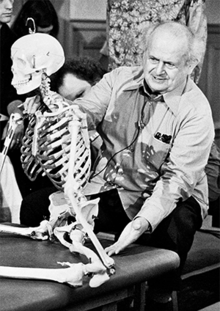
Moshe Feldenkrais (1904-1984)
Awareness Through Movement, Functional Integration
Bibliography, Links, Quotes, Notes
Sunday, March 15, 2026
Feldenkrais Techniques
I have taken 9 Feldenkrais' introductory 90 minute group classes from a local Feldenkrais practitioner, Christine Toscano. I also practice this method alone at home. I have also read a number of books on the subject.
Mrs. Toscano recommended we read Chapter 5 of the book by Norman Doidge, M.D., "The Brain's Way of Healing: Remarkable Discoveries and Recoveries from the Frontiers of Neuroplasticity," (Penguin Books, 2016). The chapter covers the life and work of Moshe Feldenkrais (1904-1984). He was a Ph.D. engineer, kudo master, movement therapist, author, and healer. The chapter discusses some of the core principles of his theory and methods as follows:
"1. The mind programs the functioning of the brain.
2. A brain cannot think without motor function.
3. Awareness of movement is the key to improving movement.
4. Differentiation: making the smallest possible sensory distinctions between movements - builds brain maps.
5. Differentiation is easiest to make when the stimulus is smallest.
6. Slowness of movement is the key to awareness, and awareness is the key to learning.
7. Reduce the effort whenever possible. Relax.
8. Errors are essential, and there is no right way to move, only better.
9. Random movements provide variation that leads to developmental breakthroughs.
10. Even the smallest movement in one part of the body involves the entire body.
11. Many movement problems, and the pain that goes with them, are caused by learned habit, not by abnormal structure."
Awareness Through Movement. Easy-To-Do Health Exercises to Improve Your Posture, Vision, Imagination and Personal Awareness. By Moshe Feldenkrais. HarperOne, Reprint edition, 2009. 192 pages. ISBN: 978-0062503220. VSCL.
Awareness Heals: The Feldenkrais Method for Dynamic Health. By Stephen Shafarman. Da Capo Lifelong Books, 1997. 224 pages. ISBN: 978-0201694697. VSCL.
The Brain's Way of Healing: Remarkable Discoveries and Recoveries from the Frontiers of Neuroplasticity. By Norman Doidge, M.D.. Penguin Books, 2016.
Change Your Age: Using Your Body and Brain to Feel Younger, Stronger, and More Fit. By Frank Wildman, Ph.D.. Da Capo Lifelong Books, 2010. 240 pages. ISBN: 978-0738213637. VSCL.
Embodied Wisdom: The Collected Papers of Moshe Feldenkrais. Edited by Elizabeth Beringer. Foreword by David Zemach-Bersin. North Atlantic Books, 1st Edition, 2010. 256 pages. ISBN: 978-1556439063. VSCL.
Sunday, February 04, 2024
Dancing with the Dao
The Fireplace Records, Chapter 45
Dancing with the Dao
In a short lecture by Alan Watts, titled "Walking on the Wheel," he contrasts those who favor listening to music with those who favor dancing to music. Both are enjoyable, beneficial, pleasurable, and healthy.
Some Christians and Platonic disciplinarians are disdainful of music, dancing, plays, jokes, games of chance, literature, etc. They contend that such arts corrupt the soul, lead one into vice, overindulge the senses, are sinful, encourage laziness, and take us away from the contemplation of the Divine. Secular pleasures are rejected, puritan attitudes prevail, and contempt for worldly pastimes are demanded.
My wife told me her Church of Christ fundamentalist parents would not allow any Christmas celebrations, not allow her to go to movies or dances, favored only church hymns, would not allow any musical instruments in church services, and condemned secular cultural pastimes. Probably, Islamic parents do the same these days.
Most people ignore the ascetic and disciplinary path to salvation and to the magical after-life. They enjoy both listening to music, playing music, and dancing to a variety of musical types.
A person with a more passive, quiet, contemplative nature enjoys relaxing and listening to music. They settle into stillness and auditory indulgence. These folks also might favor silent still meditation, standing meditation, yin yoga, and Qi Gong practices.
I enjoy dancing, tai chi chuan, and walking while listening to music. I enjoy playing the harmonica. Doing and making with my body-mind has provided me with a lifetime of pleasures and enjoyment.
Comments, Sources, Observations, Koans, Poems, Quips:
Dance, laugh, sing, and smile your way to vibrant health.
The Dao enjoys Dancing.
636 Riddles, Jokes, Witticisms, Humor
Refer to my Cloud Hands Blog Posts on the topic of Koans/Stories.
Subject Index to 1,975 Zen Buddhist Koans
Zen Buddhist Koans: Indexes, Bibliography, Commentary, Information
Pulling Onions Over 1,043 One-line Sayings, Quips, Maxims, Humor
Chinese Chan Buddhist and Taoist Stories and Koans
The Fireplace Records (Blog Version) By Michael P. Garofalo
Tuesday, November 28, 2023
Yang Taijiquan Long Form Third Section
For Tai Chi Chuan players: I often take a section of a long Taijiquan form and restudy and carefully practice only that section many times. I look up that section in books to learn more from master teachers. I also use instructional DVDs and UTube for sectional reviews. Smaller bites assists with better chewing and digestion.
I use the fine books by Fu Zhongwen, Li Deyin, T.T. Liang/Stuart Olson, and Gordon Muir for review. All have photographs or line illustrations of the movements and much commentary.
Here are some UTube demonstrations of the Third Section (Movements 56-108) of the Traditional Long Form of Yang Style Tai Chi Chuan:
In 2023, my Daily Body-Mind-Spirit Practices include:
Yang Style Taijiquan - Traditional 108 Movements T'ai Chi Ch'uan Long Form
Standard Simplified Yang Style Taijiquan 24 Movements Short Form
Eight Immortals Cane Routine #1, Yang Style
Wudang Qigong , Warmups, Exercises, Ideals, Meditation
Daoism: Principles and Practices
Third Section, Movements 55-108, List of Movements
Third Section List , Movements 55-108, Yang Long Form 108
Provides a list with the number of the movement and the name of movement. In the PDF format (print only), 1 page, 26Kb.
Third Section List, Part I, Movements 56 - 82, Yang Long Form 108
Provides a list with the number of the movement, the direction one is facing at the end of that movement, the name of the movement, and a brief description or notes about the movement. In the PDF format (print only), 1 page, 65Kb. In the HTML format provided below in this document.
Third Section List, Part II, Movements 83 - 108, Yang Long Form 108.
Provides a list with the number of the movement, the direction one is facing at the end of that movement, the name of the movement, and a brief description or notes about the movement. In the PDF format (print only), 1 page, 63Kb. In the HTML format provided below in this document.
Wednesday, October 11, 2023
The Benefits of Qigong Exercises for Older Persons
Gentle Exercise, Breathing, and Meditation
Scientific Research Many Reports on the Effect of Qigong on Improving the Health of the Elderly
Aging Well
"Qigong can do wonders to rejuvenate the elderly. In fact, more than 50 percent of the people who begin tai chi and qigong in China do so after the age of 60, when the realities of aging can no longer be pushed aside. Already, hundreds of millions of people over the age of 60 have found qigong to be uniquely effective."
- Bruce Frantzis, Qigong for Seniors
Anti-Aging Benefits of Qigong by Kenneth Sancier, Ph.D.
Qigong for the Elderly
"This report shows that regular qigong practice could relieve depression, improve self-efficacy and personal well being among elderly persons with chronic physical illness and depression"
- Effect of a Qigong Program on Elderly Persons with Depression, International Journal of Geriatric Psychiatry.
Qigong (Chi Kung): Styles,Bibliographies, Research, Resources, Links, Lessons, Benefits, Quotations. Website by Mike Garofalo.
A review of clinical trials of t’ai chi and qigong in older adults reported in the March 2009 issue of the Western Journal of Nursing Research notes that qigong improves physical functioning, limits fall risk, alleviates symptoms of depression and anxiety, and lowers blood pressure in older adults.
"Why Every Elderly Citizen Should Do Qigong: Qigong can treat many diseases. Qigong can prevent many diseases. Qigong can extend life. Qigong can improve the quality of life. Qigong can prevent accidents."
"According to T'ai Chi and Qigong enthusiasts, the discipline can prevent many ailments, including high blood pressure, tuberculosis, and diabetes, and US scientists agree that T'ai Chi can offer some important fitness benefits, particularly for older adults."
- Modern Maturity, V. 35 June/July 92 p. 60-62
Qigong (Chi Kung): Recommended Reading, Bibliography, Resources, Links, Quotations. Research by Mike Garofalo, Qigong Instructor
"The average person uses only five to ten percent of his or her 15 billion brain cells; yet studies show that Qi Gong activates 90 percent of the human brain by suffusing it with stimulating bioelectric currents. This results in significant memory improvement, learning, and enhancement of the physiological functions controlled by the brain. Studies also show that practicing Qi Gong increases the level of essential neurotransmitters in the blood. Deficiency of these elements can cause Parkinsons, Alzheimer’s, chronic depression, and insomnia."
- Lee Holden
According to the February 2009 issue of The Journal of Nursing, “evidence-based research supports the argument that qigong improves cardiovascular-respiratory function and lipid profile, decreases blood sugar, and relieves anxiety and depression.”
An Evidence-Based Review of Qi Gong by the Natural Standard Research Collaboration, 2010
The Healing Promise of Qi: Creating Extraordinary Wellness Through Qigong and Tai Chi. By Roger Jahnke, O.M.D.. Chicago, Contemporary Books, 2002. Index, notes, extensive recommended reading list, 316 pages. ISBN: 0809295288. VSCL.
The Way of Qigong: The Art and Science of Chinese Energy Healing. By Kenneth S. Cohen. Foreword by Larry Dossey. New York Ballantine Books, 1997. Index, notes, appendices, 427 pages. ISBN: 0345421094. One of my favorite books: comprehensive, informative, practical, and scientific. VSCL.
Wednesday, June 21, 2023
Rooting, Sinking, Connecting and Centering in Taijiquan
Maintain an upright posture, head lifted, chin tucked, back straight;
Keep the head, torso, and hips in a relatively straight "plumb" line;
Draw energy (Qi) up from the earth (Di 地) and allow energy to flow down into the earth through the "bubbling well" point on the bottom of the front pad of your foot (the Yong Quan acupoint KI-1);
Sink the body weight through the legs and feet into the Earth;
Stay balanced and relaxed (sung) while moving gracefully;
Keep the kneecaps over the center of the foot in settled positions;
Imagine roots branching out and down 3 feet or more into the earth from the "bubbling well" point on your foot with roots that are deep, strong, and flexible;
Develop an improved proprioceptive awareness of the skills needed for the specific activity;
Maintain a steady feeling state of being centered, stable, fixed, and strong in your position;
Resist pushes from others by sinking into the Earth and holding a fixed, strong, stable, and settled stance and footwork;
When pushing others use the earth, your feet, and your legs to generate leverage and power;
Connect with the Earth, relate to Earth energies, integrate with the Powers of the Earth, feel the Earth's Forces;
Keep a calm, grounded, relaxed, and centered mind;
Don't be so stiff and locked you cannot move with some fluidity and grace in response to situations and others;
Align the postures with the path of least resistance (wu wei) in the body;
Rooting is a feeling state and sensation-motor skill and less an intellectual concept;
Maintain postures and footwork while moving that prevent you from loosing balance, slipping, or falling;
Breathe easily, deeply, and effortlessly through the nose;
Be aware of one's footing, i.e., uneven surfaces, slippery or wet surfaces, poorly fitting or inappropriate shoes, hazards, etc.;
Avoid practicing when ill, uneasy, rushed or upset;
Maintain one's central equilibrium (Zhongding) in the postures and movements.
The characteristic manifestations, aspects, and qualities of "Central Equilibrium" (Zhongding ä¸å®š) in Taijiquan and Qigong to be cultivated through body-mind-spirit practices are as follows:
Maintain an upright posture, head lifted, chin tucked, back straight;
Keep the head, torso, and hips in a relatively straight "plumb" line;
Maintain dynamic stability, be stabilized within, be centered, be settled;
Develop an improved proprioceptive awareness of the skills needed for the specific activity;
Be calm, still and settled in one's mind and emotions;
Allow one's body to sink and settle into the ground;
Keep the kneecaps over the center of the foot in settled positions;
Direct bodily energy (Qi, Chi) downward into the earth;
Relax (Sung), loosen, untense, and unlock the joints of the body;
Avoid wobbling, getting out of balance, or straining.
Rooting and Centering. By Mike Garofalo.
T'ai Chi Chuan
Qigong
"In all qigong practice it is very important to be rooted. Being rooted means to be stable and in firm contact with the ground. If you want to push a car you have to be rooted; the force you exert into the car needs to be balanced by the force into the ground. If you are not rooted, when you push the car you will only push yourself away and not move the car. Your root is made up of your body's sinking, centering, and balance.
Before you can develop your root, you must first relax and let your body "settle." As you relax, the tension in the various parts of your body will dissolve, and you will find a comfortable way to stand. You will stop fighting the ground to keep your body up and will learn to rely on your body's structure to support itself. This lets the muscles relax even more. Since your body isn't struggling to stand up, your yi won't be pushing upward, and your body, mind, and qi will all be able to sink. If you let dirty water sit quietly, the impurities will gradually settle to the bottom, leaving the water above it clear. In the same way, if you relax your body enough to let it settle, your qi will sink to your dan tian and the bubbling wells (yongquan, K-1, 湧泉) in your feet and your mind will become clear. Then you can begin to develop your root.
To root your body you must imitate a tree and grow an invisible root under your feet. This will give you a firm root to keep you stable in your training. Your root must be wide as well as deep. Naturally, your yi must grow first because it is the yi that leads the qi. Your yi must be able to lead the qi to your feet and be able to communicate with the ground. Only when your yi can communicate with the ground will your qi be able to grow beyond your feet and enter the ground to build the root. The bubbling well cavity is the gate that enables your qi to communicate with the ground.
After you have gained your root, you must learn how to keep your center. A stable center will make your qi develop evenly and uniformly. If you lose this center, your qi will not be led evenly. In order to keep your body centered, you must first center your yi and then match your body to it. Only under these conditions will the qigong forms you practice have their root. Your mental and physical centers are the keys that enable you to lead your qi beyond your body.
Balance is the product of rooting and centering. Balance includes balancing the qi and the physical body. It does not matter which aspect of balance you are dealing with; first, you must balance your yi, and only then can you balance your qi and your physical body."
- Grandmaster Yang, Jwing-Ming
Monday, July 04, 2022
Slowing Down for Enjoyment
"The movements of Qigong exercise should be slow instead of fast because slow movements will nourish qi and combine the posture with qi. The training practice of Qigong should start with Wuji with slow movement until the closing of the training. Every movement and step must be done slowly, opening and spreading of the body be slow, closing and sinking of the body be slow, and rising and falling of the body be slow. With slow movements, one can keep thinking whether the upper, lower, left and right of the body are followed, and whether the interior and exterior are coordinated. With the slow and gentle movements and posture, the internal qi is conducted to flow slowly in the body to integrate mindwill with qi, vitality with posture, and enter the realm of forgetting the substance and me."
- Master Wang Fengming, Special Taoist Taji Stick and Ruler Qigong, p. 115.The Zen master Ling Chi said that the miracle is not to walk on burning charcoal or in the thin air or on the water; the miracle is just to walk on earth. You breathe in. You become aware of the fact that you are alive. You are still alive and you are walking on this beautiful planet. That is already performing a miracle. The greatest of all miracles is to be alive. We have to awaken ourselves to the truth that we are here, alive. We are here making steps on this beautiful planet. This is already performing a miracle. But we have to be here in order for the miracle to be possible. We have to bring ourselves back to the here and the now."
- Thich Nhat Hanh, Resting in the River
Walking Meditation: Quotes, Bibliography, Links, Information, Methods
Compiled by Mike Garofalo.
"Walking meditation is walking in full awareness of breath, body and everything the senses present. It is not an aerobic exercise - though it would be a fine lead-in to aerobic walking. Rather, walking meditation is done slowly and consciously, with each step fully feeling the earth. During this precious time, body and mind come together, joined in the present moment. Although the benefits of walking meditation will deepen over time, even from the start, you can experience some measure of the relaxation, balance and quiet energy that builds through this practice."
- Ginny Whitelaw, Body Learning, p. 55.
Saturday, April 10, 2021
Walking in Circles Around Body and Mind
"As for walking around stupas, the stupa is your body and mind. When your awareness circles your body and mind without stopping, this is called walking around a stupa. The sages of long ago followed this path to nirvana. But people today don't understand what this means. Instead of looking inside they insist on looking outside. They use their material bodies to walk around material stupas. And they keep at it day and night, wearing themselves out in vain and coming no closer to their real self."
- Bodhidharma, 515 CE
The Zen Teaching of Bodhidharma, p. 101. Translated and with an Introduction by Red Pine.
One of many stories told about Bodhidharma, the first Zen Patriarch in China and the legendary founder of Shaolin qigong and gungfu, is that he spent seven years in seated meditation while facing a stone wall. Talk about wearing yourself out in vain!
The only thing that would "wear out" while walking around a stupa, or a mountain, or a bagua circle, or a lake, or a soccer field would be one's shoes. Thankfully, the Bodhidharma finally Woke Up after his seven years of staring at a blank wall, and resolved that all Shaolin monks thereafter would be required to exercise, garden, and move about much more.
Walking the Circle: Ba Gua Zhan
Saturday, December 28, 2019
Movement and Awareness
1. The nervous system is occupied mainly with movement.
2. It is easier to distinguish the quality of movement.
3. We have a richer experience of movement.
4. The ability to move is important to self-value.
5. All muscular activity is movement.
6. Movements reflect the state of the nervous system.
7. Movement is the basis of awareness.
8. Breathing is movement.
9. Hinges of habit."
- Moshe Feldenkrais, Awareness Through Movement, pp. 33-39, 1972
Notes on Feldenkrais Methods
Saturday, November 23, 2019
Body Moving, Mind Moving
- Mark Johnson, The Body in the Mind, 1987, xix
“The human body is the best picture of the human soul.”
- Ludwig Wittgenstein, Philosophical Investigations
"It was a great thing to be a human being. It was something tremendous. Suddenly I'm conscious of a million sensations buzzing in me like bees in a hive. Gentlemen, it was a great thing."
- Karel Capek
- Richard Shusterman
Somaesthetic Practices for Health, Well-Being and Mindfulness
A Good Life
The Five Senses
Wednesday, June 13, 2018
Moving Towards Self-Improvement
"Correction of movements is the best means of self-improvement:
1. The nervous system is occupied mainly with movement.
2. It is easier to distinguish the quality of movement.
3. We have a richer experience of movement.
4. The ability to move is important to self-value.
5. All muscular activity is movement.
6. Movements reflect the state of the nervous system.
7. Movement is the basis of awareness.
8. Breathing is movement.
9. Hinges of habit."
- Moshe Feldenkrais, Awareness Through Movement, pp. 33-39, 1972
Notes on Feldenkrais Methods
Wednesday, March 28, 2018
Trying New Movements
– Emilie Conrad
"Old age, for instance, begins with the self-imposed restriction on forming new body patterns. First, one selects attitudes and postures to fit an assumed dignity and so rejects certain actions, such as sitting on the floor or jumping, which then soon become impossible to perform. The resumption and reintegration of even these simple actions has a marked rejuvenating effect not only of the mechanics of the body but also on the personality as a whole."
- Moshe Feldnekrais, Embodied Wisdom, p. 31
Body-Mind Practices: Quotes, Bibliography, Links
Wednesday, November 08, 2017
Awareness Through Movement
We have found a local Feldenkrais practitioner, Christine Toscano, that we both will visit for lessons starting in November. Ms. Toscano also had a career as a licensed acupuncturist.
Ms. Toscano recommended we read Chapter 5 of the book by Norman Doidge, M.D., "The Brain's Way of Healing: Remarkable Discoveries and Recoveries from the Frontiers of Neuroplasticity," (Penguin Books, 2016). The chapter covers the life and work of Moshe Feldenkrais (1904-1984). He was a engineer, kudo master, movement therapist, and healer. The chapter discusses some of the core principles of his theory and methods as follows:
"1. The mind programs the functioning of the brain.
2. A brain cannot think without motor function.
3. Awareness of movement is the key to improving movement.
4. Differentiation: making the smallest possible sensory distinctions between movements - builds brain maps.
5. Differentiation is easiest to make when the stimulus is smallest.
6. Slowness of movement is the key to awareness, and awareness is the key to learning.
7. Reduce the effort whenever possible. Relax.
8. Errors are essential, and there is no right way to move, only better.
9. Random movements provide variation that leads to developmental breakthroughs.
10. Even the smallest movement in one part of the body involves the entire body.
11. Many movement problems, and the pain that goes with them, are caused by learned habit, not by abnormal structure."
Awareness Through Movement by Moshe Feldenkrais
Change Your Age by Frank Wildman
Thursday, August 20, 2015
Sitting Still
- Erich Schiffmann, Yoga: The Spirit and Practice of Moving Into Stillness, 1996, p. 7.
"Sit quietly
focus and forget
rest with the great achievement.
The ancient child asks
"what is the great achievement?"
It is beyond description in any language
it can only be felt intuitively
it can only be expressed intuitively.
Engage a loose, alert, and aware
body, mind, and sound
then look into the formless
and perceive no thing.
See yourself as a sphere
small at first
growing to encompass
the vastness of infinite space.
Sit quietly
focus and forget then
in a state of ease and rest
secure the truth of the great achievement.
Employing the truth will not exhaust its power
when it seems exhausted it is really abundant
and while human art will die at the hands of utility
the great achievement is beyond being useful.
Great straightness is curved and crooked
great intelligence is raw and silly
great words are simple and naturally awkward.
Engaged movement drives out the frozen cold
mindful stillness subdues the frenzied heart.
Sit quietly
focusing
forgetting
summon order from the void
that guides the ordering of the universe."
- Tao Te Ching, Chapter 45, Translated by John Bright-Fey, 2006
- Gregory Bateson, Angels Fear
"You are sitting on the earth and you realize that this earth deserves you and you deserve this earth. You are there - fully, personally, genuinely."
- Chogyam Trungpa
Teach us to sit still."
- T.S. Eliot
Ripening Peaches: Taoist Studies and Practices
Standing Meditation
Quiet in the Garden
Sitting in the Garden
HOWEVER,
"If you cannot find stillness while sitting still, then find stillness while gardening."
- Mike Garofalo, Pulling Onions
... or walking, doing Taijiquan, or reading ...
Monday, November 26, 2012
Movement with Attention
- Anat Baniel, Move into Life: The Nine Essentials for Lifelong Vitality
Move into Life: The Nine Essentials for Lifelong Vitality
"1. Moving with Attention, Wake Up to Life, Mindful Movements
2. The Learning Switch, Bring in the New, Lifelong learning, Retraining
3. Subtlety, Experience the Power of Gentleness
4. Variation, Enjoy Abundant Possibilities
5. Taking Your Time, Slowing Down, Not Rushing, Luxuriate in the Richness of Feeling
6. Enthusiasm, Turn the Small into the Great
7. Flexible Goals, Make the Impossible Possible
8. Imagination and Dreams, Create Your Life
9. Awareness, Cultivating Mindfulness, Thrive with True Knowledge"
- Anat Baniel, Move into Life: The Nine Essentials for Lifelong Vitality