Showing posts with label 24 Form. Show all posts

Tuesday, May 12, 2026

Yang Style Tai Chi Chuan Training Principles

"1.) Head upright to let the shen [spirit of vitality] rise to the top of the head. Don't use li [external strength], or the neck will be stiff and the ch'i [vital life energy] and blood cannot flow through. It is necessary to have a natural and lively feeling. If the spirit cannot reach the headtop, it cannot raise.

2.) Sink the chest and pluck up the back. The chest is depressed naturally inward so that the ch'i can sink to the tan-t'ien [field of elixir]. Don't expand the chest: the ch'i gets stuck there and the body becomes top-heavy. The heel will be too light and can be uprooted. Pluck up the back and the ch'i sticks to the back; depress the chest and you can pluck up the back. Then you can discharge force through the spine. You will be a peerless boxer.

3.) Sung [Relax] the waist. The waist is the commander of the whole body. If you can sung the waist, then the two legs will have power and the lower part will be firm and stable. Substantial and insubstantial change, and this is based on the turning of the waist. It is said "the source of the postures lies in the waist. If you cannot get power, seek the defect in the legs and waist."

4.) Differentiate between insubstantial and substantial. This is the first principle in T'ai Chi Ch'uan. If the weight of the whole body is resting on the right leg, then the right leg is substantial and the left leg is insubstantial, and vice versa. When you can separate substantial and insubstantial, you can turn lightly without using strength. If you cannot separate, the step is heavy and slow. The stance is not firm and can be easily thrown of balance.

5.) Sink the shoulders and drop the elbows. The shoulders will be completely relaxed and open. If you cannot relax and sink, the two shoulders will be raised up and tense. The ch'i will follow them up and the whole body cannot get power. "Drop the elbows" means the elbows go down and relax. If the elbows raise, the shoulders are not able to sink and you cannot discharge people far. The discharge will then be close to the broken force of the external schools.

6.) Use the mind instead of force. The T'ai Chi Ch'uan Classics say, "all of this means use I [mind-intent] and not li." In practicing T'ai Chi Ch'uan the whole body relaxes. Don't let one ounce of force remain in the blood vessels, bones, and ligaments to tie yourself up. Then you can be agile and able to change. You will be able to turn freely and easily. Doubting this, how can you increase your power?

The body has meridians like the ground has ditches and trenches. If not obstructed the water can flow. If the meridian is not closed, the ch'i goes through. If the whole body has hard force and it fills up the meridians, the ch'i and the blood stop and the turning is not smooth and agile. Just pull one hair and the whole body is off-balance. If you use I, and not li, then the I goes to a place in the body and the ch'i follows it. The ch'i and the blood circulate. If you do this every day and never stop, after a long time you will have nei chin [real internal strength]. 

The T'ai Chi Ch'uan Classics say, "when you are extremely soft, you become extremely hard and strong." Someone who has extremely good T'ai Chi Ch'uan kung fu has arms like iron wrapped with cotton and the weight is very heavy. As for the external schools, when they use li, they reveal li. When they don't use li, they are too light and floating. There chin is external and locked together. The li of the external schools is easily led and moved, and not too be esteemed.

7.) Coordinate the upper and lower parts of the body. The T'ai Chi Ch'uan Classics say "the motion should be rooted in the feet, released through the legs, controlled by the waist and manifested through the fingers." Everything acts simultaneously. When the hand, waist and foot move together, the eyes follow. If one part doesn't follow, the whole body is disordered.

8.) Harmonize the internal and external. In the practice of T'ai Chi Ch'uan the main thing is the shen. Therefore it is said "the spirit is the commander and the body is subordinate." If you can raise the spirit, then the movements will naturally be agile. The postures are not beyond insubstantial and substantial, opening and closing. That which is called open means not only the hands and feet are open, but the mind is also open. That which is called closed means not only the hands and feet are closed, but the mind is also closed. When you can make the inside and outside become one, then it becomes complete.

9.) Move with continuity. As to the external schools, their chin is the Latter Heaven brute chin. Therefore it is finite. There are connections and breaks. During the breaks the old force is exhausted and the new force has not yet been born. At these moments it is very easy for others to take advantage. T'ai Chi Ch'uan uses I and not li. From beginning to end it is continuous and not broken. It is circular and again resumes. It revolves and has no limits. The original Classics say it is "like a great river rolling on unceasingly." and that the circulation of the chin is "drawing silk from a cocoon " They all talk about being connected together.

10.) Move with tranquility [Seek stillness in movement]. The external schools assume jumping about is good and they use all their energy. That is why after practice everyone pants. T'ai Chi Ch'uan uses stillness to control movement. Although one moves, there is also stillness. Therefore in practicing the form, slower is better. If it is slow, the inhalation and exhalation are long and deep and the ch'i sinks to the tan-t'ien. Naturally there is no injurious practice such as engorgement of the blood vessels. The learner should be careful to comprehend it. Then you will get the real meaning."

-  By Yang Cheng-fu (1883 - 1936) as researched by Lee N. Scheele


 T'ai Chi Ch'uan Bibliography

Yang Style Taijiquan

Mastering Yang Style Taijiquan  By Fu Zhongwen.  Translated by Louis Swaim.  Berkeley, California, Blue Snake Books, c 1999, 2006.  Bibliography, glossary, 226 pages.  ISBN: 9781583941522.  VSCL.  Fu Zongwen (1919-1994) was a student of Yang Cheng Fu.  Translations of many Tai Chi classics are included.  A list of 85 movements are provided.  251 movement analysis illustrations.  Over 76 of the illustrations are traced and drawn from photographs of Yang Chengfu.  Detailed descriptions of the long form, pp. 26-162.  Push hands information.  Yang Tai Chi essentials.


Master Cheng's Thirteen Chapters On Tai Chi Ch'uan. By Cheng Man-ch'ing. Translated by Douglas Wile. 101 pages. Sweet Chi Press, 1982. 101 pages. ISBN: 978-0912059006. Originally written in Chinese in 1949. VSCL.


The Essence and Applications of Taijiquan. By Yang, Chengfu (1883-1936). Translated by Louis Swaim. The original publication date was in 1934. The original book was edited by Professor Cheng Man-Chi'ng. Berkeley, California, North Atlantic Books, 2005. Introduction, appendices, bibliography, 124 pages. ISBN: 1556435452. In this book, the entire sequence of the specialized and named martial movements/postures/sections/forms is numbered from Section 1 up to Section 94; thus, the popular long taijiquan from, the Yang 94 Form. VSCL.


Monday, January 26, 2026

Yang Style of Tai Chi Chuan, Standard 24 Form

My webpage on the Standard 24 Taijiquan Form has been a very popular webpage on the Cloud Hands Tai Chi Chuan Website since 2001.  In the sidebar of this blog, you will find a quick index to this webpage.   

Standard Simplified Taijiquan 24 Form. Research by Michael P. Garofalo, M.S. This webpage includes a detailed bibliography of books, media, links, online videos, articles, and resources. It provides a list of the 24 movement names in English, Chinese, French, German and Spanish, with citations for sources of the movement names. It provides detailed descriptions of each movement with black and white line illustrations and photographs. It includes relevant quotations, notes, performance times, section breakdowns, basic Tai Chi principles, and strategies for learning the form. This hypertext document was last last updated in December of 2017.  


The Peking (Bejing) Chinese National orthodox standard simplified 24 movement T'ai Chi Ch'uan form, created in 1956, is the most popular form practiced all around the world. This form uses the Yang Style of Taijiquan.  

There is also a famous short Tai Chi Chuan form, created by Professor Cheng Man-ch'ing in the 1940's.  It has 37 movements in the Yang Style of Taijiquan.

My 24 Form webpage provides many good suggestions for a person learning this basic Tai Chi Chuan Form of 24 movements on their own if there is no Tai Chi class in their area.


I started learning Taijiquan in 1986.  I was taught the Standard 24 Movement T'ai Chi Ch'uan Form in the Yang Style of T'ai Chi Ch'uan.  I learned it from Aikido Sensei Frank McGourick in Whittier, California.  


In 1986, were no books or instructional videotapes on this popular form.  In 2019, there are dozens of books and instructional DVDs, videotapes, UTube demonstrations by women and men, streaming content, and scores of webpages on the subject of the 24 Taijiquan Form.  


Sensei McGourick also taught me the standard Long Form of the Yang Style of Tai Chi Chuan.  You hit the floor a lot in Aikido, it is vigorous, and it is very challenging for anyone, and it was too hard for me.  So, being a man in his 40's, and working 50 hours a week as a library administrator of 22 libraries in the busy and growing San Gabriel Valley, I practiced only Taijiquan and Qigong at the Aikido Ai Dojo in Whittier with Dr. Robert Moore and Sensei McGourick.

The most detailed book that I have seen on the subject of the 24 Form is:
The Yang Taiji 24 Step Short Form: A Step by Step Guide for All Levels
By James Drewe.  London, Singing Dragon Press, 2011.  382 pages, black and white photographs, charts, detailed descriptions, training tips.


I give information on many other fine books by other good authors on the Basic 24 Tai Chi Chuan Form in my webpage.  Find books by Andrew Townsend, Cheng Zhao, Foen Tjoeng Lie, Eric Chaline, Le Deyin, etc.

Many persons have told me that their favorite instructional DVD on the 24 Form is: Tai Chi - The 24 Forms  By Dr. Paul Lam.  
I attended Dr. Lam's Tai Chi for Arthritis workshop in Monterey, California; and  later workshops on Sun Tai Chi with other Bay Area teachers.  I am also quite fond of using instructional DVDs by Master Jessie Tsao from San Diego.  


I have played and practiced this form with many different persons and groups over three decades.  The many slight variations are fun to play and observe.  Taijiquan is a very pleasant and satisfying group exercise, dance, marital arts, and choreographed body-mind movements class.  Taijiquan and Qigong provide an excellent fitness class for seniors to help them with aging well.  I have practiced this Basic 24 Form with different groups in the Vancouver and Portland areas, and for many years around Red Bluff, CA.  

At age 79, I can do quite a few repetitions of the form during any day.  I warm up with Qigong and limbering up movements, if needed, before practicing the 24 Form.  I make adjustments necessitated because of my former injuries, falls, surgeries, and decreasing balance skills.  I like to play with the named movement sequences in ways outside of the 24 form choreography, e.g., HsingI type forward drills using Yang postures, changing directions to accommodate indoor practice near furniture, faster movements with intermittent fajing, etc.  I also think about the martial applications of defense or offense, following the Teacher and group members so to achieve a coordinated beauty in the performance style desired, the courtesies and comradeship of the practice team, Taijiquan principles, etc. 

I try my best to try to learn, and relearn, and unlearn.   


"At this period of wushu, the Nanking Central Kuoshu Institute in 1956 tasked the choreography of a Taijiquan routine what would be more suitable for popular dissemination among the masses, in keeping with the government's egalitarian agenda.  The traditional forms were just too long and time consuming to practice, and the traditional methods too arcane and demanding for mass propagation.  The challenge was to reduce the one hundred-odd movements of the traditional Yang Style Taijiquan, prevalent then, to its core, by removing the many repetitive movements as well as the less essential ones.  Thus, the 24-Form Taijiquan set was created.  Instrumental in this simplification effort was Li Tianji (1913-1996) who had been appointed a wushu research fellow at the Institute.  Under official auspices, the 24-Form Taijiquan quickly became the standard form, taught throughout China as part of physical education curriculum in schools and colleges.  It is perhaps the best know Taijiquan form in the world today.  As widespread as it is, the 24-Form is at best an abridged version of the traditional Yang form, a synopsis of the art."
-  C. P. Ong, Taijiquan: Cultivating Inner Strength, 2013, p. 7.  


Lift the head, stand strong and balanced, move gracefully.
Imagine resistance, water boxing, dealing with an opponent, pushing hands.

Be loose and relaxed, avoid over-exertion, use coiling energy.
Keep moving, flowing, shaping yourself in body-mind.
Shoulders down, gentle breathing, dignified bearing.
Stylish, artistic, beautiful, sensuous, dancing, formal.
Yin more than Yang, soft over hard, water over stone, gentle over muscular.
Follow the Teacher, coordinate, create unity, act as one. 


Monday, February 19, 2018

Taijiquan 24 Form


"At this period of wushu, the Nanking Central Kuoshu Institute in 1956 tasked the choreography of a Taijiquan routine what would be more suitable for popular dissemination among the masses, in keeping with the government's egalitarian agenda.  The traditional forms were just too long and time consuming to practice, and the traditional methods too arcane and demanding for mass propagation.  The challenge was to reduce the one hundred-odd movements of the traditional Yang Style Taijiquan, prevalent then, to its core, by removing the many repetitive movements as well as the less essential ones.  Thus, the 24-Form Taijiquan set was created.  Instrumental in this simplification effort was Li Tianji (1913-1996) who had been appointed a wushu research fellow at the Institute.  Under official auspices, the 24-Form Taijiquan quickly became the standard form, taught throughout China as part of physical education curriculum in schools and colleges.  It is perhaps the best know Taijiquan form in the world today.  As widespread as it is, the 24-Form is at best an abridged version of the traditional Yang form, a synopsis of the art."
-  C. P. Ong, Taijiquan: Cultivating Inner Strength, 2013, p. 7.  


I practice this Taijiquan form twice every day.  It takes from 5 to 7 minutes to perform.

You can do this indoors by adjusting to the space available, or outdoors.  When done slowly and gently you don't need to do any warmup exercises unless your knees are problematic.  A lovely Taijiquan form!  Good for persons of all ages.  This form is a cornerstone of my personal T'ai Chi Ch'uan practices. 

The first Taijiquan form I learned in 1986 was the Standard 24 Movement T'ai Chi Ch'uan Form in the Yang Style of T'ai Chi Ch'uan.  At that time there were no books or instructional videotapes on this popular form.  Since that time, nearly 31 years have past.  Now there are dozens of books and instructional DVDs and webpages on the subject of the 24 Form. 


My webpage on the Standard 24 Taijiquan Form has been the most popular webpage on the Cloud Hands Website for many years. In the sidebar of this blog, you will find a quick index to this webpage.


Standard Simplified Taijiquan 24 Form.  Research by Michael P. Garofalo, M.S. This webpage includes a detailed bibliography of books, media, links, online videos, articles, and resources.  It provides a list of the 24 movement names in English, Chinese, French, German and Spanish, with citations for sources of the movement names.  It provides detailed descriptions of each movement with black and white line illustrations and  photographs.  It includes relevant quotations, notes, performance times, section breakdowns, basic Tai Chi principles, and strategies for learning the form.  The Peking (Bejing) Chinese National orthodox standard simplified 24 movement T'ai Chi Ch'uan form, created in 1956, is the most popular form practiced all around the world.  This form uses the Yang Style of Taijiquan.  Published by Green Way Research, Valley Spirit Taijiquan, Red Bluff, California:  Webpage URL:  http://www.egreenway.com/taichichuan/short.htm.  

This webpage provides many good suggestions for a person learning this form on their own if there is no Tai Chi class in their area. 

The best book that I have seen on the subject is:

The Yang Taiji 24 Step Short Form: A Step by Step Guide for All Levels
By James Drewe
London, Singing Dragon Press, 2011.
382 pages, black and white photographs, charts, detailed descriptions, training tips.


I give information on many other fine books by other good authors on the 24 Form in my webpage: Cheng Zhao, Foen Tjoeng Lie, Eric Chaline, Le Deyin, etc.. 

My students tell me that their favorite instructional DVD on the 24 Form is:

Tai Chi - The 24 Forms
By Dr. Paul Lam


I have taught this lovely Tai Chi form to hundreds of people since 2000.  Everyone tells me how much they enjoy learning and practicing this gentle form.

Wednesday, November 01, 2017

Learning New Ways to Do a Taijiquan Form

I attend classes in Qigong and Taijiquan in Vancouver on Tuesday and Thursday morning conducted by Sifu David Fetyko.  He is teaching the 24 Taijiquan Yang form, the 19 Chen Taijiquan form, qigong sets, warmups and drills.

I learned the 24 Yang Taijiquan form in 1986, and have been practicing and teaching this popular Yang style Taijiquan form since 2000.  

Sifu Fetyko's 24 Form is beautifully done and is based on sound Taiji principles.  Sifu Fetyko is meticulous and precise in his teaching.  Each movement of the form has nuances of weighting and hand movements and angles that are slightly different in the version he teaches as compared with my habituated version.  

It is a challenge for me to pay close attention and get my body moving in new ways.  I have balance issues, so I also need to focus on this aspect of the form.  I have a lot to learn.  Some degree of clumsiness is apparent and felt internally.  Also, I need to get my knees to bend more and strengthen my legs.  

Learning requires some relearning, discarding old habits, patience, going with the flow, trusting in the teacher, enjoying the moment, and slowing down.  

Also, since I am recovering from recent surgeries to deal with my heart disease, my stamina and strength are far less than optimal.  I needed to sit and rest and observe the last 20 minutes of the last class because of fatigue.  

After three months of taking classes with Mr. Fetyko, I stopped taking his classes.  His style of teaching was far too slow for my tastes.  Too much time spent warming up, obscure explanations of Qi, expensive class costs, and too many tedious corrections of the student's form work.  Also, as you came to know Mr. Fetyko on a personal basis, your worldview and his Christian Fundamentalism and anti-intellectualism might not be compatible.  

Monday, October 23, 2017

Yang Taijiquan 24 Movement Form


"At this period of wushu, the Nanking Central Kuoshu Institute in 1956 tasked the choreography of a Taijiquan routine what would be more suitable for popular dissemination among the masses, in keeping with the government's egalitarian agenda.  The traditional forms were just too long and time consuming to practice, and the traditional methods too arcane and demanding for mass propagation.  The challenge was to reduce the one hundred-odd movements of the traditional Yang Style Taijiquan, prevalent then, to its core, by removing the many repetitive movements as well as the less essential ones.  Thus, the 24-Form Taijiquan set was created.  Instrumental in this simplification effort was Li Tianji (1913-1996) who had been appointed a wushu research fellow at the Institute.  Under official auspices, the 24-Form Taijiquan quickly became the standard form, taught throughout China as part of physical education curriculum in schools and colleges.  It is perhaps the best know Taijiquan form in the world today.  As widespread as it is, the 24-Form is at best an abridged version of the traditional Yang form, a synopsis of the art."
-  C. P. Ong, Taijiquan: Cultivating Inner Strength, 2013, p. 7.  


I practice this Taijiquan form twice every day.  It takes from 5 to 7 minutes to perform.

You can do this indoors by adjusting to the space available, or outdoors.  When done slowly and gently you don't need to do any warmup exercises unless your knees are problematic.  A lovely Taijiquan form!  Good for persons of all ages.  This form is a cornerstone of my personal T'ai Chi Ch'uan practices. 

The first Taijiquan form I learned in 1986 was the Standard 24 Movement T'ai Chi Ch'uan Form in the Yang Style of T'ai Chi Ch'uan.  At that time there were no books or instructional videotapes on this popular form.  Since that time, nearly 31 years have past.  Now there are dozens of books and instructional DVDs and webpages on the subject of the 24 Form. 


My webpage on the Standard 24 Taijiquan Form has been the most popular webpage on the Cloud Hands Website for many years. In the sidebar of this blog, you will find a quick index to this webpage.


Standard Simplified Taijiquan 24 Form.  Research by Michael P. Garofalo, M.S. This webpage includes a detailed bibliography of books, media, links, online videos, articles, and resources.  It provides a list of the 24 movement names in English, Chinese, French, German and Spanish, with citations for sources of the movement names.  It provides detailed descriptions of each movement with black and white line illustrations and  photographs.  It includes relevant quotations, notes, performance times, section breakdowns, basic Tai Chi principles, and strategies for learning the form.  The Peking (Bejing) Chinese National orthodox standard simplified 24 movement T'ai Chi Ch'uan form, created in 1956, is the most popular form practiced all around the world.  This form uses the Yang Style of Taijiquan.  Published by Green Way Research, Valley Spirit Taijiquan, Red Bluff, California:  Webpage URL:  http://www.egreenway.com/taichichuan/short.htm.  

This webpage provides many good suggestions for a person learning this form on their own if there is no Tai Chi class in their area. 

The best book that I have seen on the subject is:

The Yang Taiji 24 Step Short Form: A Step by Step Guide for All Levels
By James Drewe
London, Singing Dragon Press, 2011.
382 pages, black and white photographs, charts, detailed descriptions, training tips.
I give information on many other fine books by other good authors on the 24 Form in my webpage: Cheng Zhao,
Foen Tjoeng Lie, Eric Chaline, Le Deyin, etc.. 

My students tell me that their favorite instructional DVD on the 24 Form is:

Tai Chi - The 24 Forms
By Dr. Paul Lam


I have taught this lovely Tai Chi form to hundreds of people since 2000.  Everyone tells me how much they enjoy learning and practicing this gentle form.

I also teach and enjoy playing the
Chen Style Taijiquan 18 Movement Form created by Grandmaster Chen Zhenglei. 
 

Saturday, March 04, 2017

Tai Chi Chuan Standard Short 24 Form


"At this period of wushu, the Nanking Central Kuoshu Institute in 1956 tasked the choreography of a Taijiquan routine what would be more suitable for popular dissemination among the masses, in keeping with the government's egalitarian agenda.  The traditional forms were just too long and time consuming to practice, and the traditional methods too arcane and demanding for mass propagation.  The challenge was to reduce the one hundred-odd movements of the traditional Yang Style Taijiquan, prevalent then, to its core, by removing the many repetitive movements as well as the less essential ones.  Thus, the 24-Form Taijiquan set was created.  Instrumental in this simplification effort was Li Tianji (1913-1996) who had been appointed a wushu research fellow at the Institute.  Under official auspices, the 24-Form Taijiquan quickly became the standard form, taught throughout China as part of physical education curriculum in schools and colleges.  It is perhaps the best know Taijiquan form in the world today.  As widespread as it is, the 24-Form is at best an abridged version of the traditional Yang form, a synopsis of the art."
-  C. P. Ong, Taijiquan: Cultivating Inner Strength, 2013, p. 7.  


I practice this Taijiquan form twice every day.  It takes from 5 to 7 minutes to perform.
You can do this indoors by adjusting to the space available, or outdoors.  When done slowly and gently you don't need to do any warmup exercises unless your knees are problematic.  A lovely Taijiquan form!  Good for persons of all ages.  This form is a cornerstone of my personal T'ai Chi Ch'uan practices. 

The first Taijiquan form I learned in 1986 was the Standard 24 Movement T'ai Chi Ch'uan Form in the Yang Style of T'ai Chi Ch'uan.  At that time there were no books or instructional videotapes on this popular form.  Since that time, nearly 25 years have past.  Now there are dozens of books and instructional DVDs and webpages on the subject of the 24 Form. 


My webpage on the Standard 24 Taijiquan Form has been the most popular webpage on the Cloud Hands Website for many years. In the sidebar of this blog, you will find a quick index to this webpage.

Standard Simplified Taijiquan 24 Form.  Research by Michael P. Garofalo, M.S. This webpage includes a detailed bibliography of books, media, links, online videos, articles, and resources.  It provides a list of the 24 movement names in English, Chinese, French, German and Spanish, with citations for sources of the movement names.  It provides detailed descriptions of each movement with black and white line illustrations and  photographs.  It includes relevant quotations, notes, performance times, section breakdowns, basic Tai Chi principles, and strategies for learning the form.  The Peking (Bejing) Chinese National orthodox standard simplified 24 movement T'ai Chi Ch'uan form, created in 1956, is the most popular form practiced all around the world.  This form uses the Yang Style of Taijiquan.  Published by Green Way Research, Valley Spirit Taijiquan, Red Bluff, California:  Webpage URL:  http://www.egreenway.com/taichichuan/short.htm.  

This webpage provides many good suggestions for a person learning this form on their own if there is no Tai Chi class in their area. 

The best book that I have seen on the subject is:

The Yang Taiji 24 Step Short Form: A Step by Step Guide for All Levels
By James Drewe
London, Singing Dragon Press, 2011.
382 pages, black and white photographs, charts, detailed descriptions, training tips.
I give information on many other fine books by other good authors on the 24 Form in my webpage: Cheng Zhao,
Foen Tjoeng Lie, Eric Chaline, Le Deyin, etc.. 

My students tell me that their favorite instructional DVD on the 24 Form is:

Tai Chi - The 24 Forms
By Dr. Paul Lam


I have taught this lovely Tai Chi form to hundreds of people since 2000.  Everyone tells me how much they enjoy learning and practicing this gentle form.

I also teach and enjoy playing the
Chen Style Taijiquan 18 Movement Form created by Grandmaster Chen Zhenglei. Actually, in the last year, I prefer practicing the Chen 18 Form more. 
 

Monday, October 10, 2016

Taijiquan Standard 24 Movements Form

My webpage on the Standard 24 Taijiquan Form has been the most popular webpage on the Cloud Hands Website for many years. In the sidebar of this blog, you will find a quick index to this webpage.

Standard Simplified Taijiquan 24 Form. Research by Michael P. Garofalo, M.S. This webpage includes a detailed bibliography of books, media, links, online videos, articles, and resources. It provides a list of the 24 movement names in English, Chinese, French, German and Spanish, with citations for sources of the movement names. It provides detailed descriptions of each movement with black and white line illustrations and photographs. It includes relevant quotations, notes, performance times, section breakdowns, basic Tai Chi principles, and strategies for learning the form. The Peking (Bejing) Chinese National orthodox standard simplified 24 movement T'ai Chi Ch'uan form, created in 1956, is the most popular form practiced all around the world. This form uses the Yang Style of Taijiquan.

This webpage provides many good suggestions for a person learning this short form on their own if there is no Tai Chi class in their area.


There is also a famous short Tai Chi form, created by Professor Cheng Man-ch'ing in the 1940's.  It has 37 movements.  


Thursday, August 25, 2016

Tai Chi Chuan for Pleasure

My webpage on the Standard 24 Taijiquan Form has been the most popular webpage on the Cloud Hands Website for many years. In the sidebar of this blog, you will find a quick index to this webpage.

Standard Simplified Taijiquan 24 Form. Research by Michael P. Garofalo, M.S. This webpage includes a detailed bibliography of books, media, links, online videos, articles, and resources. It provides a list of the 24 movement names in English, Chinese, French, German and Spanish, with citations for sources of the movement names. It provides detailed descriptions of each movement with black and white line illustrations and photographs. It includes relevant quotations, notes, performance times, section breakdowns, basic Tai Chi principles, and strategies for learning the form. The Peking (Bejing) Chinese National orthodox standard simplified 24 movement T'ai Chi Ch'uan form, created in 1956, is the most popular form practiced all around the world. This form uses the Yang Style of Taijiquan.

This webpage provides many good suggestions for a person learning this short form on their own if there is no Tai Chi class in their area.


There is also a famous short Tai Chi form, created by Professor Cheng Man-ch'ing in the 1940's.  It has 37 movements.  


Monday, May 23, 2016

Tai Chi Chuan Short 24 Yang Form

My webpage on the Standard 24 Taijiquan Form has been the most popular webpage on the Cloud Hands Website for many years. In the sidebar of this blog, you will find a quick index to this webpage.

Standard Simplified Taijiquan 24 Form. Research by Michael P. Garofalo, M.S. This webpage includes a detailed bibliography of books, media, links, online videos, articles, and resources. It provides a list of the 24 movement names in English, Chinese, French, German and Spanish, with citations for sources of the movement names. It provides detailed descriptions of each movement with black and white line illustrations and photographs. It includes relevant quotations, notes, performance times, section breakdowns, basic Tai Chi principles, and strategies for learning the form. The Peking (Bejing) Chinese National orthodox standard simplified 24 movement T'ai Chi Ch'uan form, created in 1956, is the most popular form practiced all around the world. This form uses the Yang Style of Taijiquan.

This webpage provides many good suggestions for a person learning this short form on their own if there is no Tai Chi class in their area.


There is also a famous short Tai Chi form, created by Professor Cheng Man-ch'ing in the 1940's.  It has 37 movements.  


Saturday, March 26, 2016

Taijiquan Yang Style Long 108 Form


Yang Family Style Tai Chi Chuan Traditional Long Form
By Michael P. Garofalo.

This webpage provides a list and brief description of the 108 movements of the Yang Style Taijiquan Long Form divided into five sections for teaching (.html and .pdf versions available). The webpage includes an extensive bibliography on the subject, scores of Internet links, historical notes, and quotations. 120Kb.


The Yang Long Form discussed on this webpage conforms to the form developed by Yang Cheng-Fu (1883-1936) and documented in books by Bu Fu Zongwen (1903-1994) and Yang Zhenduo. The numbering of the movements varies from author to author, but the essential sequence and moves remains the same.

Doing some research on the Yang style of T'ai Chi Ch'uan (85 and 24). Two books have caught me eye:

Mastering Yang Style Taijiquan.  Bu Fu Zongwen (1903-1994).  Translated by Louis Swaim.  Berkeley, California, North Atlantic Books, 1999.  Glossary, bibliography, 226 pages.  Translations of many Tai Chi classics are included.  A list of the 85 movement long form and detailed notes and descriptions of each movement are provided.  251 movement analysis illustrations.  Over 76 of the illustrations are traced and drawn from photographs of Yang Cheng-Fu.  Detailed descriptions of the long form, pp. 26-162.  Push hands information.  Yang Tai Chi essentials.  ISBN: 1556433182.  I have found this to be an excellent book!  This book was first published in 1963 in China as "Yang Shi Taijiquan".  An informative introduction and good translation by Louis Swaim.  VSCL.    

Taijiquan.  By Li Deyin.  London, Singing Dragon, 2004, 2008.  In English.  402 pages.  ISBN: 9781848190047, 1848190042.  Includes a complimentary DVD.  Includes descriptions, with photographs, of the 81 Yang Taijiquan form, Simplified 24 Taijiquan, Competition 42 Taijiquan, Competition 42 Taiji Sword, and the 32 Taiji Sword.  The Yang long form (81 Steps) includes photographs of Li Yulin performing the Yang long form in 1931.  Li Yulin and Li Jinglin, under the supervision of Yang Chengfu, were preparing a book on the subject later published under the title "Textbook of Taijiquan."  The 81 form is described in detail in this new book by Li Deyin.  


Monday, August 24, 2015

24-Form Taijiquan


"At this period of wushu, the Nanking Central Kuoshu Institute in 1956 tasked the choreography of a Taijiquan routine what would be more suitable for popular dissemination among the masses, in keeping with the government's egalitarian agenda.  The traditional forms were just too long and time consuming to practice, and the traditional methods too arcane and demanding for mass propagation.  The challenge was to reduce the one hundred-odd movements of the traditional Yang Style Taijiquan, prevalent then, to its core, by removing the many repetitive movements as well as the less essential ones.  Thus, the 24-Form Taijiquan set was created.  Instrumental in this simplification effort was Li Tianji (1913-1996) who had been appointed a wushu research fellow at the Institute.  Under official auspices, the 24-Form Taijiquan quickly became the standard form, taught throughout China as part of physical education curriculum in schools and colleges.  It is perhaps the best know Taijiquan form in the world today.  As widespread as it is, the 24-Form is at best an abridged version of the traditional Yang form, a synopsis of the art."
-  C. P. Ong, Taijiquan: Cultivating Inner Strength, 2013, p. 7.  


I practice this Taijiquan form twice every day.  It takes from 5 to 7 minutes to perform.
You can do this indoors by adjusting to the space available, or outdoors.  When done slowly and gently you don't need to do any warmup exercises unless your knees are problematic.  A lovely Taijiquan form!  Good for persons of all ages.  This form is a cornerstone of my personal T'ai Chi Ch'uan practices. 

The first Taijiquan form I learned in 1986 was the Standard 24 Movement T'ai Chi Ch'uan Form in the Yang Style of T'ai Chi Ch'uan.  At that time there were no books or instructional videotapes on this popular form.  Since that time, nearly 25 years have past.  Now there are dozens of books and instructional DVDs and webpages on the subject of the 24 Form. 

Mike Garofalo 'Playing the Pipa'


My webpage on the Standard 24 Taijiquan Form has been the most popular webpage on the Cloud Hands Website for many years. In the sidebar of this blog, you will find a quick index to this webpage.

Standard Simplified Taijiquan 24 Form.  Research by Michael P. Garofalo, M.S. This webpage includes a detailed bibliography of books, media, links, online videos, articles, and resources.  It provides a list of the 24 movement names in English, Chinese, French, German and Spanish, with citations for sources of the movement names.  It provides detailed descriptions of each movement with black and white line illustrations and  photographs.  It includes relevant quotations, notes, performance times, section breakdowns, basic Tai Chi principles, and strategies for learning the form.  The Peking (Bejing) Chinese National orthodox standard simplified 24 movement T'ai Chi Ch'uan form, created in 1956, is the most popular form practiced all around the world.  This form uses the Yang Style of Taijiquan.  Published by Green Way Research, Valley Spirit Taijiquan, Red Bluff, California:  Webpage URL:  http://www.egreenway.com/taichichuan/short.htm.  File size: 269 Kb. 

This webpage provides many good suggestions for a person learning this form on their own if there is no Tai Chi class in their area. 

The best book that I have seen on the subject is:

The Yang Taiji 24 Step Short Form: A Step by Step Guide for All Levels
By James Drewe
London, Singing Dragon Press, 2011.
382 pages, black and white photographs, charts, detailed descriptions, training tips.
I give information on many other fine books by other good authors on the 24 Form in my webpage: Cheng Zhao,
Foen Tjoeng Lie, Eric Chaline, Le Deyin, etc.. 

My students tell me that their favorite instructional DVD on the 24 Form is:

Tai Chi - The 24 Forms
By Dr. Paul Lam


I have taught this lovely Tai Chi form to hundreds of people since 2000.  Everyone tells me how much they enjoy learning and practicing this gentle form.

I also teach and enjoy playing the
Chen Style Taijiquan 18 Movement Form created by Grandmaster Chen Zhenglei. Actually, in the last year, I prefer practicing the Chen 18 Form more. 
 

Saturday, May 23, 2015

Tai Chi 24 Form


I practice this Taijiquan form twice every day.  It takes from 5 to 7 minutes to perform.
You can do this indoors by adjusting to the space available, or outdoors.  When done slowly and gently you don't need to do any warmup exercises unless your knees are problematic.  A lovely Taijiquan form!  Good for persons of all ages.  This form is a cornerstone of my personal T'ai Chi Ch'uan practices. 


The first Taijiquan form I learned in 1986 was the Standard 24 Movement T'ai Chi Ch'uan Form in the Yang Style of T'ai Chi Ch'uan.  At that time there were no books or instructional videotapes on this popular form.  Since that time, nearly 25 years have past.  Now there are dozens of books and instructional DVDs and webpages on the subject of the 24 Form. 

Mike Garofalo 'Playing the Pipa'


My webpage on the Standard 24 Taijiquan Form has been the most popular webpage on the Cloud Hands Website for many years. In the sidebar of this blog, you will find a quick index to this webpage.

Standard Simplified Taijiquan 24 Form.  Research by Michael P. Garofalo, M.S. This webpage includes a detailed bibliography of books, media, links, online videos, articles, and resources.  It provides a list of the 24 movement names in English, Chinese, French, German and Spanish, with citations for sources of the movement names.  It provides detailed descriptions of each movement with black and white line illustrations and  photographs.  It includes relevant quotations, notes, performance times, section breakdowns, basic Tai Chi principles, and strategies for learning the form.  The Peking (Bejing) Chinese National orthodox standard simplified 24 movement T'ai Chi Ch'uan form, created in 1956, is the most popular form practiced all around the world.  This form uses the Yang Style of Taijiquan.  Published by Green Way Research, Valley Spirit Taijiquan, Red Bluff, California:  Webpage URL:  http://www.egreenway.com/taichichuan/short.htm.  File size: 269 Kb. 

This webpage provides many good suggestions for a person learning this form on their own if there is no Tai Chi class in their area. 

The best book that I have seen on the subject is:

The Yang Taiji 24 Step Short Form: A Step by Step Guide for All Levels
By James Drewe
London, Singing Dragon Press, 2011.
382 pages, black and white photographs, charts, detailed descriptions, training tips.
I give information on many other fine books by other good authors on the 24 Form in my webpage: Cheng Zhao,
Foen Tjoeng Lie, Eric Chaline, Le Deyin, etc.. 

My students tell me that their favorite instructional DVD on the 24 Form is:

Tai Chi - The 24 Forms
By Dr. Paul Lam


I have taught this lovely Tai Chi form to hundreds of people since 2000.  Everyone tells me how much they enjoy learning and practicing this gentle form.

I also teach and enjoy playing the
Chen Style Taijiquan 18 Movement Form created by Grandmaster Chen Zhenglei. Actually, in the last year, I prefer practicing the Chen 18 Form more. 

Sunday, February 08, 2015

Raise Hands and Lower Hands - Taijiquan


Variations of names for this movement include: WuJi, Standing Quietly, Reconnecting with Oneness and Emptiness, Quiet Standing Mediation
Beginning, Commencement, Starting Posture, Commencing (Qishi), Taijiquan Opening Movement, and 预 备 : Yu Bei : Preparation Form.  


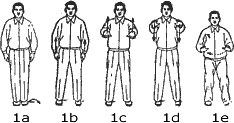
Face N 12 (1a) .  For an explanation of the directional scheme used in Cloud Hands webpages, please see below. 
Stand at attention for awhile.  In Taiji and Qigong, standing quietly in a meditative posture for awhile is the first phase Relax (Sung).  Shoulders are down, hands relaxed and gently touching the side of leg, and head is erect.  This is the phase of WuJi (empty state), or standing like a tree (Zhan Zhuang), and Reconnecting with Oneness and Emptiness.  Breathe easily and comfortably. 
Sink weight into right leg, and then step out to the left to shoulder width (1b). 
Gently raise both arms up (1c), palms facing down, to about shoulder height (1d). 
Lower both arms, palms down, to Dan Tien height, and lower knees (1e).  The lower Dan Tien is a sphere of energy located a few inches behind and below the level of the navel or belly button; the middle Dan Tien is located in the heart area, and the upper Dan Tien is located behind the eyes in the brain. The most important for Taijiquan is the lower Dan Tien.   Practitioners of Kundalini Yoga might consider correspondences of the 3rd Chakra (Manipurna) [Power, Will] with the Lower Dan Tien, the 4th Chakra (Anahata) [Compassion, Love] with the Middle Dan Tien, and the 6th Chakra (Aina) [Intuition, Vision, 6th Sense] with the Upper Dan Tien.  The Chinese energetic system is quite different from the Indian energetic system, so correspondences are weak in this case.  [Chris Akley wrote on 4/3/2012 that "Though I wouldn't say that this is wrong, I think there is a more accurate way to describe it. You could also say that the Dan Tien is in the second charka Swadhisthana which is where kundalini resides once it is awakened. But more accurately, I would say it is between the second and third chakra as this Qigong healer says, in between the energies of fire and water.]
     
This is movement often called "Raising Hands and Lowering Hands."
Breathe normally as you stand, relax, and center in position 1a.  Breathe in through nose, and out through the nose.  Slow the respiration rate to inhaling for 4-5 seconds, holding the full in-breath for 1-2 seconds, exhaling slowly for 4 to 5 seconds, pausing 1-2 seconds before beginning the yin/yang cycle of breathing again.  Breathe in at 1a, breathe out as you step to 1b. 
Breathe in as arms float up 1b-1c, and breathe out as arms float down (1d-1e).  

 
Here is a description of the beginning of the Opening Posture of Taijiquan (#1, 1b) from the book Traditional Chen Style Taijiquan by Fan Chun-Lei and A. Frank Shiery, p.37: 
    "1.  Preliminary Stance:  Stand naturally upright with the feet placed shoulder-width apart, toes pointed slightly inward, and arms hanging naturally at the side.  The body should be kept upright with the shoulders relaxed, eyes slightly closed and breathing naturally.  The body should face north.  The mind should remain empty, calm and clear.  This is the state of WuJi, (Negative Terminus in Taoist Teaching). 
    2.  Commencing Form:  The body should exhibit being relaxed externally while solid within.  The head is held naturally erect as if pulled upward by an invisible string.  Close the lips slightly with the tongue touching the upper palate.  The toes firmly grasp the ground with Yongquan point pulled upward.   The eyes are looking straight ahead with the chin drawn slightly inward.  The hip is turned up and the coccyx turned back and upward with the waist directed downwards.  The whole body should remain relaxed.  A mind state of intent is maintained while the vital energy flows upward from the Dantian to the Baihui point, while the turbid energy flows downward from the Dantian to the Yongquan point.  During this time, the body exhibits no external movement.  Yin/Yang, for example, closing/opening, supple-firm and fast-slow are manifested internally, portraying the image of the Taiji, (Grand Terminus) (1b).     
    Key Points to Remember:  For the beginner, the primary concern should be to cleanse the mind and spirit of tension and anxiety, removing all negative thoughts.  This develops even-temperedness and an alert mind for quick movement and response.  Once this technique has been mastered, the practitioner can begin to understand and practice Taijiquan more effectively."
-   Fan Chun-Lei and A. Frank Shiery, Traditional Chen Style Taijiquan


"Try this simple experiment now.  Raise your right hand toward the ceiling.  Just do it.  Then take it back down/  What did you see?  What did you experience?  Now, raise your right hand to the ceiling very slowly.  Take at least thirty seconds to do it.  Then take it back down again, just as slowly.  Don't think abou it, or try to analyze it.  "Just do it"─ but very slowly.
    Now, what did you notice; what did you see this time?  Were you able to notice the impulse that precedes the movement?  The complex mental/physical twinge that sets the arm in motion?  Did you see and feel the weight and volume of the arm?  Were there any changes in the quality of your mind or breath as the arm slowly rose or descended?  Were there mental formations, perhaps of boredom, irritation, curiosity, pleasure?  A whole cosmos arises, changes, and passes away in one simple movement, and generally we are completely blind to all of it.  Generally, until there has been a deep and real transformation at the base, when we simply "do what we are doing," we are merely dong conditioned, habitual actions.  Moving slowly allows us to see this more clearly and leads to ceto-vimutti, liberation of the mind.  It does this by giving us the time and space to see the constant process of conditioning arising here in this body-mind.  And in seeing the conditioning, we can begin the process of freely choosing how to respond, rather than blindly react."
-  Frank Jude Boccio, Mindfulness Yoga: The Awakened Union of Breath, Body, and Mind, 2004, p.89


Standard Bejing 24 Movement T'ai Chi Ch'uan Form in the Yang Style 

Taijiquan: Lessons, Styles, Forms, Practices


Thursday, December 18, 2014

Yang Style T'ai Chi Ch'uan Short Form


I practice this Taijiquan form twice every day.  It takes from 5 to 7 minutes to perform. 
You can do this indoors by adjusting to the space available, or outdoors.  When done slowly and gently you don't need to do any warmup exercises unless your knees are problematic.  A lovely Taijiquan form!  Good for persons of all ages.  This form is a cornerstone of my personal T'ai Chi Ch'uan practices. 


The first Taijiquan form I learned in 1986 was the Standard 24 Movement T'ai Chi Ch'uan Form in the Yang Style of T'ai Chi Ch'uan.  At that time there were no books or instructional videotapes on this popular form.  Since that time, nearly 25 years have past.  Now there are dozens of books and instructional DVDs and webpages on the subject of the 24 Form. 

Mike Garofalo 'Playing the Pipa'


My webpage on the Standard 24 Taijiquan Form has been the most popular webpage on the Cloud Hands Website for many years. In the sidebar of this blog, you will find a quick index to this webpage.

Standard Simplified Taijiquan 24 Form.  Research by Michael P. Garofalo, M.S. This webpage includes a detailed bibliography of books, media, links, online videos, articles, and resources.  It provides a list of the 24 movement names in English, Chinese, French, German and Spanish, with citations for sources of the movement names.  It provides detailed descriptions of each movement with black and white line illustrations and  photographs.  It includes relevant quotations, notes, performance times, section breakdowns, basic Tai Chi principles, and strategies for learning the form.  The Peking (Bejing) Chinese National orthodox standard simplified 24 movement T'ai Chi Ch'uan form, created in 1956, is the most popular form practiced all around the world.  This form uses the Yang Style of Taijiquan.  Published by Green Way Research, Valley Spirit Taijiquan, Red Bluff, California:  Webpage URL:  http://www.egreenway.com/taichichuan/short.htm.  File size: 269 Kb. 

This webpage provides many good suggestions for a person learning this form on their own if there is no Tai Chi class in their area. 

The best book that I have seen on the subject is:

The Yang Taiji 24 Step Short Form: A Step by Step Guide for All Levels
By James Drewe
London, Singing Dragon Press, 2011.
382 pages, black and white photographs, charts, detailed descriptions, training tips.
I give information on many other fine books by other good authors on the 24 Form in my webpage: Cheng Zhao,
Foen Tjoeng Lie, Eric Chaline, Le Deyin, etc.. 

My students tell me that their favorite instructional DVD on the 24 Form is:

Tai Chi - The 24 Forms
By Dr. Paul Lam


I have taught this lovely Tai Chi form to hundreds of people since 2000.  Everyone tells me how much they enjoy learning and practicing this gentle form.

I also teach and enjoy playing the
Chen Style Taijiquan 18 Movement Form created by Grandmaster Chen Zhenglei. Actually, in the last year, I prefer practicing the Chen 18 Form more. 

Tuesday, October 28, 2014

Bejing Standard T'ai Chi Ch'uan 24 Movements Form


The first Taijiquan form I learned in 1986 was the Standard 24 Movement T'ai Chi Ch'uan Form in the Yang Style of T'ai Chi Ch'uan.  At that time there were no books or instructional videotapes on this popular form.  Since that time, nearly 25 years have past.  Now there are dozens of books and instructional DVDs and webpages on the subject of the 24 Form. 

Mike Garofalo 'Playing the Pipa'


My webpage on the Standard 24 Taijiquan Form has been the most popular webpage on the Cloud Hands Website for many years. In the sidebar of this blog, you will find a quick index to this webpage.

Standard Simplified Taijiquan 24 Form.  Research by Michael P. Garofalo, M.S. This webpage includes a detailed bibliography of books, media, links, online videos, articles, and resources.  It provides a list of the 24 movement names in English, Chinese, French, German and Spanish, with citations for sources of the movement names.  It provides detailed descriptions of each movement with black and white line illustrations and  photographs.  It includes relevant quotations, notes, performance times, section breakdowns, basic Tai Chi principles, and strategies for learning the form.  The Peking (Bejing) Chinese National orthodox standard simplified 24 movement T'ai Chi Ch'uan form, created in 1956, is the most popular form practiced all around the world.  This form uses the Yang Style of Taijiquan.  Published by Green Way Research, Valley Spirit Taijiquan, Red Bluff, California:  Webpage URL:  http://www.egreenway.com/taichichuan/short.htm.  File size: 269 Kb. 

This webpage provides many good suggestions for a person learning this form on their own if there is no Tai Chi class in their area. 

The best book that I have seen on the subject is:

The Yang Taiji 24 Step Short Form: A Step by Step Guide for All Levels
By James Drewe
London, Singing Dragon Press, 2011.
382 pages, black and white photographs, charts, detailed descriptions, training tips.
I give information on many other fine books by other good authors on the 24 Form in my webpage: Cheng Zhao,
Foen Tjoeng Lie, Eric Chaline, Le Deyin, etc.. 

My students tell me that their favorite instructional DVD on the 24 Form is:

Tai Chi - The 24 Forms
By Dr. Paul Lam


I have taught this lovely Tai Chi form to hundreds of people since 2000.  Everyone tells me how much they enjoy learning and practicing this gentle form.

I also teach and enjoy playing the
Chen Style Taijiquan 18 Movement Form created by Grandmaster Chen Zhenglei. Actually, in the last year, I prefer practicing the Chen 18 Form more.