Showing posts with label Stretching. Show all posts

Sunday, May 17, 2026

Temple Qigong by Grandmaster Ho'o

Nine Temple Qigong Exercises

The Temple Qigong (Chi Kung) form consists of nine exercises.  It was popularized by Grand Master Marshall Ho'o (1910-1993) of Los Angeles, California.  It is also referred to as the Nine Temple Exercises, or the Marshall Ho'o Temple Exercises.  


My webpage on Temple Qigong provides a bibliography, links, the names of the movements, and an explanation of each movement.  


Marshall Ho'o wrote a book 1968 which included an explanation with photographic illustrations of the Temple Qigong set.  The black and white photos in that book were of poor quality and the editing was unsatisfactory.  An instructional DVD also teaches this form.  


"Dr. Ho'o was instrumental in the certification of acupuncture in the State of California. He was the first Tai Chi Master to have been elected to the Black Belt Hall of Fame.  He was Dean of the Aspen Academy of Martial & Healing Arts, on the faculty of California Institute of the Arts, and taught Tai Chi and Acupressure at many educational institutions.  In 1973, he created a series for KCET public television, in Los Angeles, teaching Tai Chi.  He was a consultant to Prevention Magazine's The Doctor's Book of Home Remedies.  A Chinese American, Dr. Ho'o was America's first Tai Chi Chuan Grandmaster.  His influence is far-reaching in both the fields of healing and martial arts."
-  The Lineage, Teachers of Two Birds Tai Chi


Tai Chi Chuan  By Marshall Hoo.  Burbank, California, Ohara Publications, Inc., 1986, 1993.  111 pages.  ISBN: 0897501098.  VSCL.  The Nine Temple exercise set is briefly described in this book on pages 18-42.  Each movement is clearly illustrated by four to eight clear black and white photographs of a woman doing the form.  The Taijiquan is the Standard 24 Form in the Yang Style. 


Tai Chi Chuan: The 27 forms by Marshall Hoo .   Instructional DVD, released in 2005, by Marshall Ho'o.  Black Belt Videos, 90 minutes.  Includes the Nine Temple Qigong.   


Wednesday, April 23, 2025

Bound Angle Pose

Baddha Konasana
Bound Angle Pose

Description in Yoga Journal  

Benefits of Bound Angle Pose


I teach two versions of the seated version the Bound Angle Pose:   

1.  Sit up straight.  Keep your heels and the soles of your feet together.  Chin slightly tucked and the crown of the head lifted, ears over shoulders.  Keep the abdominals tucked.  Allow the knees to gradually lower down to the floor.  Relax, Release and stretch!  This is a gentle static isometric stretch of the adductor muscles (inner thighs) in the groin area and a hip opener.  Inhale and exhale gently as you hold the posture for 1 to 3 minutes.  Try not to force the knees down to the floor.  Relax and release! Let gravity do the work of lowering the knees towards the floor.  Hands are placed on the floor at the sides of the hips, or behind the back as shown above. 

Some folks also lean forward while keeping the back straight, or round the back as they lean forward and draw the head towards the floor while keeping the knees drawn down to the extent that they can do so.  They try to bring the head in front of the knees. 


2.  Sit up straight.  I don't recommend leaning to far forward in this version.  Keep your heels and the soles of your feet together.  Chin slightly tucked and the crown of the head lifted, ears over shoulders  Keep the abdominals tucked.  Place your hands on the inside of your knees and press down at the same time as you tense and draw the knees upward.  The muscular lifting effort of the upper legs resists the force downward on the legs with the arms.  This is called oppositional or resistance stretching.  Press down on the legs and lift the legs up simultaneously as you slowly exhale, then relax, release the downward pressure on the legs, and slowly inhale.  Some folks prefer a two breath cycle of simultaneously pressing the legs down and pushing/lifting the legs up.  Do this for 5 to 8 repetitions.

Yoga: Research, notes, lists, bibliography, links.  By Mike Garofalo.

Qigong (Chi Kung), Chinese Health Exercises.

There is also a supine (lying on back) version of this pose, relaxing and releasing (1), including using props under the torso while lying on your back.  

The first version (1) of the Bound Angle Pose is suitable for people with osteoarthritis, as shown below in the instructional video.

Help with Arthritis: Tai Chi, Chi Kung, Yoga, Walking, and Diet   Bibliography, links, resources, recommended books, information, quotations, tips, and research.  By Michael P. Garofalo.


Friday, March 07, 2025

Yin Yoga, Gentle Yoga, Yoga for Seniors

 Yin Yoga, Gentle Yoga


The Complete Guide to Yin Yoga: The Philosophy and Practice of Yin Yoga. By Bernie Clark. Wild Strawberry, 2019, 350 pages. VSCL, Paperback. DVD. My First Choice. Excellent descriptions of Yin Postures.


Yin Yoga and Meditation
: A Mandala Map for Practice, Teaching and Beyond. By Sagel Urlacher. 2022, 331 pages. VSCL, Paperback.
 My Second Choice. Excellent meditation information and ideas.


YinSights: A Journey Into the Philosophy and Practice of Yin Yoga. By Bernie Clark. Foreword by Sarah Powers. Index, 417 pages. ISBN: 096876651X. VSCL, Paperback.


Yin Yoga: Outline of a Quiet Practice. By Paul Grilley. Ashland, Oregon, White Cloud Press, 2002. 118 pages. ISBN: 1883991439. VSCL, Paperback. 


Yin Yoga: The Foundations of a Quiet Practice. Instructional DVD featuring Paul Grilley. Pranamaya, Inc., 2005. 2 DVDs, 338 minutes. ASIN: B000B5871I.  VSCL, DVD.


Gentle Yoga: 7 Beginning Yoga Practices for Mid-Life (40's - 70's). Includes AM Energy, PM Relation, Improving Balance, Relief from Desk Work, Corce Strength, and more. By Jane Adams. DVD, 3 Hours and 12 minutes. VSCL, DVD.


Yoga for Beginners. 8 Yoga Video Routines for Beginners. Include Gentle Yoga Workouts to Increas Strength and Flexibility. By Barbara Benagh. DVDs, 13 Hours. 2019. VSCL, DVD.


Built From Broken. A Science-Based Guide to Healing Painful Joints, Preventing Injuries, and Rebuilding Your Body. By Scott H. Hogan. 2021, 348 pages. VSCL, Paperback.  


Columbia Valley Spirit Yoga Website.  By Michael P. Garofalo.


Carbohydrates 2024

Wednesday, November 27, 2024

Eight Treasures and Lohan Hands Qigong

Lately, I have been reading books that discuss Shaolin Qigong methods.  The exercises in the 18 Lohan Shaolin Qigong overlap with many in the Eight Section Brocade.  I have been adding movement sequences from the beautifully color illustrated book by Shifu Shi Yan Ming of New York.
I added a few new Swinging Arms exercises to my routine.  

The Shaolin Workout: 28 Days to Transforming Your Body and Soul the Warrior's Way.  By Sifu Shi Yan Ming. Rodale Press, 2006. Index, 293 pages. ISBN: 1594864004.  VSCL. 

18 Exercises to Help You Live a Longer, Healthier, and Happier Life.  By Marcus Santer.  193 pages, 2020, Kindle EBook.  VSCL.

Shaolin Qi Gong: Energy in Motion.  By Shi Qinggui.  160 pages, 2008.  VSCL.  Includes DVD.

Shaolin Temple Qigong  By Michael P. Garofalo

Qigong Practices  By Michael P. Garofalo

The Art of Shaolin Kung Fu: The Secrets of Kung Fu for Self-Defense, Health and Enlightenment.   By Wong, Kiew Kit.  Charles E. Tuttle, 2002.  215 pages. ISBN: 0804834393.  VSCL. 


Here is a Blog repost of mine from May 2014 about the Eight Treasures Qigong:


I frequently teach the Chinese Eight Section Brocade Chi Kung exercise and fitness routine in my Taijiquan class and my Yoga class.  Naturally, I include many comments about Shaolin and Daoist fitness and healthy living concepts. 

This Eight Treasures exercise and fitness routine has a varied and long history with ancient roots back to the Animal Frolics Dao-yin exercises of 300 CE.  Some of the Eight Treasures exercises involve toughening, courage, and fighting and were used in military exercise and conditioning drills.  Many versions of the Ba Duan Jin include 12 exercises or more.   

One recent book that provides good documentation on the history of Chinese exercise practices (Chi Kung, Qigong, Neigong), including five illustrated versions of the Eight Section Brocade, is:  

An Illustrated Handbook of Chinese Qigong Forms from the Ancient Texts  Complied by Li Jingwei and Zhu Jianping.  London, Singing Dragon, 2014.  No index or bibliography, 325 pages.  ISBN: 9781848191976.  Many excellent line drawings are included to illustrate the postures.  VSCL. 
 
Back in 2002, I created the webpage titled:  The Eight Section Brocade Chi Kung.


The Ba Duan Jin Qigong form includes eight basic exercises to help you keep limber, become stronger, improve your balance, and increase your stamina.  There are opportunities for squatting movements and postures to strengthen the legs.  
  The entire Eight Beautiful Tapestries Chi Kung form is normally done while standing, although there are some versions done in a seated posture for meditative purposes or for frail persons. 


There are numerous versions of this popular Chi Kung form.  There are many good books, instructional DVDs, and UTube videos to choose from on this topic.  My webpage includes a long bibliography on the Eight Section Brocade Chi Kung with citations for resources, links, videos, books, and instructional DVDs on the subject.  
  I make a number of comments about each of the eight movements, including comments about the movement variations, physical training targets, muscles worked, attitude, internal alchemy (Neidan), benefits, options, comparisons with yoga asanas, and breathing patterns.  


I offer my own version with fairly detailed comments on each of the eight movements.  Here is my one page class handout for the Eight Section Brocade Chi Kung class.  


"The name “Ba Duan Jin” has been found as early as the Northern Song Dynasty. According to Hong Mai's (洪邁) Yi Jian Zhi (夷堅志, Song Dynasty), Zhenghe Seventh Year, Emperor's Chief Secretary, Li Shi-Ju, lived a simple life.  He spent a large portion of his time in his mediation room practicing Daoist Monk’s exercises expanding like a bear and stretching like a bird. In the early hours, he is often found breathing and massaging, practicing the so-called Eight-Section Brocade (Ba Duan Jin). This passage reveals that Ba Duan Jin has been developed and practiced since the Song Dynasty as a general health-keeping regime. 
    
Both sitting and standing forms have been found in the history of Ba Duan Jin (
八段錦),. Standing forms were developed into two schools (northern and southern styles) in the Qing Dynasty. The Northern School, said to have been passed down by Yue Fei (岳飛), has tougher forms, and the Southern School, claimed the lineage from Liang Shi-Chang (梁世昌), focuses on softer trainings. Quite a few verses has been passed down during the period from Song Dynasty to Qing Dynasty, but all verses for the standing forms have evolved from the passages recorded in "The Chapter of Wonders, Pivot of Dao" (道樞·眾妙篇, Dao Shu, Zong Miao Pian, Song Dynasty) and verses of the sitting style from the forms recorded in "TheTen Books of Daoist Practices" (修真十書 Xiu Zhen Shi Shu, Ming Dynasty ).  or "The Methods of Curing"(活人心法, Huo Ren Xin Fa, Ming Dynasty). Sets Ba Duan Jin forms are not always limited to the number of eight. The number of forms in a set range from a single form to tens or as many as a hundred; nevertheless, they are all exercise regimes designed for health-keeping, preventive, and therapeutic purposes, and, liberally saying, all exercise regimes designed for such purposes are part of the Ba Duan Jin system."
-   Lee Chang-Chih, 
 A Brief Introduction to Ba Daun Jin.  "Reinterpreting Ba Duan Jing From the Theories of the Eight Extra Meridians" 2005 


Saturday, February 18, 2023

Limping Towards Recovery


I was making steady progress on recovery from my cryo-balloon heart ablation on 2/2/2023.  I was walking for over 6,000 Steps per day, practicing my Taijiquan, and doing some light stretching.  

Last Sunday, while getting up carelessly and quickly from a 14 inch high low bench, I twisted my right leg.  Immediate Pain!  My right knee buckled and hurt, my hamstring hurt, my quadriceps hurt.  I could not walk without serious pain.  I was slowly limping around the house.  I began treatment: rest, ice, compression, gentle massage, elevation of my right leg.  Then, I sprained my right foot on Tuesday.  More pain, more limping, more discouragement.  

This is a rare series of leg injuries for me.  Very discouraging and disappointing setback to my normal exercise routines, and my heart recovery.  I've not injured my hamstrings or quadriceps since my baseball playing days when I was 40.  

I am now studying and implementing the recommendations for slow recovery found in the excellent book:

Built from Broken. A Science-Based Guide to Healing Painful Joints, Preventing Injuries, and Rebuilding Your Body. By Scott Hogan. Salt Wrap, 2021, index, reference, appendices, 341 pages. VSCL. 

Strength Training for Seniors


For Spiritual Encouragement, I am rereading and studying the valuable book:

Light on Life: The Yoga Journey to Wholeness, Inner Peace, and Ultimate FreedomBy B.K.S. Iyengar.  With John J. Evans and Douglas Abrams.  Rodale Books, 2005.  Index, 282 pages.  ISBN: 1594862486.  VSCL.  Contrary to some critics of popularized "gym" yoga, blaming Iyengar; his books reveal his spirituality through the practice of yoga postures, breath work, self-discipline, positive psychology, and meditation.  In short, Raja Yoga and Hatha Yoga combined.  

Spiritual Practices for Self-Transformation

How to Live a Good Life: Advice from Wise and Respected Persons


I checked out three books from the Fort Vancouver Regional Library System:  

Tibetan Yoga: Magic Movements of Body, Breath and Mind.  By Alejandro Chaoul.  This yoga practice requires instruction from a qualified teacher.  The book provides theory, ancient texts, and very brief descriptions of the movements.  There are no pictures or illustrations of the specific movements.  The use of shaking the body between movements, asanas, and postures are similar to Qigong systems.  For experienced Yogis.

Accessible Yoga: Poses and Practices for Every Body.  By Jivana Heyman.  Beginner's Yoga and for people with health problems.  Good photos to illustrated modified poses.  

Both books tended to stress the incompleteness and inadequacy of popular Western hatha yoga practice in gyms and yoga studios.  They take issue with the goals of flexibility and athleticism in common yoga; and, its not making yoga accessible to different body types or sub-cultures, or for those people seeking spiritual development via Yoga practices.  

In my view, different strokes for different folks.  I'm OK with slim, young, beautiful, athletic, Christian females doing rigorous 'gym' yoga; or, male lamas doing Tibetan yoga on three month retreats; or, old Bigger men, like me, seeking a modicum of fitness without injury via yoga and strength training.  Some folks are into the 'spiritual' dimensions of Raja Yoga, others not so much so.  Everyone benefits from these Yoga practices if they Practice Daily.  

I've been doing some light stretching using a chair or table for support.  

Chair Yoga: Sit, Stretch, and Strengthen Your Way toa Happier, Healthier You.  By Kristin McGee.  William Morrow, 2017. Index, 271 pages. Basic instruction in many exercises you can do while supporting yourself with a chair.  There are numerous books on the market for Chair Yoga.  For beginners and seniors needing alternatives.  VSCL. 

Yesterday, I felt comfortable and safe enough to resume walking, Taijiquan, and gentle stretching, and even some strength training.  I walked 3,400 Steps.  My goal is to walk over 3.500 to 5,000 Steps per day for the next five days.  


Sunday, April 17, 2016

Chen Taijiquan Workshop in Sacramento

"Hello Taiji enthusiasts: 

On April 23rd and 24th Master Ronnie Yee will be giving a Chen style taiji (based on the practical method) workshop. The workshop will be covering some basics of Chen taiji, many validation drills (two person stuff) Push hands pattern and something that everyone in the last workshop really enjoyed more Mitzvah training. Mitzvah technique is a unique set postural exercises. Some of them to get your alignment all straight and others to help you stretch without pain. All about releasing into the movement. Ronnie attributes much of what he can do to what he has learned and practiced in Mitzvah technique. Not very many people in the US know about this. It is kind of an off shoot of the Alexander Technique but much more involved with the whole body.

Saturday will be from 12:00 to 4:30 so arrive already having eaten from lunch. There will be a free meet and greet from 9:00 to 10:30 on Saturday morning in the Fair Oaks Village Park. Then we break for lunch and go indoors the facility which is at 8066 Sunset Ave. Corner of Fair Oaks Blvd and Sunset. Held in the Level Up Martial arts school.

Sunday the workshop will be from 9:00 to 11:30 and from 1:00 to 4:00.

Cost for the workshop will be $60 for one day and $100 for two days. There will be a 10% discount if paid by April 15th. You can make Check out to Carmen Farruggia or to Eric Smith. Send it to 4864 Tommar Drive. Fair Oaks, CA 95628

Email me, Carmen Farruggia, if you have any questions. Or call 916-965-4469"

I plan to attend this workshop.  

Tuesday, April 12, 2016

Cane: Weapon and Training Tool

The weather is cool and nice in the morning.  A few more rainshowers predicted for Red Bluff this week.  

When I take long walks (3.6 + miles), I walk six times, east then west, .6 mile per whole lap.  I stop between laps to practice Taijiquan (24, 37, 108 Yang; 18 Chen), and the 8 Immortals Cane Form, Part 1.  The only martial arts weapon that I practice with is a cane.  I practice all the Taijiquan sword and broadsword forms that I know with a cane. 

Every time I take a long walk or hike I carry my cane with me.  A cane provides support to a walker (like a staff or trekking pole sticks), and a cane can be used effectively for self-defense.  Using various cane strikes and stretches while walking is an excellent way to exercise the upper torso.  I practice the 8 Immortals Cane Form, Part 1.  


I use an Instructor's Walking Cane, 40" (103 cm) long and 1" (2.54 cm) in diameter, from Cane Masters.  This cane weights 1lb, 2 oz (510 gm).  This beautiful martial arts combat cane is made of pure hickory heartwood, has multiple notches at three key gripping points, has a rounded hooked horn, and has a rubber covered tip.  I also own the same Instructor's Walking Cane made of oak - a gift from my children.
 
Way of the Short Staff.  By Michael P. Garofalo, M.S.  A comprehensive guide to the practice of the short staff, cane, jo, walking stick, gunzhang, whip staff, 13 Hands Staff, and related wood short staff weapons.  A detailed and annotated guide, bibliographies, lists of links, resources, instructional media, online videos, and lessons.   Includes use of the short staff and cane in martial arts, self-defense, walking and hiking.  Separate sections on Aikido Jo, Cane, Taijiquan cane and staff, Jodo, exercises with a short staff, selected quotations, techniques, selecting and purchasing a short staff, tips and suggestions, and a long section on the lore, legends, and magick of the short staff.  Includes "Shifu Miao Zhang Points the Way."  Published by Green Way Research, Valley Spirit Taijiquan, Red Bluff, California.  Updated on a regular basis since October, 2008.  Filesize: 265Kb.  Related to Mike's popular webpage on the Staff.


"The correct use of the bo (sai, tonfa, kama, naginata, sword) can produce a stimulating and practical means of "extension" training. It offers a means of martial arts training and discipline. Weapons training teaches the meaning of control, timing, distance, and flexibility as one unit. The practitioner is required to possess speed, coordination, strength, and endurance in utilizing the respective weapons."
-  
History of the Bo Staff


"The jo can be used to strike like a sword, sweep like a naginata, thrust like a spear (yari). Its two ends can be used, unlike the single point of a sword, and its ma-ai (fighting distance) can be varied according to the hand grip you take. Because of its speed and changeable ma-ai, it is a formidable weapon."
-  
Muso Shindo-Ryu Jodo   


"In Chinese shamanism, a staff represents the power of the universe. With a staff, a shaman had the power to pass on the universal knowledge to others. Later, when teachers took over part of the shaman's job, they always taught with a small staff in their hands like a shaman."
- Master Zhongxian Wu, Vital Breath of the Dao, p. 106


Thursday, April 17, 2014

Anatomy of Hatha Yoga Postures

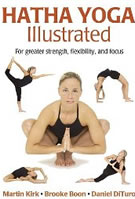
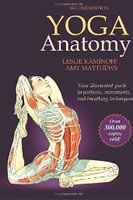
I regularly use these two books in my study of yoga.  They are both well organized, well illustrated, and highly informative.  Both are excellent reference tools, and explain yoga postures from an anatomical and scientific perspective.
Yoga Anatomy  By Leslie Kaminoff and Amy Matthews.  Published by Human Kinetics, Champain, Illinois, Second Edition, 2011.  Copyright by The Breathe Trust 2007, 2012.  Various indexes: by muscles, joints, position in English, position in Sanskrit, bibliography, 276 pages.  ISBN: 1450400248. VSCL.  An outstanding reference book on the anatomy of yoga!  
Hatha Yoga Illustrated: For Greater Strength, Flexibility and Focus  By Martin Kirk and Brooke Boon.  Photographs by Daniel DiTuro.  Champaign, Illinois, Human Kinetics, 2006.  Suggested readings, resources, index by Sanskrit name, index by English name, 233 pages.  ISBN: 0736062033.   VSCL.  Practical, informative and well organized information. 
My Hatha Yoga Postures List is in alphabetical order by both the English and Sanskrit names for many common Hatha Yoga postures for beginning and intermediate yoga students.  The list includes coding for the kind of yoga posture, e.g., balancing, standing, supine, backbend, etc.  For each posture, the list includes reference to descriptions in yoga textbooks, including the two books mentioned above.  The list also includes some Chi Kung postures that I teach in many of my yoga classes.  My Hatha Yoga Postures List is now 14 pages long, in a PDF format, print only, at Version 6, 10/1/2012.  I also have prepared numerous one page Study Lists that might be useful to yoga students and beginning teachers.