Showing posts with label Cane. Show all posts

Friday, February 27, 2026

Shifu Miao Zhang Takes A Walk

The Fireplace Records Case #57

Shifu Miao Zhang Takes a Walk


Toju Zenchu brandished his staff before Daoist 

Shifu Miao Zhang and challenged him "Miao 

Zhang, speak and you get whacked with Nanten's

staff. Do not speak and you still get whacked with

Nanten's staff." Shifu Zhang stood up quickly, 

lifted his cane strongly in defense, and quietly

said, "Yunmen's shit stick stinks and Nanten's 

staff is cracked! I am leaving now to take my

evening walk. Goodbye."


Zen Koans: The Fireplace Records
Koans by Mike Garofalo

Zen Koan Collections Studies

Subject Index to 1,975 Zen Buddhist Koans

Reading Wittgenstein 1975-

Buddhism

Taoism

Philosophy

Quintain Poetry

Pulling Onions


Thursday, February 26, 2026

Cutting Through the Wind

The Fireplace Records Case #56


Cutting Through the Wind

Mayoku walked around his old Daoist friend,
Shifu Miao Zhang, three times and then thumped
his staff on the ground. Miao Zhang stood up,
walked around Mayoku once, tapped his cane three
times on the wall, and said "The power of the wind
can topple trees and is gone by morning. My cane
can cut through the wind."

Shifu Miao Zhang


Zen Koans: The Fireplace Records
Koans by Mike Garofalo

Zen Koan Collections Studies

Subject Index to 1,975 Zen Buddhist Koans

Reading Wittgenstein 1975-

Buddhism

Taoism

Philosophy

Quintain Poetry

Pulling Onions


Friday, July 04, 2025

Cannon Cane: Eight Immortals Chen Taijiquan Cane Routine II


Eight Immortals Taijiquan Cane
Cannon Cane, Routine Two
Based on the Chen Style of Taijiquan

Created and Taught by Master Jesse Tsao, PhD.

List of Postures, Movements, Forms 

Section I

1.  Opening Form

2.  Lazily Tying Coat

3.  Six-Seal and Four Close
4.  Single Whip
5.  Striking Left and Right
6.  Wrapping Head with the Cane
7.  Uppercuts Left and Right
8.  Grand Eagle Spreads Wings
9.  Embracing the Moon
10.  Cat Catches Rat
11.  Golden Rooster Standing on One Foot
12.  Whipping Sleeves and Slamming Cane
13.  Overturn the Ocean
 

Section II

14.  Dragon’s Tail Stirring Water
15.  Pinwheel Cane
16.  Fair Lady Works at Shuttles
17.  Batting a Home Run
18.  Ruthless Lord Holds Up Flag
 

Section III

19.  Strike Low and Strike High
20.  Dragon Descends into Ocean
21.  Dragon Emerges from Water
22.  Parry Left and Right
23.  Turn-Around Strike
24.  Dragon Swings Tail
25.  Head Smashing Cane
26.  Lock Front Door
 

Section IV 

27.  Black Bear Turns Around
28.  Lock Back Door
29.  Heart Thrusting Cane
30.  Waist Blocking Cane
31.  Crotch Striking Cane
32.  Head Striking Cane
33.  Dragon’s Head Up
34.  Dragon Coiling Around Pillar
35.  Wind Devil Cane
36.  Closing Form


Mastering Tai Chi Cane for Health and Self-Defense. By Jesse Tsao, PhD. Tai Chi Healthways, 2022, 225 pages.


Traditional Tai Chi Eight Immortals Cane, Routine 2 (Cannon Cane, Chen Style).  By Jesse Tsao, PhD.  Tai Chi Healthways, Instructional DVD 62 Minutes. 

Way of the Short Staff  By Michael P. Garofalo, M.S.  A comprehensive guide to the practice of the short staff, cane, jo, walking stick, gun, zhang, whip staff, 13 Hands Staff, and related wood short staff weapons.  A detailed and annotated guide, bibliography, lists of links, resources, instructional media, online videos, and lessons.  Includes use of the short staff and cane in martial arts, self-defense, walking and hiking.  Separate sections on Aikido Jo, Cane, Taijiquan cane and staff, Jodo, exercises with a short staff, selected quotations, techniques, selecting and purchasing a short staff, tips and suggestions, and a long section on the lore, legends, and Magick of the short staff.  Includes "Shifu Miao Zhang Points the Way."

 Cloud Hands Taijiquan, Valley Spirit Center, Fir Grove, Vancouver, Washington.  List by Michael P. Garofalo, September 24, 2022. 


Eight Immortals Taijiquan Cannon Cane Routine

1.  Opening Form  Section 1

2.  Lazily Tying Coat

3.  Six-Seal and Four Close
4.  Single Whip
5.  Striking Left and Right
6.  Wrapping Head with the Cane
7.  Uppercuts Left and Right
8.  Grand Eagle Spreads Wings
9.  Embracing the Moon
10.  Cat Catches Rat
11.  Golden Rooster Standing on One Foot
12.  Whipping Sleeves and Slamming Cane
13.  Overturn the Ocean

14.  Dragon’s Tail Stirring Water  Section 2
15.  Pinwheel Cane
16.  Fair Lady Works at Shuttles
17.  Batting a Home Run
18.  Ruthless Lord Holds Up Flag

19.  Strike Low and Strike High  Section 3
20.  Dragon Descends into Ocean
21.  Dragon Emerges from Water
22.  Parry Left and Right
23.  Turn-Around Strike
24.  Dragon Swings Tail
25.  Head Smashing Cane
26.  Lock Front Door

27.  Black Bear Turns Around  Section 4
28.  Lock Back Door
29.  Heart Thrusting Cane
30.  Waist Blocking Cane
31.  Crotch Striking Cane
32.  Head Striking Cane
33.  Dragon’s Head Up
34.  Dragon Coiling Around Pillar
35.  Wind Devil Cane
36.  Closing Form


Friday, June 20, 2025

Shifu Mio Zhang's "Gradual Enlightenment"

 The Fireplace Records, Chapter 21


Shifu Mao Zhang's "Gradual Enlightenment


Xita asked Shifu Miao Zhang, "What is sudden enlightenment?"  Shifu Miao Zhang threw his staff on the muddy ground. 

Xita asked Miao Zhang, "What is gradual enlightenment?" Shifu Miao Zhang stomped on his staff three times.

Xita said, "Yes! Good!  Your understanding is straightening.  From now on, Miao Zhang, you will need to continue to clean and polish your staff."


Related Links, Resources, References

Koans:

Refer to my Cloud Hands Blog Posts on the topic of Koans/Dialogues.

The Daodejing by Laozi  

Pulling Onions  Over 1,043 One-line Sayings by Mike Garofalo

Chinese Chan Buddhist and Taoist Stories and Koans

Taoism

Buddhism

Fireplaces, Stoves, Campfires, Kitchens, Pots, Firewood

Chinese Art

Tai Chi Chuan and Qigong

Meditation Methods

Zen Koan Books I Use

Koan Database Project

Brief Spiritual Lessons Database Project: Subject Indexes


Subject Index to 621 Zen Buddhist Koans


Sparks: Brief Spiritual Lessons and Stories

Matches to Start a Kindling of Insight
May the Light from Your Inner Fireplace Help All Beings
Taoist, Chan Buddhist, Zen Buddhist, Philosophers
Catching Phrases, Inspiring Verses, Koans, Meditations
Indexing, Bibliography, Quotations, Notes, Resources
Research by Michael P. Garofalo

The Fireplace Records
By Michael P. Garofalo


Saturday, June 07, 2025

Tai Chi Ruler


The Tai Chi Ruler is a wooden stick about 12 inches long used in Qigong exercises. There is some theory involved which is related to Hand Reflexology and hand acupressure and massage.  The Taiji Ruler exercises also involve gentle movements, stretching, and breathing coordination. 

You can check my research on the subject of the Tai Chi Ruler.


Tuesday, April 01, 2025

Cannon Cane Taijiquan Routine

Cloud Hands Blog Repost from 2023:

Cannon Cane, Eight Immortals Cane Routine #2.  

A Hypertext Notebook by Michael P. Garofalo


Traditional Tai Chi Eight Immortals Cane, Routine Two (Cannon Cane). Demonstrated by Master Jesse Tsao. Instructional DVD, 65 minutes. Produced by Tai Chi Healthways, San Diego, 2008. Routine Two, Cannon Cane, is based on the Chen Style of Taijiquan. Master Tsao developed this cane form himself, with grandmaster Zhu Tiancai's support. "This is the answer for people looking for the martial arts aspect of Tai Chi. You will surely love the way Master Jessee Tsao presents to you this unique auncient practice. A short stick, umbrella, or any everyday object of the proper length can be used as a substitute for a cane. Like the Chen Style Tai Chi Cannon Fist, this routine is full of powerful moves and explosive strikes. Detailed instruction is provided in English, with front and back views. It is a good reference for home study, or a resource for instructor's teaching preparation. Suggest 30 class hours. (Difficulty: Intermediate through Advanced Levels). DVD-R, (62 minutes). There is a streaming version available through Amazon." VSCL


Mastering Tai Chi Cane for Health and Self-Defense. By Jesse Tsao, Ph.D., Tai Chi Healthways, 2022, 225 pages, $27.00.
"The cane has been used as a self-defense weapon for centuries. But it is more than just a weapon or a walking aid—it is a useful tool to practice the ancient Chinese art of tai chi and gain all the benefits of relaxation, health, and wellness for students of any age or fitness level. For the very first time, Master Jesse Tsao brings his fifty years of tai chi practice and training, combined with his PhD in Traditional Chinese Martial Arts Education, to this comprehensive guide to mastering the tai chi cane with routines he has created.
Rooted in the Taoist Eight Immortals legends, this book takes you through the steps of tai chi cane stretch and self-massage to increase flexibility, loosen tight muscles, and prepare the body for daily activities as well as stimulating energy points to open the body’s blockages and flush out stagnation and toxins to promote self-healing. Routine I blends the softer flow and circular movements of the popular Yang-style tai chi for stress management and personal fitness. And for students looking for training in cane self-defense, Routine II is based on the fast and vigorous practice of traditional Chen-style Cannon Fist that mixes robust leaps with explosive strikes—ideal for diehard martial artists.
With more than 300 photographs and illustrations, Mastering Tai Chi Cane for Health & Self-Defense provides clear, step-by-step instructions for each posture followed by key points for mastery, making it a perfect manual for beginners while the in-depth content will be invaluable to martial artists and tai chi instructors." VSCL.


Tuesday, March 18, 2025

Turning the Boat #34


The Chinese Wand Exercise Blog.  By Michael Davies.

Tai Chi Cane.  By Mike Garofalo.  

Qigong Ruler, Taji Chih, Chi Kung Dowel.  By Mike Garofalo

Turning the Boat, Exercise 34, Tai Chi Wandwork


     "The Tai Chi Wandwork 34 Exercises Routine consists of 17 open-hand and 17 wand exercises. The movements are taken from: 1. Qigong (`Shibashi') 2. Tai Chi (Yang Style) 3. Chinese Wand Exercises 4. Tai Chi Boating Wand Form 

     This routine was created to introduce wellness groups to Chinese internal health systems. It contains 34 gentle therapeutic exercises and serves as an introduction to Tai Chi, Qigong, Chinese Wand Exercises and the Tai Chi Boating Wand. The 34 exercises - 17 open handed and 17 wand-held movements - contain comprehensive physical benefits and offer an efficient approach to strengthening, stretching, building balance, good posture, coordination and mental focus. 
     The exercises can be performed standing or sitting. The movements are simple, easy to learn and make you suppler and flexible and increase your vitality. It is a great way to reduce stress, boost energy, increase circulation and improve balance. The gentle, fluid movements also relax the body and soothe the mind."

Friday, September 02, 2022

Eight Immortals Cane Practice


Cane, Walking Stick, Short Staff
Bibliography, Links, Resources, Lessons, Guides, History, Lore
Hypertext Notebook by Mike Garofalo


Eight Immortals Cane, Routine One. Demonstrated by Master Jesse Tsao. Instructional DVD, 64 minutes. Produced by Tai Chi Healthways, San Diego, 2008. Routine One is based on the Yang Style of Taijiquan. Master Tsao developed this cane form himself, with grandmaster Zhu Tiancai's support. "Traditional Tai Chi Eight Immortals Cane is a very special Tai Chi routine. A walking cane is an everyday, common object, but is also a handy weapon in self defense! This routine is based on the characteristics of Tai Chi postures with the traditional Taoist "eight immortals" cane/stick martial function. It is fun for any age level to learn. Grandmaster Zhu Tiancai created the Chinese brush writing calligraphy for this routine. Detailed instruction by Master Jesse Tsao is in English with front and back view demos, as well as martial arts applications. It is a good reference for home study, or a resource for instructor's teaching preparation. Suggest 30 class hours. (Difficulty: Beginner through Advanced Level). DVD, (64 minutes). There is a streaming version available through Amazon.

Sunday, March 06, 2022

Taiji Cane


Taiji cane forms are typically performed slowly and deliberately.  Hard and powerful strikes are seldom used in T'ai Chi Ch'uan walking stick forms.  The pace of the Taijiquan cane forms are seldom fast and vigorous.  There are few if any vigorous leaps and jumps.  Taiji forms seldom use very low stances.  Taiji cane forms are particularly suitable for fit persons over 50 years of age.  Good examples of a Taiji Cane Form are: the Standard Beijing 24 Form with Cane created by Master Wen-Ching Wu; the Eight Immortals Cane Form, Part I, created by Master Jesse Tsao;  the Plum Blossom Taiji Cane Form; the Tai Chi Stick 18 Form;  the Bodhi Dharma Walking Stick Form; Master Michael Gilman's Three Powers Cane Form; the Wu Tang Cane Form of Master T.T. Liang; the Standard 32 Sword Form; etc.  

There are also many examples of more vigorous "Taiji" cane forms, with hard strikes, leaps, fast moves, spins, and low moves.  Taijiquan saber or broadsword forms are readily adapted for use with a cane, and some are fast and vigorous.  Normally, Taijiquan sword forms are not very well adapted as cane forms, but I practice the Standard 32 Sword Form with my cane as do many others.  Karate, kung fu, Shaolin, Bagua and HsingI cane or stick forms are often fast, vigorous, powerful, twisting, agile, and with some very low stances.  Of course, when first learning any new cane form, begin with a slower, more deliberate, less vigorous practice to help the body adapt to the moves of the new form.  Thus, even a fast and vigorous cane form from any style can be done more in the "Taiji" fashion outlined and shown above.  

Many Qigong (Chi Kung) forms can also we done while holding a cane.  Adaptations are quite easily arranged.  Most often, however, Qigong forms are adapted or created for use with a short 6"-12" wooden stick called a Tai Chi Ruler or Bang.  

I consider a cane or walking stick to be, normally, a straight strong wooden stick with a curved (hook) handle that is from 30" (76 cm) to 42" (107 cm) long.  The cane will typically extend from the floor to the height of your hip socket and maybe up to your belly button.  The cane might also be made out of plastic, aluminum, steel, or rattan.  The cane might have a straight rather than curved or hooked end with a round ball shaped (pommel) end or some sort of straight or carved handle at the end.  The cane might be very simple, natural and plain; or be carved, painted or decorated.  


Each day I use an Instructor's Walking Cane, 40" (103 cm) long and 1" (2.54 cm) in diameter, purchased from Cane Masters.  This cane weights 1lb, 2 oz (510 gm).  This beautiful martial arts combat cane is made of pure hickory heartwood, has multiple notches at three key gripping points, has a ample rounded hooked horn, and has a rubber covered tip inserted over the tip end.  I also own the same Instructor's Walking Cane made of oak - a gift from my children.  I am 6'6" (198 cm) tall, and a 40" cane (103 cm) is perfect for using on my long walks and for my Taiji cane practices.  The only weapon I practice with on a daily basis is a wooden cane; and the only weapon I teach now in my Taijiquan classes is the cane.  Also, whenever I take a walk, anywhere, I bring my cane along for support, exercising the arms, and for self-defense.     


Taijiquan Cane Weapon Research, Bibliography, and Practices

Way of the Short Staff

Long Staff Weapons Practices 

A repost from the Cloud Hands Blog on March 5, 2014


Monday, December 13, 2021

Taijiquan Cane or Staff


Taiji cane forms are typically performed slowly and deliberately.  Hard and powerful strikes are seldom used in T'ai Chi Ch'uan walking stick forms.  The pace of the Taijiquan cane forms are seldom fast and vigorous.  There are few if any vigorous leaps and jumps.  Taiji forms seldom use very low stances.  Taiji cane forms are particularly suitable for fit persons over 50 years of age.  Good examples of a Taiji Cane Form are: the Standard Beijing 24 Form with Cane created by Master Wen-Ching Wu; the Eight Immortals Cane Form, Part I, created by Master Jesse Tsao;  the Plum Blossom Taiji Cane Form; the Tai Chi Stick 18 Form;  the Bodhi Dharma Walking Stick Form; Master Michael Gilman's Three Powers Cane Form; the Wu Tang Cane Form of Master T.T. Liang; the Standard 32 Sword Form; etc.  

There are also many examples of more vigorous "Taiji" cane forms, with hard strikes, leaps, fast moves, spins, and low moves.  Taijiquan saber or broadsword forms are readily adapted for use with a cane, and some are fast and vigorous.  Normally, Taijiquan sword forms are not very well adapted as cane forms, but I practice the Standard 32 Sword Form with my cane as do many others.  Karate, kung fu, Shaolin, Bagua and HsingI cane or stick forms are often fast, vigorous, powerful, twisting, agile, and with some very low stances.  Of course, when first learning any new cane form, begin with a slower, more deliberate, less vigorous practice to help the body adapt to the moves of the new form.  Thus, even a fast and vigorous cane form from any style can be done more in the "Taiji" fashion outlined and shown above.  

Many Qigong (Chi Kung) forms can also we done while holding a cane.  Adaptations are quite easily arranged.  Most often, however, Qigong forms are adapted or created for use with a short 6"-12" wooden stick called a Tai Chi Ruler or Bang.  

I consider a cane or walking stick to be, normally, a straight strong wooden stick with a curved (hook) handle that is from 30" (76 cm) to 42" (107 cm) long.  The cane will typically extend from the floor to the height of your hip socket and maybe up to your belly button.  The cane might also be made out of plastic, aluminum, steel, or rattan.  The cane might have a straight rather than curved or hooked end with a round ball shaped (pommel) end or some sort of straight or carved handle at the end.  The cane might be very simple, natural and plain; or be carved, painted or decorated.  


Each day I use an Instructor's Walking Cane, 40" (103 cm) long and 1" (2.54 cm) in diameter, purchased from Cane Masters.  This cane weights 1lb, 2 oz (510 gm).  This beautiful martial arts combat cane is made of pure hickory heartwood, has multiple notches at three key gripping points, has a ample rounded hooked horn, and has a rubber covered tip inserted over the tip end.  I also own the same Instructor's Walking Cane made of oak - a gift from my children.  I am 6'6" (198 cm) tall, and a 40" cane (103 cm) is perfect for using on my long walks and for my Taiji cane practices.  The only weapon I practice with on a daily basis is a wooden cane; and the only weapon I teach now in my Taijiquan classes is the cane.  Also, whenever I take a walk, anywhere, I bring my cane along for support, exercising the arms, and for self-defense.     


Taijiquan Cane Weapon Research, Bibliography, and Practices

Way of the Short Staff

Long Staff Weapons Practices 


Wednesday, April 28, 2021

Tai Chi Chuan Class in Vancouver, Clark County, Washington

Tai Chi Classes in 2021-2022

Would anyone like to study and learn with me, for free,
the Chen Taijiquan Lao Jia Yi Lu, First Form?
We would use the instructional DVD by Master Ken Gullette as our teacher.


The Yang Style of T'ai Chi Ch'uan

Instructor:  Mike Garofalo, M.S.   

In Vancouver, Clark County, Washington, USA

Contact Mike by Email (gwr2013a@gmail.com) or Phone: 530-200-3546

 
Practicing and teaching the Yang Style of Tai Chi Chuan 
The Standard
Long 108 Movements Yang Taijiquan Form,
The Short 24 Movements Yang Taijiquan Form,
Cane Drills,

Website:  Cloud Hands Tai Chi Chuan     Blog:  Cloud Hands Blog

  Qigong

Instructor 
Michael P. Garofalo

M.S., B.A. Philosophy

I began learning Yang Style Taijiquan and Qigong in 1986, and have taught 
Taijiquan and Qigong since 2000.  I also taught Hatha and Vinyasa
Yoga from 2003-2016. 

All of my Yoga and T'ai Chi Ch'uan Classes Include Some Qigong (Chinese Yoga) Practices


 In 2021, I am 75 years of age.


I began learning Yang Style Taijiquan and Qigong from 1986-1990 with Sensei Frank McGourick in Whittier, California.
I studied Lui Ho Ba Fa and Qigong with Sifu Robert Moore from 1987-1990 in Whittier, California.
I studied Red Dragon Kung Fu from 1991-1993 with Sensei Tony Ippolito in Hacienda Heights, California.

I taught over 950 one hour classes of Taijiquan and Qigong in Red Bluff, California, from 2000-2017. 
I also practice the
Chen 18 Style of Taijiquan and Sun 73 Style of Taijiquan, the cane weapon, and many Qigong forms. 

Tai Chi for Diabetes Instructor Trained and Certified by Dr. Paul Lam in 2003. 
Tai Chi for Arthritis Level 2 Instructor (Sun Style) Trained and Certified by Troyce Thome in 2006
Advanced Tai Chi and Qigong training at workshops or classes led by Robert Moore, Paul Lam, Ken Cohen, Yang Jun, Patricia Long, George Xu, Elaine Waters, Bill Helm, Doc Fai-Wong, Sher K. Lew, Kevin Weaver, Troyce Thome, Brian Knack, and Ken Gullette.

I taught Hatha and Vinyasa Yoga in Red Bluff from 2003 to 2016 for over 1,460 hours of one hour classes. 
YogaFit® Level IV Certified Yoga Instructor (Standard 200 Hour Yoga Alliance Curriculum Completed) in 2004
Over 100 hours of additional yoga training with Dr. Paula Barros, Desiree Rambaugh, and at the Ananda Yoga Center.
All of my Yoga Classes Include Some Qigong (Chinese Yoga) Practices

Personal Fitness Trainer Certified by AFAA 2007
Mat Pilates AFAA Certified 2005
Spin Cycling AFAA Certified 2005
Aerobics and Fitness Association of America (AFAA) Certifications
SilverSneakers® Trained Instructor 2012
CPR and AED certified from 1999-2017. 

Emergency 30-Day Substitute Teaching Permit, 4/1999 - 4/2017
Certified by the State of California Commission on Teacher Credentialing
M.A. Education, 40 units, CSU Chico; M.A., Philosophy, 30 units at CSU Los Angeles. 
M.S., Library and Information Science, University of Southern California, 1968
B.A. Philosophy, CSU Los Angeles, 1967 
  

Brief Biography


Sunday, April 11, 2021

Exercises with a Cane

Repost from 2018

The Chinese Wand Exercise Blog.  By Michael Davies.

Tai Chi Cane.  By Mike Garofalo.  

Qigong Ruler, Taji Chih, Chi Kung Dowel.  By Mike Garofalo

Turning the Boat, Exercise 34, Tai Chi Wandwork


     "The Tai Chi Wandwork 34 Exercises Routine consists of 17 open-hand and 17 wand exercises. The movements are taken from: 1. Qigong (`Shibashi') 2. Tai Chi (Yang Style) 3. Chinese Wand Exercises 4. Tai Chi Boating Wand Form 

     This routine was created to introduce wellness groups to Chinese internal health systems. It contains 34 gentle therapeutic exercises and serves as an introduction to Tai Chi, Qigong, Chinese Wand Exercises and the Tai Chi Boating Wand. The 34 exercises - 17 open handed and 17 wand-held movements - contain comprehensive physical benefits and offer an efficient approach to strengthening, stretching, building balance, good posture, coordination and mental focus. 
     The exercises can be performed standing or sitting. The movements are simple, easy to learn and make you suppler and flexible and increase your vitality. It is a great way to reduce stress, boost energy, increase circulation and improve balance. The gentle, fluid movements also relax the body and soothe the mind."

Tuesday, February 11, 2020

Taijiquan Cane Practices and Lore

[Here is a Cloud Hands Blog repost from May 14, 2014.  Six years ago I lived in a rural area south of Red Bluff, California.  


a foggy morning,
cows watching -
practicing taijiquan cane


2014:


The only martial arts weapon that I practice with is a cane.  I practice all the Taijiquan sword and broadsword forms that I know with a cane. 

Every time I take a walk I carry my cane with me.  Using various cane strikes and stretches while walking is an excellent way to exercise the upper torso.

I use an Instructor's Walking Cane, 40" (103 cm) long and 1" (2.54 cm) in diameter, from Cane Masters.  This cane weights 1lb, 2 oz (510 gm).  This beautiful martial arts combat cane is made of pure hickory heartwood, has multiple notches at three key gripping points, has a rounded hooked horn, and has a rubber covered tip.  I also own the same Instructor's Walking Cane made of oak - a gift from my children.
 
Way of the Short Staff.  By Michael P. Garofalo, M.S.  A comprehensive guide to the practice of the short staff, cane, jo, walking stick, gun, zhang, whip staff, 13 Hands Staff, and related wood short staff weapons.  A detailed and annotated guide, bibliographies, lists of links, resources, instructional media, online videos, and lessons.   Includes use of the short staff and cane in martial arts, self-defense, walking and hiking.  Separate sections on Aikido Jo, Cane, Taijiquan cane and staff, Jodo, exercises with a short staff, selected quotations, techniques, selecting and purchasing a short staff, tips and suggestions, and a long section on the lore, legends, and magick of the short staff.  Includes "Shifu Miao Zhang Points the Way."  Published by Green Way Research, Valley Spirit Taijiquan, Red Bluff, California.  Updated on a regular basis since October, 2008.  Filesize: 265Kb.  Related to Mike's popular webpage on the Staff.


"The correct use of the bo (sai, tonfa, kama, naginata, sword) can produce a stimulating and practical means of "extension" training. It offers a means of martial arts training and discipline. Weapons training teaches the meaning of control, timing, distance, and flexibility as one unit. The practitioner is required to possess speed, coordination, strength, and endurance in utilizing the respective weapons."
History of the Bo Staff


"The jo can be used to strike like a sword, sweep like a naginata, thrust like a spear (yari). Its two ends can be used, unlike the single point of a sword, and its ma-ai (fighting distance) can be varied according to the hand grip you take. Because of its speed and changeable ma-ai, it is a formidable weapon."
Muso Shindo-Ryu Jodo   


"In Chinese shamanism, a staff represents the power of the universe. With a staff, a shaman had the power to pass on the universal knowledge to others. Later, when teachers took over part of the shaman's job, they always taught with a small staff in their hands like a shaman."
- Master Zhongxian Wu, Vital Breath of the Dao, p. 106


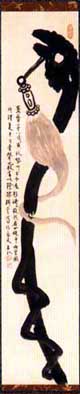
Hakuin's Dragon Staff Inka Scroll


Zen Master Hakuin (1686-1768) painted a Dragon Staff with a horsehair whisk attached.  He gave the above painting to a lay student who passed the Zen koan, "What is the sound of one hand clapping."
 

Tuesday, December 03, 2019

Taijiquan Cane Exercises


Taiji Yangsheng Zhang: Taiji Stick Qigong (Chinese Health Qigong)  By the Chinese Health Qigong Association.  Singing Dragon, 2014.  96 pages.  1 instructional DVD.  ISBN: 978-1848191945.  Brief history, warmup and cane handling, ten movement form.  VSCL.  

"A set of exciting and unusual Taiji Stick qigong exercises is presented in this accessible introduction. Embodying the concepts of taiji, the movements emphasize the harmony of yin and yang, man and nature. Appropriate for all levels of experience and for all age groups, this new set of easy-to-learn exercises distils the essence of traditional stick practice, guides body movements and the movement of the stick, and coordinates directed breathing and imagination. The book provides step-by-step, fully-illustrated instruction, and includes an account of the origins of the movements and guidance for practice. An accompanying DVD features a video demonstrating the form and additional information on its history and origins, and a CD provides options for verbal instructions to lead the practitioner through the exercises, or music to accompany them. The book is an authoritative resource that will help students and practitioners of taiji, qigong, martial arts and Chinese medicine perfect and deepen their practice. It is also an excellent practical introduction for anyone with an interest in the ancient health and martial practices of China. 


The Chinese Health Qigong Association is dedicated to the popularization of and research into Health Qigong, and is a group member of the All-China Sports Federation. Its aim is to promote and carry forward the Chinese traditional culture of health promotion and facilitate the communication between Western and Eastern Cultures."


The movements of the Taiji Yangsheng Zhang form are as follows:
Initial Stance and Opening
1.  Boatman Rows with an Oar  (Shao Gong Yao Lu)
2.  Boat Rows Slowly  (Qing Zhou Huan Xing)
3.  Wind Kisses the Lotus Leaves  (Feng Bai He Ye)
4.  Boatman Tows a Boat  (Chuan Fu Bei Qian)
5.  Iron Stick Calms the Sea  (Shen Zhen Ding Hai)
6.  Golden Dragon Wags Its Tai  (Jin Long Jiao Wei)
7.  Search for Treasure in the Sea  (Tan Hai Xun Bao)
8.  Qi Returns to the Dantian  (Qi Gui Dan Tian)
Closing and Ending Stance


"The Taiji Stick Health Preservation exercises embodies the concept of harmony between yin and yang, man and nature.  All the movements involved are soft and slow, and easy to practice.  This is not a "martial art," per se, and the stick is not wielded like a weapon.  In practicing with the Taiji Stick, we should twist, turn, bend, and stretch around the waist as a center, and move our spine accordingly.  In practicing with the Taiji Stick, we need to relax our waist and hips, and keep the body upright and comfortable, adjusting the movement of the waist in harmony with the use of the stick.  If we lift the stick, we need to sink the waist and lower the qi down to the Dantian (lower belly); and if we lower the stick, we need to straighten the waist and pull up the qi to the Baihui acupoint [top of the head].  If we rotate the stick in a circle, our waist becomes the anchor, moving our body and arms.  All this illustrates the pivotal role of the waist." p. 6.  

Moving from the waist is the "Torso Method" of Taijiquan practice.  The core (waist, hips, abdomen, back) must internally and externally initiate movement.


Tai Chi Chuan Cane

Way of the Short Staff

Staff Weapons

Taijiquan Practices


Thursday, November 07, 2019

Long Morning Walks


I enjoy walking in the early morning.  From 1998 to 2017 I walked on a country lane, Kilkenny Lane, directly in front of my home in Red Bluff, California.  This cul de sac lane is .32 miles from Highway 99W.  
Occasionally, a car might use this country lane, and I move to the side of the road.  It is a very safe, peaceful, and quiet place with lovely landscaping and dramatic views.

I walked an average of four days per week and walked from two to four miles in the cooler morning hours; when I was not working part-time for the Corning Union Elementary School District.  When cooler evenings were in season, I walked in the afternoon or evening.  At night and Saturday mornings I taught yoga, qigong, tai chi, and other fitness classes at the Tehama Family Fitness Center.  I walked on this road from June of 1998 until we moved to Vancouver, Washington, in April of 2017; nearly 19 years.  


"Putting facts by the thousands,
into the world, the toes take off
with an appealing squeak which the thumping heel
follows confidentially, the way men greet men.
Sometimes walking is just such elated
pumping."
-   Lyn Hejinian, Determination


"Every day, in the morning or evening, or both, take a walk in a safe and peaceful environment for less than an hour.  The can be a great fountain of youth.  Choose a place to walk that has no kind of disturbance.   Walking done in a work environment and when your mind is busy is different; it is not as nutritious as the walking you do for yourself in the morning or evening in a quiet, peaceful, and safe place."
-  Master Hua-Ching Ni, Entering the Tao, 1997, p. 135


Looking to the northeast on Kilkenny Lane.  Mt. Lassen (10,000 feet) in the distance is capped with a little snow.  Late Autumn.    


"Walking is the natural recreation for a man who desires not absolutely to suppress his intellect but to turn it out to play for a season."
- Leslie Stephen

"Our philosophies must be rewritten to remove them from the domain of words and "ideas," and to plant their roots firmly in the earth."
- William Vogt

"If you look for the truth outside yourself,
It gets farther and farther away.
Today walking alone, I meet it everywhere I step.
It is the same as me, yet I am not it.
Only if you understand it in this way
Will you merge with the way things are."
- Tung-Shan


`


Looking west on Kilkenny Lane.  The red leafed autumn colors are from Raywood Ash trees. The Yolly Bolly mountain range (7,000 feet) is to the west of the North Sacramento Valley.


"The interior solitude, along with the steady rhythm of walking mile after mile, served as a catalyst for deeper awareness.  The solitude I found and savored on the Camino had an amazing effect on me.  The busyness of my life slowly settled down as the miles went on.  For a good portion of my life I had longed for a fuller experience of contemplation, that peaceful prayer of the heart in which one is able to look intently and see each piece of life as sacred.  Ten days into the journey, totally unforeseen, the grace of seeing the world with startling lucidity came to me.  My eyes took in everything with wonder.  The experience was like looking through the lens of an inner camera – my heart was the photographer.  Colors and shapes took on nuances and depths never before noticed.  Each piece of beauty appeared to be framed: weeds along roadsides, hillsides of harvested fields with yellow and green stripes, layers of mountains with lines of thick mist stretching along their middle section, clumps of ripe grapes on healthy green vines, red berries on bushes, roses and vegetable gardens.  Everything revealed itself as something marvelous to behold.  Each was a work of art.  I noticed more and more details of light and shadow, lines and edges, shapes, softness, and texture.  I easily observed missed details on the path before me – skinny worms, worn pebbles, tiny flowers of various colors and shapes, black beetles, snails, and fat, grey slugs.  I became aware of the texture of everything under my feet – stones, slate, gravel, cement, dirt, sand, grass.  I responded with wonder and amazement.  Like the poet Tagore, I felt that everything “harsh and dissonant in my life” was melting into “one sweet harmony”."
-  Joyce Rupp  


In Vancouver, Washington, where we have lived since April of 2017, I walk on my suburban neighborhood streets with our dog Bruno.  I walk on Clark County trails, at local parks, along the Columbia, and indoors on tracks and treadmills.  In the photo below, my dog, Bruno, and I are walking at the nearby Orchards Community Park.  Lots of trees mean lots of cooler, foggier, rainy days in Southwestern Washington, west of the Cascades peaks like Hood, Adams, St. Helens, Rainer.  Orchards Park is adjacent to the I 205 Freeway, so it is far nosier walking here than in Red Bluff because of the surrounding automobile, truck, suburban, and PDX airport jet sounds.  Vancouver is the largest suburb north of Portland.  A busy and noisy area!


"As I went walking
That ribbon of highway
I saw above me
The endless skyway
I saw below me
The lonesome valley
This land was made for you and me."
- Woody Guthrie, This Land is Your Land


Compiled by Mike Garofalo


Fog in Red Bluff, CA


My walking path in October 2019


When I walk I nearly always walk with a wooden cane.  I keep one cane in my automobile at all times, and a number of canes and sticks around my home.  A stout wooden cane provides a modicum of self defense techniques, some balancing advantages, exercise for the arms, help for the knees, and looks cool.  Walking with a cane is carrying a potentially lethal weapon.  I've collected a lot of information on using a wooden cane in my hypertext notebook titled Way of the Short Staff.