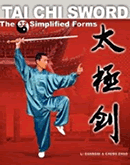
32 Sword Form, Simplified, Yang Style, Taijiquan Jian.
A webpage by Michael P. Garofalo.
A webpage by Michael P. Garofalo.
This popular webpage includes a comprehensive bibliography, scores of links to webpages; an extensive listing of the names and name variations for each movement in English, Chinese, French, German, and Spanish; a detailed analysis of each posture and movement sequence with explanations and numbered illustrations and detailed instructions; selected quotations; comments on 20 Taijiquan sword techniques; a comprehensive media bibliography; a chart of performance times; recommendations for starting to learn this form at home one your own with instructional DVDs, books and practice methods; and, a comparison of the 32 and 55 sword forms in the Yang style.
This is the standard, simplified, orthodox, 1957, 32 Taiji Sword Form, in the Yang Style of T'ai Chi Ch'uan.
32 Sword Form Pamphlet by Geoffrey Hugh Miller. Adapted from information and graphics found on the 32 Sword Form webpage by Michael P. Garofalo. 22 pages, 9/7/2015, PDF Format. Excellent job by Mr. Miller. This is a handy practice tool.
Read about the Taoist magical sword finger hand sign:
"The sword finger hand sign is to draw your own magic power to the fingers and output a beam of energy for doing Taoist magic. This beam of magical power isn’t just an imaginary thing, it’s a real visible beam if you can see it. Some of my students can see the beam of energy beams out like a long laser from the tip of the finger and extend all the way to the wall or somewhere far away. The beam is a beam a the magic power from one doing the handsign. This beam of power can be used for drawing FUs in the air, killing evils, doing magic in magic battles, healing or even saving lives! This is like a multi-usage tool, which can be a pen, a chisel, a phone, or even a drill, it all depends on how you use it and what adaptor you put on it to make it function differently. The most commonly seen usage of this handsign in Tin Yat Lineage is by drawing Taoism FU in the air or on the incense. This allow you to “carve” the Taoism FU into the object or in the air to perform magic."
Read about the Taoist magical sword finger hand sign:
"The sword finger hand sign is to draw your own magic power to the fingers and output a beam of energy for doing Taoist magic. This beam of magical power isn’t just an imaginary thing, it’s a real visible beam if you can see it. Some of my students can see the beam of energy beams out like a long laser from the tip of the finger and extend all the way to the wall or somewhere far away. The beam is a beam a the magic power from one doing the handsign. This beam of power can be used for drawing FUs in the air, killing evils, doing magic in magic battles, healing or even saving lives! This is like a multi-usage tool, which can be a pen, a chisel, a phone, or even a drill, it all depends on how you use it and what adaptor you put on it to make it function differently. The most commonly seen usage of this handsign in Tin Yat Lineage is by drawing Taoism FU in the air or on the incense. This allow you to “carve” the Taoism FU into the object or in the air to perform magic."

The Wild Horse Jumps Over the Mountain Stream
"Mike, I wonder if you could give your thoughts on something. For years I’ve been practicing 3. The Swallow Skims Across the Water with the left hand moving in a similar fashion to 5. Block and Sweep to the Left i.e. the little finger side of the hand brushing the left hip before raising above the head. I’ve recently got a book by Li Deyin which has his daughter Faye Yip performing it slightly differently. She points her fingers backwards with the back of the hand brushing the hip and mentions it in the essential points for the movement. Looking at videos on the internet they all seem to be similar to Faye Yip. Would you mind if I asked how you practice?"
- A question from Simon Ellis, UK, 9/2/2015
Simon, I have found that the details of bodily positions for any Taijiquan movement vary somewhat according to the following standards:
1. Competition standards. If you are preparing to compete in a Taijiquan event, then carefully study the standards for the forms you are performing. In the case of the 32 sword form, check out books and DVDs by Li Deyin or his heirs.
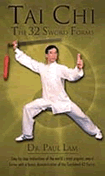
2. Your teacher's standards. If you are working closely with a Taijiquan teacher, then follow their instructions. This simplifies your learning, and shows respect for the teacher. Since I learned the 32 sword from the instructional DVD by Dr. Paul Lam, I practice this form in a manner fairly close to his instructions.
3. Your personal standards. If you have been practicing for many years, mostly alone, then more variations in bodily positions will likely emerge. Sensibly, as we age, we make adaptations in our Taijiquan form work to safely accommodate our declining physical abilities.
As for how I practice, I'm rather unconcerned about details, a bit careless, playful, free, and seldom do things exactly the same way. I just like skimming across the water, and leave the details about how to flap my wings to others. Call me a lazy dilettante Daoist, with a penchant for ziran. I don't often practice with a sword or saber anymore─ I only wield my sturdy cane.
As I recall, the front of my left hand crosses my waist while going to 3c; and, more important, I still make that magical Taoist sword finger hand sign with my left hand while doing this form.
I think that modeling your performance on the standards set by Master Faye Yip's 32 Sword form instructions and demonstration would result in much grace, improved strength, and a beautiful style.
Best wishes! Mike. 9/8/2015
"Mike, I wonder if you could give your thoughts on something. For years I’ve been practicing 3. The Swallow Skims Across the Water with the left hand moving in a similar fashion to 5. Block and Sweep to the Left i.e. the little finger side of the hand brushing the left hip before raising above the head. I’ve recently got a book by Li Deyin which has his daughter Faye Yip performing it slightly differently. She points her fingers backwards with the back of the hand brushing the hip and mentions it in the essential points for the movement. Looking at videos on the internet they all seem to be similar to Faye Yip. Would you mind if I asked how you practice?"
- A question from Simon Ellis, UK, 9/2/2015
Simon, I have found that the details of bodily positions for any Taijiquan movement vary somewhat according to the following standards:
1. Competition standards. If you are preparing to compete in a Taijiquan event, then carefully study the standards for the forms you are performing. In the case of the 32 sword form, check out books and DVDs by Li Deyin or his heirs.
2. Your teacher's standards. If you are working closely with a Taijiquan teacher, then follow their instructions. This simplifies your learning, and shows respect for the teacher. Since I learned the 32 sword from the instructional DVD by Dr. Paul Lam, I practice this form in a manner fairly close to his instructions.
3. Your personal standards. If you have been practicing for many years, mostly alone, then more variations in bodily positions will likely emerge. Sensibly, as we age, we make adaptations in our Taijiquan form work to safely accommodate our declining physical abilities.
As for how I practice, I'm rather unconcerned about details, a bit careless, playful, free, and seldom do things exactly the same way. I just like skimming across the water, and leave the details about how to flap my wings to others. Call me a lazy dilettante Daoist, with a penchant for ziran. I don't often practice with a sword or saber anymore─ I only wield my sturdy cane.
As I recall, the front of my left hand crosses my waist while going to 3c; and, more important, I still make that magical Taoist sword finger hand sign with my left hand while doing this form.
I think that modeling your performance on the standards set by Master Faye Yip's 32 Sword form instructions and demonstration would result in much grace, improved strength, and a beautiful style.
Best wishes! Mike. 9/8/2015


 By Willard Spiegelman. The seven simple pleasures discussed are: dancing, reading, walking, looking, listening, swimming, and writing. If you included
  By Fred Feldman. Clarendon Press, 2006. 240 pages. ISBN: 978-0199297603. VSCL.
 By Willard Spiegelman. The seven simple pleasures discussed are: dancing,
reading, walking, looking, listening, swimming, and writing. If you
included
By Willard Spiegelman. The seven simple pleasures discussed are: dancing,
reading, walking, looking, listening, swimming, and writing. If you
included  By Fred Feldman. Clarendon Press, 2006. 240 pages. ISBN:
978-0199297603. VSCL.
By Fred Feldman. Clarendon Press, 2006. 240 pages. ISBN:
978-0199297603. VSCL.