Showing posts with label Philosophy. Show all posts

Friday, May 22, 2026

Pulling Onions Again

Freedom opens a few doors and closes many more. 
My mind is a sea I cannot see into; I merely skim along its surface.
I think, therefore I am a living person; dead bodies don't display thinking, just stinking.
Sometimes the present alters our interpretation of the past; most often the past surrounds and infects the present. 
Wherever I go, something new becomes me. 
Be careful not to stand up for that which will cause your downfall.    
God may be very smart, but he is a poor communicator.
What ought to be cannot be derived from what is the case, but a reasonable person ought not to ignore what is the case.  
I can admire a few great persons or heroes, but seldom have much desire to try and imitate them. 
Disrespect and contempt for the body is a common trump card for spiritualists; but, our game of life does not use trump cards. 
Nonsense can sometimes improve our sense and senses. 
Prohibitions focus our aim on better choices and actions. 
Don't sell the present short on the promises of "when." 
Most tire from hatefulness; cheerfulness is abiding.
Stubborn facts are loosened up with novelty.
A sure path to the perversion of truth is to make it a belief. 
The act, the deed, the doing are the primary considerations. 
My body gave birth to my mind, is in my mind, and my body-mind thrives in our world of lived experiences. 
Objectivity is a product of our agreements, and an important feature of my imagination. 
R. Buckminster-Fuller once suggested that "God is a verb, not a noun."  Which verb?  Pretending?  Storytelling?  Fantasizing?  Believing? 
My consciousness is a vegetable soup, and the water in the soup is what I do. 
Yes, I am just this and that; but, I am also not just that and this. 
Hearing the cat purr when we pet them gently matters far more to us than whether the cat's fur is black, white, or orange. 
If you think you are damned if you do or damned if you don't, your not thinking creatively enough. 
The ten thousand things are more enchanting than the Silent One. 
To lift the mind, move the body.  

Pulling Onions: The Quips and Sayings of an Old Gardener.  Over 840 quotes.  By Mike Garofalo


Saturday, April 18, 2026

Speaking of Time: The Poetic Investigations

 The Tick-Tock Tractatus

Speaking of Time: The Poetic Investigations

By Michael P. Garofalo


        August Offerings, Red Bluff CA, 2010, MPG


Sections

1. Time: time-space, movement, measurement

2. Past: memories, habits, fixed, specific, tradition

3. Present: now, here-now, day, duration

4. Future: maybe, planned, anticipated, uncertain

5. Passing: change, cycles, aging, growth, death

6. Beginning: renewal, starting, enthusiasm

7. Psychology: learning, experience, knowing

8. Middle: in progress, half-way, steady, living

9. Language: poetry, philosophy, ordinary

10. Silence: inexpressive, nonsense, illogical

11. Mystical: numinous, profound, intense, insightful,

12. Beauty: art, crafts, music, reading/writing

13. Social: ethics, morality, economics, manners, value

14. Philosophy: ethics, history, analysis, arguments, logic

15. History: landmark events, books/printing, memory

16. Eternity: forever, infinite, unimaginable, death


Preface

Key to Books Cited

Bundled Up Quintains about Time

Additional Notes


12.6

The Gardening Sutra: Excerpts

Pulling Onions


A garden recreates itself daily; we seldom step in the
     same garden thrice.
We don't erase the past, we just build more and bigger blackboards.
The present is made from the past.
Time creeps, walks, runs and flies - it is all about moving things.
Chaos breaks its own rules to allow Order to play.

How can gardening be considered a "leisure time" activity?
Always leave extra time for unraveling the hose.
Gardeners turn into the soil their lifetime.
Time may wait for no man, but seems to muddle and poke
     quite slowly for gardeners.
Springtime for birth, Summertime for growth;
     and all Seasons for dying.


Put the right plant in the right place at the right time in
     the right way - and you won't go wrong.
Winter does not turn into Summer; ash does not turn
     into firewood - on the chopping block of time.
A garden flourishes in the mind's time of last season,
     next season, and now.
Gardening requires no commuting time.
In the right place at the right time,
     tomato worms on tomato vines.

Your pocket knife will be its dullest at just the right time.
Gardening is the right sport for a lifetime of pleasures.
Gardening sometimes takes a few hours of a day,
     but adds weeks of pleasure to your life.
The time you have wasted on your garden
     is what makes it priceless.
One purpose of a garden is to stop time in one place.


Annuals disappear, shrubs perish, trees die, and
     gardeners are buried; death is the flower of time.
In an instant there is nothing - Time produces Nature.
By the time you peel off five layers of reality,
     it's hard to recall the first.
It's a long time between my garden and the Pacific Ocean.
Time will tell, but we often fail to listen.


The "eternal truths" are sometimes clearly false.
Gardening teaches us to take our time, slow down,
     and wait in peace.
Gardeners learn to live in worm time, bee time, and seed time.
Time will not pass you, but it will follow very close behind you.
Preparation and follow up take up more time than doing the deed.

Springtime flows in our veins.
Silence - never misquoted, sometimes misunderstood,
     often meaningful.
Leave enough time for some pointless behavior
     to reveal your deeper desires.
The seed idea for "God" is springtime.
Things always go downhill, fall apart, wear out...
     the arrow of Time pierces everything.


Time prevents too much from happening at once.
A million years and a second have the same
     feeling for the dead gardener.
All metaphors aside - only living beings rise up in the Springtime;
     dead beings stay quite lie down dead.
Any gardener who is not using the scientific method
     will waste time and money.
Take the time to melt into the Details.

Time is rooted in Place.
Most of the time, we just borrow from the past.
Sometimes the present alters our interpretation of the past;
     most often the past surrounds and infects the present.
Time is on your side when you are young.
Leisure can open a window to the breezes of insights,
     and a clear view of the Trees of Time.

We get things done when there is little time left.
Our cash limits and time constraints both prune our gardens.
The second hand of time ticks on---
     measuring our past, time after time.
Beings are Becomings---for the time-being.

Perfection can be the opponent of betterment.
Without vagueness we are bored with literalness.
Borderline cases are where events become really interesting.
I may not be able to precisely define religious nonsense,
     but I know it when I hear it.

A coastline may be impossible to measure,
     but is still beautiful.
You can’t slowly boil the frog unless
     it can’t jump out of the pot.
A “heap” of something desired becomes an issue
     when the price is discussed.
Gratefully, shit happens!
The ten thousand things are more enchanting
     than the Silent One.


Walking needs earth, space, and the walker.
Sometimes, just one 'thing' is critical
     because twenty other 'things' are just so.
Gardening is a kind of deadheading---
     keeping us from going to seed.
Don't interfere, be still, and listen to the litanies of bees.

Tooth and nail, and the stench of a dead animal on the wind.
When life gives you onions, it stinks.
A rake is spaces held together by steel.
In the student's mind there are few possibilities,
     in the teacher's mind there are many;
          but only time to realize very few.


Mother Nature is always pregnant.
Time creeps, walks, runs and flies -
     it is all about moving things.
Dogmatists are less useful than dogs.
Take life with a grain of salt, and a icy margarita.
The best things in life are more expensive than you think.

Rather than "love mankind," I'd rather admire a few good people.
Some flourish when crowded together, others don't.
Garbage In, Compost Out.
It is more about You and Now, rather than Them and Back Then.


While gardening the borders between work
     and play become blurred.
When gardening, look up more often.
Just the right words can be worth more
     than a thousand pictures.
Death's door is always unlocked.
A flower needs roots; beauty a society of minds.


A callused palm and dirty fingernails precede a Green Thumb.
A working hypothesis is far better than a belief.
Only two percent of all insects are harmful.
Why are they all in my garden?
Create your own garden, the god's certainly won't.
That something is eternal is unverifiable.

Most laws of Gardening are merely local ordinances.

Too save some time, don’t let them get a foot in the door.
Some slippery slopes are actually improvements or fun.
Butterflies and bees flapping their wings don’t actually
     create hurricanes, but we are very thankful they facilitate
     the emergence of fruits in the billions.
Without metaphors we can barely speak.


Just because you reject the big request, don’t be
     fooled into accepting the smaller request.
Finding a middle ground for agreement may
     be just half of a solution, and the wrong solution.
Sometimes the wisdom of the crowd is quite unwise and unfair.

Chaos breaks its own rules to allow Order to play.

Failures, disorder and death are the
     Grim Reaper of Entropy at work.
Somehow, someway, everything gets eaten up, someday.
The meaning is lost in the saying - a nature mystic's dilemma.
Vigorous gardening might help more than a psychiatrist's couch.
A gardener is no farmer, he is much too impractical.

No garden lasts for long - neither will you.

Shade, in the summer, is as precious as a glass of water.
A wise gardener knows when to stop.
Gardens are demanding pets.
Unclench your fist to give a hand.
The little choices day after day are the biggest issue.


Gardening is but one battle against Chaos.
When life gives you onions, you ain't making lemonade.
Many friendships are sustained by a mutual
     hatred of another person or group.
Read until you go to seed.
What you see depends on when you look.

Beauty is the Mistress, the gardener her slave.

One's "true self" is changing and elusive.
A little of this and a little of that, and some exceptions -
     these are the facts.
Does a plum tree with no fruit have Buddha Nature? Whack!

BU3152, BU929, GC#9

Pulling Onions by Mike Garofalo
     Over 1,000 random quips, one-liners, sayings,
     and "insights" from an old gardener.

Process Philosophy

The History of Gardening: A Timeline From Ancient Times to 2000

The Spirit of Gardening

Months and Seasons


Monday, March 02, 2026

Lessons from Paulo Coelho

 I found this information about Paulo Coelho on a recent post to Facebook.  Since I have not read this book, I am unsure as to the correctness of this post.  However, it does fit with the messages of positive psychology and practical philosophy that I have studied by other authors.  

How to Live a Good Life: Advice from Wise Persons
Compiled by Michael P. Garofalo


10 Top Lessons
From he Book The Alchemist

A book by Paulo Coelho


1. Fear is a bigger obstacle than the obstacle itself

"Tell your heart that the fear of suffering is worse than the suffering itself.

And that no heart has ever suffered when it goes in search of its dreams."

Any new pursuit requires entering uncharted territory -- that's scary. But with any great risk comes great reward.

The experiences you gain in pursuing your dream will make it all worthwhile.


2. What is "true" will always endure

"If what one finds is made of pure matter, it will never spoil. And one can always come back.

If what you had found was only a moment of light, like the explosion of a star, you would find nothing on your return."

~ Truth cannot be veiled by smoke and mirrors -- it will always stand firm.

~ When you're searching for the "right" decision, it will be the one that withstands the tests of time and the weight of scrutiny.


3. Break the monotony

"When each day is the same as the next, it's because people fail to recognize the good things that happen in their lives every day that the sun rises."

~ Gratitude is the practice of finding the good in each day.

~ Life can easily become stagnant, mundane, and monotonous, but that changes depending on what we choose to see.

~ There's always a silver lining, if you look for it.


4. Embrace the present

"Because I don't live in either my past or my future. I'm interested only in the present.

If you can concentrate always on the present, you'll be a happy man."

~ There's no point dwelling in the past and letting it define you, nor getting lost and anxious about the future. But in the present moment, you're in the field of possibility

~ How you engage with the present moment will direct your life.


5. Your success has a ripple-effect

"That's what alchemists do. They show that, when we strive to become better than we are, everything around us becomes better, too."

~ Growth, change, and evolution are weaved into the fabric of reality.

~ Becoming a better version of yourself creates a ripple effect that benefits everything around you: your lifestyle, your family, your friends, your community.


6. Make the decision

"When someone makes a decision, he is really diving into a strong current that will carry him to places he has never dreamed of when he first made the decision."

~ It's easy to get overwhelmed by the unknowns and finer details of your dreams.

~ Actions will flow out of having confidence in your decision; sitting on the fence will get you nowhere.


7. Be unrealistic

"I see the world in terms of what I would like to see happen, not what actually does."

~ Some of the greatest inventions would not have happened if people chose to accept the world as it is.

~ Great achievements and innovations begin with a mindset that ignores the impossible.


8. Keep getting back up

"The secret of life, though, is to fall seven times and to get up eight times."

Because the eighth time could be your breakthrough.

Some of the greatest novels in history were published after receiving hundreds of rejections. Thankfully, those authors never gave up.


9. Focus on your own journey

"If someone isn't what others want them to be, the others become angry.

Everyone seems to have a clear idea of how other people should lead their lives, but none about his or her own."

~ It's easy to be influenced by others, but you'll be miserable if you end up living someone else's life.

~ There's nothing wrong with taking advice and learning from others, but make sure it aligns with your desires and passions.


10. Always take action

"There is only one way to learn. It's through action. 


Tuesday, December 23, 2025

Critical Thinkers - Who Are They?

 Who is a Good Critical Thinker?


"Today, especially, we all need to become philosophers, to develop a philosophical framework.  Critical thinking is a modern reworking of a philosophical perspective.  Who would you identify as expert critical thinkers?  To qualify, the people you identify should have lively, energetic minds that generally display the following qualities:

Open-minded: In discussions they listen carefully to every viewpoint, evaluating each perspective carefully and fairly.

Knowledgeable: When they offer an opinion, it's always based on facts or evidence.  On the other hand, if they lack knowledge of the subject, they acknowledge this.

Mentally Active: The take initiative and actively use their intelligence to confront problems and meet challenges, instead of simply responding to events.

Curious: They explore situations with probing questions that penetrate beneath the surface of issues, instead of being satisfied with superficial explanations.

Independent Thinkers: They are not afraid to disagree with the group opinion.  The develop well-supported beliefs through thoughtful analysis, instead of uncritically "borrowing" the beliefs of others or simply going along with the crowd.

Skilled Discussants: They are able to discuss ideas in and organized and intelligent way.  Even when the issues are controversial, they listen carefully to opposing viewpoints and respond thoughtfully.

Insightful: They are able to get to the heart of the issue or problem.  While others may be distracted by details they are able to zero in on the essence, seeing the "forest" as well as the "trees."

Self-aware: They are aware of their own biases and are quick to point them out and take them into consideration when analyzing a situation.

Creative: They can break out of established patterns of thinking and approach situations from innovative directions.

Passionate: They have a passion for understanding and are always striving to see issues and problems with more clarity."

-  John Chaffee, The Thinker's Way: 8 Steps to a Richer Life, 1998, p.36


The Thinker's Way: 8 Steps to a Richer Life (Think Critically, Live Creatively, Choose Freely).  By John Chaffee, Ph.D.  Boston, Little, Brown and Co, c1998.  Index, recommended reading, 420 pages. VSCL. 


Thinking Critically.  By John Chaffee, Ph.D.  Boston, Wadsworth Pub., 2012.  10th Edition.  Index, glossary, 575 pages.  John Chaffee, Ph.D., is a professor of philosophy at The City University of New York, where he has developed a popular Critical Thinking program.  VSCL. 


How to Live a Good Life: Advice from Wise Persons


Tuesday, October 28, 2025

B. K. S. Iyengar and Yoga


Iyengar, B.K.S.  1918-2014 Yogacharya Iyengar

The renowned Yoga Grand Master (Yogacharya) B. K. S. Iyengar was born in Bellur, Karnataka, India on December 14, 1918; and died at the age of 96 on August 20, 2014..  He has taught in Pune, India, since 1936; and all around the world.  "Bellur Krishnamachar Sundararaja Iyengar, (B. K. S. Iyengar)  is the founder of Iyengar Yoga. He is considered one of the foremost yoga teachers in the world and has been practicing and teaching yoga for more than 75 years. He has written many books on yoga practice and philosophy, and is best known for his books Light on YogaLight on Pranayama, and Light on the Yoga Sutras of Patanjali.  Iyengar yoga classes are offered throughout the world, and it is believed that millions of students practice Iyengar Yoga." 


Light on Life: The Yoga Journey to Wholeness, Inner Peace, and Ultimate Freedom  By B.K.S. Iyengar.  With John J. Evans and Douglas Abrams.  Rodale Books, 2005.  Index, 282 pages.  ISBN: 1594862486.  VSCL. 


Light on Prānāyāma: The Yogic Art of Breathing  By B.K.S. Iyengar.  Introduction by Yehudi Menuhin.  New York, Crossroad Pub. Co., 2012.  Originally published in 1985 in English.  Index, glossary, appendices, 296 pages.  ISBN: 9780824506865.  VSCL.


Light on the Yoga Sutras of Patanjali.   By B. K. S. Iyengar.  Foreword by Yehudi Menuhin.  London, Thorsons, 1993.  Index, 337 pages.  ISBN: 1855382253.  VSCL. 


Light on Yoga: Yoga Dipika.   
B.K.S. Iyengar.  New York, Schocken Books, 1966, Revised Edition 1977, 1979.  Glossary, index, 544 pages.  ISBN: 0805210318.   Subtitle: Yoga Dipika.  I own the revised paperback edition, 1979.  VSCL.   

 
Yoga: The Path to Holistic Health  By B.K.S. Iyengar.  London, Dorling Kindersley, 2001.  Index, glossary, appendices, 415 pages.  ISBN: 0789471655.  
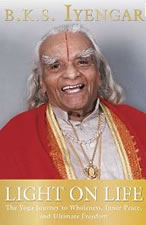
Lavishly illustrated compendium of essential poses, routines, prop use, and yoga routines to help specific health problems.  VSCL.   


Books by "Iyengar Yoga" Teachers


Yoga: The Iyengar Way.  By Mira Silva and Shyam Mehta.  New York, Alfred A. Knopf, 1995.  Index, appendices, 192 pages.  ISBN: 0679722874.  A very good reference tool for the study and practice of yoga poses.  VSCL. 


Iyengar Yoga Institute of San Francisco


Thursday, October 23, 2025

Somatic Intelligence

I have learned and benefited greatly from reading and studying the following three books:


Awakening Somatic Intelligence: The Art and Practice of Embodied Mindfulness    By Risa F. Kaparo, Ph.D.  Berkeley, California, North Atlantic Books, 2012.  Index, 368 pages.  ISBN: 978-1583944172.  Subtitle: Transform Pain, Stress, Trauma, and Aging.  VSCL.  

Philosophy in the Flesh : The Embodied Mind and Its Challenge to Western Thought.  By George Lakoff and Mark Johnson.  Basic Books, Perseu Books, 1999.  Index, bibliography, 624 pages.  ISBN: 0465056741.   "The mind is inherently embodied.  Thought is mostly unconscious.  Abstract concepts are largely metaphorical."  VSCL.

Mindfulness Yoga: The Awakened Union of Breath, Body, and Mind.   By Frank Jude Boccio.   Boston, MA, Wisdom Publications.  Index, bibliography, notes, 340 pages.  ISBN: 0861713354.  VSCL.   


Somaesthetics, Body-Mind Practices, Embodiment Arts:  Quotations, Facts, Information, Bibliography, Resources

Valley Spirit Yoga

Qigong (Chi-King) Mind-Body Practices


Sunday, October 05, 2025

Ten Golden Rules

 Ten Golden Rules for Living the Good Life

  
“1. Examine life, engage life with vengeance; always search for new pleasures and new destines to reach with your mind.

 2.  Worry only about the things that are in your control
the things that can be influenced and changed by your actions, not about the things that are beyond your capacity to direct or alter.  

 3.  Treasure Friendship, the reciprocal attachment that fills the need for affiliation. Friendship cannot be acquired in the market place, but must be nurtured and treasured in relations imbued with trust and amity.  

 4.  Experience True Pleasure
Avoid shallow and transient pleasures. Keep your life simple. Seek calming pleasures that contribute to peace of mind. True pleasure is disciplined and restrained.  

 5.  Master Yourself. Resist any external force that might delimit thought and action; stop deceiving yourself, believing only what is personally useful and convenient; complete liberty necessitates a struggle within, a battle to subdue negative psychological and spiritual forces that preclude a healthy existence; self mastery requires ruthless cador.  

 6.  Avoid Excess. Live life in harmony and balance. Avoid excesses. Even good things, pursued or attained without moderation, can become a source of misery and suffering.  

 7.  Be a Responsible Human Being
Approach yourself with honesty and thoroughness; maintain a kind of spiritual hygiene; stop the blame-shifting for your errors and shortcomings.  

 8.  Don’t Be a Prosperous Fool. Prosperity by itself, is not a cure-all against an ill-led life, and may be a source of dangerous foolishness. Money is a necessary but not a sufficient condition for the good life, for happiness and wisdom.  

 9.  Don’t Do Evil to Others. Evildoing is a dangerous habit, a kind of reflex too quickly resorted to and too easily justified that has a lasting and damaging effect upon the quest for the good life. Harming others claims two victims—the receiver of the harm, and the victimizer, the one who does harm.  

 10.  Kindness towards others tends to be rewarded
Kindness to others is a good habit that supports and reinforces the quest for the good life. Helping others bestows a sense of satisfaction that has two beneficiaries—the beneficiary, the receiver of the help, and the benefactor, the one who provides the help.” 


-   By M. A. Soupious and Panos Mourdoukoutas, The Ten Golden Rules: Ancient Wisdom from the Greek Philosophers on Living the Good Life, 2009. 


Sunday, July 13, 2025

Doubting Might Be a Good Tactic


"The problem with the world is that the intelligent people are full of doubts and the stupid ones are full of confidence."
- Charles Bukowski


"The fundamental cause of the trouble in the modern world is that the stupid are cocksure while the intelligent are full of doubt."
- Bertrand Russell


“I like the scientific spirit—the holding off, the being sure but not too sure, the willingness to surrender ideas when the evidence is against them: this is ultimately fine—it always keeps the way beyond open—always gives life, thought, affection, the whole man, a chance to try over again after a mistake—after a wrong guess.” 
- Walt Whitman

“Tell people there's an invisible man in the sky who created the universe, and the vast majority will believe you. Tell them the paint is wet, and they have to touch it to be sure.”
-  George Carlin

“Doubt is an uncomfortable condition, but certainty is a ridiculous one.”
-  Voltaire


An Old Philosopher's Notebooks   
By Michael Garofalo

Pragmatism and American Philosophy

Reasonable vs Unreasonable Doubt

Friday, June 06, 2025

Epicurean Wisdom

 I think that Professor Catherine Wilson has a through understanding of Epicurean history and philosophy.  She provides many key insights into how to we might reflect on our lives today, using Epicurean ideas and principles.  Her writing is clear, balanced, and uplifting.  

 How to be an Epicurean: The Ancient Art of Living Well.  By Catherine Wilson, Ph.D.  New York, Basic Books, 2019.  293 pages, notes.  An excellent book for the lay reader with an inquiring mind ready to consider Epicurean viewpoints on a variety of modern issues.  VSCL. 

Epicureanism at the Origins of Modernity  By Catherine Wilson.  Oxford University Press, 2008.  320 pages.  ISBN:  978-0199238811.  A study of Epicurean influences on many of the ideas that pervaded seventeenth and eighteenth century metaphysics, epistemology, ethics, and natural and political philosophy.  VSCL. 

Epicureanism: A Very Short Introduction   By Catherine Wilson.  Oxford University Press, 2016.  144 pages.  ISBN: 9780199688326.  VSCL.

I have prepared a hypertext document on Epicureanism that includes a bibliography, quotations, links, references, and notes.  


Wednesday, April 30, 2025

Little Tricks for Getting By Well

How To Live

"Don't Worry About Death
Pay Attention
Be Born
Read at lot, forget most of what you read, and be slow-witted
Survive love and loss
Use little tricks
Question Everything
Keep a private room behind the shop
Be convivial: live with others
Wake from the sleep of habit
Live temperately
Guard your humanity
Do something no one has done before
See the world
Do a good job, but not too good a job
Philosophize only by accident
Reflect on everything; regret nothing
Give up control
Be ordinary and imperfect
Let life be its own answer"


-  Summary of some of the views of Michel de Montaigne (1533-1592) by Sarah Bakewell in How to Live: Or A Life of Montaigne in One Question and Twenty Attempts at an Answer, 2010.    


How to Live a Good Life: Advice from Wise Persons

Green Way Research

A Philosopher's Notebooks by Mike Garofalo


Currently, I am reading the excellent biography of Michel de Montaigne by Sarah Blackwell.  I first read Montaigne back in 1964.  Now, in 2015, in my own semi-retirement, I find rereading Montaigne's reflections in his "retirement" on his own life, times, experiences, thoughts, and feelings to be intellectually stimulating.  Intellectual history and biographies are some of my main reading interests.  


The Essays by Michel de Montaigne (1533-1592)  Translated by Donald M. Frame.  New York, Everyman's Library, 2003.  I own the complete works by Montaigne in a Kindle digital version for easier reading.  1392 pages.  ISBN: 1400040213.  VSCL.


How to Live: Or A Life of Montaigne in One Question and Twenty Attempts at an Answer  By Sarah Bakewell.  New York, Other Press, 2010.  Index, bibliography, notes, 399 pages.  ISBN: 9781590514832.  VSCL.


Sunday, March 23, 2025

Don't Draw Attention to Yourself

"The most well-known Epicurean verse, which epitomizes his philosophy, is "lathe biōsas λάθε βιώσας "(Plutarchus De latenter vivendo 1128c; Flavius Philostratus Vita Apollonii 8.28.12), meaning "live secretly", "get through life without drawing attention to yourself", i. e. live without pursuing glory or wealth or power, but anonymously, enjoying little things like food, the company of friends, etc."

Epicurus, 341-270 BCE

Epicurean Philosophy Online

Epicurean History

How to Live a Good Life: Lifestyle Advice from Wise Persons

Taoism  


Epicureanism   A hypertext notebook by Mike Garofalo.  

From a Letter to William Short by Thomas Jefferson, 1819

"I take the liberty of observing that you are not a true disciple of our master Epicurus, in indulging the indolence to which you say you are yielding. One of his canons, you know, was that "that indulgence which prevents a greater pleasure, or produces a greater pain, is to be avoided." Your love of repose will lead, in its progress, to a suspension of healthy exercise, a relaxation of mind, an indifference to everything around you, and finally to a debility of body, and hebetude of mind, the farthest of all things from the happiness which the well-regulated indulgences of Epicurus ensure; fortitude, you know is one of his four cardinal virtues. That teaches us to meet and surmount difficulties; not to fly from them, like cowards; and to fly, too, in vain, for they will meet and arrest us at every turn of our road. Weigh this matter well; brace yourself up ..."


Syllabus of the doctrines of Epicurus (By Thomas Jefferson)

"Physical.—The Universe eternal.

Its parts, great and small interchangeable.

Matter and Void alone.

Motion inherent in matter which is weighty and declining.

Eternal circulation of the elements of bodies.

Gods, an order of beings next superior to man, enjoying in their sphere, their own felicities;
but not meddling with the concerns of the scale of beings below them.

Moral.—Happiness the aim of life.

Virtue the foundation of happiness.

Utility the test of virtue.


Pleasure active and In-do-lent.

In-do-lence, is the absence of pain, the true felicity.

Active, consists in agreeable motion; it is not happiness, but the means to produce it.

Thus the absence of hunger is an article of felicity; eating the means to obtain it.

The summum bonum is to be not pained in body, nor troubled in mind.

i.e. In-do-lence of body, tranquillity of mind.

To procure tranquillity of mind we must avoid desire and fear, the two principal diseases of the mind.

Man is a free agent.

Virtue consists in 1) Prudence. 2) Temperance. 3) Fortitude. 4) Justice." 


The Spirit of Gardening


Saturday, February 08, 2025

We Are Better Satisfied in Particulars

"Science and psychoanalysis apart, the most profound development in thought since Nietzsche, as far as we are concerned, is the phenomenological approach to the world.  Mallarmé sought "words without wrinkles," Baudelaire cherished his minutes heureuses and Valéry his "small worlds of order," as we have seen: Checkhov concentrated on the "concrete individual" and preferred "small scale and practical answers," Gide though the "systematizing is denaturing, distorting and impoverishing."  For Oliver Wendell Holmes, "all the pleasure of life is in general ideas, but all the use of life is in specific solutions."  Wallace Stevens considered that we are "better satisfied in particulars."  Thomas Nagel put it in this way: "Particulars things can have a noncompetitive completeness which is transparent to all aspects of the self.  This also helps to explain what the experience of great beauty tends to unify the self: the object engages us immediately and totally in a way that makes distinctions among points of view irrelevant."  Or, as Robert Nozick, who counseled us to make ourselves "vehicles" for beauty, said: "this is what poets and artists bring us―the immense and unsuspected reality of a small thing.  Everything has its own patient entityhood."  George Levine call for "a profound attention to the details of this world."
-  Peter Watson, "The Age of Atheists: How We Have Sought to Live Since the Death of God," p.536

"The idea of one overbearing truth is exhausted."
- Thomas Mann, translated by James Wood  

"My religion consists of a humble admiration of the illimitable superior spirit who reveals himself in the slight details we are able to perceive with our frail and feeble mind."
-  Albert Einstein

"To study the self is to forget the self.  To forget the self is to be enlightened by the ten thousand things."
-  Zen Master Dogen

"The more we understand individual things, the more we understand God."
-  Benedict De Spinoza

"God is in the details."
-  Mies Van Der Rohe

"After appreciating and understanding thousands of the details, a common variety God is really superfluous."
-  Mike Garofalo

"Caress the detail, the divine detail."
-  Vladimir Nabokov

"Details are all there are."
-  Maezumi Roshi

"We think in generalities, but we live in details."
-  W.H. Auden


Gardening and Religion

Tuesday, February 04, 2025

Subject Index to 813 Stoic Lessons, Discourses, and Letters

Subject Index to 813 Stoic Lessons, Discourses, and Letters

Indexing by Michael P. Garofalo
First Draft, July 23, 2023. Updated Quarterly.  30 Pages.
Green Way Research, Vancouver, Washington


Daily Stoic 366 Lessons Philosophy (STOA)

Epictetus 95 Discourses (EPI)

Fireplace Records 30 Chapters (TFR)

Meditations Marcus Aurelius (AUR)

Philosopher's Garden of Insights (PG)

Seneca 124 Letters (SEN)


Lessons, Letters, and Discourses from Stoics:
https://www.egreenway.com/buddhism/koans.htm


Subject Index to 3.855 Lessons From
Zen Buddhists, Stoics, and Solitary Taoists

Subject Index to 1,685 Zen Buddhist Koans

Subject Index to 813 Stoic Lessons, Discourses, and Letters

Subject Index to 1,546 Taoist Lessons, Chapter, and Stories