Showing posts with label Mysticism. Show all posts

Sunday, April 19, 2026

Art, Symbolism, and Creative Interpretations: The Tarot

Today, I am enjoying using a new copy of the:
Voyager Tarot, Intuition Cards for the 21st Century
By James Wanless, Ph.D.. Artist Ken Knutson. 
78 full color collage art Tarot cards.  117 page mini booklet. 
Fair Winds: ISBN 978-1-59233-322-6, 2017.  First edition 1984.  


Has anyone seen a chart or list correlating the 78 cards in the Voyager Tarot (or other Tarot decks) with the 64 Hexagrams of the I Ching???

For examples:

I Ching Number = Tarot Card Name

#1 Creative, Initiating = Magician, 1

#4, Childhood, Youthful Folly, Impermanence = Fool, 0

#52 Mountain = Hermit, 9

During a morning Voyager Tarot card reading, I usually select one card as the most significant for the day.  I would like to write on each Tarot card the corresponding, related, correlated, comparable, similar themed, or relevant I Ching Hexagram Number.  

Also, this is a different way for selecting an I Ching Hexagram other than yarrow sticks or coin tossing.  


A Repost from 2018:


I first purchased and used Tarot decks in 1979.  I studied numerous books on the subject of the Tarot.  I purchased numerous decks over the decades.  First, I enjoyed the variety of artwork and symbolism in the 78 cards in the different decks from different centuries.  Second, the creator of each deck brings some new insights into the overall structure and meanings for the cards in the deck.  Third, I enjoyed "reading" and creatively interpreting the symbols and images in these small art objects in the context of my own life and questions.  

I even made, in 2011, some very incomplete notes in hypertext documents on the Tarot.

My method over the years is to ask a question or reflect on my current consciousness and situation in my life.  Then, I randomly pull from 3 to 5 cards from the deck.  I try to interpret, reflect upon, and consider the meaning of each card.  I may use The Voyager Tarot book to refresh or expand my understanding or memories.  Then, I arrange the cards in some order to "tell a story."  I do this once a day, at night; then, in the morning, reconsider the meanings and relevance of that 3-5 card reading in my life.  I only look at cards right side up; although, I do sometimes reverse the meaning of the cards depending upon the story I create.  

I enjoy using the 1991 Voyager Tarot deck the most.  

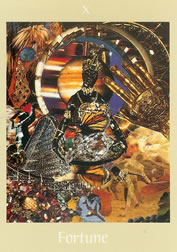
This photomontage deck was designed by James Wanless, Ph.D.  The photographic collage artwork was created by Ken Knutson.  It was first published in 1984, and then in 1991 and 2008. 

The Voyager Tarot: Way of the Great Oracle Book.  By James Wanless, 1989.  Book and Deck


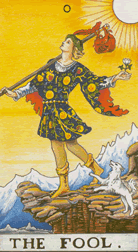
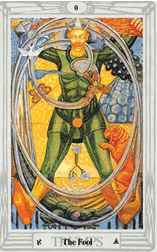
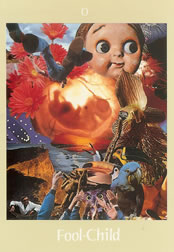
 The Fool, 0


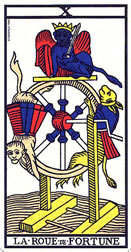
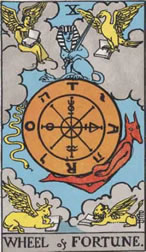
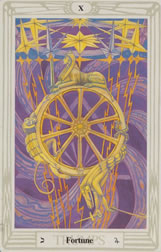
The Wheel of Fortune, 10


Thursday, April 16, 2026

Everything is Holy Now

 Holy Now

Written by Peter Mayer 
From Million Year Mind, 1999
 

"When I was a boy each week
Sunday we would go to church
Pay attention to the priest
He would read the holy word
And consecrate the holy bread
everyone would kneel and bow
Today the only difference is
Everything is Holy Now
Everything, Everything, Everything is Holy Now

When I was in Sunday School
We would learn about the time
Moses split the sea in two
Jesus made the water wine
I remember feeling sad
That miracles don't happen still
But now I just can't keep track
'Cause everything's a miracle

Everything, Everything, Everything's a miracle

Wine from water is not so small
But an even better magic trick
Is that anything is here at all
So the challenging thing becomes
Not to look for miracles
But finding where there isn't one

Holy water was rare at best
Barely wet my fingertips
But now I have to hold my breath
'Cause I'm swimming in a sea of it

It used to be a world half there
Heaven's second rate hand me down
But now I'm walking with a reverent air
'Cause everything is Holy Now

Everything, Everything, Everything is Holy Now

Read a questioning child's face
Say it's not a testament
That'd be very hard to say
See, see another new morning come
And say it's not a sacrament
I tell you that it can't be done

This morning outside I stood
I saw a little red-winged bird
Shining like a burning bush
Singing like a scripture verse
It made me want to bow my head
I remember when church let out
How things have changed since then

Everything is Holy Now
It used to be a world half there
Heaven's second rate hand me down
But I walk it with a reverent air
'Cause everything is Holy Now

Everything, Everything, Everything is Holy Now"
-  Holy Now by Peter Mayer


Monday, March 16, 2026

God's Own Eye

                 The Fireplace Records, Chapter 31


God's Own Eye


Master Seung Sahn liked to write short enigmatic mystical poems.  He once wrote:

"Who sees the All as nothingness,
as nothing all that is,
sees everything through God's own eye.
Enlightenment is this."  (WWSF #63)

"The God who is pure emptiness
is created as form,
becoming substance, light and darkness
the stillness and the storm."  (WWSF #64)

It is quite unusual, also rare, for a Zen Buddhist to refer to the Christian God to support his own mystical theological-philosophical views.  Although, belief in and references to supernatural beings of various kinds is quite common in popular-folk Buddhism. 

Emptiness, nothingness, or the void are common themes, concepts, tropes or cliches in Zen Buddhist Koans and discussions.

Maybe Master Seung Sahn was playing on the sentences from the German Christian mystic, Meister Eckhart, who once wrote: "To be full of things is to be empty of God.  To be empty of things is to be full of God. The eye with which I see God is the same eye with which God sees me."

Avalokiteshavara, a supernatural being, has a thousand hands with one eye in each hand.  Lin-Chi asked, "Which is the real eye?"  (IF 95)

The "Eye that grasps the Universe" is for Zhaozhou an Eye that is empty of defilement, free of attachments, untainted by conceptualizing, and beyond being and non-being. A clear-eyed neutral realistic objectivity--- seeing things as they are? (DSMS #291)

Yunyan contended that the Bodhisattva of Great Compassion had eyes and hands all over its' (his/her) body. Yes, we can "see" (understand/feel) our world with our hands, even with our eyes closed. (BOS #54)

Eyes, seeing, watching, observing, viewing, and overall vision are essential for surviving, learning, moving, and being-in-the-world. 

We love to use sight as a metaphor in poetry about spirituality.  Soren Kierkegaard wrote "All human speech about the spiritual is essentially metaphorical speech." Nietzsche said, "Truth is a mobile army of metaphors." 

The same Eye between God and a Person? 
Is it the same God between two million persons seeing in a spiritual way; or, are there two million Gods? How many eyes does God have? Is God blind in one eye like Sartre. Is God blind in two eyes like Ray Charles or Helen Keller? Does God have a Third Eye like yogi adepts? Is God nearsighted or far sighted and needs spiritual glasses? Are these two Transcendental Eyes looking through each other a pleasant fiction, a distorted double vision, an empty darkness, a blurred visual hallucination, an unfocused metaphor?

Now, really, does even a postulated God of Emptiness (God = Pure Emptiness) give birth to Substance, to Forms, to the realities of sunlight and darkness, man and woman, toads and ravens?  I am doubtful, even if obviously charmed. 

Maybe all this emptiness talk is just about negation. God was lonely, wanted to be creative, wanted to watch something, rejected being alone, and negated his present to create a future. So, It/He/She created ex nihilo the ordinary world. But, in this view, God is not emptiness; It/He/She is Something that rejected the emptiness of aloneness, negated his unpleasant solitude, and projected Somethings into existence. The Ten Thousand Things of Taoist ontology were born from the Dao embracing Change, rejecting and negating undifferentiated Nothingness.  

Ah ... the mysteries of ontology keep us wondering. I need a long walk!


Comments, Sources, Observations

Emptiness has little creative potency.
Somethings give birth to somethings.
Emptiness is not a metaphor for something.
Emptiness may make room for somethings to play.
"God" is maybe another metaphor, analogy, or acronym.
Emptiness is a lonely affair.

Emptiness is the subject of over 50 Zen Koans.

Meetings with Master Chang San-Feng 

Zen Master Raven

Sunyata, Emptiness, Void, Nothingness


Refer to my Cloud Hands Blog Posts on the topic of Koans/Stories. 

Subject Index to 1,975 Zen Buddhist Koans

Zen Buddhist Koans: Indexes, Bibliography, Commentary, Information


The Daodejing by Laozi

Pulling Onions  Over 1,043 One-line Sayings by Mike Garofalo

Chinese Chan Buddhist and Taoist Stories and Koans

The Fireplace Records  By Michael P. Garofalo


Or


Monday, August 25, 2025

A Day Became a Presence

 "A certain day became a presence
to me; there it was, confronting me -- a sky, air, light:
a being. And before it started to descend

from the height of noon, it leaned over
and struck my shoulder as if with
the flat of a sword, granting me
honor and a task. The day's blow
rang out, metallic -- or it was I, a bell awakened,
and what I heard was my whole self
saying and singing what it knew: I can."

Denise Levertov, Variation on a Theme by Rilke
(The Book of Hours, Book I, Poem 1, Stanza 1)


Monday, March 24, 2025

Tao Te Ching, Chapter 21

Daodejing, Laozi, Chapter 21


"A virtuous person comes into being only according to the Tao.
Tao is something which is obscure and indistinct.
Indistinct and obscure —
yet there is an appearance.
Obscure and indistinct —
yet there is a substance.
Vague and dim —
yet there is an essence within it.
This essence is genuine.
There is truth within it.
Since ancient times until now, its name never forsaken,
it stands there to guard all the good deeds.
How do I know all the good deeds are guarded by this Tao?
I know.
-  Translated by Chao-Hsiu Chen, 2004, Chapter 21  


"The grandest aspects of producing force
Find Tao their energizing way and source;
In Tao things move unseen, impalpable,
Yet in it form and semblance brood and dwell;
Impalpable, invisible, yet things
Float forth within on transcendental wings;
Dark and profound, yet lo! within it there,
Are the pure essences which aeons bear;
It holds the truth, it keeps its ancient name,
And watches all that from the beginning came;
From the Beginning! How know I this is so?
By this, it is the Tao, by this I know!"
-  Translated by Isaac Winter Heysinger, 1903, Chapter 21


"The impression made by magnificent Te comes only from Tao.
Tao is a something but elusive, but evasive.
Evasive, elusive, inside it lies the mind's true form.
Elusive, evasive, inside it lies something substantial.
Shadowy, dim.
Inside it lies vital energy.
This energy is very strong inside it lies true genuineness.
From ancient times until today
Its name has not been forgotten allowing us to see the beginnings of everything.
How do I recognize the form of the beginnings of everything?
By this low in the cycle of Change, which is Love and Beauty.
How do I know this?
By my comprehension of the Dao."
-  Translated by Michael LaFargue, 1992, Chapter 21  


"The complete manifestation of things visible proceeds only from Life.
In its nature Life is always coming into activity, yet in itself it eludes our sight and tough.
Eluding sight! eluding touch!
Within it are hid the plane of created things.
Eluding touch! eluding sight!
Within it are hid all created beings.
It is profound! It is obscure!
Within it is hid pure Spirit.
It is pure Spirit, enfolding Truth!
Within it is hid an infallible witness.
Free of Old until Now
Its Name remains unchanged.
Through its Doorway comes the Universe into existence.
How do I know that the Universe is coming to full perfection through Life?
The witness is in Life itself."
-  Translated by Isabella Mears, 1916, Chapter 21 


孔德之容, 唯道是從.
道之為物, 唯恍唯惚.
惚兮恍兮, 其中有象.
恍兮忽兮, 其中有物.
窈兮冥兮, 其中有精.
其精甚,  其中有信.
自古及今其名不去.
以閱衆甫.
吾何以知衆甫之狀哉.
以此.

-  Chinese characters, Tao Te Ching, Chapter 21


k'ung tê chih jung, wei tao shih ts'ung.
tao chih wei wu, wei huang wei hu.
hu hsi huang hsi, ch'i chung yu hsiang.
huang hsi hu hsi, ch'i chung yu wu.
yao hsi ming hsi, ch'i chung yu ching.
ch'i ching shên, chên ch'i chung yu hsin. 
tzu ku chi chin ch'i ming pu ch'ü.
yi yüeh chung fu.
wu ho yi chih chung fu chih jan tsai.
yi tz'u.
-  Wade-Giles Romanization, Tao Te Ching, Chapter 21


"The great virtue as manifested is but following the Tao.
Tao is a thing that is both invisible and intangible.
Intangible and invisible, yet there are forms in it;
Invisible and intangible, yet there is substance to it;
Subtle and obscure, there is essence in it;
This essence being invariably true, there is faith in it.
From of old till now, it has never lost its nameless name,
Through which the origin of all things has passed.
How do I know it is so with the origin of all things?
By this Tao."
-  Translated by Ch'u Ta-Kao, 1904, Chapter 21 


"One of deep virtue cherishes the subtle essence of the universe.
 The subtle essence of the universe is elusive and evasive.
 Though it is elusive and evasive,
 it unveils itself as images and forms.
 Evasive and elusive,
 it discloses itself as indefinable substance.
 Shadowy and indistinct,
 it reveals itself as impalpable subtle essence.
 This essence is so subtle, and yet so real.
 It is the subtle origin of the whole of creation and non-creation.
 It existed prior to the beginning of time as the single deep and subtle reality of the universe.
 It brings all into being."
 -  Translated by Ni Hua Ching, 1995, Chapter 21


"La virtud se expresa siguiendo al Tao.
Tao es evasivo e intengible
Pero expresa toda forma y sustancia;
Tao es oscuro y sútil
Pero expresa toda la Naturaleza;
La Naturaleza no cambia,
Pero expresa toda sensación.
Desde antes del conocimiento
El Tao ha expresado todas las cosas.
¿Cómo puedo saber?
Confiando en mis sentidos."
-  Translated by Antonio Rivas, 1998, Chapter 21 


"In his every movement a man of great virtue
Follows the way and the way only.
As a thing the way is
Shadowy and indistinct.
Indistinct and shadowy,
Yet within it is an image;
Shadowy and indistinct,
Yet within it is a substance.
Dim and dark,
Yet within it is an essence.
This essence is quite genuine
And within it is something that can be tested.
From the present back to antiquity,
Its name never deserted it.
It serves as a means for inspecting the fathers of the multitude.
How do I know that the fathers of the multitude are like that?
By means of this."
-  Translated by D. C. Lau, 1963, Chapter 21  


"The mightiest manifestations of active force flow solely from Tao.
Tao in itself is vague, impalpable, how impalpable, how vague!
Yet within it there is Form.
How vague, how impalpable!
Yet within it there is Substance.
How profound, how obscure!
Yet within it there is a Vital Principle.
This principle is the Quintessence of Reality, and out of it comes Truth.
From of old until now, its name has never passed away.
It watches over the beginning of all things.
How do I know this about the beginning of things?
Through Tao."
-  Translated by Lionel Giles, 1905, Chapter 21 


"The features (yung) of the vast (k'ung) Te,
Follows entirely (wei) from Tao.
Tao as a thing,
Is entirely illusive (huang) and evasive (hu).
Evasive and illusive,
In it there is image (hsiang).
Illusive and evasive,
In it there is thinghood (wu).
Dark and dim,
In it there is life seed (ching).
Its life seed being very genuine (chen),
In it there is growth power (hsin).
As it is today, so it was in the days of old (ku),
Its name goes not away (ch'ü),
So that we may survey (yüeh) the origins of the many (chung fu).
How do I know that the origins of the many are such?
Because of this."
-  Translated by Ellen Marie Chen, 1989, Chapter 21


"For effective contrast, this chapter is best read together with chapter 14.  Both chapters call Tao, the illusive and evasive (hu-huang), i.e., the primal Chaos or Hun-tun described in chapter 25.  In chapter 14, Tao recedes and becomes the nothing; here in chapter 21 the same illusive and evasive Tao moves forward to become the realm of beings.  There Tao is nameless; here Tao is the name that never goes away.  There Tao is the formless form, the image of nothing; here Tao contains the seeds and images of all beings that are to be.  The dominant character of Tao in chapter 14 is wu, nothing; in this chapter it is yu, being or having.  The conclusion of chapter 14 traces Tao to the beginning of old; this chapter arrives at the realm of the many in the now."
-  Ellen M. Chen, The Tao Te Ching: A New Translation with Commentary, 1989, p.107


A typical webpage created by Mike Garofalo for each one of the 81 Chapters (Verses, Sections) of the Tao Te Ching (Daodejing) by Lao Tzu (Laozi) includes up to 25 different English language translations or interpolations for that Chapter, 5 Spanish language translations for that Chapter, the Chinese characters for that Chapter, the Wade-Giles and Hanyu Pinyin transliterations (Romanization) of the Mandarin Chinese words for that Chapter, and 2 German and 1 French translation of that Chapter.  Each webpage for each one of the 81 Chapters of the Tao Te Ching includes extensive indexing by key words, phrases, and terms for that Chapter in English, Spanish, and the Wade-Giles Romanization.  Each webpage on a Chapter of the Daodejing includes recommended reading in books and websites, a detailed bibliography, some commentary, research leads, translation sources, a Google Translate drop down menu, and other resources for that Chapter.   

Chapter 21, Tao Te Ching by Lao Tzu


Chapter and Thematic Index (Concordance) to the Tao Te Ching by Lao Tzu

English Language Daodejing Translators' Source Index

Spanish Language Daodejing Translators' Source Index

Ripening Peaches: Taoist Studies and Practices


Taoism: A Selected Reading List


Tuesday, December 17, 2024

Full, Sparkling, Everywhere, Flowing ...

 
"My own experience of śaktipāta occurred at the age of 16 through meeting a powerful and loving meditation master.  It was not the product of wishful thinking, because I didn't even want to be there, at least on the level of the conscious mind.  My mother had persuaded me to take a two-day meditation retreat and I had acceded because I wanted the reward she was offering me; I had neither expectation nor hope that anything particularly magical would happen.  And indeed, the whole thing was fairly boring, though in the final meditation of the weekend, I did make a grudging effort to be fully present in the warm, dark stillness of the meditation room.  It was nice, but nothing special, until I opened my eyes and walked outside.  I was astonished to discover that the whole world had apparently changed.  Everything was more vivid and real, and almost sparkling.  Not only that, I was feeling an incredible energy in my heart, and it was flowing palpably between my heart and the hearts of everyone else I could see.  I call it "energy" for lack of a better word; it was a tangible power or force, not a passive feeling, and it had the nature of exquisitely pure love.  It was connecting the hearts of all the people around me, coursing freely in a kind of web or grid of power, entirely independent of whether the people liked each other or not.  Then I noticed it was really everywhere; the very air around me seemed thick with it; it was undoubtedly the most "real" thing in reality, though not perceptible with any of the five senses!  It was astonishing, and I was never the same, now that I knew this power, this love beyond anything I had ever imagined, was a real possibility in human life."
-  Christopher D. Wallis, Tantra Illuminated, 2012, p.323


Tantra Illuminated: The Philosophy, History, and Practice of a Timeless Tradition  By Christopher D. Wallis, M.A.  Illustrations by Ekabhumi Ellik.  Woodlands, Texas, Anusara Press, 2012.  Index, endnotes, bibliography, three appendices, 506 pages.  ISBN: 978-1937104016.  VSCL.  In 2012, the author was a Ph.D. candidate in Sanskrit at the University of California, Berkeley.  This book takes as its exemplar and focal point the lineages of nondual Śaiva Tantra most clearly typified by the Kaula Trika lineage.  Written for the educated lay reader.  The author shares his personal life, his spiritual life, his practices, his yoga, within this tradition of Tantra.   

Tantra: Path of Ecstasy  By Georg Feuerstein (1947-2012), Ph.D.  Boston, Shambhala, 1998.  Index, bibliography, notes, 314 pages.  ISBN: 157062304X.  VSCL.  An excellent introduction to Tantra, and a great starting point for readers.  I own, and have read and reread in the last ten years nearly all of the books by Dr. Georg Feuerstein.  If my understanding is correct, Dr. Feuerstein personally followed the path of Vajrayana Buddhism, a Tibetan Buddhist tradition, a lineage of Tantric Buddhism.  


"Tantra's body-positive approach is the direct outcome of its integrative metaphysics according to which this world is not mere illusion but a manifestation of the supreme Reality.  If the world is real, the body must be real as well.  If the world is in essence divine, so must be the body.  If we must honor the world as a creation or an aspect of the divine Power (shakti), we must likewise honor the body.  The body is a piece of the world and, as we shall see, the world is a piece of the body.  Or, rather, when we truly understand the body, we discover that it is the world, which in essence is divine."
-  Georg Feuerstein, Tantra: The Path of Ecstasy, p. 53  


Somaesthetic Practices and Theory

Tantra: Bibliography, Quotations, Links, Resources

Nature and Spirituality 


Friday, November 29, 2024

Tao Te Ching Index and Concordance

Daodejing, Laozi  or Tao Te Ching by Lao Tzu

Indexed by English, Spanish, and Wade-Giles Romanization

Indexing by Michael P. Garofalo, M.S.

A typical webpage created by Mike Garofalo for each one of the 81 Chapters of the Tao Te Ching (Daodejing) by Lao Tzu (Laozi) includes 20 different English translations or interpolations for that Chapter, 3 Spanish translations for that Chapter, the Chinese characters for that Chapter, and the Wade-Giles and Hanyu Pinyin Romanization of the Mandarin Chinese words for that Chapter.  Each webpage for one of the 81 Chapters of the Tao Te Ching includes extensive indexing by key words and terms in English, Spanish, and the Wade-Giles Romanization.  Each webpage on a Chapter of the Daodejing includes recommended reading in books and websites, a detailed bibliography, some commentary, research leads, translation sources, and other resources for that Chapter.   


Chapter and Thematic Index (Concordance) to the Tao Te Ching by Lao Tzu

English Language Daodejing Translators' Source Index

Spanish Language Daodejing Translators' Source Index

Ripening Peaches: Taoist Studies and Practices

Taoism: A Selected Reading List

One Old Taoist's Final Journey 


Here is an example of some of the translations and/or interpolations for:

Tao Te Ching by Lao Tzu
Daodejing by Laozi


Chapter 10


Here is my indexing of Chapter 10:


English and Chinese (Wade-Giles) Terms:  Physical and Bodily Soul, Chi or Breath or Vital Force (ch'i), Washing or Cleanse (ti), Youthfulness, Mental Clarity, What is Possible, What Can Be Done, Impartiality, Bird, Spontaneity, Wholesome Personality, Kind or Loving or Caring (ai), Separation or Parting (li), Spirit or Soul or Spiritual (ying), Vision or Perception or Insight (lan), Natural Breathing, Close or Shut (ho), One or Unity or Together (yi), Intelligent Activity, Self-Control, Vital Breath, Understanding or Awareness (ming), Cleanse the Mind, Virtue, Leadership, Chi Kung or Qigong, Progress or Advance or Grow (ch'ang), Meditate, Love, Cleansing the Mind, Impurities, Hold or Keep (tsai), People (min), Govern (chih), Country (kuo), Nurturing, Gentle or Tender or Soft (jou), Female, Can or Able to (nêng), Clean or Polish or Wipe (ch'u), Newborn or Infant (ying), Question or "?" Interrogative (hu), Passive, Cleanliness, Cause or Bring About (chih), Cunning or Cleverness (chih), Concentrate or Gather or Focus (chuan), Governing, Embrace or Carry (pao), Faults or Flaws or Blemish (ts'u), Animal Nature or Body or Vitality or Physical Being (p'o), Feed or Nurture (ch'u), Purify, Pure or Clear or Clear Minded (pai), Gate or Door (mên), Dominate or Control (tsai), Without or Free of (wu), Open (k'ai), Mother Bird or Female (tz'u), Four Directions or Four Quarters (ssu), Child or Baby or Innocent (erh), Heaven or Natural (t'ien), Possibilities Through the Dao, Produces or Gives Life (shêng), Without Acti0n (wu wei), Become or Act or Do (wei), Claim or Possess (yu), Profound or Deep or Hidden (hsüan), Virture or Power (),  能為   

Términos en Español: Fuerza Vital, Lavado, Limpieza, J
uventud, Claridad Mental, ¿Qué es posible, ¿Qué se Puede Hacer, Imparcialidad, Pájaro, Espontaneidad, Personalidad Sana, Amar, Cuidar, Separación, Espíritu, Alma Espiritual, Vision, Percepción, Perspicacia, Respiración Natural, Cerrar, Apagar, Uno, Unidad, Junto, Actividad Inteligente, Autocontrol, Aliento Vital,  Entendimiento, Conciencia, Limpiar la Mente, Virtud, Liderazgo, Progreso, Crecer, Meditar, Impurezas, Mantener, Guardar, Personas, Gobierno, País, Nutrir, Suave, Dócil, Femenino, Puede, Limpie, Polaco, Recién nacido, Lactante, Pregunta, Interrogativo, Pasivo, Causar, Provocar, Astucia, Concentrado, Reunir, Enfoque, Abrazar, Llevar, Fallos, Defectos, Naturaleza Animal, Cuerpo,  Purificar, Puro, Portón, Puerta, Dominar, Mujer, Cuatro Vientos, Niño, Bebé, Inocente, Cielo, Posibilidades, Produce, Vida, Ley, Reclamación, Posser, Profunda, Oculto.  


"One can keep the camp whole of the animal soul, by embracing the One alone,
Can bring tenderness by guarding the breath, and be as an infant child,
One can wash and be clean, and, knowing the deep, can be spotless and undefiled,
And, loving the people can rule the land with a rule that is scarcely shown.
Can one not open and close his heavenly gates like a bird on her nest?
When his intellect broadens on every side may its light not remain unknown?
Quickening, feeding, producing, must he still claim the fruit as his own?
To uplift all, and yet rule not, is virtue the deepest and best."
-  Translated by Isaac Winter Heysinger, 1903, Chapter 10 


"Carrying vitality and consciousness, embracing them as one, can you keep from parting?
Concentrating energy, making it supple, can you be like an infant?
Purifying hidden perception, can you make it flawless?
Loving the people, governing the nation, can you be uncontrived?
As the gate of heaven opens and closes, can you be impassive?
As understanding reaches everywhere, can you be innocent?
Producing and developing, producing without possessing, growing without domineering: this is called mysterious power."
-  Translated by Thomas Cleary, 1991, Chapter 10  


"By clinging to the One with both your spiritual and physical souls, can you prevent them from becoming divorced?
By concentrating your breath until you become soft, can you be like an infant?
By cleansing your secret mirror, can you make it without blemish?
In loving the people and ruling a state, can you be without action?
In opening and closing the natural gates, can you be like a hen?
In penetrating the four quarters with your intelligence, can you be without knowledge?"
-  Translated by Jan J. L. Duyvendak, 1954, Chapter 10


"Can you keep the spirit and embrace the One without departing from them?
Can you concentrate your vital force and achieve the highest degree of weakness like an infant?
Can you clean and purify your profound insight so it will be spotless?
Can you love the people and govern the state without cunning?
Can you play the role of the female in the opening and closing of the gates of Heaven?
Can you understand all and penetrate all without taking any action?
To produce things and to rear them,
To produce, but not to take possession of them,
To act, but not to rely on one's own ability,
To lead them, but not to master them.
This is called profound and secret virtue."
-  Translated by Chan Wing-Tsit, 1953, Chapter 10  


載營魄, 抱一能無離乎?
專氣致柔, 能嬰兒乎?
滌除玄覽, 能無疵乎?
愛民治國, 能無知乎?
天門開闔, 能為雌乎?
明白四達, 能無知乎?
生之畜之.
生而不有.
為而不恃.
長而不宰.
是謂玄德.
-  Chinese characters, Tao Te Ching, Chapter 10


tsai ying p'o, pao yi nêng wu li hu?
chuan ch'i chih jou, nêng ying erh hu?
ti ch'u hsüan lan, nêng wu tz'u hu?
ai min chih kuo, nêng wu chih hu?
t'ien mên k'ai ho, nêng wei tz'u hu? 
ming pai ssu ta, nêng wu wei hu?
shêng chih ch'u chih.
shêng erh pu yu.
wei erh pu shih.
ch'ang erh pu tsai.
shih wei hsüan tê.
-  Wade-Giles (1892) Romanization, Tao Te Ching, Chapter 10


"creative spirit
vital soul
wondrous bodymind

can you combine these into one phase
and gently hold onto it

one phase one part one moment
can you commune with
and direct the elemental force of life
and enter into the rebirth of gentleness
and be like a newborn 

can you wash and cleanse your mystic inner vision
while clearing it of the refuse left behind you
     ordinary sight

is it possible for you to stay out of your own way
while being your own leader

can you stomp the earth
look to the heavens while being receptive
passive
possessed of quietude

can you be knowledgeable and clever
and regard it as whimsical 

create and nourish
let all creation be the worlds
not your own

have fun when you work
work when you have fun

be a leader without appearing to be
and you will personify fine uncarved wood
in the hands of a master carpenter

can you guess who this master is."
-  Translated by John Bright-Fey, 2006, Chapter 10


"Unir cuerpo y mente en un conjunto
del que no puedan disociarse.
Equilibrar el Chi hasta hacerlo
tan armónico como el de un recién nacido.
Purificar la vision interna hasta
dejarla libre de todo vicio.
Querer al pueblo y gobernar la nación
practicando el Wu-Wei.
Abrir y cerrar las puertas del cielo
siendo como la Mujer Misteriosa.
Conocer y comprenderlo todo
usar la inteligencia.
Engendrar y criar,
Alimentar y educar
engendrar sin apropiarse,
obrar sin pedir nada a cambio,
guiar sin dominar,
esta es la Gran Virtud."
-  Translation from Wikisource, 2013, 
Capítulo 10


"Can you hold the door of your tent
Wide to the firmament?
Can you, with the simple stature
Of a child, breathing nature,
Become, notwithstanding,
A man?
Can you continue befriending
With no prejudice, no ban?
Can you, mating with heaven,
Serve as the female part?
Can your learned head take leaven
From the wisdom of your heart?
If you can bear issue and nourish its growing,
If you can guide without claim or strife,
If you can stay in the lead of men without their knowing,
You are at the core of life."
-  Translated by Witter Bynner, 1944, Chapter 10 


Wednesday, August 28, 2024

Tao Te Ching, Chapter 1

Dao De Jing, Laozi
Chapter 1


"Existence is beyond the power of words
To define:
Terms may be used
But are none of them absolute.
In the beginning of heaven and earth there were no words,
Words came out of the womb of matter;
And whether a man dispassionately
Sees to the core of life
Or passionately
Sees the surface,
The core and the surface
Are essentially the same,
Words making them seem different
Only to express appearance.
If name be needed, wonder names them both:
From wonder into wonder
Existence opens."
-  Translated by Witter Bynner, 1944, Chapter 1

"The way that can be spoken of
Is not the constant way;
The name that can be named
Is not the constant name.
The nameless was the beginning of heaven and earth;
The named was the mother of the myriad creatures.
Hence always rid yourself of desires in order to observe its secrets;
But always allow yourself to have desires in order to observe its manifestations.
These two are the same
But diverge in name as they issue forth.
Being the same they are called mysteries,
Mystery upon mystery -
The gateway of the manifold secrets."
-  Translated by D. C. Lau, 1963, Chapter 1 


"The Tao that is the subject of discussion is not the true Tao.
The quality which can be named is not its true attribute.
That which was before Heaven and Earth is called the Non-Existent.
The Existent is the mother of all things.
Therefore doth the wise man seek after the first mystery of the Non-Existent, while seeing in that which exists the Ultimates thereof.
The Non-Existent and Existent are identical in all but name.
This identity of apparent opposites I call the profound, the great deep, the open door of bewilderment."
-  Translated by Walter Gorn Old, 1904, Chapter 1

"Nature can never be completely described, for such a description of Nature would have to duplicate Nature.
No name can fully express what it represents.
It is Nature itself, and not any part or name or description abstracted from Nature, which is the ultimate source of all that happens, all that comes and goes, begins and ends, is and is not.
But to describe Nature as "the ultimate source of all" is still only a description, and such a description is not Nature itself.
Yet since, in order to speak of it, we must use words, we shall have to describe it as "the ultimate source of all."
If Nature is inexpressible, he who desires to know Nature as it is in itself will not try to express it in words
Although the existence of Nature and a description of that existence are two different things, yet they are also the same.
For both are ways of existing.
That is, a description of existence must have its own existence, which is different from the existence of that which it describes.
And so again we have to recognize an existence which cannot be described."
-  Translated by Archie J. Bahm, 1958, Chapter 1   


道可道, 非常道.
名可名, 非常名.
無名天地之始.
有名萬物之母.
故常無, 欲以觀其妙.
常有, 欲以觀其徼.
此兩者, 同出而異名.
同謂之玄.
玄之又玄.
衆妙之門.

-  Chinese characters, Tao Te Ching, Chapter 1


tao k’o tao, fei ch’ang tao.
ming k’o ming, fei ch’ang ming.
wu ming t’ien ti chih shih.
yu ming wan wu chih mu.
ku ch’ang wu, yü yi kuan ch’i miao.
ch’ang yu, yü yi kuan ch’i chiao.
tz’u liang chê, t’ung ch’u erh yi ming.
t’ung wei chih hsüan.
hsüan chih yu hsüan.
chung miao chih mên.
-  Wade Giles Romanization, Tao Te Ching, Chapter 1  


"The Tao that can be trodden is not the enduring and unchanging Tao.
The name that can be named is not the enduring and unchanging name. 
Conceived of as having no name, it is the Originator of heaven and earth;
Conceived of as having a name, it is the Mother of all things.  
Always without desire we must be found,
If its deep mystery we would sound;
But if desire always within us be,
Its outer fringe is all that we shall see.  
Under these two aspects, it is really the same;
But as development takes place, it receives the different names.
Together we call them the Mystery.
Where the Mystery is the deepest is the gate of all that is subtle and wonderful."
-  Translated by James Legge, 1891, Chapter 1 


"The Tao that can be spoken of is not the constant Tao.
The name that can be named is not the constant name.
The nameless is the beginning of life.
It is the mother of the ten thousand things.
Remove your desires and you will see the mystery.
Be filled with desire
And you will see only the manifestation.
These two are the same
yet, they diverge in nature
as they issue forth.
Being the same, they are the source
but the source remains a mystery.
Mystery upon mystery,
The gateway of Tao's manifold secrets."
-  Translated by Kari Hohne, 2009, Chapter 1


"Camino que se puede describir de manera articulada
     no es el Camino Invariable.
El nombre que se puede decir en voz alta
     no es el Nombre Invariable.
Con la boca cerrada y las cosas sin definir,
     estás al principio del universo.
Si haces definiciones, eres la medida de toda la creación.
Así, estando siempre sin deseo,
     miras en lo hondo de lo trascendente.
Albergando constantemente el deseo,
     todas las cosas que te rodean te estorban la vista.
Estos dos entran en el mundo semejantes,
     pero sus nombres son diferentes.
Semjantes, se llaman profundos y remotos.
Profundos y remotos y más aún:
Esta es la puerta de todos los misterios."
-  Translated by Alejandro Pareja, 2012, based upon the William Scott Wilson translation into English, Capítulo 1


"Tao called Tao is not Tao.
Names can name no lasting name.
Nameless: the origin of heaven and earth.
Naming: the mother of ten thousand things.
Empty of desire, perceive mystery.
Filled with desire, perceive manifestations.
These have the same source, but different names.
Call them both deep - Deep and again deep: the gateway to all mystery."
-  Translated by Stephen Addis and Stanley Lombardo, 1993, Chapter 1  
 

"The Way that can be told of is not an Unvarying Way;
The names that can be named are not unvarying names.
It was from the Nameless that Heaven and Earth sprang;
The named is but the mother that rears the ten thousand creatures, each after its kind.
Truly, “Only he that rids himself forever of desire can see the Secret Essences”;
He that has never rid himself of desire can see only the Outcomes.
These two things issued from the same mould, but nevertheless are different in name.
This “same mould” we can but call the Mystery, Or rather the “Darker than any Mystery”,
The Doorway whence issued all Secret Essences."
-  Translated by Arthur Waley, 1934, Chapter 1 


A typical webpage created by Mike Garofalo for each one of the 81 Chapters (Verses, Sections) of the Tao Te Ching (Daodejing) by Lao Tzu (Laozi) includes 25 or more different English language translations or interpolations for that Chapter, 5 or more Spanish language translations for that Chapter, the Chinese characters for that Chapter, the Wade-Giles and Hanyu Pinyin transliterations (Romanization) of the Mandarin Chinese words for that Chapter, and 2 German and 1 French translation of that Chapter.  

Each webpage for each one of the 81 Chapters of the Tao Te Ching includes extensive indexing by key words, phrases, and terms for that Chapter in English, Spanish, and the Wade-Giles Romanization.  In 2020, I will be improving the indexing.  

Each webpage on a Chapter of the Daodejing includes recommended reading in books and websites, a detailed bibliography, some commentary, research leads, translation sources, a Google Translate drop down menu, and other resources for that Chapter.  An electronic Concordance for all 81 Chapters of the  Tao Te Ching is provided.   


Chapter 1, Tao Te Ching by Lao Tzu

Concordance for the Tao Te Ching by Lao Tzu

English Language Daodejing Translators' Source Index

Spanish Language Daodejing Translators' Source Index

Ripening Peaches: Taoist Studies and Practices

Taoism: A Selected Reading List

One Old Daoist Druid's Final Journey  


Monday, July 01, 2024

The Ground is a Heart Platform


Technique is a Whisper

Some Thoughts from John Kells:

"Put everything into the initial connexion.
The posture thereafter must spring from that connexion.
The initial connexion has to be whole-hearted.
What happens thereafter must not be a distraction.
In other words, the heart keeps pumping out that connexion.
The technique is a whisper.
What is completed between you has the feeling of an entirety – of a being.
The responsibility is to be open.

The working of the mind is too slow to deal with real life.
To be sincere in this matter is not a question of thinking about it.
Sufficient practice must be undertaken so that basic body usage is not a grinding problem.
It is impossible to describe how thorough going your dedication needs to be.
What bit of you has the wisdom to know what is unknowable?
There is no mind to deliberate or be backwards.
If there isn't a feeling of coming home and finding a lively peace within then you are missing the point.

If there is a way of life or living it has to be joining from the heart.
The eyes are so quick to translate your heart feelings.
The ground is a heart platform.
Although important the eyes have to take second place to the heart.
Be open to the connecting of your heart with the other person's heart.
If the other person wants information about you let them open their heart.
Connecting is not a personal matter.
In any real interchange it is the Third Heart that counts.
Light and embracing, but embracing as a giving from the heart rather than capturing.
And the inspiration of the Third Heart is nutrition for your becoming.
The spirit must be allowed freedom to dart about and tempt the heart at the right moment.
To be a believer is to be a positive being – a believer is someone who is becoming.
Becoming leaves no imprint.
Becoming swallows what is commonly known as destiny.
Spirit is the effervescence of real interest in something other than yourself.

The essence of true destiny is yielding.
The essence of yielding is softness.
The essence of softness is entering.
The essence of entering is welcoming openness.
The essence of openness is heart."

Grandmaster John Kells

Steven Moore and John Kells

British Tai Chi Chuan Association and John Kells

Words of John Kells

A repost from Cloud Hands Blog from 2006