Showing posts with label War. Show all posts

Tuesday, November 11, 2025

Veterans Day

I say thanks to all the veterans of the United States military, first responders, law and order officials, hospitals, etc.  Volunteers and employees guard our public health and safety.  We thank them all.    We pay our respects to our fallen comrades.

Young and old we cheer for peace, prosperity, longevity.

I volunteered to serve in the United States Air Force from 1969-1973.  I was assigned to Air Training Command, Personnel, Keesler Air Force Base, Biloxi, Mississippi.  Hurricane Camille hit Keesler in August of 1969.  I was honorably discharged as a Staff Sergeant (E5).

I don't say much in my blog about current politics.  
I am a Independent who votes mostly for Democrats. I am a Liberal; support diversity, equity and equality; and have a secular Woke Epicurean Pragmatic outlook. 

I strongly disagree with the current (2025) ideas of Trump Republicans who are cutting programs and services for Veterans. Mr. Trump has shown disrespect for and dishonors our USA Veterans; and he is himself a rich draft dodger.

Saturday, June 14, 2025

Dao De Jing, Laozi, Chapter 31

Tao Te Ching, Lao Tzu
Chapter 31


"Even the finest arms are an instrument of evil,
A spread of plague,
And the way for a vital man to go is not the way of a soldier.
But in time of war men civilized in peace
Turn from their higher to their lower nature.
Arms are an instrument of evil,
No measure for thoughtful men
Until there fail all other choice
But sad acceptance of it.
Triumph is not beautiful.
He who thinks triumph beautiful
Is one with a will to kill,
And one with a will to kill
Shall never prevail upon the world.
It is a good sign when man's higher nature comes forward,
A bad sign when his lower nature comes forward,
When retainers take charge
And the master stays back
As in the conduct of a funeral.
The death of a multitude is cause for mourning:
Conduct your triumph as a funeral."
-  Translated by Witter Bynner, 1944, Chapter 31  


"So far as arms are concerned, they are implements of ill-omen.
They are not implements for the man of Tao.
For the actions of armies will be well requited; where armies have quartered, brambles and thorns grow.
Great wars are for certain followed by years of scarcity.
The man of Tao when dwelling at home makes the left as the place of honour, and when using arms makes the right the place of honour.
He uses them only when he cannot avoid it.
In his conquests he takes no delight.
If he take delight in them, it would mean that he enjoys the slaughter of men.
He who takes delight in the slaughter of men cannot have his will done in the world."
-  Translated by Ch'u Ta-Kao, 1904, Chapter 31 


"Even the finest arms are an instrument of evil,
A spread of plague,
And the way for a vital man to go is not the way of a soldier.
But in time of war men civilized in peace
Turn from their higher to their lower nature.
Arms are an instrument of evil,
No measure for thoughtful men
Until there fail all other choice
But sad acceptance of it.
Triumph is not beautiful.
He who thinks triumph beautiful
Is one with a will to kill,
And one with a will to kill
Shall never prevail upon the world.
It is a good sign when man's higher nature comes forward,
A bad sign when his lower nature comes forward,
When retainers take charge
And the master stays back
As in the conduct of a funeral.
The death of a multitude is cause for mourning:
Conduct your triumph as a funeral."
-  Translated by Witter Bynner, 1944, Chapter 31  


夫佳兵者不祥之器.
物或惡之, 故有道者不處. 
君子居則貴左.
用兵則貴右. 
兵者不祥之器.
非君子之器.
不得已而用之.
恬淡為上. 
勝而不美.
而美之者, 是樂殺人. 
夫樂殺人者, 則不可以得志於天下矣. 
吉事尚左.
凶事尚右. 
偏將軍居左.
上將軍居右.
言以喪禮處之. 
殺人之衆, 以哀悲泣之.
戰勝以喪禮處之. 
-  Chinese characters, Tao Te Ching, Chapter 31  


fu bing zhe bu xiang zhi qi.
wu huo wu zhi, gu you dao zhe bu chu.
jun zi ju ze gui zuo.
yong bing ze gui you.
bing zhe bu xiang zhi qi.
fei jun zi zhi qi.
bu de yi er yong zhi.
tian dan wei shang.
sheng er bu mei.
er mei zhi zhe, shi le sha ren.
fu le sha ren zhe, tse bu ke yi de zhi yu tian xia yi.
ji shi shang zuo.,
xiong shi shang you.
pian jiang jun ju zuo.
shang jiang jun ju you.
yan yi sang li chu zhi.
sha ren zhi zhong, yi ai bei qi zhi.
zhan sheng yi sang li chu zhi.
-  Pinyin Romanization, Dao De Jing, Chapter 31  


"Weapons of war are omens of doom,
To be loathed by every living thing
And shunned by those who keep the Way.
Presiding at court the leader honours the left.
Resorting to war he honours the right.
But weapons are never the leader’s choice.
Weapons of war are omens of doom,
Not to be used unless compelled.
Above all, with mind and heart unstirred,
To arms give no glory:
For to glory in arms
Is to sing and rejoice in the slaughter of men.
And singers in praise of the slaughter of men
Shall not in this world gain their ends.
Thus the left is for deeds that are blessed,
The right is for deeds that bring death.
To the left the minor commander,
To the right the chief general:
Placed for the rites to honour the dead.
When the slaughter is great,
Let the leader come forth to keen for the slain;
The victory won,
To perform solemn rites in mourning the day."
-  Translated by Moss Roberts, 2001, Chapter 31  


"Las armas son instrumentos nefastos.
El hombre del Tao nunca se sirve de ellas.
El hombre de bien considera a la izquierda
como sitio de honor,
pero se inclina a la derecha cuando porta armas.
El sabio prefiere la izquierda.
El soldado prefiere la derecha.
Las armas son instrumentos nefastos,
no adecuados para el hombre de bien.
Sólo las usa en caso de necesidad,
y lo hace comedidamente,
sin alegría en la victoria.
El que se alegra de vencer
es el que goza con la muerte de los hombres.
Y quien se complace en matar hombres
no puede prevalecer en el mundo.
Para los grandes acontecimientos
el sitio de honor es la izquierda,
y la derecha para los hechos luctuosos.
En el ejército,
El comandante adjunto se coloca a la izquierda,
El comandante en jefe, a la derecha.
Esta es la misma disposición que se usa en los ritos fúnebres.
Esto significa que la guerra se compara a un servicio funerario.
Cuando ha sido matada mucha gente,
sólo es justo que los supervivientes lloren por los muertos.
Por esto, incluso una victoria es un funeral."
-  Translation from Wikisource, 2013, Capitulo 31


"Of all things, soldiers are instruments of evil,
   Hated by men.
Therefore the religious man (possessed of Tao) avoids them.
The gentleman favors the left in civilian life,
But on military occasions favors the right.
Soldiers are weapons of evil.
   They are not the weapons of the gentleman.
When the use of soldiers cannot be helped,
   The best policy is calm restraint.
Even in victory, there is no beauty,
And who calls it beautiful
   Is one who delights in slaughter.
He who delights in slaughter
   Will not succeed in his ambition to rule the world.
[The things of good omen favor the left.
The things of ill omen favor the right.
The lieutenant-general stands on the left,
The general stands on the right.
That is to say, it is celebrated as a Funeral Rite.]
The slaying of multitudes should be mourned with sorrow.
A victory should be celebrated with the Funeral Rite."
-  Translated by Lin Yutang, 1955, Chapter 31   


Chapter and Thematic Index (Concordance) to the Tao Te Ching


Taoism: A Selected Reading List


 A typical webpage created by Mike Garofalo on a Chapter of the Tao Te Ching (Daodejing) by Lao Tzu (Laozi) includes at least 16 different translations or interpolations of the Chapter in English, two Spanish translations, the Chinese characters for the Chapter, a Wade-Giles and Hanyu Pinyin Romanization of the Mandarin Chinese words for the Chapter, recommended reading lists, a detailed bibliography; indexing by key words and terms for the Chapter in English, Spanish, and the Wade-Giles Romanization; some commentary, and other resources for the Chapter. 


Sunday, June 01, 2025

Tao Te Ching, Lao Tzu, Chapter 30

Dao De Jing by Laozi
Chapter 30

"He who would assist a lord of men in harmony with the Tao will not assert his mastery in the kingdom by force of arms.
Such a course is sure to meet with its proper return.
Wherever a host is stationed, briars and thorns spring up.
In the sequence of great armies there are sure to be bad years.
A skilful commander strikes a decisive blow, and stops.
He does not dare by continuing his operations to assert and complete his mastery.
He will strike the blow, but will be on his guard against being vain or boastful or arrogant in consequence of it.
He strikes it as a matter of necessity; he strikes it, but not from a wish for mastery.
When things have attained their strong maturity they become old.
This may be said to be not in accordance with the Tao.
What is not in accordance with the Tao soon comes to an end."
-  Translated by James Legge, 1891, Chapter 30  


"He who relied on the Tao to aid a ruler of men
 Would not seek to conquer with weapons.
 The man of Tao holds back from such instruments of recoiling violence.
 For where armies have camped there spring up thistles and thorns;
 And in the wake of marching armies follow years of drought.
 Having achieved his aim, the good commander stops;
 He does not venture to follow up his advantages with greater force.
 He achieves his aim, but does not plume himself.
 He achieves his aim, but is not boastful.
 He achieves his aim but is not proud of what he has done.
 He achieves his aim by means which could not be avoided.
 He achieves his aim without violence.
 For it is when creatures reach the climax of their strength that they start to grow old;
 Thus violence runs counter to the Tao,
 And what runs counter to the Tao is soon spent."
 -  Translated by Herman Old, 1946, Chapter 30   


"Who knows how to guide a leader in the path of Tao (the Laws of the Universe),
Does not try to conquer the world with military force.
It is in the nature of a military force to turn against its user.
(Economic Force strengthens the Society) 


Wherever armies are stationed, thorny bushes grow.
After a great war, bad years always follow.
(Over spending for military might only overtaxes the people)

Protect efficiently your own state,
But not to aim at selfishness.
After you have attained your purpose,
You must not show off your success,
You must not brag of your ability,
You must not feel proud,
You must rather regret that you had not been able to prevent the war.

You must never think of taking control of others by force.
To be over-developed is to quicken decay,
And this is against Tao (the Laws of the Universe),
And what is against Tao (the Laws of the Universe) will soon end."
- Translated by J. L. Trottier, 1994, Chapter 30


"Those rulers who use the Tao to assist mankind
Do not use soldiers to force the world.
Those doings can be paid back to them.
The place of the army’s encampment—
Thorns and brambles grow there.
In the wake of the military
There indeed exists a famine-year.
The good have success and stop
Not daring thereby to grab for power.
They succeed but never boast.
Succeed but never strike down.
Succeed but never arrogantly.
Succeed but do not gain thereafter.
Succeed but never force.
A strong thing ruling over what is Old—
This is called “non-Tao.”
The non-Tao soon ends."
- Translated by Aalar Fex, 2006, Chapter 30


"When one uses the Tao in assisting his sovereign, he will not employ arms to coerce the state.
Such methods easily react.
When military camps are established.
Briers and thorns flourish.
When great armies have moved through the land calamities are sure to follow.
The capable are determined, but no more.
They will not venture to compel; determined, but not conceited;
determined, but not boastful; determined, but not arrogant;
determined because it cannot be helped; determined, but not forceful.
When things reach their prime, they begin to age.
This cannot be said to be the Tao.
What is Not the Tao soon ends."
-  Translated by Spurgeon C. Medhurst, 1905, Chapter 30 


"He who would help a Ruler of men by Tao
Does not take soldiers to give strength to the kingdom.
His service is well rewarded.
Where troops dwell, there grow thorns and briers.
After great wars, there follow bad years.
He who loves, bears fruit unceasingly,
He does not dare to conquer by strength.
He bears fruit, but not with assertiveness,
He bears fruit, but not with boastfulness,
He bears fruit, but not with meanness,
He bears fruit, but not to obtain it for himself,
He bears fruit, but not to shew his strength.
Man is great and strong, then he is old,
In this he is not of Tao.
If he is not of Tao
He will quickly perish."
-  Translated by Isabella Mears, 1916, Chapter 30 


以道佐人主者, 不以兵強天下.
其事好還.
師之所處, 荊棘生焉.
大軍之後, 必有凶年.
善有果而已.
不敢以取強.
果而勿矜.
果而勿伐.
果而勿驕.
果而不得已.
果而勿強.
物壯則老.
是謂不道.
不道早已.

-  Chinese characters, Tao Te Ching, Chapter 30 


yi tao tso jên chu chê, pu yi ping ch'iang t'ien hsia.
ch'i shih hao huan.
shih chih so ch'u, ching chi shêng yen.
ta chün chih hou, pi yu hsiung nien
shan chê kuo erh yi.
pu kan yi ch'ü ch'iang.
kuo erh wu ching.
kuo erh wu fa.
kuo erh wu chiao.
kuo erh pu tê yi.
kuo erh wu ch'iang.
wu chuang tsê lao.
shih wei pu tao.
pu tao tsao yi.
-  Wade-Giles Romanization, Tao Te Ching, Chapter 30 


"Those who use Tao in assisting their Sovereign do not employ soldiers to force the Empire.
The methods of government they adopt are such as have a tendency to react upon themselves.
Where garrisons are quartered, briars and thorns spring up, and the the land is deserted by the people.
Disastrous years inevitably follow in the wake of great armies.
Wise rulers act with decision, and nothing more.
They do not venture to use overbearing measures.
They are decided without self-conceit, or boasting, or pride.
They are decided in spite of themselves, and without presuming on brute force.
After a man has arrived at the prime of his strength, he begins to age.
This is attributable to his not possessing the Tao.
Those who do not possess Tao die before their time."
-  Translated by Frederic H. Balfour, 1884, Chapter 30


"Quien sabe guiar al gobernante en el sendero del Tao no intenta dominar el mundo mediante la fuerza de las armas.
Está en la naturaleza de las armas militares volverse contra quienes las manejan.
Donde acampan ejércitos, crecen zarzas y espinos.
A una gran guerra, invariablemente suceden malos años.
Lo que quieres es proteger eficazmente tu propio estado, pero no pretender tu propia expansión.
Cuando has alcanzado tu propósito, no debes exhibir tu trifuno, ni jactarte de tu capacidad, ni sentirte orgulloso;
     más bien debes lamentar no haber sido capaz de impedir la guerra.
No debes pensar nunca en conquistar a los demás por la fuerza.
Pues expandirse excessivamente es precipitar el decaimiento, y esto es contrario al Tao, y lo que es contrario al Tao
    pronto dejará de existir."
-  Translation from Chinese to English by John C. H. Wu, translated into Spanish by Alfonso Colodrón, Capitulo 30 


"A ruler faithful to Tao will not send the army to a foreign country.
This would incur calamity onto him, first of all.

The land where an army passed becomes desolated.
After war, lean years come.

A wise commander is never bellicose.
A wise warrior never gets angry.
He who can defeat the enemy does not attack.
He who achieved victory stops and does not do violence to the defeated enemies.
The victorious does not praise himself.
He wins, but does not feel proud.
He does not like to wage wars.
He wins because he is forced to fight.
Though he wins, he is not bellicose.

If man in the prime of life begins to weaken and gets ill?
This happens only because he has lived not in the harmony with Tao.
The life of such a person ends before a due time."
-  Translated by Mikhail Nikolenko, Chapter 30  


A typical webpage created by Mike Garofalo for each one of the 81 Chapters (Verses, Sections) of the Tao Te Ching (Daodejing) by Lao Tzu (Laozi) includes 25 different English language translations or interpolations for that Chapter, 5 Spanish language translations for that Chapter, the Chinese characters for that Chapter, the Wade-Giles and Hanyu Pinyin transliterations (Romanization) of the Mandarin Chinese words for that Chapter, and 2 German and 1 French translation of that Chapter.  Each webpage for each one of the 81 Chapters of the Tao Te Ching includes extensive indexing by key words, phrases, and terms for that Chapter in English, Spanish, and the Wade-Giles Romanization.  Each webpage on a Chapter of the Daodejing includes recommended reading in books and websites, a detailed bibliography, some commentary, research leads, translation sources, a Google Translate drop down menu, and other resources for that Chapter.  These are hypertext documents, and available online under Creative Commons 4.

Chapter 30, Tao Te Ching by Lao Tzu. Complied by Mike Garofalo.

Chapter and Thematic Index (Concordance) to the Tao Te Ching by Lao Tzu


Concordance, Alphabetical Subject Index, Chapters 1-25.

English Language Daodejing Translators' Source Index

Spanish Language Daodejing Translators' Source Index

Ripening Peaches: Taoist Studies and Practices

Taoism: A Selected Reading List

A Solitary Daoist Neopagan's Final Journey

An Old Philosopher's Notebooks

How to Live a Good Life: Advice from Wise Persons


Tuesday, May 27, 2025

Crying on Memorial Day

A repost from May of 2017:

Today is an American holiday called 'Memorial Day.'  It is a day to remember American soldiers who were injured or died in wars of the past.  Yes, sometimes fighting in wars is necessary in self-defense; but, still an evil and not to be glorified.  

Even the god Krishna tried to convince Arjuna (a professional soldier) in the Bhavagad Gita that fighting and killing were a duty and necessity.  The Bible and Koran tell of how "God" slaughters people, and how murder is acceptable to punish "sinners" and non-believers. Fervent religious people are often quite pleased with killing other people.  

Scores of millions of people have died in the many useless, stupid, tragic, horrible, cruel, and crushing wars of the past. Most of the men that started or fought in these destructive rampages where merely pawns in the hands of nations or dogmas or greed or dictators or petty warlords.  There were a few heroes, and many evil men, and mostly just extremely scared soldiers and civilians crying and screaming as the bombs exploded and bullets whizzed by and their loved ones and friends were torn apart and murdered.  60 million people died because of World War II.  

So, let us instead remember on this Memorial Day to celebrate the real joy that everyone felt when we heard "The War Has Ended" and people could live again in peace.  Let us remember the millions of civilians slaughtered by soldiers marching under ten different flags.

I recommend that we adopt an amendment to the U.S. Constitution to Limit the War Making Powers of the U.S. Government. 


I served in the United States Air Force from 1969-1973.  I served because the United States forced men of my age, through "The Draft," to serve in the Vietnam War.  Penalties, social ostracism, and imprisonment were imposed on young men if they did not "serve their country" in the military.  I had been indoctrinated in my youth in Catholic Schools to hate communists and have few moral reservations about killing atheistic communists.  Again, sadly, we were merely pawns in the hands of nations or dogmas or ideology or religions or greed or dictators or petty warlords.  

When I hear women and men talking these days about how we need to fight and kill those cruel Islamist ISIS brutes in the Middle East, and that Mr. Trump is going to get "tough" and greatly increase military spending, this worries me greatly.  These war mongering nationalists very likely never gave one single hour of their life in being a soldier and/or seeing and smelling the carnage of battle.  They fret about Jidhadists 20,000 miles away, and ignore the fact that over 100,000 people are shot each year in America by Americans.    

Peace and Memorials to Peace, Less Thinking about War "Heroes."  

Beware of worshiping flags, signs, emblems, and symbols.  We, and every nation, including our "enemies," indoctrinates its ruled population to stand up and show worshipful reverence to their own nation's flags and favored religious symbols and fallen soldiers and heroes.  On Memorial Day the graves of dead soldiers in America are decorated with U.S. flags and the Christian cross and gunfire salutes to their following orders.  But, remember, the map is not the territory.   

Before you get too worked this Memorial Day about our military "heroes," our brave fighting men, our courageous soldiers ... please recall just a few of the cruel acts they did to earn such glorious distinctions, to wit:


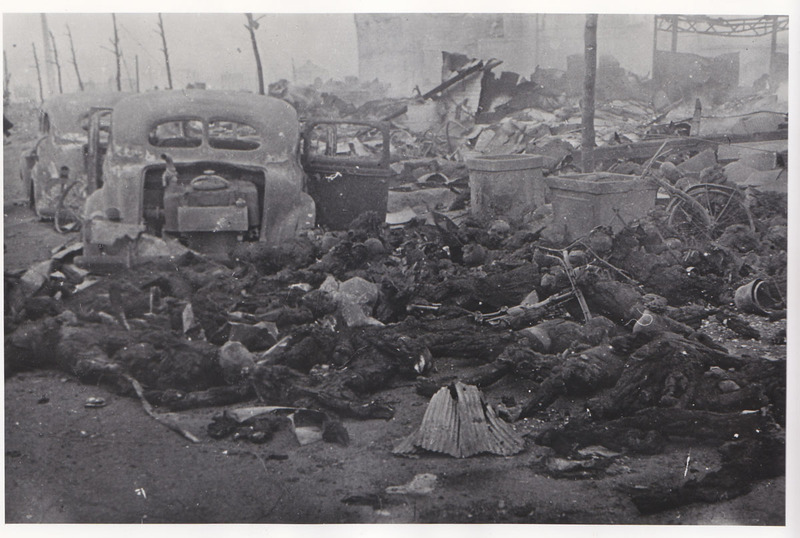
"On March 9, 1945, United States military warplanes launched a bombing offensive against Japan, dropping 2,000 tons of incendiary bombs on Tokyo over the course of the next 48 hours. Almost 16 square miles in and around the Japanese capital were incinerated, and between 80,000 and 130,000 Japanese civilians were killed in the worst single firestorm in recorded history."  
 

The United States military, during Operation Rolling Thunder, killed over 90,000 civilians in North Vietnam from 1965-1968.  Listen to a "heroic" professional U.S. soldier tell of "silencing" the Hanoi defenses to rescue one downed pilot, and the "business" of war.  


On February 14, 1945, the United States military dropped 3,900 tons of bombs on the city of Dresden in Germany, and killed over 25,000 civilians.


The United States military dropped atomic bombs on the cities of Hiroshima and Nagasaki in 1945 and killed over 129,000 civilians.  


The United States military killed over 550,000 civilians in North and South Vietnam from bombing, artillery attacks, and heavy weapons attacks.


And, in 2003, we made a "mistake" about Iraq having any weapons
of mass destruction and for having anything to do with 9/11.
American military soldiers killed over 120,000 Iraqi noncombatant civilians.  


Heroes?  Artillery men, air bombers and gunners, snipers, tank gunners ...

Only crying on Memorial Day.


Yes, the horrors of war and the intense survival necessities of battle for he conscripted soldiers is nearly unfathomable.  


Only crying on Memorial Day.


I recommend that we adopt an amendment to the U.S. Constitution
to Limit the War Making Powers of the U.S. Government. 

Memorial Day: Sorrow, Guilt, Shame, Revulsion


My Facebook Memorial Day Post on May 29, 2017:

"Every very brave and patriotic soldier knows that his enemy is also a very brave and patriotic soldier. Many patriotic soldiers and patriotic civilians, from all countries, believe some god is on their side, and that their enemy is unworthy or evil. The brave and patriotic soldiers on both sides, sworn enemies, will kill each other, and kill tenfold the number of civilians. The fighting will be hell on earth, millions will die, cities will be destroyed, famine and disease will prevail, and billions of dollars will be wasted. Each country will erect memorials and set aside days for patriotic citizens to honor their brave and patriotic soldiers. Patriotism will become a religion that few will dare to question, and doubters will be called cowards, ungrateful, and unpatriotic sinners. Such is the worldwide human condition.
We displayed a U.S. flag on our porch this Memorial Day. I am a Vietnam era veteran. While walking this morning, I noticed that 60% of my neighbors did not display a flag. I often think that they are wiser than I."

Saturday, July 13, 2024

Chapter 69, Tao Te Ching by Lao Tzu


Dao De Jing, Laozi
Chapter 69

"The generals have a saying:
"Rather than make the first move
it is better to wait and see.
Rather than advance an inch
it is better to retreat a yard."
This is called
going forward without advancing,
pushing back without using weapons.
There is no greater misfortune
than underestimating your enemy.
Underestimating your enemy
means thinking that he is evil.
Thus you destroy your three treasures
and become an enemy yourself.
When two great forces oppose each other,
the victory will go
to the one that knows how to yield."
-  Translated by Stephen Mitchell, 1988, Chapter 69 


"In conflict just be cautious
And always on your guard
Rather than advance an inch
Instead retreat a yard
In this way you go along
And make your gain without advancing
You deal with the rival
As your position is enhancing
Remember that it's possible
Your rival just may yield
So don't advance on such a foe
Let differences be healed"
-  Translated by Jim Clatfelder, 2000, Chapter 69  


"An ancient tactician has said:
'I dare not act as a host, but would rather act as a guest;
I dare not advance an inch, but would rather retreat a foot.'
This implies that he does not marshal the ranks as if there were no ranks;
He does not roll up his sleeves as if he had no arms;
He does not seize as if he had no weapons;
He does not fight as if there were no enemies.
No calamity is greater than under-estimating the enemy.
To under-estimate the enemy is to be on the point of losing our treasure.
Therefore, when opposing armies meet in the field the truthful will win."
-  Translated by Ch'u Ta-Kao, 1904, Chapter 69 


"From using force a saying emerges: I dare not act like a ruler, but instead I must act like a guest.
Do not venture an inch when you can withdraw a foot.
This is called progress without progressing.

Seize without seizing.
Apply force to no opponent.
Manage without weapons.

There is no greater calamity than disregarding the enemy.
Disregarding your enemy brings you close to the death of what you treasure.

When two armies meet and inspect each other, grieve for the winner!"
-  Translated by Alan Sheets and Barbara Tovey, 2002, Chapter 69  


"A military expert has said:
'I do not dare put myself forward as a host, but always act as a guest. I hesitate to advance an inch, but am willing to withdraw a foot.'
This is advancing by not advancing, it is winning without arms, it is charging without hostility, it is seizing without weapons.
There is no mistake greater than making light of an enemy.
By making light of an enemy we lose our treasure. 
Therefore when well-matched armies come to conflict, the one who is conscious of his weakness conquers."
-  Translated by Dwight Goddard and Henri Borel, 1919, Chapter 69 


用兵有言:
"吾不敢為主而為客.
不敢進寸而退尺."
是謂行無行,
攘無臂扔無敵,
執無兵.
禍莫大於輕敵,
輕敵幾喪吾寶.
故抗兵相加,
哀者勝矣.
-  Chinese characters, Tao Te Ching, Chapter 69


yung pin yu yen:
"wu pu kan wei chu erh wei k'o,
pu kan chin ts'un erh t'ui ch'ih."
shih wei hsing wu hsing,
jang wu pi jêng wu ti,
chih wu ping.
huo mo ta yü ch'ing ti,
ch'ing ti chi sang wu pao.
ku k'ang ping hsiang chia,
ai chê shêng yi. 
-  Wade-Giles Romanization, Tao Te Ching, Chapter 69 


"The handbook of the strategist has said:
'Do not invite the fight, accept it instead,'
'Better a foot behind than an inch too far ahead,'
Which means:
Look a man straight in the face and make no move,
Roll up your sleeve and clench no fist,
Open your hand and show no weapon,
Bare your breast and find no foe.
But as long as there be a foe, value him,
Respect him, measure him, be humble toward him;
Let him not strip from you, however strong he be,
Compassion, the one wealth which can afford him."
-  Translated by Witter Bynner, 1944, Chapter 69 


"On military operations we have:
"I do not boldly attack others first,
But take action only after being attacked."
"I do not boldly move forward even an inch,
But withdraw a foot."
This is called the operation of non-operation,
Bearing the arms of non-arms,
Charging the enemy of non-enemy,
Carrying the weapons of non-weapons.
There is no more serious misfortune
Than to engage in war lightly.
To engage in war lightly is to violate my essential teachings of compassion,
renunciation, and never longing to be first in the world.
Therefore, when two armies join in battle,
The one that is compassionate wins."
-  Translated by Chang Chung-Yuan, Chapter 69  


"Existe un dicho entre los soldados:
“No me atrevo a hacer el primer movimiento;
preferiría ser el huésped.
No me atrevo avanzar una pulgada; más bien
preferiría retroceder un pie.”

Esto es avanzar sin aparentar moverse;
capturar el enemigo sin atacar;
estar armado sin armas.

No existe mayor catástrofe que desestimar al enemigo.
por desestimar al enemigo casi pierdo lo que valoro:
por lo mismo, cuando la batalla se libra,
el más débil vencerá."
-  Translated by Cristina Bosch, 2002, Capítulo 69


"From using force a saying emerges: I dare not act like a ruler, but instead I must act like a guest.
Do not venture an inch when you can withdraw a foot.
This is called progress without progressing.

Seize without seizing.
Apply force to no opponent.
Manage without weapons.

There is no greater calamity than disregarding the enemy.
Disregarding your enemy brings you close to the death of what you treasure.

When two armies meet and inspect each other, grieve for the winner!"
-  Translated by Alan Sheets and Barbara Tovey, 2002, Chapter 69  


"A military expert has said:
'I do not dare put myself forward as a host, but always act as a guest. I hesitate to advance an inch, but am willing to withdraw a foot.'
This is advancing by not advancing, it is winning without arms, it is charging without hostility, it is seizing without weapons.
There is no mistake greater than making light of an enemy.
By making light of an enemy we lose our treasure. 
Therefore when well-matched armies come to conflict, the one who is conscious of his weakness conquers."
-  Translated by Dwight Goddard and Henri Borel, 1919, Chapter 69 


A typical webpage created by Mike Garofalo for each one of the 81 Chapters (Verses, Sections) of the Tao Te Ching (Daodejing) by Lao Tzu (Laozi) includes over 25 different English language translations or interpolations for that Chapter, 5 Spanish language translations for that Chapter, the Chinese characters for that Chapter, the Wade-Giles and Hanyu Pinyin transliterations (Romanization) of the Mandarin Chinese words for that Chapter, and 2 German and 1 French translation of that Chapter.  Each webpage for each one of the 81 Chapters of the Tao Te Ching includes extensive indexing by key words, phrases, and terms for that Chapter in English, Spanish, and the Wade-Giles Romanization.  Each webpage on a Chapter of the Daodejing includes recommended reading in books and websites, a detailed bibliography, some commentary, research leads, translation sources, a Google Translate drop down menu, and other resources for that Chapter.   


Chapter 69, Tao Te Ching by Lao Tzu

Chapter and Thematic Index (Concordance) to the Tao Te Ching by Lao Tzu

English Language Daodejing Translators' Source Index

Spanish Language Daodejing Translators' Source Index

Ripening Peaches: Taoist Studies and Practices

Taoism: A Selected Reading List

One Old Daoist Druid's Final Journey   


Thursday, December 07, 2023

Pearl Harbor Remembrance Day

On December 7th, 1941, the Japanese military attacked Pearl Harbor in Hawaii.  2,043 military personnel and civilians were killed. and 1, 178 persons were injured. This event is just real history for me.

Remembrance Day

Attack on Pearl Harbor


Today I watched numerous films, made in the 1940's, about World War II in the Pacific.  Turner Classic Movies featured a number of classic films about the War. 

On September 11, 2001, Islamic Terrorist's attacked the World Trade Center in New York and the Pentagon. nearly 3,000 people, mostly civilians, were killed; and thousands more injured.  I remember this event vividly.

Very sad days in the history of America. 


U.S. Navy Arizona RIP


Tuesday, July 04, 2023

Till the Last Shots Fired


Till the Last Shots Fired
Sung by Trace Atkins 

"I was there in the winter of '64
When we camped in the ice at Nashville's doors

Three hundred miles our trail had lead
We barely had time to bury our dead
When the Yankees charged and the colors fell
Overton hill was a living hell
When we called retreat it was almost dark
I died with a grapeshot in my heart
Say a prayer for peace
For every fallen son
Set my spirit free
Let me lay down my gun
Sweet mother Mary I'm so tired
But I can't come home 'til the last shot's fired
In June of 1944
I waited in the blood of Omaha's shores
Twenty-one and scared to death
My heart poundin' in my chest
I almost made the first seawall
When my friends turned and saw me fall
I still smell the smoke, I can taste the mud
As I lay there dying from a loss of blood
Say a prayer for peace
For every fallen son
Set my spirit free
Let me lay down my gun
Sweet mother Mary I'm so tired
But I can't come home 'til the last shot's fired
I'm in the fields of Vietnam,
The mountains of Afghanistan
And I'm still hopin', waitin' prayin'
I did not die in vain
Say a prayer for peace
For every fallen son
Set my spirit free
Let me lay down my gun
Sweet mother Mary I'm so tired
But I can't come home 'til the last shot's fired
'Til the last shot's fired
Say a prayer for peace (for peace)
For our daughters and our sons
Set our spirits free (set us free)
Let us lay down our guns
Sweet mother Mary, we're so tired
But we can't come home (No we can't come home)
'Til the last shot's fired."
Source: LyricFind
Songwriters: Doug Johnson / Rob Crosby

Monday, May 29, 2023

Memorial Day Sadness


Burning Oneself to Death

That was the best moment of the monk's life.
Firm on a pile of firewood
With nothing more to say, hear, see,
Smoke wrapped him, his folded hands blazed.

There was nothing more to do, the end
Of everything.  He remembered, as a cool breeze
Streamed through him, that one is always 
In the same place, and that there is no time.

Suddenly, a whirling mushroom cloud rose
Before his singed eyes, and he was a mass
Of flame. Globes, one after another, rolled out,
The delighted sparrows flew round like fire balls.

-  Sinkichi Takahashi (1901-1987)

Crying On Memorial Day   The Horrors of War


Protesting the Vietnam War
Where Over 1,000,000 people were Killed


Thursday, July 07, 2022

Daodejing, Chapter 80

Tao Te Ching by Lao Tzu
Chapter 80


"You want a small state with a minimal population.

Have ready to hand weaponry for a sufficient number of military units
Yet have no recourse to use them.

Make sure that the common people take dying seriously
So that they have no taste for venturing far from home.

Though you have ships and chariots enough
Have no reason to man them;
Though you have armor and weapons enough
Have no reason to parade them.

Bring the common people back to keeping their records with knotted stong,
To relishing their food,
To finding beauty in their garments,
To enjoying their customs,
An to finding security in their homes.

Although your neighboring states are within eyesight
And the sounds of their dogs and cocks are within earshot,
Your people will grow old and die without having anything to do with them."
-  Translated by Roger T. Ames and David L. Hall, 2003, Chapter 80


"The wise person reduces the importance of governments
And simplifies the modes of living,
So that people use fewer tools and wares
And treasure simplicity in their lives,
So that, though there are vehicles,
People do not take them.
And, though there are weapons,
People do not carry them.
And, though there are records,
Tying knots will serve the record-keeping purpose.
Thus, the highest political achievement is one
In which people savor their food,
Like the beauty of their clothes,
Appreciate their safe and peaceful homes,
Enjoy their social customs;
And in which roosters and dogs
Can be heard between countries;
But people, all their lives,
Have no need to go across the borders."
-  Translated by Liu Qixuan, Chapter 80   


"A small state with few people.
Let the implements (ch'ih) for ten and hundred men be unused,
Let the people fear death such that they do not move far away.
Although there are boats and carriages,
There are no places to ride them to.
Although there are weapons and armours,
There are no occasions to display them.
Let the people again tie ropes and use them (as memory aids).
Let them enjoy their food,
Consider their clothing beautiful,
Be contented with their dwellings,
And happy with their customs.
The neighbouring states overlooking one another,
The dogs' barkings and cocks' crowings are heard from other states,
Yet till they are old and dying the people do not visit one another."
-  Translated by Ellen M. Chen, Chapter 80 


小國寡民.
使有什伯之器而不用.
使民重死而不遠徙.
雖有舟輿無所乘之.
雖有甲兵無所陳之. 
使民復結繩而用之.
甘其食.
美其服安其居.
樂其俗. 
鄰國相望.
雞犬之聲相聞.
民至老死不相往來. 
-  Chinese characters, Chapter 80, Tao Te Ching


hsiao kuo kua min.
shih yu shih po chih ch'i erh pu yung.
shih min chung ssu erh pu yüan hsi.
sui yu chou yü wu so ch'êng chih.
sui yu chia ping wu so ch'ên chih.
shih jên fu chieh shêng erh yung chih.
kan ch'i shih.
mei ch'i fu an ch'i chü. 
lo ch'i su.
lin kuo hsiang wang.
chi ch'üan chih shêng hsiang wên.
min chih lao ssu pu hsiang wang lai.
-  Wade-Giles Romanization, Chapter 80, Tao Te Ching


"The ideal state is a small intimate community.
Where all the necessities of life are present in abundance.
There everyone is satisfied to live and die without looking around for greener pastures.
Even if they have cats or boats, they do not use them for traveling abroad.
Even if they have police and fortifications, these are never put to use.
Business transactions are simple enough to be calculated on one's fingers rather than requiring complicated bookkeeping.
The people are satisfied with their food,
Contented with their clothing,
Comfortable in their dwellings,
And happy with their customs.
Even though neighboring communities are within sight,
And the crowing of the neighbor's cocks and barking of the neighbor's dogs are within hearing,
They grow old and die without ever troubling themselves to go outside of their own communities."
-  Translated by Archie J. Bahm, Chapter 80  


"Let every state be simple like a small village with few people
There may be tools to speed things up ten or a hundred times yet no one will care to use them
There may be boats and carriages yet they will remain without riders
There may be armour and weaponry yet they will sit collecting dust
The people must take death seriously and not waste their lives in distant lands
Let them return to the knotting of cord
Let them enjoy their food and care for their clothing
Let them be content in their homes and joyful in the way they live
Neigbouring villages are within sight of each other
Roosters and dogs can be heard in the distance
Should a man grow old and die without ever leaving his village let him feel as though there was nothing he missed "
-  Translated by Jonathan Star, 2001, Chapter 80 


"Imaginemos que gobierno un pequeño país de pocos habitantes.
Mis súbditos tendrían embarcaciones que no utilizarían.l
Les enseñaría a temer a la muerte y a no alejarse.
Por muchos carruajes que hubiese, no viajarían en ellos.
Aunque tuviesen armas y corazas, no las mostrarían. 
Les llevaría de nuevo al uso de cuerdas con nudos (en lugar de escritura).

Encontrarían sabroso su alimento;
Ricos sus vestidos;
Cómodas sus casas;
Felicidad en sus costumbres.

Aunque los reinos vecinos se hallasen tan cerca
Que pudiesen oír el ladrido de los perros y el canto de los gallos,
Los hombres de este pequeño reino no desearían nunca abandonarlo."
-  Translated by Caridad Diaz Faes, 1970, Capítulo 80  


"Suppose I had a country small,
With people few, and I had there
Some officers of ten,
Or of a hundred men,
I'd not employ those men at all;
Though death were feared, unfrightened then,
My people would not emigrate elsewhere.
They might have carriages and boats,
But not in them to ride away,
They might have warlike arms,
But never war s alarms
Would call them with their hateful notes;
They d even forget how writing charms,
And knotted cords again they would display.
Then would they relish homely food,
Their plain clothes would seem elegant,
Though dwellings might be poor,
Content would guard the door,
And simple habits, plain and good, Far better than they knew before,
A sense of fresh enjoyment would implant.
A neighboring state might be in sight,
The voice of fowls and dogs be heard,
But life like that would make
My people such joy take
In their own state, that till the night
Of age should their enjoyment slake,
And they should die, they'd not exchange a word."
-  Translated by Isaac Winter Heysinger, 1903, Chapter 80  


"If I had a small kingdom and but ten or a hundred men of ability, I would not administrate with them.
I would teach the people to look upon death as a grievous thing, and then they would not go abroad to meet it.
Though they had boats and carriages, yet they would not go away in them.
Though they had armour, yet they would never have occasion to wear it.
The people would return to the use of the quipu.
They should find their coarse food sweet, think their plain clothes grand, regard their homes as places of rest, and take delight in their own simple pleasures.
Though the neighbouring state could be seen by us, and the crowing of the cocks and the barking of the dogs could be heard,
Yet my people would grow old, and die before ever feeling the need of having intercourse with it."
-  Translated by Walter Gorn Old, 1904, Chapter 80


A typical webpage created by Mike Garofalo for each one of the 81 Chapters (Verses) of the Tao Te Ching (Daodejing) by Lao Tzu (Laozi) includes over 25 different English language translations or interpolations for that Chapter, 5 Spanish language translations for that Chapter, the Chinese characters for that Chapter, the Wade-Giles and Hanyu Pinyin Romanization of the Mandarin Chinese words for that Chapter, and 2 German and 1 French translation of that Chapter.  Each webpage for each one of the 81 Chapters of the Tao Te Ching includes extensive indexing by key words and terms for that Chapter in English, Spanish, and the Wade-Giles Romanization.  Each webpage on a Chapter of the Daodejing includes recommended reading in books and websites, a detailed bibliography, some commentary, research leads, translation sources, and other resources for that Chapter.   

Chapter 80, Tao Te Ching by Lao Tzu

Chapter and Thematic Index (Concordance) to the Tao Te Ching by Lao Tzu

English Language Daodejing Translators' Source Index

Spanish Language Daodejing Translators' Source Index

Ripening Peaches: Taoist Studies and Practices

Taoism: A Selected Reading List

One Old Daoist Druid's Final Journey  


Tuesday, June 01, 2021

The Horrors of War

A repost from May 30, 2016:

Today is an American holiday called 'Memorial Day.'  It is a day to remember American soldiers who were injured or died in wars of the past.  I take some time to think about and grieve for all the the men and women lost in the horrors of war, both good soldiers and civilians.  Yes, sometimes fighting in wars is necessary in self-defense; but, still an evil and not to be glorified.  

Really, though, a "holiday?" Something is amiss here; something is disrespectful.  Most Americans party, celebrate, treat it as a three day weekend to kick off summertime fun.  

"In my opinion, there never was a good war, or a bad peace.  What vast additions to the conveniences and comforts of living might mankind had acquired, if the money spent in wars had been employed in works of public utility."
- Benjamin Franklin, 1783


Even the god Krishna tried to convince Arjuna (a professional soldier) in the Bhavagad Gita that fighting and killing, even his relatives, was a duty and a necessity.  The Bible and Koran tell of how "God" slaughters people, and how murder is acceptable to punish "sinners" and non-believers.  Fervent religious people are often quite pleased with killing other people.  Ruthless dictators and misguided politicians manipulate and force people into killing and dying for the Fatherland by inflaming patriotic, xenophobic, ethnic and racist emotions.  The carnage that results is horrific - revolting and beyond comprehension.  


Scores of millions of people have died in the many useless, stupid, tragic, horrible, cruel, and crushing wars of the past. Most of the men that started or fought in these destructive rampages were merely conscripts and pawns in the hands of nations or dogmas or greed or dictators or petty warlords.  There were a few heroes, and many evil macho men, and mostly just extremely scared people crying and screaming as the bombs exploded and bullets whizzed by and their loved ones and friends were torn apart and murdered.  


So, let us instead remember on this Memorial Day to celebrate the real joy that everyone felt when we heard "The War Has Ended" and people could live again in peace.  Let us remember the millions of civilians slaughtered by soldiers marching under ten different flags.

I recommend that we adopt an amendment to the U.S. Constitution to Limit the War Making Powers of the U.S. Government. 


I served in the United States Air Force from 1969-1973.  I served because the United States of America forced men of my age, through "The Draft," to serve in the Vietnam War.  Penalties, social ostracism, employment restrictions, and imprisonment were imposed on young men if they did not "serve their country" in the military.  I had been indoctrinated in my youth in Catholic Schools to hate communists, and have few moral reservations about killing atheistic communists.  Again, sadly, we were merely pawns in the hands of nations or dogmas or ideology or religions or greed or dictators or petty warlords.  Was killing our "enemies" in Vietnam justifiable on the grounds that doing so was crucial and vital to our national self-defense? - hardly!    


When I hear women and men talking these days about how we need to fight and kill those cruel Islamist ISIL brutes in the Middle East, and that President Obama is not "tough" enough, and these same warmongering people never gave one single hour of their life in being a soldier and/or seeing and smelling the carnage of battle, it makes me want to vomit.  


In the Iraq-Iran war in the 1980's over one million soldiers and civilians lost their lives, and countless more were injured or maimed, towns were destroyed ... Shites and Sunnis and Jihadhis fighting each other.  They are still fighting today in 2016 in the Middle East.  Likewise, we have our own real threat from "terror" from all the bozo angry Americans with boxes of guns in their homes - over 11,000 Americans are murdered every year in the USA.   

Peace and Memorials to Peace, Less Thinking about War "Heroes"  


Beware of worshiping flags, signs, emblems, and symbols.  We, and every other  nation, including our "enemies," indoctrinates its ruled population to stand up and show worshipful reverence to their own nation's flags and favored religious symbols and fallen soldiers and heroes.  On Memorial Day the graves of dead soldiers in America are decorated with U.S. flags, and the Christian cross, and gunfire salutes to them for loyally following orders.  But, remember, the map is not the territory.   


Be very wary of demagogues that want to 'Make America Great.'  I am quite satisfied with making America decent, making steady improvements, being respectful of one another, and enjoying peace.  

I recommend that we adopt an amendment to the U.S. Constitution to Limit the War Making Powers of the U.S. Government.  


"I confess I am a little cynical on some topics, and when a whole nation is roaring Patriotism at the top of its voice, I am fain to explore the cleanness of
its hands and the purity of its heart."
-  Ralph Waldo Emerson, 1847


I am sure the Germans cried over their brave Nazi soldiers who died in battle, and so too did the Japanese honor their brave soldiers of World War II. And, along the way of glory, these brave warriors, from many nations, including America, just laid waste to scores of cities and over 60 million people died.  


Before you get too nostalgic and weepy this Memorial Day about our military "heroes," our brave fighting men, our courageous American soldiers ... please recall just a few of the cruel acts they did to earn such glorious distinctions, to wit:


"On March 9, 1945, United States military warplanes launched a bombing offensive against Japan, dropping 2,000 tons of incendiary bombs on Tokyo over the course of the next 48 hours. Almost 16 square miles in and around the Japanese capital were incinerated, and between 80,000 and 130,000 Japanese civilians were killed in the worst single firestorm in recorded history."  


The United States military, during Operation Rolling Thunder, killed over 90,000 civilians in North Vietnam from 1965-1968.  Listen to a "heroic" professional U.S. soldier tell of "silencing" the Hanoi defenses to rescue one downed pilot, and the "business" of war.  


On February 14, 1945, the United States and Royal Air Force military planes dropped 3,900 tons of bombs on the city of Dresden in Germany, and killed over 25,000 civilians.


The United States military dropped atomic bombs on the cities of Hiroshima and Nagasaki in 1945 and killed over 129,000 civilians.  


The United States military killed over 550,000 civilians in North and South Vietnam from bombing, artillery attacks, machine guns, napham, and heavy weapons attacks.


 And, recently, we made a "mistake" about Iraq having any weapons
of mass destruction and for having anything to do with 9/11 in New York.
American military soldiers killed over 120,000 Iraqi noncombatant civilians.  


Heroes?  Artillery men, air bombers and gunners, snipers, infantry men, tank gunners ...

Only crying on Memorial Day.


Yes, the horrors of war and the intense survival necessities of battle for the conscripted soldiers is nearly unfathomable.  


"The worst barbarity of war is that if forces men collectively to commit acts against which individually they would revolt with their whole being."
-  Ellen Key, War, Peace, and the Future, 1916


Only crying on Memorial Day.
      Not a "holiday."


Memorial Day:
Sorrow, Guilt, Shame, Revulsion, Loss
Mixed Feelings, Regrets, Sadness
Paradoxes, Dilemmas, Ambiguity


Nevertheless, I, like others, do mourn our dead soldiers.
I cry along with their grieving families.

In Memory of Staff Sgt. Daniel A. Quintana
Semper Fidelis