Showing posts with label Things. Show all posts

Sunday, September 21, 2025

Tao Te Ching, Chapter 37

Daodejing by Laozi
Chapter 37


"The Way takes no action, but leaves nothing undone.
When you accept this
The world will flourish,
In harmony with nature.
Nature does not possess desire;
Without desire, the heart becomes quiet;
In this manner the whole world is made tranquil."
-  Interpolated by Peter Merel, 1992, Chapter 37 


"Tao always remains in no artificial action,
And yet nothing is left undone.
Should kings and lords follow Tao,
Ten Thousand Things would naturally mutate.
Should desires arise in their mutation,
I would be ready to pacify them with the uncarved block with no name.
Should they become the uncarved block with no name.
They would become desireless.
Should kings and loads pacify them with desirelessness,
The universe would spontaneously be one with peace.
Here the famous phrase, “Tao remains in no action and yet nothing is left undone.” "
-  Translated by Eichi Shimomisse, 1998, Chapter 37  


"The Dao never does; it takes no action.
Through it everything is done, yet there's nothing left undone.
If good kings and barons would master some fit Dao and keep it,
all things in the world should transform spontaneously.
When reformed and rising to action,
let all influenced be restrained by the blankness of the unnamed,
the nameless pristine simplicity.
Yes, if after being transformed they should desire to act,
someone has to restrain them with simplicity that has no name.
Its an unnamed blankness; it could bring dispassion;
As such nameless pristine simplicity is stripped of desire.
So to be truly, artfully dispassionate, be free of desires and still.
Simple wit and sense is free of desires.
By stripping of desire true rest is achieved almost of itself,
the whole empire will be at rest of its own accord.
And next the world could get at peace of its own accord."
-  Translated by Byrn Tromod, 1997, Chapter 37  


道常無為, 而無不為. 
侯王若能守之, 萬物將自化. 
化而欲作, 吾將鎮之以無名之樸. 
無名之樸, 夫亦將無欲. 
不欲以靜, 天下將自定. 
-  Chinese characters, Tao Te Ching, Chapter 37


dao chang wu wei, er wu bu wei.
hou wang ruo neng shou zhi, wan wu jiang zi hua.
hua er yu zuo, wu jiang zhen zhi yi wu ming zhi pu.
wu ming zhi pu, fu yi jiang bu yu.
bu yu yi jing, tian xia jiang zi ding.
-  Pinyin Romanization, Daodejing, Chapter 37 

"The Tao eternally non-acts, and so 
It does nothing and yet there is nothing left to do; 
If prince or king could keep it, all would change 
Of their own accord with a transformation strange. 
And so transformed, should desire to change again still come to be, 
I would quiet such desire by the Nameless One' s simplicity, 
But the Nameless One' s simplicity is free from all desire, 
So tranquilly, of their own accord, all things would still transpire." 
-  Translated by Isaac Winter Heysinger, 1903, Chapter 37 
"Way-making is really nameless. Were the nobles and kings able to respect this, All things would be able to develop along their own lines. Having developed along their own lines, were they to desire to depart from this, I would realign them With a nameless scarp of unworked wood. Realigned with this nameless scrap of unworked wood, They would leave off desiring. Is not desiring, they would achieve equilibrium, And all the world would be properly ordered of its own accord." -  Translated by Roger T. Ames and Donald L. Hall, 2003, Chapter 37  "El dao, permanente, no tiene nombre; si los señores y reyes pudieran conservarlo, todos los seres se transformarían por sí solos. Si al transformarse apareciera en ellos el deseo de levantar la cabeza, yo los refrenaría con el trozo de madera sin nombre. Refrenados mediante el trozo de madera sin nombre, no se sentirán ofendidos. Al no existir ofensas surgiría la tranquilidad, y el cielo y la tierra se ordenarían espontáneamente."  -  Translated by Juan Ignacio Preciado, 1978, Capítulo #37 "The Way is constantly in non-action, But it leaves nothing undone. If dukes and kings can keep to it, All things will be transformed by themselves. But, in transforming, desires arise. I will subdue them by the nameless simplicity; With nameless simplicity, There will be no desires. Being desireless is to be tranquil. All the world will become calm by itself." - Translated by Yi Wu, Chapter 37
"Tao never does anything,
And everything gets done.
If rulers can keep to it,
The ten thousand things will changes of themselves.
Changed, things may start to stir.
Quiet them with the namelessly simple,
Which alone will bring no-desire.
No-desire: then there is peace,
And beneath-heaven will settle down of itself."
-  Translated by  Herrymoon Maurer, 1985, Chapter 37

 
A typical webpage created by Mike Garofalo for each one of the 81 Chapters (Verses, Sections) of the Tao Te Ching (Daodejing) by Lao Tzu (Laozi) includes over 25 different English language translations or interpolations for that Chapter, 5 Spanish language translations for that Chapter, the Chinese characters for that Chapter, the Wade-Giles and Hanyu Pinyin transliterations (Romanization) of the Mandarin Chinese words for that Chapter, and 2 German and 1 French translation of that Chapter.  Each webpage for each one of the 81 Chapters of the Tao Te Ching includes extensive indexing by key words, phrases, and terms for that Chapter in English, Spanish, and the Wade-Giles Romanization.  Each webpage on a Chapter of the Daodejing includes recommended reading in books and websites, a detailed bibliography, some commentary, research leads, translation sources, a Google Translate drop down menu, and other resources for that Chapter.   
Chapter 37, Tao Te Ching by Lao Tzu

Monday, September 23, 2024

Tao Te Ching, Chapter 4

Daodejing, Laozi
Chapter 4


"Tao is like an empty vessel,
yet use will not drain it.
Never needing to be filled,
it is the deep and unfathomable source
of the ten thousand things.

Blunt the sharpness.
Untangle the knots.
Soften the glare.
Settle like dust.
Let your wheels move only along old ruts.

Darkly visible,
it only seems as if it were there.
I know not its name.
It existed before the ten thousand things.
I call it Tao."
-  Translated by Kari Hohne, 2009, Chapter 4  


"Tao is a whirling emptiness, yet when used it cannot be exhausted.
Out of this mysterious well flows everything in existence.
Blunting sharp edges, Untangling knots, Softening the glare, It evolves us all and makes the whole world one.
Something is there, hidden and deep!
But I do not know whose child it is.
It came even before God."
-  Translated by Brian Browne Walker, 1996, Chapter 4  


"Tao is infinite.
If we use It, we find It inexhaustible,
Deep!
It appears to be Ancestor of all things.
It rounds our angles. It unravels our difficulties. It harmonizes our Light. It brings our atoms into Unity.
Pure!
It appears to be everlasting in principle.
I do not know whose Son It is,
It existed before God was manifest in Form."
-  Translated by Isabella Mears, 1916, Chapter 4 


"The Tao is like an empty bowl, 
Which in being used can never be filled up.
Fathomless, it seems to be the origin of all things.
It blunts all sharp edges,
It unties all tangles,
It harmonizes all lights,
It unites the world into one whole.
Hidden in the deeps,
Yet it seems to exist for ever.
I do not know whose child it is;
It seems to be the common ancestor of all, the father  of things."
-  Translated by John C. H. Wu, 1961, Chapter 4  


道沖而用之或不盈.
淵兮似萬物之宗.
挫其銳.
解其紛.
和其光同其塵.
湛兮似或存.
吾不知誰之子.
象帝之先.
-  Chinese characters, Chapter 4, Tao Te Ching


dao chang er yong zhi huo bu ying.
yuan xi si wan wu zhi zong.
cuo qi rui.
jie qi fen.
he qi guang tong qi chen.
zhan xi si huo cun.
wu bu zhi shui zhi zi.
xiang di zhi xian.  
-  Pinyin Romanization, Chapter 4, Daodejing


"Existence, by nothing bred,
Breeds everything.
Parent of the universe,
It smoothes rough edges,
Unties hard knots,
Tempers the sharp sun,
Lays blowing dust,
Its image in the wellspring never fails.
But how was it conceived?--this image
Of no other sire."
-  Translated by Witter Bynner, 1944, Chapter 4 


"Tao is empty, used yet never filled.
It is deep, like the forefather of all things.
It dulls sharpness, and sorts tangles,
Blends with the light, becoming one with the dust.
So serene, as if it hardly existed.
I do not know whose son it is.
It seems to have preceded God."
-  Translated by Paul J. Lin, Chapter 4 


"El Tao es como un jarrón
que el uso nunca llena.
Es iqual que un abismo,
origen de todas las cosas del mundo.

El embota cualquier filo,
El desmadeja cualquier ovillo,
El fusiona todas las cuces,
El unifica todos los polvos.

El parece muy frofundo,
parece durar siempre.
Higo de un no sé qué,
debe de ser el antepasado de los dioses."
-  Translated by Alba, 1998, Tao Te Ching, Capítulo 4 


"The subtle Way of the universe appears to lack strength,
yet its power is inexhaustible.
Fathomless, it could be the origin of all things.
It has no sharpness,
yet it rounds off all sharp edges.
It has no form,
yet it unties all tangles.
It has no glare,
yet it merges all lights.
It harmonizes all things and unites them as one integral whole.
It seems so obscure,
yet it is the Ultimate Clarity.
Whose offspring it is can never be known.
It is that which existed before any divinity."
-  Translated by Hua-Ching Ni, 1995, Chapter 4  


"Tao is an empty vessel;
it is used but never exhausted.
It is the fathomless source
of the ten thousand beings!
It blunts the sharp
and untangles the knots.
It softens the glare
and unites with the dust of the world.
It is tranquil and serene
and endures forever.
I don't know form where it comes
yet it is the ancestor of all."
-  Translated by Solala Towler, 2016, Chapter 4 


"Tao is a container
Though used again and again
It is never full
Profound!  As though the ancestor of all things

Rounding the points
Untying the knots
Softening the glare
Unifying the dust


Tranquil!  Although having a life of its own
I do not know whose child it is
It appears to have preceded the primordial ruler"
-  Translated by Dan G. Reid, 2016, Chapter 4 


"The Tao is like an empty container: 
 it can never be emptied and can never be filled.
 Infinitely deep, it is the source of all things.
 It dulls the sharp, unties the knotted,
 shades the lighted, and unites all of creation with dust.

It is hidden but always present.
 I don't know who gave birth to it.
 It is older than the concept of God."
-  Translated by John H. McDonald, 1996, Chapter 4  


A typical webpage created by Mike Garofalo for each one of the 81 Chapters (Verses, Sections) of the Tao Te Ching (Daodejing) by Lao Tzu (Laozi) includes 25 different English language translations or interpolations for that Chapter, 5 Spanish language translations for that Chapter, the Chinese characters for that Chapter, the Wade-Giles and Hanyu Pinyin transliterations (Romanization) of the Mandarin Chinese words for that Chapter, and 2 German and 1 French translation of that Chapter.  Each webpage for each one of the 81 Chapters of the Tao Te Ching includes extensive indexing by key words, phrases, and terms for that Chapter in English, Spanish, and the Wade-Giles Romanization.  Each webpage on a Chapter of the Daodejing includes recommended reading in books and websites, a detailed bibliography, some commentary, research leads, translation sources, a Google Translate drop down menu, and other resources for that Chapter.  These are hypertext documents, and available online under Creative Commons 4.


Chapter 4, Tao Te Ching by Lao Tzu.  Compiled and indexed by Mike Garofalo.  

Chapter and Thematic Index (Concordance) to the Tao Te Ching by Lao Tzu


English Language Daodejing Translators' Source Index


Spanish Language Daodejing Translators' Source Index


Ripening Peaches: Taoist Studies and Practices


Taoism: A Selected Reading List


Saturday, September 07, 2024

What Transcends Lao Tzu?


The Fireplace Records, Chapter 2


What Transcends Lao Tzu?

Ju-ching and Chang San Feng were hoeing and weeding their garden one cool Spring day around noon. Ju-ching asked: "What transcends Lao Tzu, Confucius, or the Buddhas?" Chang answered: "Here, have a bite of my cold rice." Ju-ching responded: "But, you have not answered my question." Chang replied: "Your quest for knowing is quite admirable, Ju-ching. However, sometimes your thirst for mental matters cannot be satisfied. Here, enjoy a cup of cold water." Ju-ching said: "You think that cold water transcends Lao Tzu?" Chang replied: "Yes, or hot tea. The ordinary is the best scaffolding for transcending. The fruits emerge from trees with strong roots. Find the spring that unceasingly flows to nourish your growing garden." Ju-ching was a little startled and said: " Oh! Ah!" and he became enlightened - for an hour.


Considerations 

Enlightenment comes and goes;
Just don't fret your mind or body.
Fathom your being startled,
Revel in your wonder;
And remain steady on the scaffold,
or you will fall into errors. 
Be Patient! 
A callused palm and dirty fingernails precede a Green Thumb.
Only from the Ground of Somethings,
Can Lao Tzu's true words flourish.  


Comments, Sources

Chang San Feng is regarded as a Immortal; a enlightened man who has lived far over 888 years. He appears and disappears at will at different places around the world, and in different eras. He can incarnate as speaking animals and plants. He is regarded as a shaman, fang-shi, wizard, Taoist master, philosopher, fortune teller, mystic, Taijiquan and Internal Alchemy master, wise elder archetype, popular gift giver, odd dresser, and among the revered patriarchs. I have met with Master Chang San Feng many times.

Master Ju-ching (Rujing) was the Chan Buddhist teacher in China of Eihei Dogen from 1230-1235 CE. 

Refer to the Blue Cliff Record (Hekiganroku), Case 77.

Refer to my Cloud Hands Blog Posts on the topic of Koans. 

The Daodejing by Laozi

Pulling Onions Over 1,043 One-line Sayings by Mike Garofalo

Chinese Buddhist and Taoist Stories and Koans 

Refer to Fireplaces, Stoves, Hearths, Campfires


The Fireplace Records Compiled with Commentary by Michael P. Garofalo


Sunday, July 09, 2023

Assumptions Guide the Way

                       The Fireplace Records, Chapter 26

Assumptions Guide the Way


Frank and Mary were discussing metaphysical doctrines one bright summer afternoon. They sipped ice tea as they pondered issues related to idealism and realism.

Frank supported the idealist view, wherein the Conscious Presence of his current experiences is the main criterion for judging phenomena. The real or what exists depends on his direct and immediate consciousness of same. His body and external objects are in some way figments of his imagination, and many common-sense beliefs are the delusions of dualistic thinking.

Mary supported a realist view, dualisms, existence of objects in the world, and the reality of her and others human bodies. She assumed and supported scientific methods (e.g., logic, inference, precise measurements, mathematics, experimentation, probability, provisional theories, worldwide verification, collaborative work, peer evaluation, and pragmatic considerations, etc.) for discovering truth and using the results in technological applications.  Personal consciousness and personal experiences/gnosis, for her, had a limited value when it came to issues of veracity and knowledge.

Mary said, “You are always talking about how your Conscious Presence or Immediate Awareness reveals to you that Constant Change is the Primary Fact. My conclusions are different. An object like my body or the Douglas Fir trees in my back yard or furniture in my office do not change very much at all from day to day. Trees and furniture stay in the same locations. My height and weight and appearance stay pretty much the same each day at the gross level of everyday dealings. My molecular and atomic bodily interior changes quite a bit each day, however I am not aware of these changes unless facing illness. If things constantly change like you contend, and this is unquestionably revealed in your immediate consciousness/experience, then this would be madness.”

Frank said, “If you don’t have consciousness of something, then you know nothing about It. You are bound in unrealistic and delusive dualistic thinking.  All the great Yogis, Philosophers, and Zen Masters know this to be clear and true.  Read the “Transparency of Things” by Rupert Spira to get correctly informed.”

Mary said, “It is a matter of assumptions. I assume the scientific realists or materialists viewpoints because they are practical, efficient, useful, widely accepted, logically consistent, and in accord with common sense. I once read the “Transparency of Things.” An unconvincing repetition of vague and questionable pronouncements. No index, no bibliography, no notes, no scholarship standards, no inter-subjective verification. There, his Conscious Presence, sounds a lot like a spiritual soul (Atman) freed from his body, mind, and Others and resting in a awesome startling mystical Oneness. He does not even have a Deity (Brahma, God the Father, Allah, etc.) to have a Conscious Presence of the world to keep it in existence (e.g., as for Descartes, Berkeley, Hegel, or Green) while he sleeps in unconsciousness. In my view, just warmed over transparent Advaita Vedanta obscurantism.”

Frank said, “I know what I know directly, immediately, personally.  I don’t need the fanciful presuppositions of science to confirm the Experience of Conscious Presence.  It is beyond petty distinctions of right or wrong, good or bad, this or that, true or untrue. Human experience is God (the Divine, the Awesome, the Profound, the Real) gradually made manifest. Once you abandon your dualistic thinking, and your own imaginative and ungrounded deluded thinking, you might see the Light and experience deep awakening and enlightenment.”

Mary said, “We have different assumptions and thus follow different paths to understanding and knowing, and reach different conclusions. Nevertheless, we can both agree that the day is warm, the iced tea refreshing, and the garden looks to be flourishing. Is this not just awesome for one's soul? 

"Mary!" said Frank, surprised.  "Your soul!?"

Mary slapped Frank on the back.  "You Zen Masters love to quibble."


 A Student's Considerations:

Be clear about assumptions and definitions before the discussion.
Learn how to select useful assumptions.
For an illogical person, conclusions don't follow from assumptions.
Don't abandon the quest for reasonable explanations.
The "Mystical One" may be profound, but passes awareness quickly.
Enjoy being in awe, but don't hang on too long. 
Iron Grindstone Liu's Logic can take away our rough edges of stupidity.
Consider Sartre's assumption "Existence Precedes Essence."
Look outside to awaken, look inside to wander in memories.


Related Links, Resources, References

Transparency of Things.  By Rupert Spira.

Awakening the Other Way.  By Marcel Eschauzier.

 
Awe: The New Science of Everyday Wonder and How It Can Transform Your Life.  By Dach Keltner.  Penguin 2023.  Excellent overview, well researched, practical advice.  FVRL. 


Koans: BOS 60, BCR 24, OM 13  Iron Grindstone Liu is a famous female Zen Master.

Refer to my 
Cloud Hands Blog Posts on the topic of Koans/Dialogues.

The Daodejing by Laozi  

Pulling Onions  Over 1,043 One-line Sayings by Mike Garofalo

Subject Index to 1,001 Zen Buddhist Koans

Chinese Chan Buddhist and Taoist Stories and Koans

Taoism

Buddhism

Fireplaces, Stoves, Campfires, Kitchens, Pots, Firewood

Chinese Art

Tai Chi Chuan and Qigong

Meditation Methods

Zen Koan Books I Use

Koan Database Project

Brief Spiritual Lessons Database Project: Subject Indexes


Sparks: Brief Spiritual Lessons and Stories

Matches to Start a Kindling of Insight
May the Light from Your Inner Fireplace Help All Beings
Taoist, Chan Buddhist, Zen Buddhist, Philosophers
Catching Phrases, Inspiring Verses, Koans, Meditations
Indexing, Bibliography, Quotations, Notes, Resources
Research by Michael P. Garofalo

The Fireplace Records
By Michael P. Garofalo


Subject Index to 1,001 Zen Buddhist Koans


Wednesday, October 14, 2020

To Hold Infinity in the palm of your hand


"To see a World in a Grain of Sand
And a heaven in a Wild Flower,
Hold Infinity in the palm of your hand
And Eternity in an hour."

-  William Blake,  Auguries of Innocence, 1863


Nature Mysticism: Quotations, Poems, Sayings  By Michael P. Garofalo (M.P.G.)

Hands On by M.P. G.  Notes on the human hand, fingers, touching ...  

The Spirit of Gardening  Over 3,500 quotations, poems, sayings.  By M.P.G.


"We will endeavour to shew how the aire and genious of Gardens operat upon humane spirits towards virtue and sancitie, I meane in a remote, preparatory and instrumentall working. How Caves, Grotts, Mounts, and irregular ornaments of Gardens do contribute to contemplative and philosophicall Enthusiasms; how Elysium, Antrum, Nemus, Paradysus, Hortus, Lucus, &c., signifie all of them rem sacram et divinam; for these expedients do influence the soule and spirits of man, and prepare them for converse with good Angells; besides which, they contribute to the lesse abstracted pleasures, phylosophy naturall and longevitie."
- John Evelyn in a letter to Sir Thomas Browne, 1657


"The hand is the cutting edge of the mind."
-  Jacob Bronowski

"The mind has exactly the same power as the hands: not merely to grasp the world, but to change it."
-  Colin Wilson 

"By rubbing up against the world, I define myself to myself."
-  Deane Juhan

"The upper limb is the lightning rod to the soul."
-  Robert Markison

“We leave traces of ourselves wherever we go, on whatever we touch.”
-  Lewis Thomas


We hold these truths to be sacred ...

"Hold on.  Hold on.  Hold on.  Hold on."


"A callused palm and dirty fingernails precede a Green Thumb.
When the hoe handle is loose, you will have misplaced the steel wedges.   
Not to move either hand, nor clap, nor think too much are all good for zen gardening. 
As you move your hands so you move your mind.  
Why is it that you can find four gloves for the left hand, and none for the right? 
As with most arts, gardening is an expression of our hands.
Your hand hoe will always find its way to the bottom of the weeding barrel. 
Civilization is rooted in the hands of the gardeners.
You can sometimes get a handle on life, but it often breaks.
The eyes of a gardener are usually bigger than her hands.  
Gardening helps us to carefully attend to the close at hand.  
Chop the weeds and hose the water ... the sounds of two hands clapping - with delight. 
Your rich, famous, and handsome; and, your garden doesn't care.
The difference between a pile of rocks and a rock garden - the eyes and hands of the gardener.
Getting your hands dirty," applies to more than gardening. 
Better to lend a helping hand than just to point a finger.   
Put your hands on the earth and feel the sorrows of the world. 
Hold your hoe in your hand, sharpen it, and fully sense its meaning. 
I see my hand more often than my face, and there is a lesson here to grasp somehow. 
Unclench your fist to give a hand."
-  Michael P. Garofalo, Pulling Onions


Touching Up An Altar
 

Things to touch, small art objects to hold, 

Matches to light, incense to light

Bowls and bells to ring, pictures to clean

Wand sticks to point and orchestrate the scene.

Red chairs to move, floors to sweep,
Books to Read, to Study, for decades to keep.

Pictures as reminders of what insights we grasp
Pictures as reminders of what we think we know
about pagan ways past.

Tables to move and dust,
Symbols, Altars and Signs in the Shadows sans the Sun
A Book of Rituals to hold and read from,

Candles to light, daggers to handle,
Voyager Tarot cards to shuffle,

Feathers to finger, rocks to pick up
Thoughts ungraspable piling up
Tibetan Prayer beads thumbing one past and next up,
So I raise my hands and say

“Toys to play with,
Magikcal tools to play with;
With only memories to keep.”

Kind of like holding infinity
 in the palm of your hand:
using a microscope or telescope,
reading a science book;
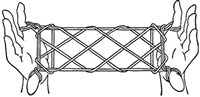
with two hands making an Apache Door string figure display,
the transfiguration of the commonplace loop of string
to help tell stories.


-  Touching Up An Altar, 
by Michael P. Garofalo, 10/15/2020

Strings on Your Fingers, by Mike Garofalo, 1977-


Saturday, November 01, 2014

Can Inanmite Realms Show the Way?

A monk asked, "Can inanminate things expound Dharma?"
Daopi said, "The jade dog roams at night, never knowing the daylight."


"Zen Master Yunmen Wenyan (864-949 CE) once took his staff and struck a pillar in the hall, saying, "Are the three vehicles and twelve divisions of scripture talking?"
He then answered himself by saying, "No, they're not talking."
Then he shouted, "Bah!  A wild fox spirit!"
A monk asked, "What does the master mean?"
Yunmen said, "Mr. Shang drinks the wine, and Mr. Li gets drunk."


"In the works of Emerson, Thoreau, and Whitman in particular, nature is portrayed as a beneficent living force that can, if studied and understood through careful and intentional reflection, offer enduring lessons about what it means to be human. In “Self-Reliance,” and the main ideas behind Thoreau’s “Walden”, as well as “Leaves of Grass”, the respective authors are deeply reverent of nature, and it is through their intimate relationship with the natural world that they construct their own identities and their philosophies about how to live a right life in the natural world. For Emerson, Thoreau, and Whitman, nature is viewed as possessing all the knowledge that man needs to know, if only he is attentive and willing enough to study its messages and apply them to his life."
-  Nicole Smith, The Role of Nature in Transcendental Poetry


Yunmen said, "A true person of the Way can speak fire without burning his mouth.  He can speak all day with moving his lips and teeth or uttering a word.  The entire day he just wears his clothes and eats his food, but never comes in contact with a single grain of rice or thread of cloth.
When we speak in this fashion it is jut the manner of our school.  It must be set forth like this to be realized.  But if you meet a true patch-robed monk of our school and try to reveal the essence through words, it will be a waste of time and effort.  Even if you get some great understanding by means of a single word you are still just dozing."
 

"Zen's Chinese Heritage: The Masters and Their Teachings."  Translated by Any Ferguson.  Boston, Wisdom Publications, 2000, p. 262.  


Way of the Short Staff.  By Michael P. Garofalo, M.S.  A comprehensive guide to the practice of the short staff, cane, jo, walking stick, gun, zhang, whip staff, 13 Hands Staff, and related wood short staff weapons.  A detailed and annotated guide, bibliographies, lists of links, resources, instructional media, online videos, and lessons.   Includes use of the short staff and cane in martial arts, self-defense, walking and hiking.  Separate sections on Aikido Jo, Cane, Taijiquan cane and staff, Jodo, exercises with a short staff, selected quotations, techniques, selecting and purchasing a short staff, tips and suggestions, and a long section on the lore, legends, and magick of the short staff.  Includes "Shifu Miao Zhang Points the Way."  Published by Green Way Research, Valley Spirit Taijiquan, Red Bluff, California.  Updated on a regular basis since October, 2008.  Filesize: 265Kb.  Related to Mike's popular webpage on the Staff.


"Zhaozhou, who had been in poor health, asked his friend Miao Zhang, "Do the bees have Buddha nature?"  Miao Zhang smiled and said, "The roses are so fragrant today, and the cherries so sweet.  Let's walk in the garden and leave our crutches behind." 

    Gathering together in an orchard of blooming sweet lime trees, the students waited for their esteemed teacher, Kasyapa.  Slowly walking down the dirt path, relying on his danda walking staff for balance, Kasyapa joined his students.  He sat quietly for a long time, enjoying the fragrance of the lime blossoms.  Finally, he raised his danda staff.  Everyone stared at Kasyapa - serious, intent, focused, and silent.  Only Shifu Miao Zhang smiled, and then lifted his cane and pointed at a lime blossom.  Kasyapa pointed his danda at Shifu Zhang.  Another transmission was completed.  The sacred thread remained unbroken."
- Shifu Miao Zhang Points the Way


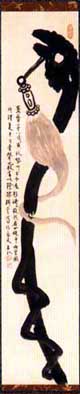
Hakuin's Dragon Staff Inka Scroll


Zen Master Hakuin (1686-1768) painted a Dragon Staff with a horsehair whisk attached.  He gave the above painting to a lay student who passed the Zen koan, "What is the sound of one hand clapping."