Showing posts with label Words. Show all posts

Sunday, October 26, 2025

Tao Te Ching, Chapter 81


Daodejing
 by Laozi

Chapter 81


"Truth has no need for fine words;
Fine words may not be true words.
The man of Tao does not try to convince by argument:
He who argues is not a man of Tao.
Wisdom does not consist in knowing everything;
The know-alls do not know the Tao.
The Sage does not hoard. The more he spends himself for others, the more he enriches himself.
The more he fives, the more he gains.
For the Tao of Heaven penetrates all things but harms none.
This, too, is the Tao of the Sage, who acts without contending."
-  Translated by Herman Ould, 1946, Chapter 81  


"Words born of the mind are not true
True words are not born of the mind
Those who have virtue do not look for faults
Those who look for faults have no virtue
Those who come to know it do not rely on learning
Those who rely on learning do not come to know it
The Sage sees the world as an expansion of his own self
So what need has he to accumulate things?
By giving to others he gains more and more
By serving others he receives everything
Heaven gives and all things turn out for the best
The Sage lives, and all things go as Tao goes all things move as the wind blows"
-  Translated by Jonathan Star, 2001, Chapter 81


Sincere words are not fine; fine words are not sincere.
Those who are skilled in the Tao do not dispute about it; the disputatious are not skilled in it.
Those who know the Tao are not extensively learned; the extensively learned do not know it.
The sage does not accumulate for himself.
The more that he expends for others, the more does he possess of his own;
The more that he gives to others, the more does he have himself.
With all the sharpness of the Way of Heaven, it injures not;
Wth all the doing in the way of the sage he does not strive."
-  Translated by James Legge, 1891, Chapter 81  


"True words are not fine-sounding;
Fine-sounding words are not true.
A good man does not argue;
he who argues is not a good man.
The wise one does not know many things;
He who knows many things is not wise.
The Sage does not accumulate for himself.
He lives for other people,
And grows richer himself;
He gives to other people,
And has greater abundance.
The Tao of Heaven
Blesses, but does not harm.
The Way of the Sage
Accomplishes, but does not contend."
-  Translated by Lin Yutang, 1955, Chapter 81


信言不美.
美言不信.
善者不辯.
辯者不善.
知者不博.
博者不知.
聖人不積.
既以為人己愈有.
既以與人己愈多.
天之道利而不害.
聖人之道為而不爭.
-  Chinese characters, Tao Te Ching, Chapter 81


xin yan bu mei.
mei yan bu xin.
shan zhe bu bian.
bian zhe bu shan.
zhi zhe bu bo,
bo zhe bu zhi.
sheng ren bu ji.
ji yi wei ren ji yu you.
ji yi yu ren ji yu duo.
tian zhi dao li er bu hai.
sheng ren zhi dao wei er bu zheng.
-  Pinyin Romanization, Daodejing, Chapter 81


"Sincere words are not fine,
Fine words are not sincere,
The Faithful friend will stick to the end,
But the flatterer tickles the ear.
The skillful do not debate,
Debaters lack in skill,
For truth is found by looking around,
And words are weapons of ill.
The knowing are not most learned,
The most learned do not know,
For knowledge is grown from thought alone,
While learning from others must grow.
The sage lays up no treasure,
No hoard of goods or gold,
For they who keep a store-house deep,
A constant watch must hold.
The more he works for others
The more he works for his own,
For it grows by use, is lost by abuse,
And he gathers by what he has sown.
The more he gives away,
The more does he have himself,
For thought's a thing that from thought will spring,
Which is quite the reverse of pelf.
The Way of Heaven is sharp,
But it never will cut nor wound,
For they who swim with the flowing stream
Will ever be safe and sound.
T'is the way of the sage to act,
He acts but never strives,
For striving breaks whatever it makes,
And only a wreck survives."
-  Translated by Isaac Winter Heysinger, 1903, Chapter 81 


"Credible words do not sound pretty, pretty words are not credible.
A nice person is not good at arguing, a person who is good at arguing is not nice.
A person who has real knowledge does not show off,
A person who shows off does not have real knowledge.
Great men do not accumulate things for themselves.
The more they do for others, the more they have,
The more they give to others, the more they get.
The law of the heavens is to benefit everything without harming it,
The law of great men is to do things for the world without fighting for the credit."
-  Translated by Xiaolin Yang, Chapter 81


"Sincere words are not beautiful; beautiful words are not sincere.
Good men are not argumentative, the argumentative are not good.
One who knows is not erudite; the erudite one does not know.
The sage does not take to hoarding.
The more he lives for others, the fuller is his life.
The more he gives, the more he abounds.
The Way of Heaven benefits and does not harm.
The Way of the sage works and does not compete with anyone."
-  Translated by Tien Cong Tran, Chapter 81


"Believed words lack embellishment
 Embellished words lack belief.
Those who value lack argument
Those who argue lack valuing
Those who know lack learning
Those who learn lack knowing.
The sages are without accumulating
Grasping, it happens they act
Others later gain presence
Grasping, it happens they give
Others later gain abundance.
The Tao of the heavens
Benefitting yet without spoiling
The Tao of the sages
Acting yet without contending."
-  Translated by David Lindauer, Chapter 81 


"Las palabras sinceras no son agradables, las palabras agradables no son sinceras.
Las buenas personas no son discutidoras, las discutidoras no son buenas.
Las personas sabias no son eruditas, las eruditas no son sabias.
El Sabio no toma nada para acaparar, cuanto más vive para los demás, más plena es su vida.
Cuanto más da, más nada en la abundancia.
La Ley del Cielo es beneficia, no perjudicar.
La Ley del sabio es cumplir su deber, no luchar contra nadie."
-  Translated in English by John C. H. Wu, Spanish version by Alfonso Colodrón, 2007, Capítulo 81   


"Faithful words may not be beautiful,
Beautiful words may not be faithful.
Those who love do not quarrel,
Those who quarrel do not love.
Those who know are not learned,
Those who are learned do not know.
The riches of the self-controlled man are in the Inner Life.
When he spends for others, he has more for himself.
When he gives to others, he has much more for himself.
Heavenly Tao blesses all and hurts no one.
The way of the self-controlled man is to act and not to fight."
-  Translated by Isabella Mears, 1916, Chapter 81  


"Sincere words and not pretty.
Pretty words are not sincere.
Good people do not quarrel.
Quarrelsome people are not good.
The wise are not learned.
The learned are not wise.
The Sage is not acquisitive - Has enough By doing for others,
Has even more By giving to others.
Heaven's Tao Benefits and does not harm.
The Sage's Tao Acts and does not contend."
-  Translated by Stephen Addis, 1993, Chapter 81  


A typical webpage created by Mike Garofalo for each one of the 81 Chapters (Verses, Sections) of the Tao Te Ching (Daodejing) by Lao Tzu (Laozi) includes 25 different English language translations or interpolations for that Chapter, 5 Spanish language translations for that Chapter, the Chinese characters for that Chapter, the Wade-Giles and Hanyu Pinyin transliterations (Romanization) of the Mandarin Chinese words for that Chapter, and 2 German and 1 French translation of that Chapter.  Each webpage for each one of the 81 Chapters of the Tao Te Ching includes extensive indexing by key words, phrases, and terms for that Chapter in English, Spanish, and the Wade-Giles Romanization.  Each webpage on a Chapter of the Daodejing includes recommended reading in books and websites, a detailed bibliography, some commentary, research leads, translation sources, a Google Translate drop down menu, and other resources for that Chapter.  These are hypertext documents, and available online under Creative Commons 4.


Chapter 81, Tao Te Ching by Lao Tzu.  Compiled and indexed by Mike Garofalo.  

Chapter and Thematic Index (Concordance) to the Tao Te Ching by Lao Tzu


English Language Daodejing Translators' Source Index


Spanish Language Daodejing Translators' Source Index


Ripening Peaches: Taoist Studies and Practices


Taoism: A Selected Reading List


Wednesday, February 24, 2021

Learning to Read Spanish


Learning to Read in Spanish
I am studying and learning each day to improve my ability to READ text in Spanish in 2021.  This is a self-study program of learning.  

We 75 year old men need to challenge our brains, train our eyes and memory, and challenge ourselves to learn and think more.  I used $500 of our U.S. stimulus check to fund this educational opportunity and challenge.  Hopefully, authors, publishers, and retail bookstores (e.g., Barnes and Noble in Vancouver, Powell's in Portland) and online booksellers (e.g., Amazon, Barnes and Noble) will all benefit from these purchases.   

I have been Using Spanish in translating chapters from the Tao Te Ching by Lao Tzu.  List of Spanish language translations, notes on translating, my project on indexing the Daodejing, and some of the books and links I use to learn to read in Spanish.  
 

Here are the resources that I am using for learning to read Spanish in 2021: 


Better Reading Spanish, Second Edition.  By Jean Yates.  McGraw Hill, 2011, 272 pages, $16.00. 


Easy Spanish Reader:  Three Part Text for Beginning Students.  Text in Spanish, questions, vocabulary, notes. By William T. Tardy.  McGraw Hill, 2006, 218 pages, $16.00. 


Easy Spanish Step-by-Step: Master High Frequency Grammar.  By Barbara Bregstein.  1st Edition, Kindle.  Mcgraw-Hill, 2005, 448 pages, $10.00 Kindle. 


English and Spanish: The Similarities and Differences.  By Scott Paulson.  Kindle, $4.00, 2019, 51 pages. 


501 Spanish Verbs.  By Christopher Kendris and Theodore Kendris.  Baron's, 2020, $16.00


Great Spanish and Latin American Short Stories of the 20th Century.  A Spanish and English, Dual-Language Book.  Edited by Anna Hiller.  Dover, 2013, 288 pages, $16.00. 


Madrigal's Magic Key to Spanish: A Creative and Proven Approach.  By Margarita Madrigal.  Crown, 1989, 512 pages, Book $12.00, Kindle $11.00. 


Merriam-Webster's Easy Learning Complete Spanish: Grammar + Verbs + Vocabulary.  Second Edition, 2016, 703 pages, $19.00. 


Mastering Spanish Vocabulary: A Thematic Approach.  Barron's Foreign Language Guides.  By Jose Maria Navarro and Axel J. Navarro Ramil.  Barrons, 2010, 490 pages, $20.00. Includes an audio CD. 


The Oxford-Duden Pictorial Spanish-English Dictionary.  Oxford University Press, 1989, 888 pages, $15.00.


Random House Webster's Spanish-English and English-Spanish Dictionary, Second Edition, 1995, 694 pages, $18.00.


Rosetta Stone, Software, Lifetime, Spanish  $200    


Short Stories in Spanish for Beginners.  Edited by Olly Richards.  Teach Yourself Books, 2018, 238 pages, $15.00. 


Spanish-English Bilingual Visual Dictionary.  By DK Publisher, 360 pages, 2017, Kindle, $8.00.


Spanish Flashcards: 800 Important Spanish-English and English-Spanish Flash Cards.  By Phinhok Languages.  Kindle Edition.  $11.00


Spanish Short Stories for Beginners.  Kindle.  $4.50


Spanish Short Stories 1, Parallel Text, Spanish and English Edition. Edited by Jean Franco.  Penguin, 1966, 203 pages, $19.00.


201 Spanish Words You Need to Know Flashcards.  Barron's Foreign Language Guides.  By Theodore Kendris.  2019, $10.00


Webster's Spanish-English Dictionary for Students.  Merriam-Webster, 2014, Second Edition, 365 pages, $6.00.  Light and handy. 


Total Cost:  $479.00 as of 2/22/2021.  Budget in 2021 for Spanish language learning resources, classes, lessons, books, materials, software: $500.00. 


Supplementary Reading Materials in Spanish


Wikipedia in Spanish


Children's Books in Spanish


Online Newspapers in Spanish


Children's Books in Spanish from Amazon


Thursday, November 14, 2019

Pondering How Words Work the Mind

"When I seek God
with something in mind,


the best I get is
the something I had

in mind."


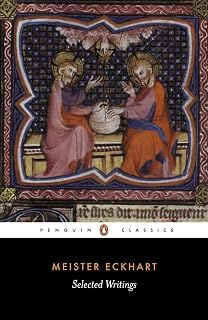
Meister Eckart, circa 1305 CE, was a Dominican clergyman, scholar, and teacher.  His theological and mystical poems, and his sermons are still read today.

Zen also tries to enlighten us to the levels of consciousness, mind, and non-verbal paths to right living.

Meister Eckhart: Selected Writings
Translated with introduction by Oliver Davies.
Penguin, 1995, Kindle Version


Selected Writings (Penguin Classics)


Friday, May 05, 2017

Dao De Jing, Chapter 1


Tao Te Ching  by Lao Tzu
Chapter 1


"Existence is beyond the power of words
To define:
Terms may be used
But are none of them absolute.
In the beginning of heaven and earth there were no words,
Words came out of the womb of matter;
And whether a man dispassionately
Sees to the core of life
Or passionately
Sees the surface,
The core and the surface
Are essentially the same,
Words making them seem different
Only to express appearance.
If name be needed, wonder names them both:
From wonder into wonder
Existence opens."
-  Translated by Witter Bynner, 1944, Chapter 1


"The way that can be spoken of
Is not the constant way;
The name that can be named
Is not the constant name.
The nameless was the beginning of heaven and earth;
The named was the mother of the myriad creatures.
Hence always rid yourself of desires in order to observe its secrets;
But always allow yourself to have desires in order to observe its manifestations.
These two are the same
But diverge in name as they issue forth.
Being the same they are called mysteries,
Mystery upon mystery -
The gateway of the manifold secrets."
- Translated by D. C. Lau, 1963, Chapter 1


"The Tao that is the subject of discussion is not the true Tao.
The quality which can be named is not its true attribute.
That which was before Heaven and Earth is called the Non-Existent.
The Existent is the mother of all things.
Therefore doth the wise man seek after the first mystery of the Non-Existent, while seeing in that which exists the Ultimates thereof.
The Non-Existent and Existent are identical in all but name.
This identity of apparent opposites I call the profound, the great deep, the open door of bewilderment."
-  Translated by Walter Gorn Old, 1904, Chapter 1

"Nature can never be completely described, for such a description of Nature would have to duplicate Nature.
No name can fully express what it represents.
It is Nature itself, and not any part or name or description abstracted from Nature, which is the ultimate source of all that happens, all that comes and goes, begins and ends, is and is not.
But to describe Nature as "the ultimate source of all" is still only a description, and such a description is not Nature itself.
Yet since, in order to speak of it, we must use words, we shall have to describe it as "the ultimate source of all."
If Nature is inexpressible, he who desires to know Nature as it is in itself will not try to express it in words
Although the existence of Nature and a description of that existence are two different things, yet they are also the same.
For both are ways of existing.
That is, a description of existence must have its own existence, which is different from the existence of that which it describes.
And so again we have to recognize an existence which cannot be described."
-  Translated by Archie J. Bahm, 1958, Chapter 1   


道可道, 非常道.
名可名, 非常名.
無名天地之始.
有名萬物之母.
故常無, 欲以觀其妙.
常有, 欲以觀其徼.
此兩者, 同出而異名.
同謂之玄.
玄之又玄.
衆妙之門.
 -  Chinese characters, Tao Te Ching, Chapter 1


tao k’o tao, fei ch’ang tao.
ming k’o ming, fei ch’ang ming.
wu ming t’ien ti chih shih.
yu ming wan wu chih mu.
ku ch’ang wu, yü yi kuan ch’i miao.
ch’ang yu, yü yi kuan ch’i chiao.
tz’u liang chê, t’ung ch’u erh yi ming.
t’ung wei chih hsüan.
hsüan chih yu hsüan.
chung miao chih mên.
-  Wade Giles Romanization, Tao Te Ching, Chapter 1  


"The Tao that can be trodden is not the enduring and unchanging Tao.
The name that can be named is not the enduring and unchanging name.
Conceived of as having no name, it is the Originator of heaven and earth;
Conceived of as having a name, it is the Mother of all things. 
Always without desire we must be found,
If its deep mystery we would sound;
But if desire always within us be,
Its outer fringe is all that we shall see. 
Under these two aspects, it is really the same;
But as development takes place, it receives the different names.
Together we call them the Mystery.
Where the Mystery is the deepest is the gate of all that is subtle and wonderful."
-  Translated by James Legge, 1891, Chapter 1 


"The Tao that can be spoken of is not the constant Tao.
The name that can be named is not the constant name.
The nameless is the beginning of life.
It is the mother of the ten thousand things.
Remove your desires and you will see the mystery.
Be filled with desire
And you will see only the manifestation.
These two are the same
yet, they diverge in nature
as they issue forth.
Being the same, they are the source
but the source remains a mystery.
Mystery upon mystery,
The gateway of Tao's manifold secrets."
-  Translated by Kari Hohne, 2009, Chapter 1


"Camino que se puede describir de manera articulada
     no es el Camino Invariable.
El nombre que se puede decir en voz alta
     no es el Nombre Invariable.
Con la boca cerrada y las cosas sin definir,
     estás al principio del universo.
Si haces definiciones, eres la medida de toda la creación.
Así, estando siempre sin deseo,
     miras en lo hondo de lo trascendente.
Albergando constantemente el deseo,
     todas las cosas que te rodean te estorban la vista.
Estos dos entran en el mundo semejantes,
     pero sus nombres son diferentes.
Semjantes, se llaman profundos y remotos.
Profundos y remotos y más aún:
Esta es la puerta de todos los misterios."
-  Translated by Alejandro Pareja, 2012, based upon the William Scott Wilson translation into English, Capítulo 1


"Tao called Tao is not Tao.
Names can name no lasting name.
Nameless: the origin of heaven and earth.
Naming: the mother of ten thousand things.
Empty of desire, perceive mystery.
Filled with desire, perceive manifestations.
These have the same source, but different names.
Call them both deep - Deep and again deep: the gateway to all mystery."
-  Translated by Stephen Addis and Stanley Lombardo, 1993, Chapter 1  


"The Way that can be told of is not an Unvarying Way;
The names that can be named are not unvarying names.
It was from the Nameless that Heaven and Earth sprang;
The named is but the mother that rears the ten thousand creatures, each after its kind.
Truly, “Only he that rids himself forever of desire can see the Secret Essences”;
He that has never rid himself of desire can see only the Outcomes.
These two things issued from the same mould, but nevertheless are different in name.
This “same mould” we can but call the Mystery, Or rather the “Darker than any Mystery”,
The Doorway whence issued all Secret Essences."
-  Translated by Arthur Waley, 1934, Chapter 1 


  "Tao that can be expressed is not Everlasting Tao.
 The name that can be named is not the Everlasting Name.
 The Name, in its inner aspect, is Life-Spring of Heaven and Earth.
 The Name, in its outer aspect, is Mother of all created things.
 Therefore:
 To perceive the mystery of Life, desire always to reach the innermost.
 To perceive the limitations of things, desire always to posses them.
 These two aspects of Life are One.
 In their out-come they become different in Name but in their depth they are One.
 In a depth, still deeper yet, is the Door of many mysteries."
 -  Translated by Isabella Mears, 1916, Chapter 1   


"The Tao that can be spoken of is not the Tao itself.
The name that can be given is not the name itself.
The unnameable is the source of the universe.
The nameable is the originator of all things.
Therefore, oftentimes without intention I see the wonder of Tao.
Oftentimes with intention I see its manifestations.
Its wonder and its manifestations are one and the same.
Since their emergence, they have been called by different names.
Their identity is called the mystery.
From mystery to further mystery:
The entry of all wonders!"
- Translated by Chang Chung-Yuan, Chapter 1

A typical webpage created by Mike Garofalo for each one of the 81 Chapters (Verses, Sections) of the Tao Te Ching (Daodejing) by Lao Tzu (Laozi) includes 25 different English language translations or interpolations for that Chapter, 5 Spanish language translations for that Chapter, the Chinese characters for that Chapter, the Wade-Giles and Hanyu Pinyin transliterations (Romanization) of the Mandarin Chinese words for that Chapter, and 2 German and 1 French translation of that Chapter.  Each webpage for each one of the 81 Chapters of the Tao Te Ching includes extensive indexing by key words, phrases, and terms for that Chapter in English, Spanish, and the Wade-Giles Romanization.  Each webpage on a Chapter of the Daodejing includes recommended reading in books and websites, a detailed bibliography, some commentary, research leads, translation sources, a Google Translate drop down menu, and other resources for that Chapter.  These are hypertext documents, and available online under Creative Commons 4.


Chapter 1, Tao Te Ching by Lao Tzu.  Compiled and indexed by Mike Garofalo.  

Chapter and Thematic Index (Concordance) to the Tao Te Ching by Lao Tzu


English Language Daodejing Translators' Source Index


Spanish Language Daodejing Translators' Source Index


Ripening Peaches: Taoist Studies and Practices


Taoism: A Selected Reading List


Monday, February 15, 2016

The Seduction of Words


"I shall repeat a hundred times: we really ought to free ourselves from the seduction of words."
- Frederick Nietzsche, Beyond Good and Evil, #16, 1886

Nietzsche can seduce you with words ... so beware.


"A very popular error: having the courage of one's convictions; rather, it is a matter of having the courage for an attack on one's convictions!!!"
- Frederick Nietzsche, Werke, XVI, p. 318.

In 2016, I have been quite consistently reading and studying the life, works, and philosophy of Friedrich Wilhelm Nietzsche (1844-1900). My hypertext notebook about Nietzsche includes some of my research and many quotations from Nietzsche. I first read Nietzsche in 1964, and since then many times in the past decades. Surprisingly, I don't remember my philosophy teachers (1962-1966) talking much about Nietzsche.


I share most of Nietzsche's views on Judeo-Christian-Moslem beliefs and practices.

I am currently reading:

Nietzsche: A Philosophical Biography. By Rüdiger Safranski. Translated by Shelley Frisch. W.W. Norton and Co., Reprint Edition, 2003. Index, 416 pages. ISBN: 978-0393323801. VSCL.

Basic Writings of Nietzsche. By Friedrich Nietzsche. Translated and Edited, with Commentaries by Walter Kaufmann. New York, Modern Library, 1966, 1968. Indexes pp 804-845, 845 pages. ISBN: B00E28VDX0 for the 1996 Edition, with and introduction by Peter Gay. I use the 1968 version. This text includes: The Birth of Tragedy, Beyond Good and Evil, On the Genealogy of Morals, The Case of Wagner, Ecce Homo, and Aphorisms. Each book has an introduction. Includes biographical notes. Separate indexes for each book. I use a Modern Library hardbound 1968 version of this work, and the very inexpensive Kindle E-book version, VSCL.

Nietzsche: The Man and his Philosophy. By R. J. Hollingdale. Cambridge University Press, 2nd Edition, 2001. 288 pages. ISBN: 9780521002950. VSCL. 


Friday, September 04, 2015

Tao Te Ching, Chapter 81, Lao Tzu

Daodejing by Laozi
Chapter 81


"Truth has no need for fine words;
Fine words may not be true words.
The man of Tao does not try to convince by argument:
He who argues is not a man of Tao.
Wisdom does not consist in knowing everything;
The know-alls do not know the Tao.
The Sage does not hoard. The more he spends himself for others, the more he enriches himself.
The more he fives, the more he gains.
For the Tao of Heaven penetrates all things but harms none.
This, too, is the Tao of the Sage, who acts without contending."
-  Translated by Herman Ould, 1946, Chapter 81  


"Words born of the mind are not true
True words are not born of the mind
Those who have virtue do not look for faults
Those who look for faults have no virtue
Those who come to know it do not rely on learning
Those who rely on learning do not come to know it
The Sage sees the world as an expansion of his own self
So what need has he to accumulate things?
By giving to others he gains more and more
By serving others he receives everything
Heaven gives and all things turn out for the best
The Sage lives, and all things go as Tao goes all things move as the wind blows"
-  Translated by Jonathan Star, 2001, Chapter 81


Sincere words are not fine; fine words are not sincere.
Those who are skilled in the Tao do not dispute about it; the disputatious are not skilled in it.
Those who know the Tao are not extensively learned; the extensively learned do not know it.
The sage does not accumulate for himself.
The more that he expends for others, the more does he possess of his own;
The more that he gives to others, the more does he have himself.
With all the sharpness of the Way of Heaven, it injures not;
Wth all the doing in the way of the sage he does not strive."
-  Translated by James Legge, 1891, Chapter 81  


"True words are not fine-sounding;
Fine-sounding words are not true.
A good man does not argue;
he who argues is not a good man.
The wise one does not know many things;
He who knows many things is not wise.
The Sage does not accumulate for himself.
He lives for other people,
And grows richer himself;
He gives to other people,
And has greater abundance.
The Tao of Heaven
Blesses, but does not harm.
The Way of the Sage
Accomplishes, but does not contend."
-  Translated by Lin Yutang, 1955, Chapter 81


信言不美.
美言不信.
善者不辯.
辯者不善.
知者不博.
博者不知.
聖人不積.
既以為人己愈有.
既以與人己愈多.
天之道利而不害.
聖人之道為而不爭.
-  Chinese characters, Tao Te Ching, Chapter 81


xin yan bu mei.
mei yan bu xin.
shan zhe bu bian.
bian zhe bu shan.
zhi zhe bu bo,
bo zhe bu zhi.
sheng ren bu ji.
ji yi wei ren ji yu you.
ji yi yu ren ji yu duo.
tian zhi dao li er bu hai.
sheng ren zhi dao wei er bu zheng.
-  Pinyin Romanization, Daodejing, Chapter 81


"Sincere words are not fine,
Fine words are not sincere,
The Faithful friend will stick to the end,
But the flatterer tickles the ear.
The skillful do not debate,
Debaters lack in skill,
For truth is found by looking around,
And words are weapons of ill.
The knowing are not most learned,
The most learned do not know,
For knowledge is grown from thought alone,
While learning from others must grow.
The sage lays up no treasure,
No hoard of goods or gold,
For they who keep a store-house deep,
A constant watch must hold.
The more he works for others
The more he works for his own,
For it grows by use, is lost by abuse,
And he gathers by what he has sown.
The more he gives away,
The more does he have himself,
For thought's a thing that from thought will spring,
Which is quite the reverse of pelf.
The Way of Heaven is sharp,
But it never will cut nor wound,
For they who swim with the flowing stream
Will ever be safe and sound.
T'is the way of the sage to act,
He acts but never strives,
For striving breaks whatever it makes,
And only a wreck survives."
-  Translated by Isaac Winter Heysinger, 1903, Chapter 81 


"Credible words do not sound pretty, pretty words are not credible.
A nice person is not good at arguing, a person who is good at arguing is not nice.
A person who has real knowledge does not show off,
A person who shows off does not have real knowledge.
Great men do not accumulate things for themselves.
The more they do for others, the more they have,
The more they give to others, the more they get.
The law of the heavens is to benefit everything without harming it,
The law of great men is to do things for the world without fighting for the credit."
-  Translated by Xiaolin Yang, Chapter 81


"Sincere words are not beautiful; beautiful words are not sincere.
Good men are not argumentative, the argumentative are not good.
One who knows is not erudite; the erudite one does not know.
The sage does not take to hoarding.
The more he lives for others, the fuller is his life.
The more he gives, the more he abounds.
The Way of Heaven benefits and does not harm.
The Way of the sage works and does not compete with anyone."
-  Translated by Tien Cong Tran, Chapter 81


"Believed words lack embellishment
 Embellished words lack belief.
Those who value lack argument
Those who argue lack valuing
Those who know lack learning
Those who learn lack knowing.
The sages are without accumulating
Grasping, it happens they act
Others later gain presence
Grasping, it happens they give
Others later gain abundance.  
The Tao of the heavens
Benefitting yet without spoiling
The Tao of the sages
Acting yet without contending."
-  Translated by David Lindauer, Chapter 81 


"Las palabras sinceras no son agradables, las palabras agradables no son sinceras.
Las buenas personas no son discutidoras, las discutidoras no son buenas.
Las personas sabias no son eruditas, las eruditas no son sabias.
El Sabio no toma nada para acaparar, cuanto más vive para los demás, más plena es su vida.
Cuanto más da, más nada en la abundancia.
La Ley del Cielo es beneficia, no perjudicar.
La Ley del sabio es cumplir su deber, no luchar contra nadie."
-  Translated in English by John C. H. Wu, Spanish version by Alfonso Colodrón, 2007, Capítulo 81   


"Les paroles sincères ne sont pas élégantes; les paroles élégantes ne sont pas sincères.
L'homme vertueux n'est pas disert; celui qui est disert n'est pas vertueux.
Celui qui connaît le Tao n'est pas savant; celui qui est savant ne le connaît pas.
Le Saint n'accumule pas les richesses.
Plus il emploie sa vertu dans l'intérêt des hommes, et plus elle augmente.
Plus il donne aux hommes et plus il s'enrichit.
Telle est la voie du ciel, qu'il est utile aux êtres et ne leur nuit point.
Telle est la voie du Saint, qu'il agit et ne dispute point."
-  Translated by Stanislas Julien, 1842, Chapter 81


"Faithful words may not be beautiful,
Beautiful words may not be faithful.
Those who love do not quarrel,
Those who quarrel do not love.
Those who know are not learned,
Those who are learned do not know.
The riches of the self-controlled man are in the Inner Life.
When he spends for others, he has more for himself.
When he gives to others, he has much more for himself.
Heavenly Tao blesses all and hurts no one.
The way of the self-controlled man is to act and not to fight."
-  Translated by Isabella Mears, 1916, Chapter 81  


"Sincere words and not pretty.
Pretty words are not sincere.
Good people do not quarrel.
Quarrelsome people are not good.
The wise are not learned.
The learned are not wise.
The Sage is not acquisitive - Has enough By doing for others,
Has even more By giving to others.
Heaven's Tao Benefits and does not harm.
The Sage's Tao Acts and does not contend."
-  Translated by Stephen Addis, 1993, Chapter 81  


A typical webpage created by Mike Garofalo for each one of the 81 Chapters (Verses) of the Tao Te Ching (Daodejing) by Lao Tzu (Laozi) includes up to 25 different English language translations or interpolations for that Chapter, 3 or 4 Spanish language translations for that Chapter, the Chinese characters for that Chapter, the Wade-Giles and Hanyu Pinyin Romanization of the Mandarin Chinese words for that Chapter, and 1 German and 1 French translation of that Chapter.  Each webpage for each one of the 81 Chapters of the Tao Te Ching includes extensive indexing by key words and terms for that Chapter in English, Spanish, and the Wade-Giles Romanization.  Each webpage on a Chapter of the Daodejing includes recommended reading in books and websites, a detailed bibliography, some commentary, research leads, translation sources, and other resources for that Chapter.   

Chapter 81, Tao Te Ching by Lao Tzu

Chapter and Thematic Index (Concordance) to the Tao Te Ching by Lao Tzu

English Language Daodejing Translators' Source Index

Spanish Language Daodejing Translators' Source Index

Ripening Peaches: Taoist Studies and Practices

Taoism: A Selected Reading List

One Old Daoist Druid's Final Journey