Recently, I have been reading many books about yoga, exercise and
spirituality. The following book by Mark Singleton has influenced my
understanding of the evolution of the practice of hatha yoga since 1880:
Yoga Body: The Origins of Modern Posture Practice By Mark Singleton. New York, Oxford University Press, 2012. Index,
bibliography, notes, 262 pages. ISBN: 9780195395341. VSCL.
By Mark Singleton. New York, Oxford University Press, 2012. Index,
bibliography, notes, 262 pages. ISBN: 9780195395341. VSCL.
Mr. Singleton's well argued and carefully documented thesis is that transnational yoga as we know it today, asana practices, emerged from physical culture practices from Europe, Indian nationalism, gymnastics, bodybuilding, medicine, health regimens, New Thought, a Hindu studies revival, fitness and gym business promoters, and the development and expansion of visual media. This process began in the 1880's and continues to this day.
"Consider the term Yoga as it refers to modern postural practice as a homonyn, and not a synonym, of the "yoga" associated with the philosophical system of Pantanjali, or the "yoga" that forms and integral component of the Saiva Tantras, or the "yoga" of the Bhagavad Gita, and so on. In other words, although the word "yoga" as it is used popularly today is identical in spelling and pronunciation in each of these instances, it has quite different meanings and origins." p.15
"As Joseph Alter has recently argued, a key methodological issue is therefore "how to exercise ethnographic relativism, historical perspectivity and intellectual skepticism all at the same time." This means critically examining modern yoga's truth claims while seeking to understand under what circumstances and to what ends such claims are made." p.14
The esoteric, magical, religious, New Age, imaginary and spiritual dimensions of "yoga" are definitely part of the currents of contemporary yoga practice and trends in non-church spirituality since the 1880's; but, the bigger picture of its popularity is due to our enthusiasm for fitness, bodybuilding, stress reduction, sexuality, improved health, relaxation, and the "good life."
Another book that points us in the right direction regarding contemporary yoga practices is:
The Science of Yoga: The Risks and the Rewards By William J. Broad. New York, Simon and Schuster, 2012.
Index, bibliography, notes, 298 pages. ISBN; 9781451641424.
VSCL.
By William J. Broad. New York, Simon and Schuster, 2012.
Index, bibliography, notes, 298 pages. ISBN; 9781451641424.
VSCL.
This book is a must read for those who question the often outlandish claims for the benefits of yoga, are concerned about risky yoga postures, and favor a more scientific approach to yoga practice.
Finally, I enjoyed reading:
Original Yoga: Rediscovering Traditional Practices of Hatha Yoga By Richard Rosen. Illustrations by Evan Yee. Boston, Shambhala,
2012. Index, bibliography, glossary, appendices, 286 pages. ISBN:
9781590308134. VSCL.
By Richard Rosen. Illustrations by Evan Yee. Boston, Shambhala,
2012. Index, bibliography, glossary, appendices, 286 pages. ISBN:
9781590308134. VSCL.
"The changes the traditional practice went through over the centuries might be considered organic, common to any living organism’s natural evolution. What happened to Hatha Yoga in the early years of the twentieth century, by contrast, happened virtually overnight and was totally "person-made," or artificial. The full story is too long to tell here and has already been masterfully recounted from slightly different perspectives by British researchers Elizabeth de Michelis in A History of Modern Yoga (Continuum, 2004) and Mark Singleton in Yoga Body (Oxford University Press, 2010. Suffice it to say that by the end of the nineteenth century in India, Hatha had fallen on hard times and was on its last trembling leg. Several Indian teachers set out to save Hatha from oblivion; among them was Tirumular Krishnamacharya, whose work provided the impetus for three of our most popular and influential modern teachers: T. K. V. Desikachar (whose teaching was once known as Viniyoga, a term that has since been abandoned); the late K. Pattabhi Jois (who taught Ashtanga-Vinyasa Yoga); and B. K. S. Iyengar, who (though he often adamantly insists there’s no such thing) created Iyengar Yoga. And save Hatha the teachers did. You may have heard or read somewhere that yoga is five thousand years old, a number that’s continually cited by people who should know better, since there’s not a shred of concrete evidence to back it up. What we do know for certain is that the yoga we practice in the West is no more than one hundred years old. Our Indian teachers took what was once the province of a relatively small, loose-knit, mostly male ascetic community that was resolutely living on the fringes of respectable Indian society and transformed it into a worldwide mass movement open to anyone of any age, gender, or physical condition. This is the second meaning of original yoga, the yoga that’s "original" to the twentieth century, or what we call modern Hatha Yoga." Original Yoga by Richard Rosen
This book includes instructions on some practices for "energizing" aspects of the esoteric body that are typical in Qigong and Yoga. Those interested in organic energy, Prana, Chi, and nadis/meridians will find it interesting.
After you set aside the preaching about worshipping Krishna, Shiva, or other Tantric dieties; strange chakras, gunas, and pranic realms; divine grace or higher consciousness; the power of meditation, mudras, and mantras; and Hindu pride ... just stick with the physical practices of yoga to effect significant transformation of your body and mind.
Consider the situation and determination of the following fellow:
Yoga Body: The Origins of Modern Posture Practice
By Mark Singleton. New York, Oxford University Press, 2012. Index,
bibliography, notes, 262 pages. ISBN: 9780195395341. VSCL.Mr. Singleton's well argued and carefully documented thesis is that transnational yoga as we know it today, asana practices, emerged from physical culture practices from Europe, Indian nationalism, gymnastics, bodybuilding, medicine, health regimens, New Thought, a Hindu studies revival, fitness and gym business promoters, and the development and expansion of visual media. This process began in the 1880's and continues to this day.
"Consider the term Yoga as it refers to modern postural practice as a homonyn, and not a synonym, of the "yoga" associated with the philosophical system of Pantanjali, or the "yoga" that forms and integral component of the Saiva Tantras, or the "yoga" of the Bhagavad Gita, and so on. In other words, although the word "yoga" as it is used popularly today is identical in spelling and pronunciation in each of these instances, it has quite different meanings and origins." p.15
"As Joseph Alter has recently argued, a key methodological issue is therefore "how to exercise ethnographic relativism, historical perspectivity and intellectual skepticism all at the same time." This means critically examining modern yoga's truth claims while seeking to understand under what circumstances and to what ends such claims are made." p.14
The esoteric, magical, religious, New Age, imaginary and spiritual dimensions of "yoga" are definitely part of the currents of contemporary yoga practice and trends in non-church spirituality since the 1880's; but, the bigger picture of its popularity is due to our enthusiasm for fitness, bodybuilding, stress reduction, sexuality, improved health, relaxation, and the "good life."
Another book that points us in the right direction regarding contemporary yoga practices is:
The Science of Yoga: The Risks and the Rewards
By William J. Broad. New York, Simon and Schuster, 2012.
Index, bibliography, notes, 298 pages. ISBN; 9781451641424.
VSCL. This book is a must read for those who question the often outlandish claims for the benefits of yoga, are concerned about risky yoga postures, and favor a more scientific approach to yoga practice.
Finally, I enjoyed reading:
Original Yoga: Rediscovering Traditional Practices of Hatha Yoga
By Richard Rosen. Illustrations by Evan Yee. Boston, Shambhala,
2012. Index, bibliography, glossary, appendices, 286 pages. ISBN:
9781590308134. VSCL. "The changes the traditional practice went through over the centuries might be considered organic, common to any living organism’s natural evolution. What happened to Hatha Yoga in the early years of the twentieth century, by contrast, happened virtually overnight and was totally "person-made," or artificial. The full story is too long to tell here and has already been masterfully recounted from slightly different perspectives by British researchers Elizabeth de Michelis in A History of Modern Yoga (Continuum, 2004) and Mark Singleton in Yoga Body (Oxford University Press, 2010. Suffice it to say that by the end of the nineteenth century in India, Hatha had fallen on hard times and was on its last trembling leg. Several Indian teachers set out to save Hatha from oblivion; among them was Tirumular Krishnamacharya, whose work provided the impetus for three of our most popular and influential modern teachers: T. K. V. Desikachar (whose teaching was once known as Viniyoga, a term that has since been abandoned); the late K. Pattabhi Jois (who taught Ashtanga-Vinyasa Yoga); and B. K. S. Iyengar, who (though he often adamantly insists there’s no such thing) created Iyengar Yoga. And save Hatha the teachers did. You may have heard or read somewhere that yoga is five thousand years old, a number that’s continually cited by people who should know better, since there’s not a shred of concrete evidence to back it up. What we do know for certain is that the yoga we practice in the West is no more than one hundred years old. Our Indian teachers took what was once the province of a relatively small, loose-knit, mostly male ascetic community that was resolutely living on the fringes of respectable Indian society and transformed it into a worldwide mass movement open to anyone of any age, gender, or physical condition. This is the second meaning of original yoga, the yoga that’s "original" to the twentieth century, or what we call modern Hatha Yoga." Original Yoga by Richard Rosen
This book includes instructions on some practices for "energizing" aspects of the esoteric body that are typical in Qigong and Yoga. Those interested in organic energy, Prana, Chi, and nadis/meridians will find it interesting.
After you set aside the preaching about worshipping Krishna, Shiva, or other Tantric dieties; strange chakras, gunas, and pranic realms; divine grace or higher consciousness; the power of meditation, mudras, and mantras; and Hindu pride ... just stick with the physical practices of yoga to effect significant transformation of your body and mind.
Consider the situation and determination of the following fellow:


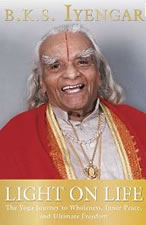
 By B.K.S. Iyengar. With John J. Evans and Douglas Abrams. Rodale Books, 2005. Index, 282 pages. ISBN: 1594862486. VSCL.
  By B.K.S. Iyengar. Introduction by Yehudi Menuhin. New York, Crossroad Pub. Co., 2012. Originally published in 1985 in English. Index, glossary, appendices, 296 pages. ISBN: 9780824506865. VSCL.
 . By B. K. S. Iyengar. Foreword by Yehudi Menuhin. London, Thorsons, 1993. Index, 337 pages. ISBN: 1855382253. VSCL.
  .
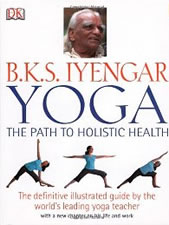
.  By B.K.S. Iyengar. London, Dorling Kindersley, 2001. Index, glossary, appendices, 415 pages. ISBN: 0789471655.