To experience
theFive
Animal Frolicswe need
to keep in mind the "Frolics" aspect of this movement art: being playful and
exuberant, freeing up our time for fun, delighting in bodily movements, enjoying games of imitation, taking pleasure in the moment, and delighting in the exercise of fantasy and imagination. We should be smiling as we enjoy our playful frolics. We should strive to return to our youth, and rekindle those memories of our joyful childhood games, innocence, freedom of fancies, and silliness. We are never too old to embrace that precious child within each of us.
The Complete Tales of Winnie-the-Pooh. By A. A. Milne. With
decorations by Ernest H. Shepard. New York, Dutton's Children's Books,
1994. 344 pages. Color illustrations, hardbound. ISBN:
9780525457237. Originally published in 1926, 1954. This book includes: Winnie-the-Pooh, and The House at Pooh Corner,
VSCL. The Te of Piglet. By Benjamin Hoff.
New York, Penguin Books, 1992. 257 pages. ISBN: 0140230165.
VSCL.
The Tao of Pooh. By Benjamin Hoff.
New York, Penguin Books. VSCL
The most famous literary Bear is Winnie the Pooh. Over 26 million
English language books
by A. A. Milne about the Pooh Bear and his friends have been sold since
1926, the books have been translated into scores of languages, and
Disney Films has made him even more famous and a lucrative commodity
line. Benjamin Hoff has explored how Pooh Bear is a quintessential
"Taoist
Bear."
So ... it is just fine for you to Dance like a Bear.
Become a Silly Bear for
a awhile.
Enjoy the real honey of just being right were you are,
here and now, content,
Pooh, it is quite easy.
"Christopher
Robin and I walked along
Under branches lit up by the moon
Posing our questions to Owl and Eeyore
As our days disappeared all too soon
But I've wandered much further today than I should
And I can't seem to find my way back to the Wood So
help me if you can
I've got to get back
To the House at Pooh Corner by one
You'd be surprised
There's so much to be done
Count all the bees in the hive
Chase all the clouds from the sky
Back to the days of Christopher Robin and Pooh."
-Return to Pooh Corner, Wordsand
lyrics by Kenny Loggins, 1969, MCA Musi
Step out into a Horse Stance. Face
towards N12. The Horse Stance should feel be
rooted, centered,
balanced, and stable.
Place your hands on your hips.
Bend the upper torso down, flexing forward, keep the back straight and head up.
Move the upper torso slowly towards the right side to E3. Try to remain
bent forward until you reach E3. Inhale.
Keep your
hands on your hips throughout this exercise.
Gradually lift the head and torso until you are upright and the face and chest
are facing towards E3.
Your right elbow
should be pointing towards S6 and your left elbow pointing towards N12.
Gently turn the head only to the left and look towards N12. Intently gaze
towards N12. Enjoy the stretch. Exhale.
Gently bring the head back to face towards E3, the whole body is in an upright
posture.
Bend forward at the waist and draw the head and torso downward towards E3.
Move the upper body, flexed
forward, from right side to the left side for 180 degrees, moving from E3 to W9.
Inhale.
Gradually lift the head and torso until you are upright, and the face and chest
are facing towards W9.
Your right elbow
should be pointing towards N12 and your left elbow pointing towards S6.
Gently turn the head only to the right and look towards N12. Intently gaze
towards N12. Enjoy the stretch. Exhale.
Gently turn the head only back to the left, and face W9.
Bend forward at the waist and draw the head and torso downward towards W9.
Move the upper body, flexed forward, from the left side to the right side for
180 degrees, moving from W9 to E3. Inhale.
Repeat the movement sequence from side to side, 3 to 8 eight repetitions.
Breathe freely, comfortably, and
deeply during this exercise. Inhale-Exhale listed are suggestions.
Try to avoid too much muscular tension as you move from side to side and up and
down. Extend rather than tense muscles.
Move slowly and comfortably.
Try to stay relaxed (Sung),
alert, calm, and peaceful.
Visualize, if you like, a mother bear coming out of a cave and powerfully
turning from side to side to survey the outside world.
Nourishing Life practices and exercises to improve fitness, maintain good health, increase energy, calm the mind, and improve the chances for longevity have a very long documented history in China. A healthy and long life are goals of Taoist theory and practices. Animal Frolics Chi Kung exercises date back to Dr. Hua Tuo (207 CE).
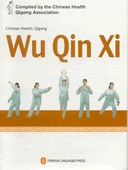
"Wu Qin Xi (Five Animal Frolics): Chinese Health Qigong. Compiled by the Chinese Health Qigong Association. Beijing, Chine, Foreign Languages Press, 2007. 102 pages, includes an instructional DVD. ISBN: 9787119047799. VSCL. "In 2001 the Chinese government showed great interest in regulating the Qigong movement. The State Sport General Administration of China founded the Chinese Health Qigong Association, as a mass-organization to popularize, spread and research Health Qigong in cooperation with the Peking Sport University. In 2003 the organization presented the newly developed four Health Qigong Exercises on the base of excellent traditional Qigong, including: Yì Jīn Jīng (tendon-changing classic), Wu Qin Xi (frolics of five animals 五禽戲), Liu Zi Jue (the art of expiration in producing six different sounds), Ba Duan Jin (eight excellent movements), to fit the people's needs of promoting their health and body, and to develop traditional Chinese national culture further. The Chinese Health Qigong Association is a member of the All-China Sports Federation. During the process of developing the exercises, strictly scientific research methods have been followed. Primary experiments took place under supervision of Traditional Chinese Medicine, Modern Medicine, Psychology, Athletic Science and other related subjects. The Four Health Qigong Exercises can be seen as the essences from the related Qigong in various schools, inherited and developed traditional Chinese national culture. The new Health Qigong represented by the Chinese Health QiGong Association is breaking with the old tradition of family-styles and close teacher-student relation. It is hoped that the new standardisation is supporting the international spread of Qigong in the western hemisphere. Starting in September 2004 the "Health Qigong Magazine" became the association magazine of the CHQA. It is the only national health qigong publication in China; edtited through China Sports Press. After the successful 1st International Health Qigong Demonstration and Exchange in 2005 the CHQA organized in August 2007 the 2nd International Health Qigong Demonstration and Exchange in Peking including an international competition and the first Duan examination on Health Qigong. At the same time, the 2007 International Symposium on Health Qigong Science was organized where important scientific studies were made public." - Wikipedia
To experience
theFive
Animal Frolicswe need
to keep in mind the "Frolics" aspect of this movement art: being playful and
exuberant, freeing up our time for fun, delighting in bodily movements, enjoying games of imitation, taking pleasure in the moment, and delighting in the exercise of fantasy and imagination. We should be smiling as we enjoy our playful frolics. We should strive to return to our youth, and rekindle those memories of our joyful childhood games, innocence, freedom of fancies, and silliness. We are never too old to embrace that precious child within each of us.
The Complete Tales of Winnie-the-Pooh. By A. A. Milne. With
decorations by Ernest H. Shepard. New York, Dutton's Children's Books,
1994. 344 pages. Color illustrations, hardbound. ISBN:
9780525457237. Originally published in 1926, 1954. This book includes: Winnie-the-Pooh, and The House at Pooh Corner,
VSCL. The Te of Piglet. By Benjamin Hoff.
New York, Penguin Books, 1992. 257 pages. ISBN: 0140230165.
VSCL.
The Tao of Pooh. By Benjamin Hoff.
New York, Penguin Books. VSCL
The most famous literary Bear is Winnie the Pooh. Over 26 million
English language books
by A. A. Milne about the Pooh Bear and his friends have been sold since
1926, the books have been translated into scores of languages, and
Disney Films has made him even more famous and a lucrative commodity
line. Benjamin Hoff has explored how Pooh Bear is a quintessential
"Taoist
Bear."
So ... it is just fine for you to Dance like a Bear.
Become a Silly Bear for
a awhile.
Enjoy the real honey of just being right were you are,
here and now, content,
Pooh, it is quite easy.
"Christopher
Robin and I walked along
Under branches lit up by the moon
Posing our questions to Owl and Eeyore
As our days disappeared all too soon
But I've wandered much further today than I should
And I can't seem to find my way back to the Wood So
help me if you can
I've got to get back
To the House at Pooh Corner by one
You'd be surprised
There's so much to be done
Count all the bees in the hive
Chase all the clouds from the sky
Back to the days of Christopher Robin and Pooh."
-Return to Pooh Corner, Wordsand
lyrics by Kenny Loggins, 1969, MCA Musi
To experience
theFive
Animal Frolicswe need
to keep in mind the "Frolics" aspect of this movement art: being playful and
exuberant, freeing up our time for fun, delighting in bodily movements, enjoying games of imitation, taking pleasure in the moment, and delighting in the exercise of fantasy and imagination. We should be smiling as we enjoy our playful frolics. We should strive to return to our youth, and rekindle those memories of our joyful childhood games, innocence, freedom of fancies, and silliness. We are never too old to embrace that precious child within each of us.
The Complete Tales of Winnie-the-Pooh. By A. A. Milne. With
decorations by Ernest H. Shepard. New York, Dutton's Children's Books,
1994. 344 pages. Color illustrations, hardbound. ISBN:
9780525457237. Originally published in 1926, 1954. This book includes: Winnie-the-Pooh, and The House at Pooh Corner,
VSCL. The Te of Piglet. By Benjamin Hoff.
New York, Penguin Books, 1992. 257 pages. ISBN: 0140230165.
VSCL.
The Tao of Pooh. By Benjamin Hoff.
New York, Penguin Books. VSCL
The most famous literary Bear is Winnie the Pooh. Over 26 million
English language books
by A. A. Milne about the Pooh Bear and his friends have been sold since
1926, the books have been translated into scores of languages, and
Disney Films has made him even more famous and a lucrative commodity
line. Benjamin Hoff has explored how Pooh Bear is a quintessential
"Taoist
Bear."
So ... it is just fine for you to Dance like a Bear.
Become a Silly Bear for
a awhile.
Enjoy the real honey of just being right were you are,
here and now, content,
Pooh, it is quite easy.
"Christopher
Robin and I walked along
Under branches lit up by the moon
Posing our questions to Owl and Eeyore
As our days disappeared all too soon
But I've wandered much further today than I should
And I can't seem to find my way back to the Wood So
help me if you can
I've got to get back
To the House at Pooh Corner by one
You'd be surprised
There's so much to be done
Count all the bees in the hive
Chase all the clouds from the sky
Back to the days of Christopher Robin and Pooh."
-Return to Pooh Corner, Wordsand
lyrics by Kenny Loggins, 1969, MCA Musi
I have practiced various versions of the Five Animal Frolics Qigong for a number of years. There are many different versions of the Animal Frolics. In the winter months I practice the Bear Frolic a bit more often.
The exercise set is considered to be Daoyin, or what is now called Qigong (Chi Kung). In this context, the word "Dao" means to guide, lead, show the way, slowly, inch by inch. The word "Yin" means to pull out, draw out, or stretch. So Daoyin are mind-body exercises that show us how to draw out the potential for diseases and restore an integrated or balanced state of well-being in body and mind.
Many people credit the famous Chinese physician, Hua Tuo (110-207 CE), with developing a popular Daoyin animal frolics set which consists of exercises based on the deer, crane, monkey, tiger, and bear. Hua Tuo's best student, Wu Pu, lived to be over 100, and wrote that Hua Tuo told him:
"Man's body must have exercise, but it should never be done to the point of exhaustion. By moving about briskly, digestion is improved, the blood vessels are opened, and illnesses are prevented. It is like a used doorstep which never rots. As far as Tao Yin (bending and stretching exercises) is concerned, we have the bear's neck, the crane's twist, and swaying the waist and moving the joints to promote long life. Now I have created the art called the Frolics of the Five Animals: the Tiger, the Deer, the Bear, the Monkey, and the Crane. It eliminates sickness, benefits the legs, and is also a form of Tao Yin. If you feel out of sorts, just practice one of my Frolics. A gentle sweat will exude, the complexion will become rosy; the body will feel light and you will want to eat."
"In addition to the key points of Qigong exercise, the Frolics of the Five Animals require attention to the following points:
1. Integration of Form and Mind
2. Flexible and Circular Movement
3. Slow and Fast Movement [The Bear's movement is slow and steady.]
4. Heaviness, Stability and Subtlety
5. Softness and Toughness
6. Order of the Frolics [The Bear movement is done first in the series: bear, deer, tiger, monkey, and crane.]
7. Coordination of Movements with Respiration
8. Three-way Stability
9. Preparation
10. Conscientiousness
11. Perseverance in Practice
- Jiao Guorui, Qigong Essentials for Health Promotion, 1988, pp. 193-195. This is one of the earliest good English language texts on Qigong practices.
Be sure to take a look at:
Bear Frolic. UTube Video, 2:08 Min. Performed by Anson Rathbone, 2007. As taught by Deguang at NESA's Medical Qigong Class.
From the Bear Meditation Stance step out to the
left into the Standing Bear Stance, Variation II.
The Standing Bear Stance, Variation II:
Take a wide horse stance.
Feet can be pointing straight ahead or pointing out from your body
at a 45° angle. The knees should be
bent as you squat down. The knees should be in line with the feet. The
depth of the squat will depend upon your level of conditioning and
any body mechanics or injury issues you may have. Try to squat down a
little
more with every
second repetition of this exercise. Back should be straight. Torso
should be centered and upright.
Lift both hands up with the palms facing to the front, fingers open like
the
claws of a bear. The elbows are bent with the upper arms parallel with
the
floor. Look forward. Face towards N12.
Movement Description of The Grizzly Bear Attacks with Its Claws
Slowly turn at the waist towards the right side, by 90 degrees until you are
facing E3.
Keep the hands up with the elbows bent.
Look towards E3, bring the hands forwards about 12 inches as if you are
attacking with the hands. Exhale as hands move forward slowly.
Draw the hands back into a centered stance.
Slowly turn at the waist towards the left side, by 180 degrees until you are
facing W9.
Look towards W9, bring the hands forwards about 12 inches as if you are
attacking with the hands towards W9. Exhale as hands move forward slowly.
Draw the hands back into a centered stance.
Slowly turn at the waist towards the right side, by 90 degrees until you are
facing N12.
Slowly bend at the waist, flexing forward and down. Draw both elbows
inward and claw downward until the hands are behind the heels. Exhale as
you bend down.
Slowly rise upward until you are back into a centered position, Standing Bear
Stance, Variation II. Look towards N12.
Arms are raised and to the sides.
Repeat the movement sequence 3 to 8 times.
Return to Bear Spirit Posture or
Wu Ji Stance.
Franklin Fick calls this exercise the "Turning and
Tipping Bear." John Du Cane calls part of this exercise the "Turning Bear."
The Bear has a gentle, peaceful, and nurturing side, a Yin side, as well as,
as circumstances dictate, a fierce, powerful and destructive side, a Yang side.
Both aspects must be acknowledged and integrated into the practice of
the Bear - as we try to become One with the Great Bear. Most bears are
omnivorous or carnivorous - hunters, stalkers, attackers.
I have practiced various versions of the Five Animal Frolics Qigong for a number of years. There are many different versions of the Animal Frolics. In the winter months I practice the Bear Frolic a bit more often.
The exercise set is considered to be Daoyin, or what is now called Qigong (Chi Kung). In this context, the word "Dao" means to guide, lead, show the way, slowly, inch by inch. The word "Yin" means to pull out, draw out, or stretch. So Daoyin are mind-body exercises that show us how to draw out the potential for diseases and restore an integrated or balanced state of well-being in body and mind.
Many people credit the famous Chinese physician, Hua Tuo (110-207 CE), with developing a popular Daoyin animal frolics set which consists of exercises based on the deer, crane, monkey, tiger, and bear. Hua Tuo's best student, Wu Pu, lived to be over 100, and wrote that Hua Tuo told him:
"Man's body must have exercise, but it should never be done to the point of exhaustion. By moving about briskly, digestion is improved, the blood vessels are opened, and illnesses are prevented. It is like a used doorstep which never rots. As far as Tao Yin (bending and stretching exercises) is concerned, we have the bear's neck, the crane's twist, and swaying the waist and moving the joints to promote long life. Now I have created the art called the Frolics of the Five Animals: the Tiger, the Deer, the Bear, the Monkey, and the Crane. It eliminates sickness, benefits the legs, and is also a form of Tao Yin. If you feel out of sorts, just practice one of my Frolics. A gentle sweat will exude, the complexion will become rosy; the body will feel light and you will want to eat."
"In addition to the key points of Qigong exercise, the Frolics of the Five Animals require attention to the following points:
1. Integration of Form and Mind
2. Flexible and Circular Movement
3. Slow and Fast Movement [The Bear's movement is slow and steady.]
4. Heaviness, Stability and Subtlety
5. Softness and Toughness
6. Order of the Frolics [The Bear movement is done first in the series: bear, deer, tiger, monkey, and crane.]
7. Coordination of Movements with Respiration
8. Three-way Stability
9. Preparation
10. Conscientiousness
11. Perseverance in Practice
- Jiao Guorui, Qigong Essentials for Health Promotion, 1988, pp. 193-195. This is one of the earliest good English language texts on Qigong practices.
Be sure to take a look at:
Bear Frolic. UTube Video, 2:08 Min. Performed by Anson Rathbone, 2007. As taught by Deguang at NESA's Medical Qigong Class.
In the winter months I practice the Bear Frolic a bit more often.
"In addition to the key points of Qigong exercise, the Frolics of the Five Animals require attention to the following points:
1. Integration of Form and Mind
2. Flexible and Circular Movement
3. Slow and Fast Movement [The Bear's movement is slow and steady.]
4. Heaviness, Stability and Subtlety
5. Softness and Toughness
6. Order of the Frolics [The Bear movement is done first in the series: bear, deer, tiger, monkey, and crane.]
7. Coordination of Movements with Respiration
8. Three-way Stability
9. Preparation
10. Conscientiousness
11. Perseverance in Practice
- Jiao Guorui, Qigong Essentials for Health Promotion, 1988, pp. 193-195
Be sure to take a look at: Bear Frolic. UTube Video, 2:08 Min. Performed by Anson Rathbone, 2007. As taught by Deguang at NESA's Medical Qigong Class.