Showing posts with label Tai Chi Chuan. Show all posts

Monday, June 01, 2026

Taijiquan Fan: Tai Chi Kung Fu 52 Movements Fan Form

There are many T'ai Chi Ch'uan exercise forms which make use of a fan.   Most are shorter forms, under 25 movements, but some, like the famous Tai Chi Kung Fu Fan Form have over 50 movements.  Most are done slowly and softly, but some include vigorous and fast movements.  The majority favor the Yang Style of Tai Chi Chuan.  


Tai Chi Fan: Bibliography, Links, Resources, Notes, Lore, Quotations. Research by Mike Garofalo.  I welcome any comments, suggestions, additions, or ideas regarding this webpage.


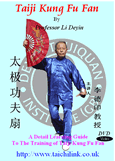
One of the most popular Tai Chi Fan forms was created by Professor Li Deyin (1938-).  It has 52 movements.  I includes slow and gentle movements in the first half of the form, then the second half is much more vigorous.  This Tai Chi Fan form is for athletic and intermediate Tai Chi students. 


Here are some instructional resources for learning the Tai Chi Kung Fu Fan Form.  


Tai Chi Kung Fu Fan. Routine 1, created by Grandmaster Li Deyin (1938-). Instructional DVD, 65 minutes, by Master Jesse Tsao. Tai Chi Healthways, San Diego, California. "The most popular Tai Chi Fan form ever practiced in China. The routine was created by Grandmaster Li Deyin, Jesse Tsao's teacher since 1978. There are 52 movements in the whole routine based on the characteristic Tai Chi posture with the fan's artistic and martial functions. Master Tsao presents demonstrations at the beginning and end. He teaches step-by-step in slow motion, in English. There are plenty of repetitions of movements in both front and back view. It is a good reference for home study, or a resource for instructor's teaching preparation." Cost: 35.00 US. Demonstration.

Tai Chi Kung Fu Fan Instructional DVD by Professor Li Deyin. Narration in English. "A fan routine, created by Professor Li, which combines the gracefulness, centrality and continuity of Taiji with the power, speed and fierceness of Wushu. It is designed as an addition to the exercises for health, and has received massive interest and support throughout the world. In this DVD, Professor Li provides in-depth teaching with Mrs. Fang Mishou performing detail demonstration." Vendor 1. Cost: $35.00 US.


Tai Chi Kung Fu Fan List, Routine 1.  A list of the 52 movement names in four languages.  

Tai Chi Kung Fun Fan List, Routine 1.  A list of the 52 movement names in English.   

Tai Chi Kung Fu Fan List, Routine 1, Movements 1-26.  A list of 26 movement names in English.   


Tuesday, May 12, 2026

Yang Style Tai Chi Chuan Training Principles

"1.) Head upright to let the shen [spirit of vitality] rise to the top of the head. Don't use li [external strength], or the neck will be stiff and the ch'i [vital life energy] and blood cannot flow through. It is necessary to have a natural and lively feeling. If the spirit cannot reach the headtop, it cannot raise.

2.) Sink the chest and pluck up the back. The chest is depressed naturally inward so that the ch'i can sink to the tan-t'ien [field of elixir]. Don't expand the chest: the ch'i gets stuck there and the body becomes top-heavy. The heel will be too light and can be uprooted. Pluck up the back and the ch'i sticks to the back; depress the chest and you can pluck up the back. Then you can discharge force through the spine. You will be a peerless boxer.

3.) Sung [Relax] the waist. The waist is the commander of the whole body. If you can sung the waist, then the two legs will have power and the lower part will be firm and stable. Substantial and insubstantial change, and this is based on the turning of the waist. It is said "the source of the postures lies in the waist. If you cannot get power, seek the defect in the legs and waist."

4.) Differentiate between insubstantial and substantial. This is the first principle in T'ai Chi Ch'uan. If the weight of the whole body is resting on the right leg, then the right leg is substantial and the left leg is insubstantial, and vice versa. When you can separate substantial and insubstantial, you can turn lightly without using strength. If you cannot separate, the step is heavy and slow. The stance is not firm and can be easily thrown of balance.

5.) Sink the shoulders and drop the elbows. The shoulders will be completely relaxed and open. If you cannot relax and sink, the two shoulders will be raised up and tense. The ch'i will follow them up and the whole body cannot get power. "Drop the elbows" means the elbows go down and relax. If the elbows raise, the shoulders are not able to sink and you cannot discharge people far. The discharge will then be close to the broken force of the external schools.

6.) Use the mind instead of force. The T'ai Chi Ch'uan Classics say, "all of this means use I [mind-intent] and not li." In practicing T'ai Chi Ch'uan the whole body relaxes. Don't let one ounce of force remain in the blood vessels, bones, and ligaments to tie yourself up. Then you can be agile and able to change. You will be able to turn freely and easily. Doubting this, how can you increase your power?

The body has meridians like the ground has ditches and trenches. If not obstructed the water can flow. If the meridian is not closed, the ch'i goes through. If the whole body has hard force and it fills up the meridians, the ch'i and the blood stop and the turning is not smooth and agile. Just pull one hair and the whole body is off-balance. If you use I, and not li, then the I goes to a place in the body and the ch'i follows it. The ch'i and the blood circulate. If you do this every day and never stop, after a long time you will have nei chin [real internal strength]. 

The T'ai Chi Ch'uan Classics say, "when you are extremely soft, you become extremely hard and strong." Someone who has extremely good T'ai Chi Ch'uan kung fu has arms like iron wrapped with cotton and the weight is very heavy. As for the external schools, when they use li, they reveal li. When they don't use li, they are too light and floating. There chin is external and locked together. The li of the external schools is easily led and moved, and not too be esteemed.

7.) Coordinate the upper and lower parts of the body. The T'ai Chi Ch'uan Classics say "the motion should be rooted in the feet, released through the legs, controlled by the waist and manifested through the fingers." Everything acts simultaneously. When the hand, waist and foot move together, the eyes follow. If one part doesn't follow, the whole body is disordered.

8.) Harmonize the internal and external. In the practice of T'ai Chi Ch'uan the main thing is the shen. Therefore it is said "the spirit is the commander and the body is subordinate." If you can raise the spirit, then the movements will naturally be agile. The postures are not beyond insubstantial and substantial, opening and closing. That which is called open means not only the hands and feet are open, but the mind is also open. That which is called closed means not only the hands and feet are closed, but the mind is also closed. When you can make the inside and outside become one, then it becomes complete.

9.) Move with continuity. As to the external schools, their chin is the Latter Heaven brute chin. Therefore it is finite. There are connections and breaks. During the breaks the old force is exhausted and the new force has not yet been born. At these moments it is very easy for others to take advantage. T'ai Chi Ch'uan uses I and not li. From beginning to end it is continuous and not broken. It is circular and again resumes. It revolves and has no limits. The original Classics say it is "like a great river rolling on unceasingly." and that the circulation of the chin is "drawing silk from a cocoon " They all talk about being connected together.

10.) Move with tranquility [Seek stillness in movement]. The external schools assume jumping about is good and they use all their energy. That is why after practice everyone pants. T'ai Chi Ch'uan uses stillness to control movement. Although one moves, there is also stillness. Therefore in practicing the form, slower is better. If it is slow, the inhalation and exhalation are long and deep and the ch'i sinks to the tan-t'ien. Naturally there is no injurious practice such as engorgement of the blood vessels. The learner should be careful to comprehend it. Then you will get the real meaning."

-  By Yang Cheng-fu (1883 - 1936) as researched by Lee N. Scheele


 T'ai Chi Ch'uan Bibliography

Yang Style Taijiquan

Mastering Yang Style Taijiquan  By Fu Zhongwen.  Translated by Louis Swaim.  Berkeley, California, Blue Snake Books, c 1999, 2006.  Bibliography, glossary, 226 pages.  ISBN: 9781583941522.  VSCL.  Fu Zongwen (1919-1994) was a student of Yang Cheng Fu.  Translations of many Tai Chi classics are included.  A list of 85 movements are provided.  251 movement analysis illustrations.  Over 76 of the illustrations are traced and drawn from photographs of Yang Chengfu.  Detailed descriptions of the long form, pp. 26-162.  Push hands information.  Yang Tai Chi essentials.


Master Cheng's Thirteen Chapters On Tai Chi Ch'uan. By Cheng Man-ch'ing. Translated by Douglas Wile. 101 pages. Sweet Chi Press, 1982. 101 pages. ISBN: 978-0912059006. Originally written in Chinese in 1949. VSCL.


The Essence and Applications of Taijiquan. By Yang, Chengfu (1883-1936). Translated by Louis Swaim. The original publication date was in 1934. The original book was edited by Professor Cheng Man-Chi'ng. Berkeley, California, North Atlantic Books, 2005. Introduction, appendices, bibliography, 124 pages. ISBN: 1556435452. In this book, the entire sequence of the specialized and named martial movements/postures/sections/forms is numbered from Section 1 up to Section 94; thus, the popular long taijiquan from, the Yang 94 Form. VSCL.


Tuesday, April 14, 2026

Chen Tai Chi Chuan Short Forms

Chen 18 Taijiquan Short Form of Grandmaster Chen Zenglei

18 Movements Short Form

Notes by Michael P. Garofalo, Vancouver, Washington, 2024

Chen Taijiquan Short 18 Form of Grandmaster Chen Zenglei
Webpage by Michael P. Garofalo
Bibliography, links, resources, notes, quotes, videos, lists, photos, comments.


Chen's Taichi for Health and Wellness  By Grandmaster Chen Zenglei. White Bench Publications, Toronto, Canada, 2010, 94 pages. Warmup exercises, and detailed instructions with some photographs for the Chen 18 Short Form. Jack Yan is a collaborator  I like this book quite a bit.  $24.00 in 2/2021. VSCL.

Chen Style Taijiquan Short 18 Form  Performance by Grandmaster Chen Zhenglei  UTube, color, 3:38 Minutes, 2007.

The Chen Style Taijiquan for Life Enhancement. Written by Chen Zhenglei and translated by Xu Hailing. Zhongzhou Classic Publishing House, Zhengzhou, China, 2002. Text in English and Chinese.  ISBN: 7534821819.  149 pages. "Describes the principles of Chen style for life enhancement, basic training, Taiji Skills for Preserving Energy and the 18 Forms of the Chen Style. Many photos of Chen Zhenglei doing Exercises and forms. Chen Zhenglei is one of the top Chen stylists in China. Paperback, 149 pages, 5 1/2' by 8'. -  Wayfarer Publications "It covers the content of the health exercise silk reeling video, and is a useful reference,  giving more detail, especially on theory." This is a very expensive out of print book, not worth $150.00. I purchased back in 2004 for $25.00. VSCL.

Essence of Traditional Chen Style 18 Posture Short Form. Instructional DVD by Shifu Jiang Jian-ye.  Color, 87 Minutes. Capital District Tai Chi and Kung Fu Association of New York, 1997.  "Cheng Zheng Lei (the 19th generation of the Chen Family) created this form from the old style of Chen first and second routines.  It includes "silk reeling," fa jin (releasing energy), and balance.  This short form is a good introduction for beginners or for those with little Chen style experience." "A good introductory Chen form that includes silk reeling and fajing movements as well as other characteristics of the Chen first and second routines. Chen Zhenglei, one of today's top Chen stylists, created the form.There is a demonstration of the entire form followed by step-by-step teaching in slow motion with 2-4 views, from the front, back and side. There are front and back demonstrations of each segment (5 to 7 moves each.)  At the end of the teaching there are demonstrations, front and back. There are also excerpts from other Chen forms." - Wayfarer Publications. CDTKA.  VSCL. I use a Cboy V-Zon portable DVD player and this DVD works fine because of the way it is organized.   


Chen Style Taijiquan
Grandmaster Chen Zhenglei's Short 18 Movements Tai Chi Hand Form, 2001
List of 18 Movements


1.     Beginning Posture of Taiji    (Taiji Chu Shi

2.     Buddha's Warrior Attendant Pounds the Mortar   (Jin Gang Dao Dui

3.     Lazily Tying One's Coat   (Lan Zha Yi)   

4.     Six Sealing and Four Closing   (Liu Feng Si Bi)    

5.     Single Whip   (Dan Bian)  

6.     White Crane Spreads Its Wings   (Bai E Liang Chi

7.     Walk Diagonally   (Xie Xing)    

8.     Brush Knee   (Lou Xi

9.     Stepping to Both Sides   (Ao Bu)    

10.   Cover Hands and Strike with Fist   (Yan Shou Gong Quan)    

11.   High Pat on the Horse   (Gao Tan Ma)   

12.   Kick with the Left Heel    (Zuo Deng Yi Gen

13.   Jade Maiden Working Her Loom   (Yu Nu Chuan Suo)    

14.   Cloud Hands   (Yun Shou)     

15.   Turn Body with Double Lotus Kick    (Zhuan Shen Shuang Bai Lian

16.   Cannon Fist Over the Head   (Dan Tou Pao)    

17.   Buddha's Warrior Attendant Pounds the Mortar   (Jin Gang Dao Dui)    

18.   Closing Posture of Taiji   (Taiji Shou Shi)      


Chen Taijiquan Short 18 Form of Grandmaster Chen Zenglei. By Michael P. Garofalo. Bibliography, links, resources, notes, information, lists, practices, quotes.

List of Movements in Grandmaster Chen Zhenglei's Short 18 Form  (1 Page, PDF)  English Only


Thursday, April 09, 2026

Tai Chi Chuan Solo Practice Thoughts

Repost from 2014:

There are many different ways that Tai Chi Chuan is taught, many different versions of different styles are taught, different teaching styles are used, there are some different types of learning skills of the students, and different objectives of the students.  

My own view is that when learning a Taijiquan form your objective should be to learn the form so that you can perform the form alone, at home, every day.  You should practice the entire form or its parts alone and often.  

How to accomplish this objective:

1.  If you are a beginner, then be sure to use verbal cues.  Memorize the names of each movement sequence.  Before you begin a movement sequence (section, part of a form, named movement) say to yourself (silently or out loud) the name of the sequence.  Bring the movement name into your mind, use it as a cue to what will happen next, a trigger for attention and remembering.  This is martialing the power of mind intent, Yi, focus, attention to action, memorization, habit formation, learning cues.  There are many brief and colorful names that can be used for each movement, e.g., Grasping the Sparrows Tail, Cloud Hands, Needle at Sea Bottom, etc.  Keep a notebook with such lists handy to refer to as needed until the Taijiquan names and movements are memorized.  

Most often, in a class setting, Taijiquan teachers do not use verbal cues and the group practices in silence.  You learn by just imitating the acts, watching, and repeating the moves of others.  

I once attended one workshop by a young Yang Jun in Portland, where verbal cues were given in Chinese; but, not useful for me, an English only speaker.  One teacher objected to my printing a list of the movements and sharing with others.  Since you will be learning on your own, with an instructional DVD, these classroom circumstances are irrelevant.  

After you know how to do the form on your own, you probably will no longer use verbal cues (out loud or silently).  

My many Taijiquan webpages will give you the information about the resources you will need to get started learning the common Forms, and more tips about learning.  

2.  Reflect on the disadvantages of most Taijiquan class learning: travel time and expenses, class fees, group conformity, inefficient teaching methods, smelly classrooms, authoritarian or pompous or silent teachers, weird variations in a form, boring and lengthy warm ups, petty disputes amongst students, not enough lessons in a week, traffic and parking difficulties, scheduling conflicts, no Taoist/Buddhist/Confucian philosophy, etc.  

You can avoid all this by practicing your Taijiquan at home every day, by using current instructional DVDs and reading books by real Taijiquan Master Teachers, by saving your money and time, by finding and using your best learning skills, and by being independent.  If you are really concerned about the environment and conservation, then why drive and use gasoline to practice Taijiquan.  You don't need much space to practice Taijiquan in your home or back yard, and it is completely convenient for practice every day.  Just Do It today at home!  

3.  Practice, practice, repeat, do it over, play, repeat, practice ... learn, memorize, internalize, leading with Mind, becoming in your body, and forming beneficial health habits.  Learn two or three named movement sequences at a time using a good instructional DVD, practice them till you remember how to perform them reasonably well, then add them to your performance of the form.  Little by little you will inch forward towards a yard then more.  Two Practice Rules: do it today at home; and, do it tomorrow at home.  Frequency of performance repetition, alone, at home, and daily, enables you to truly learn.  Group class dynamics more often foster paying followers for far longer than necessary to learn a form, because you don't work daily in nearly all Tai Chi classes.    

4.  Don't attend classes were people are doing the form differently from what you have already learned to perform on your own.  This creates confusion, dissonance, over learning, and an awkward and stumbling flow.  Different angles will cause you much frustration.  Although I respect and appreciate such variety by different teachers, I don't need to trouble myself with doing all these minor or major variations of a form in a group class.  Once you have learned to do your version of the form, and it will always be your best version based on your abilities and age, then do the form at home, alone, and enjoy yourself in playing.  

5.  Resist the urge to practice too many Taijiquan forms.  I have explored many Taijiquan styles and forms from a academic or scholarly perspective.  However, in 2024, I regularly practice at home alone only three Taijiquan forms: Yang Short 24, Yang Long 108, and the Chen Short 18. I also practice cane drills and forms.    

6.  Distinguish between warming up and doing Taijiquan.  I don’t favor “Tai Chi” classes that spend 20-30% or more of the allotted and paid for class time on warm ups, loosening, stretching, limbering up, and doing Qigong (Chi Kung) movement sets.  Yes, do warm ups before and outside of the Tai Chi Chuan class.  Do Taijiquan in the Taijiquan class!    Yes, I always do some gentle warmup and limbering exercises to ready myself for playing Taijiquan at home; but, this is a peripheral concern.   Anyway, is not a gentle slow Yang 24 Taijiquan Form a sufficient gentle warm up exercise in itself? 

7.  Vary the pace, use more energetic and athletic versions of  a Taijiquan movement sequence, use a bit more speed and power expressions when practicing at home alone.  In a group class, I have always seen teachers only doing Taijiquan slowly, deliberately, quietly, softly, gently.  When practicing at home alone, you don't need to just be a softy dancer and passive follower, you can express yourself more freely, change the pace, play Taiji to your favorite music, experiment, truly live and play with Taijiquan.  

8.  Local Taijiquan classes require a fee of up to $100 a month ($1,200 a year), not including travel time and expenses.  You can purchase excellent instructional DVDs and books on the Taijiquan form you are practicing and learning for well under a $300 one time purchase.  Practicing and learning at home alone is more cost effective and efficient.  I like instructional DVDs in English by Masters Teachers like Jesse Tsao, Paul Lam, Jiang Jian-ye, Yang Jwing-ming, Ken Gullette, and others.  Unlike in 1965 in America, there are now hundreds of excellent books in English about learning and understanding Tai Chi, and sometimes scores of books on just one style (Yang, Chen, Sun ...) of Taijiquan.  These published authors and master teachers frequently have a sports education background and know much more about how to teach beginners and intermediate students via virtual instruction using professional production crews and editing; and, most often teach far better than your local Taijiquan entrepreneurs can teach.  

9.  Some people truly enjoy group classes because they form friendships with fellow students, can't practice consistently home alone, are better followers, lack confidence in their own skills, and always need guidance from a teacher.  The problem is that a group Taijiquan class only meets for two to three hours a week.  If you don't practice Taijiquan at home alone every day, you will seldom truly learn to embody and express your unique version of the form.  Working alone you learn to lead, to memorize, to free your body-mind from just following others at their pace and mode of expression.  If you don't practice alone every day, you will likely never learn the form and will eventually drop out of the class.  If socializing is your interest, then find a class group that appeals to you.  

10.  If your interested in "fighting," push hands, sparring, competition, Da Lu ... obviously you need partners, classmates, buddies, trainers and trainees.  I think that fighting and martial arts are something for people under 45 years of age - young sportsmen.  Taijiquan is very likely useless in a real fight where size, speed, power, youth, martial skill and technique, strength, fighting spirit, serious conditioning, and toughness are the elements of success and avoidance of real injury.  I respect the under-pinning's of the internal martial arts that are part of understanding Taijiquan, but after 45, these aspects are far less important.  

I do think, however, that imagining an opponent and having a concept of the offensive/defensive applications of a movement sequence, helps our performance in solo Taijiquan practices. Taijiquan, instead, is more a fight against stress, loss of balance, high blood pressure, some diseases, laziness, inactivity, sitting too much, falling, cultural ignorance, philosophical naivete, over-achieving, aggressiveness, fantasies, unrealistic expectations, etc.  Therefore, if you have no illusions about becoming a martial artist, and you are over 45, and practicing serious Taijiquan alone at home, there is no need for any martial arts training partners.  

11.  Have confidence that you can learn to perform your Taijiquan alone.  Yes you can, and don't think you can't.  Stay positive, upbeat, determined, focused, and work, work, work.   Carefully and conscientiously follow your instructional DVD teacher and You Will Learn.  Be gentle on yourself, don't criticize yourself.

12.  If your primary interest is in joining with a group that does Tai Chi in a carefully synchronized, expertly choreographed, beautiful, coordinated manner in beautiful Taiji uniforms; then you must regularly practice with such a performing group.  If you want to line dance in a group, then you must practice with a group.  Being in a choir, band, drill team, sports team, or orchestra, etc., are demanding commitments.  I enjoy watching a dedicated group do coordinated Tai Chi Chuan forms together.  However, I don't have the time, interest, or funds to join them in the regular practicing and training together that is required.  I wish them well and will watch their performances with delight.  

13.  I have an attitude of being satisfied with how I am doing, imitating, following my good  instructional DVD teacher.  I come close enough to the model, and feel confident in my performance.  I am far from "perfect" but I don't let that get in the way of keeping my Taijiquan practice going, improving, bettering, evolving.  Yes, I could benefit from corrections by a Master, but I can't afford or access that level of guidance.  I just work, and don't fret about my intermediate skills or lack of some subtleties in the Form.  I am not performing for a critic, I am practicing Taijiquan alone for fun, good health, insights, pleasures, insight, movement ...  

I've followed this course of training since I was 50 years of age.  My body, now at age 78, is content doing my few Taijiquan forms at home, alone.  

I've tried five different Taijiquan group classes in Vancouver, WA, since 2017.  They all fell short of the significant benefits of solo Taijiquan training for the many reasons given above.  The teachers seemed well intentioned, my fellow students friendly and courteous, but the benefits to me were minimal.  

If I wanted to learn, for example, the Chen Lao Jia Yi Lu, 1840, Old Frame, First Form, 74 movements, I would use one of the best instructional DVDs and some books as my teachers, learn two or three movements each week, and practice on my own (80-200 hours) till I learned all the form.  I'd follow my advice on my webpages on the subject.  I would need supplementary stretching and conditioning exercises, and would need to modify some of the more rigorous Chen movements, so as to prepare me for this style of Taijiquan considering my age.  Am I up to the challenge at age 78?  Maybe - Yes!   And, and I could learn at low cost and in the convenience of my back yard or indoors.  Anyway, since there are no Chen Taijiquan teachers in Vancouver, I could never afford to do otherwise, e.g., live and study in the Chen Village in China or drive to classes in some other large city.  I do attend workshops occasionally.  


"No school of Chinese martial arts is as well known and popular as Taijiquan. It is suitable for both the young and the old, not only because Taijiquan possesses special features of stretching, flexing the joints, softly twining, exercising both the inside and the outside, dispelling diseases and prolonging life, but it is also the martial art that best reflects Chinese traditional philosophy. More and more people from other countries, especially those interested in Chinese culture, are beginning to practice Taijiquan. Taijiquan is becoming popular all over the world. Because of this, Taijiquan has no national boundary and is beyond the category of culture, and belongs to people everywhere."
- Fan Chun-Lei and A. Frank Shiery, Traditional Chen Style Taijiquan.

Thursday, March 26, 2026

Yang Style Tai Chi Chuan 108 Form, Third Section

 For Tai Chi Chuan players:

I often take a section of a long Taijiquan form and restudy and carefully practice only that section many times. I look up that section in books to learn more from master teachers. I also use instructional DVDs and UTube for sectional reviews. Smaller bites assists with better chewing and digestion.

I use the fine books by Fu Zhongwen, Li Deyin, T.T. Liang/Stuart Olson, and Gordon Muir for review. All have photographs or line illustrations of the movements and much commentary.

Here are some UTube demonstrations of the Third Section (Movements 56-108) of the Traditional Long Form of Yang Style Tai Chi Chuan:


Third Section,  Movements 55-108,  List of Movements


Third Section List ,  Movements 55-108,  Yang Long Form 108 

    Provides a list with the number of the movement and the name of movement.  In the PDF format (print only), 1 page, 26Kb.


Third Section List,  Part I,  Movements 56 - 82,  Yang Long Form 108
   

    Provides a list with the number of the movement, the direction one is facing at the end of that movement, the name of the movement, and a brief description or notes about the movement.  In the PDF format (print only), 1 page, 65Kb.  In the HTML format provided below in this document.  


Third Section List,  Part II,  Movements 83 - 108,  Yang Long Form 108.   

    Provides a list with the number of the movement, the direction one is facing at the end of that movement, the name of the movement, and a brief description or notes about the movement.  In the PDF format (print only), 1 page, 63Kb.  In the HTML format provided below in this document.  


Comparison of 108 Long Yang with 88 Long Yang - Chart

Sunday, March 22, 2026

Yang Style Taijiquan Long Form Section I

 Yang Style Taijiquan Long Form Section I

First Section,  Movements 1-17,  List of Movements


First Section List,  Movements 1-17,  Yang Long Form 108   

    Provides a list with the number of the movement and the name of movement. In the PDF format (print only), 1 page, 16Kb.  


First Section List,  Part I,  Movements 1 - 17,  Yang Long Form 108 

    Provides a list with the number of the movement, the direction one is facing at the end of that movement, the name of the movement, and a brief description or notes about the movement.  In the PDF format (print only), 1 page, 48Kb. 


Sunday, March 01, 2026

Cheng Man-ch'ing's Tai Chi Chuan

Yang Taijiquan 37 Form of Master Cheng Man-ch’ing in 1940

1.  Preparation: Standing, Step

2.  Beginning: Raise Hands, Lower Hands
3.  Ward Off Left
4.  Grasping the Sparrow’s Tail: Ward Off L/R, Roll Back, Press, Push
5.  Single Whip
6.  Raise Hands
7.  Shoulder Strike
8.  White Crane Spreads Its Wings
9.  Brush Left Knee, Twist Step 
10.  Play the Lute
11.  Brush Left Knee, Twist Step
12.  Step Forward, Deflect, Parry, Punch
13.  Apparently Sealing, Seemingly Closing, Apparent Close, Push
14.  Cross Hands, Embrace Tiger
15.  Return to Mountain Brush Knee, Grasping Sparrow’s Tail, Single Whip
16.  Rely on Fist Under Elbow
17.  Step Back, Retreat, Repulsing Monkey 3X  
18.  Diagonal Slant Flying
19.  Cloud Hands 4X, Single Whip
20.  Snake Creeps Down  
21.  Golden Rooster Stands on Both Legs 2X
22.  Kick with Right Foot
23.  Kick with Left Foot
24.  Turn, Kick with Left Heel
25.  Brush Knees 3X, Punch Down
26.  Grasping the Sparrow’s Tail, Single Whip
27.  Fair Lady Works the Shuttles 4X
28.  Grasping the Sparrow’s Tail, Single Whip 
29.  Snake Creeps Down Left Leg
30.  Seven Stars of the Big Dipper Step Forward 
31.  Step Back, Ride the Tiger
32.  Rotate and Turn Body, Sweeping Right Leg Lotus Kick
33.  Bend the Bow, Shoot the Tiger  
34.  Step Forward, Deflect Block, Intercept and Punch
35.  Apparent Close, Withdraw and Push 
36.  Cross Hands, Horse Stance
37.  Conclusion: Feet Together, Hands Down, Standing


List of the 37 Movements, 1 page, PDF format, 4/15/2016

http://www.egreenway.com/taichichuan/chengform4.pdf

Cheng Man-ch'ing (1902-1975): Tai Chi Chuan Master

Bibliography, Links, Quotes, Resources, Reflections, Notes.
A hypertext notebook by Michael P. Garofalo.


Bibliography, Links, Quotes, Notes, Instructions. By Mike Garofalo.

Cheng Man-ch'ing on UTube


There is a very good article 
by Master Wasentha Young titled "Professor Cheng Man-ch'ing's Design of the Yang Style Short Form."  It is located in the recent Qi Magazine: Journal of Traditional Eastern Health and Fitness (Volume 27, Number 4, 2017, pp. 30-37.)  Her instruction on pacing energetic flow levels at subsequences of dingdian, parts of the 37 form, were valuable.  


Professor Cheng Man-ch'ing was also known affectionately by one of his many nicknames -  "Whisker's Man."  Lots of pictures of him smiling - I like that.  


Monday, January 26, 2026

Yang Style of Tai Chi Chuan, Standard 24 Form

My webpage on the Standard 24 Taijiquan Form has been a very popular webpage on the Cloud Hands Tai Chi Chuan Website since 2001.  In the sidebar of this blog, you will find a quick index to this webpage.   

Standard Simplified Taijiquan 24 Form. Research by Michael P. Garofalo, M.S. This webpage includes a detailed bibliography of books, media, links, online videos, articles, and resources. It provides a list of the 24 movement names in English, Chinese, French, German and Spanish, with citations for sources of the movement names. It provides detailed descriptions of each movement with black and white line illustrations and photographs. It includes relevant quotations, notes, performance times, section breakdowns, basic Tai Chi principles, and strategies for learning the form. This hypertext document was last last updated in December of 2017.  


The Peking (Bejing) Chinese National orthodox standard simplified 24 movement T'ai Chi Ch'uan form, created in 1956, is the most popular form practiced all around the world. This form uses the Yang Style of Taijiquan.  

There is also a famous short Tai Chi Chuan form, created by Professor Cheng Man-ch'ing in the 1940's.  It has 37 movements in the Yang Style of Taijiquan.

My 24 Form webpage provides many good suggestions for a person learning this basic Tai Chi Chuan Form of 24 movements on their own if there is no Tai Chi class in their area.


I started learning Taijiquan in 1986.  I was taught the Standard 24 Movement T'ai Chi Ch'uan Form in the Yang Style of T'ai Chi Ch'uan.  I learned it from Aikido Sensei Frank McGourick in Whittier, California.  


In 1986, were no books or instructional videotapes on this popular form.  In 2019, there are dozens of books and instructional DVDs, videotapes, UTube demonstrations by women and men, streaming content, and scores of webpages on the subject of the 24 Taijiquan Form.  


Sensei McGourick also taught me the standard Long Form of the Yang Style of Tai Chi Chuan.  You hit the floor a lot in Aikido, it is vigorous, and it is very challenging for anyone, and it was too hard for me.  So, being a man in his 40's, and working 50 hours a week as a library administrator of 22 libraries in the busy and growing San Gabriel Valley, I practiced only Taijiquan and Qigong at the Aikido Ai Dojo in Whittier with Dr. Robert Moore and Sensei McGourick.

The most detailed book that I have seen on the subject of the 24 Form is:
The Yang Taiji 24 Step Short Form: A Step by Step Guide for All Levels
By James Drewe.  London, Singing Dragon Press, 2011.  382 pages, black and white photographs, charts, detailed descriptions, training tips.


I give information on many other fine books by other good authors on the Basic 24 Tai Chi Chuan Form in my webpage.  Find books by Andrew Townsend, Cheng Zhao, Foen Tjoeng Lie, Eric Chaline, Le Deyin, etc.

Many persons have told me that their favorite instructional DVD on the 24 Form is: Tai Chi - The 24 Forms  By Dr. Paul Lam.  
I attended Dr. Lam's Tai Chi for Arthritis workshop in Monterey, California; and  later workshops on Sun Tai Chi with other Bay Area teachers.  I am also quite fond of using instructional DVDs by Master Jessie Tsao from San Diego.  


I have played and practiced this form with many different persons and groups over three decades.  The many slight variations are fun to play and observe.  Taijiquan is a very pleasant and satisfying group exercise, dance, marital arts, and choreographed body-mind movements class.  Taijiquan and Qigong provide an excellent fitness class for seniors to help them with aging well.  I have practiced this Basic 24 Form with different groups in the Vancouver and Portland areas, and for many years around Red Bluff, CA.  

At age 79, I can do quite a few repetitions of the form during any day.  I warm up with Qigong and limbering up movements, if needed, before practicing the 24 Form.  I make adjustments necessitated because of my former injuries, falls, surgeries, and decreasing balance skills.  I like to play with the named movement sequences in ways outside of the 24 form choreography, e.g., HsingI type forward drills using Yang postures, changing directions to accommodate indoor practice near furniture, faster movements with intermittent fajing, etc.  I also think about the martial applications of defense or offense, following the Teacher and group members so to achieve a coordinated beauty in the performance style desired, the courtesies and comradeship of the practice team, Taijiquan principles, etc. 

I try my best to try to learn, and relearn, and unlearn.   


"At this period of wushu, the Nanking Central Kuoshu Institute in 1956 tasked the choreography of a Taijiquan routine what would be more suitable for popular dissemination among the masses, in keeping with the government's egalitarian agenda.  The traditional forms were just too long and time consuming to practice, and the traditional methods too arcane and demanding for mass propagation.  The challenge was to reduce the one hundred-odd movements of the traditional Yang Style Taijiquan, prevalent then, to its core, by removing the many repetitive movements as well as the less essential ones.  Thus, the 24-Form Taijiquan set was created.  Instrumental in this simplification effort was Li Tianji (1913-1996) who had been appointed a wushu research fellow at the Institute.  Under official auspices, the 24-Form Taijiquan quickly became the standard form, taught throughout China as part of physical education curriculum in schools and colleges.  It is perhaps the best know Taijiquan form in the world today.  As widespread as it is, the 24-Form is at best an abridged version of the traditional Yang form, a synopsis of the art."
-  C. P. Ong, Taijiquan: Cultivating Inner Strength, 2013, p. 7.  


Lift the head, stand strong and balanced, move gracefully.
Imagine resistance, water boxing, dealing with an opponent, pushing hands.

Be loose and relaxed, avoid over-exertion, use coiling energy.
Keep moving, flowing, shaping yourself in body-mind.
Shoulders down, gentle breathing, dignified bearing.
Stylish, artistic, beautiful, sensuous, dancing, formal.
Yin more than Yang, soft over hard, water over stone, gentle over muscular.
Follow the Teacher, coordinate, create unity, act as one. 


Friday, January 02, 2026

Best Taijiquan Books by Andrew Townsend


Cultivating the Civil and Mastering the Martial: The Yin and Yang of Taijiquan. By Andrew Townsend. CreateSpace Independent Publishing Platform, no publisher listed on titlepages, 2016. No index, brief bibliography, 424 pages. Small type font. This volume is a huge compendia of information, comprehensive in scope, with good explanations, observations, insights, and summaries, etc.. This thick book includes some precise and detailed movement descriptions, sound Taijiquan teaching on many topics, and more than five hundred photographs and illustrations. A heavy reference volume for your desktop; ebook versions for your tablet or phone or Kindle. ISBN: 978-1523258536. VSCL. "Andrew Townsend has been practicing martial arts for more than forty years and began practicing taijiquan in 1990. Mr. Townsend is a certified taijiquan instructor and a senior student of Grandmaster Jesse Tsao. He is a retired college professor and has been actively teaching taijiquan for the past ten years. He lives and teaches in Ormond Beach, Florida."


Sunday, November 23, 2025

Familiar Tai Chi Chuan Ideas


Tai Chi Chuan Practice and Training

Common Themes, Topics, Ideas, Suggestions, Principles, Concepts, Tips


One Sentence Taijiquan Notes by Mike Garofalo

Lift the head, tuck the chin, extend the neck, feel upright and rising.
Stand strong and balanced, then move slowly and gracefully.
Imagine resistance, water boxing, dealing with an opponent, Da Lu, pushing hands, sensing incoming energies, feeling the Other.

Be loose and relaxed, avoid over-exertion, use coiling energy.
Keep moving, flowing, shaping yourself in body-mind.
Shoulders down, gentle breathing, energized back, dignified bearing.
Be more stylish, artistic, beautiful, sensuous, dancing, formal.
Yin more than Yang, soft over hard, water over stone, gentle over muscular.
Follow the Teacher, coordinate, create unity, move together, act as one.
Act from the center, find the Dan Tien, Centering, secure internal energy.
You are responsible for your own self-defense, safety and fitness.
Develop and maintain the Inner Smile, positive disposition, enthusiasm.
Work within one's steady breathing, learn different breath/movements.
Enhance and maintain one's potential energy reserves for power.
Keep the knees over the feet, and don't over-extend in lunges.
Taijiquan, Tai Chi Chuan, Shadow Boxing, Grand Ultimate Boxing, Cotton Fist, At the Edge Fist, Mind/Fist Arts, .... whatever.
Differentiate between solo and group practices and training.
Learn the names of each numbered movement sequence.
Learn offense and/or defensive applications for each named movement.
Daily practice, review, and repetitions are essential to progress.
Distinguish substantial from unsubstantial, weighted from empty, rooted from moving, stable from unstable.
Be delicate, be gentle, be refined, be fluid, be slow.
Concentrate, remember, embody the patterns, display the Form.
Strengthen the glutes, quads, calves, ankles, and feet; Legs Powers, Thigh Chi.
Stay level, avoid to much bobbing up and down, smooth level movement. 
There is a natural automatic discomfort with falling, we wanting to stay standing and moving upright, we want to work effectively with the forces of gravity.
Working within and slowly out from your current limitations, injuries, mental or physical health problems, or other obstacles. 
Appropriate music might make your Taijiquan practice enjoyable in new ways.
Inhale while pulling in and gathering, exhale while pushing or striking out or blocking; sometimes holding breath; sometimes the opposites. 
If your huffing and puffing, breathing to fast, then you are out of shape but persist after resting and slowing down some; vary and improve your workouts. 
Think process, think evolving, think changing, think becoming; then stop thinking.

Keep a Beginner's Mind, Learn Something, relish the experiences.  


Repost from July of 2020


Tai Chi Chuan Website

Yang Style of Tai Chi Chuan 24 Short Form

Yang Style of Tai Chi Chuan 108 Long Form

Tai Chi Chuan Quotations and Classics


Friday, October 17, 2025

Iconic Posture: A Picture to Represent a Taijiquan Form


Repost from April 3, 2016:

There are many movements in a posture sequence called Single Whip in the Yang or Chen Styles of Taijiquan.   A short Yang Style Form has 24 postures (movements, forms, action sequences), and short Chen Style Form has 18 postures.   

"Fu Zhongwen uses a number of terms that require additional explanation.  One of these is the term for what is typically called the ending postures of the forms, that is, the terminus point of a given posture such as White Crane Displays Wings.  The term that Fu Zhongwen uses for these ending postures is dingdian, or "fixed points."  In Taijiquan, however, these "fixed points" are not really fixed, and "ending postures" are not really the end of anything.  Fu Zhongwen therefore advises the reader that " as each movement reaches a fixed point (dingdian), one must accomplish what is called "seems to stop, does not stop."  The dingdian, then must be understood to be both the culmination of one sequence as well as the beginning of the next."
 -  Mastering Yang Style Taijiquan  By Fu Zhongwen.  Translated by Louis Swaim.  Blue Snake Books, 2006, p. xix.  


The dingdian is an experienced physical posture, a temporary fixed form, a still photograph, a line drawing, a mental picture, an icon, a temporary fixed point in a flow of movements, a name for a fixed point somewhere in or near the end of a particular numbered posture sequence in a taijiquan form.  Here is Yang Cheng Fu's version of the dingdian for Single Whip Left:


Looks like Virabadrasana II in Hatha Yoga.  Just hold the above posture, don't move, settle, endure, tough it out.  Hold for one minute, then shift to right leg forward lunge in Single Whip Right for one more minute.  Hold for longer periods for increased intensity.    
Yang Taijiquan Quotes and Notes

Yang Style Standard 24 Form Taijiquan

Yang Family Style Taijiquan Long 108 Form


Friday, July 04, 2025

Cannon Cane: Eight Immortals Chen Taijiquan Cane Routine II


Eight Immortals Taijiquan Cane
Cannon Cane, Routine Two
Based on the Chen Style of Taijiquan

Created and Taught by Master Jesse Tsao, PhD.

List of Postures, Movements, Forms 

Section I

1.  Opening Form

2.  Lazily Tying Coat

3.  Six-Seal and Four Close
4.  Single Whip
5.  Striking Left and Right
6.  Wrapping Head with the Cane
7.  Uppercuts Left and Right
8.  Grand Eagle Spreads Wings
9.  Embracing the Moon
10.  Cat Catches Rat
11.  Golden Rooster Standing on One Foot
12.  Whipping Sleeves and Slamming Cane
13.  Overturn the Ocean
 

Section II

14.  Dragon’s Tail Stirring Water
15.  Pinwheel Cane
16.  Fair Lady Works at Shuttles
17.  Batting a Home Run
18.  Ruthless Lord Holds Up Flag
 

Section III

19.  Strike Low and Strike High
20.  Dragon Descends into Ocean
21.  Dragon Emerges from Water
22.  Parry Left and Right
23.  Turn-Around Strike
24.  Dragon Swings Tail
25.  Head Smashing Cane
26.  Lock Front Door
 

Section IV 

27.  Black Bear Turns Around
28.  Lock Back Door
29.  Heart Thrusting Cane
30.  Waist Blocking Cane
31.  Crotch Striking Cane
32.  Head Striking Cane
33.  Dragon’s Head Up
34.  Dragon Coiling Around Pillar
35.  Wind Devil Cane
36.  Closing Form


Mastering Tai Chi Cane for Health and Self-Defense. By Jesse Tsao, PhD. Tai Chi Healthways, 2022, 225 pages.


Traditional Tai Chi Eight Immortals Cane, Routine 2 (Cannon Cane, Chen Style).  By Jesse Tsao, PhD.  Tai Chi Healthways, Instructional DVD 62 Minutes. 

Way of the Short Staff  By Michael P. Garofalo, M.S.  A comprehensive guide to the practice of the short staff, cane, jo, walking stick, gun, zhang, whip staff, 13 Hands Staff, and related wood short staff weapons.  A detailed and annotated guide, bibliography, lists of links, resources, instructional media, online videos, and lessons.  Includes use of the short staff and cane in martial arts, self-defense, walking and hiking.  Separate sections on Aikido Jo, Cane, Taijiquan cane and staff, Jodo, exercises with a short staff, selected quotations, techniques, selecting and purchasing a short staff, tips and suggestions, and a long section on the lore, legends, and Magick of the short staff.  Includes "Shifu Miao Zhang Points the Way."

 Cloud Hands Taijiquan, Valley Spirit Center, Fir Grove, Vancouver, Washington.  List by Michael P. Garofalo, September 24, 2022. 


Eight Immortals Taijiquan Cannon Cane Routine

1.  Opening Form  Section 1

2.  Lazily Tying Coat

3.  Six-Seal and Four Close
4.  Single Whip
5.  Striking Left and Right
6.  Wrapping Head with the Cane
7.  Uppercuts Left and Right
8.  Grand Eagle Spreads Wings
9.  Embracing the Moon
10.  Cat Catches Rat
11.  Golden Rooster Standing on One Foot
12.  Whipping Sleeves and Slamming Cane
13.  Overturn the Ocean

14.  Dragon’s Tail Stirring Water  Section 2
15.  Pinwheel Cane
16.  Fair Lady Works at Shuttles
17.  Batting a Home Run
18.  Ruthless Lord Holds Up Flag

19.  Strike Low and Strike High  Section 3
20.  Dragon Descends into Ocean
21.  Dragon Emerges from Water
22.  Parry Left and Right
23.  Turn-Around Strike
24.  Dragon Swings Tail
25.  Head Smashing Cane
26.  Lock Front Door

27.  Black Bear Turns Around  Section 4
28.  Lock Back Door
29.  Heart Thrusting Cane
30.  Waist Blocking Cane
31.  Crotch Striking Cane
32.  Head Striking Cane
33.  Dragon’s Head Up
34.  Dragon Coiling Around Pillar
35.  Wind Devil Cane
36.  Closing Form