Showing posts with label Meditation. Show all posts

Sunday, May 31, 2026

Treasury of the True Dharma Eye by Zen Master Dogen

Zen Master Eihei Dogen Zenji (1200-1253) 
Japanese founder of Soto Zen School Tradition.
Teacher, abbot, essayist, poet, Zen philosopher
His collected works are called The Treasury of the True Dharma Eye, Shobogenzo.

I first read Dogen's works in the book Moon in a Dewdrop translated by Kazuaki Tanahashi (1995, 368 pages); and in the book Rational Zen: the Mind of Dogen Zenji translated by Thomas Clearly (2001, 232 pages.)

I have read, studied, and adopted much from my study of Zen Buddhist literature since I was 14 years old.  I am a philosopher, but I have a interest in Taoism, and associated practices like some in Zen Buddhism.

Gudo Nishijima and Chodo Cross's four volume translation of the Treasury of the True Dharma Eye, Shobogenzo in 2021.

Unfortunately, the Kindle Version of Nishijima is very poor, and cheap ($7.00), so I purchased the paperback copies at $18.00 - $27.00 each.  

The new Kazuaki Tanahashi Kindle version of the Treasury of the True Dharm Eve, Shobogenco (2013, 1280 pages) is excellent, at a cost of $60.00.  The hardbound version is $75.00, very heavy, big, like a large family Bible on a coffee table.  So, I'll purchase one volume of Nishijima's translation per month at $25.00 each.  And, then get Tanahashi in the Kindle version as money permits.


Here is an 2008 Amazon review by by Ted Beriginer of Gudo Nishijima and Chodo Cross's four volume translation of the Treasury of the True Dharma Eye, Shobogenzo in 2021.


"If you have not read Books 1 through 4 of this translation of the 95 chapter edition of Shobogenzo, do it now! If you have read them, do it again!

Gudo Nishijima and Mike (Chodo) Cross's four volume translation of the 13th century Zen master Eihei Dogen's masterpiece marked the first English language translation of the entire 95 chapter version of Shobogenzo - The True Dharma-Eye Treasury (excepting the nearly useless translation by Kosen Nishiyama and John Stevens).

By opting for a more "literal" rather than "interpretive" rendition, the translators have realized a monumental achievement by furnishing English readers with a reliable text that is certain to be invaluable for generations.

This set is also packed with a wide selection of reference material, or "Aids to the Reader", including a translation of The Heart Sutra, Dogen's Fukanzazengi, and a generous selection of passages from the Lotus Sutra, Glossaries, a variety of tables offering data on everything from The Works of Dogen, to equivalents of Chinese/Japanese/Sanskrit/English.

The extensive footnotes, while occasionally offering some overly "interpretive" (read: sectarian), provide readers with a vast amount of supplemental information with lucid explanations concerning cultural context, alternate readings, sources for material quoted in the body of the text, biographical (historical and traditional) information on personages appearing in the text, and much more.


Book 1 - Table of Contents

[1] BENDOWA - A Talk about Pursuing the Truth

[2] MAKA-HANNYA-HARAMITSU - Maha-prajna-paramita

[3] GENJO-KOAN - The Realized Universe

[4] IKKA-NO-MYOJU - One Bright Pearl

[5] JU-UNDO-SHIKI - Rules for the Hall of Heavy Cloud

[6] SOKU-SHIN-ZE-BUTSU - Mind Here and Now Is Buddha

[7] SENJO - Washing

[8] RAIHAI-TOKUZUI - Prostrating to Attainment of the Marrow

[9] KEISEI-SANSHIKI - The Voices of the River-Valley and the Form of the Mountains

[10] SHOAKU-MAKUSA - Not Doing Wrongs

[11] UJI - Existence-Time

[12] KESA-KUDOKU - The Merit of the Kasaya

[13] DEN-E - The Transmission of the Robe

[14] SANSUIGYO - The Sutra of Mountains and Water

[15] BUSSO - The Buddhist Patriarchs

[16] SHISHO - The Certificate of Succession

[17] HOKKE-TEN-HOKKE - The Flower of Dharma Turns the Flower of Dharma

[18] SHIN-FUKATOKU - Mind Cannot Be Grasped [The former]

[19] SHIN-FUKATOKU - Mind Cannot Be Grasped [The latter]

[20] KOKYO - The Eternal Mirror

[21] KANKIN - Reading Sutras


Book 2 - Table of Contents

[22] BUSSHO - The Buddha-nature

[23] GYOBUTSU-YUIGI - The Dignified Behavior of Acting Buddha

[24] BUKKYO - The Buddha's Teaching

[25] JINZU - Mystical Power

[26] DAIGO - Great Realization

[27] ZAZENSHIN - A Needle for Zazen

[28] BUTSU-KOJO-NO-JI - The Matter of the Ascendant State of Buddha

[29] INMO - It

[30] GYOJI - [Pure] Conduct and Observance [of Precepts] - Parts 1 & 2

[31] KAI-IN-ZANMAI - Samadhi, State Like the Sea

[32] JUKI - Affirmation

[33] KANNON - Avalokitesvara

[34] ARAKAN - The Arhat

[35] HAKUJUSHI - Cedar Trees

[36] KOMYO - Brightness

[37] SHINJIN-GAKUDO - Learning the Truth with Body and Mind

[38] MUCHU-SETSUMU - Preaching a Dream in a Dream

[39] DOTOKU - Expressing the Truth

[40] GABYO - A Picture of Rice Cake

[41] ZENKI - All Functions


Book 3 - Table of Contents

[42] TSUKI - The Moon

[43] KUGE - Flowers in Space

[44] KOBUSSHIN - The Mind of Eternal Buddhas

[45] BODAISATTA-SHISHOBO - Four Elements of a Bodhisattva's Social Relations

[46] KATTO - The Complicated

[47] SANGAI-YUISHIN - The Triple World is Only the Mind

[48] SESSHIN-SESSHO - Expounding the Mind & Expounding the Nature

[49] BUTSUDO - The Buddhist Truth

[50] SHOHO-JISSO - All Dharmas are Real Form

[51] MITSUGO - Secret Talk

[52] BUKKYO - The Buddhist Sutras

[53] MUJO-SEPPO - The Non-Emotional Preaches the Dharma

[54] HOSSHO - The Dharma-nature

[55] DARANI - Dharani

[56] SENMEN - Washing the Face

[57] MENJU - The Face-to-Face Transmission

[58] ZAZENGI - The Standard Method of Zazen

[59] BAIKE - Plum Blossoms

[60] JUPPO - The Ten Directions

[61] KENBUTSU - Meeting Buddha

[62] HENSAN - Thorough Exploration

[63] GANZEI - Eyes

[64] KAJO - Everyday Life

[65] RYUGIN - The Moaning of Dragons

[66] SHUNJU - Spring and Autumn

[67] SOSHI-SAIRAI-NO-I - The Ancestral Master's Intention in Coming from the West

[68] UDONGE - The Udumbara Flower

[69] HOTSU-MUJOSHIN - Establishment of the Will to the Supreme

[70] HOTSU-BODAISHIN - Establishment of the Bodhi-mind

[71] NYORAI-ZENSHIN - The Whole Body of the Tathagata

[72] ZANMAI-O-ZANMAI - The Samadhi That Is King of Samadhis

[73] SANJUSHICHI-BON-BODAI-BUNBO - The Thirty-seven Auxiliary Bodhi Methods

[74] TEMBORIN - Turning the Dharma Wheel

[75] JISHO ZANMAI - Samadhi as Self Experience

[76] DAI SHUGYO - Great Practice

[77] KOKU - Space

[78] HATSU-U - The Patra

[79] ANGO - The Retreat

[80] TASHINTSU - The Power to Know Others' Minds

[81] O SAKU SENDABA - A King's Seeking of Saindhava

[82] JI-KUIN-MON - Sentences To Be Shown in the Kitchen Hall

[83] SHUKKE - Leaving Family Life

[84] SANJI-NO-GO - Karma in Three Times

[85] SHIME - The Four Horses

[86] SHUKKE-KUDOKU - The Merit of Leaving Family Life

[87] KUYO-SHOBUTSU - Serving Offerings to Buddhas

[88] KIE-SANBO - Taking Refuge in the Three Treasures

[89] SHINJIN-INGA - Deep Belief in Cause and Effect

[90] SHIZEN-BIKU - The Bhiksu in the Fourth Dhyana

[91] YUI-BUTSU-YO-BUTSU - Buddhas Alone, Together With Buddhas

[92] SHOJI - Life-and-Death

[93] DOSHIN - The Will to the Truth

[94] JUKAI - Receiving the Precepts

[95] HACHI-DAININGAKU - The Eight Truths of a Great Human Being

[Appendix 1] BUTSU-KOJO-NO-JI - The Matter of the Ascendant State of Buddha."


Sunday, April 19, 2026

Art, Symbolism, and Creative Interpretations: The Tarot

Today, I am enjoying using a new copy of the:
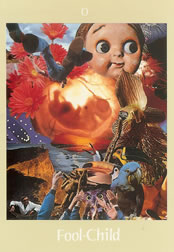
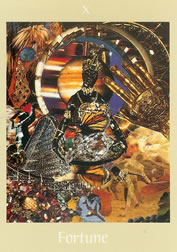
Voyager Tarot, Intuition Cards for the 21st Century
By James Wanless, Ph.D.. Artist Ken Knutson. 
78 full color collage art Tarot cards.  117 page mini booklet. 
Fair Winds: ISBN 978-1-59233-322-6, 2017.  First edition 1984.  


Has anyone seen a chart or list correlating the 78 cards in the Voyager Tarot (or other Tarot decks) with the 64 Hexagrams of the I Ching???

For examples:

I Ching Number = Tarot Card Name

#1 Creative, Initiating = Magician, 1

#4, Childhood, Youthful Folly, Impermanence = Fool, 0

#52 Mountain = Hermit, 9

During a morning Voyager Tarot card reading, I usually select one card as the most significant for the day.  I would like to write on each Tarot card the corresponding, related, correlated, comparable, similar themed, or relevant I Ching Hexagram Number.  

Also, this is a different way for selecting an I Ching Hexagram other than yarrow sticks or coin tossing.  


A Repost from 2018:


I first purchased and used Tarot decks in 1979.  I studied numerous books on the subject of the Tarot.  I purchased numerous decks over the decades.  First, I enjoyed the variety of artwork and symbolism in the 78 cards in the different decks from different centuries.  Second, the creator of each deck brings some new insights into the overall structure and meanings for the cards in the deck.  Third, I enjoyed "reading" and creatively interpreting the symbols and images in these small art objects in the context of my own life and questions.  

I even made, in 2011, some very incomplete notes in hypertext documents on the Tarot.

My method over the years is to ask a question or reflect on my current consciousness and situation in my life.  Then, I randomly pull from 3 to 5 cards from the deck.  I try to interpret, reflect upon, and consider the meaning of each card.  I may use The Voyager Tarot book to refresh or expand my understanding or memories.  Then, I arrange the cards in some order to "tell a story."  I do this once a day, at night; then, in the morning, reconsider the meanings and relevance of that 3-5 card reading in my life.  I only look at cards right side up; although, I do sometimes reverse the meaning of the cards depending upon the story I create.  

I enjoy using the 1991 Voyager Tarot deck the most.  

This photomontage deck was designed by James Wanless, Ph.D.  The photographic collage artwork was created by Ken Knutson.  It was first published in 1984, and then in 1991 and 2008. 

The Voyager Tarot: Way of the Great Oracle Book.  By James Wanless, 1989.  Book and Deck


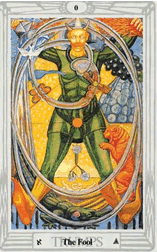
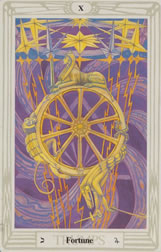
 The Fool, 0


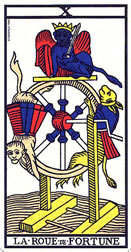
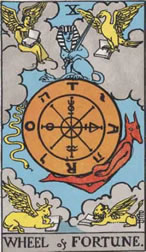
The Wheel of Fortune, 10


Saturday, April 18, 2026

Prajnatara's "It's the Attitude that Counts"


The Fireplace Records, Chapter 16


Prajnatara's "It's the Attitude that Counts"


Bill and Frank were Dharma Buddies for a number of years.  Their 'Book of the Month Club' choice in April was the "Book of Serenity" translated and introduced by Thomas Cleary, 1988. They met at the local Brewed Awakenings coffee shop to discuss the book.

Bill opened the Book of Serenity and read from Case 3: The Invitation of the Patriarch to Eastern India:

"A Rajah of an east Indian country invited the twenty-seventh Buddhist Patriarch Prajnatara to a feast. The Rajah asked him, "Why don't you read scriptures?" The Patriarch said, "This poor wayfarer doesn't dwell in the realms of the body or mind when breathing in, doesn't get involved in myriad circumstances when breathing out. I always reiterate such a scripture, hundreds, thousands, millions of scrolls."

Frank said, "I know that some people constantly, mostly silently, repeat a sacred name or phrase or prayer as part of their spiritual training.  When I was a boy we said the Hail Mary Rosary in our Catholic Church. Yogis have their 'Om Mani Padme Hum.' Transcendental meditators had a 'mantra'.  Koan meditators had their 'Hua Tou.'  Pure Landers chant 'Namo Amida Butsu.' Nichiren encouraged worship of the Lotus Sutra and the repetition of the Sutra's Title: 'Namu Myoho Renge Kyo'. Taoists repeat verses from the Tao Te Ching. Christians sing the same favorite hymn over and over."

Bill said, "Good observations, Frank.  Just being alive today and able to think or behave in some way about our spiritual development, even by chanting, is a great opportunity.  However, I have some reservations about Prajnatara's path. When we are sleeping we come close to not dwelling in the realms of body and mind and we don't get involved with myriad circumstances when we are sleeping.  Does my snoring turn the scrolls of scriptures?" Even an evil demon sleeps, does it reiterate scriptures while unconscious?"

Frank said, "A poor traveling wayfarer like Prajnatara cannot haul around delicate paper scriptures. So he must find ways to interpret the ordinary in a sympathetic manner, find ways to use breathing to focus awareness, and find ways to become more detached from desires and less entangled in myriad circumstances. Whether he sits, stands or walks, if he/she keeps the Buddhist attitude he can be an awakened and compassionate person. By being this way, acting like a Buddha, is another way of turning the scriptures, honoring them, if not by reading them because of impoverished circumstances."

Bill said, "Yes, Yes. Sometimes, reading is just not feasible or possible. One's attitude is the primary concern."

Bill added, "Changing the subject, I read that the great California translator and commentator of over 80 classic Taoist and Buddhist sacred scriptures, Thomas Cleary, passed away.  He translated the book we are studying, 'The Book of Serenity.'  I have been reading his translations since 1977."


A Student's Considerations: 

Somewhere, Somehow, Someone is Chanting
A Funeral Chant:

Gate Gate Para Gate Para Sam Gate Bodhi Swaha
Rest in Peace
Requiescat in Pace
Requiescat in Pace
Rest in Peace
Rest in Peace
Gate Gate Para Gate Para Sam Gate Bodhi Swaha

No More Breathing In or Breathing Out
The Prayer Wheels Turn Nevertheless


Related Links, Resources, References


Koans: BOS 03, 

Thomas Cleary (1949-2021)

Refer to my Cloud Hands Blog Posts on the topic of Koans/Dialogues.

The Daodejing by Laozi    Best? 

Pulling Onions  Over 1,043 One-line Sayings by Mike Garofalo

Chinese Chan Buddhist and Taoist Stories and Koans

Taoism

Buddhism

Fireplaces, Stoves, Campfires, Kitchens, Pots, Firewood

Chinese Art

Tai Chi Chuan and Qigong

Meditation Methods

Zen Koan Books I Use

Koan Database Project

Brief Spiritual Lessons Database Project: Subject Indexes


Sparks: Brief Spiritual Lessons and Stories
Matches to Start a Kindling of Insight
May the Light from Your Inner Fireplace Help All Beings
Taoist, Chan Buddhist, Zen Buddhist, Philosophers
Catching Phrases, Inspiring Verses, Koans, Meditations
Indexing, Bibliography, Quotations, Notes, Resources
Research by Michael P. Garofalo

The Fireplace Records
By Michael P. Garofalo


Thomas Cleary (1949-2021)

Tuesday, February 10, 2026

Zen Koan Books II


Zen Koans, Testing Verses, Mondos, Dialogues, Stories
Bibliography, Quotations, Notes, Resources
Compiled by Michael P. Garofalo

Here is a list of the books I own and have used to "study" the collections of recorded Taoist/Chan/Zen teaching examples.  These collections of brief spiritual stories and questions have been available in English language translations and commentaries since the 1960's. 

These popular "Koan Collections" include "Cases" of brief spiritual conversations, anecdotes, curious questions and answers, brief stories, dialogues, reports of puzzling encounters, tall tales, aphorisms, tests of basic understanding, pop quizzes, jokes, Dharma talks, poetry, summaries, etc.  

I am interested in research in "Koan Collections" primarily from a literary, scholarly, philosophical, educational, and historical viewpoint.  Taoist/Chan/Zen religious practices, attitudes, and training methods regarding koans cannot be ignored. Finally, I will share some of my own phenomenological experiences while dealing with the ideas, or no-mind non-ideas, of this enchanting Zen koan nexus. 

You can purchase all of these books for under $500.  My membership in the Dharma Rain Temple in Portland, Oregon, a Soto Zen Buddhist Sangha, costs me $30.00 per month.  Learning requires monthly financial commitments, both in support of my own intellectual and spiritual progress, and in support of the work of others spreading the Good Dharma as authors or as local priests and lay teachers.    

Here are the books I have used for trying to integrate and enrich my life with a study of these spiritual practices: Koans, Stories, Dialogues, Mondos, Testing Verses, Riddles, Taoist/Chan/Zen Directness, Non-Sequiturs, immediacy, Checking Verses, spontaneity, quiet sitting, martial arts, monks living together, lay Sanga members, etc:


1. Book of Equanimity/Serenity, 100 Koans
2. Blue Cliff Record, Hekiganroku, 100 Koans
3. Gateless Barrier, Mumonkan, 48 Koans
4. Dogen's Koans, 300 Koans
5. How to Study Koans, Mondos, and Checking Verses
6. Other Koan Collections
7. Related Links, Resources, References


1. Book of Equanimity/Serenity, 100 Koans

The Book of Equanimity: Illuminating Classic Zen Koans.  Commentary and Introduction by Gerry Shishin Wick, Roshi, Ph.D.  Roshi Wick was a Dharma Heir of Hakuyu Taizan Maezumi (1931-1995). The text was translated from the Japanese to English by Dana Fraser and Maezumi Roshi.  Foreword by Bernie Glassman.  Wisdom Publications, 2005, 360 pages.  100 Koans. VSCL, paperback.  


Book of Serenity: One Hundred Zen Dialogues.  Translation and commentary by Thomas Cleary.  Shambhala, 2005, 512 pages.  100 Koans. VSCL, paperback.


Book of Serenity  By Joan Sutherland, Roshi


2. The Blue Cliff Records (Pi Yen Lu, Hekiganroku)
    100 Koans 


In the Sung Dynasty (960-1279) Zen flourished in China.  Zen Master Xuedou Zhongxian (Jap. Setcho) (980-1052) sorted through hundreds of Yulu collections of encounter dialogues, and came up with 100 good examples, or Cases, for Zen training purposes.  His compilation was called The One Hundred Odes.   

Odes to a Classic Hundred Standards by Xuedou Zhongxian

The Chinese Zen Master Yuanwu Kegin (Jap. Engo) (1063-1135) revised The One Hundred Odes.  He added introductions/prefaces for each Case, added some all the recapitulation verses, added notes and added comments.  After his efforts, his written document came to be titled The Blue Cliff Record, Pi Yen Lu, Hekiganroku by later users.   

Blue Cliff Record - Wikipedia 

Directory of Commentaries for Each Case of the Blue Cliff Record.
By Matthew Juksan Sullivan.  


Two Zen Classics: Mumonkan and Hekiganroku. Translated with commentaries by Katsuki Sekida. Edited and introduced by A. V. Grimstone. New York, Weatherhill, 1977. Index, 413 pages. ISBN: 0834801302. 100 + 250 Koans. Extensive, detailed, and useful notes for each Case in both books.  VSCL, Paperback. 


The Garden of Flowers and Weeds: A New Translation and Commentary on the Blue Cliff Record.  By Matthew Juksan Sullivan, Roshi.  Monkfish Pubs., 2021, 580 pages.  Index, glossary, bibliography, name lists, appendices.  VSCL, Hardbound.  


The Blue Cliff Record.  Translated with commentary and notes by Thomas Cleary and J. C. Cleary. Foreword by Taizan Maezumi Roshi. Boston, Shambhala, 2005. Glossary, biographies, bibliography, 648 pages. ISBN: 9781590302323. VSCL, Paperback.  Online Bootleg


3. Gateless Barrier, Mumonkan, 48 Koans


The Gateless Barrier: Zen Comments on the Mumonkan.
By Zenkai Shibayama. Shibayama Roshi (1894-1974). Translated by Sumiko Kudo. Introduction by Shibayama Roshi. Preface by Kenneth W. Morgan, Colgate University. Boston, Shambhala, 2000. Glossary, index, 361 pages. First compiled with commentary, published in 1228, by Zen Master Mumon Ekai (1183-1260) [Wumen Huikai]. Outstanding 
teishos (comments, explanations, reflections) by Shibayama Roshi on each of Mumon Ekai's tripartite approach: koan case, commentary, and poem (capping verse).  The Gateless Barrier, a path of no-gate, is expressed in 48 Cases. VSCL, Paperback.


Two Zen Classics: Mumonkan and Hekiganroku. Translated with commentaries by Katsuki Sekida. Edited and introduced by A. V. Grimstone. New York, Weatherhill, 1977. Index, 413 pages. ISBN: 0834801302. 100 Koans. VSCL, Paperback.


Passing Through the Gateless Barrier: Koan Practice for Real Life. By Guo Gu. Shambhala, 2016, 440 pages. VSCL, Paperback.  


The Gateless Gate: The Classic Book of Zen Koans. Commentary and translation by Koun Yamada. Foreword by Ruben L. F. Habito. Wisdom Publications, 2004. 336 pages. 


4. Dogen's Koans, 301 Koans


The True Dharma Eye: Zen Master Dōgen's Three Hundred Koans. Translated by Kazuaki Tanahashi and John Daido Loori. Commentary and verse by John Daido Loori. Boston, Shambhala, 2009. Index of koans, glossary, biographical, lineage charts, notes, 540 pages. VSCL, Paperback.


Master Dogen's Shinji Shobogenzo: 301 Koan Stories.  Translation and commentary by Gudo Nishijima.  Edited by Michael Luetchford and Jeremy Pearson.  2020, 397 pages.  VSCL, Amazon Kindle EBook is hard to use.


5. How to Study Koans, Mondos, and Checking Verses


Sitting with Koans: Essential Writings on Zen Koan Introspection.  Edited by John Daido Loori.  Introduction by Tom Kirchner.  Wisdom Publications, 2005, 368 pages.  VSCL - Used paperback.   


The Zen Koan: Its History and Use in Rinzai Zen.  By Isshu Miura and Ruth Fuller Sasaki.  Harper Perennial, 1966, 176 pages.  VSCL, Paperback.  


Through Forests of Every Color: Awakening with Koans.  By Joan Sutherland.  Shambhala, 2022, 208 pages.  VSCL, Paperbound.  


The Record of Linji.  Edited by Thomas Yuho Kirchner.  Translations by Ruth Fuller Sasaki.  Nazan Library of Asian Religion and Culrture #20.  Linji Yixuan (died 866 CE). University of Hawaii Press, 2008, 520 pages. VSCL, Paperback.


Introduction to Zen Koans: Learning the Language of Dragons.  By James Ishmael Ford. Foreword by Joan Halifax.  Wisdom Publications, 2018, 264 pages.  VSCL, Paperback.


The Sound of One Hand: 281 Zen Koans with Answers.  Translation and commentary by Yoel Hoffmann.  Introduction by Dror Burstein.  NRYB, 2016, 304 pages.  VSCL, Paperback.


Bring Me the Rhinoceros: And Other Zen Koans That Will Save Your Life. By John Tarrant. Boston, Shambhala, 2008. Notes, 192 pages. VSCL, Paperback. 


6. Other Koan Collections


Transmission of Light: Zen in the Art of Enlightenment.  By Zen Master Keizan.  Translated with commentary and notes by Thomas Cleary. Shambhala, 2002, 240 pages.  53 Biographical Stories/Cases.  VSCL, Paperback.


Entangling Vines: A Classic Collection of Zen Koans.  Translated with commentary by Thomas Yuho Kirchner.  Introduction of Ueda Shizuteru.  Wisdom, 2013, 232 pages.  VSCL, Amazon Kindle EBook. 


Opening a Mountain: Koans of the Zen Masters. By Steven Heine. Oxford University Press, 2004, 200 pages. VSCL, Paperback. 


The Fireplace Records By Michael P. Garofalo


Cracking the Code of the Zen Koan: A Five Volume Zen Koan Anthology.  Compiled by Stephen Wolinsky.  E-Kindle Book, 2021, 676 pages.  VSCL, Kindle E-Book.


Collection of Stone and Sand (Shaseki-shu).  A Koans/Parables collection by Zen Teacher Muju (the "non-dweller") from circa 1275 CE.  And, cases from more recent anecdotes of Zen monks.


The Record of Empty Hall: One Hundred Classic Koans. Translated with commentary by Dosho Port. Shambhala, 2021, 320 pages. VSCL, Paperback. 


The Iron Flute: 100 Zen Koans.  Genro Oryu.  Translated by Ruth Stout McCandlesss.  Wisdom, 2004, 153 pages. VSCL, Paperback. 


Zen Flesh and Zen Bones: A Collection of Zen and Pre-Zen Writings. Translated and compiled by By Paul Reps and Nyogen Senzaki. Tuttle Publishing, Flaps edition, 1998. First published in 1957.  211 pages. The Gateless Gate (Mumonkan) was transcribed by Nyogen Senzaki (1876–1958) and Paul Reps (1895–1990) in 1934, and appeared in in "Zen Flesh, Zen Bones, 1958" pp. 109-161. VSCL, hardbound and paperback. 101 Stories/Koans.


Zen's Chinese Heritage: The Masters and Their Teachings.  By Andy Ferguson.  Wisdom Publications, 2000, 518 pages. Index, charts, notes, tables.  VSCL, Paperback.


7. Related Links, Resources, References

Refer to my Cloud Hands Blog Posts on the topic of Koans/Dialogues.
Zen Koans, Testing Verses, Mondos, Dialogues, Stories
Bibliography, Quotations, Notes, Resources
Compiled by Michael P. Garofalo

The Fireplace Records By Michael P. Garofalo