Showing posts with label Balance. Show all posts

Friday, February 27, 2026

Keeping Your Balance and Avoiding Falls for Older Persons

Keeping Your Balance and Avoiding Falls 
Safety Tips for Around Your House
For Older Persons, Seniors, Elderly:

Avoid clutter. Don't leave things on the floor. Pick up after yourself.
Make sure you have good lighting for both night and day.
Keep furniture and tables to a minimum. Leave room for walking.
Keep areas beside the bed and into a toilet clear and uncluttered.
Use hand bars beside toilet and shower.
Have a strong small ladder for reaching up to higher shelves.
Wear good shoes indoors.
Make sure rugs and runners are secure on the floor.
Watch out if you have steps into your garage or rooms.
Be careful, slow down, be alert!
Use your cane or walker as needed.
Be aware if medicines you take make you feel lightheaded or dizzy.
If sitting for a long time, stand up slowly and carefully.
Move carefully on arthritic or injured limbs.
Use tips and techniques for standing up carefully and safely.
Exercise each day to improve strength, flexibility, and balance.
Make sure all chairs, seats, and tables are in good working order.
Use it, or slowly but surely loose it.
Keep all cabinet drawers or doors pushed and closed properly.
Let others help you or pay for services.
Know you own strengths, limitations, or weaknesses.
If you are obese, it will impair your balance skills. Loose weight!
Do exercises to improve the strength of your legs and hips.
See a physician for serious dizziness.
Practice Tai Chi Chuan to improve your balance skills.
- Michael P. Garofalo, Balance

Aging Well  Information, Bibliography, Quotes, Notes, Links


Tuesday, August 26, 2025

Daodejing, Chapter 36

Tao Te Ching by Lao Tzu
Chapter 36


"Shrink to extend
exercise in order to weaken
stabilize for revolt
give in order to receive
die to live.
This is the balance of nature

soft overcomes hard,
weak overcomes strong.


Like a fish below the surface,
power should remain hidden."
-  Translated by Tom Kunesh, Chapter 36  


"That which is about to contract has surely been expanded. 
That which is about to weaken has surely been strengthened.
That which is about to fall has surely been raised.
That which is about to be despoiled has surely been endowed.  
This is an explanation of the secret that the tender and the weak conquer the hard and the strong.  
As the fish should not escape from the deep, so with the country's sharp tools the people should not become acquainted."

-  Translated by Daisetsu Teitaro Suzuki and Paul Carus, 1913, Chapter 36    


"In order to contract a thing, one should surely expand it first.
In order to weaken, one will surely strengthen first.
In order to overthrow, one will surely exalt first.
'In order to take, one will surely give first.'
This is called subtle wisdom.
The soft and the weak can overcome the hard and the strong.
As the fish should not leave the deep
So should the sharp implements of a nation not be shown to anyone."
-  Translated by Ch'u Ta-Kao, 1904, Chapter 36 


   將欲歙之, 必固張之.
將欲弱之, 必固強之.
將欲廢之, 必固興之.
將欲奪之, 必固與之. 
是謂微明. 
柔弱勝剛強. 
魚不可脫於淵.
國之利器不可以示人. 
-  Chinese characters, Tao Te Ching, Chapter 36


chiang yü hsi chih, pi ku chang chih.
chiang yü jo chih, pi ku ch'iang chih.
chiang yü fei chih, pi ku hsing chih.
chiang yü to chih, pi ku yü chih.
shih wei wei ming.
jou jo shêng kang ch'iang.
yü pu k'o t'o yü yüan.
kuo chih li ch'i, pu k'o yi shih jên.
-  Wade-Giles Romanization, Tao Te Ching, Chapter 36 


"What is in the end to be shrunken,
Begins by being first stretched out.
What is in the end to be weakened,
Begins by being first made strong.
What is in the end to be thrown down,
Begins by being first set on high.
What is in the end to be despoiled,
Begins by being first richly endowed.
Herein is the subtle wisdom of life:
The soft and weak overcomes the hard and strong.
Just as the fish must not leave the deeps,
So the ruler must not display his weapons."
-  Translated by John C. H. Wu, 1961, Chapter 36  


"In order to draw breath, first empty the lungs.
To weaken another, first strengthen him.
To overthrow another, first exalt him.
To despoil another, first load him with gifts; this is called the Occult Regimen.
The soft conquereth the hard; the weak pulleth down the strong.
The fish that leaveth ocean is lost; the method of government must be
concealed from the people."
-  Translated by Aleister Crowley, 1918, Chapter 36 


"Whatever shrinks
Must first have expanded.
Whatever becomes weak
Must first have been strong.
That which is to be destroyed
Must first have flourished.
In order to receive,
One must first give.

This is called seeing the nature of things.
The soft overcomes the hard, and the weak overcomes the strong.

As fish cannot be taken from the water,
So a ruler should not reveal to the people his means of government."
-  Translated by Keith H. Seddon, Chapter 36 


"Para que algo sea contraído,
antes debe ser expandido.
Para que algo sea debilitado,
antes debe ser fortalecido.
Para que algo sea destruido,
antes debe ser levantado.
Para que alguien obtenga algo,
antes alguien debe haberlo dado.
Este es el Misterio Oculto.
Lo tierno y lo débil
vencen lo duro y fuerte.
Los peces no deben salir de las profundidades de las aguas,
al igual que el reino no debe exhibir sus armas."

-  Translation from Wikisource, 2013, Capítulo 36 


"When about to inhale it is certainly necessary to open the mouth;
when about to weaken it is certainly necessary to strengthen;
when about to discard it is certainly necessary to promote;
when about to take away it is certainly necessary to impart – this is atomic perception.
The weak overcome the strong.
Fish cannot leave the deeps.
The innerness of the government cannot be shown to the people."
-  Translated by C. Spurgeon Medhurst, 1905, Chapter 36


"What is to be reduced,
Must first be expanded.
What is to be weakened,
Must first be made strong (ch'iang).
What is to be abolished,
Must first be established.
What is to be taken away,
Must first be given.
This is called the subtle illumination (wei ming).
The soft and weak overcome the hard and strong.
Fish must not leave the stream.
Sharp weapons (ch'i) of a state,
Must not be displayed."

-  Translated by Ellen Marie Chen, 2000, Chapter 36 


Chapter 36, Tao Te Ching by Lao Tzu
A Philosopher's Notebooks 


Friday, April 18, 2025

Daodejing, Chapter 24

Tao Te Ching by Lao Tzu
Chapter 24

"He who stands on tiptoe does not stand (firm);
He who strains his strides does not walk (well);
He who reveals himself is not luminous;
He who justifies himself is not far-famed;
He who boasts of himself is not given credit;
He who prides himself is not chief among men.
These in the eyes of Tao
Are called "the dregs and tumors of Virtue,"
Which are things of disgust.
Therefore the man of Tao spurns them."
-  Translated by Lin Yutang, 1955, Chapter 24


"By standing on tiptoe one cannot keep still.
Astride of one's fellow one cannot progress.
By displaying oneself one does not shine.
By self-approbation one is not esteemed.
In self-praise there is no merit.
He who exalts himself does not stand high.
Such things are to Tao what refuse and excreta are to the body.
They are everywhere detested.
Therefore the man of Tao will not abide with them."
-  Translated by Walter Gorn Old, 1904, Chapter 24


"It is not natural to stand on tiptoe, or being astride one does not walk.
One who displays himself is not bright, or one who asserts himself cannot shine.
A self-approving man has no merit, nor does one who praises himself grow.
The relation of these things (self-display, self-assertion, self-approval) to Tao is the same as offal is to food.
They are excrescences from the system; they are detestable; Tao does not dwell  in them."
-  Translated by Dwight Goddard, 1919, Chapter 24   


"Those who are on tiptoes cannot stand
Those who straddle cannot walk
Those who flaunt themselves are not clear
Those who presume themselves are not distinguished
Those who praise themselves have no merit
Those who boast about themselves do not last
Those with the Tao call such things leftover food or tumors
They despise them
Thus, those who possesses the Tao do not engage in them"
-  Translated by Derek Linn, 2006, Chapter 24  


企者不立.
跨者不行.
自見者不明.
自是者不彰.
自伐者無功.
自矜者不長.
其在道也, 曰餘食贅行.
物或惡之.
故有道者不處.
-  Chinese characters, Tao Te Ching, Chapter 24 


ch'i chê pu li.
k'ua chê pu hsing.
tzu chien chê pu ming.
tzu shih chê pu chang.
tzu fa chê wu kung.
tzu ching chê pu ch'ang.
ch'i tsai tao yeh, yüeh yü shih chui hsing.
wu huo wu chih.
ku yu tao chê pu ch'u.
-  Wade-Giles Romanization, Tao Te Ching, Chapter 24 


"Standing tiptoe a man loses balance,
Walking astride he has no pace,
Kindling himself he fails to light,
Acquitting himself he forfeits his hearers,
Admiring himself he does so alone.
Pride has never brought a man greatness
But, according to the way of life,
Brings the ills that make him unfit,
Make him unclean in the eyes of his neighbor,
And a sane man will have none of them."
-  Translated by Witter Bynner, 1944, Chapter 24  


"He who stands on tiptoe is not steady,
He who holds legs stiffly cannot walk.
He who looks at self does not see clearly.
He who asserts himself does not shine.
He who boasts of himself has no merit.
He who glorifies himself shall not endure.
These things are to the Tao like excreta or a hideous tumour to the body.
Therefore he who has Tao must give them no place."
-  Translated by Isabella Mears, 1916, Chapter 24  


"He who stands on his tiptoes does not stand firm;
he who stretches his legs does not walk.
He who displays himself does not shine.
He who asserts his own views is not distinguished.
He who vaunts himself does not find his merit acknowledged.
He who is self-conceited has no superiority allowed to him.
Such conditions, viewed from the standpoint of the Tao,
are like remnants of food, or a tumor on the body, which all dislike.
Hence, those who pursue the course of the Tao do not adopt and allow them."
-  Translated by James Legge, 1891, Chapter 24   


"Quien se sostiene de puntillas no permanece mucho tiempo en pie.
Quien da largos pasos no puede ir muy lejos.
Quien quiere brillar

no alcanza la iluminación.
Quien pretende ser alguien
no lo será naturalmente.
Quien se ensalza no merece honores.
Quien se vanagloria
no realiza ninguna obra.
Para los seguidores del Tao, estos excesos son como excrecencias
y restos de basura que a todos repugnan.
Por eso, quien posee el Tao
no se detiene en ellos, sino que los rechaza."
-  Translation from Wikisource, 2013, Capitulo 24  


"Standing on tiptoe, you are unsteady.
Straddle-legged, you cannot go.
If you show yourself, you will not be seen.
If you affirm yourself, you will not shine.
If you boast, you will have no merit.
If you promote yourself, you will have no success.
Those who abide in the Tao call these
Leftover food and wasted action
And all things dislike them.
Therefore the person of the Tao does not act like this."
-  Translated by Charles Muller, 1891, Chapter 24


"Those who tiptoe do not stand.
Those who stride do not walk.
Those who see for themselves are not discerning.
Those who affirm for themselves are not insightful.
Those who attack it themselves do not achieve.
Those who esteem themselves do not become elders.
When these are in guides, we say:
'Excess provision; redundant action.'
Some natural kinds avoid them.
Hence those who have guides don't place them."
- Translated by Chad Hansen, Chapter 24


"One who tiptoes to stand taller does not stand firm;
One who strides to walk faster does not walk long;
One who self-touts does not shine;
One who self-justifies does not reassure;
One who self-aggrandizes does not accomplish;
One who self-serves does not endure.
They, in relation to Direction, are the equivalent of leftover food and excess fat.
They are unattractive;
they are not held by those with Direction."
- Translated by David H. Li, Chapter 24


Is That a Fish in Your Ear?: Translation and the Meaning of Everything  By David Bellos.  New York, Faber and Faber, 2011.  Index, notes, 393 pages.  ISBN: 9780865478763. VSCL.  


A typical webpage created by Mike Garofalo for each one of the 81 Chapters (Verses, Sections) of the Tao Te Ching (Daodejing) by Lao Tzu (Laozi) includes over 25 different English language translations or interpolations for that Chapter, 5 Spanish language translations for that Chapter, the Chinese characters for that Chapter, the Wade-Giles and Hanyu Pinyin transliterations (Romanization) of the Mandarin Chinese words for that Chapter, and 2 German and 1 French translation of that Chapter.  Each webpage for each one of the 81 Chapters of the Tao Te Ching includes extensive indexing by key words, phrases, and terms for that Chapter in English, Spanish, and the Wade-Giles Romanization.  Each webpage on a Chapter of the Daodejing includes recommended reading in books and websites, a detailed bibliography, some commentary, research leads, translation sources, a Google Translate drop down menu, and other resources for that Chapter.   

Chapter 24, Tao Te Ching by Lao Tzu


Chapter and Thematic Index (Concordance) to the Tao Te Ching by Lao Tzu

English Language Daodejing Translators' Source Index

Spanish Language Daodejing Translators' Source Index

Ripening Peaches: Taoist Studies and Practices


Taoism: A Selected Reading List


Friday, March 07, 2025

Yin Yoga, Gentle Yoga, Yoga for Seniors

 Yin Yoga, Gentle Yoga


The Complete Guide to Yin Yoga: The Philosophy and Practice of Yin Yoga. By Bernie Clark. Wild Strawberry, 2019, 350 pages. VSCL, Paperback. DVD. My First Choice. Excellent descriptions of Yin Postures.


Yin Yoga and Meditation
: A Mandala Map for Practice, Teaching and Beyond. By Sagel Urlacher. 2022, 331 pages. VSCL, Paperback.
 My Second Choice. Excellent meditation information and ideas.


YinSights: A Journey Into the Philosophy and Practice of Yin Yoga. By Bernie Clark. Foreword by Sarah Powers. Index, 417 pages. ISBN: 096876651X. VSCL, Paperback.


Yin Yoga: Outline of a Quiet Practice. By Paul Grilley. Ashland, Oregon, White Cloud Press, 2002. 118 pages. ISBN: 1883991439. VSCL, Paperback. 


Yin Yoga: The Foundations of a Quiet Practice. Instructional DVD featuring Paul Grilley. Pranamaya, Inc., 2005. 2 DVDs, 338 minutes. ASIN: B000B5871I.  VSCL, DVD.


Gentle Yoga: 7 Beginning Yoga Practices for Mid-Life (40's - 70's). Includes AM Energy, PM Relation, Improving Balance, Relief from Desk Work, Corce Strength, and more. By Jane Adams. DVD, 3 Hours and 12 minutes. VSCL, DVD.


Yoga for Beginners. 8 Yoga Video Routines for Beginners. Include Gentle Yoga Workouts to Increas Strength and Flexibility. By Barbara Benagh. DVDs, 13 Hours. 2019. VSCL, DVD.


Built From Broken. A Science-Based Guide to Healing Painful Joints, Preventing Injuries, and Rebuilding Your Body. By Scott H. Hogan. 2021, 348 pages. VSCL, Paperback.  


Columbia Valley Spirit Yoga Website.  By Michael P. Garofalo.


Carbohydrates 2024

Wednesday, January 15, 2025

Balance for Seniors

 Balance

Maintaining and Improving Your Balance
Methods, Exercises, Concepts, Causes
Better Balance for Seniors and Avoiding Falls


By Michael P. Garofalo


Bibliography Links Resources Information

Quotations References Commentary

Instructor Qualifications of Michael P. Garofalo


Keeping Your Balance and Avoiding Falls 
Safety Tips for Around Your House
For Older Persons, Seniors, Elderly:

Avoid clutter. Don't leave things on the floor. Pick up after yourself.
Make sure you have good lighting for both night and day.
Keep furniture and tables to a minimum. Leave room for walking.
Keep areas beside the bed and into a toilet clear and uncluttered.
Use hand bars beside toilet and shower.
Have a strong small ladder for reaching up to higher shelves.
Wear good shoes indoors.
Make sure rugs and runners are secure on the floor.
Watch out if you have steps into your garage or rooms.
Be careful, slow down, be alert!
Use your cane or walker as needed.
Be aware if medicines you take make you feel lightheaded or dizzy.
If sitting for a long time, stand up slowly and carefully.
Move carefully on arthritic or injured limbs.
Use tips and techniques for standing up carefully and safely.
Exercise each day to improve strength, flexibility, and balance.
Make sure all chairs, seats, and tables are in good working order.
Use it, or slowly but surely loose it.
Keep all cabinet drawers or doors pushed and closed properly.
Let others help you or pay for services.
Know you own strengths, limitations, or weaknesses.
If you are obese, it will impair your balance skills. Loose weight!
Do exercises to improve the strength of your legs and hips.
See a physician for serious dizziness.
Practice Tai Chi Chuan to improve your balance skills.
- Michael P. Garofalo, Balance

Aging Well  Information, Bibliography, Quotes, Notes, Links


9 Practical Walking Principles
By Arieh Lev Breslow
"Tai Chi Falls Prevention Manual"

"1. Wear shoes that fit comfortably and promote balance. Look for shoes that are stable from side to side and are well-cushioned. They should enable you to walk smoothly and comfortably and provide you enough room to wiggle your toes while being snug in the heels. 

2. When you step forward, always step with the heel first. Then roll your weight onto the bottom of your foot. This is the natural way to walk. If you can’t do this, then you need to ask for a diagnosis from your physician or physical therapist. If you are stepping with the flat part of the foot or the ball of the foot first, you will be unbalanced with each step. 

3. Allow your weight to sink into your ankles and knees as if they were springs. This will impart a sense of buoyancy to your body as you walk. If your knee and ankle joints are held in a rigid or locked position, your gait will lose its fluidity and thus increase the probability of falling. 

4. As you walk, be aware of the shifting of weight - Tai Chi Walking 

5. Walk from your belly button. The Chinese call this area, Tan-Tien (pronounced “Dahn T-yen"). It is approximately the center of the body and the storage place of Chi energy. Imagine that you have a belt around your body with a piece of it extended out from your belly button. When you walk, allow yourself to be gently led as if someone was pulling the extended piece of belt. Remember that this is only an image. You should not walk with your belly sticking out. No one from the outside should know that you are using this image. 

6. Walk with an Upright Body. The idea of your headtop being lifted toward heaven by a string is an important image in Tai Chi Walking. It works against the tendency to lean. When you lean, you are likely to fall in that direction. 

7. Before you change direction, first turn your head and look in the direction you want to go. Then turn your body in that direction. Many falls occur when turning too fast. 

8. The arms should swing naturally at the sides of the body. This is important because the arms provide balance and momentum. If they are held in the pockets, they cannot be used to prevent or to cushion a fall. 

9. Breathe deeply in a natural way to relax the body. A stiff body is like a pole ready to topple over. Breathing deeply will also mitigate the mental fear factor." 

Sunday, January 12, 2025

Taijiquan Treatise


The Taijiquan Lun (Treatise, Theory, Discussion, Thesis)

"English Translation of "The Taijiquan Lun," with extensive and good commentary, by Yonatan Vexler, Qufu Teacher's University, Shandong, China

Published in "Qi: The Journal of Traditional Eastern Health and Fitness," Volume 27, No. 1, Spring 2017, pp. 38-51.


This Treatise is sometimes attributed to Wang Zongyue.


"Taiji (complementary duality) originates from wuji (non-polarity).  It is the process of motion and stillness, also known as the creator of contrast (the yin and yang).  Motion causes separation, while stillness leads to unity.  I allow opponents to advance, and I advance when they recoil.  When my opponents are hard and I am soft it is to flow, successfully following their motions is to stick.  When they move fast, I quickly react, and when they move slowly, I slowly follow.  There can be a thousand scenarios, but the one principle applies to all.  Engrain this principle in practice to understand force, understanding force will lead to higher levels of advancement.  Without a long time of serious practice, one cannot advance.

Emptiness leads power up, while breath sinks down the dantian.  Don't lean, and don't bend.  Able to become shadow and suddenly materialize, if opponents go left, nothing will be there, of opponents go right, let them be led to the right.  If opponents look up, let them go up, and if opponents lean down, let them go lower.  If they go forward, let them have to go more forward, and if they go back, let them have to go even further back.  A feather's weight can't be added, sensitive even to a fly landing on one's skin.  They cannot follow me, only I can follow them.  To be a hero that encounters now opposition, this is what one must do.

Many schools try to mimic this.  There are many different methods, but most emphasize the strong defeating the weak and the slow yielding to the quick.  When the strong beat the weak and the slow yield to the quick, it is only natural ability, and has no relation to the power that comes from learning and wisdom.  Consider the phrase, "four ounces overcoming a thousand pounds", and it obviously cannot be done with brute strength.  Consider the old man who can fend off a gang of attackers; is this outcome determined by sheer speed?

Stand like a balanced level, and be as dynamic as a cartwheel can spin.  Shift weight as needed to be lively, for being uncoordinated stagnates the flow.  If you see one practicing for years without advancing, being controlled by the opponent, it's because one has not heard of the fault of being uncoordinated.  To avoid this fault, one must know about yin and yang.  To stick is to flow, to flow is to stick, yang is within the yin, and yin is within the yang.  They (the passive and the active) compliment each other, so one can understand force.  Identify different forces to advance your training.  Carefully study this knowledge, put it to practice, and you will be able to do anything.

The most basic idea is to follow your opponent.  Many make the mistake of planning ahead.  As the saying goes, "off by an inch, off by a mile", so a student must be able to clearly distinguish!  Hence, there is this treatise."

English Translation of The Tijiquan Lun by Yonatan Vexler, 2017


Tai Chi Chuan Classics 


Cloud Hands Taijiquan   


Chang San Feng

Thirteen Postures of Tai Chi Chuan

The above four webpages were prepared by Mike Garofalo


Saturday, October 21, 2023

Improving Balance in Seniors

 Balance

Maintaining and Improving Your Balance
Methods, Exercises, Concepts, Causes
Better Balance for Seniors and Avoiding Falls


By Michael P. Garofalo


Bibliography Links Resources Information

Quotations References Commentary

Instructor Qualifications of Michael P. Garofalo


Thursday, August 24, 2023

Stand on One Leg

Repost from 2017:

"The Taichi Classics say that the proper root is in the foot.  A beginner can develop root by simply spending three to five minutes, morning and night, standing fully on a single leg.  Alternate legs and gradually increase the time as you sink lower.  This 'bitter work' not only develops a root, it stimulates the cardiovascular system, with benefits the brain.  It is essential that your ch'i sinks to the tan-t'ien, both feet adhere to the floor, and you exert absolutely no force.  When practicing this Standing Posture, you may assist your balance by lightly touching a chair or table with the middle and index fingers.  After a while us only the middle finger.  When you can stand unassisted, you my choose either the Lift Hands Posture or Playing the Guitar Posture to continue your practice.  Do not fear bitter work.  If you do you will never progress."

-  Professor Cheng Man-ch'ing, New Method of Taichi Ch'uan Self-Cultivation, 1965, 1999, p. 11  


Practitioners might also do the Golden Rooster Stands on One Leg Posture or the White Stork Spreads Its Wings Posture.

Standing on one leg, holding static poses, is also a common practice in Hatha Yoga, e.g., Tree Pose, Vriksasana. 

Standing Meditation

You stand on one leg.  You can hold the arms in a variety of positions.  I suppose you could even hold weights in the hands.  You can hold the lifted leg in a variety of positions.  There are many possibilities for different static postures. You could use a cane or staff to help with balance.  You "can develop root by simply spending three to five minutes, morning and night, standing fully on a single leg."  

Effectively Using Rooting, Sinking, Centered, and Vertical Forces in Taijiquan


Effectively Using Rotating, Spiraling, Spinning, and Circular Forces in Taijiquan


Hatha Yoga has many effective balancing postures (Asanas)


Wednesday, June 21, 2023

Rooting, Sinking, Connecting and Centering in Taijiquan


The characteristic manifestations, aspects, and qualities of "Rooting" in Taijiquan and Qigong to be cultivated through body-mind-spirit practices are as follows:

Maintain an upright posture, head lifted, chin tucked, back straight;
Keep the head, torso, and hips in a relatively straight "plumb" line;
Draw energy (Qi) up from the earth (
Di and allow energy to flow down into the earth through the "bubbling well" point on the bottom of the front pad of your foot (the Yong Quan acupoint KI-1);
Sink the body weight through the legs and feet into the Earth; 
Stay balanced and relaxed (sung) while moving gracefully;
Keep the kneecaps over the center of the foot in settled positions;
Imagine roots branching out and down 3 feet or more into the earth from the "bubbling well" point on your foot with roots that are deep, strong, and flexible;
Develop an improved proprioceptive awareness of the skills needed for the specific activity;
Maintain a steady feeling state of being centered, stable, fixed, and strong in your position;
Resist pushes from others by sinking into the Earth and holding a fixed, strong, stable, and settled stance and footwork;
When pushing others use the earth, your feet, and your legs to generate leverage and power;
Connect with the Earth, relate to Earth energies, integrate with the Powers of the Earth, feel the Earth's Forces;
Keep a calm, grounded, relaxed, and centered mind;
Don't be so stiff and locked you cannot move with some fluidity and grace in response to situations and others;
Align the postures with the path of least resistance (wu wei) in the body;
Rooting is a feeling state and sensation-motor skill and less an intellectual concept;
Maintain postures and footwork while moving that prevent you from loosing balance, slipping, or falling;
Breathe easily, deeply, and effortlessly through the nose;
Be aware of one's footing, i.e., uneven surfaces, slippery or wet surfaces, poorly fitting or inappropriate shoes, hazards, etc.;
Avoid practicing when ill, uneasy, rushed or upset; 
Maintain one's central equilibrium (Zhongding) in the postures and movements.  


The characteristic manifestations, aspects, and qualities of "Central Equilibrium" (
Zhongding 定) in Taijiquan and Qigong to be cultivated through body-mind-spirit practices are as follows: 

Maintain an upright posture, head lifted, chin tucked, back straight;
Keep the head, torso, and hips in a relatively straight "plumb" line;
Maintain 
dynamic stability, be stabilized within, be centered, be settled;
Develop an improved proprioceptive awareness of the skills needed for the specific activity;
Be calm, still and settled in one's mind and emotions;
Allow one's body to sink and settle into the ground;
Keep the kneecaps over the center of the foot in settled positions;
Direct bodily energy (Qi, Chi) downward into the earth;
Relax (Sung), loosen, untense, and unlock the joints of the body;
Avoid wobbling, getting out of balance, or straining.  


Rooting and Centering.  By Mike Garofalo.  

T'ai Chi Chuan

Qigong


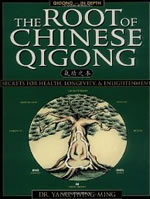
"In all qigong practice it is very important to be rooted. Being rooted means to be stable and in firm contact with the ground. If you want to push a car you have to be rooted; the force you exert into the car needs to be balanced by the force into the ground. If you are not rooted, when you push the car you will only push yourself away and not move the car. Your root is made up of your body's sinking, centering, and balance.
    Before you can develop your root, you must first relax and let your body "settle." As you relax, the tension in the various parts of your body will dissolve, and you will find a comfortable way to stand. You will stop fighting the ground to keep your body up and will learn to rely on your body's structure to support itself. This lets the muscles relax even more. Since your body isn't struggling to stand up, your yi won't be pushing upward, and your body, mind, and qi will all be able to sink. If you let dirty water sit quietly, the impurities will gradually settle to the bottom, leaving the water above it clear. In the same way, if you relax your body enough to let it settle, your qi will sink to your dan tian and the bubbling wells (yongquan, K-1, 湧泉) in your feet and your mind will become clear. Then you can begin to develop your root.
    To root your body you must imitate a tree and grow an invisible root under your feet. This will give you a firm root to keep you stable in your training. Your root must be wide as well as deep. Naturally, your yi must grow first because it is the yi that leads the qi. Your yi must be able to lead the qi to your feet and be able to communicate with the ground. Only when your yi can communicate with the ground will your qi be able to grow beyond your feet and enter the ground to build the root. The bubbling well cavity is the gate that enables your qi to communicate with the ground.  
    After you have gained your root, you must learn how to keep your center. A stable center will make your qi develop evenly and uniformly. If you lose this center, your qi will not be led evenly. In order to keep your body centered, you must first center your yi and then match your body to it. Only under these conditions will the qigong forms you practice have their root. Your mental and physical centers are the keys that enable you to lead your qi beyond your body.
    Balance is the product of rooting and centering. Balance includes balancing the qi and the physical body. It does not matter which aspect of balance you are dealing with; first, you must balance your yi, and only then can you balance your qi and your physical body."
-  Grandmaster Yang, Jwing-Ming  


Tuesday, June 06, 2023

Falling Down

I was working in my front yard yesterday.  The whole west side of our yard slopes down to the street.  Because the area is not flat, we must be very careful when working there in our vegetable garden so that we don't fall.  

Yesterday, I turned and misjudged the curb edge at the street, stumbled, lost my balance, and fell hard on the street asphalt.  Injured my right hip, right knee, left leg inside abductor, and right elbow.  The right knee was injured the most.  Bruises and scrapes in a number of areas.

I iced the knee and elbow.  I put antiseptic cream on the abrasions.  Rested!  Complained to myself!  Pissed off about falling.  Mumbling Cussing ... for little while. 

I fell once in the July of 2016 at Red Bluff.  I feel once in December 2016 my daughters Alicia's home in Vancouver.  Both times the injuries were painful and serious.  I consulted with an orthopedic doctor.  I did physical therapy on my left kneecap, right knee, and right hip.  Now, I fell again in June of 2023.  

I guess I should not complain. At the age of 77 many folks get out of balance sometimes, stumble, or lose their balance temporarily.  Three falls in 25 years ... what am I complaining about.  

Still, getting out of balance and falling and hurting myself really pisses me off.  Carelessness?  Physical Health?  Dangerous area for working?  Clumsiness?  Balance Isses?    

I do think my practices of Tai Chi Chuan, Qigong, and Walking do actually help me maintain better balance.

So, for now, REST, and ICE, and Gentle Movements.  Slow Down.  Be More Careful. Watch my Step!  Be careful in dangerous areas were stumbling or falling is a possible hazard.  Be Patient.  Stop complaining and move on!


Built from Broken. A Science-Based Guide to Healing Painful Joints, Preventing Injuries, and Rebuilding Your Body. By Scott Hogan. Salt Wrap, 2021, index, reference, appendices, 341 pages. VSCL, Paperback.  

Strength Training for Seniors


Wednesday, March 22, 2023

Walking Meditation: When Walking is Only for Walking

"Walking meditation means to enjoy walking without any intention to arrive. We don't need to arrive anywhere.  We just walk. We enjoy walking. That means walking is already stopping, and that needs some training.  Usually in our daily life we walk because we want to go somewhere. Walking is only a means to an end, and that is why we do not enjoy every step we take. Walking meditation is different. Walking is only for walking. You enjoy every step you take. So this is a kind of revolution in walking. You allow yourself to enjoy every step you take.
The Zen master Ling Chi said that the miracle is not to walk on burning charcoal or in the thin air or on the water; the miracle is just to walk on earth. You breathe in. You become aware of the fact that you are alive. You are still alive and you are walking on this beautiful planet. That is already performing a miracle. The greatest of all miracles is to be alive. We have to awaken ourselves to the truth that we are here, alive. We are here making steps on this beautiful planet. This is already performing a miracle.  But we have to be here in order for the miracle to be possible. We have to bring ourselves back to the here and the now."
-  Thich Nhat Hanh, Resting in the River


Walking Meditation:  Quotes, Bibliography, Links, Information, Methods


"Walking meditation is walking in full awareness of breath, body and everything the senses present.  It is not an aerobic exercise - though it would be a fine lead-in to aerobic walking.  Rather, walking meditation is done slowly and consciously, with each step fully feeling the earth.  During this precious time, body and mind come together, joined in the present moment.  Although the benefits of walking meditation will deepen over time, even from the start, you can experience some measure of the relaxation, balance and quiet energy that builds through this practice."
-  Ginny Whitelaw, Body Learning, p. 55.   


"Research conducted at Harvard Medical School’s Mind/Body Medical Institute has found that focused walking meditations are highly effective for reducing anxiety and producing  what’s called the “relaxation response.”
Borgess Health   


The Ways of Walking
Compiled by Mike Garofalo
Quotations, Poems, Sayings, Lore, Facts


"Walking meditation is not just for stretching our legs. It is a technique just as powerful as sitting. Within the Buddhist world there are many styles of walking meditation: the formal kinhin of Zen, the kaihogyo of Mt. Hiei, the rlung-sgom of Tibet, etc.
    Walk slowly but naturally. Try to register as much information as possible about the sensation in each foot as it moves. Break the movement into distinct components and note each one.  Distinguish the lifting, swinging and down-tread. Experience each change in tactile sensation against the floor as you lift and touch down. Try to feel the many tiny jerks of muscles involved in the foot's seemingly smooth motion. Try to see that each component and sub-component of the foot's motion has its own distinct beginning, middle and end.
    At first you may want to make explicit mental note of the components by saying to yourself something like "Begin lift, lifting, end lift, begin swing, swinging, end swing, begin coming down, coming down, begin touching ground, touching..." However, as you become more and more aware of subtle events, you will not have time to characterize each with words. In any event, keep an unbroken stream of awareness about the foot. If your attention wanders, be aware of that fact and return to the foot. Remember, it is very important to keep the rest of the body relaxed
while you do this.
    Our sense of solidity and separateness comes about because we habitually grasp and freeze each moment of sensation. The vipassana walking exercise is designed to so completely flood your consciousness with reality moments that there simply is no time left for grasping and freezing. As soon as a piece of data is registered, move on to the next piece of data without allowing the memory of the former piece of data to congeal."
-   Walking Meditation, Shinzen Young


Sunday, June 19, 2022

Tao Te Ching, Chapter 77, by Lao Tzu

Daodejing, Laozi
Chapter 77

"The way of heaven,
Is it not like stretching a bow?
What is high up is pressed down,
What is low down is lifted up;
What has surplus is reduced,
What is deficient is supplemented.
The way of heaven,
It reduces those who have surpluses,
To supplement those who are deficient.
The human way is just not so.
It reduces those who are deficient,
To offer those who have surpluses.
Who can offer his surpluses to the world?
Only a person of Tao.
Therefore the sage works (wei) without holding on to,
Accomplishes without claiming credit.
Is it not because he does not want to show off his merits?"
-  Translated by Ellen M. Chen, 1989, Chapter 77  


"The Tao of Heaven resembles a drawn bow.
It brings down the high and exalts the lowly;
it takes from those who have superfluity,
and gives to those who have not enough.
The Tao of Heaven abstracts where there is too much,
and supplements where there is deficiency.
The Tao of men does not so.
It takes away from what is already deficient
in order to bestow on those who have a superfluity.
Who is able to devote his surplus to the needs of others?
Only he who is possessed of Tao. 
Thus it is that the Sage acts, yet does not plume himself;
achieves works of merit, yet does not hold to them.
He has no wish to make a display of his worthiness."
-  Translated by Frederic H. Balfour, 1884, Chapter 77  


"The Path of Heaven is like bending a bow-
the upper part is pressed down,
the lower part is raised up;
the part which has much is reduced,
the part that has little is increased.
Therefore, the Path of Heaven
reduced surplus to make up for scarcity;
the way of mankind's Ego
reduces scarcity and pays tribute to surplus!
Who is there who can have a surplus
and take from it to pay tribute to Heaven?
Surely, only one who is on the Path.
For this reason, Sages transact, but do not hoard,
complete their work but do not dwell upon it.
In this way, they have no desire to display their 'worth.' "
-  Translated by Jerry C. Welch, 1998, Chapter 77

"The Tao of Heaven,
Is it not like the bending of a bow?
The top comes down and the bottom-end goes up,
The extra length is shortened, the insufficient width is expanded.
It is the way of Heaven to take away from those that have too much
And give to those that have not enough.
Not so with man's way:
He takes from those that have not
And gives it as tribute to those that have too much.
Who can have enough and to spare to give to the entire world?
Only the man of Tao.
Therefore the Sage acts, but does not possess,
Accomplishes but lays claim to no credit,
Because he has no wish to seem superior."
-  Translated by Lin Yutang, 1955, Chapter 77 


天之道, 其猶張弓與?
高者抑之,
下者舉之,
有餘者損之,
不足者補之.

天之道損有餘而補不足,
人之道則不然,
損不足以奉有餘.
孰能有餘以奉天下?

唯有道者.
是以聖人為而不恃, 
功成而不處,
其不欲見賢.
-  Chinese characters, Chapter 77, Tao Te Ching


tian zhi dao, qi you zhang gong yu?
gao zhe yi zhi,
xia zhe ju zhi,
you yu zhe sun zhi,
bu zu zhe bu zhi.

tian zhi dao sun you yu er bu bu zu,
ren zhi dao ze bu ran,
sun bu zu yi feng you yu.
shu neng you yu yi feng tian xia?

wei you dao zhe.
shi yi sheng ren wei er bu shi,
gong cheng er bu chu,
qi bu yu xian xian.
-  Pinyin Romanization, Chapter 77, Daodejing 
 
"Bend the bow and embrace the tiger
to emulate the way of heave

drawn with resoluteness
the bow changes length and width
turning in on itself

released with resoluteness
the bow projects its arrow fixedly to a target
by equalizing itself

the bow can shoot up or down as needed
always seeking to balance out
flexibility and cohesion
always seeking to resolve
excesses of energy and deficiencies of energy

equalizing and balancing out and resolving
are the ways of heaven

but the ways of man
make things unequal
imbalanced and unresolved
cutting man off from heaven and earth

only a sage wise man humbly cultivating the tao
     way of life
can entreat heaven on man's behalf
asking heaven
to reestablish the natural order
by not asking heaven

when he is successful
he does not dwell on it
displaying his skill at emulating the way of heaven

he simply smiles
and moves on to the next task."
-  Translated by John Bright-Fey, Chapter 77


"Is not Tao like the drawn bow?
The highest part is lowered,
the lowest part is raised.
Overall length is shortened,
overall depth is lengthened.
So the Great Tao
lowers the highest and raises the lowest.
But the Tao of man
increases the high and decreases the low.
Who can take from the high and give to the low?
Only the true follower of Tao.
Thus, the truly wise act but are not possessive,
achieve but claim no credit,
because they have no desire for vain glory."
-  Translated by C. Ganson, Chapter 77 


¿Acaso el camino del cielo no procede
igual que el que tensa un arco?
Rebaja lo que está arriba
y elva lo que está arriba
y elva lo que está abajo;
quita lo que sobra
y reemplaza lo que falta.

El camino del Cielo quita el excedente
para compensar lo que falta.
El camino del hombre es my distinto:
el homre quita al indigente
para sumárselo al rico.

¿Quién puede dar al mundo lo que tiene de superfluo
sino el que posee el Tao?

El santo actúa sin esperar nada
lleva a cabo su obra sin encapricharse con ella
y mantiene escondido su mérito."
-  Translated by Alba, 1998, Tao Te Ching, Capítulo 77 


"The Tao of heaven is like the art of archery,
tall man, aim low;
short man, aim high.
If the string is too long, shorten it;
not enough, lengthen it.
The Tao of heaven is just like that,
short the long, long the short.
Man's way is different.
He takes from those who do not have enough,
to give to those who already have too much.
Who can have anything left for taking?
Only the man of Tao, as sage,
works without taking,
achieves without keeping,
does not show his greatness."
-  Translated by Tienzen Gong, Chapter 77 


"Is not the Tao of heaven like the drawing of a bow?
It brings down the part which is high; it raises the part which is low;
it lessens the part which is redundant (convex); it fills up the part which is insufficient (concave).
The Tao of heaven is to lessen the redundant and fill up the insufficient.
The Tao of man, on the contrary, is to take from the insufficient and give to the redundant.
Who can take from the redundant and give to the insufficient?
Only he who has Tao can.
Therefore the Sage does not horde.
The more he helps others, the more he benefits himself the more he gives to others, the more he gets himself.
The Tao of heaven does one good but never does one harm; the Tao of the Sage acts but never contends."
-  Translated by Ch'u Ta-Kao, 1904, Chapter 77  


A typical webpage created by Mike Garofalo for each one of the 81 Chapters (Verses, Sections) of the Tao Te Ching (Daodejing) by Lao Tzu (Laozi) includes over 25 different English language translations or interpolations for that Chapter, 5 Spanish language translations for that Chapter, the Chinese characters for that Chapter, the Wade-Giles and Hanyu Pinyin transliterations (Romanization) of the Mandarin Chinese words for that Chapter, and 2 German and 1 French translation of that Chapter.  Each webpage for each one of the 81 Chapters of the Tao Te Ching includes extensive indexing by key words, phrases, and terms for that Chapter in English, Spanish, and the Wade-Giles Romanization.  Each webpage on a Chapter of the Daodejing includes recommended reading in books and websites, a detailed bibliography, some commentary, research leads, translation sources, a Google Translate Webpage drop down menu, and other resources for that Chapter.   

Chapter 77, Tao Te Ching by Lao Tzu

Chapter and Thematic Index (Concordance) to the Tao Te Ching by Lao Tzu

English Language Daodejing Translators' Source Index

Spanish Language Daodejing Translators' Source Index

Ripening Peaches: Taoist Studies and Practices

Taoism: A Selected Reading List

One Old Daoist Druid's Final Journey  


Friday, February 07, 2020

Dao De Jing, Laozi, Chapter 9


Tao Te Ching by Lao Tzu
Chapter 9


"It is better to leave a vessel unfilled, than to attempt to carry it when it is full.
If you keep feeling a point that has been sharpened, the point cannot long preserve its sharpness.
When gold and jade fill the hall, their possessor cannot keep them safe.
When wealth and honors lead to arrogance, this brings its evil on itself.
When the work is done, and one's name is becoming distinguished,
To withdraw into obscurity is the way of Heaven."
-  Translated by James Legge, 1891, Chapter 9 


"Holding to fullness
Is not as good as stopping in time.
Sharpness that probes
Cannot protect for long.
A house filled with riches
Cannot be defended.
Pride in wealth and position
Is overlooking one's collapse.
Withdrawing when success is achieved
Is the Tao in Nature."
-  Translated by R. L. Wing, 1986, Chapter 9  


"You hold to fullness, and it is better to stop in time!
You keep on beating and sharpening a sword, and the edge cannot be preserved for long.
You fill your house with gold and jade, and it can no longer be guarded.
You put on airs by your riches and honor, and you will only reap a crop of calamities.
Here is the Way of Heaven: When you have done your work, retire."
-  Translated by Tran Tien Cong, Chapter 9 


  "Do not concentrate one's wealth in abundance.
It is far better for one to know where to stop.
Do not beat one's sword sharp, one can never keep its edge for ever.
If their houses are full of gold and jade, they have no way to keep them forever.
If they are proud of having great riches and honors, they just make more troubles for themselves.
When merits have been achieved, fame has been completed - one may withdraw himself.
That is to follow the law of Nature."
-  Translated by Tang Zi-Chang, Chapter 9


"It is advisable to refrain from continual reaching after wealth.
Continual handling and sharpening wears away the most durable thing.
If the house be full of jewels, who shall protect it?
Wealth and glory bring care along with pride.
To stop when good work is done and honour advancing is the way of Heaven."
-  Translated by Walter Gorn Old, 1904, Chapter 9  


"Continuing to fill a pail after it is full the water will be wasted.
Continuing to grind an axe after it is sharp will soon wear it away.
Who can protect a public hall crowded with gold and jewels?
The pride of wealth and position brings about their own misfortune.
To win true merit, to preserve just fame, the personality must be retiring.
This is the heavenly Dao."
-  Translated by Dwight Goddard and Henri Borel, 1919, Chapter 9 


持而盈之, 不如其已.
揣而銳之, 不可長保.
金玉滿堂莫之能守富貴而驕, 自遺其咎.
功遂身退天之道.
-  Chinese characters, Chapter 9, Tao Te Ching


"Let Heavenly Love fill you and overflow in you,
Not according to your measure of fullness.
Prove it, probe deeply into it,
It shall not long withstand you.
You may fill a place with gold and precious stones,
You will not be able to guard them.
You may be weighted with honors and become proud.
Misfortune then will come to your Self.
You may accomplish great deeds and acquire fame,
Retire yourself;
This is Heavenly Tao."
-  Translated by Isabella Mears, 1916, Chapter 9 


"Stretch a bow to the very full,
And you will wish you had stopped in time;
Temper a sword-edge to its very sharpest,
And you will find it soon grows dull.
When bronze and jade fill your hall.
It can no longer be guarded.
Wealth and place breed insolence.
That brings ruin in its train.
When your work is done, then withdraw!
Such is Heaven's Way."
-  Translated by Arthur Waley, 1934, Chapter 9  


"Asir fuertemente y colmar
 Vale menos que dejar de hacerlo.
 Calcular y afilar las armas
 No significa que se prolongue su cuidado.
 Atiborrar la gran sala de oro y jade
 Y no habrá quien pueda custodiarlos.
 Ser rico y orgulloso.
 Quizás perderse a sí mismo sea la desgracia.
 Cuando la obra se completa y la persona se retira,
 Ése es el Tao del Cielo."
 -  Translated by Álex Ferrara, 2003, Capítulo 9


"Going to extremes is never best.
For if you make a blade too sharp, it will become dull too quickly
And if you hoard all the wealth, you are bound to be attacked.
If you become proud and arrogant regarding your good fortune, you will naturally beget enemies who jealously despise you.
The way to success is this: having achieved your goal, be satisfied not to go further. For this is the way Nature operates."
-  Translated by Archie J. Balm, 1958, Chapter 9 


A typical webpage created by Mike Garofalo for each one of the 81 Chapters (Verses, Sections) of the Tao Te Ching (Daodejing) by Lao Tzu (Laozi) includes 25 or more different English language translations or interpolations for that Chapter, 5 or more Spanish language translations for that Chapter, the Chinese characters for that Chapter, the Wade-Giles and Hanyu Pinyin transliterations (Romanization) of the Mandarin Chinese words for that Chapter, and 2 German and 1 French translation of that Chapter.

Each webpage for each one of the 81 Chapters of the Tao Te Ching includes extensive indexing by key words, phrases, and terms for that Chapter in English, Spanish, and the Wade-Giles Romanization. 


An electronic Concordance for all 81 Chapters of the Tao Te Ching is provided.

Each webpage on a Chapter of the Daodejing includes recommended reading in books and websites, a detailed bibliography, some commentary, research leads, translation sources, a Google Translate drop down menu, and other resources for that Chapter. 


Chapter 9, Tao Te Ching by Lao Tzu