Showing posts with label Wild Goose. Show all posts

Sunday, March 29, 2026

Dayan (Wild Goose) Chi Kung Exercises

Dayan (Wild Goose) Qigong Exercises

Bibliography, Links, Quotes, Notes, List of Movements
Research by Mike Garofalo

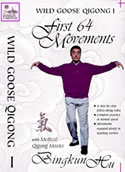
This Qigong form is one long continuous sequence of movements, much like a Taiji form.  There are many aspects of the Wild Goose

Watch UTube Video of Part One of Wild Goose Qigong

Qigong system as presented by Dr. Bingkun Hu of San Francisco.
 
I was practicing this Dayan form one autumn winter morning in my Sacred Circle Garden when a flock of Canadian Geese flew overhead.  The North Sacramento Valley is the winter home of birds from Canada.  Behold ... 'everything is holy now':


"A second Grandfather, he of the North, spoke again: 
"Take courage, younger brother," he said, "on earth a nation you shall make live, for yours shall be the power of the white giant's wing, the cleansing wing." 
Then he got up very tall and started running toward the north; and when he turned toward me, it was a white goose wheeling. I looked about me now, and the horses in the west were thunders and the horses of the north where geese. 
And the second Grandfather sang two songs that were like this:
"They are appearing, may you behold!
They are appearing , may you behold!
The thunder nation is appearing, behold!
They are appearing, may you behold!
The white geese nation is appearing, behold!"
- Black Elk Speaks, 1932, p. 22, as told to John G. Neihardt.


A post from October 2015.  

"In the north-west of China, high above the Himalayas, are the mystical Kunlun Mountains. Nearly 1700 years ago a hermit named Si Dao An (the Peaceful Way) observed the movements of the many wild geese that haunt the area and began to incorporate these bending, stretching, twisting and fluttering techniques into a health-enhancing routine called the Dayan Gong or Wild Goose Qigong.  Since then over 30 generations have taught this skill to the world.  The 27th generation inheritor, Grandmaster Yang Mei-Jun (who died in 2002 aged 107) was the first to open the Dayan Gong outside China ...  through Master Tse Wei Jing Who is the only authorised senior instructor of the Kunlun Mountains Qigong in the East of England." 
-   Julian Wilde, Norwich Tse Tai Chi


"Wild Goose Qigong belongs to the Kunlun School, so it is also called Kunlun School Qigong.  This school began in the Sichuan Province in China.  The most famous practitioner of Wild Goose Qigong was Dao An, who spread it during the Jin Dynasty (265-420 A.D.).  Because he was the most famous teacher of Wild Goose Qigong, he was crowned as its founder by later generations.   Later on, Wild Goose Qigong spread to northern China, and was kept by Wan Li at Wutai Mountain.  Emperor Qian Long, during the Qing Dynasty (1368-1840 A.D.), promoted religion and established temples all over the country so that Wild Goose Qigong could be passed down to the present."
-   By Hong-Chao Zhang, Wild Goose Qigong, p 12


"Dayan Qigong is a content-rich set of system consisting of two categories: dynamic and silent. For the former, the routine forms imitate wild goose's shape, movements or even habits, with the aim letting the internal energy flow smoothly within the body along the channels and meridians, thus moving away the thwarting blocks. In a whole, all forms shine out the feeling of wonderful harmony consisting both softness and hardness, of unrestrainedness, simpleness, and lightness. Also, some strange feeling may arise to the heart that seems to fly over the wild stretch of ocean and the vastness overpowers all consciousness." 
-   Dayan Qigong 


Thursday, April 21, 2022

Wild Goose Qigong Exercises

Dayan (Wild Goose) Qigong Exercises


Bibliography, Links, Quotes, Notes, List of Movements
Research by Mike Garofalo

The Wild Goose Qigong form is one long continuous sequence of movements, much like a Taiji form.  There are many aspects of the Wild Goose Qigong system as presented by Dr. Bingkun Hu of San Francisco.

"In Ancient Egypt as well as in Ancient China the goose was considered a messenger between Heaven and Earth. In China geese are still a symbol of marriage, because of their lifelong pair-bond.  In the Roman empire, the goose was the sacred animal of Juno, a goddess of light, marriage and childbirth, who was later considered adviser and protectress of the Roman people. A story tells of how geese saved the Romans with their warning cries when the Gauls attacked the citadel of the Capitol.  The Celts associated the goose with war, possibly because of its watchful nature and aggressive temperament. Warrior gods were sometimes depicted with geese as companions. Remains of geese have been found in warrior's graves. The Britons kept geese, but did not eat them. They were, however, sometimes used as sacrificial offerings.  The goose, with its steady, powerful flight and migratory habits, can be associated with travelling, undertaking a journey to a new destination. This journey can be difficult and may take long.  The goose can help people find the perseverance needed to go on with their quests. In earlier times, shamans were aided by spirit geese on their journeys to other worlds."
-   Geese - The Animal Files    


"Wild Goose Qigong claims that “there are no intentional movements without awareness. Wild Goose Qigong advocates “wu-wei” (or “doing nothing”) and “tuo-yi” (“reduce one’s awareness to the minimum”). A good example is Wild Goose-1 (the first 64 Movements). We often tell our beginning learners that the movements in this set of qigong are supposed to describe the daily activities of a wild goose. There are three parts to this qigong.  Part One is “The Goose Wakes Up”. It stretches itself, it brushes up its wings and shakes them. It plays innocently.  A made-up story is even included: “Then the goose looks at the moon, which is reflected in the water and tries to scoop it up."  Part Two is “The Flying Goose”.  Flapping its wings, the care-free wild goose skims over a smooth lake.  It looks at the water and dips down to drink the water.  Then the goose is playing with he “qi”.  It tries to grasp the qi.  It holds and rotates the qi-ball.  It pushes out the dirty qi, and tries to receive the fresh qi from its lower back.  In Part Three, the goose is first flying up into the sky. Now it is flying over the water.  Then it is looking for some food.  After that, it is looking for its nest. At last, the goose goes to sleep.  When beginning, learners are encouraged to be pre-occupied with the daily activity of an innocent wild goose, when they are imagining that they are “flapping their wings” beside shimmering lake under a full moon, their heart beat will be naturally slow down, and their mind will gradually be quieting down too. At the same time, they will be more responsive to the instructor’s words on how to relax themselves through the shifting of body weight. Wild Goose Qigong is a medical qigong. We practice it because of its health benefits. When we have better qi flow, our blood circulation will improve. We will have more oxygen supply to our brain. Our mind will be more alert. We will get stronger, and we will have more physical strength, etc.."
-   Bingkun Hu, Ph.D., A Safe and Delightful Approach to Good Health   


Thursday, August 27, 2020

Geese in the Sky

 While walking at 6 am each morning this week, I have seen seven flocks of geese flying in V formation and heading in a southeast direction.  I suppose some geese might go to our Steigerwald National Wildlife Refuge in nearby Washoughal to rest for the night.  All kinds of waterfowl migrate from north (even Alaska) to as far south as Sacramento, California.  All kinds of ducks and geese would forage in the fields and rice wetlands during the Winter months in the north Sacramento valley near our rural home in Red Bluff, CA.   

"In Ancient Egypt as well as in Ancient China the goose was considered a messenger between Heaven and Earth. In China geese are still a symbol of marriage, because of their lifelong pair-bond.  In the Roman empire, the goose was the sacred animal of Juno, a goddess of light, marriage and childbirth, who was later considered adviser and protectress of the Roman people. A story tells of how geese saved the Romans with their warning cries when the Gauls attacked the citadel of the Capitol.  The Celts associated the goose with war, possibly because of its watchful nature and aggressive temperament. Warrior gods were sometimes depicted with geese as companions. Remains of geese have been found in warrior's graves. The Britons kept geese, but did not eat them. They were, however, sometimes used as sacrificial offerings.  The goose, with its steady, powerful flight and migratory habits, can be associated with travelling, undertaking a journey to a new destination. This journey can be difficult and may take long.  The goose can help people find the perseverance needed to go on with their quests. In earlier times, shamans were aided by spirit geese on their journeys to other worlds."
-   Geese - The Animal Files   


"Coming home
long necked geese–
Canadian-Americans.

A warm rest for
coots, geese, and ducks–
wet rice fields.

The white geese
ascend from the far fields
fleeing popping shotguns.

The honking geese
a quacking cacophony
flapping overhead.

Flocks of white
geese in the light gray fog–
this way and that way."
- Mike Garofalo, Poetry


Thursday, June 18, 2020

Wild Goose Qigong

Dayan (Wild Goose) Qigong Exercises


Bibliography, Links, Quotes, Notes, List of Movements
Research by Mike Garofalo


The Wild Goose Qigong form is one long continuous sequence of movements, much like a Taiji form.  There are many aspects of the Wild Goose Qigong system as presented by Dr. Bingkun Hu of San Francisco.  


"In Ancient Egypt as well as in Ancient China the goose was considered a messenger between Heaven and Earth. In China geese are still a symbol of marriage, because of their lifelong pair-bond.  In the Roman empire, the goose was the sacred animal of Juno, a goddess of light, marriage and childbirth, who was later considered adviser and protectress of the Roman people. A story tells of how geese saved the Romans with their warning cries when the Gauls attacked the citadel of the Capitol.  The Celts associated the goose with war, possibly because of its watchful nature and aggressive temperament. Warrior gods were sometimes depicted with geese as companions. Remains of geese have been found in warrior's graves. The Britons kept geese, but did not eat them. They were, however, sometimes used as sacrificial offerings.  The goose, with its steady, powerful flight and migratory habits, can be associated with travelling, undertaking a journey to a new destination. This journey can be difficult and may take long.  The goose can help people find the perseverance needed to go on with their quests. In earlier times, shamans were aided by spirit geese on their journeys to other worlds."
-   Geese - The Animal Files    


"Wild Goose Qigong claims that “there are no intentional movements without awareness. Wild Goose Qigong advocates “wu-wei” (or “doing nothing”) and “tuo-yi” (“reduce one’s awareness to the minimum”). A good example is Wild Goose-1 (the first 64 Movements). We often tell our beginning learners that the movements in this set of qigong are supposed to describe the daily activities of a wild goose. There are three parts to this qigong.  Part One is “The Goose Wakes Up”. It stretches itself, it brushes up its wings and shakes them. It plays innocently.  A made-up story is even included: “Then the goose looks at the moon, which is reflected in the water and tries to scoop it up."  Part Two is “The Flying Goose”.  Flapping its wings, the care-free wild goose skims over a smooth lake.  It looks at the water and dips down to drink the water.  Then the goose is playing with he “qi”.  It tries to grasp the qi.  It holds and rotates the qi-ball.  It pushes out the dirty qi, and tries to receive the fresh qi from its lower back.  In Part Three, the goose is first flying up into the sky. Now it is flying over the water.  Then it is looking for some food.  After that, it is looking for its nest. At last, the goose goes to sleep.  When beginning, learners are encouraged to be pre-occupied with the daily activity of an innocent wild goose, when they are imagining that they are “flapping their wings” beside shimmering lake under a full moon, their heart beat will be naturally slow down, and their mind will gradually be quieting down too. At the same time, they will be more responsive to the instructor’s words on how to relax themselves through the shifting of body weight. Wild Goose Qigong is a medical qigong. We practice it because of its health benefits. When we have better qi flow, our blood circulation will improve. We will have more oxygen supply to our brain. Our mind will be more alert. We will get stronger, and we will have more physical strength, etc.."
-   Bingkun Hu, Ph.D., A Safe and Delightful Approach to Good Health   


Sunday, October 09, 2016

Wild Goose Chi Kung Exercises

Dayan (Wild Goose) Qigong Exercises


Bibliography, Links, Quotes, Notes, List of Movements
Research by Mike Garofalo


The Wild Goose Qigong form is one long continuous sequence of movements, much like a Taiji form.  There are many aspects of the Wild Goose Qigong system as presented by Dr. Bingkun Hu of San Francisco.  


"Wild Goose Qigong claims that “there are no intentional movements without awareness. Wild Goose Qigong advocates “wu-wei” (or “doing nothing”) and “tuo-yi” (“reduce one’s awareness to the minimum”). A good example is Wild Goose-1 (the first 64 Movements). We often tell our beginning learners that the movements in this set of qigong are supposed to describe the daily activities of a wild goose. There are three parts to this qigong.  Part One is “The Goose Wakes Up”. It stretches itself, it brushes up its wings and shakes them. It plays innocently.  A made-up story is even included: “Then the goose looks at the moon, which is reflected in the water and tries to scoop it up."  Part Two is “The Flying Goose”.  Flapping its wings, the care-free wild goose skims over a smooth lake.  It looks at the water and dips down to drink the water.  Then the goose is playing with he “qi”.  It tries to grasp the qi.  It holds and rotates the qi-ball.  It pushes out the dirty qi, and tries to receive the fresh qi from its lower back.  In Part Three, the goose is first flying up into the sky. Now it is flying over the water.  Then it is looking for some food.  After that, it is looking for its nest. At last, the goose goes to sleep.  When beginning, learners are encouraged to be pre-occupied with the daily activity of an innocent wild goose, when they are imagining that they are “flapping their wings” beside shimmering lake under a full moon, their heart beat will be naturally slow down, and their mind will gradually be quieting down too. At the same time, they will be more responsive to the instructor’s words on how to relax themselves through the shifting of body weight. Wild Goose Qigong is a medical qigong. We practice it because of its health benefits. When we have better qi flow, our blood circulation will improve. We will have more oxygen supply to our brain. Our mind will be more alert. We will get stronger, and we will have more physical strength, etc.."
-   Bingkun Hu, Ph.D., A Safe and Delightful Approach to Good Health   


Monday, November 16, 2015

Wild Goose Qigong Exercise System

Dayan (Wild Goose) Qigong Exercises


Bibliography, Links, Quotes, Notes, List of Movements
Research by Mike Garofalo


The Wild Goose Qigong form is one long continuous sequence of movements, much like a Taiji form.  There are many aspects of the Wild Goose Qigong system as presented by Dr. Bingkun Hu of San Francisco.  


"Wild Goose Qigong claims that “there are no intentional movements without awareness. Wild Goose Qigong advocates “wu-wei” (or “doing nothing”) and “tuo-yi” (“reduce one’s awareness to the minimum”). A good example is Wild Goose-1 (the first 64 Movements). We often tell our beginning learners that the movements in this set of qigong are supposed to describe the daily activities of a wild goose. There are three parts to this qigong.  Part One is “The Goose Wakes Up”. It stretches itself, it brushes up its wings and shakes them. It plays innocently.  A made-up story is even included: “Then the goose looks at the moon, which is reflected in the water and tries to scoop it up."  Part Two is “The Flying Goose”.  Flapping its wings, the care-free wild goose skims over a smooth lake.  It looks at the water and dips down to drink the water.  Then the goose is playing with he “qi”.  It tries to grasp the qi.  It holds and rotates the qi-ball.  It pushes out the dirty qi, and tries to receive the fresh qi from its lower back.  In Part Three, the goose is first flying up into the sky. Now it is flying over the water.  Then it is looking for some food.  After that, it is looking for its nest. At last, the goose goes to sleep.  When beginning, learners are encouraged to be pre-occupied with the daily activity of an innocent wild goose, when they are imagining that they are “flapping their wings” beside shimmering lake under a full moon, their heart beat will be naturally slow down, and their mind will gradually be quieting down too. At the same time, they will be more responsive to the instructor’s words on how to relax themselves through the shifting of body weight. Wild Goose Qigong is a medical qigong. We practice it because of its health benefits. When we have better qi flow, our blood circulation will improve. We will have more oxygen supply to our brain. Our mind will be more alert. We will get stronger, and we will have more physical strength, etc.."
-   Bingkun Hu, Ph.D., A Safe and Delightful Approach to Good Health   


Sunday, June 28, 2015

Wild Goose Chi Kung

Dayan (Wild Goose) Qigong Exercises


Bibliography, Links, Quotes, Notes, List of Movements
Research by Mike Garofalo


The Wild Goose Qigong form is one long continuous sequence of movements, much like a Taiji form.  There are many aspects of the Wild Goose Qigong system as presented by Dr. Bingkun Hu of San Francisco.  


"Wild Goose Qigong claims that “there are no intentional movements without awareness. Wild Goose Qigong advocates “wu-wei” (or “doing nothing”) and “tuo-yi” (“reduce one’s awareness to the minimum”). A good example is Wild Goose-1 (the first 64 Movements). We often tell our beginning learners that the movements in this set of qigong are supposed to describe the daily activities of a wild goose. There are three parts to this qigong.  Part One is “The Goose Wakes Up”. It stretches itself, it brushes up its wings and shakes them. It plays innocently.  A made-up story is even included: “Then the goose looks at the moon, which is reflected in the water and tries to scoop it up."  Part Two is “The Flying Goose”.  Flapping its wings, the care-free wild goose skims over a smooth lake.  It looks at the water and dips down to drink the water.  Then the goose is playing with he “qi”.  It tries to grasp the qi.  It holds and rotates the qi-ball.  It pushes out the dirty qi, and tries to receive the fresh qi from its lower back.  In Part Three, the goose is first flying up into the sky. Now it is flying over the water.  Then it is looking for some food.  After that, it is looking for its nest. At last, the goose goes to sleep.  When beginning, learners are encouraged to be pre-occupied with the daily activity of an innocent wild goose, when they are imagining that they are “flapping their wings” beside shimmering lake under a full moon, their heart beat will be naturally slow down, and their mind will gradually be quieting down too. At the same time, they will be more responsive to the instructor’s words on how to relax themselves through the shifting of body weight. Wild Goose Qigong is a medical qigong. We practice it because of its health benefits. When we have better qi flow, our blood circulation will improve. We will have more oxygen supply to our brain. Our mind will be more alert. We will get stronger, and we will have more physical strength, etc.."
-   Bingkun Hu, Ph.D., A Safe and Delightful Approach to Good Health   


Tuesday, June 03, 2014

Wild Goose Chi Kung Exercises

Dayan (Wild Goose) Qigong Exercises


Bibliography, Links, Quotes, Notes, List of Movements
Research by Mike Garofalo


The Wild Goose Qigong form is one long continuous sequence of movements, much like a Taiji form.  There are many aspects of the Wild Goose Qigong system as presented by Dr. Bingkun Hu of San Francisco.  


"In Ancient Egypt as well as in Ancient China the goose was considered a messenger between Heaven and Earth. In China geese are still a symbol of marriage, because of their lifelong pair-bond.  In the Roman empire, the goose was the sacred animal of Juno, a goddess of light, marriage and childbirth, who was later considered adviser and protectress of the Roman people. A story tells of how geese saved the Romans with their warning cries when the Gauls attacked the citadel of the Capitol.  The Celts associated the goose with war, possibly because of its watchful nature and aggressive temperament. Warrior gods were sometimes depicted with geese as companions. Remains of geese have been found in warrior's graves. The Britons kept geese, but did not eat them. They were, however, sometimes used as sacrificial offerings.  The goose, with its steady, powerful flight and migratory habits, can be associated with travelling, undertaking a journey to a new destination. This journey can be difficult and may take long.  The goose can help people find the perseverance needed to go on with their quests. In earlier times, shamans were aided by spirit geese on their journeys to other worlds."
-   Geese - The Animal Files    


"Wild Goose Qigong claims that “there are no intentional movements without awareness. Wild Goose Qigong advocates “wu-wei” (or “doing nothing”) and “tuo-yi” (“reduce one’s awareness to the minimum”). A good example is Wild Goose-1 (the first 64 Movements). We often tell our beginning learners that the movements in this set of qigong are supposed to describe the daily activities of a wild goose. There are three parts to this qigong.  Part One is “The Goose Wakes Up”. It stretches itself, it brushes up its wings and shakes them. It plays innocently.  A made-up story is even included: “Then the goose looks at the moon, which is reflected in the water and tries to scoop it up."  Part Two is “The Flying Goose”.  Flapping its wings, the care-free wild goose skims over a smooth lake.  It looks at the water and dips down to drink the water.  Then the goose is playing with he “qi”.  It tries to grasp the qi.  It holds and rotates the qi-ball.  It pushes out the dirty qi, and tries to receive the fresh qi from its lower back.  In Part Three, the goose is first flying up into the sky. Now it is flying over the water.  Then it is looking for some food.  After that, it is looking for its nest. At last, the goose goes to sleep.  When beginning, learners are encouraged to be pre-occupied with the daily activity of an innocent wild goose, when they are imagining that they are “flapping their wings” beside shimmering lake under a full moon, their heart beat will be naturally slow down, and their mind will gradually be quieting down too. At the same time, they will be more responsive to the instructor’s words on how to relax themselves through the shifting of body weight. Wild Goose Qigong is a medical qigong. We practice it because of its health benefits. When we have better qi flow, our blood circulation will improve. We will have more oxygen supply to our brain. Our mind will be more alert. We will get stronger, and we will have more physical strength, etc.."
-   Bingkun Hu, Ph.D., A Safe and Delightful Approach to Good Health   


Monday, January 27, 2014

A White Goose Wheeling

Wild Goose Qigong Exercises
Bibliography, Links, Quotes, Notes, List of Movements
Research by Mike Garofalo
 
This Qigong form is one long continuous sequence of movements, much like a Taiji form.  There are many aspects of the Wild Goose Qigong system as presented by Dr. Bingkun Hu of San Francisco.  

I was practicing this Dayan form one winter morning in my Sacred Circle Garden when a flock of Canadian Geese flew overhead.  The North Sacramento Valley is the winter home of birds from Canada.  Behold ... 'everything is holy now':


"A second Grandfather, he of the North, spoke again: 
"Take courage, younger brother," he said, "on earth a nation you shall make live, for yours shall be the power of the white giant's wing, the cleansing wing." 
Then he got up very tall and started running toward the north; and when he turned toward me, it was a white goose wheeling. I looked about me now, and the horses in the west were thunders and the horses of the north where geese. 
And the second Grandfather sang two songs that were like this:
"They are appearing, may you behold!
They are appearing , may you behold!
The thunder nation is appearing, behold!
They are appearing, may you behold!
The white geese nation is appearing, behold!"
- Black Elk Speaks, 1932, p. 22, as told to John G. Neihardt.


Monday, August 27, 2012

Dayan Chi Kung

Dayan (Wild Goose) Qigong Exercises

Bibliography, Links, Quotes, Notes, List of Movements
Research by Mike Garofalo

This Qigong form is one long continuous sequence of movements, much like a Taiji form.  There are many aspects of the Wild Goose Qigong system as presented by Dr. Bingkun Hu of San Francisco.  

 
I was practicing this Dayan form one winter morning in my
Sacred Circle Garden when a flock of Canadian Geese flew overhead.  The North Sacramento Valley is the winter home of birds from Canada.  Behold ... 'everything is holy now':

"A second Grandfather, he of the North, spoke again: 
"Take courage, younger brother," he said, "on earth a nation you shall make live, for yours shall be the power of the white giant's wing, the cleansing wing." 
Then he got up very tall and started running toward the north; and when he turned toward me, it was a white goose wheeling. I looked about me now, and the horses in the west were thunders and the horses of the north where geese. 
And the second Grandfather sang two songs that were like this:
"They are appearing, may you behold!
They are appearing , may you behold!
The thunder nation is appearing, behold!
They are appearing, may you behold!
The white geese nation is appearing, behold!"
- Black Elk Speaks, 1932, p. 22, as told to John G. Neihardt.


Thursday, May 17, 2012

Wild Goose (Dayan) Qigong

Dayan (Wild Goose) Qigong Exercises

Bibliography, Links, Quotes, Notes, List of Movements
Research by Mike Garofalo

This Qigong form is one long continuous sequence of movements, much like a Taiji form.  There are many aspects of the Wild Goose Qigong system as presented by Dr. Bingkun Hu of San Francisco.  
 

I was practicing this Dayan form one winter morning in my Sacred Circle Garden when a flock of Canadian Geese flew overhead.  The North Sacramento Valley is the winter home of birds from Canada.  Behold ... 'everything is holy now':


"A second Grandfather, he of the North, spoke again: 
"Take courage, younger brother," he said, "on earth a nation you shall make live, for yours shall be the power of the white giant's wing, the cleansing wing." 
Then he got up very tall and started running toward the north; and when he turned toward me, it was a white goose wheeling. I looked about me now, and the horses in the west were thunders and the horses of the north where geese. 
And the second Grandfather sang two songs that were like this:
"They are appearing, may you behold!
They are appearing , may you behold!
The thunder nation is appearing, behold!
They are appearing, may you behold!
The white geese nation is appearing, behold!"
- Black Elk Speaks, 1932, p. 22, as told to John G. Neihardt.


Friday, April 30, 2010

Wild Goose (Dayan) Qigong

Wild Goose Qigong, Dayan Chi Kung
Bibliography, Links, Quotes, Notes, List of Movements
By Mike Garofalo
Last updated on 30 April 2010

"A second Grandfather, he of the North, spoke again: "Take courage, younger brother," he said, "on earth a nation you shall make live, for yours shall be the power of the white giant's wing, the cleansing wing." Then he got up very tall and started running toward the north; and when he turned toward me, it was a white goose wheeling. I looked about me now, and the horses in the west were thunders and the horses of the north where geese. And the second Grandfather sang two songs that were like this:

"They are appearing, may you behold!
They are appearing , may you behold!
The thunder nation is appearing, behold!

They are appearing, may you behold!
The white geese nation is appearing, behold!"

- Black Elk Speaks, 1932, p. 22, as told to John G. Neihardt.