Showing posts with label Awareness. Show all posts

Sunday, August 23, 2026

Body-Mind Centering

Exploring Body-Mind Centering: An Anthology of Experience and Method.  Edited by Gill Wright Miller, Pat Ethridge, and Kate Tarlow Morgan.  North Atlantic Books, 2011, 470 pages, index. bibliography. VSCL.

Principles of Body-Mind Centering Approach

"All cells have consciousness (mind).

All levels of physiological organization (e.g., tissues, systems) have consciousness that can be experienced directly.

As we begin to make all systems more conscious,
they become more accessible. 

We can transmit to each other the embodiment.
of the group's shared learning.

The mind of the body system (e.g., bones, muscles, organs,
nervous system) is reflected in the room when that system.
is touched.  

It is possible to create, evoke, and titrate resonance.

Support precedes movement.

Embodiment can initiate movement; movement can
initiate embodiment.

The is a difference between the map of the body
and the territory of the living person's somatic experience."


Sunday, March 15, 2026

Feldenkrais Techniques

A repost from February 2018:

I have taken 9 Feldenkrais' introductory 90 minute group classes from a local Feldenkrais practitioner, Christine Toscano.  I also practice this method alone at home.  I have also read a number of books on the subject.


Mrs. Toscano recommended we read Chapter 5 of the book by Norman Doidge, M.D., "The Brain's Way of Healing: Remarkable Discoveries and Recoveries from the Frontiers of Neuroplasticity," (Penguin Books, 2016). The chapter covers the life and work of Moshe Feldenkrais (1904-1984).  He was a Ph.D. engineer, kudo master, movement therapist, author, and healer. The chapter discusses some of the core principles of his theory and methods as follows:

"1. The mind programs the functioning of the brain.
2. A brain cannot think without motor function.
3. Awareness of movement is the key to improving movement.
4. Differentiation: making the smallest possible sensory distinctions between movements - builds brain maps.
5. Differentiation is easiest to make when the stimulus is smallest.
6. Slowness of movement is the key to awareness, and awareness is the key to learning.
7. Reduce the effort whenever possible. Relax.
8. Errors are essential, and there is no right way to move, only better.
9. Random movements provide variation that leads to developmental breakthroughs.
10. Even the smallest movement in one part of the body involves the entire body.
11. Many movement problems, and the pain that goes with them, are caused by learned habit, not by abnormal structure." 


Awareness Through Movement.  Easy-To-Do Health Exercises to Improve Your Posture, Vision, Imagination and Personal Awareness.  By Moshe Feldenkrais.  HarperOne, Reprint edition, 2009.  192 pages.  ISBN: 978-0062503220.  VSCL. 

Awareness Heals: The Feldenkrais Method for Dynamic Health.  By Stephen Shafarman.  Da Capo Lifelong Books, 1997.  224 pages.  ISBN: 978-0201694697.  VSCL. 


The Brain's Way of Healing: Remarkable Discoveries and Recoveries from the Frontiers of Neuroplasticity.  By Norman Doidge, M.D..  Penguin Books, 2016.

Change Your Age: Using Your Body and Brain to Feel Younger, Stronger, and More Fit.  By Frank Wildman, Ph.D..  Da Capo Lifelong Books, 2010.  240 pages.  ISBN: 978-0738213637.  VSCL. 


Embodied Wisdom: The Collected Papers of Moshe Feldenkrais.  Edited by Elizabeth Beringer.  Foreword by David Zemach-Bersin.  North Atlantic Books, 1st Edition, 2010.  256 pages.  ISBN: 978-1556439063.  VSCL.  


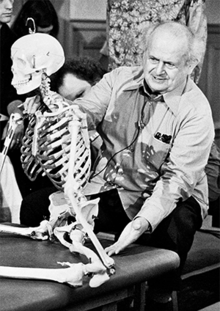
Moshe Feldenkrais.png


Monday, December 15, 2025

Using the Center


For some, finding one’s “center” is very problematic.  Either you have no “center” and feel lousy about the emptiness or chaos; or, you have a “center” and dislike the way the “center” is now.  Or like me, you just don’t care at all about having or not finding an illusive “center.”  Yes, I’m the smiling uncaring yellow cupcake, just enjoying a nice moment of pleasant relaxation while sitting centered on my wide butt.     


Wednesday, July 16, 2025

Taijiquan and Seeing

 "Looking and seeing are two different things. In tai chi we see without looking. When we look, we focus our gaze on some point. As we do that, there are subtle changes in our facial muscles which affect all our muscles. We see what we're looking at but miss the rest. Imagine having to deal with multiple opponents. The ideal is to see as if you're looking from behind your head so that your vision broadens. An easy way to understand it is by holding your arms at your side as if making a cross with your body. Can you see your hands with your peripheral vision? If you can, that's what your seeing should feel like. As you do that, you will notice that things get quieter and softer, more relaxed, and seem to slow down."
- Joe Eber, Facebook Post 


"Eyelids relaxed:  The eyelids should be relaxed like a curtain. As the eyelids relax, the mind is able to calm down and release the tension of the body’s muscles. The facial muscles also need to be soft and relaxed. As always, your outlook should be aware but not focused. Another reason to curtain the eyes is to hide your intention from others. In a martial arts’ sense, this is used for effective defense and offense.

Center the vision:  Set the eyes straight ahead but do not focus outward onto anything in particular. I tell my students to see, without looking; likewise to hear, without listening. By not focusing on any one thing, we cultivate awareness of all things. A centered vision helps to engage our peripheral vision so that we get a better sense of what is going on all around us. This also encourages awareness of our internal environment; our sense of feeling, balance, movement, and posture. A centered vision pertains to seeing both within and without."
-  William Ting, Essential Concepts of Tai Chi  


"What is the color of your head from the standpoint of your eyes?  You feel that you head is black, or that it has not any color at all.  Outside you see your field of vision as an oval because your two eyes act as two centers of an ellipse.  But what is beyond the field of vision?  What color is it where you can't see?  It is not black, and this is an important point; there is no color at all beyond your field of vision.  This little mental exercise gives us an idea of what is mean by the character hsüan.  Although its dictionary definition is "dark, deep, obscure," it actually refers to this kind of no color that is the color of your head - as far as your eyes are concerned.  Perhaps we could say that the invisibility of one's head, in a certain sense the lack of a head, is the secret of being alive.  To be headless, or have no head in just the same sense I am talking about, is our way of talking about the Chinese expression wu hsin, or "no mind."  As a matter of fact, if you want to see the inside of your head all you have to do is keep your eyes open, because all that you are experiencing in the external, visual field is a state of your brain."
-  Alan Watts, Swimming Headless, 1966 

Vision, Seeking, Sensations, Perceptions, Looking  By Michael P. Garofalo


Seeing, in solo Taijiquan practice, refers mostly to being visually aware of one's immediate physical environment your moving within.  With home indoor practice, that involves awareness of tripping hazards, walls, chairs, etc.  Adjustments are made accordingly.  Take in the big picture of where you are practicing - outdoors or indoors.  A wider angle of vision is preferred.
Some aspects of seeing in Taijiquan practices involve carefully looking at an imaginary opponent, your hands, or in a specific direction.  Looking is a focused kind of seeing, and the field of vision is more circumscribed.  

Tuesday, July 08, 2025

Concentration and Gazing in Yoga Practice

"Drishti (IPA: [ dɽʂʈi ]; Sanskrit: दृष्टि; IAST:dṛṣṭi), or focused gaze, is a means for developing concentrated intention. It relates to the fifth limb of yoga (pratyahara) concerning sense withdrawal as well as the sixth limb dharana relating to concentration."
Drishti - Wikipedia


While doing various yoga postures the eyes gaze at and concentrate on eight specific parts of the body: 
middle of the thumb
eyes lowered, imagine gazing at third eye in the middle of the forehead
tip of the nose
palm of the hand and fingers
look to left side or right side
look upwards at sky or ceiling
navel

toes


"Simply speaking, drushti is sensitive awareness to that which you are doing. This has two aspects that are vital to every aspect of our practice. First it means bringing your mind to bear exactly on what you are doing. Not doing one thing while thinking another. This actually means learning not even to be thinking about what you are doing. Rather, just be doing it, feeling it. In the beginning we must think before we act. Then we act. Then think again. But we must learn to separate these two processes so that we can act with precision and clarity, without the distraction of thought. Eventually we will learn to trust the intelligence of the body and will be able to dispense with the thinking process more and more. Then our practice becomes meditation in action."

"The second aspect is to feel the effect of what we are doing. Not only at the point of the action itself, but throughout the whole structure of the body and the quality of the mind. We must feel its impact on the functioning of the body, breath and mind. We use this feedback to go deeper into the poses by making adjustments according to the four secondary techniques of asana, vinyasa, bandha and pranayama. Then through the dynamic created between our intention and our actions, a meditative awareness emerges."

- Godfrey Devereux, Dynamic Yoga, 1998, p. 24 


Seeing, Looking, Watching

Yoga:  Posture Lists, Research, Reading Lists, Notes   By Mike Garofalo

Meditation

Mike Garofalo's Yoga Classes in Red Bluff, California 

Qigong (Chi Kung)

Body-Mind: Theory and Practices


"Seeing is a gift that comes with practice."
-   Stephanie Mills   


"What we see depends mainly on what we look for."
-  John Lubbock    


Thursday, December 26, 2024

Dao De Jing, Laozi, Chapter 14


Tao Te Ching, by Lao Tzu

Chapter 14


"Look for It, you won't see It: It is called 'fleeting'.
Listen for It, you won't hear It: It is called 'thin'. 
Grasp at It, You can't get It: It is called 'subtle'.

These three lines
       are about something that evades scrutiny.
Yes, in it everything blends and becomes one.


Its top is not bright
Its underside is not dim.
Always unnameable, It turns back to nothingness. 
This is the shape of something shapeless
The form of a nothing
this is elusive and evasive.
 

Encountering It, you won't see the front
Following It, you won't see Its back.


Keep to the Tao of the ancients
And so manage things happening today.

The ability to know the ancient sources,
this is the main thread of Tao."
-  Translated by Michael LaFargue, 1992, Chapter 14 


"When you're sitting, trying to get in touch with the Softness, the One important thing, it evades your grasp─like a spirit that appears here, then there, then is gone.  You think you see it, then it recedes into nothing.  This is the only way to describe the presence that is formless.  But in this practice we achieve a oneness.  And we come in contact with the deep sources of all things, the ancient sources that enable us to handle whatever comes to us today."  ...  "I take "know the ancient sources" of things to mean gaining an intuitive understanding of the deep truth about affairs.  (As often, "ancient" serves to express what we more commonly express by images of "depth" or "Origin."  (Note that here Tao is not the name of the ancient source that one knows, but of the practice by which one comes to know it.)  It seems very unlikely that "these three" refers to the three different things mentioned [i.e., seeing, listening, grasping] which "become one."  It makes more sense to suppose that "these three" refers to the three line saying, which is about a presence or mental quality incapable of being grasped through close mental scrutiny.  in this mental space everything is Merged, "blends and becomes one."  This observation is a partial basis for my solution to the puzzle about the meaning of Chapter 1, reading literally "these two, merged."  That is, it refers to the previous two-line saying in Chapter 1, which is (partly) about the state of "not desiring," which identifies with a mentally Still state called t'ung/"The Merging.""
-  Michael LaFargue  


The Tao of the Tao Te Ching.  A Translation and Commentary by Michael LaFargue.  State University of New York Press, 1992.  Detailed glossary, extensive bibliography, 270 pages. This translation is based on the oldest version ( 168 BCE) of the Tao Te Ching found in King Ma's tomb - the famous Magwandali manscript.  81 Chapters arranged in a topical order by the author.  Chapter 14, pp. 80-81. 


The Tao and Method: A Reasoned Approach to the Tao Te Ching.  A translation and commentary by Professor Michael LaFargue.  New York, SUNY Press, 1994.  640 pages.  Detailed index, bibliography, notes, and tables.  An essential research tool. 


"What you don't see when you look
is called the unobtrusive.
What you don hear when you listen
is called the rarefied.
What you don't get when you grasp
is called the subtle.
These three cannot be completely fathomed,
so they merge into one:
above is not bright, below is not dark.
Continuous, unnameable, it returns again to
     nothing.
This is called the stateless state,
the image of no thing;
this is called mental abstraction.
When you face it you do not see its head,
when you follow it you do not see its back.
Hold the ancient Way
so as to direct present existence:
only when you can know the ancient
can this be called the basic cycle of the Way."
-  Translated by Thomas Cleary, 1991, Chapter 14


"Looked at, but cannot be seen -
That is called the Invisible (yi).
Listened to, but cannot be heard -
That is called the Inaudible (hsi).
Grasped at, but cannot be touched -
That is called the Intangible (wei).
These three elude our inquiries
And hence blend and become One.

Not by its rising, is there light,
Nor by its sinking, is there darkness.
Unceasing, continuous,
It cannot be defined,
And reverts again to the realm of nothingness.

That is why it is called the Form of the Formless,
The Image of Nothingness.
That is why it is called the Elusive:
Meet it and you do not see its face;
Follow it and you do not see its back."
-  Translated by Lin Yutang, 1955, Chapter 14  


視之不見名曰夷.
聽之不聞名曰希.
搏之不得名曰微.
此三者不可致詰.
故混而為一.
其上不皦其下不昧.
繩繩不可名.
復歸於無物.
是謂無狀之狀.
無物之象.
是謂惚恍.
迎之不見其首.
隨之不見其後.
執古之道.
以御今之有.
能知古始.
是謂道紀.
-  Chinese characters, Tao Te Ching, Chapter 14


shih chih pu chien ming yüeh yi.
t'ing chih pu wên ming yüeh hsi.
po chih pu tê ming yüeh wei.
tz'u san chê pu k'o chih chieh.
ku hun erh wei yi.
ch'i shang pu chiao ch'i hsia pu mei.
shêng shêng pu k'o ming.
fu kuei yü wu wu.
shih wei wu chuang chih chuang.
wu wu chih hsiang.
shih wei hu huang.
ying chih pu chien ch'i shou.
sui chih pu chien ch'i hou.
chih ku chih tao.
yi yü chin chih yu.
nêng chih ku shih.
shih wei tao chi.
-  Wade-Giles Romanization, Tao Te Ching, Chapter 14


"We look for it but do not see it:
    we name it "subtle."
We listen for it but do not hear it;
    we name it "rare."
We grope for it but do not grasp it;
    we name it "serene."
These three cannot be fully fathomed,
Therefore,
They are bound together to make unity.
Of unity,
its top is not distant,
its bottom is not blurred.
Infinitely extended
and unnameable,
It returns to non-entity.
This is called
"the form of the formless,"
"the image of nonentity."
This is called "the amorphous."
Following behind it,
    you cannot see its back;
Approaching it from the front,
    you cannot see its head.
Hold to the Way of today
    to manage the actualities of today
    thereby understanding the primeval beginning.
This is called "the thread of the Way.""
-  Translated by Victor H. Mair, 1990, Chapter 14 


"When you look, it isn't there
 Listen and you cannot hear it
 It seems to be beyond your reach
 Because you are so near it
 This single source of everything
 Appears to be an empty image
 Though it cannot be understood
 You can see its naked visage
 Follow it to nothingness
 Approach it where you have no face
 From nowhere to infinity
 This vacant image leaves no trace
 From never to eternity
 This naked face is what you are
 An empty, vacant, open door
 Forevermore ajar"
 -  Translated by Jim Clatfelder, 2000, Chapter 14   


"Se le llama invisible porque mirándole no se le ve.
Se le llama inaudible porque escuchándole no se le oye.
Se le llama impalpable porque tocándole no se le siente.
Estos tres estados son inescrutables y se confunden en uno solo.
En lo alto no es luminoso, en lo bajo no es oscuro.
Es eterno y no puede ser nombrado, retorna al no-ser de las cosas.
Es la forma sin forma y la imagen sin imagen.
Es lo confuso e inasible.
De frente no ves su rostro, por detrás no ves su espalda.
Quien es fiel al Tao antiguo domina la existencia actual.
Quien conoce el primitivo origen posee la esencia del Tao."   

-  Translation from Wikisource, 2013, Tao Te Ching, Capítulo 14


"Look at it: nothing to see.
Call it colorless.
Listen to it: nothing to hear.
Call it soundless.
Reach for it: nothing to hold.
Call it intangible.
Triply undifferentiated,
it merges into oneness,
not bright above,
not dark below.
Never, oh! never
can it be named.
It reverts, it returns
to unbeing.
Call it the form of the unformed,
the image of no image.
Call it the unthinkable thought.
Face it: no face.
Follow it: no end.
Hold fast to the old Way,
we can live in the present.
Mindful of the ancient beginnings,
we hold the thread of the Tao."
-  Translated by Ursula K. Le Guin, 1997, Chapter 14 


"Look, it cannot be seen,
So it is called invisible.
Listen, it cannot be heard,
So it is called soundless.
Touch, it cannot be caught,
So it is called elusive.
These three cannot be examined,
So they unite into one.  
Above it there is no light,  
Below it there is no darkness.
Endlessness beyond description.
It returns to non-existence.
It is called the shapeless shape,
The substance without form.
It is called obscurely evasive.
Meet it and you do not see its beginning,
Follow it and you do not see its end.
Hold on to the ancient Way to master the present,
And to learn the distant beginning.
This is called the unbroken strand of the Way."
-  Translated by Stefan Stenudd, Chapter 14


"Looking for it, it cannot be seen -
Being formless, it is called Yi, the invisible.
Listening to it, it cannot be heard -
Being soundless, it is called Hsi, the inaudible.
Grasping at it, it cannot be reached -
Being subtle, it is called Wei, the intangible.
These three; imperceptible, indescribable -
Mystically united and elusively perceived
as an undefinable oneness.

As the oneness ascends - no light appears.
As the oneness descends - no darkness is perceived.
Unceasingly, continually, form eluding definition,
Evasively reverting to spirit - to nothingness.
The form of formlessness.
The image of imagelessness.
The oneness remains nameless.
Meeting it, it has no part which is front.
Following it, it has no behind.

Encompassing the ancient Tao,
Present affairs are mastered.
Knowing the primal nature of mankind
and the universe,
Is to know the essence of Tao."
-  Translated by Alan B. Taplow, 1982, Chapter 14 


 "Plainness is that which cannot be seen by looking at it.
 Stillness is that which cannot be heard by listening to it.
 Rareness is that which cannot be felt by handling it.
 These, being indiscernible, may be regarded as a Unity of the Tao.
 It is not bright above nor dark beneath.
 Infinite in operation, it is yet without name.
 Issuing forth it enters into Itself.
 This is the appearance of the Non-Apparent, the form of the Non-Existent.
 This is the unfathomable mystery.
 Going before, its face is not seen; following after, its back is not observed.
 Yet to regulate one's life by the ancient knowledge of Tao is to have found the path."
 -  Translated by Walter Gorn Old, 1904, Chapter 14


A typical webpage created by Mike Garofalo for each one of the 81 Chapters (Verses, Sections) of the Tao Te Ching (Daodejing) by Lao Tzu (Laozi) includes over 25 different English language translations or interpolations for that Chapter, 5 Spanish language translations for that Chapter, the Chinese characters for that Chapter, the Wade-Giles and Hanyu Pinyin transliterations (Romanization) of the Mandarin Chinese words for that Chapter, and 2 German and 1 French translation of that Chapter.  Each webpage for each one of the 81 Chapters of the Tao Te Ching includes extensive indexing by key words, phrases, and terms for that Chapter in English, Spanish, and the Wade-Giles Romanization.  Each webpage on a Chapter of the Daodejing includes recommended reading in books and websites, a detailed bibliography, some commentary, research leads, translation sources, a Google Translate drop down menu, and other resources for that Chapter.   

Chapter 14, Tao Te Ching by Lao Tzu


Chapter and Thematic Index (Concordance) to the Tao Te Ching by Lao Tzu


English Language Daodejing Translators' Source Index


Spanish Language Daodejing Translators' Source Index


Ripening Peaches: Taoist Studies and Practices


Taoism: A Selected Reading List


Friday, July 12, 2024

Nature and Our Awareness, Interactions, Insights, and Wholeness


Nature and Spirituality: A Bibliography
The Natural World and Our Awareness, Interaction, Insights, Wholeness

By Michael P. Garofalo

Readings about bringing natural settings more into our lives, having a deeper appreciation and love for the natural world, finding inspiration and profound experiences while immersed in a natural setting, spiritual retreats a quests into Nature, learning more about our bodies, nature mysticism, and finding spiritual insights with a deep involvement with the natural world.

Manifestos for the Green Movement!


Spiritual Ecology: The Cry of the Earth.  Edited by Llewellyn Vaughan-Lee.  2021, 259 pages. EBook. VSCL.

Awake in the Wild: Mindfulness in Nature as a Path of Self-Discovery. By Mark Coleman. New World, 2006, 231 pages. VSCL.

An Inconvenient Truth: The Crisis of Global Warming. By Al Gore. Vintage, 2007, 192 pages. VSCL.

Silent Spring. By Rachel Carson. 1962, 400 pages. VSCL.

Braiding Sweetgrass: Indigenous Wisdom, Scientific Knowledge, and the Teachings of Plants. By Robin Wall Kimmerer. Milkweed, 2013, 394 pages. VSCL.

The Spell of the Sensuous: Perception and Language in a More-Than-Human World. By David Abram. Vintage, 1967, 368 pages. VSCL.

Pilgrim at Tinker Creek. By Annie Dillard. 2007, 302 pages. VSCL.

Ecomysticism: The Profound Experience of Nature as a Spiritual Guide. Carl Von Essen. Bear, 2010, 288 pages. VSCL.

Simple in Means, Rich in Ends: Practicing Deep Ecology. By Bill Deval. Gibbs-Smith, 1988, 232 pages. VSCL.

Walden. By Henry David Thoreau. 1854, 400 pages, Annotated. VSCL.

Buddhism. Edited by Michael P. Garofalo.

Nature Mysticism. By John Edward Mercer. 2012, 271 pages. EBook. VSCL.

Gardening - Quotations. Edited by Michael P. Garofalo.

Sacred Nature: Restoring Our Ancient Bond with the Natural World. By Karen Armstrong. Anchor, 2022, 197 pages.

Reconnect with Mother Nature: Awaken Your Higher Consciousness. By Alwynn Emerson. Soothsayer, 2023, 231 pages.

How to Live a Good Life: Advice from Wise and Respected Persons

Becoming Rooted: One Hundred Days of Reconnecting with Sacred Earth. By Randy Woodley. Broadleaf, 2022, 256 pages.

Walking Outdoors - Quotations. Edited by Michael P. Garofalo.

The Sky and the Earth Touched Me: Sharing Nature Wellness Exercises. By Joseph Cornell. Crystal Clarity, 2014, 144 pages.

Meditations of John Muir: Nature's Temple. Wilderness Press, 2001, 168 pages.

Modern Druidry. Edited by Michael P. Garofalo.

Earth Prayers: 365 Prayers, Poems, and Invocations from Around the World. By Elizabeth Roberts and Elias Amidon. 2009, 480 pages.

Virtue Ethics. Edited by Michael P. Garofalo.

If Trees Could Talk: Life Lessons from the Wisdom of the Woods. By Holly Worton. 2022, 296 pages.

Listen to Nature: Living in Harmony with the Earth. By Sri Chinmoy. 2021.

Tai Chi Chuan and Qigong Done Outdoors. By Michael P. Garofalo.

The Wisdom of Wilderness: Experiencing the Healing Power of Nature. By Gerald G. May. 2007, 224 pages.

The Five Senses - Quotations. Edited by Michael P. Garofalo.

The Great Conversation: Nature and the Care of the Soul. By Belden C. Lane. Oxford University Press, 2019, 344 pages.

Tao Te Ching by Lao Tzu. Edited by Michael P. Garofalo.

Church of the Wild: How Nature Invites Us into the Sacred. By Victoria Loorz. Broadleaf, 2021, 262 pages.

Tao of Thoreau. By Mark J. Bozeman. 2022, 139 pages.

Taoism. Edited by Michael P. Garofalo.

Yearning for the Wild: Celtic Reflections on Nature and the Soul. By Tom Cowan and Sandra Ingerman. New World, 2003, 208 pages.

Wild Wisdom: Zen Masters, Mountain Monks and Rebellious Eccentrics Reflect on the Healing Power of Nature. By Neil Douglas-Klotz and M. Amos Clifford. Hampton Rhodes, 2021, 202 pages.

Simplicity. By Nancy Braithwaite. 2014, 296 pages.

Looking to Nature: Exploring a Modern Way of Being Spiritual Without the Supernatural. By Todd Macalister. 2020, 149 pages.

Deep Ecology: Living As If Nature Mattered. By Bill Deval and George Sessions. Gibbs-Smith, 2007, 280 pages. VSCL. 

Tending To the Sacred: Rituals to Connect with Earth, Spirit, and Self. 2021, 273 pages. FVRL.

Deep Ecology for the Twenty-first Century: Readings in the Philosophy and Practice of the New Environmentalism. 1995, 520 pages.

Journeys of Simplicity: Traveling Light with Thomas Merton, Basho, Edward Abbey, Annie Dillard and Others.  Edited by Philip Hamden. Skylight, 2007, 144 pages.

Nature Mysticism. Edited by Michael P. Garofalol.

Two Winters in a Tipi: My Search for the Soul of the Forest. By Mark Warren. Lyons, 2012, 264 pages.

Church of the Wild: How Nature Invites Us Into the Sacred. By Victoria Loorz. 2021, 245 pages.

VSCL  Valley Spirit Center Library. My home library and books I own.


Monday, June 24, 2024

Sensual-Organismic Awareness

"Organismic awareness is what we - on the Ego Level - ordinarily, but clumsily, refer to as seeing, touching, tasting, smelling and hearing.   But in its very purest form, this "sensual awareness" is non-symbolic, non-conceptual, momentary consciousness.  Organismic awareness is awareness of the Present only -  you can't taste the past, smell the past, see the past, touch the past, or hear the past.  Neither can you taste, smell, see, touch or hear the future.   In other words, organismic consciousness is properly timeless, and being timeless, it is essentially spaceless.  Just as organismic awareness knows no past or future, it knows no inside or outside, no self or other.  Thus pure organismic consciousness participates fully in the non-dual awareness called Absolute Subjectivity."
-  Ken Wilber, Spectrum of Consciousness, 1977, p. 115


A Repost from the Cloud Hands Blog from 2017


Thursday, February 02, 2023

Special Conditions for Spiritual Transformation

 The topic of aging is one that interests older people.  I have read numerous books and articles about aging and dying.  

Aging Well  By Michael P. Garofalo

Thee is a book titled "The Grace in Aging: Awaken as You Grow Older" by Kathleen Dowling Singh, 2014. 

She lists a number of  Special Conditions for Spiritual Transformation:

"Opening to our own mortality is a liberation from pettiness and the smallness of selfing.  It allows release from the inessential.

Withdrawal allows freedom from the blind habits upon which we impute our sense of self.

Silence engenders a liberation from illusions and from the internal monologue that so convinces us of the reality of self. 

Solitude brings us to a stable platform from which we can liberate attention from attachments.

Forgiveness liberates us from anger and from judgment.  It allows a release of attention from the mental affliction of aversion.

Humility unfolds into freedom from pride and the illusions of perfectionism.  It is a liberation to ordinariness. 

The practice of moment-by-moment presence, breath-by-breath awareness, emancipates attention from frivolity, from all that is meaningless, from all of the ways in which we squander this precious human life.

Commitment entails "taking the one seat." It is a way of describing the conditions of a committed, earnest practice and the choiceless conditions of dying.  It liberates us from wavering, from wandering in our attention and intention.  Taking the one seat eliminates the escape routes.

The work of life review, leading to life resolution, releases us from our story.  It is the work of self-inquiry.  It engenders a liberation into the freedom of presence-into experiential attention, free from narrative.

Opening the heart liberates us from the limitations of fear.  It is here that we enter into awareness beyond self.  It brings us to communion, directly into love. It is one of the great tasks and the great joys of human experience.

Open the mind is to make space in the mind.  It emancipates our attention from the distractions of assumptions and reactions.  It also frees us from our beliefs, from all that we think we know.  It allows entrance into the wonder of the great mystery and the wisdom clarity of direct knowing.  It allows entrance into the wonder of the great mystery and the wisdom of clarity of direct knowing.  It, also, is an essential task of awakening." - page 90.


Thursday, July 08, 2021

New Ways of Explaining Perceptions

What counts as "a perception" or "perceptions?"
These authors argue for an expanded notion of perceptions grounded in our lived human experiences in temporal body-mind frameworks.  


I am studying the following three books:

Reenchantment Without Supernaturalism: A Process Philosophy of Religion. By David Ray Griffin. Cornell University Press, 2000, 440 pages. 

The Mind of Charles Hartshorne: A Critical Examination. By Donald Wayne Viney and George W. Shields. Process Century Press, 2020, 584 pages. 

Whitehead, Alfred North. Process and Reality, 1927. Gifford Lectures delivered in the University of Edinburgh during the Session 1927-1928.  Published in 1929. Corrected Edition (1978) by David Ray Griffin and Donald W. Sherburne. New York, Free Press, 1978. Index (pp.355-387), editor's notes (pp.391-413), paperbound, 413 pages. VSCL: I own both the paperback copy and the eBook Kindle copy.

Process Philosophy   My hypertext notebook on the subject.  


Saturday, March 27, 2021

Just Rest

"You've probably experienced something similar after finishing a long and difficult job, whether it involved physical labor or the type of mental effort involved in writing a report or completing some sort of financial analysis.  When you finish the job, your mind and body naturally come to rest in a state of happy exhaustion.  This perfectly effortless state of relaxation is what is meant by natural peace." ...

"First, assume a position in which your spine is straight, and you body is relaxed.  Once your body is positioned comfortably, allow your mind to simply rest for three minutes or so. Just let your mind go, as though you just have finished ad long and difficult task.
Whatever happens, whether thoughts or emotions occur, whether you notice some physical discomfort, whether you are aware of sounds or smells around you, or you mind is a total blank, don't worry.  Anything that happens or ─doesn't happen─ is simply part of the experience of allowing you mind to rest.
So now, just ret inn the awareness of whatever is passing through you mind ...
Just rest ...
Just rest ..."

"Let me confide in you a big secret.  Whatever you experience when you simply rest your attention on whatever's going on in your mind at any moment is meditation.  Simply resting in this way is the experience of natural mind." ...

"In fact, experiencing natural peace is easier than drinking water.  In order to drink, you have to expend effort.  You have to reach for the glass, tip the glass so that the water pours into your mouth, swallow the water, and then put the glass down.  No such effort is required to experience natural peace.  All you have to do is rest your mind in its natural openness.  No special focus, no special effort is required."
-  Yongey Mingyur Rinpoche, "The Joy of Living," 2007, pp. 55-58


So, I relax, breathe gently and easily, stand up straight, unloosen myself from thinking and judging, settle down into ease, rest the mind, and begin a slow and easy Taiji form ... one path to "natural peace."


Relaxation, Sung, Fang Song, Rest, Ease

Tai Chi Chuan

Buddhism


Thursday, October 15, 2020

Benefits of Conscious Relaxation

"True relaxation is always a dropping into ourselves, a movement toward our core and very center of self.  In addition to distorting what we can see, hear, and feel, the inability to relax and release tension will inevitably fuel the involuntary internal monologue of the mind.  As we become more enmeshed in the drama that our mind is scripting about ourselves, our ability to relate in a wholesome and relaxed manner with the current condition and circumstances of our lives becomes further distorted. ... The relaxation of tension in our bodies melts the armoring that keeps our bodies hard and inflexible.  This hardening of the tissue creates a layer of numbness that keeps our awareness of the rich web of shimmering sensations concealed and contained.  Relaxation allows the armoring to begin to soften and melt away.  The inevitable result is a much greater awareness of sensational presence and a diminution of the ongoing involuntary monologue of the mind.  Learning how to relax by surrendering the weight of the body to the pull of gravity and remaining standing at the same time significantly catalyzes the practice of mindfulness."
-  Will Johnson, Aligned, Relaxed and Resilient, 2000, p. 55


"To be relaxed means to release tension, but not to let go of substance.  There is a quality in-between stiff and loose which is stable, yet flexible, that has fullness without being rigid, that is calm in motion yet conveys a vigorous presence.  For lack of an equivalent English word, I refer to this concept as flowing within firmness, firmness within flowing.  Flowing and firmness do not gain support from a rigid skeletal posture or strength from muscular tension.  Rather, their integrity comes from expansion.  Expansion is the ability to spread out in all directions.  This is the key to relaxing without collapsing."
-  Ting Kuo-Piao, Understanding Flowing and Firmness, 2000


"Relaxation of the whole body means the conscious relaxation of all the joints, and this organically links up all parts of the body in a better way.  This does not mean softness.  It requires a lot of practice in order to understand this point thoroughly.  Relaxation also means the "stretching" of the limbs, which gives you a feeling of heaviness.  (This feeling of heaviness or stiffness is a concrete reflection of strength.)  This feeling is neither a feeling of softness nor stiffness, but somewhere in between.  It should not be confined to a specific part, but involves the whole body.  It is like molten iron under high temperature.  So relaxation "dissolves" stiff strength in very much the same way.  Stiff strength, also called "clumsy strength," undergoes a qualitative change after thousands of times of "dissolution" exercises.  Just like iron which can be turned into steel, so "clumsy strength" can be turned into force, and relaxation is a means of gradually converting it into force.  Our ancestors put it well: "Conscious relaxation will unconsciously produce force."  There is truth in this statement."
-  Yang Zhenduo, "Yang Style Taijiquan", p 16


Relaxed (Sung, Song, Fan Song):  Quotations, Bibliography, Resources

Standing Meditation

T'ai Chi Ch'uan

Somaesthetic Practices and Theory


Saturday, January 04, 2020

Sensitive Awareness: Drishti

"Drishti (IPA: [ dɽʂʈi ]; Sanskrit: दृष्टि; IAST:dṛṣṭi), or focused gaze, is a means for developing concentrated intention. It relates to the fifth limb of yoga (pratyahara) concerning sense withdrawal as well as the sixth limb dharana relating to concentration."
Drishti - Wikipedia


While doing various yoga postures the eyes gaze at and concentrate on eight specific parts of the body: 
middle of the thumb
eyes lowered, imagine gazing at third eye in the middle of the forehead
tip of the nose
palm of the hand and fingers
look to left side or right side
look upwards at sky or ceiling
navel

toes


"Simply speaking, drushti is sensitive awareness to that which you are doing. This has two aspects that are vital to every aspect of our practice. First it means bringing your mind to bear exactly on what you are doing. Not doing one thing while thinking another. This actually means learning not even to be thinking about what you are doing. Rather, just be doing it, feeling it. In the beginning we must think before we act. Then we act. Then think again. But we must learn to separate these two processes so that we can act with precision and clarity, without the distraction of thought. Eventually we will learn to trust the intelligence of the body and will be able to dispense with the thinking process more and more. Then our practice becomes meditation in action."

"The second aspect is to feel the effect of what we are doing. Not only at the point of the action itself, but throughout the whole structure of the body and the quality of the mind. We must feel its impact on the functioning of the body, breath and mind. We use this feedback to go deeper into the poses by making adjustments according to the four secondary techniques of asana, vinyasa, bandha and pranayama. Then through the dynamic created between our intention and our actions, a meditative awareness emerges."

- Godfrey Devereux, Dynamic Yoga, 1998, p. 24 


Seeing, Looking, Watching

Yoga:  Posture Lists, Research, Reading Lists, Notes   By Mike Garofalo

Meditation

Qigong (Chi Kung)

Body-Mind: Theory and Practices


"Seeing is a gift that comes with practice."
-   Stephanie Mills   


"What we see depends mainly on what we look for."
-  John Lubbock    


Wednesday, June 13, 2018

Moving Towards Self-Improvement


"Correction of movements is the best means of self-improvement:
1.  The nervous system is occupied mainly with movement. 
2.  It is easier to distinguish the quality of movement.
3.  We have a richer experience of movement.
4.  The ability to move is important to self-value.
5.  All muscular activity is movement.
6.  Movements reflect the state of the nervous system.
7.  Movement is the basis of awareness.
8.  Breathing is movement.
9.  Hinges of habit."
-  Moshe Feldenkrais, Awareness Through Movement, pp. 33-39, 1972


Notes on Feldenkrais Methods


Sunday, January 21, 2018

Sensing Ourselves

“Proprioception is, literally, how we “sense ourselves.” There are three main sources of input into our proprioceptive system. One of them, kinesthesia, is the feeling of movement derived from all skeletal and muscular structures. Kinesthesia also includes the feeling of pain, our orientations in space, the passage of time, and rhythm. A second source, visceral feedback, consists of the miscellaneous impressions from our internal organ. Labyrinthine or vestibular feedback? The feeling of balance as related to our position in space is provided by the chochlea, and organ of the inner ear. The physiological term “proprioception” refers to the ability to evaluate, and respond to stimuli sensed by the proprioceptives, actual nerves imbedded in our tissues (muscles, joints and tendons). These cells constantly communicate with the brain, orienting the body to its movement, position, and tone. It is our sixth sense. The other five senses provide information about the outer world. Proprioception provides information about the inner world, which we alone inhabit. Physicist David Bohm used the term “proprioceptive intelligence” to describe an optimal state of self-sensing, self-correcting, and self-organizing awareness? allowing for coherent participation in life through the integral functioning of all modes of intelligence.”
- Risa Kaparo, Awakening Somatic Intelligence, 2012, p.25

"Awareness is the function of isolating "new" sensory-motor phenomena in order to learn to recognize and control them. It is only through the exclusionary function of awareness that the involuntary is made voluntary, the unknown made known, and the never-done the doable. Awareness serves as a probe, recruiting new material for the repertoire of voluntary consciousness. The upshot of this is somatic learning begins by focusing awareness of the unknown. This active functioning identifies traits of the unknown that can be associated with traits already known in one's conscious repertoire. Through the process the unknown becomes known by the voluntary consciousness. In a word, the unlearned becomes learned."
- Thomas Hanna

Body-Mind, Somaesthetics, Somatics: Quotations, Bibliography, Resources


Wednesday, November 08, 2017

Awareness Through Movement

My wife, Karen, has persistent painful problems with her upper back and neck.  Arthritis, head tilted forward, upper back rounded, injuries, and 70 years of active use have all causally contributed to her discomfort.  My own back has been cramping up lately on the mid and lower right side.  We both are doing restorative yoga, massage, and heat treatments.  

We have found a local Feldenkrais practitioner, Christine Toscano, that we both will visit for lessons starting in November.  Ms. Toscano also had a career as a licensed acupuncturist. 

Ms. Toscano recommended we read Chapter 5 of the book by Norman Doidge, M.D., "The Brain's Way of Healing: Remarkable Discoveries and Recoveries from the Frontiers of Neuroplasticity," (Penguin Books, 2016).  The chapter covers the life and work of Moshe Feldenkrais (1904-1984).  He was a engineer, kudo master, movement therapist, and healer.  The chapter discusses some of the core principles of his theory and methods as follows:

"1.  The mind programs the functioning of the brain.
2.  A brain cannot think without motor function.
3.  Awareness of movement is the key to improving movement.
4.  Differentiation: making the smallest possible sensory distinctions between movements - builds brain maps.
5.  Differentiation is easiest to make when the stimulus is smallest.
6.  Slowness of movement is the key to awareness, and awareness is the key to learning.
7.  Reduce the effort whenever possible.  Relax.
8.  Errors are essential, and there is no right way to move, only better.
9.  Random movements provide variation that leads to developmental breakthroughs.
10.  Even the smallest movement in one part of the body involves the entire body.
11.  Many movement problems, and the pain that goes with them, are caused by learned habit, not by abnormal structure." 


Awareness Through Movement by Moshe Feldenkrais

Change Your Age by Frank Wildman


Moshe Feldenkrais.png


Tuesday, May 30, 2017

Self-Organizing Awareness

“Proprioception is, literally, how we “sense ourselves.”  There are three main sources of input into our proprioceptive system.  One of them, kinesthesia, is the feeling of movement derived from all skeletal and muscular structures.  Kinesthesia also includes the feeling of pain, our orientations in space, the passage of time, and rhythm.  A second source, visceral feedback, consists of the miscellaneous impressions from our internal organ.  Labyrinthine or vestibular feedback?  The feeling of balance as related to our position in space is provided by the chochlea, and organ of the inner ear.  The physiological term “proprioception” refers to the ability to evaluate, and respond to stimuli sensed by the proprioceptives, actual nerves imbedded in our tissues (muscles, joints and tendons).  These cells constantly communicate with the brain, orienting the body to its movement, position, and tone.  It is our sixth sense.  The other five senses provide information about the outer world.  Proprioception provides information about the inner world, which we alone inhabit.  Physicist David Bohm used the term “proprioceptive intelligence” to describe an optimal state of self-sensing, self-correcting, and self-organizing awareness? allowing for coherent participation in life through the integral functioning of all modes of intelligence.”
- Risa Kaparo, Awakening Somatic Intelligence, 2012, p.25


"Awareness is the function of isolating "new" sensory-motor phenomena in order to learn to recognize and control them.  It is only through the exclusionary function of awareness that the involuntary is made voluntary, the unknown made known, and the never-done the doable.  Awareness serves as a probe, recruiting new material for the repertoire of voluntary consciousness.  The upshot of this is somatic learning begins by focusing awareness of the unknown.  This active functioning identifies traits of the unknown that can be associated with traits already known in one's conscious repertoire.  Through the process the unknown becomes known by the voluntary consciousness.  In a word, the unlearned becomes learned."
-  Thomas Hanna  


Body-Mind, Somaesthetics, Somatics: Quotations, Bibliography, Resources