Showing posts with label Forms. Show all posts

Friday, October 17, 2025

Iconic Posture: A Picture to Represent a Taijiquan Form


Repost from April 3, 2016:

There are many movements in a posture sequence called Single Whip in the Yang or Chen Styles of Taijiquan.   A short Yang Style Form has 24 postures (movements, forms, action sequences), and short Chen Style Form has 18 postures.   

"Fu Zhongwen uses a number of terms that require additional explanation.  One of these is the term for what is typically called the ending postures of the forms, that is, the terminus point of a given posture such as White Crane Displays Wings.  The term that Fu Zhongwen uses for these ending postures is dingdian, or "fixed points."  In Taijiquan, however, these "fixed points" are not really fixed, and "ending postures" are not really the end of anything.  Fu Zhongwen therefore advises the reader that " as each movement reaches a fixed point (dingdian), one must accomplish what is called "seems to stop, does not stop."  The dingdian, then must be understood to be both the culmination of one sequence as well as the beginning of the next."
 -  Mastering Yang Style Taijiquan  By Fu Zhongwen.  Translated by Louis Swaim.  Blue Snake Books, 2006, p. xix.  


The dingdian is an experienced physical posture, a temporary fixed form, a still photograph, a line drawing, a mental picture, an icon, a temporary fixed point in a flow of movements, a name for a fixed point somewhere in or near the end of a particular numbered posture sequence in a taijiquan form.  Here is Yang Cheng Fu's version of the dingdian for Single Whip Left:


Looks like Virabadrasana II in Hatha Yoga.  Just hold the above posture, don't move, settle, endure, tough it out.  Hold for one minute, then shift to right leg forward lunge in Single Whip Right for one more minute.  Hold for longer periods for increased intensity.    
Yang Taijiquan Quotes and Notes

Yang Style Standard 24 Form Taijiquan

Yang Family Style Taijiquan Long 108 Form


Thursday, September 14, 2023

Form is Not Emptiness

              The Fireplace Records, Chapter 30


Scholar Eagle Ask Questions
About the Heart Sutra

Form is Not Emptiness


Scholar Eagle asked Professor Coyote "The Heart Sutra says that,
" '
Form Does not Differ From the Void, And the Void Does Not Differ From Form. Form is Void and Void is Form.' Is this true?"

Professor Coyote said, "Did I not discuss this question yesterday? The Heart Sutra says that Profound Insight is a Supreme Spell, a magical incantation. Why concern yourself with spells?

Scholar Eagle said, "But reaching the supreme understanding will remove all obstructions, fears, and confused imagination. Can't you help  me understand that Supreme Enlightenment?"

Professor Coyote said, "If you could even attain non-attainment, and if all your perceptions and consciousness were empty, and nothing could be made of nothing, then I don't believe you would need Supreme Enlightenment. Why do you reach for the comet, and ignore the smell of the wet earth? Just be here and now, and have a cup of tea."

Scholar Eagle replied, "You are avoiding my question. You are evasive."

Professor Coyote said, "So be it! Even Sutras are often less useful to real wisdom and clear understanding. Listen, I'm sorry, but I am nauseated today and don't feel like answering metaphysical questions. Go ask Raven Roshi."

Scholar Eagle then went and asked Raven Roshi the same questions about emptiness.  

Raven Roshi said,
"The moon shines brightly in the empty sky.
The bucket bottom broke and all the water emptied out.
I wrote the characters for 'True" and "False' on an empty page.
I have nothing more to say, nothing!"

Raven Roshi then paused, then laughed. He told Scholar Eagle to go ask Reverend Toad the same questions.

Scholar Eagle went and asked Reverend Toad the same questions about emptiness.

Reverend Toad said, "Croak! Croak! Empty Nonsense! Your soul will live for all eternity. You might be reborn as a old woman with Alzheimer's disease and think about and remember nothing; or, find yourself as a young beautiful woman arguing with two obnoxious ugly men in Sartre's Hell; or, sing with the Angels in the blissful Afterworld's Choir; or, be reborn as a croaking toad, like me. Much more interesting than being dissolved into nothingness."  

Reverend Toad than smacked Scholar Eagle three times on his back with a dirty wash rag.  He laughed and said, Go ask Badger Nerdy the same questions.

Scholar Eagle gave up, stopped asking questions, went home, and brewed some tea.  It was refreshing! The cup warmed his hands. The steamy tea tickled his nostrils. That afternoon, he drank all the tea, until the small kettle was completely empty (except for wet tea leaves).  


Comments, Sources, Observations

If Forms are Empty, Idealism is sadly triumphant.
There is nothing to concern yourself about Nothing.
When nothing is left, there is no more You.
Fret less about ideas, and feel more.
Leave such puzzles for bored adults to figure out.
Magic spells seldom work for useful purposes.
Void does differ from Forms, otherwise confusion reigns.
Form does differ from Void, otherwise mindlessness triumphs.
So you get over to the other shore--- what then do you do?
Never abandon your boat, you or others may need it again.
Nothing is ever Completely Empty!
Truth or falsity don't apply to meaningless pronouncements.


Emptiness is the subject of over 50 Zen Koans.

Meetings with Master Chang San-Feng 

Zen Master Raven

Sunyata, Emptiness


Refer to my Cloud Hands Blog Posts on the topic of Koans/Stories. 

Subject Index to 1,975 Zen Buddhist Koans

Zen Buddhist Koans: Indexes, Bibliography, Commentary, Information


The Daodejing by Laozi

Pulling Onions  Over 1,043 One-line Sayings by Mike Garofalo

Chinese Chan Buddhist and Taoist Stories and Koans

The Fireplace Records  By Michael P. Garofalo


Or


The Heart Sutra

"When the Bodhisattva Avalokitesvara
Was Discoursing in the Deep Prajna Paramita,
He Perceived That All Five Skandhas Are Empty.
Thus He Overcame All Ills and Suffering.
Oh, Sariputra, Form Does not Differ From the Void,
And the Void Does Not Differ From Form.
Form is Void and Void is Form;
The Same is True For Feelings,
Perceptions, Volitions and Consciousness.
Sariputra, the Characteristics of the
Voidness of All Dharmas
Are Non-Arising, Non-Ceasing, Non-Defiled,
Non-Pure, Non-Increasing, Non-Decreasing.
Therefore, in the Void There Are No Forms,
No Feelings, Perceptions, Volitions or Consciousness.
No Eye, Ear, Nose, Tongue, Body or Mind;
No Form, Sound, Smell, Taste, Touch or Mind Object;
No Realm of the Eye,
Until We Come to No realm of Consciousness.
No ignorance and Also No Ending of Ignorance,
Until We Come to No Old Age and Death and
No Ending of Old Age and Death.
Also, There is No Truth of Suffering,
Of the Cause of Suffering,
Of the Cessation of Suffering, Nor of the Path.
There is No Wisdom, and There is No Attainment Whatsoever.
Because There is Nothing to Be Attained,
The Bodhisattva Relying On Prajna Paramita Has
No Obstruction in His Mind.
Because There is No Obstruction, He Has no Fear,
And He passes Far Beyond Confused Imagination.
And Reaches Ultimate Nirvana.
The Buddhas of the Past, Present and Future,
By Relying on Prajna Paramita
Have Attained Supreme Enlightenment.
Therefore, the Prajna Paramita is the Great Magic Spell,
The Spell of Illumination, the Supreme Spell,
Which Can Truly Protect One From All Suffering Without Fail.
Therefore He Uttered the Spell of Prajnaparmita,
Saying 'Gate, Gate, Paragate, Parasamgate, Bodhi Svaha.' "

The Heart Sutra of Buddhism


The Heart Sutra (PDF Version) 

Green Way Wisdom - Zen Buddhist Poems and Scriptures

Emptiness (Sunyata, Mu, Inter-Dependent Arising)

Wednesday, September 13, 2023

Emptiness is "A" Form


The Fireplace Records, Chapter 29


Emptiness is "A" Form


The short Heart Sutra is recited frequently in Zen Buddhist Temples and Churches.  It is a fundamental scripture of great importance to Buddhist philosophy and beliefs.

Emptiness, the Void, Nothing, Nothingness, Not Here, Not Present,
the Fecund Voidness of the Dao, etc. .... have kept Taoists and Zen Buddhists and Existentialists busy thinking for a long time. 

Sartre examined "Being and Nothingness" as did Heidegger.  Taoists reflected on how Emptiness Gives Birth to Everything.  The Empty Circle is an artistic rendering of the importance of the Void found on Zen altars and walls everywhere. 

Conditions of emptiness or the non-presence of Something or Other are obvious from the visual and tactile clues in our daily lives.  We know (see and feel) when the kitchen larder is empty, when a loved one disappears upon their death, when a classroom is empty of students, in the pitch black moonless night, when the music stops, when the cup is empty, when some words are insincere and empty of honesty, when a Nazi criminal is empty of empathy, when we empty our bowels, when our lives seem empty of achievements, or when viewing the vast empty sky from a mountain peak, etc.  As a child, we learn how to talk about empty candy jars, the absence of siblings or mothers and crying about being left alone, being scared of the dark, the loss of toys, the realization that Santa Claus is a fiction.  The Void is familiar to us, and, we must deal with it's conditions; but multiplicity, fullness, and the ten-thousand-things occupy most of our attention and concerns.   

ALL Forms (shapes, things, ideas, concepts, perceptions, etc.) are NOT emptiness or void. Situations and circumstances and times may change and some forms do disappear, but they are or were Present, Real, tangible, concrete, existents...  The transitoriness of things and events does not imply that they are empty or void in essence.  Just because circumstances/beings are not eternal, does not imply that they are empty, void of meaning, or unreal.

So, in my opinion, emptiness/void/nothing is indeed part of reality; but just one aspect of our experiences.  Emptiness is one form, "a" Form; not the source, nature, or reality of All Forms - as the Heart Sutra touts.

Some seem to speak of "emptiness" as a mode of perception--- seeing things as they are without conceptions or presuppositions.  Similar to phenomenological "bracketing" or epoche.  A kind of purified perception.  I doubt this can be accomplished--- we are "impure" and caught within a mental and perceptual web of previous experience and future intentionality. Even Zen Masters say that only a few, out of thousands, can achieve this level or dimension of awareness and awakening, i.e., being in a state of non-dual consciousness.

Yes, all objects/events/things exist now because of the existence of Everything Else, our environment, Webs, Inter-Dependence, the Inter-Being of interrelated causes and effects.  However, this does not imply that the Reality of Now is empty or grounded in Voidness; on the contrary, it is grounded in Plentitude, in Richness.

Even "empty space" outside the Air of Our Earth is Not Empty.  Particles/waves of energy flow through space from the Sun, and cosmic microwave background radiation is everywhere. Don't consider what we cannot see with our eyes as the only criterion of emptiness.  Even an empty barrel is full of air. 

Of course, the Heart Sutra says "There is No Wisdom, and There is No Attainment Whatsoever." But, if there is "No Wisdom" then the Sutra itself stumbles and trips on its own unwise feet and leaves us with fallen ideas, obvious doubts, and gives little support for standing beliefs. 

It could just be a matter of my action-method-somatic preferences.  I don't find useful or beneficial the dulling quiet stillness and pretending-empty- mind of long hours of Zazen. I prefer the joys of gardening, reading, walking, dancing, and enjoying the Fullness, Plentitude, Richness, Complexity, and Substantial Nature of our and my Reality and Experiences. [However, I need to be cautious about having a "sour grapes" attitude. Just because I cannot physically or psychologically tolerate sitting in zazen many days in a Zen Buddhist Sesshin Retreat, I should be careful of not scorning those who do so, or pooh-poohing the benefits derived thereof.]

"Oh, I love to climb a mountainAnd to reach the highest peak;But it doesn't thrill me half as much
As dancing cheek to cheek."


Comments, Sources, Observations:

Emptiness is the subject of over 50 Zen Koans.

Inter-Dependence, Webs, Inter-Being

Meetings with Master Chang San-Feng

Emptiness (Sunyata, Void, Nothingness, Inter-Dependent Arising)


Refer to my Cloud Hands Blog Posts on the topic of Koans/Stories. 

Subject Index to 1,975 Zen Buddhist Koans

Zen Buddhist Koans: Indexes, Bibliography, Commentary, Information


The Daodejing by Laozi

Pulling Onions  Over 1,043 One-line Sayings by Mike Garofalo

Chinese Chan Buddhist and Taoist Stories and Koans

The Fireplace Records  By Michael P. Garofalo


Or


 The Heart Sutra

"When the Bodhisattva Avalokitesvara
Was Discoursing in the Deep Prajna Paramita,
He Perceived That All Five Skandhas Are Empty.
Thus He Overcame All Ills and Suffering.
Oh, Sariputra, Form Does not Differ From the Void,
And the Void Does Not Differ From Form.
Form is Void and Void is Form;
The Same is True For Feelings,
Perceptions, Volitions and Consciousness.
Sariputra, the Characteristics of the
Voidness of All Dharmas
Are Non-Arising, Non-Ceasing, Non-Defiled,
Non-Pure, Non-Increasing, Non-Decreasing.
Therefore, in the Void There Are No Forms,
No Feelings, Perceptions, Volitions or Consciousness.
No Eye, Ear, Nose, Tongue, Body or Mind;
No Form, Sound, Smell, Taste, Touch or Mind Object;
No Realm of the Eye,
Until We Come to No realm of Consciousness.
No ignorance and Also No Ending of Ignorance,
Until We Come to No Old Age and Death and
No Ending of Old Age and Death.
Also, There is No Truth of Suffering,
Of the Cause of Suffering,
Of the Cessation of Suffering, Nor of the Path.
There is No Wisdom, and There is No Attainment Whatsoever.
Because There is Nothing to Be Attained,
The Bodhisattva Relying On Prajna Paramita Has
No Obstruction in His Mind.
Because There is No Obstruction, He Has no Fear,
And He passes Far Beyond Confused Imagination.
And Reaches Ultimate Nirvana.
The Buddhas of the Past, Present and Future,
By Relying on Prajna Paramita
Have Attained Supreme Enlightenment.
Therefore, the Prajna Paramita is the Great Magic Spell,
The Spell of Illumination, the Supreme Spell,
Which Can Truly Protect One From All Suffering Without Fail.
Therefore He Uttered the Spell of Prajnaparmita,
Saying 'Gate, Gate, Paragate, Parasamgate, Bodhi Svaha.' "

The Heart Sutra of Buddhism


The Heart Sutra (PDF Version) 

Green Way Wisdom - Zen Buddhist Poems and Scriptures

Emptiness (Sunyata, Void, Nothingness,Inter-Dependent Arising)

Friday, January 20, 2023

Dao De Jing, Chapter 15

 Daodejing, Laozi

Chapter 15


"The Tao of those eminent for wisdom in the olden times was subtle, mysterious, recondite, and penetrating.
Its depths were unrecognizable by others.
The non-adepts, being unable to learn it, strove by main force, therefore, to act it out in practice.
They endured the hardships of their search as those who ford streams in the winter.
Cautious were they, as those who dread the ridicule of their neighbors.
Reverent were they, as those who entertain a visitor.
Expansive were they, as ice on the point of melting.
Simple and unpolished were they, as unhewn wood. 
Vacant were they, as a ravine.
Undiscerning were they, as turbid water.
Who is able to make turbid water grow gradually clear by reducing it to quiescence?
Who is able to impart unending life to that which is at rest by setting it in perpetual motion?
Those who preserve this Tao desire no fullness; wherefore, having no fullness,
they are able to guard it in their hearts for ever and it never requires to be renewed."
-  Translated by Frederic Henry Balfour, 1884, Chapter 15  


"The Sages of old were profound
and knew the ways of subtlety and discernment.
Their wisdom is beyond our comprehension.
Because their knowledge was so far superior
I can only give a poor description.

They were careful
as someone crossing a frozen stream in winter.
Alert as if surrounded on all sides by the enemy.
Courteous as a guest.
Fluid as melting ice.
Whole as an uncarved block of wood.
Receptive as a valley.
Turbid as muddied water.

Who can be still
until their mud settles
and the water is cleared by itself?
Can you remain tranquil until right action occurs by itself?

The Master doesn't seek fulfillment.
For only those who are not full are able to be used
which brings the feeling of completeness."
-  Translated by John H. McDonald, 1996, Chapter 15 


"Of old, those who were leaders in good actions examined mysteries with deep penetration; searching deeply, they did not understand; even Masters did not understand; therefore their actions were void of strength.
They were timid, as those who cross a torrent in winter; irresolute, as those who fear their neighbours; grave, as strangers before their host; they effaced themselves as ice that melts; they were rough as undressed wood, empty as a valley, confused as troubled water.
Who is able by quietness to make pure the troubled heart?
Who is able by repose to become conscious of Inner Life?
He who safely maintains his consciousness of Life will find it to be inexhaustible.
Therefore he will be able, though not faultless, to renew perfectness."
-  Translated by Isabella Mears, 1916, Chapter 15 


"Profound indeed were the most excellent among the ancients, penetrating, fathomless;
inasmuch as they were fathomless it becomes necessary to employ far fetched symbols when speaking of them.
Irresolute? as if fording a stream in winter.
Timid? as though fearful of their neighbours.
Grave? as if they were guests.
Elusive? like ice about to melt.
Simple? like raw material.
Expansive? like the space between hills.
Turbid? like muddy water.
Who can still the turbid and make it gradually clear;
or quiet the active so that by degrees it shall become productive?
Only he who keeps this Tao, without desiring fullness.
If one is not full it is possible to be antiquated and not newly fashioned." 
-  Translated by C. Supurgeon Medhurst, 1905, Chapter 15  


古之善為士者, 微妙玄通, 深不可識.
夫唯不可識.
故強為之容.
豫兮若冬涉川.
猶兮若畏四鄰.
儼兮其若容.
渙兮若冰之將釋.
敦兮其若樸.
曠兮其若谷.
混兮其若濁.
孰能濁以靜之徐清.
孰能安以久動之徐生.
保此道者不欲盈.
夫唯不盈.
故能蔽不新成.
-  Chinese Characters, Tao Te Ching, Chapter 15 


ku chih shan wei shih chê, wei miao hsüan t'ung, shên pu k'o shih.
fu wei pu k'o shih.
ku ch'iang wei chih jung.
yü yen jo tung shê ch'uan.
yu hsi jo wei ssu lin.
yen hsi ch'i jo jung.
huan hsi jo ping chih chiang shih.
tun hsi ch'i jo p'u.
k'uang hsi ch'i jo ku.
hun hsi ch'i jo cho.
shu nêng cho yi ching chih hsü ch'ing.
shu nêng an yi chiu tung chih hsü shêng.
pao tz'u tao chê pu yü ying.
fu wei pu ying.
ku nêng pi pu hsin ch'êng.
-  Wade-Giles Romanization, Tao Te Ching, Chapter 15 


"The Tao of those eminent for wisdom in the olden times was subtle, mysterious, recondite, and penetrating.
Its depths were unrecognizable by others.
The non-adepts, being unable to learn it, strove by main force, therefore, to act it out in practice.
They endured the hardships of their search as those who ford streams in the winter.
Cautious were they, as those who dread the ridicule of their neighbors.
Reverent were they, as those who entertain a visitor.
Expansive were they, as ice on the point of melting.
Simple and unpolished were they, as unhewn wood. 
Vacant were they, as a ravine.
Undiscerning were they, as turbid water.
Who is able to make turbid water grow gradually clear by reducing it to quiescence?
Who is able to impart unending life to that which is at rest by setting it in perpetual motion?
Those who preserve this Tao desire no fullness; wherefore, having no fullness,
they are able to guard it in their hearts for ever and it never requires to be renewed."
-  Translated by Frederic Henry Balfour, 1884, Chapter 15  


"Los sabios perfectos de la antigüedad
eran tan sutiles, agudos y profundos
que no podían ser conocidos.
Puesto que no podían ser conocidos,
sólo se puede intentar describirlos:
Eran prudentes, como quien cruza un arroyo en invierno;
cautos, como quien teme a sus vecinos por todos lados;
reservados, como un huésped;
inconstantes, como el hielo que se funde;
compactos, como un tronco de madera;
amplios, como un valle;
confusos, como el agua turbia.
¿Quién puede, en la quietud, pasar lentamente de lo
turbio a la claridad?
¿Quién puede, en el movimiento, pasar lentamente
de la calma a la acción?
Quien sigue este Tao
no anhela la abundancia.
Por no estar colmado
puede ser humilde,
eludir lo vulgar
y alcanzar la plenitud."
-  Translation from Wikisource, 2013, Tao Te Ching, Capítulo 15
 

A typical webpage created by Mike Garofalo for each one of the 81 Chapters of the Tao Te Ching (Daodejing) by Lao Tzu (Laozi) includes 20 different English translations or interpolations of each Chapter, 3 Spanish translations for each Chapter, the Chinese characters for each Chapter, and the Wade-Giles and Hanyu Pinyin Romanization of the Mandarin Chinese words for each Chapter; extensive indexing by key words and terms for each Chapter in English, Spanish, and the Wade-Giles Romanization is provided; recommended reading in books and websites, a detailed bibliography, some commentary, research leads, translation sources, and other resources for each Chapter are included.  


Chapter and Thematic Index (Concordance) to the Tao Te Ching


Taoism: A Selected Reading List


In 2023, I will be studying books by Deng Ming-Dao.


Sunday, January 15, 2023

Dao De Jing, Chapter 14

Tao Te Ching by Lao Tzu

Chapter 14

"We look at it, and do not see it; it is invisible.
We listen to it, and do not hear it; it is inaudible.
We touch it, and do not feel it; it is intangible.
These three elude our inquiries, and hence merge into one.
Not by its rising, is it bright,
nor by its sinking, is it dark.
Infinite and eternal, it cannot be defined.
It returns to nothingness.
This is the form of the formless, being in non-being.
It is nebulous and elusive.
Meet it, and you do not see its beginning.
Follow it, and you do not see its end.
Stay with the ancient Way
in order to master what is present.
Knowing the primeval beginning is the essence of the Way."
-  Translated by Sanderson Beck, 1996, Chapter 14  


"What is looked at but not (pu) seen,
Is named the extremely dim (yi).
What is listened to but not heard,
Is named the extremely faint (hsi).
What is grabbed but not caught,
Is named the extremely small (wei).
These three cannot be comprehended,
Thus they blend into one.
As to the one, its coming up is not light,
Its going down is not darkness.
Unceasing, unnameable,
Again it reverts to nothing.
Therefore it is called the formless form,
The image (hsiang) of nothing.
Therefore it is said to be illusive and evasive (hu-huang).
Come toward it one does not see its head,
Follow behind it one does not see its rear.
Holding on to the Tao of old (ku chih tao),
So as to steer in the world of now (chin chih yu).
To be able to know the beginning of old,
It is to know the thread of Tao."
-  Translated by Ellen Marie Chen, 2000, Chapter 14


"We look for it but do not see it:
    we name it "subtle."
We listen for it but do not hear it;
    we name it "rare."
We grope for it but do not grasp it;
    we name it "serene." 
These three cannot be fully fathomed,
Therefore,
They are bound together to make unity.
Of unity,
its top is not distant,
its bottom is not blurred.
Infinitely extended
and unnameable,
It returns to non-entity.
This is called
"the form of the formless,"
"the image of nonentity."
This is called "the amorphous."
Following behind it,
    you cannot see its back;
Approaching it from the front,
    you cannot see its head.
Hold to the Way of today
    to manage the actualities of today
    thereby understanding the primeval beginning.
This is called "the thread of the Way.""
-  Translated by Victor H. Mair, 1990, Chapter 14 


"When you look, it isn't there
Listen and you cannot hear it
It seems to be beyond your reach
Because you are so near it
This single source of everything
Appears to be an empty image
Though it cannot be understood
You can see its naked visage
Follow it to nothingness
Approach it where you have no face
From nowhere to infinity
This vacant image leaves no trace
From never to eternity
This naked face is what you are
An empty, vacant, open door
Forevermore ajar"
-  Translated by Jim Clatfelder, 2000, Chapter 14  


"Look, it cannot be seen,
So it is called invisible.
Listen, it cannot be heard,
So it is called soundless.
Touch, it cannot be caught,
So it is called elusive.
These three cannot be examined,
So they unite into one.  
Above it there is no light,  
Below it there is no darkness.
Endlessness beyond description.
It returns to non-existence.
It is called the shapeless shape,
The substance without form.
It is called obscurely evasive.
Meet it and you do not see its beginning,
Follow it and you do not see its end.
Hold on to the ancient Way to master the present,
And to learn the distant beginning.
This is called the unbroken strand of the Way."
-  Translated by Stefan Stenudd, Chapter 14


One Qigong and Taijiquan Grandmaster, Dr. Yang Jwing-Ming, has published a fine translation and extensive general and Qigong commentaries on the Tao Te Ching.  

“When looked at, it cannot be seen, named “Yi” (i.e.. invisible);
when listened, it cannot be heard, named “Xi” (i.e., inaudible);
when grasped, it cannot be acquired, named “Wei” (i.e., fine formless).
These three cannot be completely unraveled;
thus, they are combined into one.
Above it (i.e., in the sky), it is not bright (i.e., clear) and below it
(i.e., on the ground), it is not dim (i.e., concealed).
It is continuous and endless, it cannot be named.
It returns to a state of nothingness.
Thus, it can be called the shape of the shapeless,
with the appearance of nothingness,
and is called “Huang Hu.”
When in front of it, its head cannot be seen, and
when following it, its tail cannot be seen.
Use this ancient Dao and apply it to the needs of today.
When able to know the ancient beginning, then it is called
Knowing the principles of the Dao.”
-  Translated by Dr. Yang Jwing-Ming, Chapter 14


A typical webpage created by Mike Garofalo for each one of the 81 Chapters (Verses, Sections) of the Tao Te Ching (Daodejing) by Lao Tzu (Laozi) includes 25 different English language translations or interpolations for that Chapter, 5 Spanish language translations for that Chapter, the Chinese characters for that Chapter, the Wade-Giles and Hanyu Pinyin transliterations (Romanization) of the Mandarin Chinese words for that Chapter, and 2 German and 1 French translation of that Chapter.  Each webpage for each one of the 81 Chapters of the Tao Te Ching includes extensive indexing by key words, phrases, and terms for that Chapter in English, Spanish, and the Wade-Giles Romanization.  Each webpage on a Chapter of the Daodejing includes recommended reading in books and websites, a detailed bibliography, some commentary, research leads, translation sources, a Google Translate drop down menu, and other resources for that Chapter. 


Tuesday, November 05, 2019

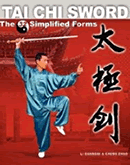
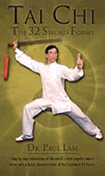
Learning the 32 Sword Form

Numbered lists, names, illustrations, pictures, books, DVDs, practice ...
all aides to memorizing.  


List of Standard 32 Movements Taijiquan Sword Form
One Page, 2007
By Mike Garofalo
Valley Spirit Taijiquan, Red Bluff, California


Taijiquan Standard 32 Double Edged Sword Form
Hypertext Document
By Mike Garofalo


I also practice the 32 Sword Form with my martial arts cane.  


Friday, October 11, 2019

Tai Chi Sword, 32 Form


This popular webpage includes a comprehensive bibliography, scores of links to webpages; an extensive listing of the names and name variations for each movement in English, Chinese, French, German, and Spanish; a detailed analysis of each posture and movement sequence with explanations and numbered illustrations and detailed instructions; selected quotations; comments on 20 Taijiquan sword techniques; a comprehensive media bibliography; a chart of performance times; recommendations for starting to learn this form at home one your own with instructional DVDs, books and practice methods; and, a comparison of the 32 and 55 sword forms in the Yang style. 

This is the standard, simplified, orthodox, 1957, 32 Taiji Sword Form, in the Yang Style of T'ai Chi Ch'uan. 

32 Sword Form Pamphlet by Geoffrey Hugh Miller.  Adapted from information and graphics found on the 32 Sword Form webpage by Michael P. Garofalo.  22 pages, 9/7/2015, PDF Format.  Excellent job by Mr. Miller.  This is a handy practice tool.  

Read about the Taoist magical sword finger hand sign:
"The sword finger hand sign is to draw your own magic power to the fingers and output a beam of energy for doing Taoist magic.  This beam of magical power isn’t just an imaginary thing, it’s a real visible beam if you can see it. Some of my students can see the beam of energy beams out like a long laser from the tip of the finger and extend all the way to the wall or somewhere far away. The beam is a beam a the magic power from one doing the handsign. This beam of power can be used for drawing FUs in the air, killing evils, doing magic in magic battles, healing or even saving lives!  This is like a multi-usage tool, which can be a pen, a chisel, a phone, or even a drill, it all depends on how you use it and what adaptor you put on it to make it function differently. The most  commonly seen usage of this handsign in Tin Yat Lineage is by drawing Taoism FU in the air or on the incense. This allow you to “carve” the Taoism FU into the object or in the air to perform magic." 

The Wild Horse Jumps Over the Mountain Stream 


  "Mike, I wonder if you could give your thoughts on something.  For years I’ve been practicing 3. The Swallow Skims Across the Water with the left hand moving in a similar fashion to 5. Block and Sweep to the Left i.e. the little finger side of the hand brushing the left hip before raising above the head.  I’ve recently got a book by Li Deyin which has his daughter Faye Yip performing it slightly differently.  She points her fingers backwards with the back of the hand brushing the hip and mentions it in the essential points for the movement.  Looking at videos on the internet they all seem to be similar to Faye Yip.  Would you mind if I asked how you practice?"
-  A question from Simon Ellis, UK, 9/2/2015


Simon, I have found that the details of bodily positions for any Taijiquan movement vary somewhat according to the following standards:

1.  Competition standards.  If you are preparing to compete in a Taijiquan event, then carefully study the standards for the forms you are performing.  In the case of the 32 sword form, check out books and DVDs by Li Deyin or his heirs.

2.  Your teacher's standards.  If you are working closely with a Taijiquan teacher, then follow their instructions.  This simplifies your learning, and shows respect for the teacher.  Since I learned the 32 sword from the instructional DVD by Dr. Paul Lam, I practice this form in a manner fairly close to his instructions.  

3.  Your personal standards.  If you have been practicing for many years, mostly alone, then more variations in bodily positions will likely emerge.  Sensibly, as we age, we make adaptations in our Taijiquan form work to safely accommodate our declining physical abilities.

As for how I practice, I'm rather unconcerned about details, a bit careless, playful, free, and seldom do things exactly the same way.  I just like skimming across the water, and leave the details about how to flap my wings to others.  Call me a lazy dilettante Daoist, with a penchant for ziran.  I don't often practice with a sword or saber anymore─ I only wield my sturdy cane.  

As I recall, the front of my left hand crosses my waist while going to 3c; and, more important, I still make that magical Taoist sword finger hand sign with my left hand while doing this form.

I think that modeling your performance on the standards set by Master Faye Yip's 32 Sword form instructions and demonstration would result in much grace, improved strength, and a beautiful style.  
Best wishes!  Mike.  9/8/2015 


Friday, May 11, 2018

Tao Te Ching, Chapter 21

Daodejing, Laozi
Chapter 21


"A virtuous person comes into being only according to the Tao.
Tao is something which is obscure and indistinct.
Indistinct and obscure —
yet there is an appearance.
Obscure and indistinct —
yet there is a substance.
Vague and dim —
yet there is an essence within it.
This essence is genuine.
There is truth within it.
Since ancient times until now, its name never forsaken,
it stands there to guard all the good deeds.
How do I know all the good deeds are guarded by this Tao?
I know.
-  Translated by Chao-Hsiu Chen, 2004, Chapter 21  


"The grandest aspects of producing force
Find Tao their energizing way and source;
In Tao things move unseen, impalpable,
Yet in it form and semblance brood and dwell;
Impalpable, invisible, yet things
Float forth within on transcendental wings;
Dark and profound, yet lo! within it there,
Are the pure essences which aeons bear;
It holds the truth, it keeps its ancient name,
And watches all that from the beginning came;
From the Beginning! How know I this is so?
By this, it is the Tao, by this I know!"
-  Translated by Isaac Winter Heysinger, 1903, Chapter 21


"The impression made by magnificent Te comes only from Tao.
Tao is a something but elusive, but evasive.
Evasive, elusive, inside it lies the mind's true form.
Elusive, evasive, inside it lies something substantial.
Shadowy, dim.
Inside it lies vital energy.
This energy is very strong inside it lies true genuineness.
From ancient times until today
Its name has not been forgotten allowing us to see the beginnings of everything.
How do I recognize the form of the beginnings of everything?
By this low in the cycle of Change, which is Love and Beauty.
How do I know this?
By my comprehension of the Dao."
-  Translated by Michael LaFargue, 1992, Chapter 21  


"The complete manifestation of things visible proceeds only from Life.
In its nature Life is always coming into activity, yet in itself it eludes our sight and tough.
Eluding sight! eluding touch!
Within it are hid the plane of created things.
Eluding touch! eluding sight!
Within it are hid all created beings.
It is profound! It is obscure!
Within it is hid pure Spirit.
It is pure Spirit, enfolding Truth!
Within it is hid an infallible witness.
Free of Old until Now
Its Name remains unchanged.
Through its Doorway comes the Universe into existence.
How do I know that the Universe is coming to full perfection through Life?
The witness is in Life itself."
-  Translated by Isabella Mears, 1916, Chapter 21 


孔德之容, 唯道是從.
道之為物, 唯恍唯惚.
惚兮恍兮, 其中有象.
恍兮忽兮, 其中有物.
窈兮冥兮, 其中有精.
其精甚,  其中有信.
自古及今其名不去.
以閱衆甫.
吾何以知衆甫之狀哉.
以此.

-  Chinese characters, Tao Te Ching, Chapter 21


k'ung tê chih jung, wei tao shih ts'ung.
tao chih wei wu, wei huang wei hu.
hu hsi huang hsi, ch'i chung yu hsiang.
huang hsi hu hsi, ch'i chung yu wu.
yao hsi ming hsi, ch'i chung yu ching.
ch'i ching shên, chên ch'i chung yu hsin. 
tzu ku chi chin ch'i ming pu ch'ü.
yi yüeh chung fu.
wu ho yi chih chung fu chih jan tsai.
yi tz'u.
-  Wade-Giles Romanization, Tao Te Ching, Chapter 21


"The great virtue as manifested is but following the Tao.
Tao is a thing that is both invisible and intangible.
Intangible and invisible, yet there are forms in it;
Invisible and intangible, yet there is substance to it;
Subtle and obscure, there is essence in it;
This essence being invariably true, there is faith in it.
From of old till now, it has never lost its nameless name,
Through which the origin of all things has passed.
How do I know it is so with the origin of all things?
By this Tao."
-  Translated by Ch'u Ta-Kao, 1904, Chapter 21 


"One of deep virtue cherishes the subtle essence of the universe.
 The subtle essence of the universe is elusive and evasive.
 Though it is elusive and evasive,
 it unveils itself as images and forms.
 Evasive and elusive,
 it discloses itself as indefinable substance.
 Shadowy and indistinct,
 it reveals itself as impalpable subtle essence.
 This essence is so subtle, and yet so real.
 It is the subtle origin of the whole of creation and non-creation.
 It existed prior to the beginning of time as the single deep and subtle reality of the universe.
 It brings all into being."
 -  Translated by Ni Hua Ching, 1995, Chapter 21


"La virtud se expresa siguiendo al Tao.
Tao es evasivo e intengible
Pero expresa toda forma y sustancia;
Tao es oscuro y sútil
Pero expresa toda la Naturaleza;
La Naturaleza no cambia,
Pero expresa toda sensación.
Desde antes del conocimiento
El Tao ha expresado todas las cosas.
¿Cómo puedo saber?
Confiando en mis sentidos."
-  Translated by Antonio Rivas, 1998, Chapter 21 


"In his every movement a man of great virtue
Follows the way and the way only.
As a thing the way is
Shadowy and indistinct.
Indistinct and shadowy,
Yet within it is an image;
Shadowy and indistinct,
Yet within it is a substance.
Dim and dark,
Yet within it is an essence.
This essence is quite genuine
And within it is something that can be tested.
From the present back to antiquity,
Its name never deserted it.
It serves as a means for inspecting the fathers of the multitude.
How do I know that the fathers of the multitude are like that?
By means of this."
-  Translated by D. C. Lau, 1963, Chapter 21  


"The mightiest manifestations of active force flow solely from Tao.
Tao in itself is vague, impalpable, how impalpable, how vague!
Yet within it there is Form.
How vague, how impalpable!
Yet within it there is Substance.
How profound, how obscure!
Yet within it there is a Vital Principle.
This principle is the Quintessence of Reality, and out of it comes Truth.
From of old until now, its name has never passed away.
It watches over the beginning of all things.
How do I know this about the beginning of things?
Through Tao."
-  Translated by Lionel Giles, 1905, Chapter 21 


"The features (yung) of the vast (k'ung) Te,
Follows entirely (wei) from Tao.
Tao as a thing,
Is entirely illusive (huang) and evasive (hu).
Evasive and illusive,
In it there is image (hsiang).
Illusive and evasive,
In it there is thinghood (wu).
Dark and dim,
In it there is life seed (ching).
Its life seed being very genuine (chen),
In it there is growth power (hsin).
As it is today, so it was in the days of old (ku),
Its name goes not away (ch'ü),
So that we may survey (yüeh) the origins of the many (chung fu).
How do I know that the origins of the many are such?
Because of this."
-  Translated by Ellen Marie Chen, 1989, Chapter 21


"For effective contrast, this chapter is best read together with chapter 14.  Both chapters call Tao, the illusive and evasive (hu-huang), i.e., the primal Chaos or Hun-tun described in chapter 25.  In chapter 14, Tao recedes and becomes the nothing; here in chapter 21 the same illusive and evasive Tao moves forward to become the realm of beings.  There Tao is nameless; here Tao is the name that never goes away.  There Tao is the formless form, the image of nothing; here Tao contains the seeds and images of all beings that are to be.  The dominant character of Tao in chapter 14 is wu, nothing; in this chapter it is yu, being or having.  The conclusion of chapter 14 traces Tao to the beginning of old; this chapter arrives at the realm of the many in the now."
-  Ellen M. Chen, The Tao Te Ching: A New Translation with Commentary, 1989, p.107


A typical webpage created by Mike Garofalo for each one of the 81 Chapters (Verses, Sections) of the Tao Te Ching (Daodejing) by Lao Tzu (Laozi) includes up to 25 different English language translations or interpolations for that Chapter, 5 Spanish language translations for that Chapter, the Chinese characters for that Chapter, the Wade-Giles and Hanyu Pinyin transliterations (Romanization) of the Mandarin Chinese words for that Chapter, and 2 German and 1 French translation of that Chapter.  Each webpage for each one of the 81 Chapters of the Tao Te Ching includes extensive indexing by key words, phrases, and terms for that Chapter in English, Spanish, and the Wade-Giles Romanization.  Each webpage on a Chapter of the Daodejing includes recommended reading in books and websites, a detailed bibliography, some commentary, research leads, translation sources, a Google Translate drop down menu, and other resources for that Chapter.   

Chapter 22, Tao Te Ching by Lao Tzu


Chapter and Thematic Index (Concordance) to the Tao Te Ching by Lao Tzu

English Language Daodejing Translators' Source Index

Spanish Language Daodejing Translators' Source Index

Ripening Peaches: Taoist Studies and Practices


Taoism: A Selected Reading List