Showing posts with label Yang 108. Show all posts

Thursday, March 26, 2026

Yang Style Tai Chi Chuan 108 Form, Third Section

 For Tai Chi Chuan players:

I often take a section of a long Taijiquan form and restudy and carefully practice only that section many times. I look up that section in books to learn more from master teachers. I also use instructional DVDs and UTube for sectional reviews. Smaller bites assists with better chewing and digestion.

I use the fine books by Fu Zhongwen, Li Deyin, T.T. Liang/Stuart Olson, and Gordon Muir for review. All have photographs or line illustrations of the movements and much commentary.

Here are some UTube demonstrations of the Third Section (Movements 56-108) of the Traditional Long Form of Yang Style Tai Chi Chuan:


Third Section,  Movements 55-108,  List of Movements


Third Section List ,  Movements 55-108,  Yang Long Form 108 

    Provides a list with the number of the movement and the name of movement.  In the PDF format (print only), 1 page, 26Kb.


Third Section List,  Part I,  Movements 56 - 82,  Yang Long Form 108
   

    Provides a list with the number of the movement, the direction one is facing at the end of that movement, the name of the movement, and a brief description or notes about the movement.  In the PDF format (print only), 1 page, 65Kb.  In the HTML format provided below in this document.  


Third Section List,  Part II,  Movements 83 - 108,  Yang Long Form 108.   

    Provides a list with the number of the movement, the direction one is facing at the end of that movement, the name of the movement, and a brief description or notes about the movement.  In the PDF format (print only), 1 page, 63Kb.  In the HTML format provided below in this document.  


Comparison of 108 Long Yang with 88 Long Yang - Chart

Sunday, March 22, 2026

Yang Style Taijiquan Long Form Section I

 Yang Style Taijiquan Long Form Section I

First Section,  Movements 1-17,  List of Movements


First Section List,  Movements 1-17,  Yang Long Form 108   

    Provides a list with the number of the movement and the name of movement. In the PDF format (print only), 1 page, 16Kb.  


First Section List,  Part I,  Movements 1 - 17,  Yang Long Form 108 

    Provides a list with the number of the movement, the direction one is facing at the end of that movement, the name of the movement, and a brief description or notes about the movement.  In the PDF format (print only), 1 page, 48Kb. 


Saturday, January 04, 2025

Standard Taijiquan 32 Sword Form


This popular webpage includes a comprehensive bibliography, scores of links to webpages; an extensive listing of the names and name variations for each movement in English, Chinese, French, German, and Spanish; a detailed analysis of each posture and movement sequence with explanations and numbered illustrations and detailed instructions; selected quotations; comments on 20 Taijiquan sword techniques; a comprehensive media bibliography; a chart of performance times; recommendations for starting to learn this form at home one your own with instructional DVDs, books and practice methods; and, a comparison of the 32 and 55 sword forms in the Yang style. 

This is the standard, simplified, orthodox, 1957, 32 Taiji Sword Form, in the Yang Style of T'ai Chi Ch'uan. 

32 Sword Form Pamphlet by Geoffrey Hugh Miller.  Adapted from information and graphics found on the 32 Sword Form webpage by Michael P. Garofalo.  22 pages, 9/7/2015, PDF Format.  Excellent job by Mr. Miller.  This is a handy practice tool.  

Read about the Taoist magical sword finger hand sign:
"The sword finger hand sign is to draw your own magic power to the fingers and output a beam of energy for doing Taoist magic.  This beam of magical power isn’t just an imaginary thing, it’s a real visible beam if you can see it. Some of my students can see the beam of energy beams out like a long laser from the tip of the finger and extend all the way to the wall or somewhere far away. The beam is a beam a the magic power from one doing the handsign. This beam of power can be used for drawing FUs in the air, killing evils, doing magic in magic battles, healing or even saving lives!  This is like a multi-usage tool, which can be a pen, a chisel, a phone, or even a drill, it all depends on how you use it and what adaptor you put on it to make it function differently. The most commonly seen usage of this handsign in Tin Yat Lineage is by drawing Taoism FU in the air or on the incense. This allow you to “carve” the Taoism FU into the object or in the air to perform magic." 

The Wild Horse Jumps Over the Mountain Stream 


  "Mike, I wonder if you could give your thoughts on something.  For years I’ve been practicing 3. The Swallow Skims Across the Water with the left hand moving in a similar fashion to 5. Block and Sweep to the Left i.e. the little finger side of the hand brushing the left hip before raising above the head.  I’ve recently got a book by Li Deyin which has his daughter Faye Yip performing it slightly differently.  She points her fingers backwards with the back of the hand brushing the hip and mentions it in the essential points for the movement.  Looking at videos on the internet they all seem to be similar to Faye Yip.  Would you mind if I asked how you practice?"
-  A question from Simon Ellis, UK, 9/2/2015


Simon, I have found that the details of bodily positions for any Taijiquan movement vary somewhat according to the following standards: 

1.  Competition standards.  If you are preparing to compete in a Taijiquan event, then carefully study the standards for the forms you are performing.  In the case of the 32 sword form, check out books and DVDs by Li Deyin or his heirs. 
2.  Your teacher's standards.  If you are working closely with a Taijiquan teacher, then follow their instructions.  This simplifies your learning, and shows respect for the teacher.  Since I learned the 32 sword from Dr. Paul Lam, I practice this form in a manner fairly close to his instructions.   
3.  Your personal standards.  If you have been practicing for many years, mostly alone, then more variations in bodily positions will likely emerge.  Sensibly, as we age, we make adaptations in our Taijiquan form work to safely accommodate our declining physical abilities. 

As for how I practice, I'm rather unconcerned about details, a bit careless, playful, free, and seldom do things exactly the same way.  I just like skimming across the water, and leave the details about how to flap my wings to others.  Call me a lazy dilettante Daoist, with a penchant for ziran.  I don't even practice with a sword or saber anymore─ I only wield my sturdy cane.  As I recall, the front of my left hand crosses my waist while going to 3c; and, more important, I still make that magical Taoist sword finger hand sign with my left hand while doing this form. 

I think that modeling your performance on the standards set by Master Faye Yip's 32 Sword form instructions and demonstration would result in much grace, improved strength, and a beautiful style.   
Best wishes!  Mike.  9/8/2015 


Tuesday, November 28, 2023

Yang Taijiquan Long Form Third Section

For Tai Chi Chuan players: I often take a section of a long Taijiquan form and restudy and carefully practice only that section many times. I look up that section in books to learn more from master teachers. I also use instructional DVDs and UTube for sectional reviews. Smaller bites assists with better chewing and digestion.

I use the fine books by Fu Zhongwen, Li Deyin, T.T. Liang/Stuart Olson, and Gordon Muir for review. All have photographs or line illustrations of the movements and much commentary.

Here are some UTube demonstrations of the Third Section (Movements 56-108) of the Traditional Long Form of Yang Style Tai Chi Chuan:


Third Section,  Movements 55-108,  List of Movements


Third Section List ,  Movements 55-108,  Yang Long Form 108 

    Provides a list with the number of the movement and the name of movement.  In the PDF format (print only), 1 page, 26Kb.


Third Section List,  Part I,  Movements 56 - 82,  Yang Long Form 108
   

    Provides a list with the number of the movement, the direction one is facing at the end of that movement, the name of the movement, and a brief description or notes about the movement.  In the PDF format (print only), 1 page, 65Kb.  In the HTML format provided below in this document.  


Third Section List,  Part II,  Movements 83 - 108,  Yang Long Form 108.   

    Provides a list with the number of the movement, the direction one is facing at the end of that movement, the name of the movement, and a brief description or notes about the movement.  In the PDF format (print only), 1 page, 63Kb.  In the HTML format provided below in this document.  


Comparison of 108 Long Yang with 88 Long Yang - Chart

Saturday, November 25, 2023

Yang Style Tai Chi Chuan 108 Long Form


Yang Family Style Tai Chi Chuan Traditional 108 Long Form
By Michael P. Garofalo.

This webpage provides a list and brief description of the 108 movements of the Yang Style Taijiquan Long Form divided into five sections for teaching (.html and .pdf versions available). The webpage includes an extensive bibliography on the subject, scores of Internet links, historical notes, and quotations. 


The Yang Long Form discussed on this webpage conforms to the form developed by Yang Cheng-Fu (1883-1936) and documented in books by Bu Fu Zongwen (1903-1994) and Yang Zhenduo. The numbering of the movements varies from author to author, but the essential sequence and moves remains the same.

Doing some research on the Yang style of T'ai Chi Ch'uan (85 and 24). Two books have caught me eye:

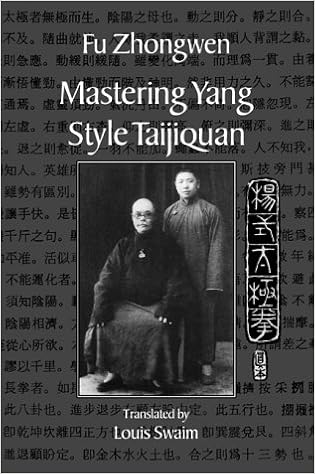
Mastering Yang Style Taijiquan.  Bu Fu Zongwen (1903-1994).  Translated by Louis Swaim.  Berkeley, California, North Atlantic Books, 1999.  Glossary, bibliography, 226 pages.  Translations of many Tai Chi classics are included.  A list of the 85 movement long form and detailed notes and descriptions of each movement are provided.  251 movement analysis illustrations.  Over 76 of the illustrations are traced and drawn from photographs of Yang Cheng-Fu.  Detailed descriptions of the long form, pp. 26-162.  Push hands information.  Yang Tai Chi essentials.  ISBN: 1556433182.  I have found this to be an excellent book!  This book was first published in 1963 in China as "Yang Shi Taijiquan".  An informative introduction and good translation by Louis Swaim.  VSCL.    

Taijiquan.  By Li Deyin.  London, Singing Dragon, 2004, 2008.  In English.  402 pages.  ISBN: 9781848190047, 1848190042.  Includes a complimentary DVD.  Includes descriptions, with photographs, of the 81 Yang Taijiquan form, Simplified 24 Taijiquan, Competition 42 Taijiquan, Competition 42 Taiji Sword, and the 32 Taiji Sword.  The Yang long form (81 Steps) includes photographs of Li Yulin performing the Yang long form in 1931.  Li Yulin and Li Jinglin, under the supervision of Yang Chengfu, were preparing a book on the subject later published under the title "Textbook of Taijiquan."  The 81 form is described in detail in this new book by Li Deyin.  


Yang Style Traditional Long Form T'ai Chi Ch'uan; As Taught by Master T. T. Liang.  By Gordon Muir.  Berkeley, California, Blue Snake Books, 2008.  225 pages.  150 numbered postures.  VSCL. 


Saturday, January 28, 2023

Yang Style Tai Chi Chuan Long 108 Form


Yang Family Style Tai Chi Chuan Traditional Long Form
By Michael P. Garofalo.

This webpage provides a list and brief description of the 108 movements of the Yang Style Taijiquan Long Form divided into five sections for teaching (.html and .pdf versions available). The webpage includes an extensive bibliography on the subject, scores of Internet links, historical notes, and quotations. 


The Yang Long Form discussed on this webpage conforms to the form developed by Yang Cheng-Fu (1883-1936) and documented in books by Bu Fu Zongwen (1903-1994) and Yang Zhenduo. The numbering of the movements varies from author to author, but the essential sequence and moves remains the same.

Doing some research on the Yang style of T'ai Chi Ch'uan (85 and 24). Two books have caught me eye:

Mastering Yang Style Taijiquan.  Bu Fu Zongwen (1903-1994).  Translated by Louis Swaim.  Berkeley, California, North Atlantic Books, 1999.  Glossary, bibliography, 226 pages.  Translations of many Tai Chi classics are included.  A list of the 85 movement long form and detailed notes and descriptions of each movement are provided.  251 movement analysis illustrations.  Over 76 of the illustrations are traced and drawn from photographs of Yang Cheng-Fu.  Detailed descriptions of the long form, pp. 26-162.  Push hands information.  Yang Tai Chi essentials.  ISBN: 1556433182.  I have found this to be an excellent book!  This book was first published in 1963 in China as "Yang Shi Taijiquan".  An informative introduction and good translation by Louis Swaim.  VSCL.    

Taijiquan.  By Li Deyin.  London, Singing Dragon, 2004, 2008.  In English.  402 pages.  ISBN: 9781848190047, 1848190042.  Includes a complimentary DVD.  Includes descriptions, with photographs, of the 81 Yang Taijiquan form, Simplified 24 Taijiquan, Competition 42 Taijiquan, Competition 42 Taiji Sword, and the 32 Taiji Sword.  The Yang long form (81 Steps) includes photographs of Li Yulin performing the Yang long form in 1931.  Li Yulin and Li Jinglin, under the supervision of Yang Chengfu, were preparing a book on the subject later published under the title "Textbook of Taijiquan."  The 81 form is described in detail in this new book by Li Deyin.  


Saturday, June 11, 2022

Yang Style Tai Chi Chuan - Third Section

A Repost form 2020!

Yesterday, because of wildfire smoke and ashes and low clouds in Vancouver, WA, the visibility out my front door was less than 100 feet.  The hazardous air quality was dangerous to anyone's health.  I practiced my Tai Chi Chuan and Qigong indoors, in a 20’x6” area.  This is sufficient space to practice the Yang Style Taijiquan Long 108 and Short 24 forms, and any qigong form.  

The practice of Tai Chi Chuan or Chi Kung can be done indoors or outdoors.  The only equipment needed is your body. 

I move a little furniture and practice indoors quite often.    

These are wonderful movement arts for better health.  Try them yourself!

Currently, I am reviewing the 3rd Section of the Yang Taijiquan Long 108 Form.  


Hypertext Notebooks by Michael Garofalo:

Grandmaster Yang Chen Fu's Taijiquan 94 Movements Long Form  1920's

List of All the Movements in Third Section of Yang Style Long Form  1 page

Third Section, Part 1, List of Movements and brief instructions  1 page

Third Section, Part 2, List of Movements and brief instructions  1 page 

Cloud Hands Tai Chi Chuan Website


Wednesday, April 28, 2021

Tai Chi Chuan Class in Vancouver, Clark County, Washington

Tai Chi Classes in 2021-2022

Would anyone like to study and learn with me, for free,
the Chen Taijiquan Lao Jia Yi Lu, First Form?
We would use the instructional DVD by Master Ken Gullette as our teacher.


The Yang Style of T'ai Chi Ch'uan

Instructor:  Mike Garofalo, M.S.   

In Vancouver, Clark County, Washington, USA

Contact Mike by Email (gwr2013a@gmail.com) or Phone: 530-200-3546

 
Practicing and teaching the Yang Style of Tai Chi Chuan 
The Standard
Long 108 Movements Yang Taijiquan Form,
The Short 24 Movements Yang Taijiquan Form,
Cane Drills,

Website:  Cloud Hands Tai Chi Chuan     Blog:  Cloud Hands Blog

  Qigong

Instructor 
Michael P. Garofalo

M.S., B.A. Philosophy

I began learning Yang Style Taijiquan and Qigong in 1986, and have taught 
Taijiquan and Qigong since 2000.  I also taught Hatha and Vinyasa
Yoga from 2003-2016. 

All of my Yoga and T'ai Chi Ch'uan Classes Include Some Qigong (Chinese Yoga) Practices


 In 2021, I am 75 years of age.


I began learning Yang Style Taijiquan and Qigong from 1986-1990 with Sensei Frank McGourick in Whittier, California.
I studied Lui Ho Ba Fa and Qigong with Sifu Robert Moore from 1987-1990 in Whittier, California.
I studied Red Dragon Kung Fu from 1991-1993 with Sensei Tony Ippolito in Hacienda Heights, California.

I taught over 950 one hour classes of Taijiquan and Qigong in Red Bluff, California, from 2000-2017. 
I also practice the
Chen 18 Style of Taijiquan and Sun 73 Style of Taijiquan, the cane weapon, and many Qigong forms. 

Tai Chi for Diabetes Instructor Trained and Certified by Dr. Paul Lam in 2003. 
Tai Chi for Arthritis Level 2 Instructor (Sun Style) Trained and Certified by Troyce Thome in 2006
Advanced Tai Chi and Qigong training at workshops or classes led by Robert Moore, Paul Lam, Ken Cohen, Yang Jun, Patricia Long, George Xu, Elaine Waters, Bill Helm, Doc Fai-Wong, Sher K. Lew, Kevin Weaver, Troyce Thome, Brian Knack, and Ken Gullette.

I taught Hatha and Vinyasa Yoga in Red Bluff from 2003 to 2016 for over 1,460 hours of one hour classes. 
YogaFit® Level IV Certified Yoga Instructor (Standard 200 Hour Yoga Alliance Curriculum Completed) in 2004
Over 100 hours of additional yoga training with Dr. Paula Barros, Desiree Rambaugh, and at the Ananda Yoga Center.
All of my Yoga Classes Include Some Qigong (Chinese Yoga) Practices

Personal Fitness Trainer Certified by AFAA 2007
Mat Pilates AFAA Certified 2005
Spin Cycling AFAA Certified 2005
Aerobics and Fitness Association of America (AFAA) Certifications
SilverSneakers® Trained Instructor 2012
CPR and AED certified from 1999-2017. 

Emergency 30-Day Substitute Teaching Permit, 4/1999 - 4/2017
Certified by the State of California Commission on Teacher Credentialing
M.A. Education, 40 units, CSU Chico; M.A., Philosophy, 30 units at CSU Los Angeles. 
M.S., Library and Information Science, University of Southern California, 1968
B.A. Philosophy, CSU Los Angeles, 1967 
  

Brief Biography


Monday, September 07, 2020

Yang Style Taijiquan - Second Section

The practice of Tai Chi Chuan or Chi Kung can be done indoors or outdoors.  The only equipment needed is your body. 

I move a little furniture and practice indoors quite often.   Lately, I use commercial breaks on TV to practice the Yang Style of Tai Chi Chuan, Section Two.  

These are wonderful movement arts for better health.  Try them yourself!


Hypertext Notebooks by Michael Garofalo:

Grandmaster Yang Chen Fu's Taijiquan 94 Movements Long Form  1920's

List of Movements in Second Section of Yang Style Long Form  (1 page)

Second Section, Part 1, List of Movements and brief instructions

Second Section, Part 2, List of Movements and brief instructions 

Cloud Hands Tai Chi Chuan Website


Monday, June 08, 2020

Tai Chi Chuan - Yang Long Form

Yang Family Style Tai Chi Chuan Traditional Long Form
By Michael P. Garofalo.
This webpage provides a list and brief descriptions of the 108 movements of the Yang Style Taijiquan Long Form divided into five sections for teaching (.html and .pdf versions available). The webpage includes an extensive bibliography on the subject, scores of Internet links, historical notes, and quotations. 

The Yang Long Form discussed on this webpage conforms to the form developed by Yang Cheng-Fu (1883-1936) and documented in books by Bu Fu Zongwen (1903-1994) and Yang Zhenduo. The numbering of the movements varies from author to author, but the essential sequence and moves remains the same.

Mastering Yang Style Taijiquan.  Bu Fu Zongwen (1903-1994).  Translated by Louis Swaim.  Berkeley, California, North Atlantic Books, 1999.  Glossary, bibliography, 226 pages.  Translations of many Tai Chi classics are included.  A list of the 85 movement long form and detailed notes and descriptions of each movement are provided.  251 movement analysis illustrations.  Over 76 of the illustrations are traced and drawn from photographs of Yang Cheng-Fu.  Detailed descriptions of the long form, pp. 26-162.  Push hands information.  Yang Tai Chi essentials.  ISBN: 1556433182.  I have found this to be an excellent book!  This book was first published in 1963 in China as "Yang Shi Taijiquan".  An informative introduction and good translation by Louis Swaim.  VSCL.    


Monday, January 09, 2017

Yang Style of Taijiquan

Yang Family Style Tai Chi Chuan Traditional Long Form
By Michael P. Garofalo.
This webpage provides a list and brief descriptions of the 108 movements of the Yang Style Taijiquan Long Form divided into five sections for teaching (.html and .pdf versions available). The webpage includes an extensive bibliography on the subject, scores of Internet links, historical notes, and quotations. 

The Yang Long Form discussed on this webpage conforms to the form developed by Yang Cheng-Fu (1883-1936) and documented in books by Bu Fu Zongwen (1903-1994) and Yang Zhenduo. The numbering of the movements varies from author to author, but the essential sequence and moves remains the same.

Mastering Yang Style Taijiquan.  Bu Fu Zongwen (1903-1994).  Translated by Louis Swaim.  Berkeley, California, North Atlantic Books, 1999.  Glossary, bibliography, 226 pages.  Translations of many Tai Chi classics are included.  A list of the 85 movement long form and detailed notes and descriptions of each movement are provided.  251 movement analysis illustrations.  Over 76 of the illustrations are traced and drawn from photographs of Yang Cheng-Fu.  Detailed descriptions of the long form, pp. 26-162.  Push hands information.  Yang Tai Chi essentials.  ISBN: 1556433182.  I have found this to be an excellent book!  This book was first published in 1963 in China as "Yang Shi Taijiquan".  An informative introduction and good translation by Louis Swaim.  VSCL.    


Sunday, November 06, 2016

Yang Style Tai Chi Chuan Principles

"1.) Head upright to let the shen [spirit of vitality] rise to the top of the head. Don't use li [external strength], or the neck will be stiff and the ch'i [vital life energy] and blood cannot flow through. It is necessary to have a natural and lively feeling. If the spirit cannot reach the headtop, it cannot raise.

2.) Sink the chest and pluck up the back. The chest is depressed naturally inward so that the ch'i can sink to the tan-t'ien [field of elixir]. Don't expand the chest: the ch'i gets stuck there and the body becomes top-heavy. The heel will be too light and can be uprooted. Pluck up the back and the ch'i sticks to the back; depress the chest and you can pluck up the back. Then you can discharge force through the spine. You will be a peerless boxer.

3.) Sung [Relax] the waist. The waist is the commander of the whole body. If you can sung the waist, then the two legs will have power and the lower part will be firm and stable. Substantial and insubstantial change, and this is based on the turning of the waist. It is said "the source of the postures lies in the waist. If you cannot get power, seek the defect in the legs and waist."

4.) Differentiate between insubstantial and substantial. This is the first principle in T'ai Chi Ch'uan. If the weight of the whole body is resting on the right leg, then the right leg is substantial and the left leg is insubstantial, and vice versa. When you can separate substantial and insubstantial, you can turn lightly without using strength. If you cannot separate, the step is heavy and slow. The stance is not firm and can be easily thrown of balance.

5.) Sink the shoulders and drop the elbows. The shoulders will be completely relaxed and open. If you cannot relax and sink, the two shoulders will be raised up and tense. The ch'i will follow them up and the whole body cannot get power. "Drop the elbows" means the elbows go down and relax. If the elbows raise, the shoulders are not able to sink and you cannot discharge people far. The discharge will then be close to the broken force of the external schools.

6.) Use the mind instead of force. The T'ai Chi Ch'uan Classics say, "all of this means use I [mind-intent] and not li." In practicing T'ai Chi Ch'uan the whole body relaxes. Don't let one ounce of force remain in the blood vessels, bones, and ligaments to tie yourself up. Then you can be agile and able to change. You will be able to turn freely and easily. Doubting this, how can you increase your power?

The body has meridians like the ground has ditches and trenches. If not obstructed the water can flow. If the meridian is not closed, the ch'i goes through. If the whole body has hard force and it fills up the meridians, the ch'i and the blood stop and the turning is not smooth and agile. Just pull one hair and the whole body is off-balance. If you use I, and not li, then the I goes to a place in the body and the ch'i follows it. The ch'i and the blood circulate. If you do this every day and never stop, after a long time you will have nei chin [real internal strength]. 

The T'ai Chi Ch'uan Classics say, "when you are extremely soft, you become extremely hard and strong." Someone who has extremely good T'ai Chi Ch'uan kung fu has arms like iron wrapped with cotton and the weight is very heavy. As for the external schools, when they use li, they reveal li. When they don't use li, they are too light and floating. There chin is external and locked together. The li of the external schools is easily led and moved, and not too be esteemed.

7.) Coordinate the upper and lower parts of the body. The T'ai Chi Ch'uan Classics say "the motion should be rooted in the feet, released through the legs, controlled by the waist and manifested through the fingers." Everything acts simultaneously. When the hand, waist and foot move together, the eyes follow. If one part doesn't follow, the whole body is disordered.

8.) Harmonize the internal and external. In the practice of T'ai Chi Ch'uan the main thing is the shen. Therefore it is said "the spirit is the commander and the body is subordinate." If you can raise the spirit, then the movements will naturally be agile. The postures are not beyond insubstantial and substantial, opening and closing. That which is called open means not only the hands and feet are open, but the mind is also open. That which is called closed means not only the hands and feet are closed, but the mind is also closed. When you can make the inside and outside become one, then it becomes complete.

9.) Move with continuity. As to the external schools, their chin is the Latter Heaven brute chin. Therefore it is finite. There are connections and breaks. During the breaks the old force is exhausted and the new force has not yet been born. At these moments it is very easy for others to take advantage. T'ai Chi Ch'uan uses I and not li. From beginning to end it is continuous and not broken. It is circular and again resumes. It revolves and has no limits. The original Classics say it is "like a great river rolling on unceasingly." and that the circulation of the chin is "drawing silk from a cocoon " They all talk about being connected together.

10.) Move with tranquility [Seek stillness in movement]. The external schools assume jumping about is good and they use all their energy. That is why after practice everyone pants. T'ai Chi Ch'uan uses stillness to control movement. Although one moves, there is also stillness. Therefore in practicing the form, slower is better. If it is slow, the inhalation and exhalation are long and deep and the ch'i sinks to the tan-t'ien. Naturally there is no injurious practice such as engorgement of the blood vessels. The learner should be careful to comprehend it. Then you will get the real meaning."

-  By Yang Cheng-fu (1883 - 1936) as researched by Lee N. Scheele


 T'ai Chi Ch'uan Bibliography

Yang Style Taijiquan

Mastering Yang Style Taijiquan  By Fu Zhongwen.  Translated by Louis Swaim.  Berkeley, California, Blue Snake Books, c 1999, 2006.  Bibliography, glossary, 226 pages.  ISBN: 9781583941522.  VSCL.  Fu Zongwen (1919-1994) was a student of Yang Cheng Fu.  Translations of many Tai Chi classics are included.  A list of 85 movements are provided.  251 movement analysis illustrations.  Over 76 of the illustrations are traced and drawn from photographs of Yang Chengfu.  Detailed descriptions of the long form, pp. 26-162.  Push hands information.  Yang Tai Chi essentials.


Master Cheng's Thirteen Chapters On Tai Chi Ch'uan. By Cheng Man-ch'ing. Translated by Douglas Wile. 101 pages. Sweet Chi Press, 1982. 101 pages. ISBN: 978-0912059006. Originally written in Chinese in 1949. VSCL.


The Essence and Applications of Taijiquan. By Yang, Chengfu (1883-1936). Translated by Louis Swaim. The original publication date was in 1934. The original book was edited by Professor Cheng Man-Chi'ng. Berkeley, California, North Atlantic Books, 2005. Introduction, appendices, bibliography, 124 pages. ISBN: 1556435452. In this book, the entire sequence of the specialized and named martial movements/postures/sections/forms is numbered from Section 1 up to Section 94; thus, the popular long taijiquan from, the Yang 94 Form. VSCL.