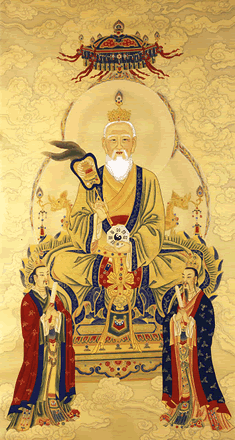
Showing posts with label Opening. Show all posts

Tuesday, April 28, 2026

Dao De Jing Chapter 16

Tao Te Ching by Lao Tzu
Chapter 16


"Attaining perfect emptiness
 Remain patient and sincere
 The myriad beings arise as one
 Through this we observe the return
 Of beings in numberless multitudes
 Each coming home to its root
 Return to the root means serenity
 It may be called a return to a higher order
 Return to higher order speaks of the enduring
 To comprehend the enduring speaks of clarity
 To not comprehend the enduring
 Is to recklessly create suffering
 To comprehend the enduring (is) tolerance
 Tolerance becomes justice
 Justice becomes sovereignty
 Sovereignty becomes celestial
 The celestial becomes the path
 The path is then continuous
 The death of self is nothing to fear"
 -  Translated by Bradford Hatcher, 2005, Chapter 16


"Bring about emptiness to the extreme.
Guard true stillness.
The ten-thousand things rise together.
I therefore observe their return:
Those ten-thousand plants—each plant—returns
Going back to its root.
Going back to the root is said to be stillness.
This is called returning to life.
Returning to life is called the Constant.
Understanding the Constant is called clarity.
Not understanding the Constant:
Reckless actions—misfortune.
Understanding the Constant, forgive.
Forgive, then be unbiased.
Be unbiased, then be whole.
Be whole, then be Heaven.
Be Heaven, then be Tao.
Be Tao, then be eternal.
Not having a body, there is no danger."
-  Translated by Aalar Fex, 2006, Chapter 16  


"Empty the self completely; Embrace perfect peace.
 Realize that all beings alike go through their processes of activity and life,
 and then they return to the original source.
 Returning to the source brings peacefulness and stillness.
 This stillness is the flow of nature, and signifies that the beings have lived their allotted span of life.
 Accepting this brings enlightenment and tranquility,
 ignoring this brings confusion and sorrow
 If one can accept this flow of nature; one can cherish all things.
 Being all-cherishing you become impartial;
 Being impartial you become magnanimous;
 Being magnanimous you become natural;
 Being natural you become one with The Way;
 Being one with The Way you become immortal:
 Though the body will decay, the Way will not."
 -  Translated by John Discus, 2002, Chapter 16   


致虛極.
守靜篤.
萬物並作.
吾以觀復.
夫物芸芸, 各復歸其根.
歸根曰靜.
是謂復命.
復命曰常.
知常曰明.
不知常, 妄作凶知常容.
容乃公.
公乃王.
王乃天.
天乃道.
道乃久.
沒身不殆.
-  Chinese characters, Tao Te Ching, Chapter 16


zhi xu ji.
shou jing du.
wan wu bing zuo.
wu yi guan fu.
fu wu yun yun, ge fu gui qi gen.  
gui gen yue jing.
shi yue fu ming.
fu ming yue chang.
zhi chang yue ming.
bu zhi chang, wang zuo xiong zhi chang rong.
rong nai gong.
gong nai quan.
quan nai tian.
tian nai dao.
dao nai jiu.
mo shen bu dai.
-  Pinyin translation, Daodejing, Chapter 16 


"Effect emptiness to the extreme.
 Keep stillness whole.
 Myriad things act in concert.
 I therefore watch their return.
 All things flourish and each returns to its root.
 Returning to the root is called quietude.
 Quietude is called returning to life.
 Return to life is called constant.
 Knowing this constant is called illumination.
 Acting arbitrarily without knowing the constant is harmful.
 Knowing the constant is receptivity, which is impartial.
 Impartiality is kingship.
 Kingship is Heaven.
 Heaven is Tao
 Tao is eternal.
 Though you lose the body, you do not die."
 -  Translated by Charles Muller, 1891, Chapter 16


"Vacía tu Ego completamente;
Abraza la paz perfecta.
El Mundo se mueve y gira;
Observale regresar a la quietud.
Todas las cosas que florecen
Regresarán a su origen.

Este regreso es pacífico;
Es el camino de la Naturaleza,
Eternamente decayendo y renovandose.
Comprender ésto trae la iluminación,
Ignorar esto lleva a la miseria.

Aquel que comprende el camino de la Naturaleza llega a apreciarlo todo;
Apreciandolo todo, se convierte en imparcial;
Siendo imparcial, se convierte en magnánimo;
Siendo magnánimo, se convierte en parte de la Naturaleza;
Siendo parte de la Naturaleza, se hace uno con el Tao;
Siendo uno con el Tao, se alcanza la inmortalidad:
Piensa que el cuerpo perecerá, el Tao no."
-  Translated by Antonio Rivas Gonzálvez, 1998, Tao Te Ching, Capítulo 16


"To arrive at ultimate quietness
Steadfastly maintain repose.
All creatures together have form;
I see them return again to their root.
The Master creatures come to perfect form,
Continuously they return to their root.
Continuous return to the root is called repose,
Repose is called the law of return,
The law of return is called eternity.
To know eternity is called illumination.
To ignore eternity is to draw misfortune on oneself,
To know eternity is to be great of Soul,
To be great of soul is to be a ruler,
To be a ruler is to be greater than all,
To be greater than all is to be conscious of Life,
To be conscious of Life is to endure.
The body shall disappear but not decay."
-  Translated by Isabella Mears, 1916, Chapter 16  


Audio Recordings (Podcasts) in English by Mike Garofalo

Here is an audio recording of selected translations from Chapter 16 of the Tao Te Ching. This reading includes translations by Isabella Mears 1916, Charles Muller 1891, John Discus 2002, Bradford Hatcher 2005, Stephen Addis 1993.  Reading and recording by Michael P. Garofalo at the Valley Spirit Center in Red Bluff, California.  Recorded on December 5, 2016. MP3 format.  12.7 MB.    


A typical webpage created by Mike Garofalo for each one of the 81 Chapters (Verses, Sections) of the Tao Te Ching (Daodejing) by Lao Tzu (Laozi) includes 25 different English language translations or interpolations for that Chapter, 5 Spanish language translations for that Chapter, the Chinese characters for that Chapter, the Wade-Giles and Hanyu Pinyin transliterations (Romanization) of the Mandarin Chinese words for that Chapter, and 2 German and 1 French translation of that Chapter.  Each webpage for each one of the 81 Chapters of the Tao Te Ching includes extensive indexing by key words, phrases, and terms for that Chapter in English, Spanish, and the Wade-Giles Romanization.  Each webpage on a Chapter of the Daodejing includes recommended reading in books and websites, a detailed bibliography, some commentary, research leads, translation sources, a Google Translate drop down menu, and other resources for that Chapter.   

Chapter 16, Tao Te Ching by Lao Tzu


Chapter and Thematic Index (Concordance) to the Tao Te Ching by Lao Tzu


English Language Daodejing Translators' Source Index


Spanish Language Daodejing Translators' Source Index


Ripening Peaches: Taoist Studies and Practices


Taoism: A Selected Reading List


Tuesday, November 21, 2023

Tao Te Ching by Lao Tzu, Chapter 52

Dao De Jing by Laozi
Chapter 52

Returning to the Source, Great Mother, Soft and Small, Avoiding Misfortune, Study Origins, Humility, Listening, Seeds, Undying Nature, Examine Relationships,  歸元  


"All under Heaven has a generatrix, which we regard as the mother of all under Heaven.
Once one has access to the mother, through it he can know the child.
Once one knows the child, if he again holds on to the mother, as long as he lives, no danger shall befall him.
Block up your apertures; close your door,
And to the end of your life you will never be exhausted.
But if you open your apertures and deal consciously with things, to the end of your life you will never have relief.
To see the small is called "perspicacious."
To hold on to softness is called "strength."
Make use of its brightness,
But always let its brightness revert.
Never let one's person be exposed to disaster: this is a matter of practicing constancy."
-   Translation by Richard Lynn, Chapter 52 

"The world (t'ien hsia) has an origin (shih),
Which is the world's (t'ien hsia) mother (mu).
Having reached the mother,
(We) know her child.
Having known the child,
Return and abide by its mother.
(In this way) one loses the body without becoming exhausted.
Stop the apertures (tui),
Close the doors,
(In this way) one's whole life (shen) is without toil (ch'in).
Open the apertures,
Going about the affairs,
(In this way) one's whole life (shen) cannot be saved.
To see the small is called illumination (ming).
To abide by the soft is called strength.
Use the bright light (kuang),
But return to the dim light (ming),
Do not expose your life (shen) to perils,
Such is to follow (hsi) the everlasting (ch'ang)."
-   Translated by Ellen M. Chen, Chapter 52 

"If you trace problems in your relationship
back to the beginning
you will find their seeds
were sown and then ignored.
They grew unnoticed until their fruit
ripened and surprised you.
But if you can find
where the seeds were sown,
there you will find the roots as well.
And if you remove the roots
your problems will wither."
-   Translated by William Martin, Chapter 52

"When creation began, Tao became the world's mother.
When one knows one's mother he will m turn know that he is her son.
When he recognizes his sonship, he will in turn keep to his mother and to the end of life will be free from danger.
He who closes his mouth and shuts his sense gates will be free from trouble to the end of life.
He who opens his mouth and meddles with affairs cannot be free from trouble even to the end of life.
To recognize one's insignificance is called enlightenment.
To keep one's sympathy is called strength.
He who uses Tao's light returns to Tao's enlightenment and does not surrender his person to perdition.
This is called practicing the eternal."
-   Translation by Dwight Goddard, Chapter 52 

"The beginning of the universe, when materialized, is considered to be a mother.
When a man finds the mother, he will know the children, accordingly.
Even though he knows the children, he still clings to the mother:
Therefore, although his body wanes, he never perishes.
The person who shuts his mouth and closes his doors
Will never perish.
If he opens his mouth and increases his affairs,
He will never be saved.
The person who sees the tiniest thing possesses clear vision,
The person who adheres to the weak possesses strength.
Use your light, but dim your brightness,
In this way you will not do yourself any harm.
This is called following the eternal Tao."
-   Translated by Chou-Wing Chohan, Chapter 52 

"Everything begins with the Tao and ends with the Tao.
To know it retrace the steps of your life.
When you reach back to the beginning, the Tao lies herein.
Then you will realise there is no death.
Without desire your heart is at peace.
Without judgment your mind is clear.
See who it is that sees.
Witness thoughts come and go.
Turn the light around and find its source.
Practicing this leads to enlightenment."
-   Translated by David Bullen, Chapter 52 

"This world must have begun in certain way;
We may thenceforth consider it the origin (mother) of our world;
Once we manage to ascertain the origin, we could [apply it] to study its offsprings;
After we learn more about the offsprings, we may reciprocally eke out our knowledge about the mother (the origin);
This is my never-ending life-long quest.
If paths and openings of one's connections [to the outside world] are blocked, he will never be aroused to do anything in life;
If paths and openings of one's connections [to the outside world] are unlocked and he is properly motivated, he will never cease [from the quest described above].
One who perceives subtleties is brilliant;
One who maintains humility is strong.
One who would use [the light of Tao] to illuminate his [potential] brilliance will thus leave behind nothing that could cause misfortune to later generations.
A person, who achieves all of the above described fulfillment, is what I called the person with embodiment of the perpetual [Te]."
-   Translated by Lee Org, Chapter 52 

"The world had a beginning
And this beginning could be the mother of the world.
When you know the mother
Go on to know the child.
After you have known the child
Go back to holding fast to the mother,
And to the end of your days you will not meet with danger.
Block the openings,
Shut the doors,
And all your life you will not run dry.
Unblock the openings,
Add to your troubles,
And to the end of your days you will be beyond salvation.
To see the small is called discernment;
To hold fast to the submissive is called strength.
Use the light
But give up the discernment.
Bring not misfortune upon yourself.
This is known as following the constant."
-   Translation by D. C. Lau, Chapter 52 

“Realizing the interplay of the Tao way of life
and the virtue of nuturing all things under heaven
will introduce you to the primal mother
The mother of the world
resting peacefully with the mother
will introduce you to her sons and daughters
The sons and daughters of the world
these children can be exhausting
and though they mean no harm
trying to follow or control them
will only bring great danger to you
To be safe
rest peacefully with the mother
gently close your eyes
and look inward
softly direct your eyes
to listen within
lightly close your mouth
raise your tongue to its roof
and quietly savor the interior
gently lift your crown
sit firm with a relaxed hold
on your bodymind
and let her love
fill you up
you will never be empty
again
remember
chasing children
brings calamity
no matter
how hard
you try
to follow
or grasp them
the whole universe is in the palm
of your hand
but without
illumination
you cannot see it
the real world is not open
to the rational mind 
the ancient child asks
when you have rested sufficiently
in the arms of the primal mother
and you vision begins to clear
what occurs
it is an unexpected sense of making
that first arises within the bodymind 
then you are engulfed in a benevolent flame
that outlines rather than burns
and I do not know if I am
the source or the witness
the senses play
leaping to and fro
mischievously acting against their nature 
emotions of comfort and satisfaction swell
so that even the harshest rain
feels like a lover’s kiss
resting deeper
you fell as if an unseen enemy
has been vanquished
and life courses through you limbs
as the warrior’s belt collects you
the connection to the Tao source and way of life
becomes punctuated and definite
possessed of a wholly benevolent clarity 
language leaves you
and a light and sensitive energy collects at your
     crown
visions cascade upon you so rapidly
that it becomes impossible
to divide or discern
what we normally regard as real
death becomes impossible 
fire and force penetrate deeply
within you bodymind
and a new truth shapes you
into someone altogether different 
you begin to breathe
the Tao way of life
as true respiration
within a quickening
that shines out
for all to see  
spinning out of the quickening
you understand the mother’s children
you sing and dance
you paint and play
you look at the palm of your hand and 
you see 
you can still make mistakes
you can still be confused
you can still misstep
but you will always have the eyes of the Tao 
however
should you ever see yourself as separate from it 
you will cease
to see
altogether”
-  Translation and Interpretation by the Reverend Venerable John Bright-Fey, Chapter 52 

“All the universal things have a common origin.  We regard it as the “Mother” of all things. 
Gaining the mother, we can know its children,
Knowing how the children come into being, we can return to hold onto the mother.
Thus ensuring nor danger to life.
Closing the eyes and shutting up the mouth,
One can keep from sickness forever.
Opening the eyes to chase after desires and passions,
One can be helpless forever.
Watching less and less can be enlightened.
Holding onto the weak can be mighty.
Using the outgoing eyesight,
To turn to illuminate the inward,
Thus, there can be no disaster to the body.
This is called practicing enduring Tao.”
-   Translated by Hu Huezhi, Chapter 52


Chapter 50   The Value Set on Life, Value Life, Esteem Life, Become Invulnerable, Followers of Life, Accept Death, Esteem Life, Out of Harms Way,  貴生

Chapter 51   The Nourishment of the Tao, Virtue as a Nurse, Guiding, Creativity, Mystical Power, Freedom, Nature, Follow the Tao, Harmony, Honor Virtue,  養德 
 
Chapter 52   Returning to the Source, Great Mother, Soft and Small, Avoiding Misfortune, Study Origins, Humility, Listening, Seeds, Undying Nature, Examine Relationships,  歸元  

Chapter 53   Follow the Way, Avoid Shortcuts, Disadvantages of Wealth, Avoid Greed, Work, Be Diligent, Gaining Insight, Look at the Facts, Appearances, Thieves,  益証  

Chapter 54   Cultivating Insight and Intuition, Person, Family, Village, State, Cultivation, Views, Virtue, Observing the Tao, As Below So Above,  修觀   

Chapter 55   Mysterious Virtue, Sign of the Mysterious,  玄符  


Monday, August 16, 2021

Daodejing, Chapter 52

Tao Te Ching, by Lao Tzu

Chapter 52


"The beginning of the universe, when materialized, is considered to be a mother.
When a man finds the mother, he will know the children, accordingly.
Even though he knows the children, he still clings to the mother:
Therefore, although his body wanes, he never perishes.
The person who shuts his mouth and closes his doors
Will never perish.
If he opens his mouth and increases his affairs,
He will never be saved.
The person who sees the tiniest thing possesses clear vision,
The person who adheres to the weak possesses strength.
Use your light, but dim your brightness,
In this way you will not do yourself any harm.
This is called following the eternal Tao."
-   Translated by Chou-Wing Chohan, Chapter 52 


"The world has an origin.
The origin is the mother.
Knowing the mother, we know the son.
Knowing the son, we deduce the mother.
This way, we can be successful.
Plugging leakages,
Closing openings,
We can never be depleted.
Opening leakages,
Making too many commitments,
We can be hopeless.
Those who pay attention to details are wise.
Those who exercise flexibility are strong.
Use the light,
Things are illuminated.
Thus we can avoid mistakes.
This is called normal behavior."
-   Translated by Thomas Zhang, Chapter 52  


"If you trace problems in your relationship
back to the beginning
you will find their seeds
were sown and then ignored.
They grew unnoticed until their fruit
ripened and surprised you.
But if you can find
where the seeds were sown,
there you will find the roots as well.
And if you remove the roots
your problems will wither."
-   Translated by William Martin, Chapter 52


"That which was the beginning of all things under heaven
We may speak of as the “mother” of all things.
He who apprehends the mother
Thereby knows the sons.
And he who has known the sons,
Will hold all the tighter to the mother,
And to the end of his days suffer no harm;
“Block the passages, shut the doors,
And till the end your strength shall not fail.
Open up the passages, increase your doings,
And till your last day no help shall come to you.”
As good sight means seeing what is very small
So strength means holding on to what is weak.
He who having used the outer-light can return to the innerlight
Is thereby preserved from all harm.
This is called resorting to the always-so."
-   Translated by Arthur Waley, Chapter 52 


"This world must have begun in certain way;
We may thenceforth consider it the origin (mother) of our world;
Once we manage to ascertain the origin, we could [apply it] to study its offsprings;
After we learn more about the offsprings, we may reciprocally eke out our knowledge about the mother (the origin);
This is my never-ending life-long quest.
If paths and openings of one's connections [to the outside world] are blocked, he will never be aroused to do anything in life;
If paths and openings of one's connections [to the outside world] are unlocked and he is properly motivated, he will never cease [from the quest described above].
One who perceives subtleties is brilliant;
One who maintains humility is strong.
One who would use [the light of Tao] to illuminate his [potential] brilliance will thus leave behind nothing that could cause misfortune to later generations.
A person, who achieves all of the above described fulfillment, is what I called the person with embodiment of the perpetual [Te]."
-   Translated by Lee Org, Chapter 52 


Sunday, July 18, 2021

Tao Te Ching, Chapter 49, Verse 1, Translations


Daodejing by Laotzu
Chapter 49
Tao Te Ching by Lao Tzu
Chapter Order in Wang Bi's Daodejing Commentary in 246 CE

Translations into English of Chapter 49, Verse 1


The Wise Person has no Ego,
He identifies himself with the universe.

The Sage has no set heart.
Ordinary people's hearts
Become the Sage's heart.

The wise man has no fixed opinions to call his own.
He accommodates himself to the minds of others.

The sage has no mind of his own.
He takes the minds of the people as his own.

A wise ruler has no preconceived ideas,
He adopts the people's ideas as his own.

The sage has no mind of his own.
He is aware of the needs of others.

Sages never have a mind of their own;
they consider the minds of the common people to be their mind.

The sage has no mind of her own.
She is at one with all of humanity.

The Tao–Master does not have his heart set on anything in particular.
He wants to understand the hearts of the people.

The Sage is free of the law of fixed belief;
It reflects the heart of every seeker.

The Complete Thinker has no interests of their own,
But takes the interests of the people as their own.

The Sage is without a set mind.
He makes the mind of the people his own.

The Taoist has no opinions
He simply listens, and acts

The wise man has no fixed opinions to call his own.
He accommodates himself to the minds of others.

sheng ren wu chang xin.
yi bai xing xin wei xin.

shêng jên wu ch'ang hsin.
yi pai hsing hsin wei hsin.

The Sage has no decided opinions and feelings,
But regards the people's opinions and feelings as his own.

The wise leader does not impose a personal agenda or value system on the group.
The leader follows the group's lead and is open to whatever emerges.

The sage's heart is not unchangeable,
He makes his own the people' s heart and will,

The Sage has no interests of his own,
But takes the interests of the people as his own.

The sage has no set mind.
She adopts the concerns of others as her own.

The Saint has no fixed mind.
He makes the mind of the people his own,

The sage is never opinionated,
He listens to the mind of the people.

Sages have no mind-set.
They take common people's concerns as theirs.

The wise man hath no fixed principle;
he adapted his mind to his environment.

The Heart of the self-controlled man is always in the Inner Kingdom.
He draws the hearts of all men into his Heart.

The Sage’s heart is not immutable;
he regards the people’s heart as his own.

The wise have no mind-set.
They regard the people's minds as their own.

Der Berufene hat kein eigenes Herz.
Er macht das Herz der Leute zu seinem Herzen.

Der Weyse hat kein selbstsüchtiges Herz,
unvoreingenommen nimmt er die Herzen
der anderen in sich auf.

The great men did not have a fixed will;
they made the people's will their own.

The Sage has no self to call his own.
He makes the self of the people his self.

El Sabio no tiene intereses propios,
Hace suyos los intereses del pueblo.

El Sabio no tiene intereses propios,
pero hace suyos los interesesde la gente.

A sound man's heart is not shut within itself
But is open to other people's hearts:

Evolved Individuals have no fixed mind;
They make the mind of the People their mind.

Le Saint n'a point de sentiments immuables.
Il adopte les sentiments du peuple.

El sabio es constante en su mente,
hace de la mente del pueblo su propia mente.

El sabio carece siempre de espíritu propio,
hace suyo el espíritu del pueblo.

The best ruler has no personal ideas
And what the people think is what he/she thinks.

The sage has no invariable mind of his own;
he makes the mind of the people his mind.


Process Philosophy

Positive Psychology


Mind, Self, and Society: The Definitive Edition. By George Herbert Mead. Originally published in 1934 by his students. Edited by Charles W. Morris. Annotated Edition by Daniel R. Huebner and Hans Joas. University of Chicago Press, 2015, index, bibliography, appendix, supplementary essays, notes, 515 pages.

Reality as a Social Process: Studies in Metaphysics and Religion. By Charles Hartshorne. Free Press, 1953, 223 pages.

Reenchantment Without Supernaturalism: A Process Philosophy of Religion. By David Ray Griffin. Cornell University Press, 2000, 440 pages. 


Our minds are, indeed, formed and evolved from our habits of body-mind and our existing social/educational life.
Your family is one key root of your personality.    
We need to have an open, flexible, modifiable approach to learning and knowing.
Our changing personal needs are furthered by good social relations.
We ride the surf of change in life always with others.
Avoid inflexible and "certain" attitudes and opinions.    
Adapt your thinking to your environment.  
-  Michael P. Garofalo, Chapter 49, Verse 1


A typical webpage created by Mike Garofalo for each one of the 81 Chapters (Verses, Sections) of the Tao Te Ching (Daodejing) by Lao Tzu (Laozi) includes over 25 different English language translations or interpolations for that Chapter, 5 Spanish language translations for that Chapter, the Chinese characters for that Chapter, the Wade-Giles and Hanyu Pinyin transliterations (Romanization) of the Mandarin Chinese words for that Chapter, and 2 German and 1 French translation of that Chapter.  Each webpage includes a Google Translate option menu for reading the entire webpage in many other languages.  Each webpage for each one of the 81 Chapters of the Tao Te Ching [246 CE Wang Bi version] includes extensive indexing by key words, phrases, and terms (concordance) for that Chapter in English, Spanish, and the Wade-Giles Romanization.  Each webpage on a Chapter of the Daodejing includes recommended reading in books and websites, a detailed bibliography, some commentary, links, research leads, translator sources, and other resources for that Chapter.  

     A Top Tier online free resource for English and Spanish readers, researchers, Daoist devotees, scholars, students, fans and fellow travelers on the Way. 


Daodejing
 Chapter Number Index


Standard Traditional Chapter Arrangement of the Daodejing
Chapter Order in Wang Bi's Daodejing Commentary in 246 CE
Chart by Mike Garofalo
Index
 
12345678910
11121314151617181920
21222324252627282930
31323334353637383940
41424344454647484950
51525354555657585960
61626364656667686970
71727374757677787980
81