"Research in the relatively new discipline of neuro-cardiology has confirmed that the heart is a sensory organ and acts as a sophisticated information encoding and processing center that enables it to learn, remember, and make independent functional decisions that do not involve the cerebral cortex. Additionally, numerous studies have demonstrated that patterns of cardiac signals to the brain affect autonomic regulatory centers and higher brain centers involved in perception and emotional processing.\."
- Thomas R. Verny, M.D., The Embodied Mind, Pegasus Books, 2021, p. 125.
"Common Heart Expressions
Follow your heart.
He had a big heart.
If you find it in your heart.
My heartfelt sympathies on you loss.
Wear one's heart on one's sleeve.
He died of a broken heart.
His heart is in the right place.
Eat your heart out.
She was a lighthearted person.
She had a change of heart.
Her heart was not in it.
He has a heart of gold.
He was a heartless villain.
A bleeding heart.
A faint heart.
Absence makes the heart grow fonder.
With an aching heart.
She is all heart.
Open one's heart to.
Pour open's heart out to.
With a heavy heart."
- Thomas R. Verny, M.D., The Embodied Mind, Pegasus Books, 2021, p. 116, and Mike Garofalo.
"Put your heart, mind, and soul into even your smallest acts. This is the secret of success."
- Swami Sivananda
"Your heart is full of fertile seeds, waiting to sprout."
- Morihei Ueshiba
"A loving heart is the beginning of all knowledge."
Thomas Carlyle
Tai Chi Chuan, Chi Kung, Nei Gung, and Yoga Masters all mention the role of our hearts and lungs in our brief lives.
Chinese medical theorists and martial artists (Heart-Mind Boxing) point to the Heart or Middle Dantian or Hsing-Ming (Heart-Mind) as a locus for energy and consciousness. Breathing techniques involving the lungs is also a constant point of emphasis.
"The nearest equivalent to the English term for mind in the classical period is xin 心, which originated as a picture of the heart in human beings and animals and directs body’s behavior. Since ethical guidance in Chinese thought arises from both the cognitive function of the mind and the affective states attributed to the heart, xin is frequently translated as “heart-mind”. This translation will be used here. The xin is credited with thinking si 思, understanding míng 明, knowing zhi 知, intention zhi 志, felt moods and/or emotions qing 情, and desire yu 欲. Xin plays a central role in Chinese ethics, epistemology, and metaphysics; and philosophical disputes often turn on how different schools or Masters portray the role of xin. How it arrives at ethical guidance is a central point of contention between those who treat the guidance as internal (Mengzi) to those who treat xin as navigating an external normative structure and those who advocate emptying or ignoring the xin and taking guidance from some other organ or authority."
Mind (Heart-Mind) in Chinese Philosophy
I have more doubts about the efficacy of the Lower Dan Tien, and its role as an energy source, reservoir, and generator. See my post titled:
Dantian: A Baffling Legacy. The area below and behind our belly button is primarily used for digestion, elimination, the female reproductive organs (womb), and some big muscles involved with leg movement and balancing. Digestion is critical for life and has its own biochemistry and automatic functioning. However, A TCM "Dantian" is invisible and undetectable to modern medical anatomy.
I've never heard any Chi Kung or Tai Chi Chuan teacher talk about sending Chi energy from the heart and lungs out to the arms, hand, legs, feet, or brain; or Chi energy circulation to and from the Middle Dantian or Heart area. This seems remiss to me.
I have heard both taijiquan and qigong teachers talk about their large bellies as the Dantian source of their power and a chi resovoir. Men don't have a womb for reproduction, but I guess they envy a woman's power. People who eat too much and don't exercise, as they age, accumulate fat: men morso in the abdomen and women in the hips. Since the lower Dantian is invisible and non-existent, people can still imagine what they want to imagine about "It" as with other supernatural entities.
Heart and vascular diseases are the highest cause of death in the world. Far fewer die of kidney or bowel or excretory diseases. If your heart or lungs fail you die quickly. If your lower intestine is diseased you die far less quickly. The heart and lungs never rest; but, you can live a week without water and a month without food. Which is more important to immediate good health and life?
Yoga masters and Indian doctors speak about the Heart Charkra (Anhata) in a similar way. Yoga practitioners practice a variety of breathing exercises (Pranayama).
"The middle dantian is located at the center of the chest and is most closely related to the heart chakra, or Anahata. It’s associated with the thymus gland and is considered to be the seat of qi. “Qi is more subtle and less dense of an energy than jing, and as you elevate through the dantians, you also evolve through the purity of consciousness and subtlety of energy, just like you would in looking at the chakras,” says Soffer. “Qi, like prana, is as ubiquitous in the body as it is in nature. It’s the basis of form and function for universal energy.” According to practitioners, the middle dantian is the spark of all living things. The energy in this dantian is considered unique when compared with the other two. “The energy here is created from the food and fluids we consume and the air we breathe, and is appropriately located around the upper abdomen, where we consume, digest, and distribute energy throughout the body,” explains Ali Vander Baan, a licensed acupuncturist and founder of Yintuition Wellness in Boston. According to Soffer, when a person’s essence (jing) is properly cultivated, their life force rises to support the middle dantian and the opening of the heart. “This is a common occurrence on the path of enlightenment, to become open-hearted, loving, compassionate, and a source of good for the world around you,” explains Soffer."
- What are Dantian
When I teach Tai Chi Chuan, Qigong, Nei Gong, and Yoga I place much more emphasis on strengthening the heart, improving the functioning of the heart, using the emotional-mental aspects of the heart, having the heart and desire for training, having a big and kind heart, and heartfelt understanding; and proper breathing methods and exercises. Sending energy from the heart and lungs to all parts of our body via blood and the circulatory system is my focus. Blood and nerves transmissions seem a more understandable anatomical and physiological concept to me. I place little or no emphasis upon the Lower Dantian except for centering and balance in the lower back and hip areas.


 By Risa F. Kaparo, Ph.D. Berkeley, California, North Atlantic Books, 2012. Index, 368 pages. ISBN: 978-1583944172. Subtitle: Transform Pain, Stress, Trauma, and Aging. VSCL.
  By George Lakoff and Mark Johnson. Basic Books, Perseu Books, 1999. Index, bibliography, 624 pages. ISBN: 0465056741. "The mind is inherently embodied. Thought is mostly unconscious. Abstract concepts are largely metaphorical." VSCL.


 By Mark Singleton. New York, Oxford University Press, 2012. Index,
bibliography, notes, 262 pages. ISBN: 9780195395341. VSCL.
By Mark Singleton. New York, Oxford University Press, 2012. Index,
bibliography, notes, 262 pages. ISBN: 9780195395341. VSCL.
 By Richard Rosen. Illustrations by Evan Yee. Boston, Shambhala,
2012. Index, bibliography, glossary, appendices, 286 pages. ISBN:
9781590308134. VSCL.
By Richard Rosen. Illustrations by Evan Yee. Boston, Shambhala,
2012. Index, bibliography, glossary, appendices, 286 pages. ISBN:
9781590308134. VSCL. 
 Instructional DVD, 2009. 2 Discs, 300 Minutes. VSCL.
  .
By Laurie Sanford and Nancy Forstbauer. Hatherleigh Press, 2014. 112
pages. ISBN: 978-1578264483.
.
By Laurie Sanford and Nancy Forstbauer. Hatherleigh Press, 2014. 112
pages. ISBN: 978-1578264483.  By Grandmaster Yang Jwing Ming. YMAA Publications Center, 3rd Edition,
2005. Index, 2014 pages. ISBN: 978-1594390333. VSCL.
By Grandmaster Yang Jwing Ming. YMAA Publications Center, 3rd Edition,
2005. Index, 2014 pages. ISBN: 978-1594390333. VSCL.  .
By Susan Blum, MD and MPH; and Michele Bender. Foreword by Mark Hyman,
M.D.. Scribner, 2013. 384 pages. ISBN: 978-1451694970.
VSCL.
.
By Susan Blum, MD and MPH; and Michele Bender. Foreword by Mark Hyman,
M.D.. Scribner, 2013. 384 pages. ISBN: 978-1451694970.
VSCL. 
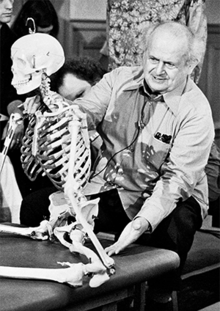


 By B.K.S. Iyengar. With John J. Evans and Douglas Abrams. Rodale Books, 2005. Index, 282 pages. ISBN: 1594862486. VSCL.
  By B.K.S. Iyengar. Introduction by Yehudi Menuhin. New York, Crossroad Pub. Co., 2012. Originally published in 1985 in English. Index, glossary, appendices, 296 pages. ISBN: 9780824506865. VSCL.
 . By B. K. S. Iyengar. Foreword by Yehudi Menuhin. London, Thorsons, 1993. Index, 337 pages. ISBN: 1855382253. VSCL.
  .
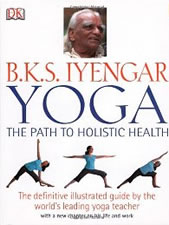
.  By B.K.S. Iyengar. London, Dorling Kindersley, 2001. Index, glossary, appendices, 415 pages. ISBN: 0789471655.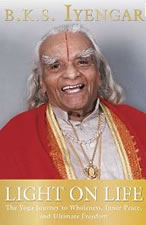




 .
.

