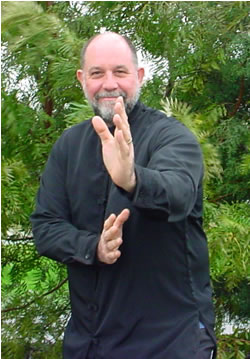
Repost from 2014:
There are many different ways that Tai Chi Chuan is taught, many different versions of different styles are taught, different teaching styles are used, there are some different types of learning skills of the students, and different objectives of the students.
My own view is that when learning a Taijiquan form your objective should be to learn the form so that you can perform the form alone, at home, every day. You should practice the entire form or its parts alone and often.
How to accomplish this objective:
1. If you are a beginner, then be sure to use verbal cues. Memorize the names of each movement sequence. Before you begin a movement sequence (section, part of a form, named movement) say to yourself (silently or out loud) the name of the sequence. Bring the movement name into your mind, use it as a cue to what will happen next, a trigger for attention and remembering. This is martialing the power of mind intent, Yi, focus, attention to action, memorization, habit formation, learning cues. There are many brief and colorful names that can be used for each movement, e.g., Grasping the Sparrows Tail, Cloud Hands, Needle at Sea Bottom, etc. Keep a notebook with such lists handy to refer to as needed until the Taijiquan names and movements are memorized.
Most often, in a class setting, Taijiquan teachers do not use verbal cues and the group practices in silence. You learn by just imitating the acts, watching, and repeating the moves of others.
I once attended one workshop by a young Yang Jun in Portland, where verbal cues were given in Chinese; but, not useful for me, an English only speaker. One teacher objected to my printing a list of the movements and sharing with others. Since you will be learning on your own, with an instructional DVD, these classroom circumstances are irrelevant.
After you know how to do the form on your own, you probably will no longer use verbal cues (out loud or silently).
My many Taijiquan webpages will give you the information about the resources you will need to get started learning the common Forms, and more tips about learning.
2. Reflect on the disadvantages of most Taijiquan class learning: travel time and expenses, class fees, group conformity, inefficient teaching methods, smelly classrooms, authoritarian or pompous or silent teachers, weird variations in a form, boring and lengthy warm ups, petty disputes amongst students, not enough lessons in a week, traffic and parking difficulties, scheduling conflicts, no Taoist/Buddhist/Confucian philosophy, etc.
You can avoid all this by practicing your Taijiquan at home every day, by using current instructional DVDs and reading books by real Taijiquan Master Teachers, by saving your money and time, by finding and using your best learning skills, and by being independent. If you are really concerned about the environment and conservation, then why drive and use gasoline to practice Taijiquan. You don't need much space to practice Taijiquan in your home or back yard, and it is completely convenient for practice every day. Just Do It today at home!
3. Practice, practice, repeat, do it over, play, repeat, practice ... learn, memorize, internalize, leading with Mind, becoming in your body, and forming beneficial health habits. Learn two or three named movement sequences at a time using a good instructional DVD, practice them till you remember how to perform them reasonably well, then add them to your performance of the form. Little by little you will inch forward towards a yard then more. Two Practice Rules: do it today at home; and, do it tomorrow at home. Frequency of performance repetition, alone, at home, and daily, enables you to truly learn. Group class dynamics more often foster paying followers for far longer than necessary to learn a form, because you don't work daily in nearly all Tai Chi classes.
4. Don't attend classes were people are doing the form differently from what you have already learned to perform on your own. This creates confusion, dissonance, over learning, and an awkward and stumbling flow. Different angles will cause you much frustration. Although I respect and appreciate such variety by different teachers, I don't need to trouble myself with doing all these minor or major variations of a form in a group class. Once you have learned to do your version of the form, and it will always be your best version based on your abilities and age, then do the form at home, alone, and enjoy yourself in playing.
5. Resist the urge to practice too many Taijiquan forms. I have explored many Taijiquan styles and forms from a academic or scholarly perspective. However, in 2024, I regularly practice at home alone only three Taijiquan forms: Yang Short 24, Yang Long 108, and the Chen Short 18. I also practice cane drills and forms.
6. Distinguish between warming up and doing Taijiquan. I don’t favor “Tai Chi” classes that spend 20-30% or more of the allotted and paid for class time on warm ups, loosening, stretching, limbering up, and doing Qigong (Chi Kung) movement sets. Yes, do warm ups before and outside of the Tai Chi Chuan class. Do Taijiquan in the Taijiquan class! Yes, I always do some gentle warmup and limbering exercises to ready myself for playing Taijiquan at home; but, this is a peripheral concern. Anyway, is not a gentle slow Yang 24 Taijiquan Form a sufficient gentle warm up exercise in itself?
7. Vary the pace, use more energetic and athletic versions of a Taijiquan movement sequence, use a bit more speed and power expressions when practicing at home alone. In a group class, I have always seen teachers only doing Taijiquan slowly, deliberately, quietly, softly, gently. When practicing at home alone, you don't need to just be a softy dancer and passive follower, you can express yourself more freely, change the pace, play Taiji to your favorite music, experiment, truly live and play with Taijiquan.
8. Local Taijiquan classes require a fee of up to $100 a month ($1,200 a year), not including travel time and expenses. You can purchase excellent instructional DVDs and books on the Taijiquan form you are practicing and learning for well under a $300 one time purchase. Practicing and learning at home alone is more cost effective and efficient. I like instructional DVDs in English by Masters Teachers like Jesse Tsao, Paul Lam, Jiang Jian-ye, Yang Jwing-ming, Ken Gullette, and others. Unlike in 1965 in America, there are now hundreds of excellent books in English about learning and understanding Tai Chi, and sometimes scores of books on just one style (Yang, Chen, Sun ...) of Taijiquan. These published authors and master teachers frequently have a sports education background and know much more about how to teach beginners and intermediate students via virtual instruction using professional production crews and editing; and, most often teach far better than your local Taijiquan entrepreneurs can teach.
9. Some people truly enjoy group classes because they form friendships with fellow students, can't practice consistently home alone, are better followers, lack confidence in their own skills, and always need guidance from a teacher. The problem is that a group Taijiquan class only meets for two to three hours a week. If you don't practice Taijiquan at home alone every day, you will seldom truly learn to embody and express your unique version of the form. Working alone you learn to lead, to memorize, to free your body-mind from just following others at their pace and mode of expression. If you don't practice alone every day, you will likely never learn the form and will eventually drop out of the class. If socializing is your interest, then find a class group that appeals to you.
10. If your interested in "fighting," push hands, sparring, competition, Da Lu ... obviously you need partners, classmates, buddies, trainers and trainees. I think that fighting and martial arts are something for people under 45 years of age - young sportsmen. Taijiquan is very likely useless in a real fight where size, speed, power, youth, martial skill and technique, strength, fighting spirit, serious conditioning, and toughness are the elements of success and avoidance of real injury. I respect the under-pinning's of the internal martial arts that are part of understanding Taijiquan, but after 45, these aspects are far less important.
I do think, however, that imagining an opponent and having a concept of the offensive/defensive applications of a movement sequence, helps our performance in solo Taijiquan practices. Taijiquan, instead, is more a fight against stress, loss of balance, high blood pressure, some diseases, laziness, inactivity, sitting too much, falling, cultural ignorance, philosophical naivete, over-achieving, aggressiveness, fantasies, unrealistic expectations, etc. Therefore, if you have no illusions about becoming a martial artist, and you are over 45, and practicing serious Taijiquan alone at home, there is no need for any martial arts training partners.
11. Have confidence that you can learn to perform your Taijiquan alone. Yes you can, and don't think you can't. Stay positive, upbeat, determined, focused, and work, work, work. Carefully and conscientiously follow your instructional DVD teacher and You Will Learn. Be gentle on yourself, don't criticize yourself.
12. If your primary interest is in joining with a group that does Tai Chi in a carefully synchronized, expertly choreographed, beautiful, coordinated manner in beautiful Taiji uniforms; then you must regularly practice with such a performing group. If you want to line dance in a group, then you must practice with a group. Being in a choir, band, drill team, sports team, or orchestra, etc., are demanding commitments. I enjoy watching a dedicated group do coordinated Tai Chi Chuan forms together. However, I don't have the time, interest, or funds to join them in the regular practicing and training together that is required. I wish them well and will watch their performances with delight.
13. I have an attitude of being satisfied with how I am doing, imitating, following my good instructional DVD teacher. I come close enough to the model, and feel confident in my performance. I am far from "perfect" but I don't let that get in the way of keeping my Taijiquan practice going, improving, bettering, evolving. Yes, I could benefit from corrections by a Master, but I can't afford or access that level of guidance. I just work, and don't fret about my intermediate skills or lack of some subtleties in the Form. I am not performing for a critic, I am practicing Taijiquan alone for fun, good health, insights, pleasures, insight, movement ...
I've followed this course of training since I was 50 years of age. My body, now at age 78, is content doing my few Taijiquan forms at home, alone.
I've tried five different Taijiquan group classes in Vancouver, WA, since 2017. They all fell short of the significant benefits of solo Taijiquan training for the many reasons given above. The teachers seemed well intentioned, my fellow students friendly and courteous, but the benefits to me were minimal.
If I wanted to learn, for example, the Chen Lao Jia Yi Lu, 1840, Old Frame, First Form, 74 movements, I would use one of the best instructional DVDs and some books as my teachers, learn two or three movements each week, and practice on my own (80-200 hours) till I learned all the form. I'd follow my advice on my webpages on the subject. I would need supplementary stretching and conditioning exercises, and would need to modify some of the more rigorous Chen movements, so as to prepare me for this style of Taijiquan considering my age. Am I up to the challenge at age 78? Maybe - Yes! And, and I could learn at low cost and in the convenience of my back yard or indoors. Anyway, since there are no Chen Taijiquan teachers in Vancouver, I could never afford to do otherwise, e.g., live and study in the Chen Village in China or drive to classes in some other large city. I do attend workshops occasionally.

"No school of Chinese martial arts is as well known and popular as Taijiquan. It is suitable for both the young and the old, not only because Taijiquan possesses special features of stretching, flexing the joints, softly twining, exercising both the inside and the outside, dispelling diseases and prolonging life, but it is also the martial art that best reflects Chinese traditional philosophy. More and more people from other countries, especially those interested in Chinese culture, are beginning to practice Taijiquan. Taijiquan is becoming popular all over the world. Because of this, Taijiquan has no national boundary and is beyond the category of culture, and belongs to people everywhere."
- Fan Chun-Lei and A. Frank Shiery, Traditional Chen Style Taijiquan.