Showing posts with label Relaxation. Show all posts

Sunday, March 15, 2026

Feldenkrais Techniques

A repost from February 2018:

I have taken 9 Feldenkrais' introductory 90 minute group classes from a local Feldenkrais practitioner, Christine Toscano.  I also practice this method alone at home.  I have also read a number of books on the subject.


Mrs. Toscano recommended we read Chapter 5 of the book by Norman Doidge, M.D., "The Brain's Way of Healing: Remarkable Discoveries and Recoveries from the Frontiers of Neuroplasticity," (Penguin Books, 2016). The chapter covers the life and work of Moshe Feldenkrais (1904-1984).  He was a Ph.D. engineer, kudo master, movement therapist, author, and healer. The chapter discusses some of the core principles of his theory and methods as follows:

"1. The mind programs the functioning of the brain.
2. A brain cannot think without motor function.
3. Awareness of movement is the key to improving movement.
4. Differentiation: making the smallest possible sensory distinctions between movements - builds brain maps.
5. Differentiation is easiest to make when the stimulus is smallest.
6. Slowness of movement is the key to awareness, and awareness is the key to learning.
7. Reduce the effort whenever possible. Relax.
8. Errors are essential, and there is no right way to move, only better.
9. Random movements provide variation that leads to developmental breakthroughs.
10. Even the smallest movement in one part of the body involves the entire body.
11. Many movement problems, and the pain that goes with them, are caused by learned habit, not by abnormal structure." 


Awareness Through Movement.  Easy-To-Do Health Exercises to Improve Your Posture, Vision, Imagination and Personal Awareness.  By Moshe Feldenkrais.  HarperOne, Reprint edition, 2009.  192 pages.  ISBN: 978-0062503220.  VSCL. 

Awareness Heals: The Feldenkrais Method for Dynamic Health.  By Stephen Shafarman.  Da Capo Lifelong Books, 1997.  224 pages.  ISBN: 978-0201694697.  VSCL. 


The Brain's Way of Healing: Remarkable Discoveries and Recoveries from the Frontiers of Neuroplasticity.  By Norman Doidge, M.D..  Penguin Books, 2016.

Change Your Age: Using Your Body and Brain to Feel Younger, Stronger, and More Fit.  By Frank Wildman, Ph.D..  Da Capo Lifelong Books, 2010.  240 pages.  ISBN: 978-0738213637.  VSCL. 


Embodied Wisdom: The Collected Papers of Moshe Feldenkrais.  Edited by Elizabeth Beringer.  Foreword by David Zemach-Bersin.  North Atlantic Books, 1st Edition, 2010.  256 pages.  ISBN: 978-1556439063.  VSCL.  


Moshe Feldenkrais.png


Thursday, May 25, 2023

How to Sleep Better Each Day

 How to Sleep Better Each Day

Follow a schedule and routine for sleep
Prepare for sleeping at 9:00 pm
Sleeping around 7-9 hours is best for most
Don’t use stimulants: drugs, ideas, worry
Get enough sunlight during the day
Get enough exercise during the day
Avoid foods that prevent sleep
Alcohol or drugs might reduce your sleep
Don’t drink liquids a few hours before sleeping
Reduce or eliminate naps during the day
Turn off the television or radio or pod-cast
Bathe if dirty, and change into clean pajamas
Listen only to soft, gentle, relaxing instrumental music
Do any gentle stretching or gentle yoga well before sleeping
Sleep in a cooler room
Reduce, avoid, dim, or turn off any lights in bedroom
Don’t look at clocks if you awaken
Use pillows or bolsters to relieve bodily discomfort
Use clean sheets, covers, pillows and mattress
Don’t work in bed
Reduce reading books or eReader in bed
Sexual activity may or may not help you sleep
Excessive sex will keep you awake
Use techniques to turn off your thinking
Don’t talk a lot or write in bed
Try changing the smell of your bedroom
Go to sleep and get up at the same time each day
Don’t over-sleep beyond your normal wake up time
Keep bugs out of your sleeping area
Other people need to be quiet from 9 pm to 5 am
Some people favor a cup of warm soporific tea
There are many soporific supplemental medicines
  available, but use care with combining medicines
Some people elevate the upper torso and sleep better
If you suffer from insomnia, restless legs syndrome,
  sleep apnea, or narcolepsy consult a physician
Sleep apnea sometimes can be helped with equipment
Keep the CPAP equipment clean
Use meditation techniques to turn off thinking too much

By Michael P. Garofalo  August 23, 2022

I have been dealing with some sleep problems: insomnia, mild sleep apnea,
nighttime urination, tossing and turning when sleeping, no dreams.  

Today, I have an appointment for a consultation with Dr. Steven Hill at the Vancouver Clinic in east Vancouver.  He is a M.D. Sleep Medicine specialist.  Medicare requires an overnight sleep test before any follow up equipment (CPAP, dental devices) or medicine can be prescribed. 

I am reading the following book on the subject:

Say Good Night to Insomnia: The Six Week, Drug Free Program Developed at the Harvard Medical School.  By Gregg D. Jacob.  2009, 256 pages. VSCL.

The Harvard Medical School Guide to Tai Chi: 12 Weeks to a Healthy Body, Strong Heart, and Sound Mind.  By Peter Wayne, Ph.D.. Harvard Health Publications.
Shambhala Press, 2013, 240 pages.  

Wednesday, March 22, 2023

Walking Meditation: When Walking is Only for Walking

"Walking meditation means to enjoy walking without any intention to arrive. We don't need to arrive anywhere.  We just walk. We enjoy walking. That means walking is already stopping, and that needs some training.  Usually in our daily life we walk because we want to go somewhere. Walking is only a means to an end, and that is why we do not enjoy every step we take. Walking meditation is different. Walking is only for walking. You enjoy every step you take. So this is a kind of revolution in walking. You allow yourself to enjoy every step you take.
The Zen master Ling Chi said that the miracle is not to walk on burning charcoal or in the thin air or on the water; the miracle is just to walk on earth. You breathe in. You become aware of the fact that you are alive. You are still alive and you are walking on this beautiful planet. That is already performing a miracle. The greatest of all miracles is to be alive. We have to awaken ourselves to the truth that we are here, alive. We are here making steps on this beautiful planet. This is already performing a miracle.  But we have to be here in order for the miracle to be possible. We have to bring ourselves back to the here and the now."
-  Thich Nhat Hanh, Resting in the River


Walking Meditation:  Quotes, Bibliography, Links, Information, Methods


"Walking meditation is walking in full awareness of breath, body and everything the senses present.  It is not an aerobic exercise - though it would be a fine lead-in to aerobic walking.  Rather, walking meditation is done slowly and consciously, with each step fully feeling the earth.  During this precious time, body and mind come together, joined in the present moment.  Although the benefits of walking meditation will deepen over time, even from the start, you can experience some measure of the relaxation, balance and quiet energy that builds through this practice."
-  Ginny Whitelaw, Body Learning, p. 55.   


"Research conducted at Harvard Medical School’s Mind/Body Medical Institute has found that focused walking meditations are highly effective for reducing anxiety and producing  what’s called the “relaxation response.”
Borgess Health   


The Ways of Walking
Compiled by Mike Garofalo
Quotations, Poems, Sayings, Lore, Facts


"Walking meditation is not just for stretching our legs. It is a technique just as powerful as sitting. Within the Buddhist world there are many styles of walking meditation: the formal kinhin of Zen, the kaihogyo of Mt. Hiei, the rlung-sgom of Tibet, etc.
    Walk slowly but naturally. Try to register as much information as possible about the sensation in each foot as it moves. Break the movement into distinct components and note each one.  Distinguish the lifting, swinging and down-tread. Experience each change in tactile sensation against the floor as you lift and touch down. Try to feel the many tiny jerks of muscles involved in the foot's seemingly smooth motion. Try to see that each component and sub-component of the foot's motion has its own distinct beginning, middle and end.
    At first you may want to make explicit mental note of the components by saying to yourself something like "Begin lift, lifting, end lift, begin swing, swinging, end swing, begin coming down, coming down, begin touching ground, touching..." However, as you become more and more aware of subtle events, you will not have time to characterize each with words. In any event, keep an unbroken stream of awareness about the foot. If your attention wanders, be aware of that fact and return to the foot. Remember, it is very important to keep the rest of the body relaxed
while you do this.
    Our sense of solidity and separateness comes about because we habitually grasp and freeze each moment of sensation. The vipassana walking exercise is designed to so completely flood your consciousness with reality moments that there simply is no time left for grasping and freezing. As soon as a piece of data is registered, move on to the next piece of data without allowing the memory of the former piece of data to congeal."
-   Walking Meditation, Shinzen Young


Thursday, February 02, 2023

Cryo-Balloon Ablation of My Heart


At 9:30 am this morning, at the Peace Health Hospital in Vancouver, a team led by Dr. Reese will perform a cryo-balloon catheter ablation of my heart.  We hope this will correct some of my current electrical heart problems.  This is a non-invasive procedure, is "relatively safe," and does help 60-80% of people who undergo the procedure.  Dr. Reese told me he thought I was a good candidate for using this procedure.  

At age 77, I have been slowed down by shortness of breath, mild chest tightness, fatigue, and lightheadedness caused by paroxysmal atrial fibrillation.  My heart went into atrial fibrillation in May of 2022.

We shall see what happens in the next month to me as a result of this technical procedure.  


Friday, 7 am, 2/3/2023

The procedure went smoothly.  AFib controlled.  Dr. Reese said it would take three months to feel fully back to "normal."  Little discomfort, and no pain.  Sutures in thighs healing OK thus far.  Feeling very good.  Alert and thinking all night with little sound sleep.  Moving 10-15 minutes at the end of one hour of sitting.  Moving slowly, carefully, gently.  No chest tightness.  No lightheadedness or dizziness.  Clear vision.  

Cancelled February retreat to a yurt at Pacific Beach State Park in Washington.  My next retreat will come in April.  Waiting nearly 3 months to go on retreat.  Staying close to home until recovery comes.  Also, Karen has upcoming hip surgery on March 7th.  


Saturday, 4 am, 2/4/2023

Still feeling pretty good.  No problems.  Sutures healing OK.  No chest pain or discomfort.  Don't get out of breath.  A few cases of blurred/odd visual disturbances - wavy edges.  Trying to sit for 1 hour and then get up and gently exercise for 20 minutes today: walking, treadmill, qigong, taijiquan, yoga stretches.  

Before the ablation, I was in AFib frequently.  My heartbeat averaged 61 bpm when at rest.  Now my average heartbeats per minute is between 70-80 bpm at rest.  


Sunday, Noon, 2/5/2023

A little punked today.  Did not sleep well again last night: too much thinking.  My legs are a little sore from lots of Taijiquan practice yesterday.  Truly, a day of complete resting for me.  Sutures healed and looking good.  Very little chest discomfort.  Somewhat anxious.  No exercise.  Read, relax, sit, nap.  Ate  up to my recommended limit of calories 1500/carbohydrates 150.  


Monday, 2/6/2023,

Four days since the ablation procedure.  Slept 7 hours last night - excellent for me.  Feeling alert and ready to move.


Thursday, 2/9/2023

Met with James Mathey, Physician's Assistant, Peace Health Hospital today.  He ran an EKG and checked my pacemaker memory.  I am in normal heart rhythm with no AFib.  He checked my leg wounds.  In his assessment, overall, I am progressing well.  I return to be evaluated by him on March 6th.  I can ramp my walking up to 5,000 steps per day in the next 10 days.  No heavy workouts, sweating, or hard labor.  


Sunday, 2/12/2023

Injured my right leg.  Limping and in pain.  Start recovery process.


Thursday, May 06, 2021

Relaxing and Loosening Up

 "True relaxation is always a dropping into ourselves, a movement toward our core and very center of self.  In addition to distorting what we can see, hear, and feel, the inability to relax and release tension will inevitably fuel the involuntary internal monologue of the mind.  As we become more enmeshed in the drama that our mind is scripting about ourselves, our ability to relate in a wholesome and relaxed manner with the current condition and circumstances of our lives becomes further distorted. ... The relaxation of tension in our bodies melts the armoring that keeps our bodies hard and inflexible.  This hardening of the tissue creates a layer of numbness that keeps our awareness of the rich web of shimmering sensations concealed and contained.  Relaxation allows the armoring to begin to soften and melt away.  The inevitable result is a much greater awareness of sensational presence and a diminution of the ongoing involuntary monologue of the mind.  Learning how to relax by surrendering the weight of the body to the pull of gravity and remaining standing at the same time significantly catalyzes the practice of mindfulness."

-  Will Johnson, Aligned, Relaxed and Resilient, 2000, p. 55


"To be relaxed means to release tension, but not to let go of substance.  There is a quality in-between stiff and loose which is stable, yet flexible, that has fullness without being rigid, that is calm in motion yet conveys a vigorous presence.  For lack of an equivalent English word, I refer to this concept as flowing within firmness, firmness within flowing.  Flowing and firmness do not gain support from a rigid skeletal posture or strength from muscular tension.  Rather, their integrity comes from expansion.  Expansion is the ability to spread out in all directions.  This is the key to relaxing without collapsing."
-  Ting Kuo-Piao, Understanding Flowing and Firmness, 2000


"Relaxation of the whole body means the conscious relaxation of all the joints, and this organically links up all parts of the body in a better way.  This does not mean softness.  It requires a lot of practice in order to understand this point thoroughly.  Relaxation also means the "stretching" of the limbs, which gives you a feeling of heaviness.  (This feeling of heaviness or stiffness is a concrete reflection of strength.)  This feeling is neither a feeling of softness nor stiffness, but somewhere in between.  It should not be confined to a specific part, but involves the whole body.  It is like molten iron under high temperature.  So relaxation "dissolves" stiff strength in very much the same way.  Stiff strength, also called "clumsy strength," undergoes a qualitative change after thousands of times of "dissolution" exercises.  Just like iron which can be turned into steel, so "clumsy strength" can be turned into force, and relaxation is a means of gradually converting it into force.  Our ancestors put it well: "Conscious relaxation will unconsciously produce force."  There is truth in this statement."
-  Yang Zhenduo, "Yang Style Taijiquan", p 16


Relaxed (Sung, Song, Fan Song):  Quotations, Bibliography, Resources

Standing Meditation

T'ai Chi Ch'uan

Somaesthetic Practices and Theory


Saturday, March 27, 2021

Just Rest

"You've probably experienced something similar after finishing a long and difficult job, whether it involved physical labor or the type of mental effort involved in writing a report or completing some sort of financial analysis.  When you finish the job, your mind and body naturally come to rest in a state of happy exhaustion.  This perfectly effortless state of relaxation is what is meant by natural peace." ...

"First, assume a position in which your spine is straight, and you body is relaxed.  Once your body is positioned comfortably, allow your mind to simply rest for three minutes or so. Just let your mind go, as though you just have finished ad long and difficult task.
Whatever happens, whether thoughts or emotions occur, whether you notice some physical discomfort, whether you are aware of sounds or smells around you, or you mind is a total blank, don't worry.  Anything that happens or ─doesn't happen─ is simply part of the experience of allowing you mind to rest.
So now, just ret inn the awareness of whatever is passing through you mind ...
Just rest ...
Just rest ..."

"Let me confide in you a big secret.  Whatever you experience when you simply rest your attention on whatever's going on in your mind at any moment is meditation.  Simply resting in this way is the experience of natural mind." ...

"In fact, experiencing natural peace is easier than drinking water.  In order to drink, you have to expend effort.  You have to reach for the glass, tip the glass so that the water pours into your mouth, swallow the water, and then put the glass down.  No such effort is required to experience natural peace.  All you have to do is rest your mind in its natural openness.  No special focus, no special effort is required."
-  Yongey Mingyur Rinpoche, "The Joy of Living," 2007, pp. 55-58


So, I relax, breathe gently and easily, stand up straight, unloosen myself from thinking and judging, settle down into ease, rest the mind, and begin a slow and easy Taiji form ... one path to "natural peace."


Relaxation, Sung, Fang Song, Rest, Ease

Tai Chi Chuan

Buddhism


Friday, March 26, 2021

Dao De Jing Chapter 35 Tao Te Ching


Tao Te Ching  Chapter 35  Dao De Jing  


"One who holds fast to the Great Symbol
Gains the whole world
Bestows purest peace
Serenity and bliss.
Yet the hasty wayfarer
Attracted only by outer characteristics
Tastes Tao and is not aware of it
Sees Tao and does not perceive it
Listens to Tao and does not hear it.
But whoever
Grasps and holds it
Amid impermanence
Is grasped by the permanent
And attains duration."
-  Translated by K. O. Schmidt, 1975, Chapter 35


"Reside in the center
where understanding does not require words or images,
and folk will come to you to be taught
how to be serene.
Where there is good music and food
people stop to rest and regain their energy.
But though the Tao seems unmelodious or even bland
it is an inexhaustible source of refreshment."
-  Translated by Crispin Starwell, Chapter 35


"To him who holds to the Great Form all the world go.
It will go and see no danger, but tranquility, equality and community.
Music and dainties will make the passing stranger stop.
But Tao when uttered in words is so pure and void of flavor
When one looks at it, one cannot see it;
When one listens to it, one cannot hear it.
However, when one uses it, it is inexhaustible."
-  Translated by Ch'u Ta-Kao, 1904, Chapter 35 


"The owner of the biggest image attracts the whole world.
When all who come have been safely settled,
The world will then be peaceful.
Melodious music and delicious food
Can only attract passers-by.
But the Way is, when put into one's mouth, tasteless,
When looked at, colorless,
When listened to, uninteresting,
And, when used, limitlessly bountiful."

-  Translated by Liu Qixuan, Chapter 35 


執大象, 天下往.
往而不害, 安平大.
樂與餌, 過客止.
道之出口, 淡乎其無味.
視之不足見.
聽之不足聞.
用之不足既. 

-  Chinese characters, Tao Te Ching, Chapter 35

zhi da xiang, tian xia wang.
wang er bu hai, an ping tai.
le yu er, guo ke zhi.
dao zhi chu kou, dan hu qi wu wei.
shi zhi bu zu jian.
ting zhi bu zu wen.
yong zhi bu zu ji.

-  Pinyin Romanization, Daodejing, Chapter 35 


"Hold the Great Symbol
and all the world follows,
Follows without meeting harm,
And lives in health, peace, commonwealth.
Offer good things to eat
And the wayfarer stays.
But Tao is mild to the taste.
Looked at, it cannot be seen;
Listened to, it cannot be heard;
Applied, its supply never fails."
-  Translated by Lin Yutang, 1955, Chapter 35 


"Apprehend the inimitable conception, you attract the world;
coming it receives no harm, but it tranquil, peaceful, satisfied.
Like transient guests, music and dainties pass away.
The Tao entering the mouth is insipid and without flavour;
when looked at it evades sight;
when listened for it escapes the ear.
Yet, its operations are interminable."
-  Translated by C. Spurgeon Medhurst, 1905, Chapter 35 


"The owner of the biggest image attracts the whole world.
When all who come have been safely settled,
The world will then be peaceful.
Melodious music and delicious food
Can only attract passers-by.
But the Way is, when put into one's mouth, tasteless,
When looked at, colorless,
When listened to, uninteresting,
And, when used, limitlessly bountiful."

-  Translated by Liu Qixuan, Chapter 35 


"El Tao carece de forma y aroma;
No puede ser visto ni oido,
Y su aplicación no puede ser agotada.
Si ofreces música y comida
Los extraños se detienen a tu lado;
Pero si estás de acuerdo con el Tao
La gente del Mundo te mantendrá
En seguridad, salud, compañía y paz."
-  Translated by Antonio Rivas Gonzálvez, 1998, Capítulo 35 


"If you offer music and food
Strangers may stop with you;
But if you accord with the Way
All the people of the world will keep you
In safety, health, community and peace.
The Way lacks art and flavor;
It can neither be seen or heard,
But its benefits cannot be exhausted."

-  Translated by Peter Merel, 1992, Chapter 35


"Hold fast the idea of "The Great,"
Then all men will be drawn to you.  
They will come to you and receive no hurt,
But rest, peace and great calm.
When you provide music and exquisite food
The traveller will stay with you gladly.
When the Tao flows out from you to him
By his palate he does not detect its savour,
By his eye he cannot perceive it,
By his ears he cannot hear it,
But in using it he finds it to be inexhaustible." 
- Translated by Isabella Mears, 1916, Chapter 35 


A typical webpage created by Mike Garofalo for each one of the 81 Chapters (Verses, Sections) of the Tao Te Ching (Daodejing) by Lao Tzu (Laozi) includes over 25 different English language translations or interpolations for that Chapter, 5 Spanish language translations for that Chapter, the Chinese characters for that Chapter, the Wade-Giles and Hanyu Pinyin transliterations (Romanization) of the Mandarin Chinese words for that Chapter, and 2 German and 1 French translation of that Chapter.  Each webpage includes a Google Translate option menu for reading the entire webpage in many other languages.  Each webpage for each one of the 81 Chapters of the Tao Te Ching [246 CE Wang Bi version] includes extensive indexing by key words, phrases, and terms (concordance) for that Chapter in English, Spanish, and the Wade-Giles Romanization.  Each webpage on a Chapter of the Daodejing includes recommended reading in books and websites, a detailed bibliography, some commentary, links, research leads, translator sources, and other resources for that Chapter.  
     A Top Tier online free resource for English and Spanish readers, researchers, Daoist devotees, scholars, students, fans and fellow travelers on the Way. 


Thursday, October 15, 2020

Benefits of Conscious Relaxation

"True relaxation is always a dropping into ourselves, a movement toward our core and very center of self.  In addition to distorting what we can see, hear, and feel, the inability to relax and release tension will inevitably fuel the involuntary internal monologue of the mind.  As we become more enmeshed in the drama that our mind is scripting about ourselves, our ability to relate in a wholesome and relaxed manner with the current condition and circumstances of our lives becomes further distorted. ... The relaxation of tension in our bodies melts the armoring that keeps our bodies hard and inflexible.  This hardening of the tissue creates a layer of numbness that keeps our awareness of the rich web of shimmering sensations concealed and contained.  Relaxation allows the armoring to begin to soften and melt away.  The inevitable result is a much greater awareness of sensational presence and a diminution of the ongoing involuntary monologue of the mind.  Learning how to relax by surrendering the weight of the body to the pull of gravity and remaining standing at the same time significantly catalyzes the practice of mindfulness."
-  Will Johnson, Aligned, Relaxed and Resilient, 2000, p. 55


"To be relaxed means to release tension, but not to let go of substance.  There is a quality in-between stiff and loose which is stable, yet flexible, that has fullness without being rigid, that is calm in motion yet conveys a vigorous presence.  For lack of an equivalent English word, I refer to this concept as flowing within firmness, firmness within flowing.  Flowing and firmness do not gain support from a rigid skeletal posture or strength from muscular tension.  Rather, their integrity comes from expansion.  Expansion is the ability to spread out in all directions.  This is the key to relaxing without collapsing."
-  Ting Kuo-Piao, Understanding Flowing and Firmness, 2000


"Relaxation of the whole body means the conscious relaxation of all the joints, and this organically links up all parts of the body in a better way.  This does not mean softness.  It requires a lot of practice in order to understand this point thoroughly.  Relaxation also means the "stretching" of the limbs, which gives you a feeling of heaviness.  (This feeling of heaviness or stiffness is a concrete reflection of strength.)  This feeling is neither a feeling of softness nor stiffness, but somewhere in between.  It should not be confined to a specific part, but involves the whole body.  It is like molten iron under high temperature.  So relaxation "dissolves" stiff strength in very much the same way.  Stiff strength, also called "clumsy strength," undergoes a qualitative change after thousands of times of "dissolution" exercises.  Just like iron which can be turned into steel, so "clumsy strength" can be turned into force, and relaxation is a means of gradually converting it into force.  Our ancestors put it well: "Conscious relaxation will unconsciously produce force."  There is truth in this statement."
-  Yang Zhenduo, "Yang Style Taijiquan", p 16


Relaxed (Sung, Song, Fan Song):  Quotations, Bibliography, Resources

Standing Meditation

T'ai Chi Ch'uan

Somaesthetic Practices and Theory


Wednesday, September 09, 2020

Loosen Up and Stand Tall

 "Throughout this book one encounters the terms song and fang song.  These are often translated as "relaxed" and "relax."  Etymologically the term song is based on a character for "long hair that hangs down ─that is, hair that is loosened and expanded, not "drawn up."  Therefore, "loosened" and "loosen" are more accurate renderings for song and fang song.  The phonetic element that gives the character song its pronunciation means, by itself, "a pine tree,"" which carries an associated imagery of "longevity," much as evergreens are associated with ongoing vitality in the West.  This may provide a clue to the Taijiquan usage of this term, which must not be confused with total relaxation, but is closer to an optimal state of the condition referred to as tonus in English anatomical parlance: that is, the partial contraction of the musculature, which allows one to maintain equilibrium and upright posture.  The aligned equilibrium that is prescribed in Taijiquan is associated with imagery of being "suspended" from the crown of the head.  One can, therefore, draw upon the available imagery of both something that is loosened and hangs down, and that of the upright pine, whose limbs do not droop down, but are buoyant and lively."
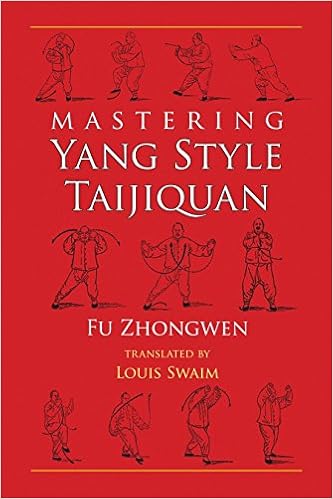
Mastering Yang Style Taijiquan.  Bu Fu Zhongwen (1903-1994).  Translated by Louis Swaim. p. xv.  


"True relaxation is always a dropping into ourselves, a movement toward our core and very center of self.  In addition to distorting what we can see, hear, and feel, the inability to relax and release tension will inevitably fuel the involuntary internal monologue of the mind.  As we become more enmeshed in the drama that our mind is scripting about ourselves, our ability to relate in a wholesome and relaxed manner with the current condition and circumstances of our lives becomes further distorted. ... The relaxation of tension in our bodies melts the armoring that keeps our bodies hard and inflexible.  This hardening of the tissue creates a layer of numbness that keeps our awareness of the rich web of shimmering sensations concealed and contained.  Relaxation allows the armoring to begin to soften and melt away.  The inevitable result is a much greater awareness of sensational presence and a diminution of the ongoing involuntary monologue of the mind.  Learning how to relax by surrendering the weight of the body to the pull of gravity and remaining standing at the same time significantly catalyzes the practice of mindfulness."
-  Will Johnson, Aligned, Relaxed and Resilient, 2000, p. 55


"Sung is probably one of the most important terms in t'ai chi ch'uan. It implies a very high level of alertness, sensitivity, nimbleness and lightness, with an inordinate mindfulness for the conservation of energy.  ...  Sung is the very modus operandi of all energies in t'ai chi ch'uan."
 -   Stuart A. Olson, Intrinsic Energies of T'ai Chi Ch'uan, 1994, p. 55


Loosen, Relaxed, Loose, Open, Yielding, Free, Responsive, Upright, Effortless, Spacious, Song, Sung, Fang Song.  A Defining Characteristic and Essential Quality of Taijiquan and Qigong Practice.  Notes, Quotes, Bibliography.  By Mike Garofalo.

Cloud Hands Taijiquan Website.  By Mike Garofalo.  


Sunday, May 31, 2020

Natural Movement Principles


Lately, I've been reading a book by Tara Stiles titled "Guiding Strala: The Yoga Training Manual.  To Ignite Freedom, Get Connected, and Build Radiant Health and Happiness.  By Tara Stiles.  Carlsbad, California, Hay House Inc., 2017.  Index, 361 pages.  ISBN: 978-1401948108.  The Fort Vancouver Regional Libraries supply me with plenty of good books, CDs, VCDs, ebooks, etc. 

In Guiding Strala, she outlines "11 Principles of Natural Movement" (pp.69-85)  These 11 Principles are then discussed throughout the book mostly in the context of Vinyasa style yoga.

These Principles can also be found in Tai Chi Chuan theory and practices.  Qigong and Feldenkrais practices and theory use some of same concepts. 

"So here they are: 11 principles to natural movement that will get you moving easily and powerfully, without tiring, in everything you do."

1.  Soften
2.  Establish Your Breath-Body Connection
3.  Lead From Your Middle
4.  Use Your Opposites
5.  Use Momentum
6.  Use Your Whole Body
7.  Open the Door, Close the Door
8.  Conserve Energy
9.  Sensitize
10.  Focus on Body Position
11.  Play

For example, Principle 7 (Open the Door, Close the Door): "Always move into challenges from where you are comfortable and open. Always open the door to movement first so you don't have to force your way through."  Relax while learning new movements, be open, don't rush, welcome yourself in.  Don't let impatience, immaturity, or pride close the door to your progress.  Overly stressful exertion, too much effort, or high octane challenges might delay your overall progress and close the door on real progress, benefits, and mastery.  Close the door on dis-ease, and open the door to ease.  Breathing practices (pranayama) use inhaling (opening the door) and exhaling (closing the door) to our benefit and mental-spiritual well-being. Mind-body yoga practices enable us to close the door on unhealthy practices, and open the door to a healthier lifestyle.  [The "Door" metaphor works in many ways.]


Monday, December 30, 2019

You Can't Dance and Stay Uptight

Dancing in the Moonlight
By King Harvest
1972

"We get it almost every night
When that moon gets big and bright
It's supernatural delight
Everybody was dancing in the moonlight

Everybody here is out of sight
They don't bark and they don't bite
They keep things loose, they keep things light
Everybody was dancing in the moonlight

Dancing in the moonlight
Everybody feeling warm and bright
It's such a fine and natural sight
Everybody's dancing in the moonlight

We like our fun and we never fight
You can't dance and stay uptight
It's supernatural delight
Everybody was dancing in the moonlight

Dancing in the moonlight
Everybody's feeling warm and bright
It's such a fine and natural sight
Everybody's dancing in the moonlight

Dancing in the moonlight
Everybody's feeling warm and bright
It's such a fine and natural sight
Everybody's dancing in the moonlight"


Friday, October 11, 2019

Tai Chi Sword, 32 Form


This popular webpage includes a comprehensive bibliography, scores of links to webpages; an extensive listing of the names and name variations for each movement in English, Chinese, French, German, and Spanish; a detailed analysis of each posture and movement sequence with explanations and numbered illustrations and detailed instructions; selected quotations; comments on 20 Taijiquan sword techniques; a comprehensive media bibliography; a chart of performance times; recommendations for starting to learn this form at home one your own with instructional DVDs, books and practice methods; and, a comparison of the 32 and 55 sword forms in the Yang style. 

This is the standard, simplified, orthodox, 1957, 32 Taiji Sword Form, in the Yang Style of T'ai Chi Ch'uan. 

32 Sword Form Pamphlet by Geoffrey Hugh Miller.  Adapted from information and graphics found on the 32 Sword Form webpage by Michael P. Garofalo.  22 pages, 9/7/2015, PDF Format.  Excellent job by Mr. Miller.  This is a handy practice tool.  

Read about the Taoist magical sword finger hand sign:
"The sword finger hand sign is to draw your own magic power to the fingers and output a beam of energy for doing Taoist magic.  This beam of magical power isn’t just an imaginary thing, it’s a real visible beam if you can see it. Some of my students can see the beam of energy beams out like a long laser from the tip of the finger and extend all the way to the wall or somewhere far away. The beam is a beam a the magic power from one doing the handsign. This beam of power can be used for drawing FUs in the air, killing evils, doing magic in magic battles, healing or even saving lives!  This is like a multi-usage tool, which can be a pen, a chisel, a phone, or even a drill, it all depends on how you use it and what adaptor you put on it to make it function differently. The most  commonly seen usage of this handsign in Tin Yat Lineage is by drawing Taoism FU in the air or on the incense. This allow you to “carve” the Taoism FU into the object or in the air to perform magic." 

The Wild Horse Jumps Over the Mountain Stream 


  "Mike, I wonder if you could give your thoughts on something.  For years I’ve been practicing 3. The Swallow Skims Across the Water with the left hand moving in a similar fashion to 5. Block and Sweep to the Left i.e. the little finger side of the hand brushing the left hip before raising above the head.  I’ve recently got a book by Li Deyin which has his daughter Faye Yip performing it slightly differently.  She points her fingers backwards with the back of the hand brushing the hip and mentions it in the essential points for the movement.  Looking at videos on the internet they all seem to be similar to Faye Yip.  Would you mind if I asked how you practice?"
-  A question from Simon Ellis, UK, 9/2/2015


Simon, I have found that the details of bodily positions for any Taijiquan movement vary somewhat according to the following standards:

1.  Competition standards.  If you are preparing to compete in a Taijiquan event, then carefully study the standards for the forms you are performing.  In the case of the 32 sword form, check out books and DVDs by Li Deyin or his heirs.

2.  Your teacher's standards.  If you are working closely with a Taijiquan teacher, then follow their instructions.  This simplifies your learning, and shows respect for the teacher.  Since I learned the 32 sword from the instructional DVD by Dr. Paul Lam, I practice this form in a manner fairly close to his instructions.  

3.  Your personal standards.  If you have been practicing for many years, mostly alone, then more variations in bodily positions will likely emerge.  Sensibly, as we age, we make adaptations in our Taijiquan form work to safely accommodate our declining physical abilities.

As for how I practice, I'm rather unconcerned about details, a bit careless, playful, free, and seldom do things exactly the same way.  I just like skimming across the water, and leave the details about how to flap my wings to others.  Call me a lazy dilettante Daoist, with a penchant for ziran.  I don't often practice with a sword or saber anymore─ I only wield my sturdy cane.  

As I recall, the front of my left hand crosses my waist while going to 3c; and, more important, I still make that magical Taoist sword finger hand sign with my left hand while doing this form.

I think that modeling your performance on the standards set by Master Faye Yip's 32 Sword form instructions and demonstration would result in much grace, improved strength, and a beautiful style.  
Best wishes!  Mike.  9/8/2015 


Monday, January 29, 2018

Memories of the Tea House

Teahouse by the Pond, Red Bluff, California

Our "tea house," at our home in Red Bluff, California, is hidden by weeping willows, eucalyptus and other trees and shrubs. The tea house is next to a small pond and gives a clear view to the west across the North Sacramento Valley to the Yolly Bolly Mountain range.  These photos are from a Spring month. 

I in the cooler months I drink more coffee than tea, and in the warmer months more cold water and iced tea.  


Teahouse by the Pond, Red Bluff, California


"The first bowl sleekly moistened throat and lips,
The second banished all my loneliness
The third expelled the dullness from my mind,
Sharpening inspiration gained
from all the books I've read.
The fourth brought forth light perspiration,
Dispersing a lifetime's troubles through my pores."
- Lu Tung, Chinese Poet, On Drinking Tea


It is a nice quiet area to read, listen to music, write, and practice taijiquan.  The shade is invaluable in the warm months.  

Here is what the view to the west looks like in the winter.  Just west of our fenceline is a low area were winter rain collects, then open grazing fields used by horses or cattle.  About .3 miles west from our fence is a large almond orchard. Snow on the far western Yolly Bolly mountain range was down to about 2,000 feet on this day in January - a rare event.  


Sunday, December 31, 2017

With Slow Movements ...


"The movements of Qigong exercise should be slow instead of fast because slow movements will nourish qi and combine the posture with qi. The training practice of Qigong should start with Wuji with slow movement until the closing of the training.  Every movement and step must be done slowly, opening and spreading of the body be slow, closing and sinking of the body be slow, and rising and falling of the body be slow.  With slow movements, one can keep thinking whether the upper, lower, left and right of the body are followed, and whether the interior and exterior are coordinated.  With the slow and gentle movements and posture, the internal qi is conducted to flow slowly in the body to integrate mindwill with qi, vitality with posture, and enter the realm of forgetting the substance and me."
-  Master Wang Fengming, Special Taoist Taji Stick and Ruler Qigong, p. 115. 


Hun Yuan Stick and Ruler Qigong

Hun Yuan Qigong, Primordial Qigong, Mixed Circles Qigong

Valley Spirit Qigong

Vancouver Tai Chi and Chi Kung Studio, Vancouver, Washington State


I was given a number of books by family and friends this holiday season, and for my 72nd birthday. I thank them for their generosity. 

A 5 DVD set of instructional DVDs from Brett Wagland and Fontane Ip from Canberra, Australia.  They teach Hunyuan Taijiquan and Qigong.  A $125 investment in coaching in Hunyuan:

Yang Tai Chi for Beginners. By Dr. Yang, Jwing-Ming. Instructional DVD, 293 minutes. YMAA, 2012. VSCL.

Tai Chi Chuan Martial Power: Advanced Yang Style. By Dr. Wang, Jwing Ming. Foreword by Tsung-Hwa Jou. Wolfeboro, New Hampshire, YMAA Publication Center, 3rd Edition, 1986, 1996, 2015. Index, glossary, bibliography, 274 pages. ISBN: 978-1594392948. VSCL.


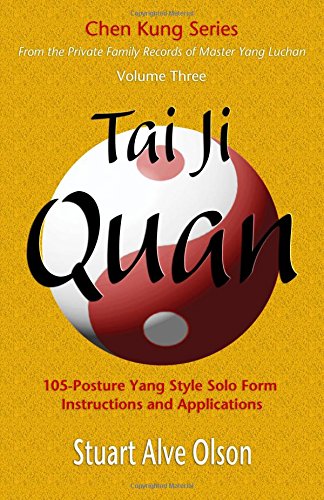
Tai Ji Quan: 105 Posture Yang Style Solo Form - Instructions and Applications. Chen Kung Series, From the Private Family Records of Master Yang Luchan, Volume Three. Translation and commentary by Master Stuart Alve Olson. Phoenix, Arizona, Valley Spirit Arts, 2017. Bibliography, appendices, 234 pages. ISBN: 978-1548105372. VSCL. "The long-awaited third volume in the Chen Kung Series presents the detailed instructions on the original Yang Style 105-Posture Taijiquan form, along with explanations of the practical self-defense applications, commentaries by Chen Kung, translations of the illustrations in the text, and notes by Stuart Alve Olson. A truly remarkable, insightful work that complements anyone’s library on the art of Taijiquan." "Born in 1906, Master Chen Kung (a.k.a., Yearning K. Chen and Chen Yen-lin) passed away in Shanghai, Chiina, in 1980. Master Chen Kung copied the Yang Family manuscripts in 1930."


Tuesday, December 19, 2017

Let It Go


"To study Tai Chi Chuan means to learn to relax," were his first words to my beginners' class, and it was his constant message.  "Relax.  Let go of all tension, all hardness.  Be soft.  Hardness is the discipline of death; softness is the discipline of life.  So, wherever you identify tension or hardness, let it go.  Relax completely.  This is what it means to study Tai Chi Chuan."

- The words of the Tai Chi Chuan Master Cheng Man-ch'ing, 1967. 
Gateway to the Miraculous: Further Explorations in the Tao of Cheng Man-ch'ing.  By Wolfe Lowenthal, p. 41.  


Gateway to the Miraculous: Further Explorations in the Tao of Cheng Man-ch'ing.  By Wolfe Lowenthal.  Berkeley, California, North Atlantic Books, Frog Ltd., 1994.  124 pages.  ISBN: 1883319137.  Wolfe Lowenthal was a student of Cheng Man-ch'ing from 1967-1975; and later taught Taijiquan at the Long River Tai Chi Circle.  VSCL. 


Relax (Sung) in Tai Chi Chuan
Relaxed, Loosened, Soft, Released
Bibliography, Links, Quotes, Notes, Resources, Instructions.
A hypertext notebook by Michael P. Garofalo.


Valley Spirit Taijiquan, Vancouver, Washington

Cloud Hands Taijiquan


"If we want to fold something up, we must first spread it out.
If we want to weaken something, we must first strengthen it.
If we want to get rid of something, we must first encourage it.
If we want to have something, we must first let it go.

This is called The Secret Wisdom:
That the soft and the weak shall overcome the hard and the strong."


- Dao De Jing, Chapter 36
  Translated by Roderic and Amy Sorrell, 2003


Thursday, May 12, 2016

Katastematic ... What?


"It would be a condition of no pleasure and no pain classifiable as kinetic, but it would by no means be a condition of no pleasure and no pain at all. It would in fact be a condition of pleasure arising from the simple, undisturbed, undistracted, awareness of oneself, and of one's openness to the world through specific sensory inputs, but without being currently engaged with any. It would be an active awareness of one's constitution as a particular sort of animal—a constitution for such sensory engagement. And, one would not be experiencing this pleasant awareness unless one's condition were one of normal healthiness and ongoing natural functioning: if one's condition were not such, one would be experiencing some disturbing movements in one's consciousness—unhealthy or disturbed and distorted functioning is just what does cause kinetic pain. Accordingly, to pleasure arising in this second set of circumstances for the arousal of pleasure, Epicurus gave the name "katastematic," drawing upon a Greek term for a condition or state, or for the constitution, of a thing. It is called "katastematic" not so to indicate a special kind of pleasure, any more than kinetic pleasures are a kind of pleasure, but rather so as to draw attention to the special circumstances of pleasure's arousal, on which it is conditioned, in the case of this pleasure. We would describe this pleasure as pleasure in the awareness of the healthy functioning of one's own natural constitution, physical and psychic."
- John M. Cooper, Pursuits of Wisdom, 2012, p. 234


"For Epicurus, the only criterion for deciding on one's way of life is what will work out best form the point of view on one's own pursuit of a continuous experience of katastematic pleasure, varied suitably so as to conform to one's own, perhaps somewhat idiosyncratic, preferences among sources of kinetic pleasure."
- John M. Cooper, Pursuits of Wisdom, 2012, p. 263


Epicureanism
Notes, bibliography, resources. Research notes by Mike Garofalo.


Friday, May 06, 2016

Relax and Drop the Bags


"I have been practicing Tai-Chi Chuan for over fifty years. Only two years ago that I started to understand the word “relax”. I remember my Tai-Chi Chuan teacher Yang Cheng-Fu who did not like to talk much and he used to sit all day without saying a word if no one asked him questions. However, in our T’ai-chi class he would tell us to “relax” repeatedly. Sometimes it seemed like he would say the word hundreds of times during the practice so that the word could fill up my ears. Strangely enough he also said that if he did not tell me of this word that I would not be able to learn T’ai-chi in three life-times (meaning never). I doubted his words then. Now that I think back, I truly believe that if he did not keep reminding me of the word “relax”, I doubt if I could have learned T’ai-chi Chuan in six life-times.

What is the meaning of “relax” in T’ai-chi? Here is an example to help you understand the word. When we go visit a Buddhist temple we usually see a statue of Me-Lo Buddha. The one who has a big rounded stomach with a big smile on his face. He carries a large bag on his shoulder. On top of this statue we see a motto: “Sit with a bag. Walk with a bag. It would be such a relief to drop the bag.” What does all this mean? To me, a person himself or herself is a bag. Everything he or she owns is baggage, including one’s children, family, position and wealth. It is difficult to drop any of one’s baggage, especially the “self” bag.

T’ai-chi Chuan is difficult to learn. To relax in practicing T’ai-chi Chuan is the most difficult phase to go through. To relax a person’s mind is the most significant obstacle to overcome in practicing T’ai-Chi. It takes a great effort to train and exercise one’s mind to relax (or drop one’s “self” bag)."
-  Professor Cheng Man-ch'ing


I think it takes somewhat of a Stoic or Buddhist attitude to view one's children, family, position and wealth, and self as "baggage."  I favor an Epicurean view regarding these generally pleasant aspects of our life - namely as a means to ongoing pleasures derived from kinetic (movement) activity and interactions, social and intellectual conviviality, natural healthy functioning, and katastematic awareness.   


Chinese Medical Doctor, Author, Painter, Taijiquan Master