Showing posts with label Philosophical Poetry. Show all posts

Tuesday, August 18, 2026

The Poetic Investigations: Time: The Tick-Tock Tractatus by Mike Garofalo

The Tick-Tock Tractatus

Speaking About Time: The Poetic Investigations

By Michael Peter Garofalo, mpgarofalo, .m.p.g.


Sections

1. Time: time-space, movement, measurement

2. Past: memories, habits, fixed, specific, tradition

3. Present: now, here-now, day, duration

4. Future: maybe, planned, anticipated, uncertain

5. Passing: change, cycles, aging, growth, death

6. Beginning: renewal, starting, enthusiasm

7. Psychology: learning, experience, knowing

8. Middle: in progress, half-way, steady, living

9. Language: poetry, philosophy, ordinary

10. Silence: inexpressive, nonsense, illogical

11. Mystical: numinous, profound, intense, insightful,

12. Beauty: art, crafts, music, reading/writing

13. Social: ethics, morality, economics, manners, value

14. Philosophy: ethics, history, analysis, arguments, logic

15. History: landmark events, books/printing, memory

16. Eternity: forever, infinite, unimaginable, death


Preface

Key to Books Cited

Bundled Up Quintains about Time

Additional Notes


Tuesday, August 04, 2026

Tao Te Ching by Lao Tzu, Chapter 21

Daodejing, Laozi
Chapter 21


"A virtuous person comes into being only according to the Tao.
Tao is something which is obscure and indistinct.
Indistinct and obscure —
yet there is an appearance.
Obscure and indistinct —
yet there is a substance.
Vague and dim —
yet there is an essence within it.
This essence is genuine.
There is truth within it.
Since ancient times until now, its name never forsaken,
it stands there to guard all the good deeds.
How do I know all the good deeds are guarded by this Tao?
I know.
-  Translated by Chao-Hsiu Chen, 2004, Chapter 21  


"The grandest aspects of producing force
Find Tao their energizing way and source;
In Tao things move unseen, impalpable,
Yet in it form and semblance brood and dwell;
Impalpable, invisible, yet things
Float forth within on transcendental wings;
Dark and profound, yet lo! within it there,
Are the pure essences which aeons bear;
It holds the truth, it keeps its ancient name,
And watches all that from the beginning came;
From the Beginning! How know I this is so?
By this, it is the Tao, by this I know!"
-  Translated by Isaac Winter Heysinger, 1903, Chapter 21


"The impression made by magnificent Te comes only from Tao.
Tao is a something but elusive, but evasive.
Evasive, elusive, inside it lies the mind's true form.
Elusive, evasive, inside it lies something substantial.
Shadowy, dim.
Inside it lies vital energy.
This energy is very strong inside it lies true genuineness.
From ancient times until today
Its name has not been forgotten allowing us to see the beginnings of everything.
How do I recognize the form of the beginnings of everything?
By this low in the cycle of Change, which is Love and Beauty.
How do I know this?
By my comprehension of the Dao."
-  Translated by Michael LaFargue, 1992, Chapter 21  


"The complete manifestation of things visible proceeds only from Life.
In its nature Life is always coming into activity, yet in itself it eludes our sight and tough.
Eluding sight! eluding touch!
Within it are hid the plane of created things.
Eluding touch! eluding sight!
Within it are hid all created beings.
It is profound! It is obscure!
Within it is hid pure Spirit.
It is pure Spirit, enfolding Truth!
Within it is hid an infallible witness.
Free of Old until Now
Its Name remains unchanged.
Through its Doorway comes the Universe into existence.
How do I know that the Universe is coming to full perfection through Life?
The witness is in Life itself."
-  Translated by Isabella Mears, 1916, Chapter 21 


孔德之容, 唯道是從.
道之為物, 唯恍唯惚.
惚兮恍兮, 其中有象.
恍兮忽兮, 其中有物.
窈兮冥兮, 其中有精.
其精甚,  其中有信.
自古及今其名不去.
以閱衆甫.
吾何以知衆甫之狀哉.
以此.

-  Chinese characters, Tao Te Ching, Chapter 21


k'ung tê chih jung, wei tao shih ts'ung.
tao chih wei wu, wei huang wei hu.
hu hsi huang hsi, ch'i chung yu hsiang.
huang hsi hu hsi, ch'i chung yu wu.
yao hsi ming hsi, ch'i chung yu ching.
ch'i ching shên, chên ch'i chung yu hsin. 
tzu ku chi chin ch'i ming pu ch'ü.
yi yüeh chung fu.
wu ho yi chih chung fu chih jan tsai.
yi tz'u.
-  Wade-Giles Romanization, Tao Te Ching, Chapter 21


"The great virtue as manifested is but following the Tao.
Tao is a thing that is both invisible and intangible.
Intangible and invisible, yet there are forms in it;
Invisible and intangible, yet there is substance to it;
Subtle and obscure, there is essence in it;
This essence being invariably true, there is faith in it.
From of old till now, it has never lost its nameless name,
Through which the origin of all things has passed.
How do I know it is so with the origin of all things?
By this Tao."
-  Translated by Ch'u Ta-Kao, 1904, Chapter 21 


"One of deep virtue cherishes the subtle essence of the universe.
 The subtle essence of the universe is elusive and evasive.
 Though it is elusive and evasive,
 it unveils itself as images and forms.
 Evasive and elusive,
 it discloses itself as indefinable substance.
 Shadowy and indistinct,
 it reveals itself as impalpable subtle essence.
 This essence is so subtle, and yet so real.
 It is the subtle origin of the whole of creation and non-creation.
 It existed prior to the beginning of time as the single deep and subtle reality of the universe.
 It brings all into being."
 -  Translated by Ni Hua Ching, 1995, Chapter 21


"La virtud se expresa siguiendo al Tao.
Tao es evasivo e intengible
Pero expresa toda forma y sustancia;
Tao es oscuro y sútil
Pero expresa toda la Naturaleza;
La Naturaleza no cambia,
Pero expresa toda sensación.
Desde antes del conocimiento
El Tao ha expresado todas las cosas.
¿Cómo puedo saber?
Confiando en mis sentidos." -  Translated by Antonio Rivas, 1998, Chapter 21 


"In his every movement a man of great virtue
Follows the way and the way only.
As a thing the way is
Shadowy and indistinct.
Indistinct and shadowy,
Yet within it is an image;
Shadowy and indistinct,
Yet within it is a substance.
Dim and dark,
Yet within it is an essence.
This essence is quite genuine
And within it is something that can be tested.
From the present back to antiquity,
Its name never deserted it.
It serves as a means for inspecting the fathers of the multitude.
How do I know that the fathers of the multitude are like that?
By means of this."
-  Translated by D. C. Lau, 1963, Chapter 21  


"The mightiest manifestations of active force flow solely from Tao.
Tao in itself is vague, impalpable, how impalpable, how vague!
Yet within it there is Form.
How vague, how impalpable!
Yet within it there is Substance.
How profound, how obscure!
Yet within it there is a Vital Principle.
This principle is the Quintessence of Reality, and out of it comes Truth.
From of old until now, its name has never passed away.
It watches over the beginning of all things.
How do I know this about the beginning of things?
Through Tao."
-  Translated by Lionel Giles, 1905, Chapter 21 


"The features (yung) of the vast (k'ung) Te,
Follows entirely (wei) from Tao.
Tao as a thing,
Is entirely illusive (huang) and evasive (hu).
Evasive and illusive,
In it there is image (hsiang).
Illusive and evasive,
In it there is thinghood (wu).
Dark and dim,
In it there is life seed (ching).
Its life seed being very genuine (chen),
In it there is growth power (hsin).
As it is today, so it was in the days of old (ku),
Its name goes not away (ch'ü),
So that we may survey (yüeh) the origins of the many (chung fu).
How do I know that the origins of the many are such?
Because of this."
-  Translated by Ellen Marie Chen, 1989, Chapter 21


"For effective contrast, this chapter is best read together with chapter 14.  Both chapters call Tao, the illusive and evasive (hu-huang), i.e., the primal Chaos or Hun-tun described in chapter 25.  In chapter 14, Tao recedes and becomes the nothing; here in chapter 21 the same illusive and evasive Tao moves forward to become the realm of beings.  There Tao is nameless; here Tao is the name that never goes away.  There Tao is the formless form, the image of nothing; here Tao contains the seeds and images of all beings that are to be.  The dominant character of Tao in chapter 14 is wu, nothing; in this chapter it is yu, being or having.  The conclusion of chapter 14 traces Tao to the beginning of old; this chapter arrives at the realm of the many in the now."
-  Ellen M. Chen, The Tao Te Ching: A New Translation with Commentary, 1989, p.107


Chapter and Thematic Index (Concordance) to the Tao Te Ching


Taoism: A Selected Reading List


A typical webpage created by Mike Garofalo on each one of the 81 Chapters of the Tao Te Ching (Daodejing) by Lao Tzu (Laozi) includes over 25 different English translations or interpolations of each Chapter, 5 Spanish translations for each Chapter, the Chinese characters for each Chapter, and a Wade-Giles and Hanyu Pinyin Romanization of the Mandarin Chinese words for each Chapter; indexing by key words and terms for each Chapter in English, Spanish, and the Wade-Giles Romanization; recommended reading in books and websites, a detailed bibliography, some commentary, research leads, translation sources, and other resources for each Chapter. 


Sunday, May 31, 2026

Treasury of the True Dharma Eye by Zen Master Dogen

Zen Master Eihei Dogen Zenji (1200-1253) 
Japanese founder of Soto Zen School Tradition.
Teacher, abbot, essayist, poet, Zen philosopher
His collected works are called The Treasury of the True Dharma Eye, Shobogenzo.

I first read Dogen's works in the book Moon in a Dewdrop translated by Kazuaki Tanahashi (1995, 368 pages); and in the book Rational Zen: the Mind of Dogen Zenji translated by Thomas Clearly (2001, 232 pages.)

I have read, studied, and adopted much from my study of Zen Buddhist literature since I was 14 years old.  I am a philosopher, but I have a interest in Taoism, and associated practices like some in Zen Buddhism.

Gudo Nishijima and Chodo Cross's four volume translation of the Treasury of the True Dharma Eye, Shobogenzo in 2021.

Unfortunately, the Kindle Version of Nishijima is very poor, and cheap ($7.00), so I purchased the paperback copies at $18.00 - $27.00 each.  

The new Kazuaki Tanahashi Kindle version of the Treasury of the True Dharm Eve, Shobogenco (2013, 1280 pages) is excellent, at a cost of $60.00.  The hardbound version is $75.00, very heavy, big, like a large family Bible on a coffee table.  So, I'll purchase one volume of Nishijima's translation per month at $25.00 each.  And, then get Tanahashi in the Kindle version as money permits.


Here is an 2008 Amazon review by by Ted Beriginer of Gudo Nishijima and Chodo Cross's four volume translation of the Treasury of the True Dharma Eye, Shobogenzo in 2021.


"If you have not read Books 1 through 4 of this translation of the 95 chapter edition of Shobogenzo, do it now! If you have read them, do it again!

Gudo Nishijima and Mike (Chodo) Cross's four volume translation of the 13th century Zen master Eihei Dogen's masterpiece marked the first English language translation of the entire 95 chapter version of Shobogenzo - The True Dharma-Eye Treasury (excepting the nearly useless translation by Kosen Nishiyama and John Stevens).

By opting for a more "literal" rather than "interpretive" rendition, the translators have realized a monumental achievement by furnishing English readers with a reliable text that is certain to be invaluable for generations.

This set is also packed with a wide selection of reference material, or "Aids to the Reader", including a translation of The Heart Sutra, Dogen's Fukanzazengi, and a generous selection of passages from the Lotus Sutra, Glossaries, a variety of tables offering data on everything from The Works of Dogen, to equivalents of Chinese/Japanese/Sanskrit/English.

The extensive footnotes, while occasionally offering some overly "interpretive" (read: sectarian), provide readers with a vast amount of supplemental information with lucid explanations concerning cultural context, alternate readings, sources for material quoted in the body of the text, biographical (historical and traditional) information on personages appearing in the text, and much more.


Book 1 - Table of Contents

[1] BENDOWA - A Talk about Pursuing the Truth

[2] MAKA-HANNYA-HARAMITSU - Maha-prajna-paramita

[3] GENJO-KOAN - The Realized Universe

[4] IKKA-NO-MYOJU - One Bright Pearl

[5] JU-UNDO-SHIKI - Rules for the Hall of Heavy Cloud

[6] SOKU-SHIN-ZE-BUTSU - Mind Here and Now Is Buddha

[7] SENJO - Washing

[8] RAIHAI-TOKUZUI - Prostrating to Attainment of the Marrow

[9] KEISEI-SANSHIKI - The Voices of the River-Valley and the Form of the Mountains

[10] SHOAKU-MAKUSA - Not Doing Wrongs

[11] UJI - Existence-Time

[12] KESA-KUDOKU - The Merit of the Kasaya

[13] DEN-E - The Transmission of the Robe

[14] SANSUIGYO - The Sutra of Mountains and Water

[15] BUSSO - The Buddhist Patriarchs

[16] SHISHO - The Certificate of Succession

[17] HOKKE-TEN-HOKKE - The Flower of Dharma Turns the Flower of Dharma

[18] SHIN-FUKATOKU - Mind Cannot Be Grasped [The former]

[19] SHIN-FUKATOKU - Mind Cannot Be Grasped [The latter]

[20] KOKYO - The Eternal Mirror

[21] KANKIN - Reading Sutras


Book 2 - Table of Contents

[22] BUSSHO - The Buddha-nature

[23] GYOBUTSU-YUIGI - The Dignified Behavior of Acting Buddha

[24] BUKKYO - The Buddha's Teaching

[25] JINZU - Mystical Power

[26] DAIGO - Great Realization

[27] ZAZENSHIN - A Needle for Zazen

[28] BUTSU-KOJO-NO-JI - The Matter of the Ascendant State of Buddha

[29] INMO - It

[30] GYOJI - [Pure] Conduct and Observance [of Precepts] - Parts 1 & 2

[31] KAI-IN-ZANMAI - Samadhi, State Like the Sea

[32] JUKI - Affirmation

[33] KANNON - Avalokitesvara

[34] ARAKAN - The Arhat

[35] HAKUJUSHI - Cedar Trees

[36] KOMYO - Brightness

[37] SHINJIN-GAKUDO - Learning the Truth with Body and Mind

[38] MUCHU-SETSUMU - Preaching a Dream in a Dream

[39] DOTOKU - Expressing the Truth

[40] GABYO - A Picture of Rice Cake

[41] ZENKI - All Functions


Book 3 - Table of Contents

[42] TSUKI - The Moon

[43] KUGE - Flowers in Space

[44] KOBUSSHIN - The Mind of Eternal Buddhas

[45] BODAISATTA-SHISHOBO - Four Elements of a Bodhisattva's Social Relations

[46] KATTO - The Complicated

[47] SANGAI-YUISHIN - The Triple World is Only the Mind

[48] SESSHIN-SESSHO - Expounding the Mind & Expounding the Nature

[49] BUTSUDO - The Buddhist Truth

[50] SHOHO-JISSO - All Dharmas are Real Form

[51] MITSUGO - Secret Talk

[52] BUKKYO - The Buddhist Sutras

[53] MUJO-SEPPO - The Non-Emotional Preaches the Dharma

[54] HOSSHO - The Dharma-nature

[55] DARANI - Dharani

[56] SENMEN - Washing the Face

[57] MENJU - The Face-to-Face Transmission

[58] ZAZENGI - The Standard Method of Zazen

[59] BAIKE - Plum Blossoms

[60] JUPPO - The Ten Directions

[61] KENBUTSU - Meeting Buddha

[62] HENSAN - Thorough Exploration

[63] GANZEI - Eyes

[64] KAJO - Everyday Life

[65] RYUGIN - The Moaning of Dragons

[66] SHUNJU - Spring and Autumn

[67] SOSHI-SAIRAI-NO-I - The Ancestral Master's Intention in Coming from the West

[68] UDONGE - The Udumbara Flower

[69] HOTSU-MUJOSHIN - Establishment of the Will to the Supreme

[70] HOTSU-BODAISHIN - Establishment of the Bodhi-mind

[71] NYORAI-ZENSHIN - The Whole Body of the Tathagata

[72] ZANMAI-O-ZANMAI - The Samadhi That Is King of Samadhis

[73] SANJUSHICHI-BON-BODAI-BUNBO - The Thirty-seven Auxiliary Bodhi Methods

[74] TEMBORIN - Turning the Dharma Wheel

[75] JISHO ZANMAI - Samadhi as Self Experience

[76] DAI SHUGYO - Great Practice

[77] KOKU - Space

[78] HATSU-U - The Patra

[79] ANGO - The Retreat

[80] TASHINTSU - The Power to Know Others' Minds

[81] O SAKU SENDABA - A King's Seeking of Saindhava

[82] JI-KUIN-MON - Sentences To Be Shown in the Kitchen Hall

[83] SHUKKE - Leaving Family Life

[84] SANJI-NO-GO - Karma in Three Times

[85] SHIME - The Four Horses

[86] SHUKKE-KUDOKU - The Merit of Leaving Family Life

[87] KUYO-SHOBUTSU - Serving Offerings to Buddhas

[88] KIE-SANBO - Taking Refuge in the Three Treasures

[89] SHINJIN-INGA - Deep Belief in Cause and Effect

[90] SHIZEN-BIKU - The Bhiksu in the Fourth Dhyana

[91] YUI-BUTSU-YO-BUTSU - Buddhas Alone, Together With Buddhas

[92] SHOJI - Life-and-Death

[93] DOSHIN - The Will to the Truth

[94] JUKAI - Receiving the Precepts

[95] HACHI-DAININGAKU - The Eight Truths of a Great Human Being

[Appendix 1] BUTSU-KOJO-NO-JI - The Matter of the Ascendant State of Buddha."


Sunday, April 26, 2026

Tick-Tock Tractatus, Section 12.6

 A Gardener's Sutra on Time

By mpgarofalo

The Tick-Tock Tractatus, Section 12.6

The Tick-Tock Tractatus

Speaking About Time: The Poetic Investigations

By Michael Peter Garofalo, mpgarofalo, .m.p.g.


Sections

1. Time: time-space, movement, measurement

2. Past: memories, habits, fixed, specific, tradition

3. Present: now, here-now, day, duration

4. Future: maybe, planned, anticipated, uncertain

5. Passing: change, cycles, aging, growth, death

6. Beginning: renewal, starting, enthusiasm

7. Psychology: learning, experience, knowing

8. Middle: in progress, half-way, steady, living

9. Language: poetry, philosophy, ordinary

10. Silence: inexpressive, nonsense, illogical

11. Mystical: numinous, profound, intense, insightful,

12. Beauty: art, crafts, music, reading/writing

13. Social: ethics, morality, economics, manners, value

14. Philosophy: ethics, history, analysis, arguments, logic

15. History: landmark events, books/printing, memory

16. Eternity: forever, infinite, unimaginable, death


Preface

Key to Books Cited

Bundled Up Quintains about Time

Additional Notes


12.6

Pulling Onions

By Michael P. Garofalo


Pulling Onions

Speaking of Time: The Poetic Investigations, Part 2
Another Crop of Gardening Thoughts
A Gardener's Sutra on Time, Part 2.1

Red Bluff, California
1998 - 2017
By: .m.p.g.
michael p garofalo


A Gardener's Sutra on Time
by mpgarofalo


A garden recreates itself daily; we seldom
     step into the same garden thrice.

The present is made from the past.
Time creeps, walks, runs and flies---
     it is all about moving things.
Chaos breaks its own rules to allow Order to play.


How can gardening be considered
     a "leisure time" activity?
Always leave extra time for unraveling the hose.

Gardeners turn into the soil their lifetime.
Time may wait for no man,
     but seems to muddle and poke
     quite slowly for gardeners.

Springtime for birth, Summertime for growth;
     and all Seasons for dying.
We don't erase the past, we just build more
     and bigger blackboards.


Put the right plant in the right place at the right time in
     the right way - and you won't go wrong.
Winter does not turn into Summer; ash does not turn
     into firewood - on the chopping block of time.
A garden flourishes in the mind's time of last season,
     next season, and now.
Gardening requires no commuting time.
In the right place at the right time,
     tomato worms on tomato vines.


The Onion Garden, a concrete poem by .m.p.g.


Your pocket knife will be its dullest at just the right time.
Gardening is the right sport for a lifetime of pleasures.
Gardening sometimes takes a few hours of a day,
     but adds weeks of pleasure to your life.
The time you have wasted on your garden
     is what makes it priceless.
One purpose of a garden is to stop time in one place.


Annuals disappear, shrubs perish, trees die, and
     gardeners are buried; death is the flower of time.
In an instant there is nothing - Time produces Nature.
By the time you peel off five layers of reality,
     it's hard to recall the first.
It's a long time between my garden
     and the Pacific Ocean.
Time will tell, but we often fail to listen.


The "eternal truths" are sometimes clearly false.
Gardening teaches us to take our time, slow down,
     and wait in peace.
Gardeners learn to live in worm time,
     bee time, and seed time.
Time will not pass you, but it will follow
     very close behind you.
Preparation and follow up take up
     more time than doing the deed.

Springtime flows in our veins.
Silence - never misquoted, sometimes misunderstood,
     often meaningful.
Leave enough time for some pointless behavior
     to reveal your deeper desires.
The seed idea for "God" is springtime.
Things always go downhill, fall apart, wear out...
     the arrow of Time pierces everything.


Time prevents too much from happening at once.
A million years and a second have the same
     feeling for the dead gardener.
All metaphors aside - only living beings rise up in the Springtime;
     dead beings stay quite lie down dead.
Any gardener who is not using the scientific method
     will waste time and money.
Take the time to melt into the Details.

Time is rooted in Place.
Most of the time, we just borrow from the past.
Sometimes the present alters our interpretation of the past;
     most often the past surrounds and infects the present.
Time is on your side when you are young.
Leisure can open a window to the breezes of insights,
     and a clear view of the Trees of Time.


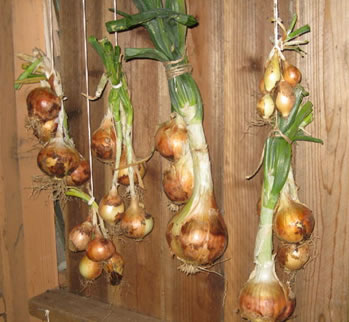
Harvesting Onions 2006
Red Bluff, California
.m.p.g.


We get things done when there is little time left.
Our cash limits and time constraints both prune our gardens.
The second hand of time ticks on---
     measuring our past, time after time.
Beings are Becomings---for the time-being.

Perfection can be the opponent of betterment.
Without vagueness we are bored with literalness.
Borderline cases are where events become really interesting.
I may not be able to precisely define religious nonsense,
     but I know it when I hear it.

A coastline may be impossible to measure,
     but is still beautiful.
You can’t slowly boil the frog unless
     it can’t jump out of the pot.
A “heap” of something desired becomes an issue
     when the price is discussed.
Gratefully, shit happens!
The ten thousand things are more enchanting
     than the Silent One.


Walking needs earth, space, and the walker.
Sometimes, just one 'thing' is critical
     because twenty other 'things' are just so.
Gardening is a kind of deadheading---
     keeping us from going to seed.
Don't interfere, be still, and listen to the litanies of bees.

Tooth and nail, and the stench of a dead animal on the wind.
When life gives you onions, it stinks.
A rake is spaces held together by steel.
In the student's mind there are few possibilities,
     in the teacher's mind there are many;
          but only time to realize very few.


Mother Nature is always pregnant.
Time creeps, walks, runs and flies -
     it is all about moving things.
Dogmatists are less useful than dogs.
Take life with a grain of salt, and a icy margarita.
The best things in life are more expensive than you think.


Rather than "love mankind," I'd rather admire a few good people.
Some flourish when crowded together, others don't.
Garbage In, Compost Out.
It is more about You and Now, rather than Them and Back Then.


While gardening the borders between work
     and play become blurred.
When gardening, look up more often.
Just the right words can be worth more
     than a thousand pictures.
Death's door is always unlocked.
A flower needs roots; beauty a society of minds.


A callused palm and dirty fingernails precede a Green Thumb.
A working hypothesis is far better than a belief.
Only two percent of all insects are harmful.
Why are they all in my garden?


Create your own garden, the god's certainly won't.

{{{ Karen Garofalo, Red Bluff, CA, 1999-2016.
We purchased $300 to $400 every year
on trees and shrubs; and we planted them
mostly in January or February. We sold our
house and property to two working women
with four children. I hope these children had
wonderful memoriers of growing up in the
gardens and orchards that Karen and I made
before April of 2017 . }}}

The Spirit of Gardening

That something is eternal is unverifiable.

Most laws of Gardening are merely local ordinances.

Too save some time, don’t let them get a foot in the door.
Some slippery slopes are actually improvements or fun.
Butterflies and bees flapping their wings don’t actually
     create hurricanes, but we are very thankful they facilitate
     the emergence of fruits in the billions.
Without metaphors we can barely speak.


Just because you reject the big request, don’t be
     fooled into accepting the smaller request.
Finding a middle ground for agreement may
     be just half of a solution, and the wrong solution.
Sometimes the wisdom of the crowd is quite unwise and unfair.

Chaos breaks its own rules to allow Order to play.

Failures, disorder and death are the
     Grim Reaper of Entropy at work.
Somehow, someway, everything gets eaten up, someday.
The meaning is lost in the saying - a nature mystic's dilemma.
Vigorous gardening might help more than a psychiatrist's couch.
A gardener is no farmer, he is much too impractical.

No garden lasts for long - neither will you.

Shade, in the summer, is as precious as a glass of water.
A wise gardener knows when to stop.
Gardens are demanding pets.
Unclench your fist to give a hand.
The little choices day after day are the biggest issue.


Gardening is but one battle against Chaos.
When life gives you onions, you ain't making lemonade.
Many friendships are sustained by a mutual
     hatred of another person or group.
Read until you go to seed.
What you see depends on when you look.

Beauty is the Mistress, the gardener her slave.

One's "true self" is changing and elusive.
A little of this and a little of that, and some exceptions -
     these are the facts.
Does a plum tree with no fruit have Buddha Nature? Whack!


Pulling Onions by Mike Garofalo
     Over 1,000 random quips, one-liners, aphroisms, sayings,
     bullets, onions, and "insights" from an old gardener.

Speaking of Time: The Poetic Investigations, Part 2

The History of Gardening
A Timeline From Ancient Times to 2000

The Spirit of Gardening

Months and Seasons

The Green Way

Speaking of Time: The Poetic Investigations, Part 1


Sunday, April 19, 2026

Poetry About Time: The Investigations

The Tick-Tock Tractatus

Speaking About Time: The Poetic Investigations

By Michael P. Garofalo


        August Offerings, Red Bluff CA, 2010, MPG


Sections

1. Time: time-space, movement, measurement

2. Past: memories, habits, fixed, specific, tradition

3. Present: now, here-now, day, duration

4. Future: maybe, planned, anticipated, uncertain

5. Passing: change, cycles, aging, growth, death

6. Beginning: renewal, starting, enthusiasm

7. Psychology: learning, experience, knowing

8. Middle: in progress, half-way, steady, living

9. Language: poetry, philosophy, ordinary

10. Silence: inexpressive, nonsense, illogical

11. Mystical: numinous, profound, intense, insightful,

12. Beauty: art, crafts, music, reading/writing

13. Social: ethics, morality, economics, manners, value

14. Philosophy: ethics, history, analysis, arguments, logic

15. History: landmark events, books/printing, memory

16. Eternity: forever, infinite, unimaginable, death


Preface

Key to Books Cited

Bundled Up Quintains about Time

Additional Notes


7.   Psychology: experience, learning,
      phenomenology, sense of time, personal


7.1
Generalities, Questions, Quips

What you see depends on when you look.
What you hear requires you to listen now.

Time is our 6th Sense.

The Specious Present extends consciousness
to include a pinch of the past,
a pinch of the future,
and the fullness of the now.

Give awareness a 5 second window
for processing perceptions.

Afraid to run out of time.
He had time on his hands, then dropped it.

Your brain works on time schedules.

"The quality of attention determines
the nature of the experience."
Joanne Kyger

BU794, GC§14

The Five Senses


7.2
Using vs Knowing

We knew that water was essential,
but did not know it was H2O;
We knew the sun was hot,
but had no concept of nuclear.
It works but we don't know how or why.

BU2930

History of Science


7.2.1
Unfolding Time

     Implicate orders of a
Underlying Reality
Unfolding Being... and the
     Explicate orders of
ordinary common things.

BU1149, GC§7

David Bohm

Net of Indra


7.3.1
End Game

They ran out of time
The game ended on time
They lost this time.
They all got back to the bus in time.
They will do better next time.

BU2835


7.3.1.1
The Game of Death

I'm too old
for any real Destiny
except for Death
creeping up to me, tagging Me:
"Your It!"

BU891, GC§36


7.3.1.2
Impermanence of Samsara

Samsara is Nirvana?
10,000 Things are Nothing?
Past and future are gone (Empty?).
The Present is gone in a Flash.
What's left? Samsara won't last.

BU918


7.3.1.3
Silent Lips

          The sting of Death,
the sharp pains of unseeing,
the final closing of the eyes,
the silent lips of emptiness...
faces lost forever in future times.

BU1246


7.3.2
Better Next Month

That such and such is the case
May piss me off for all the day
Why should it be this damn way?

Next month, such and such will not be the case.
I will be very pleased come that day.

BU3431

Quintain Poetry

Time Explained: Experience, Consciousness and Relativity.
By Alan Bennett, 2026.

Reading Wittgenstein 1975-


7.3.2.1
Timely Emotions

Emotions cluster around Immediacy.
Distant futures lack emotional density.
We feel very little about 2222 CE.
Few have any passion for far distant unrealities.
We lust after, say, Hot SEX Today! Fuck the Future!

BU3371

Emotions and Time


7.3.3
Take it Slow

Travel light
Even yesterday is a heavy backpack.
Travel slowly
Even tomorrow can wait---
Move on, don't hesitate.

BU2890

Time, Change, Freedom:
An Introduction to Metaphysics

By Nathan Oaklander


7.3.4
Differences and Distinctions

Things that look the same
are often really different---
in a web of new respects as to usage
in a web of words wedded meanings
in a different place in space/time.

BU2968

Appearances


7.3.5
Time Snuck By

The time sauntered by
invisibly, casually, punctually...
I barely noticed.
so busy with pressing deeds---
time flew by in a gentle breeze.

BU3083

"... time is not a linear flow, as we think it is,
into past, present, and future. Time is an
indivisible whole, a great pool in which all
events are eternally embodied and still have
their meaningful flash of super-normal or
extra-sensory perception, and a glimpse of
something that happened long ago in our
linear time."
- Frank Waters, Mountain Dialogues, 1981


7.3.5.1
The Time of Inner Mind

Under the Water
of my mind
an unconscious Sea
of Memories
guide me through time

Keep me on a course line
send me some signs
become conscious at times...
freedom may a fiction be
controlled by unknown destinies.

Bring the Unconscious,
Sub-Conscious, ego, and Id,
Collective Unconscious figured in—
Over the waves of Consciousness
the flotsam of Unknowns are adrift.

BU9

The Gushen Grove Sonnets

The Five Senses