Showing posts with label Brain. Show all posts

Sunday, March 15, 2026

Feldenkrais Techniques

A repost from February 2018:

I have taken 9 Feldenkrais' introductory 90 minute group classes from a local Feldenkrais practitioner, Christine Toscano.  I also practice this method alone at home.  I have also read a number of books on the subject.


Mrs. Toscano recommended we read Chapter 5 of the book by Norman Doidge, M.D., "The Brain's Way of Healing: Remarkable Discoveries and Recoveries from the Frontiers of Neuroplasticity," (Penguin Books, 2016). The chapter covers the life and work of Moshe Feldenkrais (1904-1984).  He was a Ph.D. engineer, kudo master, movement therapist, author, and healer. The chapter discusses some of the core principles of his theory and methods as follows:

"1. The mind programs the functioning of the brain.
2. A brain cannot think without motor function.
3. Awareness of movement is the key to improving movement.
4. Differentiation: making the smallest possible sensory distinctions between movements - builds brain maps.
5. Differentiation is easiest to make when the stimulus is smallest.
6. Slowness of movement is the key to awareness, and awareness is the key to learning.
7. Reduce the effort whenever possible. Relax.
8. Errors are essential, and there is no right way to move, only better.
9. Random movements provide variation that leads to developmental breakthroughs.
10. Even the smallest movement in one part of the body involves the entire body.
11. Many movement problems, and the pain that goes with them, are caused by learned habit, not by abnormal structure." 


Awareness Through Movement.  Easy-To-Do Health Exercises to Improve Your Posture, Vision, Imagination and Personal Awareness.  By Moshe Feldenkrais.  HarperOne, Reprint edition, 2009.  192 pages.  ISBN: 978-0062503220.  VSCL. 

Awareness Heals: The Feldenkrais Method for Dynamic Health.  By Stephen Shafarman.  Da Capo Lifelong Books, 1997.  224 pages.  ISBN: 978-0201694697.  VSCL. 


The Brain's Way of Healing: Remarkable Discoveries and Recoveries from the Frontiers of Neuroplasticity.  By Norman Doidge, M.D..  Penguin Books, 2016.

Change Your Age: Using Your Body and Brain to Feel Younger, Stronger, and More Fit.  By Frank Wildman, Ph.D..  Da Capo Lifelong Books, 2010.  240 pages.  ISBN: 978-0738213637.  VSCL. 


Embodied Wisdom: The Collected Papers of Moshe Feldenkrais.  Edited by Elizabeth Beringer.  Foreword by David Zemach-Bersin.  North Atlantic Books, 1st Edition, 2010.  256 pages.  ISBN: 978-1556439063.  VSCL.  
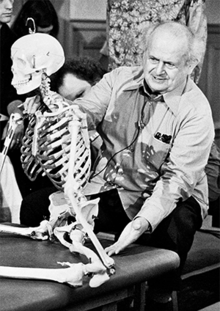


Moshe Feldenkrais.png


Sunday, October 12, 2025

One Picture of Me


One Picture of Me

By Mike Garofalo


When Laurence asked for poems on the theme of "Self-Portrait" I though of a long philosophical poem I wrote about the interrelated subjects of Picturing and Describing. 

One set of examples I used in that long poem was the human skull. I spoke of memories of Halloween in East Los Angeles, where Mexican Skulls, calaveras, filled displays on El Dia De La Muerte. Meaningful from artistic and religious perspectives.

The brief poem I'm sharing today is a excerpt about my own skull as Pictured by medical imaging, and described by me and interpreted by the oral surgeon.


"This bony skull of mine
electrified
pictured onscreen for me.
     Doctor recommends
     some oral surgery.

The brain disappeared,
an empty space
sliced from
X Ray images retraced.
Eyeless in inner space.

Monkey nose holes,
bony eye glasses,
teeth glowing in the dark.
     Inner spaces never seen
     underneath my very being.

Skinless, noseless, earless,
a shape, a form—
     the images informed.
Stripping away the unneeded,
revealing my inner core."


So, as we all know, a single picture or image can cause a flow of ideas, interpretations, and feelings in our minds.

Or, just two words can please, excite or inflame our minds. Our lover's name can explode our feelings.

But, just two other words can frighten our moral being.

For example, 

Donald Trump ...
[pause, raise your elbow]

Kick Him Out. 

See you on the street next Saturday.


The above "brief poem" will be printed in
The SkullCrushing Hummingbird
Zine #7
, in Portland, Oregon,
on 10/12/2025.


Commentary: Off the Cuff


So, considering, have you ever seen
a picture or a video or a drawing
of a Skull Crushing Hummingbird,
crushing an insect's Skull
with its tiny beak or flashing wings?

No, you have not,
and that is just one reason why,
you don't believe
that Skull Crushing Hummingbirds
are really alive.

However,
Words, context, technical knowledge,
and intent claim meaningfulness,
even truth,
in addition to any pictures viewed.
The surgeon and I see differently.

Sometimes, though, we reader's prefer
fantasies and fictional
Skull Crushing Hummingbirds
to any ho-hum boring beings-
a moniker for fun memories.


***********************


Pictures mirroring things
displaying aspects of reality
uncovering hidden realms of being
pointing to more clear correspondence.
Show me a good picture - Please!

We drew pictures in caves
Heroes pictured in statues
Books illustrated pictured facts
Drones picture our towns from above
Hubble sends us clear pictures of Space

Our brains are
Picture processing ... Machines-
and you can picture mindfulness
you can picture your intent verbally...
picturing is a form of meaningfulness.

Science and technology have
invented new ways of picturing
so we can see into Reality
and open our ordinary eyes
to new ways of seeing.

Picturing - Defining
Planning - Imagining
Painting - Photography
Reflecting - Mimicking
Do I see what I mean?

Wittgenstein in the Tractatus of 1921
Used Pictures and Picturing as the
criterion of meaningfulness and truth.
Wittgenstein in the Investigations of 1953
changed to talking about our talking
about, in ordinary words, aspects of Picturing.

The best pictures, the best descriptions,
how we talk in everyday ways,
point to correspondence, mirroring,
a theory of epistemology.
Richard Rorty disagreed.


**********************************


Bundled Up, Volume 1
Quintains, Pentastichs, Tankas

Gushen Grove Sonnets

Highway 101 and 1: A Docu-Poem
California, Oregon, Washington

25 Steps and Beyond
The Poetry by Mike Garofalo


Saturday, July 27, 2024

Benefits of Playing Music

The Benefits of Playing Music Help Your Brain
More Than Any Other Activity

By John Rampton, 2017

"Long-Lasting Benefits for Musicians

Brain-scanning studies have found that the anatomical change in musicians' brains is related to the age when training began. It shouldn't be surprising, but learning at a younger age causes the most drastic changes.

Interestingly, even brief periods of musical training can have long-lasting benefits. A 2013 study found that even those with moderate musical training preserved sharp processing of speech sounds. It was also able to increase resilience to any age-related decline in hearing.

Researchers also believe that playing music helps speech processing and learning in children with dyslexia. Furthermore, learning to play an instrument as a child can protect the brain against dementia.

"Music reaches parts of the brain that other things can't," says Loveday. "It's a strong cognitive stimulus that grows the brain in a way that nothing else does, and the evidence that musical training enhances things like working memory and language is very robust."

Other Ways Learning an Instrument Strengthens Your Brain

Guess what? We're still not done. Here are eight additional ways that learning an instrument strengthens your brain.

1. Strengthens bonds with others. This shouldn't be surprising. Think about your favorite band. They can only make a record when they have contact, coordination, and cooperation with one another.

2. Strengthens memory and reading skills. The Auditory Neuroscience Laboratory at Northwestern University states this is because music and reading are related via common neural and cognitive mechanisms.

3. Playing music makes you happy. McMaster University discovered that babies who took interactive music classes displayed better early communication skills. They also smiled more.

4. Musicians can process multiple things at once. As mentioned above, this is because playing music forces you to process multiple senses at once. This can lead to superior multisensory skills.

5. Music increases blood flow in your brain. Studies have found that short bursts of musical training increase the blood flow to the left hemisphere of the brain. That can be helpful when you need a burst of energy. Skip the energy drink and jam for 30 minutes.

6. Music helps the brain recover. Motor control improved in everyday activities with stroke patients.

7. Music reduces stress and depression. A study of cancer patients found that listening to and playing music reduced anxiety. Another study revealed that music therapy lowered levels of depression and anxiety.

8. Musical training strengthens the brain's executive function. Executive function covers critical tasks like processing and retaining information, controlling behavior, making decisions, and problem solving. If strengthened, you can boost your ability to live. Musical training can improve and strengthen executive functioning in both children and adults."

Wednesday, March 18, 2020

Reprogramming the Body and Brain


Change Your Age: Using Your Body and Brain to Feel Younger, Stronger, and More Fit.  By Frank Wildman, Ph.D..  Certified Feldenkrais Trainer.  Da Capo Lifelong Books, 2010.  Index, 214 pages.  ISBN: 978-0738213637.  VSCL. 

Karen and I have been doing many of the movement-awareness routines specified in this informative book.  

Moshe Feldenkrais (1904-1984)  Bibliography, Quotes, Biography

I attend a one hour class "Awareness Through Movement" on Wednesday  conducted by Christine Toscano in Vancouver, Washington.  

Saturday, February 23, 2019

Yoga and Mental Health

I attended a three hour workshop titled "Yoga for Mental Health" this Saturday.  The speaker was Eve Parker, LICSW and Yoga Teacher.

Ms. Parker provided a good overview of brain functioning, neurotransmitters, triggers, hyper and hypo responses to stress or trauma, healthy lifestyle choices, self-help and treatment options for types of mental health issues, balance, hierarchy of needs, coping skills, yoga practices suited to emotive-physical needs, yoga models, yoga breathing, etc..  She was very knowledgeable about psychology, a lively young speaker, well organized, and approachable.

She provided a 12 page handout and note taking materials.  She had set out a mat, blocks, bolster, and blanket for each of the 15 attendees.

We finished with yoga practices for 45 minutes.  Breathing techniques and postures for energizing, uplifting, and stimulating; as well as for softening, relaxing, releasing, and destressing were illustrated.

The Simply Yoga Studio has all the needed facilities, comforts, and supplies for group yoga activities.  There are many knowledgeable and experienced teachers at this Studio.

I also attended a 'Gentle Yoga' class for one hour in the morning, led by Eve Parker.  Quieting, restful, and some chair yoga movements.  A refreshing atmosphere at this Simply Yoga Studio.

I've been attending some yoga classes at three locations in Vancouver, Washington:  Simply Yoga Studio (6.1 miles) in Salmon Creek along Hwy 99; LA Fitness Gym (5.6 miles) in the Hazel Dell Market Center along 78th Street; and, the LA Fitness Gym (2.8 miles) in the Orchards Market Center along NE Fourth Plain Road.  There are numerous high quality and new fitness facilities and programs near my home in northeast Vancouver. 

I am enjoying myself, in a good mood, and trying to slowly but surely improve my physical conditioning, stamina, strength, and balance.  On the "mental health" side I want to reduce anxiety, become more fearless, and increase my self-confidence.  Reasonable goals for a fellow at 73 years of age?  Yes!