Showing posts with label Eight Trigrams. Show all posts

Thursday, November 03, 2022

Eight Section Brocade Chi Kung and the Eight Trigrams


Sequence C:  Trigrams, Bagua, and Eight Section Brocade (Ba Duan Jin) Exercises Correlations

Soft Qigong (Rou Gong), Inner Qigong (Nei Gong); Slow Pace, Gentle, Soft, At Ease, Relaxed (Sung), Rooted/Sunk, Yin Style
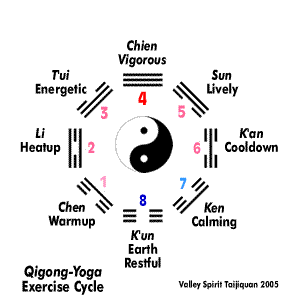
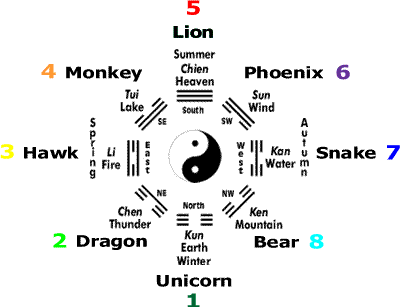


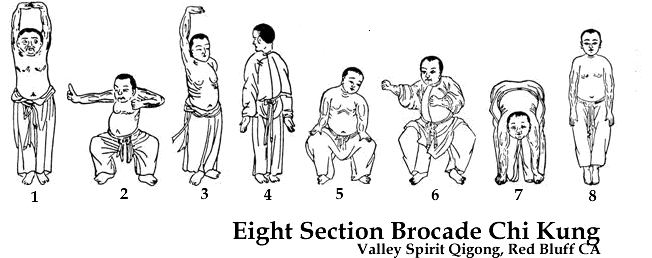
Eight Section Brocade Exercise
I Ch'ing Trigram 
Parts of the Body Affected
1.  Pressing Up to the Heavens with
Two Hands
South, Summer
Ch'ien, Qián, Heaven, Sky, Air
Intense Yang
Lion
Heart, Small Intestine, Stomach, Lungs
(The Triple Warmer)
              
2.  Drawing the Bow and Letting the Arrow Fly Southwest, Mid-Summer
Sun, Wind
Yang
Phoenix
Kidneys, Spleen, Waist, Eyes, Legs
                     
4.  Wise Owl Gazes Backward West, Autumn
K'an, Water
Yang-Yin
Snake
Lungs, Immune System, Large Intestine
                   
5.  Big Bear Turns from Side to Side Northwest, Mid-Autumn
Ken, Gèn, Mountain
Yin-Yang
Bear
Heart, Waist, Legs
                   
3.  Separating Heaven and Earth North, Winter
K'un, Earth
Intense Yin
Unicorn, Qilin
Spleen, Kidneys, Bladder, Pancreas
                        

8.  Shaking the Body Northeast, Mid-Winter
Chen, Zhèn, Thunder
Yin
Dragon
Immune System, Calves, Feet
                         
6.  Punching with Angry Gaze Spring, East
Li, Fire
Yin-Yang
Hawk, Falcon
Liver, Gallbladder, Blood, Eyes
                      

8.  Touching Toes then Bending Backwards Southeast, Mid-Spring
Tui, Lake
Yang-Yin
Monkey

 
Kidneys, Waist, Legs, Back

The above three charts were proposed in 2005 by Mike Garofalo, in his webpage on the Eight Section Brocade.  See also Mike's webpage on the Eight Trigrams.  


In 2014, Christina Barea-Young and Peyton Young provided another set of associations for the Eight Section Brocade movements with the Eight Trigrams in Qi Magazine (Volume 24, No. 2, 2014, p. 48).  

I find these kinds of correlations, associations, and relational charts quite inconsistent between various authors.  Yoga, Western Esoteric Magic, and Qigong have many of the same kind of charts and tables of correlations; again, with considerable inconsistency between various "masters."  Other than the "traditions of specific esoteric schools", I find the associations rather arbitrary and fanciful, primarily aids to remembering clusters of ideas, poetic devices, magical-metaphysical lore, and lacking in much pragmatic-scientific meaningfulness.  Contrast these charming and pre-scientific tables with the modern and justifiably famous "Periodic Table of the Elements" for a real lesson in an objective and empirical approach to understanding the world.  Nevertheless, these clusters of ideas may stimulate the imagination, and are fun for playing thought games.  


"The names of the 108 Forms are each symbolic and signify concepts removed from the literal  physicality of the object - horse, tiger, bird, and so forth.  Each name has its separate allusion, and metaphorically may connote an aspiration, a philosophical attitude towards self and  conduct, a turn of mind, a sense of being, some thought about life and spirit.  The true meanings are revealed when the T'ai-Chi Ch'uan exponent has advanced to that stage of experience comprehension where he can utilize the implication of the philosophical  intentions, and where the symbols can be part of his growing consciousness.  This happens only when the mind and body have "changed" and absorbed the reasons for mental, emotional, and physical unity."
-   Sophia Delza, The T'ai Chi Ch'uan Experience, 1996, p. 24


The above long chart is more readable on my Eight Section Brocade webpage, 441 KB, last updated on June 20, 2014. 


Monday, May 03, 2021

Warding Off and Bouncing Off Movements in Taijiquan

Péng (掤)

Péng Jing is outward expanding and moving energy.  It is a quality of responding to incoming energy by adhering to that energy, maintaining one's own posture, and bouncing the incoming energy back like a large inflated rubber ball.  You don't really respond to force with your own muscular force (Li) to repel, block, or ward off the attack.  Peng is a response of the whole body, the whole posture, unified in one's center, grounded, and capable of gathering and then giving back the opponent's energy.  

Péng Jing is often referred to as a kind of "bouncing" energy.  Péng Jing is also considered one fundamental way of delivering energy and embodied in some way in each of the other Eight Gates.  Although, there are frequent references to "energies" or "intrinsic energies," Jing is more of a skill, an expertise developed through much practice, an experience, a pragmatic achievement.  Authors such as Chen Kung identified 38 different intrinsic energies, e.g., Sticking/Adhering Jing, Listening Jing, Receiving Jing, Neutralizing Jing, etc.  Jing is used in various ways in both offensive and defensive applications. 


Examples of movements with Péng Jing Ward Off characteristics (i.e., stepping, turning waist, curved arm, outward and upward, strong lunge stance) in the Yang 108 Taijiquan Form:  Grasping the Sparrow's Tail (Ward Off Right), Ward Off Left, Fair Lady Works the Shuttles, Press, Parting the Wild Horses Mane.


"Peng Ching is the source of these eight methods.  When you Push Hands or practice the set, at no time can you neglect this category of energy.  Actually, one can say that T'ai Chi boxing is Peng ching boxing because without Peng ching there is no T'ai Chi boxing.  Peng ching is the power of resilience and flexibility.  It is born in the thighs and called Ch'i kung.  Ch'i kung is concealed through-out the entire body.  Then the body becomes the wheel's rubber band and you can gain achievement of defense.  But this is not the striking aspect.  When you have this reaction force, you then have the ability to strike by returning the strike to its originator.  This is the energy of the defensive attack.  It is used to evade and also to adhere.  When moving, receiving, collecting, and striking, Peng ching is always used.  It is not easy to complete consecutive movements and string them together without flexibility.  Peng ching is Tai Chi boxing's essential energy.  The body becomes like a spring: when pressed it recoils immediately."
-  Kuo Lien-Ying, the T'ai Chi Boxing Chronicle, 1994, p.44. 


"Taijiquan has been called Peng Jin Quan or "Peng Energy Boxing" as described in the famous Chen book by Gu Liuxin and Chen Jiazheng.  Peng carries two meanings.  The first is a sense of buoyancy throughout the body, giving it a feeling of vitality and resilience (ne qi).  It is contained in every movement at all times and is an inflated, outward-expanding energy.  The second is an action, a technique that uses a vertical circular movement that spirals upwards and outwards, intercepting and warding off an advancing force. Peng energy is created by the elastic force of muscles, combined with the elongation of the joints and tendons.  It can be compared with the buoyancy of water.  On it a tiny leaf can drift, but it can also carry a ten-thousand ton ship.  Peng energy prevents and opponent from reaching one's body.  The Peng strength used never exceeds the strength an opponent is using in attack.  It is sufficient to hold off an attack, but not to resist or stop the attack.  The main purpose is to prevent the opponent from reaching one's body and then to change the direction of the attack by utilizing one of the other hand methods.  Peng energy, therefore, acts as the foundation for the change of energies in Push Hands.  As it is an organic (living) force, it can only be truly felt and realized in Push Hands.  It is difficult for those who have never pushed hands to fully comprehend this concept.  Proper understanding of the concept and acquisition of the authentic skill cannot be achieved by attempts at logic or theoretical guessing.  Only through diligent and consistent as well as intellignt practice can one reach a level of proficiency.  Example of Peng: Transition from Single Whip to Buddha''s Warrior Attendant Pounds Mortar."
-  Davidine Siaw-Voon Sim and David Gaffney, Chen Style Taijiquan, 2002, p. 152.  "The Eight Kinetic Movements of Taijiquan" (Ba Fa)


Tye's Peng Path Analogy
  Beads on a string.  


"Peng is a form of Jing that responds to incoming energy by adhering or sticking to it, and then bouncing the incoming energy back like a large inflated rubber ball. It is the primary Yang or “projecting” energy force in Tai Chi, and can be equally defensive and offensive. Peng is expressed by the entire body as a whole, unified in your center and grounded. When one standing in the correct Peng posture, it is almost impossible to move them.  The first energy is Ward Off, expressed as you Step Forward into the left Bow Stance, round the left arm forward and float the right hand to the hip.  Peng puts a curved barrier between you and your opponent; creating a buffer zone that prevents the first shock of an incoming attack from penetrating your defenses. This buffer zone also gives you the critical microsecond to avoid being overwhelmed by an attack, giving you neurological space to to deflect, absorb or counter an attack.  Peng energy can be compared to the type of force that causes wood to float on water or a balloon to inflate, or a garden hose to fill with a torrent of water. It has a “bounce off” sensation, like the feeling of rebounding off of a beach ball or Yoga ball. It is Peng that enables the Tai Chi fighter to hit opponents and cause them, as the Chinese like to say, “to fly away.”  Imagine a young mother standing on a crowded beach pier, searching frantically for her child. After a moment, she spots her toddler climbing up the pier railing, some 60 feet above the ocean. As she rushing to grab her child, anyone in her way would literally be “bounced away” by her singularly-focused forward energy. This is Peng."
Tai Chi Transformation


Eight Gates and Five Directions


Monday, April 03, 2017

Eight Beautiful Tapestries Chi Kung

Sequence C:  Trigrams, Bagua, and Eight Section Brocade (Ba Duan Jin) Exercises Correlations

Soft Qigong (Rou Gong), Inner Qigong (Nei Gong); Slow Pace, Gentle, Soft, At Ease, Relaxed (Sung)Rooted/Sunk, Yin Style


Eight Section Brocade Exercise
I Ch'ing Trigram 
Parts of the Body Affected
1.  Pressing Up to the Heavens with
Two Hands
South, Summer
Ch'ienQián, Heaven, Sky, Air
Intense Yang
Lion
Heart, Small Intestine, Stomach, Lungs
(The Triple Warmer)
              
2.  Drawing the Bow   and Letting the Arrow FlySouthwest, Mid-Summer
Sun, Wind
Yang
Phoenix
Kidneys, Spleen, Waist, Eyes, Legs
                     
4.  Wise Owl Gazes BackwardWest, Autumn
K'an, Water
Yang-Yin
Snake
Lungs, Immune System, Large Intestine
                   
5.  Big Bear Turns from Side to SideNorthwest, Mid-Autumn
KenGèn, Mountain
Yin-Yang
Bear
Heart, Waist, Legs
                   
3.  Separating Heaven and EarthNorth, Winter
K'un, Earth
Intense Yin
Unicorn, Qilin
Spleen, Kidneys, Bladder, Pancreas
                        

8.  Shaking the BodyNortheast, Mid-Winter
ChenZhèn, Thunder
Yin
Dragon
Immune System, Calves, Feet
                         
6.  Punching with Angry GazeSpring, East
Li, Fire
Yin-Yang
Hawk, Falcon
Liver, Gallbladder, Blood, Eyes
                      

8.  Touching Toes then Bending BackwardsSoutheast, Mid-Spring
Tui, Lake
Yang-Yin
Monkey
Kidneys, Waist, Legs, Back

The above three charts were proposed in 2005 by Mike Garofalo, in his webpage on the Eight Section Brocade.  See also Mike's webpage on the Eight Trigrams.  


In 2014, Christina Barea-Young and Peyton Young provided another set of associations for the Eight Section Brocade movements with the Eight Trigrams in Qi Magazine (Volume 24, No. 2, 2014, p. 48).  

I find these kinds of correlations, associations, and relational charts quite inconsistent between various authors.  Yoga, Western Esoteric Magic, and Qigong have many of the same kind of charts and tables of correlations; again, with considerable inconsistency between various "masters."  Other than the "traditions of specific esoteric schools", I find the associations rather arbitrary and fanciful, primarily aids to remembering clusters of ideas, poetic devices, magical-metaphysical lore, and lacking in much pragmatic-scientific meaningfulness.  Contrast these charming and pre-scientific tables with the modern and justifiably famous "Periodic Table of the Elements" for a real lesson in an objective and empirical approach to understanding the world.  Nevertheless, these clusters of ideas may stimulate the imagination, and are fun for playing thought games.  


"The names of the 108 Forms are each symbolic and signify concepts removed from the literal  physicality of the object - horse, tiger, bird, and so forth.  Each name has its separate allusion, and metaphorically may connote an aspiration, a philosophical attitude towards self and  conduct, a turn of mind, a sense of being, some thought about life and spirit.  The true meanings are revealed when the T'ai-Chi Ch'uan exponent has advanced to that stage of experience comprehension where he can utilize the implication of the philosophical  intentions, and where the symbols can be part of his growing consciousness.  This happens only when the mind and body have "changed" and absorbed the reasons for mental, emotional, and physical unity."
-   Sophia Delza, The T'ai Chi Ch'uan Experience, 1996, p. 24

 
The above long chart is more readable on my Eight Section Brocade webpage, 441 KB, last updated on June 20, 2014.  


Tuesday, December 02, 2014

Eight Trigrams and Chi Kung

Sequence C:  Trigrams, Bagua, and Eight Section Brocade (Ba Duan Jin) Exercises Correlations

Soft Qigong (Rou Gong), Inner Qigong (Nei Gong); Slow Pace, Gentle, Soft, At Ease, Relaxed (Sung), Rooted/Sunk, Yin Style


Eight Section Brocade Exercise
I Ch'ing Trigram 
Parts of the Body Affected


1.  Pressing Up to the Heavens with
Two Hands
South, Summer
Ch'ien, Qián, Heaven, Sky, Air
Intense Yang
Lion
Heart, Small Intestine, Stomach, Lungs
(The Triple Warmer)
              

2.  Drawing the Bow and Letting the Arrow Fly Southwest, Mid-Summer
Sun, Wind
Yang
Phoenix
Kidneys, Spleen, Waist, Eyes, Legs
                     

4.  Wise Owl Gazes Backward West, Autumn
K'an, Water
Yang-Yin
Snake
Lungs, Immune System, Large Intestine
                   

5.  Big Bear Turns from Side to Side Northwest, Mid-Autumn
Ken, Gèn, Mountain
Yin-Yang
Bear
Heart, Waist, Legs
                   

3.  Separating Heaven and Earth North, Winter
K'un, Earth
Intense Yin
Unicorn, Qilin
Spleen, Kidneys, Bladder, Pancreas
                        

8.  Shaking the Body Northeast, Mid-Winter
Chen, Zhèn, Thunder
Yin
Dragon
Immune System, Calves, Feet
                         

6.  Punching with Angry Gaze Spring, East
Li, Fire
Yin-Yang
Hawk, Falcon
Liver, Gallbladder, Blood, Eyes
                      

8.  Touching Toes then Bending Backwards Southeast, Mid-Spring
Tui, Lake
Yang-Yin
Monkey

 
Kidneys, Waist, Legs, Back

The above three charts were proposed in 2005 by Mike Garofalo, in his webpage on the Eight Section Brocade.  See also Mike's webpage on the Eight Trigrams.  


In 2014, Christina Barea-Young and Peyton Young provided another set of associations for the Eight Section Brocade movements with the Eight Trigrams in Qi Magazine (Volume 24, No. 2, 2014, p. 48).  

I find these kinds of correlations, associations, and relational charts quite inconsistent between various authors.  Yoga, Western Esoteric Magic, and Qigong have many of the same kind of charts and tables of correlations; again, with considerable inconsistency between various "masters."  Other than the "traditions of specific esoteric schools", I find the associations rather arbitrary and fanciful, primarily aids to remembering clusters of ideas, poetic devices, magical-metaphysical lore, and lacking in much pragmatic-scientific meaningfulness.  Contrast these charming and pre-scientific tables with the modern and justifiably famous "Periodic Table of the Elements" for a real lesson in an objective and empirical approach to understanding the world.  Nevertheless, these clusters of ideas may stimulate the imagination, and are fun for playing thought games.  


"The names of the 108 Forms are each symbolic and signify concepts removed from the literal  physicality of the object - horse, tiger, bird, and so forth.  Each name has its separate allusion, and metaphorically may connote an aspiration, a philosophical attitude towards self and  conduct, a turn of mind, a sense of being, some thought about life and spirit.  The true meanings are revealed when the T'ai-Chi Ch'uan exponent has advanced to that stage of experience comprehension where he can utilize the implication of the philosophical  intentions, and where the symbols can be part of his growing consciousness.  This happens only when the mind and body have "changed" and absorbed the reasons for mental, emotional, and physical unity."
-   Sophia Delza, The T'ai Chi Ch'uan Experience, 1996, p. 24

 
The above long chart is more readable on my Eight Section Brocade webpage, 441 KB, last updated on June 20, 2014.