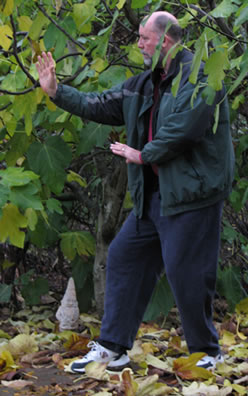
Showing posts with label Standing. Show all posts

Thursday, June 04, 2026

Standing Fully on a Single Leg


"The Taichi Classics say that the proper root is in the foot.  A beginner can develop root by simply spending three to five minutes, morning and night, standing fully on a single leg.  Alternate legs and gradually increase the time as you sink lower.  This 'bitter work' not only develops a root, it stimulates the cardiovascular system, with benefits the brain.  It is essential that your ch'i sinks to the tan-t'ien, both feet adhere to the floor, and you exert absolutely no force.  When practicing this Standing Posture, you may assist your balance by lightly touching a chair or table with the middle and index fingers.  After a while us only the middle finger.  When you can stand unassisted, you my choose either the Lift Hands Posture or Playing the Guitar Posture to continue your practice.  Do not fear bitter work.  If you do you will never progress."

-  Professor Cheng Man-ch'ing, New Method of Taichi Ch'uan Self-Cultivation, 1965, 1999, p. 11  


Practitioners might also do the Golden Rooster Stands on One Leg Posture or the White Stork Spreads Its Wings Posture.

Standing on one leg, holding static poses, is also a common practice in Hatha Yoga, e.g., Tree Pose, Vriksasana. 

Standing Meditation

You stand on one leg.  You can hold the arms in a variety of positions.  I suppose you could even hold weights in the hands.  You can hold the lifted leg in a variety of positions.  There are many possibilities for different static postures. You could use a cane or staff to help with balance.  You "can develop root by simply spending three to five minutes, morning and night, standing fully on a single leg."  


Effectively Using Rooting, Sinking, Centered, and Vertical Forces in Taijiquan


Effectively Using Rotating, Spiraling, Spinning, and Circular Forces in Taijiquan


Thursday, August 24, 2023

Stand on One Leg

Repost from 2017:

"The Taichi Classics say that the proper root is in the foot.  A beginner can develop root by simply spending three to five minutes, morning and night, standing fully on a single leg.  Alternate legs and gradually increase the time as you sink lower.  This 'bitter work' not only develops a root, it stimulates the cardiovascular system, with benefits the brain.  It is essential that your ch'i sinks to the tan-t'ien, both feet adhere to the floor, and you exert absolutely no force.  When practicing this Standing Posture, you may assist your balance by lightly touching a chair or table with the middle and index fingers.  After a while us only the middle finger.  When you can stand unassisted, you my choose either the Lift Hands Posture or Playing the Guitar Posture to continue your practice.  Do not fear bitter work.  If you do you will never progress."

-  Professor Cheng Man-ch'ing, New Method of Taichi Ch'uan Self-Cultivation, 1965, 1999, p. 11  


Practitioners might also do the Golden Rooster Stands on One Leg Posture or the White Stork Spreads Its Wings Posture.

Standing on one leg, holding static poses, is also a common practice in Hatha Yoga, e.g., Tree Pose, Vriksasana. 

Standing Meditation

You stand on one leg.  You can hold the arms in a variety of positions.  I suppose you could even hold weights in the hands.  You can hold the lifted leg in a variety of positions.  There are many possibilities for different static postures. You could use a cane or staff to help with balance.  You "can develop root by simply spending three to five minutes, morning and night, standing fully on a single leg."  

Effectively Using Rooting, Sinking, Centered, and Vertical Forces in Taijiquan


Effectively Using Rotating, Spiraling, Spinning, and Circular Forces in Taijiquan


Hatha Yoga has many effective balancing postures (Asanas)


Saturday, October 08, 2022

Chen Taijquan Studies: Report 1

Chen Style Tai Chi Chuan
Study and Sharing Group
Vancouver, Washington
Location: 100 NE 100th Street, Vancouver, Washington, 98662
Time:  Every Friday from 9 am to 10:30 am
Coordinator:  Michael Garofalo   

Introductory Webpage


Report 1 for October 7, 2022

Comparison of instructional DVDs used to study Chen Taijiquan
Values and drawbacks of standing isometric practices
Meditation practices: styles and objectives
Circling movements in warm ups
Silk reeling practices with one hand
Chen 19 Form
Sharing, Demonstrations, Discussion, Viewing DVDs


Sunday, September 04, 2022

Sitting Becomes Tiresome


A typical American watches and average of 34 hours of television each week.  A few people don’t watch television and, of course, many people watch television more than 40 hours a week.  Neilsen surveys report that children aged 2-11 watch over 24 hours of TV per week, while adults aged 35-49 watch more than 33 hours a week. The average American watches more than five hours of television every day. Once we pass 65, the typical person watches more than seven hours a day.


Sitting and watching television for seven hours each day?? ... how tiresome.  And, sitting for long periods is very bad for your health.  Even more, most television programs and their incessant commercials are, for me, just boring, repetitious, and tiresome. 


So, a secret revealed:  You will get, on the average, 21 hours of “free” time every week by not sitting and watching more than 2 hours of television each day.  Even better, turn off your television for a month and you will get 136 hours of free time in that month.  And, another benefit is that by not sitting you will improve your health. 


"A monk asked Hsiang Lin, "What is the meaning of the Patriarch's coming from the West?"
Hsiang Lin said, "Sitting for a long time becomes tiresome."

-  The Blue Cliff Record, Case 17, Translated by Thomas Cleary and J. C. Cleary, 2005, p 110


Standing Meditation

Walking Meditation

Gardening

Taijiquan Moving Meditation


Tuesday, May 10, 2022

Standing Meditation

“Let me keep my mind on what matters, which is my work, which is mostly standing still, learning to be astonished.” - Mary Oliver, Messenger

"Standing still in the circle of trees, in the sacred space,
one wet and chilly morn,
feet rooted, turtle toes clawing the earth, sunk deeply down;
twisted like a dragon, alert, poised, ready to fly;
settled like a bear, strong, full of power, gathering;
looking through the tiger's eye, mind-intent, penetrating;
embracing the World of Body, Mind, and Spirit,
as ancient as Now, the Three Realms, all still, all one.

From the edge, the cosmic circle opened,
Chang San-Feng slipped inside, smiling,
he stroked his long black beard and spoke softly,
"Ah, another old man standing so still in San Ti Shi.
Continue, my friend, stand in peace, touch the mind. 
Xuan Wu guards the Gate, the Turtle chants, the Snake rises, and
The subtle winds of understanding blow down the centuries.
When still, soar like the Black Dragon; when moving, walk like the Mountain.
Tame the Tiger within, ride the Tiger to the temple, and roar in silence.
Awaken like the Bear from the winter of the soul, and rise like a Man.
Feel the vital energies from bone to brain,
Sense the Great Tao before you Now,
Drop delusions, enter the Gate of Mystery,
Embrace the Center, Empty, unattached, ready to be filled
With boundless beauty, everything There, marvelous beyond words."

The cottonwood leaves spoke with the wind,
the sun rose over the shadows,
my legs shook a little;
the cosmic circle trembled,
Xuan Wu's sword flashed in the sun,
Master Chang disappeared in the trees."

-  By Michael P. Garofalo, Poetic Reflections on Chang San-Feng.


Xuan Wu Dadi, Dark Lord of the North

Union of the Three Realms: San Ti Shi


.

Mike Garofalo and San Ti Shi Posture

.

A commonoly used standing posture in internal martial arts is the San Ti Shi. This is the “Trinity Posture, Three Bodies Posture, Union of the Three Realms, the Three Legged Posture….” For a description of the posture, photographs of the posture, and the purpose of standing postures visit my notes on the webpage San Ti Shi, Three Body (Heaven, Man, Earth) Standing Posture

Zhan Zhuang (Standing Like A Tree) Rooting Deeply Into Tranquility, Power and Vitality A Chinese Meditation and Qigong Discipline By Mike Garofalo, 137 Kb.

Chang San Feng, Taoist Master, Circa 1300 CE

Sacred Circle

Meetings with Chang San-Feng. Poetic reflections by Mike Garofalo.

Xuan Wu Dadi, Dark Lord of the North

Standing Meditation: Trinity Stance

Cloud Hands Blog

Thursday, May 06, 2021

Relaxing and Loosening Up

 "True relaxation is always a dropping into ourselves, a movement toward our core and very center of self.  In addition to distorting what we can see, hear, and feel, the inability to relax and release tension will inevitably fuel the involuntary internal monologue of the mind.  As we become more enmeshed in the drama that our mind is scripting about ourselves, our ability to relate in a wholesome and relaxed manner with the current condition and circumstances of our lives becomes further distorted. ... The relaxation of tension in our bodies melts the armoring that keeps our bodies hard and inflexible.  This hardening of the tissue creates a layer of numbness that keeps our awareness of the rich web of shimmering sensations concealed and contained.  Relaxation allows the armoring to begin to soften and melt away.  The inevitable result is a much greater awareness of sensational presence and a diminution of the ongoing involuntary monologue of the mind.  Learning how to relax by surrendering the weight of the body to the pull of gravity and remaining standing at the same time significantly catalyzes the practice of mindfulness."

-  Will Johnson, Aligned, Relaxed and Resilient, 2000, p. 55


"To be relaxed means to release tension, but not to let go of substance.  There is a quality in-between stiff and loose which is stable, yet flexible, that has fullness without being rigid, that is calm in motion yet conveys a vigorous presence.  For lack of an equivalent English word, I refer to this concept as flowing within firmness, firmness within flowing.  Flowing and firmness do not gain support from a rigid skeletal posture or strength from muscular tension.  Rather, their integrity comes from expansion.  Expansion is the ability to spread out in all directions.  This is the key to relaxing without collapsing."
-  Ting Kuo-Piao, Understanding Flowing and Firmness, 2000


"Relaxation of the whole body means the conscious relaxation of all the joints, and this organically links up all parts of the body in a better way.  This does not mean softness.  It requires a lot of practice in order to understand this point thoroughly.  Relaxation also means the "stretching" of the limbs, which gives you a feeling of heaviness.  (This feeling of heaviness or stiffness is a concrete reflection of strength.)  This feeling is neither a feeling of softness nor stiffness, but somewhere in between.  It should not be confined to a specific part, but involves the whole body.  It is like molten iron under high temperature.  So relaxation "dissolves" stiff strength in very much the same way.  Stiff strength, also called "clumsy strength," undergoes a qualitative change after thousands of times of "dissolution" exercises.  Just like iron which can be turned into steel, so "clumsy strength" can be turned into force, and relaxation is a means of gradually converting it into force.  Our ancestors put it well: "Conscious relaxation will unconsciously produce force."  There is truth in this statement."
-  Yang Zhenduo, "Yang Style Taijiquan", p 16


Relaxed (Sung, Song, Fan Song):  Quotations, Bibliography, Resources

Standing Meditation

T'ai Chi Ch'uan

Somaesthetic Practices and Theory


Thursday, October 15, 2020

Benefits of Conscious Relaxation

"True relaxation is always a dropping into ourselves, a movement toward our core and very center of self.  In addition to distorting what we can see, hear, and feel, the inability to relax and release tension will inevitably fuel the involuntary internal monologue of the mind.  As we become more enmeshed in the drama that our mind is scripting about ourselves, our ability to relate in a wholesome and relaxed manner with the current condition and circumstances of our lives becomes further distorted. ... The relaxation of tension in our bodies melts the armoring that keeps our bodies hard and inflexible.  This hardening of the tissue creates a layer of numbness that keeps our awareness of the rich web of shimmering sensations concealed and contained.  Relaxation allows the armoring to begin to soften and melt away.  The inevitable result is a much greater awareness of sensational presence and a diminution of the ongoing involuntary monologue of the mind.  Learning how to relax by surrendering the weight of the body to the pull of gravity and remaining standing at the same time significantly catalyzes the practice of mindfulness."
-  Will Johnson, Aligned, Relaxed and Resilient, 2000, p. 55


"To be relaxed means to release tension, but not to let go of substance.  There is a quality in-between stiff and loose which is stable, yet flexible, that has fullness without being rigid, that is calm in motion yet conveys a vigorous presence.  For lack of an equivalent English word, I refer to this concept as flowing within firmness, firmness within flowing.  Flowing and firmness do not gain support from a rigid skeletal posture or strength from muscular tension.  Rather, their integrity comes from expansion.  Expansion is the ability to spread out in all directions.  This is the key to relaxing without collapsing."
-  Ting Kuo-Piao, Understanding Flowing and Firmness, 2000


"Relaxation of the whole body means the conscious relaxation of all the joints, and this organically links up all parts of the body in a better way.  This does not mean softness.  It requires a lot of practice in order to understand this point thoroughly.  Relaxation also means the "stretching" of the limbs, which gives you a feeling of heaviness.  (This feeling of heaviness or stiffness is a concrete reflection of strength.)  This feeling is neither a feeling of softness nor stiffness, but somewhere in between.  It should not be confined to a specific part, but involves the whole body.  It is like molten iron under high temperature.  So relaxation "dissolves" stiff strength in very much the same way.  Stiff strength, also called "clumsy strength," undergoes a qualitative change after thousands of times of "dissolution" exercises.  Just like iron which can be turned into steel, so "clumsy strength" can be turned into force, and relaxation is a means of gradually converting it into force.  Our ancestors put it well: "Conscious relaxation will unconsciously produce force."  There is truth in this statement."
-  Yang Zhenduo, "Yang Style Taijiquan", p 16


Relaxed (Sung, Song, Fan Song):  Quotations, Bibliography, Resources

Standing Meditation

T'ai Chi Ch'uan

Somaesthetic Practices and Theory


Thursday, June 01, 2017

Chi Kung: On Smiling and Doubting

In nearly all of the photographs of persons doing standing meditation their faces are impassive, close mouthed, neutral, glum, even mean looking.  Do you ever see any pictures of persons doing Zhan Zhuang with a nice smile on their face?  Don't the majority look rather stern, stiff, and aloof?  Is the coolness, toughness, frowning, and closed eyes of these faux standing posts a defiant reaction to the many other people who look at them and smile or laugh at them?  Is the gruff expression a bodily mudra to affirm the Buddhist claim about the inherent unhappiness and suffering of human existence?  Is the Yiquan toughness required to endure this demanding standing physical exercise the source of this hard, 'don't mess with me' facial expression?  C'mon Man!  Why all the serious, sad, and stern looks? 

Also, most persons doing hours and hours of seated zazen mostly look, to me, just tired, frustrated, aching, and pissed off about their inner insights. 

I don't resist smiling or having pleasant and easy going look on my face when I do seated or standing meditation.  I've read about smiling meditation, laughing yoga, smiling heart qigong, and Inner Smile Taoist Neidan.  Seek and embrace more options than glum, neutral, stern postures and attitudes.  More Yin, Less Yang!!

Hours and hours of these standing or seated "meditation" practices are often just boring, dull, uneventful, uninspiring, and non-productive for me.  Twenty minutes a couple of times a week are more than ample.  I lay odds that if you try to do standing meditation for an hour a day you will end up frowning, stiff, tired, grumpy, and ready to quit.  It would be far better to take a walk each day and enjoy yourself.

I enjoy doing Chi Kung (Qigong), Taijiquan and Yoga movements because they are fun and provide fitness exercise variety.  Their gentle stretching benefits have be objectively verified. Their benefits can also be explained scientifically.  

On the other hand, when the qigong or yoga teachers drone on about invisible organs and esoteric anatomy, contradict one another, discourage questioning, are vague and confusing, share only anecdotal reports of benefits, overuse flaccid metaphors, worship specific lineage traditions and bad mouth competing styles, don't explain much or seldom talk, or are too secretive ...  then I just loose my interest and move on.  I recommend learning early on about how to smell out that kind of bull crap qigong or bull crap yoga.  

I would question the claims that long sessions of standing post will make your legs stronger, build up your Qi, or give you super powers (siddhis) of some kind.  I would argue confidently for more benefits to your legs and overall fitness from walking, jogging, squats, weight lifting, stretching, form practice, sports, and other leg intensive exercises.  I often call Tai Chi "Thigh Chi."  

Since there is no known way of quantifying and measuring Qi, how do you know you have built up, increased, or amplified your Qi??  Increase in leg strength in squats is easy to quantify and measure, as are positive blood pressure and other physiological changes.  

And, as for those super powers (siddhis), they are the unreal stuff of our playful imaginations, fantasies, reading too many Wuxia novels and comic books, and watching amazing motion picture special effects. 

I don't deny that a few, rare, and unique persons have unusual and powerful inner martial arts skills.  Likewise, a few yogis are superior contortionists and gymnasts that can do extreme postures, or lower their heartbeat.  But, so what!   So you can defeat everyone you meet in push hands, so you can stand on one leg for two hours, so you can walk/run 70 miles in a day .... fine, and some of us will be amazed.  However, most reasonable people don't aspire to Olympic standards of performance, and don't need to endure the strict training regimes of the extremely rare Amazing Masters and Siddhi Adepts.  Further, I do not have much of a pressing need to fly up walls, defeat 40 swordsmen like the blind Zatoichi, repulse ten men with a single magical push, kill a man with the touch of a finger, disappear through walls (doors work quite well), read your mind (probably as hohum as mine), or live to 300 years of age and have to dutifully work at seven careers.  Since I am a poor swimmer, I might have an occasional need to walk on water, but I might die before completing the required discipline of forty days and nights in the desert alone fasting, doing yoga and chanting - so that particular unpleasant task and marginal benefit are now off of my bucket list. Playing drums, dancing, and chanting for three hours before walking on burning hot coals might appeal to some, but I will pass on that experience also.  

Some people claim profound inner experiences, mystical insights, revelations, epiphanies, ecstasy, personal gnosis, satori, kensho, illumination, or enlightenment as a result of enduring these strict bodily disciplines.  Even the Buddha tried these physical austerities for many years until he "realized" that enough is enough and that moderation is a better course.  I hear LSD takers and steady alcohol drinkers and marihuana pot heads claim the same "benefits" of consciousness expansion.  Personally, I'd rather water my garden each day, do some Taijiquan, take walks, play, and read good books; and not be a drug user or face a cave wall in stiff seated meditation for seven years like the Bodhidharma.  Some say they practiced for many years, even decades, to gain a "glimpse" of some degree of profound, unified, or universal consciousness.  Seems to me like a very big investment of time and effort for very little return.  Sharpening your critical thinking and reasoning skills, and obtaining more scientific knowledge, would reap more "insight" rewards and much faster.

Some people take up these hard physical practices because their guru, preacher, master, roshi, sifu, or other authority or leader tells them or orders them to do so.  Students are taught to trust, obey, submit, respect, and kow-tow to the guru.  I say, keep your independence!!  Sensibly respect and learn from worthy teachers, but don't be slavish.  Some degree of healthy skepticism is valuable.  Practice on your own rather than humble yourself before some faker, phony, braggart, secretive or expensive master.  Discover what works for you to earn better fitness and well being rather than dumbly following an unbending formulaic physical regimen lineage invented by some illiterate old man 400 years ago.  Not obeying a goofy or exploitative guru is quite sensible.  Some rich gurus, preachers and masters are often merely just trying to tap the soul of your wallet.  Beware of quacks, and keep thinking clearly.

Long periods of standing, fasting, sitting, and self-humiliation may be required as a kind of initiation or hazing ritual before the neophyte applicant is allowed into the practice group.  These disciplinary practices are to test the mettle, seriousness, intent and grit of the applicant.  Stories abound about monks being struck with a stick, insulted and rebuffed and made to wait standing outside in the cold for weeks until the "master" allowed them into the temple or training center.  College fraternities have bizarre hazing rituals, and occasionally young applicants have died in the process.  Criminal gangs may beat up new members or make that potential gang member beat up, rape, or kill some enemy or random person before they are admitted to the gang.  ISIS recruits probably have to blow up some antiquity or decapitate a retired museum director to get into the inner circle of that cabal of True Believers.  Military recruits must endure Boot Camp to prove they have guts, are obedient, and have a killer attitude.   Sports have their "hell week" of double practices to test the toughness of new players. Likewise, new Tai Chi players may be made to stand like a post for long periods of time, maybe for weeks, before the exalted Taiji Wizard will teach them anything.  You have to prove to the regular members of the group that you are trustworthy, obedient, loyal, submissive, and can endure discipline.  In some cases it makes sense and the initiation is worth the effort; but, in many cases the hazing and self-humiliation are unnecessary and just humbug. 

Yes, I do exaggerate here to try to make a few points.  I do greatly enjoy and benefit from TaijiquanYoga, and Qigong.  But, in addition, being a doubter and skeptic and smiler all do have their own benefits. 


I might not push hands with this guy.
He probably could have flung my disrespectful and sassy rear end ten feet away.
Maybe not!  I'm pretty tough, big, and strong myself - but with a smile.


Another sad looking group doing serious
standing meditation to find inner peace.


The 'enlightened' and sour puss Bodhidharma.
He might cut off your finger if you question him improperly.


An "unenlightened" and smiling old Taijiquan player.
Me!

Sunday, October 16, 2016

Standing in the Sensuous Present

    "There is a useful exercise that I devised to keep myself from falling completely into the civilized oblivion of linear time.  You are welcome to try it the next time you are out of doors.  I locate myself in a relatively open space─ a low hill is particularly good, or a wide field.  I relax at bit, take a few breaths, gaze around.  Then I close my eyes, and let myself begin to feel the whole bulk of my past─the whole mass of events leading up to this very moment.  And I call into awareness, as well, my whole future─all those projects and possibilities that lie waiting to be realized.  I imagine this past and this future as two vast balloons of time, separated from each other like the bulbs of an hourglass, yet linked together at the single moment where I stand pondering them.  And then, very slowly, I allow both of these immense bulbs of time to begin leaking their substance into this minute movement between them, into the present.  Slowly, imperceptibly at first, the present moment begins to grow.  Nourished by the leakage from the past and the future, the present moment swells in proportion as those other dimensions shrink.  Soon it is very large; and the past and future have dwindled down to mere knots on the edge of this huge expanse.  At this point I let the past and future dissolve entirely.  And, I open my eyes.  ...

    I find myself standing in the midst of an eternity, a vast and inexhaustible present.  The whole world rests within itself─the trees at the fields edge, the hum of crickets in the grass, cirrocumulus clouds rippling like wave across the sky, from horizon to horizon. ... I remain standing on this hill under rippled clouds, my skin tingling with sensations.  The expansiveness of the present holds my body enthralled.  My animal senses are all awake─my ears attuned to a multiplicity of minute sounds, the tine hairs on my face registering every lull and shift in the breeze.  I am embedded in this open moment, my muscles stretching and bending with the grass.  The present seems endless, inexhaustible.  What, then, has become of the past and future?"


-  David Abrams, The Spell of the Sensuous, Vintage, 1996, p. 202


Thursday, March 03, 2016

Swinging Arms Chi Kung Exercises


Swinging Arms Qigong Exercises.  By Mike Garofalo.  Notes, bibliography, quotations, descriptions of exercises.  

1.  Swinging Arms Exercise - Form One
Swinging the Arms Forward and Back, Up and Down
Swinging to Connect the Kidneys and Lungs
Pendulum Swing

1.  Stand with your feet at a hip width distance apart, less than shoulder width, feet pointing straight ahead.  Keep the knees slightly bent.  This standing stance should be comfortable.  Release tension in the body, soften, stay loose, open the chest, keep an open mind - in short, maintain Sung

2.  Keep your head over your shoulders, and the head in line with the spine.  Lift the crown of the head and tuck the chin a little.  Shoulders are kept relaxed, but don't slouch.  Maintain central equilibrium.  Keep an upright posture. 
3.  The feet are grounded and rooted into the earth.  Feet remain flat on the floor during the entire exercise.  The feet should point straight ahead.  The knees are over the feet.   
4.  Look forward, soften and widen your visual focus.  Take in the whole practice scene.  Don't try to block sensory feelings, zone out, or escape being fully present in the simple here and now.
5.  Arms should be loose, relaxed, and hanging gently at the sides of your hips.  Hands should remain soft and relaxed. 
6.  Gently raise both arms up in front of the body, palms facing down.  Raise the arms up to about shoulder height or less, depending upon the mobility or comfort range of motion for your shoulder joint.  The arms are fairly straight with only a slight bend in the elbow. 
7.  Allow the arms to gently move down and back to the sides of your hips.  Continue to lift the arms up behind the body, palms facing up, to a height you are comfortable with, depending upon the mobility of your shoulder joint.  Most people draw the hands up behind the back at considerably less than a 30 degree angle up from the hips.  Then bring the arms downward until the hands are along sides of the hips.  The arms are fairly straight with only a slight bend in the elbow. 
8.  Continue moving both arms at the same time from the hips, up to about shoulder height or less in front, down to the sides of the hips, and up the back, then down to the hips.  Be gentle.  Take your time.  Both arms will gradually begin to effortlessly swing up and down, forward and back, up and down.  Relax!  The arms are fairly straight with only a slight bend in the elbow. 
9.  Breathing is natural, comfortable, effortless, unstrained.  Breathe in through your nose and out through your mouth.  The tongue rests gently on the upper palate.  
10.  The knees will gently begin to bend and straighten slightly as the arms swing forward and back.  A swinging rhythm will establish a bending pattern and movement flow in the knees.  Don't keep the knees stiff, locked, or rigid.  Go with the flow. 
11.  Continue to swing the arms forward and back until you have warmed up your body, loosed the joints, and established a comfortable and flowing motion of swinging your arms.  Slowly increase the pace of your swinging. 
12.  Avoid rapidly snapping the lower arms or hands as you draw you arms downward from the front.   
13.  Enjoy swinging your arms forward and backward for as long as you like.  Start with a swinging practice of two to four minutes, and gradually increase the practice time as your body becomes conditioned to the exercise, your stamina increases, and you find benefits from doing this exercise. 
14.  As you near the end of the exercise period, slow the swinging pace down and reduce the range of motion in the swing.  Gradually slow down and finally stop.  Stand and rest for awhile.   
    This dynamic stretching exercise helps various parts of the body and is an excellent warm up exercise.  It stretches the biceps as you draw the arms back and up.  It stretches the triceps as you swing the arms up and forward.  The relaxed fingers and wrists are stretched on the downward fall of the arms (a nice counter to the flexed and tensed positions of the hands on a keyboard).  The shoulder joint and tendons benefit from the gentle range of motion activity, and the deltoid muscles are exercised.  The pectoral muscles are stretched on the backward movement of the arms.  Strength gains, although very modest, are primarily in the deltoids, latissimus, quadriceps, and trapesius.  If the swinging arms activity is continued long enough the heartbeat will increase slightly.  This kind of rhythmic activity has a calming effect on the body and reduces stress.  Stephen Sinatra, M.D., claims this exercise will benefit the thoracic duct and help the heart.  Chinese Qigong masters claim that Qi flow is enhanced and the body energized, blood pressure is reduced, and various diseases are prevented or healed. 

    There are alternative versions of this Swinging Arms exercise practiced and recommended by different folks.  Some people like to quietly count the repetitions on the forward up swing as it helps them to focus and maintain a regular breathing pattern.  Some people just swing one arm forward and back, and alternate between the arms.  Guo Lin's Qigong, a Walking Qigong, for cancer patients, alternates the arm swing from side to side, but the elbows are bent more and the waist turns from side to side as the arms swing upward.  Some people enjoy stepping in place or walking forward in a coordinated manner (e.g., Yang Jwing Ming) as they swing their arms forward and backward, up and down.  Swinging the arms or pumping the arms during brisk walking is a popular exercise.  Some swing the arms higher up in the front, up to face level or higher.  Some rise on their heels as they swing the arms up.  Some rock the toes up and down, or the heels up and down as they swing their arms.  Some like to talk with others as they swing their arms, others prefer being quiet.  Some hold very light dumbbells or kettlebells in the hands while doing this exercise for greater strength gains (forward dumbbell raises), although repetitions are kept low.  

Here are the instructions for this exercise found in: 
The Harvard Medical School Guide to Tai Chi: 12 Weeks to a Healthy Body, Strong Heart, and Sharp Mind .  By Peter M. Wayne, Ph.D., and Mark L. Fuerst.  Boston, Shambhala Press, 2013.  Index, detailed notes, 336 pages.  A Harvard Health Publication.  ISBN: 978-1590309421.  VSCL. 

Swinging to Connect the Kidneys and Lungs, p. 72:
    
     "This gentle movement also loosens up the body, provides moderate aerobic activity, develops dynamic balance, and stimulates deep breathing.

    Maintaining a comfortable shoulder-width stance, begin by raising up your arms overhead, and then release them down, surrendering to the simple pull of gravity.  As your arms swing upward and slightly outward, allow a gentle opening of your chest and ribs, a lengthening of your spine, as well as a lengthening of your arms from the shoulder blades to the fingertips.  Also, shift about 70 percent of your weight to the balls of the feet (stand a little more forward).  And, if it's comfortable for you, lift you chin and the gaze of your eyes slightly as your arms move up.  Imagine your lungs opening and stretching with this shape, and breath in during the upswing. 

    Each time your arms come down, bend the knees slightly and sit into the kwah, shift about 60 percent of the weight in your feet to your heels, and exhale.  As you "sit" into this posture, relax your hips and pelvic area (kwah), feel the slight opening of the lower spine, and feel the gentle stretch and massage in your lower back muscles and kidney region.
    Repeat the upward and downward swinging, stimulating and connecting the lung and kidney region, 9 to 36 times.  If your balance is stable, and/or if you want gradually to challenge and improve your dynamic balance, slightly raise your heels off the ground during the upswing, and return to a flat footed position (slightly more weighed in the heels) on the downswing.
    Begin with smaller movements, and as your tissues and joints warm up, gently let the movements get larger.  But never force any movements, and stay within 70 percent of your maximum range of motion.  Do even less if you have shoulder or back injuries.  Do not bend your knees more than 10 percent; this is not a deep knee-bending exercise.  Focus more on folding or sitting into the kwah.  If coordinating your breath with the movements creates any discomfort, such as shortness of breath or light-headedness, simply breathe naturally and focus on the quality of the movements." 

The kwah is the area of the body located in the groin, where the hips meet the legs.  The major anterior muscles in the kwah area are the psoas major, illio psosas, and adductor muscles.  The posterior muscles in the kwah area are mainly the gluteus.  Whole books have been written about the Posas:  The Vital Psoas Muscle: Connecting Physical, Emotional, and Spiritual Well-Being, by Jo Ann Staugaard-Jones, North Atlantic Books, 2012.