Showing posts with label Pragmatism. Show all posts

Thursday, May 07, 2026

A Pragmatic Non-Religious Life

 Reasons for living one's life without religious interference.

Living a Good Life Without God
A freethinker's ruminations.
A Practical and Pragmatic Persons Views on Religions

1. Since religions have little scientific, technological, or practical daily life value, you just don't need to bother with them.  For examples: If you needed good medical advice about a proper lifestyle for coping with Type II diabetes, see a competent doctor; and the Bible is useless for this advice. I you needed information on repairing your bicycle chain, don't waste your time reading the Koran. I you want to know how to create and care for an orchard, the Bagjavagita would be useless.  If you wanted to learn a foreign language, reading the Book of Mormon would unnecessary. If you needed to improve you mathematical skills, consulting the Pranjaparamitra Sutra would be useless.

Religious works are filled with stories and fictional tales of ancient tribal peoples, just like some fictional literary works. They might be pleasant leisure diversions, but have little or no substantive practical value.

2. Don't waste your time going to religious services at a Church or Temple. You have heard all these theology stories in the past, read about them in childhood, and listened to preachers splitting theological hairs and repeating the same old stories over and over, year after year. Why use your limited time listening again and again to the same old sermons? It is a non-productive use of your limited leisure hours; like seeing the same old situation comedy over again, watching football games for hours on end, or watching the "News" on TV for many hours. Get off you butt, take a walk, or garden, or practice on your piano, or read a science book. Don't be a passive listener, a dolt in a pew, a dullar sponge of a mind. Free yourself from boring indoctrination by preachers and priests telling you what and how to think. Quietly laugh at their threats, and never return. Think of how many thousands of hours saved for worthy practical and enjoyable pursuits by just not attending any church or temple meetings. 

3. You don't have enough money to give to religious organizations that have little value in your personal, daily, and social life. Don't pay for religious tax free buildings, and put some more money on your own mortgage. Don't fatten the wallets of wealthy preachers and priests, invest your money, or help a friend or somebody struggling. Don't pay for religious pre-schools that indoctrinate little children with absurd ideas. Don't give money to religious institutions that want to control politics, make everyone follow their own lifestyle, advocate violence and hate towards peaceful people of other religious or ideologies. Financially helping hospitals, food banks, libraries, public schools, rest homes, the homeless, children's music programs and sports teams might be a few good alternatives for you expenditures. What would be more useful to your community, a new up-to-date hospital or another church building? Improve your own family home before giving any money to an old worn corner church with few members that have rather rigid opinions about how everyone should live their version of a "moral" and 'godly' life.

4. Don't bother arguing with religious people. They  have been indoctrinated since childhood in the habitual thinking of their parent's religion.  Such habits of thought are seldom changed by talking with non-religious persons. Just mentioning to them that you just don't find religion very useful or practical is enough on your part. Don't let them preach to you or try to convert you; tell them that you are just not interested. Save yourself the time and trouble. 

5. Be skeptical of anyone who acts like they know it all, possess the one truth, speaks with with an attitude of unquestioned absolute authority, and claims to know an invisible god's thoughts. Beware of preachers and priests with spiritual insights and opinions that cannot be questioned. Don't be fooled by "Mysteries" that surpass human understanding. Don't let dramatic and clever preaching get in the way of clear understanding and reasoning. Find other thinkers to read and listen to that have some humility, some practical ideas, some generous humanity, know about limits, and have some common sense.

6. Religious people can become fanatical, mean, and violent. History provides ample horrible evidence for this claim. Avoid and do not in any way support these people.

7. Religious hypocrites talk on an on about the terrible dangers of secularism, modernism, and consumerism. Yet they live just like everyone else in our modern society. Be suspicious of holier-than-thou hypocrites, and wealthy preachers railing against secularism.

8.  Beware of any religious organization that is male dominated, supports macho attitudes, denies women rights, has only male leaders and elders and speakers, keeps women in the back of the church, and encourages male domination over women. Half the population everywhere are women. Don't give your money or time to religious organizations that denigrate and subordinate women.  Such behavior is impractical, unfair, unkind, and spiritually limiting. Support equal education for women, women's rights, and support women in leadership roles in our community. 

9. Being Non-Religious does not mean being Anti-Religious. There are decent people with religious beliefs that you can share your life with. Tolerance, pluralism, compassion, and friendship are good to share with everyone. Yes, there are some extremist religious fanatics you should avoid, shun, and be cautious around. But don't let the bad apples ruin the apple harvest. It is best for us just to avoid and not participate with religious rituals, organizations, and believers rather than persecute and or harass them.  Let the few great writers and orators, like the New Atheists, present the articulate arguments against the negative impacts of religion.

10. Don't Ask, Don't Tell.  Keep your spiritual and philosophical opinions to yourself in daily life. In America, religious people might hamper your success in work and business or public service if they know about your non-religious views.  Speak in general humanistic ethical ways, and avoid references to religious views in your daily ordinary life. Be neutral.  Don't proselytize for non-religious views amongst your ordinary daily contacts with people. 

11. Lead by example.  Make your lifestyle and thinking a model for others seeking alternatives to religious indoctrination and authoritarianism and magical irrelevance. Consult my "How to Live a Good Life: Advice from Wise and Respected Persons" for ample information on a viable humanistic lifestyle for the 21st Century.


he Little Book of Humanism: Universal Lessons on Finding Purpose, Meaning and Joy. By Andrew Copson and Alice Roberts. Piatkus, 2022, 256 pages. VSCL, Hardbound.

Humanly Possible: Seven Hundred Years of Humanist Freethinking, Inquiry and Hope. Penguin Press, 2023, 454 pages. VSCL, Paperback.

American Humanist Association

Humanists of Greater Portland, Oregon


Good Without God: What a Billion Nonreligious People Do Believe.  By Greg M. Epstein, Humanist Chaplain at Harvard University.  William Morrow, 2009, 250 pages. FVRL, Hardbound. Outstanding presentation!


Thursday, December 05, 2024

Tao Te Ching by Lao Tzu, Chapter 11

Daodejing by Laozi
Chapter 11


"Thirty spokes unite in a nave, but the nothingness in the hub
Gives to the wheel its usefulness, for thereupon it goes round;
The potter kneads the clay as he works, with many a twist and rub,
But in the nothingness within, the vessel's use is found;
Doors and windows cut in the walls thereby a room will make,
But in its nothingness is found the room' s utility;
So the profit of existences is only for the sake
Of non-existences, where all the use is found to be."
-  Translated by Isaac Winter Heysinger, 1903, Chapter 11 


"Thirty spokes share one hub.
Adapt the nothing therein to the purpose in hand, and you will have the use of the cart.
Knead clay in order to make a vessel.
Adapt the nothing therein to the purpose in hand, and you will have the use of the vessel.
Cut out doors and windows in order to make a room.
Adapt the nothing therein to the purpose in hand, and you will have the use of the room.
Thus what we gain is Something, yet it is by virtue of Nothing that this can be put to use."
-  Translated by D. C. Lau, 1963, Chapter 11 


"Thirty spokes share one hub.
It is just the space (the Nothingness) between them
That makes a cart function as a cart.
Knead clay to make a vessel
And you find within it the space
That makes a vessel as a vessel.
To build a house with doors and windows
And you find within them the space
That makes a house function as a house.
Hence the Being (substance) can provide a condition
Under which usefulness is found,
But the Nothingness (space) is the usefulness itself."
-  Translated by Gu Zengkun, Chapter 11 


"Thirty spokes surround one nave, the usefulness of the wheel is always in that empty innermost.
You fashion clay to make a bowl, the usefulness of the bowl is always in that empty innermost.
You cut out doors and windows to make a house, their usefulness to a house is always in their empty space.
Therefore profit comes from external form, but usefulness comes from the empty innermost."
-  Translated by Isabella Mears, 1916, Chapter 11 


"Although the wheel has thirty spokes its utility lies in the emptiness of the hub.
The jar is made by kneading clay, but its usefulness consists in its capacity.
A room is made by cutting out windows and doors through the walls, but the space the walls contain measures the room's value.
In the same way matter is necessary to form, but the value of reality lies in its immateriality.
Or thus: a material body is necessary to existence, but the value of a life is measured by its immaterial soul."
-  Translated by Dwight Goddard and Henri Borel, 1919, Chapter 11


"Thirty spokes will converge
In the hub of a wheel;
But the use of the cart
Will depend on the part
Of the hub that is void.
With a wall all around
A clay bowl is molded;
But the use of the bowl
Will depend on the part
Of the bowl that is void.
Cut out windows and doors
In the house as you build;
But the use of the house
Will depend on the space
In the walls that is void.
So advantage is had
From whatever is there;
But usefulness rises
From whatever is not."
-  Translated by Raymond Blackney, 1955, Chapter 11   


"Treinta rayos convergen en el medio,
pero el vacío mediano
hace andar al carro.
Se modela la arcilla para hacer jarrones con ella,
pero de su vacío interno
depende su utilización.
Una casa está abierta con puertas y ventanas,
otra vez el vacío
permite que se habite en ella.
El Ser da posibilidades,
sólo se utilizan a través del no-ser."
-  Translated by Alba, 1998, Tao Te Ching, Capítulo 11 


"Though thirty spokes may be joined in one hub, the utility of the carriage lies in what is not there.
Though clay may be moulded into a vase, the utility of the vase lies in what is not there
Though doors and windows may be cut to make a house, the utility of the house lies in what is not there.
Therefore, taking advantage of what is, we recognize the utility of what is not."
-  Translated by Jan J. L. Duyvendak, 1954, Chapter 11


"Thirty spokes share the hub of a wheel;
 yet it is its center that makes it useful.
 You can mould clay into a vessel;
 yet, it is its emptiness that makes it useful.
 Cut doors and windows from the walls of a house;
 but the ultimate use of the house
 will depend on that part where nothing exists.
 Therefore, something is shaped into what is;
 but its usefulness comes from what is not."
 -  Translated by Kari Hohne, 2009, Chapter 11 


三十輻共一轂.
當其無, 有車之用.
埏埴以為器.
當其無有器之用.
鑿戶牖以為室.
當其無, 有室之用.
故有之以為利.
無之以為用.
-  Chinese characters, Tao Te Ching, Chapter 11   


san shih fu kung yi ku.
tang ch'i wu, yu ch'ê chih yung.
yen ch'ih yi wei ch'i.
tang ch'i wu yu ch'i chih yung.
tso hu yu yi wei shih.
tang ch'i wu, yu shih chih yung.
ku yu chih yi wei li.
wu chih yi wei yung.
-  Wade-Giles Romanization, Tao Te Ching, Chapter 11   


"Thirty spokes unite in one hub: on what in it is nothing
depends the usefulness of the cart.

Clay may be made into vessels: on what in them is nothing
depends the usefulness of the vessels.

We cut out doors and windows to make a house: on what in them
is nothing depends the usefulness of the house.

So the existent may be regarded as profitable; the non-existent
may be regarded as useful. The sage discards the outer life in favour of the inner."
-  Translated by P. J. Maclagan, 1898, Chapter 11


"Thirty Spokes converge upon a single hub;
It is on the hole in the center that the use of the cart hinges.
We make a bowl or cup from a lump of clay;
It is the empty space within the vessel that makes it useful.
We make doors and windows for a room;
It is the empty spaces that make the room livable.
Thus, take advantage of what is visible, by making use of what is not visible."
-  Translated by J. L. Trottier, 1994, Chapter 11


A typical webpage created by Mike Garofalo for each one of the 81 Chapters (Verses, Sections) of the Tao Te Ching (Daodejing) by Lao Tzu (Laozi) includes 25 different English language translations or interpolations for that Chapter, 5 Spanish language translations for that Chapter, the Chinese characters for that Chapter, the Wade-Giles and Hanyu Pinyin transliterations (Romanization) of the Mandarin Chinese words for that Chapter, and 2 German and 1 French translation of that Chapter.  Each webpage for each one of the 81 Chapters of the Tao Te Ching includes extensive indexing by key words, phrases, and terms for that Chapter in English, Spanish, and the Wade-Giles Romanization.  Each webpage on a Chapter of the Daodejing includes recommended reading in books and websites, a detailed bibliography, some commentary, research leads, translation sources, a Google Translate drop down menu, and other resources for that Chapter. 


Chapter 11, Tao Te Ching by Lao Tzu.  Complied by Mike Garofalo.  

Chapter and Thematic Index (Concordance) to the Tao Te Ching by Lao Tzu


English Language Daodejing Translators' Source Index


Spanish Language Daodejing Translators' Source Index


Ripening Peaches: Taoist Studies and Practices


Taoism: A Selected Reading List


Friday, April 26, 2024

Humanism

Humanism: Good Reads

The Little Book of Humanism: Universal Lessons on Finding Purpose, Meaning and Joy. By Andrew Copson and Alice Roberts. Piatkus, 2022, 256 pages. VSCL, Hardbound.

Humanly Possible: Seven Hundred Years of Humanist Freethinking, Inquiry and Hope. Penguin Press, 2023, 454 pages. VSCL, Paperback.

American Humanist Association

Humanists of Greater Portland, Oregon


Good Without God: What a Billion Nonreligious People Do Believe.  By Greg M. Epstein, Humanist Chaplain at Harvard University.  William Morrow, 2009, 250 pages. FVRL, Hardbound. Outstanding presentation!


I have enjoyed and benefitted from reading three books by the fine writer, humanist, and scholar: Sarah Bakewell. 

How to Live, or A Life of Montaigne in One Question and Twenty Attempts at an Answer.

At the Existentialist Cafe: Freedom, Being and Apricot Cocktails.

This week, I have enjoyed reading her newest book:

Humanly Possible: Seven Hundred Years of Humanist Freethinking, Inquiry and Hope. Penguin Press, 2023, 454 pages. VSCL.


I have a number of webpages with my notes on Humanist philosophy:

How to Live a Good Life: Advice From Wise Persons

Pragmatism

My Views on Religion

Free Thought


"You are what you make of yourselves. Aim high, aim for the stars, and you may yet clear the rooftops. You will need courage, tenacity, motivation, and a good sense of humor on the route. Quality of character, happiness, fulfilment of potential and of human needs can be improved through changed values, through redirection of individual life, by a process of personal change, and personal evolution."
- Jeaneane Fowler


"The secret of happiness is this: let your interests be as wide as possible and let your reactions to the things and persons that interest you be as far as possible friendly rather than hostile." - Bertrand Russell


"Is it so small a thing To have enjoyed the sun, To have lived light in the spring, To have loved to have thought, to have done; To have advanced true friends, and beat down baffling foes.

That we must feign a bliss Of doubtful future date, And while we dream on this Lose all our present state, And relegate to worlds yet distant our repose? - Matthew Arnold


The Great Agnostic: Robert Ingersoll and American Freethought.  By Susan Jacoby.  Yale University Press, 2013, 246 pages. VSCL. 


Sunday, October 29, 2023

How Do You Get Out?

              The Fireplace Records, Chapter 38


How Do You Get Out?


Porcupine Roshi was a jovial fellow. He enjoyed jokes.  He laughed often. He was fond of riddles.  

Porcupine Roshi died last winter of pneumonia. One of his friends was reading one of Porcuspine's many old notebooks. He found some curious riddles:

Imagine you are in a room with no windows or doors. How do you get out?

I dreamt I was in jail and to be executed for a crime I did not commit.  How do I escape?

I thought about all the bad situations I could get myself into. This was driving me crazy. What can I do?

Answers: Stop imagining; stop dreaming; stop thinking for awhile.


How many sides does a Zen Circle have?
Two! The inside and the outside.

Porcupine drew a small circle on the ground with his stick. He sat outside the circle. Then, he said, "We must choose to sit outside of the Zen Circle, or sit inside of the Zen Circle, or standing strong and passing between the two sides of the Zen Circle while laughing at ourselves."


Comments, Sources, Observations, Koans, Poems, Quips:

Know the difference between fiction and non-fiction.
Reasoning can be more useful than dreams or imagination.
It is easy to distinguish between being awake or dreaming.
Deal with real events, not how you imagine them beforehand.
Think about or imagine something positive happening.
Don't let your imagination cripple you.
Nobody ever gets away from the grasp of Death.
Imagining something does not make it real.
Watch out for Porcupine Roshi's sharp quills.

Draw the Zen Circle wide enough so that many can sit within.
A few Zen Koans are riddles, and a few Riddles are zen koans.
Surprise laughter after a riddle's answer is a minor insight of sorts.
Some puzzles have no solution, no resolution, no conclusion.
Drawing a circle is a common metaphorical act in Zen.
What side of the Zen Circle are you on?


Riddles (200+ Riddles, with No Ads.)

Refer to my Cloud Hands Blog Posts on the topic of Koans/Stories. 

Subject Index to 1,975 Zen Buddhist Koans

Zen Buddhist Koans: Indexes, Bibliography, Commentary, Information

The Daodejing by Laozi

Pulling Onions  Over 1,043 One-line Sayings, Quips, Maxims, Humor

Chinese Chan Buddhist and Taoist Stories and Koans

The Fireplace Records (Blog Version) By Michael P. Garofalo


Or


Saturday, July 16, 2022

Can You Explain Your Reasoning?

 "Rationality is not just a matter of having some reasons for what one does, but of aligning one's beliefs, actions, and evaluations effectively with the best or strongest available reasons.  It pivots on doing that which, everything considered, one is "well advised" to do.  The matter of giving or following the course of intelligent and responsible advice is the crux of rationality.  There is nothing complex or arcane about the sorts of considerations that determine good and cogent reasons in this regard.  It is a matter of the sort of things that conduce to one's real advantage, to one's best interests.  This is a matter of furthering the full and rewarding life, preeminently involving the sort of things that make us happier and/or better persons in what relates to our benefit and the benefit of those who do and should matter for us (our family, community, and fellows at large, and the advancement of our individual and communal values.)  Practical rationality thus calls for appropriate resolutions intelligently arrived at and sensibly implemented.  It is geared to the sensible pursuit of appropriate ends.  The idea of optimization, of seeking for the best among visibly available alternatives, lies at the very core of rationality."
-  Nicholas Rescher, A System of Pragmatic Idealism, Volume I  1992, p.9


The Thinker's Way to Solve Problems

Have I accepted the problem?
What do I know about the problem?
How can I define the problem?
What are the alternatives?
What are the advantages and/or disadvantages of each alternative?
What is the solution?
How well is the solution working?

-  John Chaffee, The Thinker's Way: 8 Steps to a Richer Life,  1998


How to Live a Good Life: Advice From Wise Persons


Tuesday, May 18, 2021

Process Philosophy

Process Philosophy   A hypertext notebook by Michael Garofalo including quotes, bibliography, links, notes, research, and related information.  

My summer reading list includes books on process philosophy by Nicholas Rescher, Alfred North Whitehead, Robert Mesle, Hank Keeton, and Elizabeth Kraus.  


"Philosophers who appeal to process rather than substance include HeraclitusKarl MarxFriedrich NietzscheHenri BergsonMartin HeideggerCharles Sanders PeirceWilliam JamesAlfred North WhiteheadMaurice Merleau-PontyThomas NailAlfred KorzybskiR. G. CollingwoodAlan WattsRobert M. PirsigRoberto Mangabeira UngerCharles HartshorneArran GareNicholas RescherColin WilsonTim IngoldBruno Latour, and Gilles Deleuze. In physics, Ilya Prigogine distinguishes between the "physics of being" and the "physics of becoming". Process philosophy covers not just scientific intuitions and experiences, but can be used as a conceptual bridge to facilitate discussions among religion, philosophy, and science."   Process Philosophy - Wikipedia     

Process Philosophy - Stanford Encyclopedia of Philosophy


Whitehead, Alfred North  (1861-1947)

Wikipedia     Stanford Encyclopedia of Philosophy  


Whitehead, Alfred North.  Science and the Modern World.  1926, 218 pages.  Kindle Version, VSCL . 


Whitehead, Alfred North.  Process and Reality.  Gifford Lectures delivered in the University of Edinburgh during the Session 1927-1928.  Published in 1929.  Free Press, 1979, 413 pages.  VSCL. 


Whitehead:  Keeton, Hank.  Dao De Jing: A Process Perspective.  By Yu Fu and Hank Keeton.  Susanna Mennicke, Designer.  Seeing Tao Pub., 2019, 296 pages.  VSCL. 


Whitehead:  Process-Relational Philosophy: An Introduction to Alfred North Whitehead.  By C. Robert Mesle.  TFP, 2008, 136 pages.  VSCL. 


Whitehead:  Process Philosophy: A Survey of Basic Issues.  By Nicholas Rescher.  University of Pittsburgh, 2000, 152 pages. 


Whitehead: Emptiness and Becoming: Integhrating Madhyamika Buddhism and Process Philosophy.  By Peter Paul Kakol.  D. K. Printworld, 2009, 432 pages. 


Whitehead:  Process Metaphysics: An Introduction to Process Philosophy.  By Nicholas Rescher.  SUNY, 1996, 240 pages. 
 

Whitehead:  Process Philosophy and Political Liberalism: Rawls, Whitehead, Hartshorne.  By Daniel A. Dombrowski.  Edinburgh University Press, 2019, 224 pages. 


Whitehead:  The Metaphysics of Experience: A Companion to Whitehead's Process and Reality.  By Elizabeth Kraus.  Fordham University Press, 2018, 256 pages.  Kindle, VSCL. 


Saturday, October 31, 2020

All Knowing is Doing

"Our experience is moored to our structure in a binding way.  We do not see the "space" of the world; we live in our field of vision.  We do not see the "colors" of the world; we live in our chromatic space.  Doubtless, as we shall show throughout these pages, we are experiencing a world.  But when we examine more closely how we get to know this world, we invariably find that we cannot separate our history of actions - biological and social - from how this world appears to us.  It is so obvious and close that it is very hard to see."

"All doing is knowing and all knowing is doing." 


The Tree of Knowledge: The Biological Roots of Human Understanding.  By Humberto R. Maturana, PhD and Francisco J. Varela, PhD.  Boston, Shambhala, 1987.  Revised Edition, 1998.  Index, glossary, 269 pages.  ISBN: 9780877736424.  VSCL.  Subjects:  History, Philosophy, Knowledge, Science, Evolution, Philosophy.    


Wednesday, September 02, 2020

American Philosophy

I have been reading many books about American intellectual history, American philosophy, ethics, contemporary issues, general U.S. history, biographies of American thinkers, Native Americans, values, etc.  Here are a few of these books:

The American Pragmatists.  By Cheryl Misak, Ph.D.  The Oxford History of Philosophy.  Oxford University Press, 2015, 1st Edition, 304 pages.  VSCL. 

Braiding Sweetgrass: Indigenous Wisdom, Scientific Knowledge, and the Teachings of Plants.  By Robin Wall Kimmerer.  Milkweed Editions, 2013, 390 pages.  

How to be an Epicurean: The Ancient Art of Living Well.  By Catherine Wilson, Ph.D.  New York, Basic Books, 2019.  293 pages, notes.  VSCL. 

Hiking with Nietzsche: On Becoming Who You Are.  By John Kaag, Farrar Straus, 2018.  VSCL.   

Slouching Towards Bethlehem: Essays.  By Joan Didion, 1968.  1960's California.  VSCL.   


Here are some of my hypertext notebooks on related subjects:

Epircureanism

How to Live a Good Life: Advice from Wise Persons

Virtues  

Native Americans of the Northwest   

Walking


Wednesday, December 20, 2017

Responding to Changing Circumstances


Lately, I have been reading the letters and short essays by the Roman philosopher, Lucius Annaeus Seneca, 4 BCE - 65 CE.  Seneca was a wealthy Roman, influential writer, political advisor, and aristocrat.  Many consider him a Stoic. He grew up in Spain.  Once, he was banished to Corsica for seven years; and, later, ordered to commit suicide by the Emperor Nero.  

"And we ought to make ourselves adaptable.  We should not be partial to a rigid program but pass easily where chance has taken us without shrinking from change or plan or status, provided we do not fall into the vice of fickleness, which is an enemy to repose.  Obstinacy is necessarily anxious and unhappy because Fortune often forces it askew, but fickleness is a more serious fault because it never holds its posture.  Each, inability to change and inability to persevere, is hostile to tranquility.  In any case, the mind must be recalled from externals and focus upon itself.  It must confide in itself, find pleasure in itself, respect its own interests, withdraw as far as may be from what is foreign to it and devote itself to itself; it must not feel losses and must even construe adversity charitably."
-  Seneca, On Tranquility, Section 14, p.99 in the Hadas' translation; online version transleated by Aubrey Stewart.   


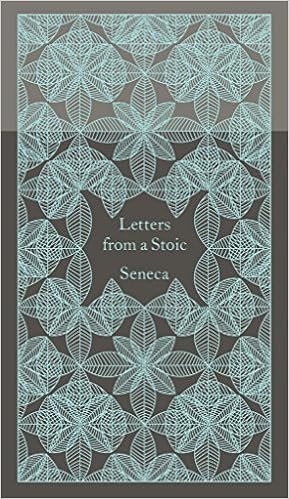
Letters from a Stoic. By Seneca. Translated with an introduction by Robin Campbell. Illustrated by Coralie Bickford-Smith. Hardcover Classics Series. New York, Penguin Classics, Reissue Edition, 2015. Index of persons, appendix, notes, 352 pages. ISBN: 978-0141395852. VSCL. 


Seneca The Stoic Philosophy of Seneca: Essays and Letters. By Seneca. Translated with and introduction by Moses Hadas.  New York, W. W. Norton, 1958, 1968. 261 pages. ISBN: 0393004597. VSCL. 

Stoicism: Bibliography, Links, Notes, Quotations, Reflections, Resources.
A hypertext notebook by Michael P. Garofalo.


Personally, I favor the metaphysics and natural philosophy of the Epicureans over the Stoics.  


Monday, August 31, 2015

Remember the Songs and Become Alive

"However that may be, I now wish that I had spent somewhat more of my life with verse. This is not because I fear having missed out on truths that are incapable of statement in prose. There are no such truths; there is nothing about death that Swinburne and Landor knew but Epicurus and Heidegger failed to grasp. Rather, it is because I would have lived more fully if I had been able to rattle off more old chestnuts — just as I would have if I had made more close friends. Cultures with richer vocabularies are more fully human — farther removed from the beasts — than those with poorer ones; individual men and women are more fully human when their memories are amply stocked with verses."

Richard McKay Rorty, 1931-2007  American Philosopher
   The Fire of Life, 2007


Philosophy and the Mirror of Nature: Thirtieth-Anniversary Edition


"We thank with brief thanksgiving
Whatever gods may be
That no life lives for ever;
That dead men rise up never;
That even the weariest river
Winds somewhere safe to sea."
-  A. C. Swinburne, "Garden of Proserpine"


Last night, Karen and I watched a fascinating and touching documentary about the efforts of Dan Cohen to bring music to persons in nursing homes.   "Alive Inside: Music and Memory", 1 hour and 20 minutes.  A worthy cause!!  A fascinating discussion about how music effects our minds from infancy to old age.  How is it that you can remember the verses to songs you learned when you were three years old? 

As for Tai Chi Chuan and music ... I recall only T. T. Liang recommending you play music while practicing Taijiquan and timing your moves to the music as if dancing.  Maybe Sophia Delza also advocated doing Taijiquan to music since she was an expert on Asian dancing.  Now, in 2015, you can use an IPod or Sony Walkman or other devices to play digital music and listen on ear phones or ear plugs while practicing Taijiquan or Qigong.  I have also purchased and listened to prerecorded music especially designed for specific Taijiquan forms or Qigong which are timed to match a proper performance of the form.  I know that the Tai Chi Kung Fu fan form is specifically timed for performance to a specific piece of music.  I am not particularly fond of the tuning and twanginess and lively pace used in traditional Chinese music, but anyone can find music they favor to suit the ambience desired for Taijiquan or Qigong practice.  I like a lot of New Age music or Japanese Zen flutes. 


Wednesday, February 05, 2014

I Wish I Had ...


"However that may be, I now wish that I had spent somewhat more of my life with verse. This is not because I fear having missed out on truths that are incapable of statement in prose. There are no such truths; there is nothing about death that Swinburne and Landor knew but Epicurus and Heidegger failed to grasp. Rather, it is because I would have lived more fully if I had been able to rattle off more old chestnuts — just as I would have if I had made more close friends. Cultures with richer vocabularies are more fully human — farther removed from the beasts — than those with poorer ones; individual men and women are more fully human when their memories are amply stocked with verses."

Richard McKay Rorty, 1931-2007  American Philosopher
   The Fire of Life, 2007


Philosophy and the Mirror of Nature: Thirtieth-Anniversary Edition


"We thank with brief thanksgiving
Whatever gods may be
That no life lives for ever;
That dead men rise up never;
That even the weariest river
Winds somewhere safe to sea."
-  A. C. Swinburne, "Garden of Proserpine"