Showing posts with label Speech. Show all posts

Thursday, January 30, 2025

Dao De Jing, Chapter 17

Tao Te Ching by Lao Tzu
Chapter 17

"Those of preeminent wisdom and purity knew this Tao intuitively from their birth,
and so possessed it.
Those of the second rank—the men of virtue—approached it nearly, and eulogised it.
Those of the third rank—who were still above the commonalty—stood in awe of it.
Those of the lowest rank held it in light esteem.
Their belief in it was superficial, or imperfect; while there were even some who did not believe in it at all.
The first spoke only with forethought and calculation, as though honouring their words.
When their public labours were achieved, and affairs progressed unimpeded, the  people all said,
"This is our natural and spontaneous condition.""
-  Translated by Frederic Henry Balfour, 1884, Chapter 17


"A leader is best
When people barely know that he exists,
Not so good when people obey and acclaim him,
Worst when they despise him.
'Fail to honor people,
They fail to honor you;'
But of a good leader, who talks little,
When his work is done, his aim fulfilled,
They will all say, 'We did this ourselves.'"
-  Translated by Witter Bynner, 1944, Chapter 17  


"In the highest antiquity people scarce knew
That rulers existed among them; In the next age attachment and praise for them grew, In the next people feared they might wrong them;  And then in the next age the people despised The rulers whom fate set above them, For when faith by the rulers no longer is prized, The people no longer can love them. Those earliest rulers! what caution they had In weighing the words they were using; How successful their deeds! while the people all said We are what we are by our choosing.
"
-  Translated by Isaac Winter Heysinger, 1903, Chapter 17


"Great rising and falling - People only know it exists.
Next they see and praise.
Soon they fear.
Finally they despise.
Without fundamental trust There is no trust at all.
Be careful in valuing words.
When the work is done,
Everyone says
"We just acted naturally."  "
-  Translated by Stephen Addis, 1993, Chapter 17


"With the highest rulers -
Those below simply know they exist.
With those one step down -
They love and praise them.
With those one further step down -
They fear them.
And with those at the bottom -
They ridicule and insult them.

Who does not trust enough
will not be trusted.
Hesitant and undecided!
Like this is his respect for speaking.
He completes his tasks and finishes his affairs
Yet the common people say,
"These things all happened by nature."
-  Translated by Bram den Hond, Chapter 17 


太上下知有之.
其次親而譽之.
其次畏之.
其次侮之.
信不足焉有不信焉.
悠兮其貴言.
功成事遂百姓皆謂我自然.  
-  Chinese characters, Tao Te Ching, Chapter 17


t'ai shang hsia chih yu chih.
ch'i tz'u ch'in erh yü chih.
chi tz'u wei chih.
ck'i tz'u wu chih.
hsin pu tsu yen yu pu hsin yen.
yu hsi ch'i kuei yen.
kung ch'êng shih sui pai hsing chieh wei wo tzu jan.
-  Wade-Giles Romanization, Tao Te Ching, Chapter 17


"Of great rulers the subjects do not notice the existence.
To lesser ones people are attached; they praise them.
Still lesser ones people fear, and the meanest ones people despise.
For it is said: 'If your faith be insufficient, verily, you will receive no faith.'
How reluctantly the great rulers considered their words!
Merit they accomplished; deeds they performed; and the hundred families thought: 'We are independent.' "
-  Translated by D. T. Suzuki and Paul Carus, 1913, Chapter 17    


"Of the best ruler,
The people only know he exists.
Next comes one the love and praise.
Next comes one they fear.
Next comes one they abhor.
When you are lacking in trust,
Others have no trust in you.
Of the work of one who is short with his words,
The hundred families say,
We have done it ourselves!"
-  Translated by Herrymoon Maurer, 1985, Chapter 17 


"The best leader is one whose existence is barely known.
Next best is one who is lived and praised.
Next is one who is feared.
Worst of all is a leader who is despised.
If you fail to trust people, they won't turn out to be trustworthy.
Therefore, guide others by quietly relying on Tao.
Then, when the work is done, the people can say,
"We did this ourselves." "
-  Translated by Brian Browne Walker, 1996, Chapter 17


"Acerca de los antiguos todo lo que se sabe es que existían.
Los sucesores fueron amados y alabados, y los siguientes fueron temidos.
Los que vinieron después aborrecidos.
Sí no te tienes plena confianza, otros te serán infieles.
Entonces las palabras rituales estaban medidas.
El mérito de las obras tenía plenitud.
Todo el mundo decía:
"Estamos en armonía con nosotros mismos"."
-  Translation from Logia Medio Dia, 2015, 
Capítulo 17


"Of the best rulers
The people only know that they exist;
The next best the love and praise;
The next they fear;
And the next they revile.

When they do not command the people's faith,
Some will lose faith in them,
And then they resort to oaths!
But of the best, when their task is accomplished,
their work done,
The people all remark, "We have done it ourselves.""
-  Translated by Lin Yutang, 1955, Chapter 17


"In ancient times
The people knew that they had rulers.
Then they loved and praised them,
Then they feared them,
Then they despised them.
The rulers did not trust the people,
The people did not trust the rulers.
The rulers were grave, their words were precious.
The people having finished their work,
and brought it to a successful issue, said:
"We affirm the Self.""
-  Translated by Isabella Mears, 1916, Chapter 17 


Audio Recordings in English by Mike Garofalo

Here is an audio recording of selected translations from Chapter 17 of the Tao Te Ching. This reading includes translations by Frederic Henry Balfour 1884, Witter Bynner 1944, Isaac Winter Heysinger 1903, Bram den Hond, Herrymoon Maurer 1985, and Isabella Mears 1916.  Reading and recording by Michael P. Garofalo from the Valley Spirit Center, Gushen Grove, in Red Bluff, California.  Recorded on November 22, 2016. MP3 format.  7.1 MB.  


A typical webpage created by Mike Garofalo for each one of the 81 Chapters (Verses, Sections) of the Tao Te Ching (Daodejing) by Lao Tzu (Laozi) includes 25 different English language translations or interpolations for that Chapter, 5 Spanish language translations for that Chapter, the Chinese characters for that Chapter, the Wade-Giles and Hanyu Pinyin transliterations (Romanization) of the Mandarin Chinese words for that Chapter, and 2 German and 1 French translation of that Chapter.  Each webpage for each one of the 81 Chapters of the Tao Te Ching includes extensive indexing by key words, phrases, and terms for that Chapter in English, Spanish, and the Wade-Giles Romanization.  Each webpage on a Chapter of the Daodejing includes recommended reading in books and websites, a detailed bibliography, some commentary, research leads, translation sources, a Google Translate drop down menu, and other resources for that Chapter.   

Chapter 17, Tao Te Ching by Lao Tzu


Chapter and Thematic Index (Concordance) to the Tao Te Ching by Lao Tzu


English Language Daodejing Translators' Source Index


Spanish Language Daodejing Translators' Source Index


Ripening Peaches: Taoist Studies and Practices


Taoism: A Selected Reading List


Wednesday, October 02, 2024

Dao De Jing, Chapter 5


Tao Te Ching by Lao Tzu
Chapter 5


"Nature is non-benevolent. 
It regards the masses as straw dogs.
The Holy Man is non-benevolent.
He regards the masses as straw dogs.
The space between the heaven and the earth is like a bellows;
though unsupported, it does not warp; when in motion the more it expels.
Though words could exhaust this theme, they would not be so profitable
As the preservation of its inner essence."
-  Translated by C. Spurgeon Medhurst, 1905, Chapter 5


"Nature is indifferent to life.
It realizes everything is as a straw dog
(a sacrificial animal-image).
The truly wise are also indifferent to life.
They realize humanity is as a straw dog.
The universe is like a bellows:
empty, yet quite full.
As it proceeds, it produces.
Much talk, much exhaustion.
Keep your thoughts within!"
-  Translated by C. Ganson, Chapter 5 


"Heaven and Earth do not claim to be kindhearted or pitiful.
To them all things and all creatures are as straw dogs brought to the sacrifice and afterwards discarded.
Nor is the Sage kindhearted or pitiful.
To him to the people are as straw dogs.
But the space between Heaven and Earth may be likened to a bellows:
It seems empty, and yet it gives all that is required of it.
The more it is worked, the more it yields.
Whereas the force puffed up by words is soon exhausted.
Better to hold fast to that which dwells within the heart."
-  Translated by Herman Ould, 1946, Chapter 5  


天地不仁, 以萬物為芻狗.
聖人不仁, 以百姓為芻狗.
天地之間, 其猶橐籥乎.
虛而不屈.
動而愈出.
多言數窮.
不如守中.  
-  Chinese characters, Chapter 5, Tao Te Ching


t'ien ti pu jên, yi wan wu wei ch'u kou.
shêng jên pu jên, yi pai hsing wei ch'u kou.
t'ien ti chih chien, ch'i yu t'o yo hu.
hsü erh pu ch'u.
tung erh yü ch'u.
to yen shu ch'iung.
pu ju shou chung.
-  Wade-Giles Romanization, Chapter 5, Tao Te Ching


"Heaven and Earth have no humanity;
They regard all things as straw-dogs.
The sage has no humanity;
He regards the people as straw-dogs.
Between Heaven and Earth, it is like a bellows or a flute!
Empty, but not exhausted;
With movement, more comes out.
Too much talk always exhausts;
It is better to keep to the inside."
-  Translated by Yi Wu, Chapter 5


"Heaven and earth are not merciful,
They treat all things as straw dogs;
The sage is not merciful,
He treats the people as straw dogs.
Does not the space between heaven and earth form like a bellows?
It is empty but the air in it can never be exhausted;
The more air it expels, the more comes out.
That is why too many government decrees only result in more failures.
It is better, therefore, to hold fast to moderation and the void."
-  Translated by Gu Zhengkun, Chapter 5


"Heaven and Earth are not humane.
They regard all things a straw dogs.
The sage is not humane.
He regards all people as straw dogs.
How Heaven and Earth are like a bellows.
While vacuous, it is never exhausted.
When active, it produces even more.
Much talk will of course come to a dead end.
It is better to keep to the centre."
-  Translated by Chan Wing-Tsit, 1963, Chapter 5   


"El universo no tiene afecciones humanas:
todas las cosas del mundo son para él como un perro de paja.
El santo no tiene affeciones humanas;
el pueblo es para él como un perro de paja.

El universo es iqual que un fuelle de forja;
vacío, pero no aplanado.
Cuanto máa se le mueve, más exhala,
cuanto más se habla de él, menos se le comprende,
más vale insertarse en el."
-  Translated by Alba, 1998, Tao Te Ching, Capítulo 5 


"Heaven and Earth are impartial; 
They see the ten thousand things as straw dogs.
The wise are impartial;
They see the people as straw dogs.
The space between heaven and Earth is like a bellows.
The shape changes but not the form;
The more it moves, the more it yields.
More words count less.
Hold fast to the center."
-  Translated by Gia-fu Feng and Jane English, 1989, Chapter 5  


"The Sage does not take sides,
He welcomes both saints and sinners.
The Tao works upon man as it works upon the grasses of the fields.
Sages act out of the need for rightness, not purely compassion.
The Tao is like a bellows, even though it appears empty, its workings are obvious,
Yet the more you use it the more it produces, it is inexhaustible.
Yet speaking of it will not increase the comprehension.
Hold to the center path."
-  Translated by John Dicus, 2002, Chapter 5 


"Heaven and Earth are not (willfully) benevolent
The myriad things are treated no differently
Than grass for dogs
Sages are not (willfully) benevolent
The hundred clans are treated no differently
Than grass for dogs
The gate of Heaven and Earth
Is it not like a bagpipe:
Empty yet not finished.
It moves, and again more is pushed forth
To speak countless words is worthless
This is not as good ad guarding balance within."
-  Translated by Dan G. Reid, 2016, Chapter 5 


"Heaven and earth are ruthless, and treat the myriad creatures as straw dogs;
the sage is ruthless, and treats the people as straw dogs.
Is not the space between heaven and earth like a bellows?
It is empty without being exhausted:
The more it works the more comes out.

Much speech leads inevitably to silence.
Better to hold fast to the void."
-  Translated by D. C. Lau, 1963, Chapter 5 


A typical webpage created by Mike Garofalo for each one of the 81 Chapters (Verses, Sections) of the Tao Te Ching (Daodejing) by Lao Tzu (Laozi) includes 25 different English language translations or interpolations for that Chapter, 5 Spanish language translations for that Chapter, the Chinese characters for that Chapter, the Wade-Giles and Hanyu Pinyin transliterations (Romanization) of the Mandarin Chinese words for that Chapter, and 2 German and 1 French translation of that Chapter.  Each webpage for each one of the 81 Chapters of the Tao Te Ching includes extensive indexing by key words, phrases, and terms for that Chapter in English, Spanish, and the Wade-Giles Romanization.  Each webpage on a Chapter of the Daodejing includes recommended reading in books and websites, a detailed bibliography, some commentary, research leads, translation sources, a Google Translate drop down menu, and other resources for that Chapter.  These are hypertext documents, and available online under Creative Commons 4.


Chapter 5, Tao Te Ching by Lao Tzu.  Complied by Mike Garofalo.  

Chapter and Thematic Index (Concordance) to the Tao Te Ching by Lao Tzu


English Language Daodejing Translators' Source Index


Spanish Language Daodejing Translators' Source Index


Ripening Peaches: Taoist Studies and Practices


Taoism: A Selected Reading List


Saturday, November 07, 2015

Can Inanimate Realms Show the Way

A monk asked, "Can inanminate things expound Dharma?"
Daopi said, "The jade dog roams at night, never knowing the daylight."


"Zen Master Yunmen Wenyan (864-949 CE) once took his staff and struck a pillar in the hall, saying, "Are the three vehicles and twelve divisions of scripture talking?"
He then answered himself by saying, "No, they're not talking."
Then he shouted, "Bah!  A wild fox spirit!"
A monk asked, "What does the master mean?"
Yunmen said, "Mr. Shang drinks the wine, and Mr. Li gets drunk."


"In the works of Emerson, Thoreau, and Whitman in particular, nature is portrayed as a beneficent living force that can, if studied and understood through careful and intentional reflection, offer enduring lessons about what it means to be human. In “Self-Reliance,” and the main ideas behind Thoreau’s “Walden”, as well as “Leaves of Grass”, the respective authors are deeply reverent of nature, and it is through their intimate relationship with the natural world that they construct their own identities and their philosophies about how to live a right life in the natural world. For Emerson, Thoreau, and Whitman, nature is viewed as possessing all the knowledge that man needs to know, if only he is attentive and willing enough to study its messages and apply them to his life."
-  Nicole Smith, The Role of Nature in Transcendental Poetry


Yunmen said, "A true person of the Way can speak fire without burning his mouth.  He can speak all day with moving his lips and teeth or uttering a word.  The entire day he just wears his clothes and eats his food, but never comes in contact with a single grain of rice or thread of cloth.
When we speak in this fashion it is jut the manner of our school.  It must be set forth like this to be realized.  But if you meet a true patch-robed monk of our school and try to reveal the essence through words, it will be a waste of time and effort.  Even if you get some great understanding by means of a single word you are still just dozing."
 

"Zen's Chinese Heritage: The Masters and Their Teachings."  Translated by Any Ferguson.  Boston, Wisdom Publications, 2000, p. 262.  


Way of the Short Staff.  By Michael P. Garofalo, M.S.  A comprehensive guide to the practice of the short staff, cane, jo, walking stick, gun, zhang, whip staff, 13 Hands Staff, and related wood short staff weapons.  A detailed and annotated guide, bibliographies, lists of links, resources, instructional media, online videos, and lessons.   Includes use of the short staff and cane in martial arts, self-defense, walking and hiking.  Separate sections on Aikido Jo, Cane, Taijiquan cane and staff, Jodo, exercises with a short staff, selected quotations, techniques, selecting and purchasing a short staff, tips and suggestions, and a long section on the lore, legends, and magick of the short staff.  Includes "Shifu Miao Zhang Points the Way."  Published by Green Way Research, Valley Spirit Taijiquan, Red Bluff, California.  Updated on a regular basis since October, 2008.  Filesize: 265Kb.  Related to Mike's popular webpage on the Staff.


"Zhaozhou, who had been in poor health, asked his friend Miao Zhang, "Do the bees have Buddha nature?"  Miao Zhang smiled and said, "The roses are so fragrant today, and the cherries so sweet.  Let's walk in the garden and leave our crutches behind." 

    Gathering together in an orchard of blooming sweet lime trees, the students waited for their esteemed teacher, Kasyapa.  Slowly walking down the dirt path, relying on his danda walking staff for balance, Kasyapa joined his students.  He sat quietly for a long time, enjoying the fragrance of the lime blossoms.  Finally, he raised his danda staff.  Everyone stared at Kasyapa - serious, intent, focused, and silent.  Only Shifu Miao Zhang smiled, and then lifted his cane and pointed at a lime blossom.  Kasyapa pointed his danda at Shifu Zhang.  Another transmission was completed.  The sacred thread remained unbroken."
- Shifu Miao Zhang Points the Way


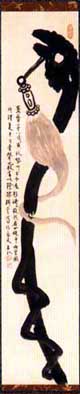
Hakuin's Dragon Staff Inka Scroll


Zen Master Hakuin (1686-1768) painted a Dragon Staff with a horsehair whisk attached.  He gave the above painting to a lay student who passed the Zen koan, "What is the sound of one hand clapping." 


Lately, during Stoic Week exercises, I have read the words of Hellenistic Stoics reminding us to follow nature, be true to our nature, live in accordance with our nature, study nature, accept the limitiations placed on us by our appearance in the natural world, align ourselves with Nature and Fate (Zeus, Gods, Immanent).  My hypertext notebook on Stoicism reflects some of my reading and research on various "Stoic Spiritual Exercises."

I take off at daybreak, doing a long walk, my cane in my hand, energized in the chill of Autumn.