Showing posts with label Energy. Show all posts

Sunday, March 22, 2026

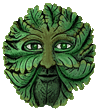
The Forces of Green


"There lies within
A hidden glen
An altar made of stone.
Creeping vine
And moss entwine
To hide this ancient throne.
Tangled thorn
Grows thick to scorn
Those who seek to enter.
For though they strive
No man alive
Shall ever reach its center.
Known as Pan,
To some Green Man,
This glen is his sacred place.
He dons his hood
Of wildwood
To hide his leafy face.
The roving clans
That raped the lands,
Cut down his beloved trees.
And so, alas
As time did pass
The Green God fell to his knees. ..."
- Kristina Peters Moone, The Green Man


"The force that through the green fuse drives the flower
Drives my green age; that blasts the roots of trees
Is my destroyer.
And I am dumb to tell the crooked rose
My youth is bent by the same wintry fever.

The force that drives the water through the rocks
Drives my red blood; that dries the mouthing streams
Turns mine to wax.
And I am dumb to mouth unto my veins
How at the mountain spring the same mouth sucks."
-   Dylan Thomas, The Force That Through the Green Fuse Drives the Flower


Lore, Legends, Tales, Celebrations, Springtime Symbols, Folk Stories and Plays
From the hypertext research notebooks of Mike Garofalo


This cabbage, these carrots, these potatoes,
these onions ... will soon become me.
Such a tasty fact!
- Mike Garofalo, Cuttings


Portrait of the Emperor Rudolph II as Autumn.By Arcimboldo, 1591, Held at the Museo Civico, Brescia. 


Tuesday, April 22, 2025

The Green God Fell to His Knees


"There lies within
A hidden glen
An altar made of stone.
Creeping vine
And moss entwine
To hide this ancient throne.
Tangled thorn
Grows thick to scorn
Those who seek to enter.
For though they strive
No man alive
Shall ever reach its center.
Known as Pan,
To some Green Man,
This glen is his sacred place.
He dons his hood
Of wildwood
To hide his leafy face.
The roving clans
That raped the lands,
Cut down his beloved trees.
And so, alas
As time did pass
The Green God fell to his knees. ..."
- Kristina Peters Moone, The Green Man


"The force that through the green fuse drives the flower
Drives my green age; that blasts the roots of trees
Is my destroyer.
And I am dumb to tell the crooked rose
My youth is bent by the same wintry fever.

The force that drives the water through the rocks
Drives my red blood; that dries the mouthing streams
Turns mine to wax.
And I am dumb to mouth unto my veins
How at the mountain spring the same mouth sucks."
-   Dylan Thomas, The Force That Through the Green Fuse Drives the Flower


Lore, Legends, Tales, Celebrations, Springtime Symbols, Folk Stories and Plays
From the hypertext research notebooks of Mike Garofalo


This cabbage, these carrots, these potatoes,
these onions ... will soon become me.
Such a tasty fact!
- Mike Garofalo, Cuttings


Portrait of the Emperor Rudolph II as Autumn.By Arcimboldo, 1591, Held at the Museo Civico, Brescia. 


Tuesday, December 17, 2024

Full, Sparkling, Everywhere, Flowing ...

 
"My own experience of śaktipāta occurred at the age of 16 through meeting a powerful and loving meditation master.  It was not the product of wishful thinking, because I didn't even want to be there, at least on the level of the conscious mind.  My mother had persuaded me to take a two-day meditation retreat and I had acceded because I wanted the reward she was offering me; I had neither expectation nor hope that anything particularly magical would happen.  And indeed, the whole thing was fairly boring, though in the final meditation of the weekend, I did make a grudging effort to be fully present in the warm, dark stillness of the meditation room.  It was nice, but nothing special, until I opened my eyes and walked outside.  I was astonished to discover that the whole world had apparently changed.  Everything was more vivid and real, and almost sparkling.  Not only that, I was feeling an incredible energy in my heart, and it was flowing palpably between my heart and the hearts of everyone else I could see.  I call it "energy" for lack of a better word; it was a tangible power or force, not a passive feeling, and it had the nature of exquisitely pure love.  It was connecting the hearts of all the people around me, coursing freely in a kind of web or grid of power, entirely independent of whether the people liked each other or not.  Then I noticed it was really everywhere; the very air around me seemed thick with it; it was undoubtedly the most "real" thing in reality, though not perceptible with any of the five senses!  It was astonishing, and I was never the same, now that I knew this power, this love beyond anything I had ever imagined, was a real possibility in human life."
-  Christopher D. Wallis, Tantra Illuminated, 2012, p.323


Tantra Illuminated: The Philosophy, History, and Practice of a Timeless Tradition  By Christopher D. Wallis, M.A.  Illustrations by Ekabhumi Ellik.  Woodlands, Texas, Anusara Press, 2012.  Index, endnotes, bibliography, three appendices, 506 pages.  ISBN: 978-1937104016.  VSCL.  In 2012, the author was a Ph.D. candidate in Sanskrit at the University of California, Berkeley.  This book takes as its exemplar and focal point the lineages of nondual Śaiva Tantra most clearly typified by the Kaula Trika lineage.  Written for the educated lay reader.  The author shares his personal life, his spiritual life, his practices, his yoga, within this tradition of Tantra.   

Tantra: Path of Ecstasy  By Georg Feuerstein (1947-2012), Ph.D.  Boston, Shambhala, 1998.  Index, bibliography, notes, 314 pages.  ISBN: 157062304X.  VSCL.  An excellent introduction to Tantra, and a great starting point for readers.  I own, and have read and reread in the last ten years nearly all of the books by Dr. Georg Feuerstein.  If my understanding is correct, Dr. Feuerstein personally followed the path of Vajrayana Buddhism, a Tibetan Buddhist tradition, a lineage of Tantric Buddhism.  


"Tantra's body-positive approach is the direct outcome of its integrative metaphysics according to which this world is not mere illusion but a manifestation of the supreme Reality.  If the world is real, the body must be real as well.  If the world is in essence divine, so must be the body.  If we must honor the world as a creation or an aspect of the divine Power (shakti), we must likewise honor the body.  The body is a piece of the world and, as we shall see, the world is a piece of the body.  Or, rather, when we truly understand the body, we discover that it is the world, which in essence is divine."
-  Georg Feuerstein, Tantra: The Path of Ecstasy, p. 53  


Somaesthetic Practices and Theory

Tantra: Bibliography, Quotations, Links, Resources

Nature and Spirituality 


Saturday, December 16, 2023

With Open Arms

For an excellent presentation on how the various parts of our bodies influence other parts and interact with our nervous/brain system read "The Embodied Mind" by Thomas R. Verny, M.D., 2021. Chapter 8 deals with the impact of our hearts on on our personality, energy levels, hormonal levels, alertness, emotions, etc., pp. 134-159.

A question:  Does the Heart Chakra govern, control, energetically interact with, or involve both arms?  


In the above artwork, from the cover of "Wheels of Life" by Anodea Judith, 1987, the Heart Chakra zone of the body is highlighted in a green color.  One would infer from the artwork that the arms are in the zone of the Heart Chakra.  In Anodea Judith's chart of correspondences for Chakra Four she lists parts of the body: lungs, heart, arm, hands. 
It would make sense from the point of view of the fact that most labor, work, productive activity involves the arms and hands.  We often work hard and long for those we love.  We hug those we love.  I like to welcome yogis, taoists, and druids with open arms.  I love to move my arms about gracefully in yoga, chi kung, and tai chi postures an know this helps my heart and lungs, the zone of the fourth chakra.  

The Chinese speak of mind-heart (hsin) and human nature (hsing) from Menicus.  


Hsin literally means "heart." It means mind, not the deluded mind of the ignorant but the Buddha-mind. Hsin is the mind that merge with the all-encompassing One Mind.
  
There is a Middle Dan Tien in chi kung theory.  It is in the heart area.  

Citta, a Pali word, refers to one's state of mind, emotional state, one's heart-mind, the quality of mental processes as a whole, heart-mind field of consciousness.

Tantric Yoga
Heart Chakra, Metta, Heart-Mind, Loving Kindness

Tuesday, February 01, 2022

I've Grown a Little Taller

A repost from August 2016:

"Today I have grown taller from walking with the trees."
-  Karle Wilson


"I like to walk about amidst the beautiful things that adorn the world."
-  George Santayana


"I was never less alone than when by myself."
-  Edward Gibbon


"The walking stick serves the purpose of an advertisement that the bearer's hands are employed otherwise that in useful effort, and it therefore has utility as an evidence of leisure."
-  Thorstein Veblen, Theory of the Leisure Class


"... the brisk exercise imparts elasticity to the muscles, fresh and healthy blood circulates through the brain, the mind works well, the eye is clear, the step is firm, and the day's exertion always make the evening's repose thoroughly enjoyable."
-  Dr. David Livingstone


Currently, I am reading the following three books:


Solar Electricity Handbook: 2016 Edition: A Simple, Practical Guide to Solar Energy - Designing and Installing Solar PV Systems.  Greenstream Publishing, 2016, Kindle Edition.  307 pages.  VSCL. 

Our Choice: A Plan to Solve the Climate Crisis.  By Al Gore.  Rodale Books, 2009.  416 pages.  ISBN: 978-1594867347.  VSCL.  

Bohemian Manifesto: A Field Guide to Living on the Edge  By Laren Stover.  New York, Bulfinch Press, 2004.  271 pages.  ISBN: 9780821228906.  A lighthearted and free flowing discussion of the five variations of Bohemians (Nouveau, Gypsy, Beat, Zen and Dandy) and of Bohemian philosophy generally.  VSCL. 


Walking - Quotations, Sayings, Poems, Lore

Solitude - Quotations  

Traveling, Camping and Hiking in Oregon

Pleasure, Satisfaction, Desire - Quotations

Renewable Energy Options


Nearly every Sunday morning, at daybreak, I walk four miles along a quiet paved country lane.  The photograph below, taken by Karen, was on a nice Spring day.  


Monday, May 03, 2021

Warding Off and Bouncing Off Movements in Taijiquan

Péng (掤)

Péng Jing is outward expanding and moving energy.  It is a quality of responding to incoming energy by adhering to that energy, maintaining one's own posture, and bouncing the incoming energy back like a large inflated rubber ball.  You don't really respond to force with your own muscular force (Li) to repel, block, or ward off the attack.  Peng is a response of the whole body, the whole posture, unified in one's center, grounded, and capable of gathering and then giving back the opponent's energy.  

Péng Jing is often referred to as a kind of "bouncing" energy.  Péng Jing is also considered one fundamental way of delivering energy and embodied in some way in each of the other Eight Gates.  Although, there are frequent references to "energies" or "intrinsic energies," Jing is more of a skill, an expertise developed through much practice, an experience, a pragmatic achievement.  Authors such as Chen Kung identified 38 different intrinsic energies, e.g., Sticking/Adhering Jing, Listening Jing, Receiving Jing, Neutralizing Jing, etc.  Jing is used in various ways in both offensive and defensive applications. 


Examples of movements with Péng Jing Ward Off characteristics (i.e., stepping, turning waist, curved arm, outward and upward, strong lunge stance) in the Yang 108 Taijiquan Form:  Grasping the Sparrow's Tail (Ward Off Right), Ward Off Left, Fair Lady Works the Shuttles, Press, Parting the Wild Horses Mane.


"Peng Ching is the source of these eight methods.  When you Push Hands or practice the set, at no time can you neglect this category of energy.  Actually, one can say that T'ai Chi boxing is Peng ching boxing because without Peng ching there is no T'ai Chi boxing.  Peng ching is the power of resilience and flexibility.  It is born in the thighs and called Ch'i kung.  Ch'i kung is concealed through-out the entire body.  Then the body becomes the wheel's rubber band and you can gain achievement of defense.  But this is not the striking aspect.  When you have this reaction force, you then have the ability to strike by returning the strike to its originator.  This is the energy of the defensive attack.  It is used to evade and also to adhere.  When moving, receiving, collecting, and striking, Peng ching is always used.  It is not easy to complete consecutive movements and string them together without flexibility.  Peng ching is Tai Chi boxing's essential energy.  The body becomes like a spring: when pressed it recoils immediately."
-  Kuo Lien-Ying, the T'ai Chi Boxing Chronicle, 1994, p.44. 


"Taijiquan has been called Peng Jin Quan or "Peng Energy Boxing" as described in the famous Chen book by Gu Liuxin and Chen Jiazheng.  Peng carries two meanings.  The first is a sense of buoyancy throughout the body, giving it a feeling of vitality and resilience (ne qi).  It is contained in every movement at all times and is an inflated, outward-expanding energy.  The second is an action, a technique that uses a vertical circular movement that spirals upwards and outwards, intercepting and warding off an advancing force. Peng energy is created by the elastic force of muscles, combined with the elongation of the joints and tendons.  It can be compared with the buoyancy of water.  On it a tiny leaf can drift, but it can also carry a ten-thousand ton ship.  Peng energy prevents and opponent from reaching one's body.  The Peng strength used never exceeds the strength an opponent is using in attack.  It is sufficient to hold off an attack, but not to resist or stop the attack.  The main purpose is to prevent the opponent from reaching one's body and then to change the direction of the attack by utilizing one of the other hand methods.  Peng energy, therefore, acts as the foundation for the change of energies in Push Hands.  As it is an organic (living) force, it can only be truly felt and realized in Push Hands.  It is difficult for those who have never pushed hands to fully comprehend this concept.  Proper understanding of the concept and acquisition of the authentic skill cannot be achieved by attempts at logic or theoretical guessing.  Only through diligent and consistent as well as intellignt practice can one reach a level of proficiency.  Example of Peng: Transition from Single Whip to Buddha''s Warrior Attendant Pounds Mortar."
-  Davidine Siaw-Voon Sim and David Gaffney, Chen Style Taijiquan, 2002, p. 152.  "The Eight Kinetic Movements of Taijiquan" (Ba Fa)


Tye's Peng Path Analogy
  Beads on a string.  


"Peng is a form of Jing that responds to incoming energy by adhering or sticking to it, and then bouncing the incoming energy back like a large inflated rubber ball. It is the primary Yang or “projecting” energy force in Tai Chi, and can be equally defensive and offensive. Peng is expressed by the entire body as a whole, unified in your center and grounded. When one standing in the correct Peng posture, it is almost impossible to move them.  The first energy is Ward Off, expressed as you Step Forward into the left Bow Stance, round the left arm forward and float the right hand to the hip.  Peng puts a curved barrier between you and your opponent; creating a buffer zone that prevents the first shock of an incoming attack from penetrating your defenses. This buffer zone also gives you the critical microsecond to avoid being overwhelmed by an attack, giving you neurological space to to deflect, absorb or counter an attack.  Peng energy can be compared to the type of force that causes wood to float on water or a balloon to inflate, or a garden hose to fill with a torrent of water. It has a “bounce off” sensation, like the feeling of rebounding off of a beach ball or Yoga ball. It is Peng that enables the Tai Chi fighter to hit opponents and cause them, as the Chinese like to say, “to fly away.”  Imagine a young mother standing on a crowded beach pier, searching frantically for her child. After a moment, she spots her toddler climbing up the pier railing, some 60 feet above the ocean. As she rushing to grab her child, anyone in her way would literally be “bounced away” by her singularly-focused forward energy. This is Peng."
Tai Chi Transformation


Eight Gates and Five Directions


Monday, April 26, 2021

Silk Reeling Energy


"Silk reeling energy' is common in most all the Northern Chinese martial arts. It refers to moving the torso and limbs in circular, spiral or twisting patterns. At a basic level (striking for example), the greater the speed, the greater the potential force of impact. In the body, this translates to combining and coordinating the overall movement of the body so that the combined power of several types of movement is many times greater than a single type of movement alone. For example, if I hold my arm straight out ahead of me and walk directly into you I will hit with x amount of force. If I combine the forward movement with a rotation of the torso (y amount of force) as I hit you, the force will be much greater (x and y combined). The method of silk reeling is to combine the many rotational forces of the body into one coordinated flow (the rotational power of the legs with the hips with the torso with the arms), resulting in an exponentially greater force than could be achieved by using one part of the body alone. Another advantage of silk reeling power applied to striking is that the spiralling power issued bores into the opponent's body (just like the bullet of a rifle penetrates more readily than a musket ball). When applied to throwing, the same types of rotational body movement allow the thrower to put more force into an opponent from point blank range (which is where most grappling occurs). In addition, people are more able to resist straight pushing and pulling motions, and are easily put off their base when twisted. Joints are much more resistant to straight bending and stretching forces than they are to twisting or rotational forces. So silk reeling applied to Chin Na and joint locking techniques makes them more efficient. Twisting the joints of the extremities is the only practical way to chain lock into an opponent's center for techniques which push inward. Defensively, twisting to neutralize an incoming blow ('rolling with a punch' for exmple) is the only method of avoiding harm while maintaining the ability for simultaneous counter attack (for example, you push my left shoulder, I rotate my torso with the push, neutralizing the incoming force while simultaneously striking back with my right hand. These types of techniques are only possible when rotational movement is applied). Health wise, rotational movements of the joints are invaluable in maintaining range of motion and proper lubrication. In addition, twisting the muscles (and internal organs) helps to 'squeeze' the blood and fluids out and allow fresh blood in. Circular or rotational movements also greatly improve flexibility, and the strength of the connective tissue."- Tim Cartmell


Sunday, March 21, 2021

Ward Off


Ward Off Left by Yang Cheng Fu (1883-1936)


The movement called "Ward Off" appears 10 times in the Long 108 Taijiquan Form.  There are 5 right Ward Offs, as part of the sequence Grasping the Sparrow's Tail to the Right.  There are 5 left Ward Offs, but no sequence of Grasping the Sparrow's Tail to the Left.  No other movement appears so often in the Long 108 as Ward Off.  Also, movements like Fair Lady Works Shuttles are similar.  


Ward Off  (Peng) is one of the basic Eight Energies or Eight Gates of Taijiquan.  Its energy display is variously described as being outward and upward, bouncy, whip like, circular, off-setting.    

Peng Ching is outward expanding and moving Energy (Jing, Ching).  It is a quality of responding to incoming energy by adhering to that energy, maintaining one's own posture, and bouncing the incoming energy back like a large inflated rubber ball.  You don't really respond to force with your own muscular force to repel, block, or ward off the attack.  Ward Off is a response of the whole body, the whole posture, unified in one's center, grounded, and capable of gathering and then giving back the opponent's energy.  

Peng is often referred to as a kind of "bouncing" energy.  It is also considered the fundamental way of delivering energy and embodied in some way in each of the other Eight Gates.  


"When moving, receiving, collecting, and striking, Peng Ching is always used.  It is not easy to complete consecutive movements and string them together without flexibility.  Pen Ching is T'ai Chi boxing's essential energy.  The body becomes like a spring; when pressed it recoils immediately."
-  Kuo, Lien-Ying, "The T'ai Chi Boxing Chronicle," p. 44


"Peng is a form of Jing that responds to incoming energy by adhering or sticking to it, and then bouncing the incoming energy back like a large inflated rubber ball. It is the primary Yang or “projecting” energy force in Tai Chi, and can be equally defensive and offensive. Peng is expressed by the entire body as a whole, unified in your center and grounded. When one standing in the correct Peng posture, it is almost impossible to move them.  The first energy is Ward Off, expressed as you Step Forward into the left Bow Stance, round the left arm forward and float the right hand to the hip.  Peng puts a curved barrier between you and your opponent; creating a buffer zone that prevents the first shock of an incoming attack from penetrating your defenses. This buffer zone also gives you the critical microsecond to avoid being overwhelmed by an attack, giving you neurological space to to deflect, absorb or counter an attack.  Peng energy can be compared to the type of force that causes wood to float on water or a balloon to inflate, or a garden hose to fill with a torrent of water. It has a “bounce off” sensation, like the feeling of rebounding off of a beach ball or Yoga ball. It is Peng that enables the Tai Chi fighter to hit opponents and cause them, as the Chinese like to say, “to fly away.”  magine a young mother standing on a crowded beach pier, searching frantically for her child. After a moment, she spots her toddler climbing up the pier railing, some 60 feet above the ocean. As she rushing to grab her child, anyone in her way would literally be “bounced away” by her singularly-focused forward energy. This is Peng."
Tai Chi Transformation


"One exercise style I enjoy practicing at home, and often in my Taijiquan classes (2000-2017), is straight line repetition drills.  For example, do Ward Off Left, then Ward Off Right, then Ward Off Left ... alternating and repeating in a straight line direction till the end of the room, then turn, and go back to the other side of the workout space doing alternating Ward Off Left and Right.  Those who have practiced Hsing Yi drills are familiar with this style of movement.  I did this exercise style with Brush Knee Right and Left, Kick Right and Left, Fair Lady Right and Left, etc.  This can get vigorous with more speed and/or explosive moves.  Also, you can do Ward of Right and Left to the four cardinal directions, as with Fair Lady Works Her Shuttles to four sides."
-  Michael P. Garofalo


Thursday, March 18, 2021

Spring Around the Corner

"The Green Fire
Aengus is a deathless comrade of the Spring, and we may well pray to him to let his green fire move in our veins."-  Fiona MacLeod, "The Birds of Aengus Og"

Aengus Ma Og is the Irish deity whose spirit inhabits the megalithic monument of Newgrange in the Boyne Valley of Ireland.  His hostel on the banks of the Boyne is a traditional entrance to the otherworld, a place where souls congregate and rest.  In their soul's circuit, several Irish heroes and heroines have become lost or disorientated.  It is within Aengus's care that they are given time to recover.  

Birds and other animals begin to choose their mates as the growing year burgeons strongly in the strengthening sunlight.  The green fire that runs all over the earth is sparked by this very sunlight and the deep germinating power of the earth.  When plants reach toward the sunlight, the red, violet, and blue bands of the light spectrum activate the chlorophyll pigment within each leaf so that it reflects green.  This pigment alters as the year progresses, causing the leaves to change color, but from this time forward  the medley of greens is apparent.  

This green fire is also within us - not in our physical bodies, as it is in plants, but in our emotional and creative lives.  Spring fever has many manifestations, some almost hormonal.  The creative urge of spring brings into being much verse, for example, as our emotional upheavals reach out for fresh life and vigor.  To experience the green fire and answer to its call is to commune with the green vigor of Aengus.  

Where is the green fire in your own life at this time?  Take your emotional and creative temperature; then give yourself over to something pleasurable and enlivening this week."  

-  Caitlin Matthews, The Celtic Spirit: Daily Meditations for the Turning Year, 1999, p. 159; Meditation for March 29th.  
March Holidays and Religious Celebrations

March Poetry and Lore  


Friday, May 11, 2018

Tao Te Ching, Chapter 21

Daodejing, Laozi
Chapter 21


"A virtuous person comes into being only according to the Tao.
Tao is something which is obscure and indistinct.
Indistinct and obscure —
yet there is an appearance.
Obscure and indistinct —
yet there is a substance.
Vague and dim —
yet there is an essence within it.
This essence is genuine.
There is truth within it.
Since ancient times until now, its name never forsaken,
it stands there to guard all the good deeds.
How do I know all the good deeds are guarded by this Tao?
I know.
-  Translated by Chao-Hsiu Chen, 2004, Chapter 21  


"The grandest aspects of producing force
Find Tao their energizing way and source;
In Tao things move unseen, impalpable,
Yet in it form and semblance brood and dwell;
Impalpable, invisible, yet things
Float forth within on transcendental wings;
Dark and profound, yet lo! within it there,
Are the pure essences which aeons bear;
It holds the truth, it keeps its ancient name,
And watches all that from the beginning came;
From the Beginning! How know I this is so?
By this, it is the Tao, by this I know!"
-  Translated by Isaac Winter Heysinger, 1903, Chapter 21


"The impression made by magnificent Te comes only from Tao.
Tao is a something but elusive, but evasive.
Evasive, elusive, inside it lies the mind's true form.
Elusive, evasive, inside it lies something substantial.
Shadowy, dim.
Inside it lies vital energy.
This energy is very strong inside it lies true genuineness.
From ancient times until today
Its name has not been forgotten allowing us to see the beginnings of everything.
How do I recognize the form of the beginnings of everything?
By this low in the cycle of Change, which is Love and Beauty.
How do I know this?
By my comprehension of the Dao."
-  Translated by Michael LaFargue, 1992, Chapter 21  


"The complete manifestation of things visible proceeds only from Life.
In its nature Life is always coming into activity, yet in itself it eludes our sight and tough.
Eluding sight! eluding touch!
Within it are hid the plane of created things.
Eluding touch! eluding sight!
Within it are hid all created beings.
It is profound! It is obscure!
Within it is hid pure Spirit.
It is pure Spirit, enfolding Truth!
Within it is hid an infallible witness.
Free of Old until Now
Its Name remains unchanged.
Through its Doorway comes the Universe into existence.
How do I know that the Universe is coming to full perfection through Life?
The witness is in Life itself."
-  Translated by Isabella Mears, 1916, Chapter 21 


孔德之容, 唯道是從.
道之為物, 唯恍唯惚.
惚兮恍兮, 其中有象.
恍兮忽兮, 其中有物.
窈兮冥兮, 其中有精.
其精甚,  其中有信.
自古及今其名不去.
以閱衆甫.
吾何以知衆甫之狀哉.
以此.

-  Chinese characters, Tao Te Ching, Chapter 21


k'ung tê chih jung, wei tao shih ts'ung.
tao chih wei wu, wei huang wei hu.
hu hsi huang hsi, ch'i chung yu hsiang.
huang hsi hu hsi, ch'i chung yu wu.
yao hsi ming hsi, ch'i chung yu ching.
ch'i ching shên, chên ch'i chung yu hsin. 
tzu ku chi chin ch'i ming pu ch'ü.
yi yüeh chung fu.
wu ho yi chih chung fu chih jan tsai.
yi tz'u.
-  Wade-Giles Romanization, Tao Te Ching, Chapter 21


"The great virtue as manifested is but following the Tao.
Tao is a thing that is both invisible and intangible.
Intangible and invisible, yet there are forms in it;
Invisible and intangible, yet there is substance to it;
Subtle and obscure, there is essence in it;
This essence being invariably true, there is faith in it.
From of old till now, it has never lost its nameless name,
Through which the origin of all things has passed.
How do I know it is so with the origin of all things?
By this Tao."
-  Translated by Ch'u Ta-Kao, 1904, Chapter 21 


"One of deep virtue cherishes the subtle essence of the universe.
 The subtle essence of the universe is elusive and evasive.
 Though it is elusive and evasive,
 it unveils itself as images and forms.
 Evasive and elusive,
 it discloses itself as indefinable substance.
 Shadowy and indistinct,
 it reveals itself as impalpable subtle essence.
 This essence is so subtle, and yet so real.
 It is the subtle origin of the whole of creation and non-creation.
 It existed prior to the beginning of time as the single deep and subtle reality of the universe.
 It brings all into being."
 -  Translated by Ni Hua Ching, 1995, Chapter 21


"La virtud se expresa siguiendo al Tao.
Tao es evasivo e intengible
Pero expresa toda forma y sustancia;
Tao es oscuro y sútil
Pero expresa toda la Naturaleza;
La Naturaleza no cambia,
Pero expresa toda sensación.
Desde antes del conocimiento
El Tao ha expresado todas las cosas.
¿Cómo puedo saber?
Confiando en mis sentidos."
-  Translated by Antonio Rivas, 1998, Chapter 21 


"In his every movement a man of great virtue
Follows the way and the way only.
As a thing the way is
Shadowy and indistinct.
Indistinct and shadowy,
Yet within it is an image;
Shadowy and indistinct,
Yet within it is a substance.
Dim and dark,
Yet within it is an essence.
This essence is quite genuine
And within it is something that can be tested.
From the present back to antiquity,
Its name never deserted it.
It serves as a means for inspecting the fathers of the multitude.
How do I know that the fathers of the multitude are like that?
By means of this."
-  Translated by D. C. Lau, 1963, Chapter 21  


"The mightiest manifestations of active force flow solely from Tao.
Tao in itself is vague, impalpable, how impalpable, how vague!
Yet within it there is Form.
How vague, how impalpable!
Yet within it there is Substance.
How profound, how obscure!
Yet within it there is a Vital Principle.
This principle is the Quintessence of Reality, and out of it comes Truth.
From of old until now, its name has never passed away.
It watches over the beginning of all things.
How do I know this about the beginning of things?
Through Tao."
-  Translated by Lionel Giles, 1905, Chapter 21 


"The features (yung) of the vast (k'ung) Te,
Follows entirely (wei) from Tao.
Tao as a thing,
Is entirely illusive (huang) and evasive (hu).
Evasive and illusive,
In it there is image (hsiang).
Illusive and evasive,
In it there is thinghood (wu).
Dark and dim,
In it there is life seed (ching).
Its life seed being very genuine (chen),
In it there is growth power (hsin).
As it is today, so it was in the days of old (ku),
Its name goes not away (ch'ü),
So that we may survey (yüeh) the origins of the many (chung fu).
How do I know that the origins of the many are such?
Because of this."
-  Translated by Ellen Marie Chen, 1989, Chapter 21


"For effective contrast, this chapter is best read together with chapter 14.  Both chapters call Tao, the illusive and evasive (hu-huang), i.e., the primal Chaos or Hun-tun described in chapter 25.  In chapter 14, Tao recedes and becomes the nothing; here in chapter 21 the same illusive and evasive Tao moves forward to become the realm of beings.  There Tao is nameless; here Tao is the name that never goes away.  There Tao is the formless form, the image of nothing; here Tao contains the seeds and images of all beings that are to be.  The dominant character of Tao in chapter 14 is wu, nothing; in this chapter it is yu, being or having.  The conclusion of chapter 14 traces Tao to the beginning of old; this chapter arrives at the realm of the many in the now."
-  Ellen M. Chen, The Tao Te Ching: A New Translation with Commentary, 1989, p.107


A typical webpage created by Mike Garofalo for each one of the 81 Chapters (Verses, Sections) of the Tao Te Ching (Daodejing) by Lao Tzu (Laozi) includes up to 25 different English language translations or interpolations for that Chapter, 5 Spanish language translations for that Chapter, the Chinese characters for that Chapter, the Wade-Giles and Hanyu Pinyin transliterations (Romanization) of the Mandarin Chinese words for that Chapter, and 2 German and 1 French translation of that Chapter.  Each webpage for each one of the 81 Chapters of the Tao Te Ching includes extensive indexing by key words, phrases, and terms for that Chapter in English, Spanish, and the Wade-Giles Romanization.  Each webpage on a Chapter of the Daodejing includes recommended reading in books and websites, a detailed bibliography, some commentary, research leads, translation sources, a Google Translate drop down menu, and other resources for that Chapter.   

Chapter 22, Tao Te Ching by Lao Tzu


Chapter and Thematic Index (Concordance) to the Tao Te Ching by Lao Tzu

English Language Daodejing Translators' Source Index

Spanish Language Daodejing Translators' Source Index

Ripening Peaches: Taoist Studies and Practices


Taoism: A Selected Reading List


Monday, May 22, 2017

Developing Essential Skills in Taijiquan


"When asked what I consider the five most important skills for a beginner student in Taijiquan, I listed them as:
Fang Song – Loosen the body by relaxing the joints
Peng Jing – an outward supportive strength, the basic skill of taiji
Ding Jing – upright and straight
Chen – rooted
Chan Si Jing – Reeling Silk Skill"
- By Chen Taijiquan Master Wang Hi Jun in Tai Chi Forum


Mike Garofalo created the following webpages to discuss these important concepts and skills (Jin) and to provide links and references to additional resources on the subject:
Fan Song   Relaxed, Loose, Open, Yielding, Free, Responsive, Effortless

Jin (Chin, Jing)   Skilled use of energy, coordinated and focused engagement using muscular force, trained movement responses, skillful use of interactive powers and forces, energies, powers, skills, martial arts skills and training energy.  These are possible mind-body skills created and realized after years of dedicated training (Gong).  The overall benefits to health and well being go far beyond martial arts applications.  


Often mentioned as Taijiquan Jins (trained movement responses, energetic skills) are Wardoff (Peng), Rollback (Lu), Press (Ji), Push (An), Pull Down (Tsai) Split (Leih), Elbow (Chou), Shoulder (Kao), etc.  Sometimes, these are referred to as the Thirteen Postures or Eight Gates.  

Ding Jing   Central Equilibrium, Upright and Straight, Gravity Powers, Vertical Forces

Chen   Rooting, Grounding, Stabilizing, Sinking, Balancing

Chan Si Jing   Silk Reeling Exercises and Skills  


Friday, October 28, 2016

Tao Te Ching, Chapter 21

Daodejing, Laozi
Chapter 21


"A virtuous person comes into being only according to the Tao.
Tao is something which is obscure and indistinct.
Indistinct and obscure —
yet there is an appearance.
Obscure and indistinct —
yet there is a substance.
Vague and dim —
yet there is an essence within it.
This essence is genuine.
There is truth within it.
Since ancient times until now, its name never forsaken,
it stands there to guard all the good deeds.
How do I know all the good deeds are guarded by this Tao?
I know.
-  Translated by Chao-Hsiu Chen, 2004, Chapter 21  


"The grandest aspects of producing force
Find Tao their energizing way and source;
In Tao things move unseen, impalpable,
Yet in it form and semblance brood and dwell;
Impalpable, invisible, yet things
Float forth within on transcendental wings;
Dark and profound, yet lo! within it there,
Are the pure essences which aeons bear;
It holds the truth, it keeps its ancient name,
And watches all that from the beginning came;
From the Beginning! How know I this is so?
By this, it is the Tao, by this I know!"
-  Translated by Isaac Winter Heysinger, 1903, Chapter 21


"The impression made by magnificent Te comes only from Tao.
Tao is a something but elusive, but evasive.
Evasive, elusive, inside it lies the mind's true form.
Elusive, evasive, inside it lies something substantial.
Shadowy, dim.
Inside it lies vital energy.
This energy is very strong inside it lies true genuineness.
From ancient times until today
Its name has not been forgotten allowing us to see the beginnings of everything.
How do I recognize the form of the beginnings of everything?
By this low in the cycle of Change, which is Love and Beauty.
How do I know this?
By my comprehension of the Dao."
-  Translated by Michael LaFargue, 1992, Chapter 21  


"The complete manifestation of things visible proceeds only from Life.
In its nature Life is always coming into activity, yet in itself it eludes our sight and tough.
Eluding sight! eluding touch!
Within it are hid the plane of created things.
Eluding touch! eluding sight!
Within it are hid all created beings.
It is profound! It is obscure!
Within it is hid pure Spirit.
It is pure Spirit, enfolding Truth!
Within it is hid an infallible witness.
Free of Old until Now
Its Name remains unchanged.
Through its Doorway comes the Universe into existence.
How do I know that the Universe is coming to full perfection through Life?
The witness is in Life itself."
-  Translated by Isabella Mears, 1916, Chapter 21 


孔德之容, 唯道是從.
道之為物, 唯恍唯惚.
惚兮恍兮, 其中有象.
恍兮忽兮, 其中有物.
窈兮冥兮, 其中有精.
其精甚,  其中有信.
自古及今其名不去.
以閱衆甫.
吾何以知衆甫之狀哉.
以此.

-  Chinese characters, Tao Te Ching, Chapter 21


k'ung tê chih jung, wei tao shih ts'ung.
tao chih wei wu, wei huang wei hu.
hu hsi huang hsi, ch'i chung yu hsiang.
huang hsi hu hsi, ch'i chung yu wu.
yao hsi ming hsi, ch'i chung yu ching.
ch'i ching shên, chên ch'i chung yu hsin. 
tzu ku chi chin ch'i ming pu ch'ü.
yi yüeh chung fu.
wu ho yi chih chung fu chih jan tsai.
yi tz'u.
-  Wade-Giles Romanization, Tao Te Ching, Chapter 21


"The great virtue as manifested is but following the Tao.
Tao is a thing that is both invisible and intangible.
Intangible and invisible, yet there are forms in it;
Invisible and intangible, yet there is substance to it;
Subtle and obscure, there is essence in it;
This essence being invariably true, there is faith in it.
From of old till now, it has never lost its nameless name,
Through which the origin of all things has passed.
How do I know it is so with the origin of all things?
By this Tao."
-  Translated by Ch'u Ta-Kao, 1904, Chapter 21 


"One of deep virtue cherishes the subtle essence of the universe.
 The subtle essence of the universe is elusive and evasive.
 Though it is elusive and evasive,
 it unveils itself as images and forms.
 Evasive and elusive,
 it discloses itself as indefinable substance.
 Shadowy and indistinct,
 it reveals itself as impalpable subtle essence.
 This essence is so subtle, and yet so real.
 It is the subtle origin of the whole of creation and non-creation.
 It existed prior to the beginning of time as the single deep and subtle reality of the universe.
 It brings all into being."
 -  Translated by Ni Hua Ching, 1995, Chapter 21


"La virtud se expresa siguiendo al Tao.
Tao es evasivo e intengible
Pero expresa toda forma y sustancia;
Tao es oscuro y sútil
Pero expresa toda la Naturaleza;
La Naturaleza no cambia,
Pero expresa toda sensación.
Desde antes del conocimiento
El Tao ha expresado todas las cosas.
¿Cómo puedo saber?
Confiando en mis sentidos."
-  Translated by Antonio Rivas, 1998, Chapter 21 


"In his every movement a man of great virtue
Follows the way and the way only.
As a thing the way is
Shadowy and indistinct.
Indistinct and shadowy,
Yet within it is an image;
Shadowy and indistinct,
Yet within it is a substance.
Dim and dark,
Yet within it is an essence.
This essence is quite genuine
And within it is something that can be tested.
From the present back to antiquity,
Its name never deserted it.
It serves as a means for inspecting the fathers of the multitude.
How do I know that the fathers of the multitude are like that?
By means of this."
-  Translated by D. C. Lau, 1963, Chapter 21  


"The mightiest manifestations of active force flow solely from Tao.
Tao in itself is vague, impalpable, how impalpable, how vague!
Yet within it there is Form.
How vague, how impalpable!
Yet within it there is Substance.
How profound, how obscure!
Yet within it there is a Vital Principle.
This principle is the Quintessence of Reality, and out of it comes Truth.
From of old until now, its name has never passed away.
It watches over the beginning of all things.
How do I know this about the beginning of things?
Through Tao."
-  Translated by Lionel Giles, 1905, Chapter 21 


"The features (yung) of the vast (k'ung) Te,
Follows entirely (wei) from Tao.
Tao as a thing,
Is entirely illusive (huang) and evasive (hu).
Evasive and illusive,
In it there is image (hsiang).
Illusive and evasive,
In it there is thinghood (wu).
Dark and dim,
In it there is life seed (ching).
Its life seed being very genuine (chen),
In it there is growth power (hsin).
As it is today, so it was in the days of old (ku),
Its name goes not away (ch'ü),
So that we may survey (yüeh) the origins of the many (chung fu).
How do I know that the origins of the many are such?
Because of this."
-  Translated by Ellen Marie Chen, 1989, Chapter 21


"For effective contrast, this chapter is best read together with chapter 14.  Both chapters call Tao, the illusive and evasive (hu-huang), i.e., the primal Chaos or Hun-tun described in chapter 25.  In chapter 14, Tao recedes and becomes the nothing; here in chapter 21 the same illusive and evasive Tao moves forward to become the realm of beings.  There Tao is nameless; here Tao is the name that never goes away.  There Tao is the formless form, the image of nothing; here Tao contains the seeds and images of all beings that are to be.  The dominant character of Tao in chapter 14 is wu, nothing; in this chapter it is yu, being or having.  The conclusion of chapter 14 traces Tao to the beginning of old; this chapter arrives at the realm of the many in the now."
-  Ellen M. Chen, The Tao Te Ching: A New Translation with Commentary, 1989, p.107


A typical webpage created by Mike Garofalo for each one of the 81 Chapters (Verses, Sections) of the Tao Te Ching (Daodejing) by Lao Tzu (Laozi) includes up to 25 different English language translations or interpolations for that Chapter, 5 Spanish language translations for that Chapter, the Chinese characters for that Chapter, the Wade-Giles and Hanyu Pinyin transliterations (Romanization) of the Mandarin Chinese words for that Chapter, and 2 German and 1 French translation of that Chapter.  Each webpage for each one of the 81 Chapters of the Tao Te Ching includes extensive indexing by key words, phrases, and terms for that Chapter in English, Spanish, and the Wade-Giles Romanization.  Each webpage on a Chapter of the Daodejing includes recommended reading in books and websites, a detailed bibliography, some commentary, research leads, translation sources, a Google Translate drop down menu, and other resources for that Chapter.   

Chapter 22, Tao Te Ching by Lao Tzu


Chapter and Thematic Index (Concordance) to the Tao Te Ching by Lao Tzu

English Language Daodejing Translators' Source Index

Spanish Language Daodejing Translators' Source Index

Ripening Peaches: Taoist Studies and Practices


Taoism: A Selected Reading List


Friday, August 26, 2016

Catching the Sun


The United States needs to intensify its implementation of solar energy electrical power production as have Germany and China.  The near future is obvious!

I will begin studying renewable energy topics during in the next eight months.  


Solar Energy - Wikipedia


Catching the Sun.  Documentary film, 73 Minutes, 2015.  
Filmmaker: Shalini KantayyaWikipedia article