Showing posts with label Walking Stick. Show all posts

Friday, July 04, 2025

Cannon Cane: Eight Immortals Chen Taijiquan Cane Routine II


Eight Immortals Taijiquan Cane
Cannon Cane, Routine Two
Based on the Chen Style of Taijiquan

Created and Taught by Master Jesse Tsao, PhD.

List of Postures, Movements, Forms 

Section I

1.  Opening Form

2.  Lazily Tying Coat

3.  Six-Seal and Four Close
4.  Single Whip
5.  Striking Left and Right
6.  Wrapping Head with the Cane
7.  Uppercuts Left and Right
8.  Grand Eagle Spreads Wings
9.  Embracing the Moon
10.  Cat Catches Rat
11.  Golden Rooster Standing on One Foot
12.  Whipping Sleeves and Slamming Cane
13.  Overturn the Ocean
 

Section II

14.  Dragon’s Tail Stirring Water
15.  Pinwheel Cane
16.  Fair Lady Works at Shuttles
17.  Batting a Home Run
18.  Ruthless Lord Holds Up Flag
 

Section III

19.  Strike Low and Strike High
20.  Dragon Descends into Ocean
21.  Dragon Emerges from Water
22.  Parry Left and Right
23.  Turn-Around Strike
24.  Dragon Swings Tail
25.  Head Smashing Cane
26.  Lock Front Door
 

Section IV 

27.  Black Bear Turns Around
28.  Lock Back Door
29.  Heart Thrusting Cane
30.  Waist Blocking Cane
31.  Crotch Striking Cane
32.  Head Striking Cane
33.  Dragon’s Head Up
34.  Dragon Coiling Around Pillar
35.  Wind Devil Cane
36.  Closing Form


Mastering Tai Chi Cane for Health and Self-Defense. By Jesse Tsao, PhD. Tai Chi Healthways, 2022, 225 pages.


Traditional Tai Chi Eight Immortals Cane, Routine 2 (Cannon Cane, Chen Style).  By Jesse Tsao, PhD.  Tai Chi Healthways, Instructional DVD 62 Minutes. 

Way of the Short Staff  By Michael P. Garofalo, M.S.  A comprehensive guide to the practice of the short staff, cane, jo, walking stick, gun, zhang, whip staff, 13 Hands Staff, and related wood short staff weapons.  A detailed and annotated guide, bibliography, lists of links, resources, instructional media, online videos, and lessons.  Includes use of the short staff and cane in martial arts, self-defense, walking and hiking.  Separate sections on Aikido Jo, Cane, Taijiquan cane and staff, Jodo, exercises with a short staff, selected quotations, techniques, selecting and purchasing a short staff, tips and suggestions, and a long section on the lore, legends, and Magick of the short staff.  Includes "Shifu Miao Zhang Points the Way."

 Cloud Hands Taijiquan, Valley Spirit Center, Fir Grove, Vancouver, Washington.  List by Michael P. Garofalo, September 24, 2022. 


Eight Immortals Taijiquan Cannon Cane Routine

1.  Opening Form  Section 1

2.  Lazily Tying Coat

3.  Six-Seal and Four Close
4.  Single Whip
5.  Striking Left and Right
6.  Wrapping Head with the Cane
7.  Uppercuts Left and Right
8.  Grand Eagle Spreads Wings
9.  Embracing the Moon
10.  Cat Catches Rat
11.  Golden Rooster Standing on One Foot
12.  Whipping Sleeves and Slamming Cane
13.  Overturn the Ocean

14.  Dragon’s Tail Stirring Water  Section 2
15.  Pinwheel Cane
16.  Fair Lady Works at Shuttles
17.  Batting a Home Run
18.  Ruthless Lord Holds Up Flag

19.  Strike Low and Strike High  Section 3
20.  Dragon Descends into Ocean
21.  Dragon Emerges from Water
22.  Parry Left and Right
23.  Turn-Around Strike
24.  Dragon Swings Tail
25.  Head Smashing Cane
26.  Lock Front Door

27.  Black Bear Turns Around  Section 4
28.  Lock Back Door
29.  Heart Thrusting Cane
30.  Waist Blocking Cane
31.  Crotch Striking Cane
32.  Head Striking Cane
33.  Dragon’s Head Up
34.  Dragon Coiling Around Pillar
35.  Wind Devil Cane
36.  Closing Form


Thursday, November 07, 2019

Long Morning Walks


I enjoy walking in the early morning.  From 1998 to 2017 I walked on a country lane, Kilkenny Lane, directly in front of my home in Red Bluff, California.  This cul de sac lane is .32 miles from Highway 99W.  
Occasionally, a car might use this country lane, and I move to the side of the road.  It is a very safe, peaceful, and quiet place with lovely landscaping and dramatic views.

I walked an average of four days per week and walked from two to four miles in the cooler morning hours; when I was not working part-time for the Corning Union Elementary School District.  When cooler evenings were in season, I walked in the afternoon or evening.  At night and Saturday mornings I taught yoga, qigong, tai chi, and other fitness classes at the Tehama Family Fitness Center.  I walked on this road from June of 1998 until we moved to Vancouver, Washington, in April of 2017; nearly 19 years.  


"Putting facts by the thousands,
into the world, the toes take off
with an appealing squeak which the thumping heel
follows confidentially, the way men greet men.
Sometimes walking is just such elated
pumping."
-   Lyn Hejinian, Determination


"Every day, in the morning or evening, or both, take a walk in a safe and peaceful environment for less than an hour.  The can be a great fountain of youth.  Choose a place to walk that has no kind of disturbance.   Walking done in a work environment and when your mind is busy is different; it is not as nutritious as the walking you do for yourself in the morning or evening in a quiet, peaceful, and safe place."
-  Master Hua-Ching Ni, Entering the Tao, 1997, p. 135


Looking to the northeast on Kilkenny Lane.  Mt. Lassen (10,000 feet) in the distance is capped with a little snow.  Late Autumn.    


"Walking is the natural recreation for a man who desires not absolutely to suppress his intellect but to turn it out to play for a season."
- Leslie Stephen

"Our philosophies must be rewritten to remove them from the domain of words and "ideas," and to plant their roots firmly in the earth."
- William Vogt

"If you look for the truth outside yourself,
It gets farther and farther away.
Today walking alone, I meet it everywhere I step.
It is the same as me, yet I am not it.
Only if you understand it in this way
Will you merge with the way things are."
- Tung-Shan


`


Looking west on Kilkenny Lane.  The red leafed autumn colors are from Raywood Ash trees. The Yolly Bolly mountain range (7,000 feet) is to the west of the North Sacramento Valley.


"The interior solitude, along with the steady rhythm of walking mile after mile, served as a catalyst for deeper awareness.  The solitude I found and savored on the Camino had an amazing effect on me.  The busyness of my life slowly settled down as the miles went on.  For a good portion of my life I had longed for a fuller experience of contemplation, that peaceful prayer of the heart in which one is able to look intently and see each piece of life as sacred.  Ten days into the journey, totally unforeseen, the grace of seeing the world with startling lucidity came to me.  My eyes took in everything with wonder.  The experience was like looking through the lens of an inner camera – my heart was the photographer.  Colors and shapes took on nuances and depths never before noticed.  Each piece of beauty appeared to be framed: weeds along roadsides, hillsides of harvested fields with yellow and green stripes, layers of mountains with lines of thick mist stretching along their middle section, clumps of ripe grapes on healthy green vines, red berries on bushes, roses and vegetable gardens.  Everything revealed itself as something marvelous to behold.  Each was a work of art.  I noticed more and more details of light and shadow, lines and edges, shapes, softness, and texture.  I easily observed missed details on the path before me – skinny worms, worn pebbles, tiny flowers of various colors and shapes, black beetles, snails, and fat, grey slugs.  I became aware of the texture of everything under my feet – stones, slate, gravel, cement, dirt, sand, grass.  I responded with wonder and amazement.  Like the poet Tagore, I felt that everything “harsh and dissonant in my life” was melting into “one sweet harmony”."
-  Joyce Rupp  


In Vancouver, Washington, where we have lived since April of 2017, I walk on my suburban neighborhood streets with our dog Bruno.  I walk on Clark County trails, at local parks, along the Columbia, and indoors on tracks and treadmills.  In the photo below, my dog, Bruno, and I are walking at the nearby Orchards Community Park.  Lots of trees mean lots of cooler, foggier, rainy days in Southwestern Washington, west of the Cascades peaks like Hood, Adams, St. Helens, Rainer.  Orchards Park is adjacent to the I 205 Freeway, so it is far nosier walking here than in Red Bluff because of the surrounding automobile, truck, suburban, and PDX airport jet sounds.  Vancouver is the largest suburb north of Portland.  A busy and noisy area!


"As I went walking
That ribbon of highway
I saw above me
The endless skyway
I saw below me
The lonesome valley
This land was made for you and me."
- Woody Guthrie, This Land is Your Land


Compiled by Mike Garofalo


Fog in Red Bluff, CA


My walking path in October 2019


When I walk I nearly always walk with a wooden cane.  I keep one cane in my automobile at all times, and a number of canes and sticks around my home.  A stout wooden cane provides a modicum of self defense techniques, some balancing advantages, exercise for the arms, help for the knees, and looks cool.  Walking with a cane is carrying a potentially lethal weapon.  I've collected a lot of information on using a wooden cane in my hypertext notebook titled Way of the Short Staff.

Thursday, May 17, 2018

Tai Chi Cane Solo Practices


Cane, Walking Stick, Short Staff
Bibliography, Links, Resources, Lessons, Guides, History, Lore
Hypertext Notebook by Mike Garofalo


Wednesday, January 17, 2018

Benefits of Walking

"It engages your buttocks with the world
It modestly reduces fat
It improves glycemic control, especially after meals
It improves triglyceride levels and lowers blood pressure, especially after meals
It might help you live longer if you do it briskly
It is well tolerated by people with arthritis
It is good for your brain
It reduces stress
It boosts immune function
It helps prevent falls in the elderly
It gives you a chance to think
It can be a kind of meditation
It is in your blood, in your genes
It enables recognition of the felt presence of immediate experience."
-  Mark Sisson, Reasons to Walk this Year, 2014


"Walking might:
Allow you to see new aspects of your local environment
Make you a bit mellower and more peaceful
Set a good example for others
Enable you to meet other people and dogs
Make for good conversations with a friend while walking
Engender more gratefulness and kindness
Lift your mood and improve your attitude
Give you time to think, reflect, or contemplate alone
Energize your body, mind, and spirit
Bring new scents and smells to your nostrils
Provide mystical experiences and epiphanies
Reduce or resolve your worries
Enjoying good memories or testing your memory
Allow you to feel and see the effects of our invisible Air
Give you more confidence in achieving your goals
Get you in better awareness of your feelings
Change your perspective
Allow you to help with neighborhood watch
Let you be alone for awhile
Make your legs feel good
Appreciate the beauty in our world
Allow you to come under the 'Spell of the Sensuous'
Provide some time for listening to music or lectures
Reduce the onset or ameliorate physical ailments or diseases."
-  Michael P. Garofalo, Ways of Walking, October 2016  


Ways of Walking Website:  Quotations, Information, Facts, Poetry, Inspiration

Benefits of Walking

Caloric Expenditures While Walking

Walking Meditation

Exercise Options for Older Persons

Aging Well


Monday, November 20, 2017

Tai Chi Chuan Cane


Taiji cane forms are typically performed slowly and deliberately.  Hard and powerful strikes are seldom used in T'ai Chi Ch'uan walking stick forms.  The pace of the Taijiquan cane forms are seldom fast and vigorous.  There are few if any vigorous leaps and jumps.  Taiji forms seldom use very low stances.  Taiji cane forms are particularly suitable for fit persons over 50 years of age.  Good examples of a Taiji Cane Form are: the Standard Beijing 24 Form with Cane created by Master Wen-Ching Wu; the Eight Immortals Cane Form, Part I, created by Master Jesse Tsao;  the Plum Blossom Taiji Cane Form; the Tai Chi Stick 18 Form;  the Bodhi Dharma Walking Stick Form; Master Michael Gilman's Three Powers Cane Form; the Wu Tang Cane Form of Master T.T. Liang; the Standard 32 Sword Form; etc.  

There are also many examples of more vigorous "Taiji" cane forms, with hard strikes, leaps, fast moves, spins, and low moves.  Taijiquan saber or broadsword forms are readily adapted for use with a cane, and some are fast and vigorous.  Normally, Taijiquan sword forms are not very well adapted as cane forms, but I practice the Standard 32 Sword Form with my cane as do many others.  Karate, kung fu, Shaolin, Bagua and HsingI cane or stick forms are often fast, vigorous, powerful, twisting, agile, and with some very low stances.  Of course, when first learning any new cane form, begin with a slower, more deliberate, less vigorous practice to help the body adapt to the moves of the new form.  Thus, even a fast and vigorous cane form from any style can be done more in the "Taiji" fashion outlined and shown above.  

Many Qigong (Chi Kung) forms can also we done while holding a cane.  Adaptations are quite easily arranged.  Most often, however, Qigong forms are adapted or created for use with a short 6"-12" wooden stick called a Tai Chi Ruler or Bang.  

I consider a cane or walking stick to be, normally, a straight strong wooden stick with a curved (hook) handle that is from 30" (76 cm) to 42" (107 cm) long.  The cane will typically extend from the floor to the height of your hip socket and maybe up to your belly button.  The cane might also be made out of plastic, aluminum, steel, or rattan.  The cane might have a straight rather than curved or hooked end with a round ball shaped (pommel) end or some sort of straight or carved handle at the end.  The cane might be very simple, natural and plain; or be carved, painted or decorated.  


Each day I use an Instructor's Walking Cane, 40" (103 cm) long and 1" (2.54 cm) in diameter, purchased from Cane Masters.  This cane weights 1lb, 2 oz (510 gm).  This beautiful martial arts combat cane is made of pure hickory heartwood, has multiple notches at three key gripping points, has a ample rounded hooked horn, and has a rubber covered tip inserted over the tip end.  I also own the same Instructor's Walking Cane made of oak - a gift from my children.  I am 6'6" (198 cm) tall, and a 40" cane (103 cm) is perfect for using on my long walks and for my Taiji cane practices.  The only weapon I practice with on a daily basis is a wooden cane; and the only weapon I teach now in my Taijiquan classes is the cane.  Also, whenever I take a walk, anywhere, I bring my cane along for support, exercising the arms, and for self-defense.     


Taijiquan Cane Weapon Research, Bibliography, and Practices

Way of the Short Staff

Long Staff Weapons Practices 


Sunday, March 05, 2017

Walking in the Morning


I enjoy walking in the early morning.  I walk on a country lane, Kilkenny Lane, directly in front of my home in Red Bluff, California.  This cul de sac lane is .32 miles from Highway 99W.  
Occasionally, a car might use this country lane, and I move to the side of the road.  It is a very safe, peaceful, and quiet place with lovely landscaping and dramatic views.

The photos show here were taken in November after a series of gentle rain storms.  

I try to walk every day from two to four miles in the morning; when I was not working for the Corning Union Elementary School District.  I walked on this road from June of 1998 until we moved to Vancouver, Washington, in April of 2017; nearly 19 years.  


"Putting facts by the thousands,
into the world, the toes take off
with an appealing squeak which the thumping heel
follows confidentially, the way men greet men.
Sometimes walking is just such elated
pumping."
-   Lyn Hejinian, Determination


"Every day, in the morning or evening, or both, take a walk in a safe and peaceful environment for less than an hour.  The can be a great fountain of youth.  Choose a place to walk that has no kind of disturbance.   Walking done in a work environment and when your mind is busy is different; it is not as nutritious as the walking you do for yourself in the morning or evening in a quiet, peaceful, and safe place."
-  Master Hua-Ching Ni, Entering the Tao, 1997, p. 135


Looking to the northeast on Kilkenny Lane.  Mt. Lassen (10,000 feet) in the distance is capped with a little snow.  These photos were taken in late Autumn.   


"Walking is the natural recreation for a man who desires not absolutely to suppress his intellect but to turn it out to play for a season."
- Leslie Stephen

"Our philosophies must be rewritten to remove them from the domain of words and "ideas," and to plant their roots firmly in the earth."
- William Vogt

"If you look for the truth outside yourself,
It gets farther and farther away.
Today walking alone, I meet it everywhere I step.
It is the same as me, yet I am not it.
Only if you understand it in this way
Will you merge with the way things are."
- Tung-Shan


`


Looking west on Kilkenny Lane.  The red leafed autumn colors are from Raywood Ash trees. The Yolly Bolly mountain range (7,000 feet) is to the west of the North Sacramento Valley.  


"The interior solitude, along with the steady rhythm of walking mile after mile, served as a catalyst for deeper awareness.  The solitude I found and savored on the Camino had an amazing effect on me.  The busyness of my life slowly settled down as the miles went on.  For a good portion of my life I had longed for a fuller experience of contemplation, that peaceful prayer of the heart in which one is able to look intently and see each piece of life as sacred.  Ten days into the journey, totally unforeseen, the grace of seeing the world with startling lucidity came to me.  My eyes took in everything with wonder.  The experience was like looking through the lens of an inner camera – my heart was the photographer.  Colors and shapes took on nuances and depths never before noticed.  Each piece of beauty appeared to be framed: weeds along roadsides, hillsides of harvested fields with yellow and green stripes, layers of mountains with lines of thick mist stretching along their middle section, clumps of ripe grapes on healthy green vines, red berries on bushes, roses and vegetable gardens.  Everything revealed itself as something marvelous to behold.  Each was a work of art.  I noticed more and more details of light and shadow, lines and edges, shapes, softness, and texture.  I easily observed missed details on the path before me – skinny worms, worn pebbles, tiny flowers of various colors and shapes, black beetles, snails, and fat, grey slugs.  I became aware of the texture of everything under my feet – stones, slate, gravel, cement, dirt, sand, grass.  I responded with wonder and amazement.  Like the poet Tagore, I felt that everything “harsh and dissonant in my life” was melting into “one sweet harmony”."
-  Joyce Rupp  


"As I went walking
That ribbon of highway
I saw above me
The endless skyway
I saw below me
The lonesome valley
This land was made for you and me."
- Woody Guthrie, This Land is Your Land

Tuesday, April 12, 2016

Cane: Weapon and Training Tool

The weather is cool and nice in the morning.  A few more rainshowers predicted for Red Bluff this week.  

When I take long walks (3.6 + miles), I walk six times, east then west, .6 mile per whole lap.  I stop between laps to practice Taijiquan (24, 37, 108 Yang; 18 Chen), and the 8 Immortals Cane Form, Part 1.  The only martial arts weapon that I practice with is a cane.  I practice all the Taijiquan sword and broadsword forms that I know with a cane. 

Every time I take a long walk or hike I carry my cane with me.  A cane provides support to a walker (like a staff or trekking pole sticks), and a cane can be used effectively for self-defense.  Using various cane strikes and stretches while walking is an excellent way to exercise the upper torso.  I practice the 8 Immortals Cane Form, Part 1.  


I use an Instructor's Walking Cane, 40" (103 cm) long and 1" (2.54 cm) in diameter, from Cane Masters.  This cane weights 1lb, 2 oz (510 gm).  This beautiful martial arts combat cane is made of pure hickory heartwood, has multiple notches at three key gripping points, has a rounded hooked horn, and has a rubber covered tip.  I also own the same Instructor's Walking Cane made of oak - a gift from my children.
 
Way of the Short Staff.  By Michael P. Garofalo, M.S.  A comprehensive guide to the practice of the short staff, cane, jo, walking stick, gunzhang, whip staff, 13 Hands Staff, and related wood short staff weapons.  A detailed and annotated guide, bibliographies, lists of links, resources, instructional media, online videos, and lessons.   Includes use of the short staff and cane in martial arts, self-defense, walking and hiking.  Separate sections on Aikido Jo, Cane, Taijiquan cane and staff, Jodo, exercises with a short staff, selected quotations, techniques, selecting and purchasing a short staff, tips and suggestions, and a long section on the lore, legends, and magick of the short staff.  Includes "Shifu Miao Zhang Points the Way."  Published by Green Way Research, Valley Spirit Taijiquan, Red Bluff, California.  Updated on a regular basis since October, 2008.  Filesize: 265Kb.  Related to Mike's popular webpage on the Staff.


"The correct use of the bo (sai, tonfa, kama, naginata, sword) can produce a stimulating and practical means of "extension" training. It offers a means of martial arts training and discipline. Weapons training teaches the meaning of control, timing, distance, and flexibility as one unit. The practitioner is required to possess speed, coordination, strength, and endurance in utilizing the respective weapons."
-  
History of the Bo Staff


"The jo can be used to strike like a sword, sweep like a naginata, thrust like a spear (yari). Its two ends can be used, unlike the single point of a sword, and its ma-ai (fighting distance) can be varied according to the hand grip you take. Because of its speed and changeable ma-ai, it is a formidable weapon."
-  
Muso Shindo-Ryu Jodo   


"In Chinese shamanism, a staff represents the power of the universe. With a staff, a shaman had the power to pass on the universal knowledge to others. Later, when teachers took over part of the shaman's job, they always taught with a small staff in their hands like a shaman."
- Master Zhongxian Wu, Vital Breath of the Dao, p. 106


Tuesday, February 16, 2016

T'ai Chi Ch'uan Cane Practices

The only martial arts weapon that I practice with is a cane.  I practice all the Taijiquan sword and broadsword forms that I know with a cane. 

Every time I take a walk I carry my cane with me.  Using various cane strikes and stretches while walking is an excellent way to exercise the upper torso.


I use an Instructor's Walking Cane, 40" (103 cm) long and 1" (2.54 cm) in diameter, from Cane Masters.  This cane weights 1lb, 2 oz (510 gm).  This beautiful martial arts combat cane is made of pure hickory heartwood, has multiple notches at three key gripping points, has a rounded hooked horn, and has a rubber covered tip.  I also own the same Instructor's Walking Cane made of oak - a gift from my children.
 
Way of the Short Staff.  By Michael P. Garofalo, M.S.  A comprehensive guide to the practice of the short staff, cane, jo, walking stick, gunzhang, whip staff, 13 Hands Staff, and related wood short staff weapons.  A detailed and annotated guide, bibliographies, lists of links, resources, instructional media, online videos, and lessons.   Includes use of the short staff and cane in martial arts, self-defense, walking and hiking.  Separate sections on Aikido Jo, Cane, Taijiquan cane and staff, Jodo, exercises with a short staff, selected quotations, techniques, selecting and purchasing a short staff, tips and suggestions, and a long section on the lore, legends, and magick of the short staff.  Includes "Shifu Miao Zhang Points the Way."  Published by Green Way Research, Valley Spirit Taijiquan, Red Bluff, California.  Updated on a regular basis since October, 2008.  Filesize: 265Kb.  Related to Mike's popular webpage on the Staff.


"The correct use of the bo (sai, tonfa, kama, naginata, sword) can produce a stimulating and practical means of "extension" training. It offers a means of martial arts training and discipline. Weapons training teaches the meaning of control, timing, distance, and flexibility as one unit. The practitioner is required to possess speed, coordination, strength, and endurance in utilizing the respective weapons."
-  
History of the Bo Staff


"The jo can be used to strike like a sword, sweep like a naginata, thrust like a spear (yari). Its two ends can be used, unlike the single point of a sword, and its ma-ai (fighting distance) can be varied according to the hand grip you take. Because of its speed and changeable ma-ai, it is a formidable weapon."
-  
Muso Shindo-Ryu Jodo   


"In Chinese shamanism, a staff represents the power of the universe. With a staff, a shaman had the power to pass on the universal knowledge to others. Later, when teachers took over part of the shaman's job, they always taught with a small staff in their hands like a shaman."
- Master Zhongxian Wu, Vital Breath of the Dao, p. 106


Saturday, December 20, 2014

Walking for Peace of Mind

A cornerstone of my weekly fitness practices is walking.  


Looking east on Kilkenny Lane near Red Bluff, California.  I walk 3.6 miles on this cul de sac lane, four days each week, in the morning.  I walk at daybreak on Friday, Saturday, Sunday, and Monday morning throughout the entire year.  

Occasionally, a car might use this country lane, and I move to the side of the road.  It is a very safe, peaceful, and quiet place.  

Sometimes I listen to my MP3 player while I walk.  Sometimes I walk in silence.   

Sometimes I take my dog, Bruno, for a walk.  Most often, I walk alone.  


"Putting facts by the thousands,
into the world, the toes take off
with an appealing squeak which the thumping heel
follows confidentially, the way men greet men.
Sometimes walking is just such elated
pumping."
-   Lyn Hejinian, Determination


"Every day, in the morning or evening, or both, take a walk in a safe and peaceful environment for less than an hour.  The can be a great fountain of youth.  Choose a place to walk that has no kind of disturbance.   Walking done in a work environment and when your mind is busy is different; it is not as nutritious as the walking you do for yourself in the morning or evening in a quiet, peaceful, and safe place."
-  Master Hua-Ching Ni, Entering the Tao, 1997, p. 135


Looking to the northeast on Kilkenny Lane.  Mt. Lassen (10,000 feet) in the distance is capped with a little snow.  These photos were taken in the Autumn.   

"Walking is the natural recreation for a man who desires not absolutely to suppress his intellect but to turn it out to play for a season." 
-  Leslie Stephen  


`


Looking west on Kilkenny Lane.  The red leafed autumn colors are from Raywood Ash trees. The Yolly Bolly mountain range (7,000 feet) is to the west of the North Sacramento Valley.  

"The interior solitude, along with the steady rhythm of walking mile after mile, served as a catalyst for deeper awareness.  The solitude I found and savored on the Camino had an amazing effect on me.  The busyness of my life slowly settled down as the miles went on.  For a good portion of my life I had longed for a fuller experience of contemplation, that peaceful prayer of the heart in which one is able to look intently and see each piece of life as sacred.  Ten days into the journey, totally unforeseen, the grace of seeing the world with startling lucidity came to me.  My eyes took in everything with wonder.  The experience was like looking through the lens of an inner camera – my heart was the photographer.  Colors and shapes took on nuances and depths never before noticed.  Each piece of beauty appeared to be framed: weeds along roadsides, hillsides of harvested fields with yellow and green stripes, layers of mountains with lines of thick mist stretching along their middle section, clumps of ripe grapes on healthy green vines, red berries on bushes, roses and vegetable gardens.  Everything revealed itself as something marvelous to behold.  Each was a work of art.  I noticed more and more details of light and shadow, lines and edges, shapes, softness, and texture.  I easily observed missed details on the path before me – skinny worms, worn pebbles, tiny flowers of various colors and shapes, black beetles, snails, and fat, grey slugs.  I became aware of the texture of everything under my feet – stones, slate, gravel, cement, dirt, sand, grass.  I responded with wonder and amazement.  Like the poet Tagore, I felt that everything “harsh and dissonant in my life” was melting into “one sweet harmony”."
-  Joyce Rupp  


Study Tai Chi Chuan and Chi Kung with Mike Garofalo


Sunday, December 07, 2014

Taiji Stick Health Preservation Exercises

I enjoy practicing the following cane exercise form:

Taiji Yangsheng Zhang: Taiji Stick Qigong (Chinese Health Qigong)  By the Chinese Health Qigong Association.  Singing Dragon, 2014.  96 pages.  1 instructional DVD.  ISBN: 978-1848191945.  Brief history, warmup and cane handling, ten movement form.  VSCL. 
"A set of exciting and unusual Taiji Stick qigong exercises is presented in this accessible introduction. Embodying the concepts of taiji, the movements emphasize the harmony of yin and yang, man and nature. Appropriate for all levels of experience and for all age groups, this new set of easy-to-learn exercises distils the essence of traditional stick practice, guides body movements and the movement of the stick, and coordinates directed breathing and imagination. The book provides step-by-step, fully-illustrated instruction, and includes an account of the origins of the movements and guidance for practice. An accompanying DVD features a video demonstrating the form and additional information on its history and origins, and a CD provides options for verbal instructions to lead the practitioner through the exercises, or music to accompany them. The book is an authoritative resource that will help students and practitioners of taiji, qigong, martial arts and Chinese medicine perfect and deepen their practice. It is also an excellent practical introduction for anyone with an interest in the ancient health and martial practices of China. 

The Chinese Health Qigong Association is dedicated to the popularization of and research into Health Qigong, and is a group member of the All-China Sports Federation. Its aim is to promote and carry forward the Chinese traditional culture of health promotion and facilitate the communication between Western and Eastern Cultures."


The movements of the Taiji Yangsheng Zhang form are as follows:
Initial Stance and Opening
1.  Boatman Rows with an Oar  (Shao Gong Yao Lu)  
2.  Boat Rows Slowly  (Qing Zhou Huan Xing
3.  Wind Kisses the Lotus Leaves  (Feng Bai He Ye
4.  Boatman Tows a Boat  (Chuan Fu Bei Qian
5.  Iron Stick Calms the Sea  (Shen Zhen Ding Hai
6.  Golden Dragon Wags Its Tai  (Jin Long Jiao Wei
7.  Search for Treasure in the Sea  (Tan Hai Xun Bao
8.  Qi Returns to the Dantian  (Qi Gui Dan Tian
Closing and Ending Stance


"The Taiji Stick Health Preservation exercises embodies the concept of harmony between yin and yang, man and nature.  All the movements involved are soft and slow, and easy to practice.  This is not a "martial art," per se, and the stick is not wielded like a weapon. 
In practicing with the Taiji Stick, we should twist, turn, bend, and stretch around the waist as a center, and move our spine accordingly.
In practicing with the Taiji Stick, we need to relax our waist and hips, and keep the body upright and comfortable, adjusting the movement of the waist in harmony with the use of the stick.  If we lift the stick, we need to sink the waist and lower the qi down to the Dantian (lower belly); and if we lower the stick, we need to straighten the waist and pull up the qi to the Baihui acupoint [top of the head].  If we rotate the stick in a circle, our waist becomes the anchor, moving our body and arms.  All this illustrates the pivotal role of the waist." p. 6.  


Tai Chi Chuan Cane

Way of the Short Staff

Staff Weapons

Taijiquan Practices


Saturday, November 01, 2014

Can Inanmite Realms Show the Way?

A monk asked, "Can inanminate things expound Dharma?"
Daopi said, "The jade dog roams at night, never knowing the daylight."


"Zen Master Yunmen Wenyan (864-949 CE) once took his staff and struck a pillar in the hall, saying, "Are the three vehicles and twelve divisions of scripture talking?"
He then answered himself by saying, "No, they're not talking."
Then he shouted, "Bah!  A wild fox spirit!"
A monk asked, "What does the master mean?"
Yunmen said, "Mr. Shang drinks the wine, and Mr. Li gets drunk."


"In the works of Emerson, Thoreau, and Whitman in particular, nature is portrayed as a beneficent living force that can, if studied and understood through careful and intentional reflection, offer enduring lessons about what it means to be human. In “Self-Reliance,” and the main ideas behind Thoreau’s “Walden”, as well as “Leaves of Grass”, the respective authors are deeply reverent of nature, and it is through their intimate relationship with the natural world that they construct their own identities and their philosophies about how to live a right life in the natural world. For Emerson, Thoreau, and Whitman, nature is viewed as possessing all the knowledge that man needs to know, if only he is attentive and willing enough to study its messages and apply them to his life."
-  Nicole Smith, The Role of Nature in Transcendental Poetry


Yunmen said, "A true person of the Way can speak fire without burning his mouth.  He can speak all day with moving his lips and teeth or uttering a word.  The entire day he just wears his clothes and eats his food, but never comes in contact with a single grain of rice or thread of cloth.
When we speak in this fashion it is jut the manner of our school.  It must be set forth like this to be realized.  But if you meet a true patch-robed monk of our school and try to reveal the essence through words, it will be a waste of time and effort.  Even if you get some great understanding by means of a single word you are still just dozing."
 

"Zen's Chinese Heritage: The Masters and Their Teachings."  Translated by Any Ferguson.  Boston, Wisdom Publications, 2000, p. 262.  


Way of the Short Staff.  By Michael P. Garofalo, M.S.  A comprehensive guide to the practice of the short staff, cane, jo, walking stick, gun, zhang, whip staff, 13 Hands Staff, and related wood short staff weapons.  A detailed and annotated guide, bibliographies, lists of links, resources, instructional media, online videos, and lessons.   Includes use of the short staff and cane in martial arts, self-defense, walking and hiking.  Separate sections on Aikido Jo, Cane, Taijiquan cane and staff, Jodo, exercises with a short staff, selected quotations, techniques, selecting and purchasing a short staff, tips and suggestions, and a long section on the lore, legends, and magick of the short staff.  Includes "Shifu Miao Zhang Points the Way."  Published by Green Way Research, Valley Spirit Taijiquan, Red Bluff, California.  Updated on a regular basis since October, 2008.  Filesize: 265Kb.  Related to Mike's popular webpage on the Staff.


"Zhaozhou, who had been in poor health, asked his friend Miao Zhang, "Do the bees have Buddha nature?"  Miao Zhang smiled and said, "The roses are so fragrant today, and the cherries so sweet.  Let's walk in the garden and leave our crutches behind." 

    Gathering together in an orchard of blooming sweet lime trees, the students waited for their esteemed teacher, Kasyapa.  Slowly walking down the dirt path, relying on his danda walking staff for balance, Kasyapa joined his students.  He sat quietly for a long time, enjoying the fragrance of the lime blossoms.  Finally, he raised his danda staff.  Everyone stared at Kasyapa - serious, intent, focused, and silent.  Only Shifu Miao Zhang smiled, and then lifted his cane and pointed at a lime blossom.  Kasyapa pointed his danda at Shifu Zhang.  Another transmission was completed.  The sacred thread remained unbroken."
- Shifu Miao Zhang Points the Way


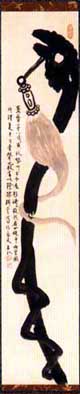
Hakuin's Dragon Staff Inka Scroll


Zen Master Hakuin (1686-1768) painted a Dragon Staff with a horsehair whisk attached.  He gave the above painting to a lay student who passed the Zen koan, "What is the sound of one hand clapping."