Showing posts with label Crane Frolic. Show all posts

Monday, April 06, 2026

Crane Frolic Chi Kung Exercise #6

6.  The Crane Opens and Closes Its Wings

Begin in the basic Crane stance with the hands at the waist.  The legs are separated with a shoulder's width.  Stretch the fingers open.  Inhale as you lift both hands up the center of the body, fingers pointing forward, arms about 24" apart.
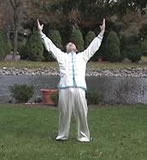
As the hands reach the neck begin to move both hands to the side, upwards, and backwards.  Spread the arms as far apart as you can and to either side of the body as you lift both arms high above the head.  Draw the arms up and back as you gently bend backwards.
At the same time as the arms are lifted up and back, try to lift both heels off the ground, and come up on your toes.  Look up at the sky with your head drawn back. 
As you begin to exhale, gently draw the arms forward and down, straighten the back, look forward, and move the arms down to the waist. 
Repeat for 4 to 8 repetitions in a gentle, slow, calm, deliberate, and smooth manner. 

This movement is found in the Wild Goose Qigong (Dayan Chi Kung) routine.  Refer to "Wild Goose Qigong" by Hong-Chao Zhang, pp.20-21. 
Back-bending while standing with the arms lifted above the head and with the hands touching is a commonly used hatha yoga posture called Anyvittasana.   
This exercise is a hyperextension of the back, stretching of the latissimus dorsi muscles of sides of the upper back, a stretching of the upper rectus abdominis, engaging the pectoralis major, and a tensing of the trapezius muscles in the upper back and neck. 
This movement opens and fills with Qi (Chi, Energy) the Middle Dan Tien (i.e., 中丹田, Zhong Dantian, middle elixir fields, cauldron) of the esoteric body system explained in Chinese Qigong (Yoga); or, analogously, opens the Heart Chakra (Anhata) of Hatha Yoga.  Exercise of this area in the front of the body helps heal disturbed emotions, calms the spirit, strengthens the heart and lungs, and opens the Heart-Soul to the grace of light energy. 
The wide-spread arms held up high help establish a feeling of opening up, freeing oneself, and uplifting one's mood and spirit. 
You often see this ritual body posture in Christian revival meetings as a kind of "Saying Hallelujah" posture.
If the movement was done forcefully and with power and quickly it would be the flapping of the wings of a powerful bird like a Crane or wild Goose or for a human bodybuilder the performance of incline dumbbell flys. 


Crane Frolic Qigong Exercise Set

Eight Animals Frolics Mind/Body Fitness Practices (Chi Kung) by Mike Garofalo
 

The webpages for the eight specific animals will also have photographs of me or others doing these exercises.  There are also five, eight or twelve animals in Shaolin Kung Fu, Ba Gua Zhang, Taijiquan, and Xing Yi Quan.  Movements or postures called a "crane" or "hawk" or "rooster" are found in most of these mind-body internal arts.   

Chinese exercises recommended for improving fitness, maintaining good health, overcoming diseases, increasing energy and vitality, contributing to good mental health, and improving one's chances for longevity have a very long documented history going back to as early as 160 BCE in the Daoyin Tu.    

Sunday, April 05, 2026

Crane Frolic, Exercise #2

Crane Frolics Qigong Exercises

2.  The Red-Headed Crane Delights in Seeing Its Mate  

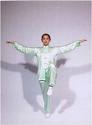
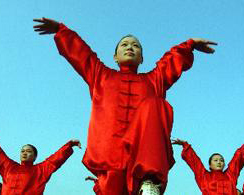
Lift both arms up to the sides until they are both above shoulder level.  The hands take the shape of the Crane's Hand they move above shoulder height.  (The ladies in the pictures below exemplify the posture desired when hands and knees are raised to the highest levels.) 

As the arms raise up, lift the left knee up until it is about at hip level.  Breathe in as you lift both arms up.  Pause for a moment at the highest point and look forward as if recognizing your mate or sweet-heart in a group.  Then lower the left leg and arms simultaneously as you exhale.  As the hands come down to the sides of your thighs, bend the knees slightly and dip down a little.  Then raise the arms up again as you lift the right knee up to hip height.  Inhale as you rise, exhale as you lower down.  Alternate the raising of arms and one leg for 4 to 10 repetitions.   
The height to which you will raise your knee depends upon your balancing skills, coordination, strength, confidence, and degree of skill.  Do try your best to raise the knee upward and draw your foot off of the floor. 
Folklore favors the idea that Cranes mate for life.  Some scientific research indicates that they do mate monogamously for long periods, but may change mates after a long period of time - serial monogamy.   Keeping the same mate means that their partner is special, recognizable, identifiable, and can be spotted in a group of Cranes feeding in a marsh or flying in formation during migration.  


Wednesday, June 19, 2013

Crane Frolic Qigong, Exercise #3

Crane Frolics Chi Kung, Exercise #3

3.  The Grandmother Crane Shakes the Dust from Her Wings  

a) From the Crane Stance step out with the right leg at an angle, placing the heel gently on the floor.  Lean back as you raise your arms up the sides of the body.  As the arms are raised upward the palms face downward and the fingers are spread open.  Inhale as you raise your arms and lean back. 

b) Begin to shift the weight forward into right leg and flatten the right foot as you draw your hands in a downward and inward arc towards the center of your body.  As the arms move down, turn the hands so that the palms are facing upward when you reach about waist level.  Exhale as you move the arms downward.  Some people might need to bring both fee together at this point so as to be able to balance well enough to perform part c) of this movement sequence. 
c) Shift all the weight into the right leg.  Begin to raise the arms forward and upward to above shoulder height, palms up, fingers open, arms out to the side.  As the arms raise the left knee is drawn upward until it is at about waist height.  Inhale as you drawn both arms and the left knee upward.  Look forward. 
d) Draw both arms down and back as you lower your left knee and step backward to the starting position.  Step back with the right foot to return to the starting position and a Crane Stance.  The hands return to Dan Tian level.  Exhale as you move from c) to d). 
Repeat the same movement sequence above (a-d) to the opposite left side (i.e., stepping out to the left side at an angle, leaning back and raising arms, drawing right knee to waist, then steeping back). 
Instead of stepping back in part d) you could bring the foot back to alongside the other foot.  Then turn the body slightly to the left and begin a repetition of parts (a-d) to the opposite left side.  You would need room for moving forward.  
The model I have used for this movement is identical to the movement performed by Anson Rathbone in his Bird Frolic, #4 Dry Your Wings.   
 
Crane Frolics

Five Animal Frolics

Valley Spirit Qigong


Wednesday, June 12, 2013

Crane Animal Frolic Qigong, Exercise #5

5.  The Wise Crane Listens to the Healing Sound for the Heart  
The use of one of the Six Healing Sounds is a common practice in Daoyin (Qigong) practice.  The Daoist healing sound He is use to heal the heart and small intenstine, and is associated with the summer months.  The Crane Frolic is intended to heal the heart, calm the mind, draw out a serene spirit, and be a summertime favorite.   
 
I use the technique described by Daniel Reid as follows:
"Start in a relaxed Horse stance.  Bring your hands slightly forward so that he palms are facing each other at thigh level.  Focus attention on the point between the eyebrows [Upper Tan Tian] and on the point midway between the nipples [Middle Dan Tian], in order to open up these vital energy centers, then shift attention to the centers of the palms and the tips of the little fingers.  Commence inhalation and, as you begin to raise your hands up and out to the sides, turn the palms so that they face towards the back, and extend the little fingers outwards as far as possible to activate the heart meridian.  When your breath is full and the hands reach shoulder level, commence exhalation through the mouth, aspirating the syllable her in the top of the throat (He is pronounced as 'her' but without the final 'r', with mouth open, tip of tongue pressed against lower teeth, and syllable aspirating in the top of the throat on exhalation.), while slowly lowering the hands back down the sides with little fingers relaxed.  Visualize hot Fire energy streaming up and out of the heart with exhalation.  When the breath is empty and your hands are back down in the front, pause to relax, then begin the next cycle on the next inhalation."
-  Daniel Reid, "The Complete Book of Chinese Health and Healing," 1995, p.223 
 
Don't strain when breathing on the inhale or exhale.  Some recommend and demonstrate a fairly loud sounding of the healing sound, while others recommend a very soft or nearly silent sounding of the healing sound.  I favor a soft, gentle, and quiet but audible sounding of the healing sound on the exhale.  Experiment!  Try!  What works for you?  What do you feel comfortable with doing? 

Saturday, June 08, 2013

Crane Animal Frolic Chi Kung, Exercise #4

4.  The Sandhill Crane Glides Down to Land Along the Platte River    

Step forward with the right leg.  Place the weight evenly into the right foot.  Gradually lift the arms to the side and slightly backward, palms facing down.  Gradually lift the left leg into the air, and point the left toe.  Balance on the right foot.  Lift the head slightly and look forward.  Inhale as you lift the left leg and lift both arms up.  Hold in the upward position for a few moments.  Then, exhale as you draw the left leg back down to the floor, and draw both arms down to the sides of the thighs.  As you exhale, imagine yourself as a Crane gliding downward, lowering and angling your wings to slow your descent, getting your feet ready to land on the muddy ground by the riverbank of the Platte River.   

With our breathing in we lift to flight.  With our breathing out we prepare to land on the riverbank.   
Repeat the same movement to the opposite side: left leg on ground, right leg lifted, arms out to the side and back.  Alternate back and forth from side to side. 
I prefer moving forward as I shift from side to side.  However, if room does not permit, then step back with both feet into the Crane Stance before stepping out to the opposite side.  


Hatha yoga practitioners know a variation of this movement as "Warrior Three" (Virabhadrasana III) or "Balancing Stick."  In the yoga version, both arms are extended forward as far as possible with the palms touching.  The extended position, balancing on one leg, is held for 20 to 30 seconds (B.K. S. Iyengar, Light on Yoga, 1966, p.74).  The Crane Frolic method is more like a Vinyasa or Flowing style of yoga, coordinated more with breathing pace without extended holding in a static isometric posture for longer periods of time.   
 
Over 500,000 Sandhill Cranes migrate to the Platte River in Nebraska from Canada each year.  
 
We do see many gaggles of Canadian Geese in the winter months that migrate from as far as Alaska to the warmer climate and muddy rice fields of the North Sacramento Valley in California.  However, I've never seen any cranes migrate to our area.  

Animal Frolics Chi Kung

Crane Animal Frolics Chi Kung

Valley Spirit Qigong 

Mike Garofalo's Qigong and Yoga Classes in Red Bluff


Saturday, June 01, 2013

Crane Frolic Chi Kung Exercise #6

6.  The Crane Opens and Closes Its Wings

Begin in the basic Crane stance with the hands at the waist.  The legs are separated with a shoulder's width.  Stretch the fingers open.  Inhale as you lift both hands up the center of the body, fingers pointing forward, arms about 24" apart.
As the hands reach the neck begin to move both hands to the side, upwards, and backwards.  Spread the arms as far apart as you can and to either side of the body as you lift both arms high above the head.  Draw the arms up and back as you gently bend backwards.
At the same time as the arms are lifted up and back, try to lift both heels off the ground, and come up on your toes.  Look up at the sky with your head drawn back. 
As you begin to exhale, gently draw the arms forward and down, straighten the back, look forward, and move the arms down to the waist. 
Repeat for 4 to 8 repetitions in a gentle, slow, calm, deliberate, and smooth manner. 

This movement is found in the Wild Goose Qigong (Dayan Chi Kung) routine.  Refer to "Wild Goose Qigong" by Hong-Chao Zhang, pp.20-21. 
Back-bending while standing with the arms lifted above the head and with the hands touching is a commonly used hatha yoga posture called Anyvittasana.   
This exercise is a hyperextension of the back, stretching of the latissimus dorsi muscles of sides of the upper back, a stretching of the upper rectus abdominis, engaging the pectoralis major, and a tensing of the trapezius muscles in the upper back and neck. 
This movement opens and fills with Qi (Chi, Energy) the Middle Dan Tien (i.e., 中丹田, Zhong Dantian, middle elixir fields, cauldron) of the esoteric body system explained in Chinese Qigong (Yoga); or, analogously, opens the Heart Chakra (Anhata) of Hatha Yoga.  Exercise of this area in the front of the body helps heal disturbed emotions, calms the spirit, strengthens the heart and lungs, and opens the Heart-Soul to the grace of light energy. 
The wide-spread arms held up high help establish a feeling of opening up, freeing oneself, and uplifting one's mood and spirit. 
You often see this ritual body posture in Christian revival meetings as a kind of "Saying Hallelujah" posture.
If the movement was done forcefully and with power and quickly it would be the flapping of the wings of a powerful bird like a Crane or wild Goose or for a human bodybuilder the performance of incline dumbbell flys. 


Crane Frolic Qigong Exercise Set

Eight Animals Frolics Mind/Body Fitness Practices (Chi Kung) by Mike Garofalo
 

The webpages for the eight specific animals will also have photographs of me or others doing these exercises.  There are also five, eight or twelve animals in Shaolin Kung Fu, Ba Gua Zhang, Taijiquan, and Xing Yi Quan.  Movements or postures called a "crane" or "hawk" or "rooster" are found in most of these mind-body internal arts.   

Chinese exercises recommended for improving fitness, maintaining good health, overcoming diseases, increasing energy and vitality, contributing to good mental health, and improving one's chances for longevity have a very long documented history going back to as early as 160 BCE in the Daoyin Tu.