Showing posts with label Patience. Show all posts

Friday, June 20, 2025

Shifu Mio Zhang's "Gradual Enlightenment"

 The Fireplace Records, Chapter 21


Shifu Mao Zhang's "Gradual Enlightenment


Xita asked Shifu Miao Zhang, "What is sudden enlightenment?"  Shifu Miao Zhang threw his staff on the muddy ground. 

Xita asked Miao Zhang, "What is gradual enlightenment?" Shifu Miao Zhang stomped on his staff three times.

Xita said, "Yes! Good!  Your understanding is straightening.  From now on, Miao Zhang, you will need to continue to clean and polish your staff."


Related Links, Resources, References

Koans:

Refer to my Cloud Hands Blog Posts on the topic of Koans/Dialogues.

The Daodejing by Laozi  

Pulling Onions  Over 1,043 One-line Sayings by Mike Garofalo

Chinese Chan Buddhist and Taoist Stories and Koans

Taoism

Buddhism

Fireplaces, Stoves, Campfires, Kitchens, Pots, Firewood

Chinese Art

Tai Chi Chuan and Qigong

Meditation Methods

Zen Koan Books I Use

Koan Database Project

Brief Spiritual Lessons Database Project: Subject Indexes


Subject Index to 621 Zen Buddhist Koans


Sparks: Brief Spiritual Lessons and Stories

Matches to Start a Kindling of Insight
May the Light from Your Inner Fireplace Help All Beings
Taoist, Chan Buddhist, Zen Buddhist, Philosophers
Catching Phrases, Inspiring Verses, Koans, Meditations
Indexing, Bibliography, Quotations, Notes, Resources
Research by Michael P. Garofalo

The Fireplace Records
By Michael P. Garofalo


Friday, October 28, 2022

Dao De Jing, Laozi, Chapter 10


Tao Te Ching by Lao Tzu

Chapter 10


"Can you govern your animal soul, hold to the One and never depart from it?
 Can you throttle your breath, down to the softness of breath in a child?
 Can you purify your mystic vision and wash it until it is spotless?
 Can you love all your people, rule over the land without being known?
 Can you be like a female, and passively open and shut heaven's gates?
 Can you keep clear in your mind the four quarters of earth and not interfere?
 Quicken them, feed them;
 Quicken but do not possess them.
 Act and be independent;
 Be the chief but never the lord:
 This describes the mystic virtue."
 -  Translated by Raymond Blakney, 1955, Chapter 10 


"By husbanding the animal and spiritual souls
and embracing unity, it is possible to prevent their separation.
By undivided attention to the passion-nature,
and increasing tenderness, it is possible to be a little child.
By putting away impurity from the hidden eye of the heart,
it is possible to be without spot.
By loving the people, and so governing the nation,
it is possible to be unknown.
In opening and shutting the heavenly doors (mouth, nostrils, etc.)
it is possible to have no creaking.
One may be bright and transparent on all sides, and yet be unknown.
To produce and to nourish, to produce and have not,
to act and expect not, to enlarge and cut not off, —
this is called sublime virtue."
-  Translated by John Chalmers, 1968, Chapter 10 


"By patience the animal spirits can be disciplined.
By self-control one can unify the character.
By close attention to the will, compelling gentleness, one can become like a little child.
By purifying the subconscious desires one may be without fault.
In ruling his country, if the wise magistrate loves his people, he can avoid compulsion.
In measuring out rewards, the wise magistrate will act like a mother bird.
While sharply penetrating into every corner, he may appear to be unsuspecting.
While quickening and feeding his people, he will be producing but without pride of ownership.
He will benefit but without claim of reward.
He will persuade, but not compel by force.
This is De, the profoundest virtue."

-  Translated by Dwight Goddard and Henri Borel, 1919, Chapter 10 


"Can you hold the door of your tent
Wide to the firmament?
Can you, with the simple stature
Of a child, breathing nature,
Become, notwithstanding,
A man?
Can you continue befriending
With no prejudice, no ban?
Can you, mating with heaven,
Serve as the female part?
Can your learned head take leaven
From the wisdom of your heart?
If you can bear issue and nourish its growing,
If you can guide without claim or strife,
If you can stay in the lead of men without their knowing,
You are at the core of life."

-  Translated by Witter Bynner, 1944, Chapter 10 


"Can you keep the soul always concentrated from straying?
Can you regulate the breath and become soft and pliant like an infant?
Can you clear and get rid of the unforeseen and be free from fault?
Can you love the people and govern the state by non-action?
Can you open and shut the gates of nature like a female?
Can you become enlightened and penetrate everywhere without knowledge?"
-  Translated by Ch'u Ta-Kao, 1904, Chapter 10


"When 'carrying your soul,' embracing the One Thing, can you be undivided?
When 'concentrating ch'i', bringing about Softness, can you be like an infant?
When 'cleansing and purifying the mysterious mirror,' can you be without blemish?
When 'loving the people and caring for the kingdom,' can you be without knowledge?
When 'the Doors of Heaven open and shut,' can you remain Feminine?
When 'Clarity and bareness penetrate everywhere,' can you remain not doing?
Produce and nourish. Produce but don't possess work but don't rely on this preside but don't rule.
This is mysterious Te."
-  Translated by Michael LaFargue, 1992, Chapter 10   


載營魄, 抱一能無離乎?
專氣致柔, 能嬰兒乎?
滌除玄覽, 能無疵乎?
愛民治國, 能無知乎?
天門開闔, 能為雌乎?
明白四達, 能無知乎?
生之畜之.
生而不有.
為而不恃.
長而不宰.
是謂玄德.
-  Chinese characters, Tao Te Ching, Chapter 10


"Having received, in the birth-process, a living soul, one is able, by preserving its individuality pure and uncorrupted, to prevent disunion with the pure original.
By controlling the vital force, and bringing it to the utmost degree of pliancy, one is able to become as a little child again and revert to one’s pristine state of innocence.
By washing and cleansing oneself of that which Heaven alone can see, one may become without one blemish.
By governing the Empire by love towards the people, one is able to keep them from knowing evil; and, they will live in an atmosphere of contentment and trust.
When the Door of Heaven is now open, now closed, then the Female Principle will disappear; and, all will be pure Yang.
If one’s understanding reaches in every direction, he can disregard knowledge.
What he produces, he nourishes.
Producing, he does not claim the possession of virtue.
Acting, he does not presume upon his ability.
Though he be a veteran among his fellows, he assumes no seniority over them.
This may be called Sublime Virtue, the highest development of Tao."
-  Translated by Frederic Henry Balfour, 1884, Chapter 10  


"¿Se puede mantener el espíritu y abrazar al Uno sin apartarse de ellos?
¿Se puede concentrar su fuerza vital y lograr el más alto grado de debilidadcomo un niño?
¿Se puede limpiar y purificar su visión profunda por lo que será sin mancha?
¿Se puede amar al pueblo y gobernar el Estado sin la astucia?
¿Se puede jugar el papel de la mujer en la apertura y cierre de las puertas del cielo?
¿Se puede entender todo y penetrar en todos ellos sin hacer nada?
Para producir las cosas y les trasera,
Para producirpero no para tomar posesión de ellos,
Para actuar, pero no confiar en la propia capacidad,
Para guiarlos, pero no para dominarlos.
Esto se llama la virtud profunda y secreta ".
Traducido al Inglés por Chan Wing-Tsit, 1953, Capítulo 10


"Bring soul and spirit into unity, they will become welded in the Inner Life.
Conquer vital force until it yields to you, you will become as a new-born child.
Purify the channels of deep perception, you will dwell safely in the Inner Life.
Govern a kingdom by loving the people, they will learn to act from the Inner Life.
Open and shut the doors of heaven, you will have repose of mind in active life.
Let your purity shine forth in all directions, men will see that you have an Inner Life.
Give it birth, nourish it,
Give it birth, but do not seek to possess.
Act but do not appropriate.
Endure but do not rule.
That is called profound Teh."
-  Translated by Isabella Mears, 1916, Chapter 10


 zai ying po, bao yi neng wu li hu?
 tuan qi zhi rou, neng ying er hu? 
 di chu xuan lan, neng wu ci hu? 
 ai min zhi guo, neng wu wei hu?
 tian men kai he, neng wei ci hu?
 ming bai si da, neng wu zhi hu?
 sheng zhi xu zhi.
 sheng er bu you.
 wei er bu shi,
 zhang er bu zai.
 shi wei xuan de.

-  Hanyu Pinyin (1982) Romanization, Daodejing, Chapter 10  


"In harmonizing your hun and p'o to embrace the One,
Can you concentrate without deviating?
In attuning your breath to induce tenderness,
Can you become like a new-born babe?
In cleansing and purifying your Mystic Mirror,
Can you make it free from all stain?
In loving the people and ruling the state,
Can you practice non-interference?
When the Heavenly Gate opens and closes,
Can you play the part of the Female?
When your light shines forth in all directions,
Can you ignore it with perfect equanimity?
To produce things and nourish them,
To produce but not to claim ownership,
To act but not to presume on the result,
To lead but not to manipulate, -
This is called Mystic Virtue."
-  Translated by Henry Wei, 1982, Chapter 10


A typical webpage created by Mike Garofalo for each one of the 81 Chapters (Verses, Sections) of the Tao Te Ching (Daodejing) by Lao Tzu (Laozi) includes 25 different English language translations or interpolations for that Chapter, 5 Spanish language translations for that Chapter, the Chinese characters for that Chapter, the Wade-Giles and Hanyu Pinyin transliterations (Romanization) of the Mandarin Chinese words for that Chapter, and 2 German and 1 French translation of that Chapter.  Each webpage for each one of the 81 Chapters of the Tao Te Ching includes extensive indexing by key words, phrases, and terms for that Chapter in English, Spanish, and the Wade-Giles Romanization.  Each webpage on a Chapter of the Daodejing includes recommended reading in books and websites, a detailed bibliography, some commentary, research leads, translation sources, a Google Translate drop down menu, and other resources for that Chapter. 


Chapter 10, Tao Te Ching by Lao Tzu.  Complied by Mike Garofalo.  

Chapter and Thematic Index (Concordance) to the Tao Te Ching by Lao Tzu


English Language Daodejing Translators' Source Index


Spanish Language Daodejing Translators' Source Index


Ripening Peaches: Taoist Studies and Practices


Taoism: A Selected Reading List


A Daoist Druid's Final Journey  

An Old Philosopher's Notebooks


Tao Te Ching
 Chapter Number Index


Standard Traditional Chapter Arrangement of the Daodejing
Chapter Order in Wang Bi's Daodejing Commentary in 246 CE
Chart by Mike Garofalo
Subject Index
 
1 2 3 4 5 6 7 8 9 10
11 12 13 14 15 16 17 18 19 20
21 22 23 24 25 26 27 28 29 30
31 32 33 34 35 36 37 38 39 40
41 42 43 44 45 46 47 48 49 50
51 52 53 54 55 56 57 58 59 60
61 62 63 64 65 66 67 68 69 70
71 72 73 74 75 76 77 78 79 80
81


The Eight Immortals on a Journey Together
Early Chinese lore about a Super Hero Team

Sunday, December 31, 2017

With Slow Movements ...


"The movements of Qigong exercise should be slow instead of fast because slow movements will nourish qi and combine the posture with qi. The training practice of Qigong should start with Wuji with slow movement until the closing of the training.  Every movement and step must be done slowly, opening and spreading of the body be slow, closing and sinking of the body be slow, and rising and falling of the body be slow.  With slow movements, one can keep thinking whether the upper, lower, left and right of the body are followed, and whether the interior and exterior are coordinated.  With the slow and gentle movements and posture, the internal qi is conducted to flow slowly in the body to integrate mindwill with qi, vitality with posture, and enter the realm of forgetting the substance and me."
-  Master Wang Fengming, Special Taoist Taji Stick and Ruler Qigong, p. 115. 


Hun Yuan Stick and Ruler Qigong

Hun Yuan Qigong, Primordial Qigong, Mixed Circles Qigong

Valley Spirit Qigong

Vancouver Tai Chi and Chi Kung Studio, Vancouver, Washington State


I was given a number of books by family and friends this holiday season, and for my 72nd birthday. I thank them for their generosity. 

A 5 DVD set of instructional DVDs from Brett Wagland and Fontane Ip from Canberra, Australia.  They teach Hunyuan Taijiquan and Qigong.  A $125 investment in coaching in Hunyuan:

Yang Tai Chi for Beginners. By Dr. Yang, Jwing-Ming. Instructional DVD, 293 minutes. YMAA, 2012. VSCL.

Tai Chi Chuan Martial Power: Advanced Yang Style. By Dr. Wang, Jwing Ming. Foreword by Tsung-Hwa Jou. Wolfeboro, New Hampshire, YMAA Publication Center, 3rd Edition, 1986, 1996, 2015. Index, glossary, bibliography, 274 pages. ISBN: 978-1594392948. VSCL.


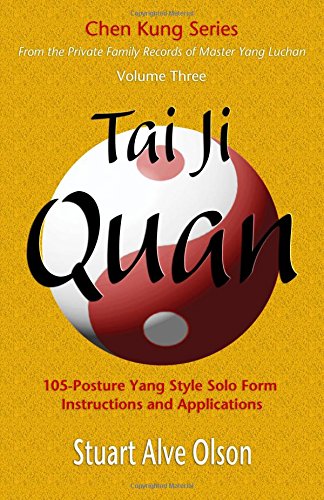
Tai Ji Quan: 105 Posture Yang Style Solo Form - Instructions and Applications. Chen Kung Series, From the Private Family Records of Master Yang Luchan, Volume Three. Translation and commentary by Master Stuart Alve Olson. Phoenix, Arizona, Valley Spirit Arts, 2017. Bibliography, appendices, 234 pages. ISBN: 978-1548105372. VSCL. "The long-awaited third volume in the Chen Kung Series presents the detailed instructions on the original Yang Style 105-Posture Taijiquan form, along with explanations of the practical self-defense applications, commentaries by Chen Kung, translations of the illustrations in the text, and notes by Stuart Alve Olson. A truly remarkable, insightful work that complements anyone’s library on the art of Taijiquan." "Born in 1906, Master Chen Kung (a.k.a., Yearning K. Chen and Chen Yen-lin) passed away in Shanghai, Chiina, in 1980. Master Chen Kung copied the Yang Family manuscripts in 1930."


Saturday, December 23, 2017

Regain Childhood Suppleness


Tao Te Ching (Daodejing) by Lao Tzu (Laozi)
Chapter 10


"While you
Cultivate the soul and embrace unity,
can you keep them from separating?
Focus your vital breath until it is supremely soft,
can you be like a baby?
Cleanse the mirror of mysteries,
can you make it free of blemish?"
- Translated by Victor H. Mair, 1990, Chapter 10


"By patience the animal spirits can be disciplined.
By self-control one can unify the character.
By close attention to the will, compelling gentleness,
one can become like a little child.
By purifying the subconscious desires one may be without fault."
- Translated by Dwight Goddard and Henri Borel, 1919, Chapter 10


"When the intelligent and animal souls are held together in one embrace, they can be kept from separating.
When one gives undivided attention to the vital breath, and brings it to the utmost degree of pliancy,
He can become as a tender babe.
When he has cleansed away the most mysterious sights of his imagination,
He can become without a flaw."
- Translated by James Legge, 1891, Chapter 10 


"Can you coax your mind from its wandering
and keep to the original oneness?
Can you let your body become
supple as a newborn child's?
Can you cleanse your inner vision
until you see nothing but the light?
Can you love people and lead them
without imposing your will?
Can you deal with the most vital matters
by letting events take their course?
Can you step back from you own mind
and thus understand all things?
Giving birth and nourishing,
having without possessing,
acting with no expectations,
leading and not trying to control:
this is the supreme virtue."
- Translated by Stephen Mitchell, 1988, Chapter 10