Showing posts with label Imagination. Show all posts

Sunday, April 19, 2026

Art, Symbolism, and Creative Interpretations: The Tarot

Today, I am enjoying using a new copy of the:
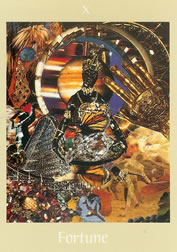
Voyager Tarot, Intuition Cards for the 21st Century
By James Wanless, Ph.D.. Artist Ken Knutson. 
78 full color collage art Tarot cards.  117 page mini booklet. 
Fair Winds: ISBN 978-1-59233-322-6, 2017.  First edition 1984.  


Has anyone seen a chart or list correlating the 78 cards in the Voyager Tarot (or other Tarot decks) with the 64 Hexagrams of the I Ching???

For examples:

I Ching Number = Tarot Card Name

#1 Creative, Initiating = Magician, 1

#4, Childhood, Youthful Folly, Impermanence = Fool, 0

#52 Mountain = Hermit, 9

During a morning Voyager Tarot card reading, I usually select one card as the most significant for the day.  I would like to write on each Tarot card the corresponding, related, correlated, comparable, similar themed, or relevant I Ching Hexagram Number.  

Also, this is a different way for selecting an I Ching Hexagram other than yarrow sticks or coin tossing.  


A Repost from 2018:


I first purchased and used Tarot decks in 1979.  I studied numerous books on the subject of the Tarot.  I purchased numerous decks over the decades.  First, I enjoyed the variety of artwork and symbolism in the 78 cards in the different decks from different centuries.  Second, the creator of each deck brings some new insights into the overall structure and meanings for the cards in the deck.  Third, I enjoyed "reading" and creatively interpreting the symbols and images in these small art objects in the context of my own life and questions.  

I even made, in 2011, some very incomplete notes in hypertext documents on the Tarot.

My method over the years is to ask a question or reflect on my current consciousness and situation in my life.  Then, I randomly pull from 3 to 5 cards from the deck.  I try to interpret, reflect upon, and consider the meaning of each card.  I may use The Voyager Tarot book to refresh or expand my understanding or memories.  Then, I arrange the cards in some order to "tell a story."  I do this once a day, at night; then, in the morning, reconsider the meanings and relevance of that 3-5 card reading in my life.  I only look at cards right side up; although, I do sometimes reverse the meaning of the cards depending upon the story I create.  

I enjoy using the 1991 Voyager Tarot deck the most.  

This photomontage deck was designed by James Wanless, Ph.D.  The photographic collage artwork was created by Ken Knutson.  It was first published in 1984, and then in 1991 and 2008. 

The Voyager Tarot: Way of the Great Oracle Book.  By James Wanless, 1989.  Book and Deck


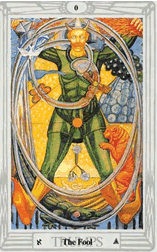
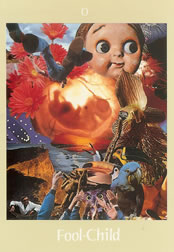
 The Fool, 0


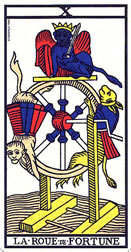
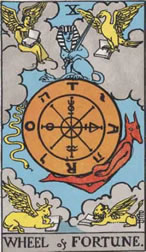
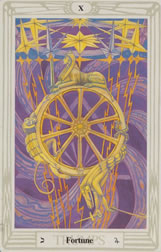
The Wheel of Fortune, 10


Sunday, October 12, 2025

One Picture of Me


One Picture of Me

By Mike Garofalo


When Laurence asked for poems on the theme of "Self-Portrait" I though of a long philosophical poem I wrote about the interrelated subjects of Picturing and Describing. 

One set of examples I used in that long poem was the human skull. I spoke of memories of Halloween in East Los Angeles, where Mexican Skulls, calaveras, filled displays on El Dia De La Muerte. Meaningful from artistic and religious perspectives.

The brief poem I'm sharing today is a excerpt about my own skull as Pictured by medical imaging, and described by me and interpreted by the oral surgeon.


"This bony skull of mine
electrified
pictured onscreen for me.
     Doctor recommends
     some oral surgery.

The brain disappeared,
an empty space
sliced from
X Ray images retraced.
Eyeless in inner space.

Monkey nose holes,
bony eye glasses,
teeth glowing in the dark.
     Inner spaces never seen
     underneath my very being.

Skinless, noseless, earless,
a shape, a form—
     the images informed.
Stripping away the unneeded,
revealing my inner core."


So, as we all know, a single picture or image can cause a flow of ideas, interpretations, and feelings in our minds.

Or, just two words can please, excite or inflame our minds. Our lover's name can explode our feelings.

But, just two other words can frighten our moral being.

For example, 

Donald Trump ...
[pause, raise your elbow]

Kick Him Out. 

See you on the street next Saturday.


The above "brief poem" will be printed in
The SkullCrushing Hummingbird
Zine #7
, in Portland, Oregon,
on 10/12/2025.


Commentary: Off the Cuff


So, considering, have you ever seen
a picture or a video or a drawing
of a Skull Crushing Hummingbird,
crushing an insect's Skull
with its tiny beak or flashing wings?

No, you have not,
and that is just one reason why,
you don't believe
that Skull Crushing Hummingbirds
are really alive.

However,
Words, context, technical knowledge,
and intent claim meaningfulness,
even truth,
in addition to any pictures viewed.
The surgeon and I see differently.

Sometimes, though, we reader's prefer
fantasies and fictional
Skull Crushing Hummingbirds
to any ho-hum boring beings-
a moniker for fun memories.


***********************


Pictures mirroring things
displaying aspects of reality
uncovering hidden realms of being
pointing to more clear correspondence.
Show me a good picture - Please!

We drew pictures in caves
Heroes pictured in statues
Books illustrated pictured facts
Drones picture our towns from above
Hubble sends us clear pictures of Space

Our brains are
Picture processing ... Machines-
and you can picture mindfulness
you can picture your intent verbally...
picturing is a form of meaningfulness.

Science and technology have
invented new ways of picturing
so we can see into Reality
and open our ordinary eyes
to new ways of seeing.

Picturing - Defining
Planning - Imagining
Painting - Photography
Reflecting - Mimicking
Do I see what I mean?

Wittgenstein in the Tractatus of 1921
Used Pictures and Picturing as the
criterion of meaningfulness and truth.
Wittgenstein in the Investigations of 1953
changed to talking about our talking
about, in ordinary words, aspects of Picturing.

The best pictures, the best descriptions,
how we talk in everyday ways,
point to correspondence, mirroring,
a theory of epistemology.
Richard Rorty disagreed.


**********************************


Bundled Up, Volume 1
Quintains, Pentastichs, Tankas

Gushen Grove Sonnets

Highway 101 and 1: A Docu-Poem
California, Oregon, Washington

25 Steps and Beyond
The Poetry by Mike Garofalo


Wednesday, June 26, 2024

String Figures from Native Americans

 Repost from 2013:

"Take a deep breath of all the stories that live here. A re-ligious act, to be true to the origin of the word “re-ligios”- to re-tie, re-link - is to find ways to re-connect, re-turn, re-imagine.”


In the winter season, we are allowed to say,

“Ts' its' tsi' nako,
Thought-Woman, the Spider
named things and as she named them they appeared.
She is sitting in her room thinking of a story now
I'm telling you the story she is thinking.”
-  Keresan Pueblo introduction


Strings on Your Fingers by Mike Garofalo

Spider Grandmother weaves the Grand Cosmic Web and then spins off the planets and stars in the Navaho myths.  Zuni myths say the Spider Grandmother gave the art of string figures into the hands of the children.  Spider Grandmother is a powerful earth spirit being, the primary Creatrix of the cosmos and mind, a source of boundless imagination and the creation of the new.  An archaic Goddess of Weaving is essential to a pleasant life for all our people. 

Many Stars, Son-thlani, or Spider Grandmother’s Web is one of my favorite Navaho string figures to make.  I usually do the Spider Web (Jayne SF51) string figure first, for ritual purposes, to remind myself of my debt to all the people who have helped me learn to make string figures, everyone past and present are here symbolized as the Cosmic Web of Spider Grandmother.  

The image above is of the string figure called The Apache Door (Jayne SF12) known to many string players.  A different Navaho string figure, with a criss-crossing web pattern, is called Many Stars (Jayne SF51).    


Strings on Your Fingers by Mike Garofalo

2024 Update

I recently found a brand of string that works fairly well when making string figures. It is called Cora's Cotton Craft Cord Dyeable Fiber 2 mm/.08 in in diameter.  

The best string I've used for make string figures with my hands was a string used by carpenters or masons or gardeners to mark out a straight line during construction.  I'm still looking for the correct brand of string, softness, strength, thickness, flexibility, etc.

Thursday, June 20, 2024

"The Slow Pacific Swell" by Yvor Winters

The Slow Pacific Swell

By Yvor Winters (1902-1968)

Far out of sight stands the sea,
Bounding the land with pale tranquility.
When a small child, I watched it from a hill
At thirty miles or more. The vision still
Lies in the eye, soft blue and far away:
The rain has washed the dust from April day;
Paint-brush and lupine lie against the ground;
The wind above the hill-top has the sound
Of distant water in unbroken sky;
Dark and precise the little steamers ply--
Firm in direction the seem not to stir.
That is illusion. The artificer
Of quiet, distance holds me in a vise
And holds the ocean steady to my eyes.

Once when I rounded Flattery, the sea
Hove its loose weight like sand to tangle me
Upon the washing deck, to crush the hull;
Subsiding, dragged flesh at the bone. The skull
Felt the retreating wash of dreaming hair.
Half drenched in dissolution, I lay bare.
I scarcely pulled myself erect; I came
Back slowly, slowly knew myself the same.
That was the ocean. From the ship we saw
Grey whales for miles: the long sweep of the jaw,
The blunt head plunging clean above the wave.
And one rose in a tent of sea and gave
A darkening shudder; water fell away;
The whale stood shining, and then sank in spray.

A landsman, I. The sea is but a sound.
I would be near it on a sandy mound,
And hear the steady rushing of the deep
While I lay stinging in the sand with sleep.
I have lived inland long. The land is numb.
It stands beneath the feet, and one may come
Walking securely, till the sea extends
Its limber margin, and precision ends.
By night a chaos of commingling power,
The whole Pacific hovers hour by hour.
The slow Pacific swell stirs on the land,
Sleeping to sink away, withdrawing land,
Heaving and wrinkled in the moon, and blind;
Or gathers seaward, ebbing out of mind.


The Selected Poetry of Yvor Winters. By Yvor Winters and R. L. Barth. Swallow Press, 1999, 176 pages. VSCL.


California Poetry: From the Gold Rush to the Present.  Edited by Dana Gioia, Chryss Yost and Jack Hicks.  Santa Clara University, 2004, 376 pages. VSCL.


Four Days at Grayland by Michael P. Garofalo  Pacific Coast travel and camping adventures in Washington, Oregon, and Northern California. 
Guides, Links, Bibliography, Research, Photographs, Commentary, Notes, Travel Information, Hiking trips, Outdoor Fun, Natural History. A special emphasis on Native American People of the Pacific Northwest.  Focus on US Highway 101.  Yurt camping tips and techniques.


Sunday, October 29, 2023

How Do You Get Out?

              The Fireplace Records, Chapter 38


How Do You Get Out?


Porcupine Roshi was a jovial fellow. He enjoyed jokes.  He laughed often. He was fond of riddles.  

Porcupine Roshi died last winter of pneumonia. One of his friends was reading one of Porcuspine's many old notebooks. He found some curious riddles:

Imagine you are in a room with no windows or doors. How do you get out?

I dreamt I was in jail and to be executed for a crime I did not commit.  How do I escape?

I thought about all the bad situations I could get myself into. This was driving me crazy. What can I do?

Answers: Stop imagining; stop dreaming; stop thinking for awhile.


How many sides does a Zen Circle have?
Two! The inside and the outside.

Porcupine drew a small circle on the ground with his stick. He sat outside the circle. Then, he said, "We must choose to sit outside of the Zen Circle, or sit inside of the Zen Circle, or standing strong and passing between the two sides of the Zen Circle while laughing at ourselves."


Comments, Sources, Observations, Koans, Poems, Quips:

Know the difference between fiction and non-fiction.
Reasoning can be more useful than dreams or imagination.
It is easy to distinguish between being awake or dreaming.
Deal with real events, not how you imagine them beforehand.
Think about or imagine something positive happening.
Don't let your imagination cripple you.
Nobody ever gets away from the grasp of Death.
Imagining something does not make it real.
Watch out for Porcupine Roshi's sharp quills.

Draw the Zen Circle wide enough so that many can sit within.
A few Zen Koans are riddles, and a few Riddles are zen koans.
Surprise laughter after a riddle's answer is a minor insight of sorts.
Some puzzles have no solution, no resolution, no conclusion.
Drawing a circle is a common metaphorical act in Zen.
What side of the Zen Circle are you on?


Riddles (200+ Riddles, with No Ads.)

Refer to my Cloud Hands Blog Posts on the topic of Koans/Stories. 

Subject Index to 1,975 Zen Buddhist Koans

Zen Buddhist Koans: Indexes, Bibliography, Commentary, Information

The Daodejing by Laozi

Pulling Onions  Over 1,043 One-line Sayings, Quips, Maxims, Humor

Chinese Chan Buddhist and Taoist Stories and Koans

The Fireplace Records (Blog Version) By Michael P. Garofalo


Or


Tuesday, February 09, 2021

Standing Quietly Along the Columbia at Frenchman's Bar


I often take short local trips (under 100 miles round trip).  I live in the Orchards area, in the northeast Vancouver area, Clark County, Washington.  I live about 8 miles north of the I 205, Glen L. Jackson Memorial Bridge, over the Columbia River, leading into Portland.   

This past week I enjoyed visiting Lake Vancouver, Frenchman's Bar Regional Park, the Columbia River, and the lowlands of farms, woods, sloughs, and marshy areas along the north bank of the Columbia River.  This area is south of the Ridgefield National Wildlife Refuge.  The Columbia flows north from here to Longview.  Less than 40 miles round trip for me.


Very nice walking options at Frenchman's Bar
I bring a good outdoor folding chair in my old van.
Thus, I can sit outdoors in comfort at the right chosen vantage point.


"Sit quietly
focus and forget
rest with the great achievement.

The ancient child asks
"what is the great achievement?"
It is beyond description in any language
it can only be felt intuitively
it can only be expressed intuitively. 
Engage a loose, alert, and aware
body, mind, and sound
then look into the formless
and perceive no thing.
See yourself as a sphere
small at first
growing to encompass
the vastness of infinite space. 
Sit quietly
focus and forget then
in a state of ease and rest
secure the truth of the great achievement.
Employing the truth will not exhaust its power
when it seems exhausted it is really abundant
and while human art will die at the hands of utility
the great achievement is beyond being useful.
Great straightness is curved and crooked
great intelligence is raw and silly
great words are simple and naturally awkward. 
Engaged movement drives out the frozen cold
mindful stillness subdues the frenzied heart.
Sit quietly
focusing
forgetting
summon order from the void
that guides the ordering of the universe."
-  Tao Te ChingChapter 45, Translated by John Bright-Fey, 2006 


"Teach us to care and not to care.
Teach us to sit still."
-  T.S. Eliot

"I have discovered that all human evil comes from this,
man's being unable to sit still in a room."

-  Blaise Pascal

Sunday, October 11, 2020

Sit Quietly: Focus and Forget

"Teach us to care and not to care.
Teach us to sit still."
- T.S. Eliot


"You are sitting on the earth and you realize that this earth deserves you and you deserve this earth.  You are there - fully, personally, genuinely."
-  Chogyam Trungpa


"Remain sitting at your table and listen. 
Do not even listen, simply wait, 
be quiet still and solitary. 
The world will freely offer itself 
to you to be unmasked, 
it has no choice, it will roll in ecstasy 
at your feet."
-  Franz Kafka


"Sit quietly
focus and forget
rest with the great achievement.
The ancient child asks
"what is the great achievement?"
It is beyond description in any language
it can only be felt intuitively
it can only be expressed intuitively.
Engage a loose, alert, and aware
body, mind, and sound
then look into the formless
and perceive no thing.
See yourself as a sphere
small at first
growing to encompass
the vastness of infinite space.
Sit quietly
focus and forget then
in a state of ease and rest
secure the truth of the great achievement.
Employing the truth will not exhaust its power
when it seems exhausted it is really abundant
and while human art will die at the hands of utility
the great achievement is beyond being useful.
Great straightness is curved and crooked
great intelligence is raw and silly
great words are simple and naturally awkward.
Engaged movement drives out the frozen cold
mindful stillness subdues the frenzied heart.
Sit quietly
focusing
forgetting
summon order from the void
that guides the ordering of the universe."
-  Tao Te ChingChapter 45, Translated by John Bright-Fey, 2006


"There are many matters and many circumstances in which consciousness is undesirable and silence is golden, so that secrecy can be used as a marker to tell us that we are approaching the holy."-  Gregory Bateson, Angels Fear


Sitting in the Garden

Zuowang Meditation

Spirituality and Nature


Thursday, November 14, 2019

Pondering How Words Work the Mind

"When I seek God
with something in mind,


the best I get is
the something I had

in mind."


Meister Eckart, circa 1305 CE, was a Dominican clergyman, scholar, and teacher.  His theological and mystical poems, and his sermons are still read today.

Zen also tries to enlighten us to the levels of consciousness, mind, and non-verbal paths to right living.

Meister Eckhart: Selected Writings
Translated with introduction by Oliver Davies.
Penguin, 1995, Kindle Version


Selected Writings (Penguin Classics)


Tuesday, October 15, 2019

Monday, March 06, 2017

Playing like a Deer

"The Deer Play is to imitate the shape and movement of a deer hoping to attain long life and pure soul like a deer. The features of a deer are its gentle disposition, swift movement, love to push with horns, and good at running. When it stands it likes to stretch its neck to glance at things afar. The deer also likes looking at left and right and its rear foot. It is also good at moving its tail bones (sacrum). The tail bone is the place where the Jen and Du meridians meet. Thus, during practice, the practitioner not only needs to imitate the attitude of a deer with swift movement and calm spirit, but also need to focus attention on the tail bone. This will guide Qi to the whole body, open meridians, circulate blood, relax tendons and bones, and benefit kidney and strengthen waist. It can also enhance blood circulation in the abdomen. This play is suitable for curing dysfunctional nerves in the internal organs, chronicle infections of the internal organs in the abdomen, fatigue in the waist muscles, nerve pain in the pelvis, deteriorated thigh bones, and the lack of sex drives."
-   Five Animal Frolics  


"Breathing in and out in various manners, spitting out the old and taking in the new, walking like a bear and stretching their neck like a bird to achieve longevity - this is what such practitioners of Daoyin, cultivators of the body and all those searching for long life like Ancestor Peng, enjoy."
-   Chuang-tzu, circa 300 BCE. 


"Firstly, we analyze its function in the aspect of psychological regulation as it is required that the practitioner should do it before and during each routines in the exercise of the Health Qigong Wu Qin Xi. The practitioner should mind on the Dantian and rid of the distracted thoughts with quiet mind and spirit before the exercise, get into the imitation of its physical activities of each animal in the exercise. When practicing the tiger exercise, try to imagine yourself as a fierce tiger in the mountains who is looking down upon other beasts and stretching its own pawns and about to pounce on its prey; in the deer exercise, imagine that you are prudent and mild, jogging on a green field; in the exercise of the bear, you are a clumsy bear, composed and steady, freely roaming the forests; in the monkey exercise, you become a happy and agile monkey; in the bird exercise, you are a free bird with quiet mind and flying in the sky. Therefore you can continuously regulate the mind state in the exercise and it is helpful to the relaxation of the mind. The regular exercise of this skill can transform and regulate the mind of the practitioner to relieve the spiritual nervousness, improve the emotional stability, reduce the mental stress and keep the healthy mind."
-   The Effect of Precaution against Sub-health of the Health Qigong Wu Qin Xi.  Chinese Health Qigong Association.  2008.   


Deer Frolic  (Someday I might finish this webpage.  Oh well!  No hurry!) 


Monday, December 05, 2016

Playing For Its Own Sake

"Creative people are curious, flexible, persistent, and independent with a tremendous spirit of adventure and a love of play."-   Henri Matisse  

Play: Quotes, Sayings and Poetry

Play: It is an an activity which proceeds within certain limits of time and space, in a visible order, according to rules freely accepted, and outside the sphere of necessity or material utility.  The play-mood is one of rapture and enthusiasm, and is sacred or festive in accordance with the occasion.  A feeling of exaltation and tension accompanies the action."
-  Johan Huizinga, Homo Ludens


"In rare moments of deep play, we can lay aside our sense of self, shed time's continuum, ignore pain, and sit quietly in the absolute present, watching the world's ordinary miracles. No mind or heart hobbles. No analyzing or explaining. No questing for logic. No promises. No goals. No relationships. No worry. One is completely open to whatever drama may unfold."
- Diane Ackerman in Deep Play


Deep Play  By Diane Ackerman.  New York, Random House, 1999.  Index, 235 pages.  ISBN: 0679448799.  


"We may play with and pass on a garden, possessing one is an illusion.
Gardeners must dance with feedback, play with results, turn as they learn.
Some gardeners don't grow old and stop playing; they stop playing and grow old.
Nature's playfulness is a gardener's delight.
A garden is a sporting field, an area for play."
-   Michael P. Garofalo, Pulling Onions


"To play is to listen to the imperative inner force that wants to take form and be acted out without reason. It is the joyful, spontaneous expression of one's self. The inner force materializes the feeling and perception without planning or effort. That is what play is."
-  Michelle Cassou and Stewart Cubley in Life, Paint and Passion


"Play exists for its own sake.  Play is for the moment; it is not hurried, even when the pace is fast and timing seems important. When we play, we also celebrate holy uselessness.  Like the calf frolicking in the meadow, we need no pretense or excuses.  Work is productive; play, in its disinterestedness and self-forgetting, can be fruitful."
-  Margaret Guenther in Toward Holy Ground


Homo Ludens: A Study of the Play-Element in Culture  By Johan Huizinga.  Beacon Press, 1971.  240 pages.  ISBN: 978-0807046814.  VSCL. 

Play: How it Shapes the Brain, Opens the Imagination, and Invigorates the Soul  By Stuart Brown, M.D..  Avery Trade, 2010.  240 pages.  ISBN: 978-1583333785. 


Tuesday, February 24, 2015

Rising Wave, Falling Wave

"Let's start from the beginning with the very first move, the T'ai Chi Open Stance, in which you simply raise the hands prior to stepping off [to ward off right in the long 108 form].  When raising the arms and hands you want to simultaneously press your Bubbling Well [Yung Chuan, K-1, bottom center behind the ball of each foot] points down into the earth.  This downward press into your feet will lend a wavelike quality to your body and arms as you raise your arms up in front.  You'll feel this wave of force traveling up through your body and out to your fingertips before it returns back down through your body to the earth, (the returning down part being somewhat analogous to an undertow).  Though there are no corners per se, the hands and fingertips are where that wavelike force changes direction for "up and out" to "back in and down."  In order to really feel this quality you can exaggerate the movement of the hands as the fingers extend out and up so that they resemble the tail fin of a whale propelling itself forward through the ocean's depths."
-  Sifu John Loupos,  Inside Tai Chi: Hints, Tips, Training, and Process for Students and Teachers, 2002, p. 176.  

Explanations, Descriptions, Interpretations, Reflections

Here are three very good Taijiquan books by Sifu John Loupos that I have studied for a many years.  Sifu Loupos has been studying and teaching external and internal martial arts since 1966.  He has a B.S. degree in psychology.  His writing is clear, informative, insightful, and very useful for Taijiquan practitioners at all levels.  

Inside Tai Chi: Hints, Tips, Training, and Process for Students and Teachers.  By John Loupos.  Boston, Massachusetts, YMAA Publications, 2002.  Glossary, resources, index, 209 pages.  ISBN: 1886969108.   
   
Exploring Tai Chi: Contemporary Views on an Ancient Art.  By John Loupos.  Boston, Massachusetts,  YMAA Publications, 2003.  135 illustrations.  Glossary, index, 206 pages.  ISBN: 0940871424.  

Tai Chi Connections: Advancing Your Tai Chi Experience.  By John Loupos.  Boston, MA, YMAA Publication Center, 2005.  Index, 194 pages.  ISBN: 1594390320.   

Raise Hands and Lower Hands, 1c - 1e