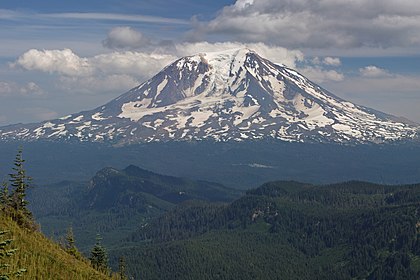
Stratovolcano, 12,281 Feet (3,743 M)
Cascade Mountain Range, Southwestern WA
Near Yakima, Packwood, Klickitat, and Goldendale WA
Karen and I have traveled all around this immense and dramatic mountain many times since 2016.


Stratovolcano, 12,281 Feet (3,743 M)
Cascade Mountain Range, Southwestern WA
Near Yakima, Packwood, Klickitat, and Goldendale WA
Karen and I have traveled all around this immense and dramatic mountain many times since 2016.


The Fireplace Records, Chapter 1
Can You Grasp Emptiness?
One drizzling cold afternoon, Shih-kung and Hsi-tang stopped along the steep trail up to the Temple on Mount Wudang. They rested while quietly sitting. Shih-kung picked up a small rock and tossed in down the hill. A short while later, Shih-kung asked Hsi-tang: "Can you grasp emptiness?" Hsing-tang replied: "Yes, I think I can." Shih-kung continued: "How would you grasp emptiness?" Using his hand, Hsi-tang then grasped at empty space. Shih-kung replied: "You are 70% correct, and 30% uncertain." "Then how do you do it?" asked Hsi-tang. Shih-kung then grasped Hsi-tang's ear and pulled it. Hsi-tang exclaimed "Ouch, your hurting my ear!" Shih-tang said "You can grasp and hear emptiness only in this way." Hsi-tang gently rubbed is ear, laughed, and told Shih-kung, "You are a clever devil, Shih-kung, and your diligent practice on your zither has improved your music."
Hsi-tang then picked up a small rock and tossed it down the canyon.
Both listened. Both smiled.
Capping Verse
Opening bell
echoes from the canyon walls —
raindrops on the river.
The sounds of rocks bouncing off rocks;
the shadows of trees traced on trees.
We sit quietly, still.
The canyon river chants,
moving mountains.
The sermon spun on the still point:
dropping off eternity, picking up time;
letting go of self, awakened to Mind.
Can You Grasp Emptiness? A Dialogue.
By Michael P. Garofalo
- For a insightful discussion of Eihei Dogen's (1250-1253 CE) views on Buddha-Mind, expressions and actions, existence, emptiness, the total exertion of a single thing, thusness, and time read Chapter 4 of "Eihei Dogen: Mystical Realist," by Hee-Jin Kim, 2004.
Another version of the Shih-kung and Hsi-tang dialogue is found on p.134 of Hee-Jin Kim's fine book.
Spiritual Stories and Dialogues
Refer to Fireplaces, Stoves, Hearths, Campfires
"There is no such thing as an empty space or an empty time. There is always something to see, something to hear. In fact, try as we may to make a silence, we cannot." - John Cage
The Fireplace Records Compiled with Commentary by Michael P. Garofalo


The Fireplace Records, Chapter 2
What Transcends Lao Tzu?
Ju-ching and Chang San Feng were hoeing and weeding their garden one cool Spring day around noon. Ju-ching asked: "What transcends Lao Tzu, Confucius, or the Buddhas?" Chang answered: "Here, have a bite of my cold rice." Ju-ching responded: "But, you have not answered my question." Chang replied: "Your quest for knowing is quite admirable, Ju-ching. However, sometimes your thirst for mental matters cannot be satisfied. Here, enjoy a cup of cold water." Ju-ching said: "You think that cold water transcends Lao Tzu?" Chang replied: "Yes, or hot tea. The ordinary is the best scaffolding for transcending. The fruits emerge from trees with strong roots. Find the spring that unceasingly flows to nourish your growing garden." Ju-ching was a little startled and said: " Oh! Ah!" and he became enlightened - for an hour.
Considerations
Enlightenment comes and goes;
Just don't fret your mind or body.
Fathom your being startled,
Revel in your wonder;
And remain steady on the scaffold,
or you will fall into errors.
Be Patient!
A callused palm and dirty fingernails precede a Green Thumb.
Only from the Ground of Somethings,
Can Lao Tzu's true words flourish.
Comments, Sources
Chang San Feng is regarded as a Immortal; a enlightened man who has lived far over 888 years. He appears and disappears at will at different places around the world, and in different eras. He can incarnate as speaking animals and plants. He is regarded as a shaman, fang-shi, wizard, Taoist master, philosopher, fortune teller, mystic, Taijiquan and Internal Alchemy master, wise elder archetype, popular gift giver, odd dresser, and among the revered patriarchs. I have met with Master Chang San Feng many times.
Master Ju-ching (Rujing) was the Chan Buddhist teacher in China of Eihei Dogen from 1230-1235 CE.
Refer to the Blue Cliff Record (Hekiganroku), Case 77.
Refer to my Cloud Hands Blog Posts on the topic of Koans.
Pulling Onions Over 1,043 One-line Sayings by Mike Garofalo
Chinese Buddhist and Taoist Stories and Koans
Refer to Fireplaces, Stoves, Hearths, Campfires
The Fireplace Records Compiled with Commentary by Michael P. Garofalo


Stratovolcano, 14,411 Feet (4,392M)
Cascades Mountain Range, Western Washington
Due East of Seattle, Tacoma, Olympia, and Puget Sound
Karen and I have traveled all around this immense and dramatic mountain many times since 2010.


Stratovolcano, 11,240 Feet (3,425 M)
East of Portland, Vancouver, Gresham, Troutdale, Sandy OR
Cascades Mountain Range, Northwestern Oregon
We can view Mt. Hood from many locations in Vancouver and Portland, Washington.
Karen and I have traveled all around this dramatic mountain many times since 2001.


The Fireplace Records, Chapter 28
Comings and Goings Around Mt. Adams (Pahto)
Chang San-Feng Remembers Mount AdamsI met a sturdy young man, Frank, at a campground along the Klickitat River,
far below Mt. Adams. We talked for a good while at sunset.
He told me that he had met a fine fellow, a Mr. Chang San-Feng,
in the forest below Old Pahto; who had published a book of
poems and short essays. I later found a copy of that book
at Klindt's Bookstore in The Dalles. Here is one poem
from the book by Mr. Chang San-Feng:
"Ancient Mt. Adams glows in the last light,
winds whistling in the thick flowing firs.
Slithering snakes in the cracks of warm
lava beds. Dry skies: empty vastness.
A dusty camp near shallow Trout Lake, all
cooling in the darkening shadows.
Stellar Jays check my table
for crumbs. Nothing there to eat.
Both Presence and Absence wrapped
in Becoming. Just sit─ a mirror in the dim dusk.
Long stretches of not thinking just
listening. The mountains are speechless.
Turning on a flashlight reveals the tent's
thin armor. The beam pierces the walls.
The Tao unfolds itself─ moon rising
midnight. Sleeping away losses and fears.
Coyotes calling at first hour hunting
hungry. The hard ground gets colder.
The Yakima's named It "Pahto or Klickitat" many
centuries past. Thus It became something human,
Something Pointed Out, Something Named,
Something Talked About, slipping away from Presence.
Some man loudly snoring and a dog barks in a nearby tent
at second hour. My watch does not really embrace Time.
At third hour I awaken, sit up, nurturing
my liver. I smile, alone, in passing Darkness,
without Her but within Her,
the Valley Spirit Here and Now.
At fourth hour, Buddha-Mountains disintegrate, and slowly
drying racoon Buddha-Crap shrivels on Buddha-Poppy seeds.
In the distance, somewhere, out there,
Rising, rising into the black clouds, just-so,
Making Clouds Itself, As Is, and in no-mind,
the Transforming Pahto.
I suddenly remembered something Sifu Miao Zhang once told me:
"Master Yellow-Bitterroot Mountain asked me,
'What is the meaning of Old Pahto emerging in the West?'
I lifted my cane and placed it in my mouth, saying nothing.
Later, zany Zen liar that I am, I wrote:
"No minds, no dharmas. No-mind, much Dharma."
Daybreak crawls in earlier in June, Solstice
Coming, Growing more Sunbeams, Ch'i
Flowing over Everything awakening.
Dawn, we are the Light, everything appearing
pristine, startling, sudden brief jolt of Insight.
After the Awakening,
roll up the sleeping bag, take down the tent,
eat some cereal."
- Michael P. Garofalo, Vancouver, Washington, 2021
Comments, Sources
Life in the Mountains are the subject of over 55 Zen Koans.
Meetings with Master Chang San-Feng
Refer to my Cloud Hands Blog Posts on the topic of Koans/Stories.
Subject Index to 1,975 Zen Buddhist Koans
Zen Buddhist Koans: Indexes, Bibliography, Commentary, Information
Pulling Onions Over 1,043 One-line Sayings by Mike Garofalo
Chinese Chan Buddhist and Taoist Stories and Koans
The Fireplace Records By Michael P. Garofalo
In downtown Tillamook a road sign says "Portland 72 miles"
This is a pleasant drive from Tillamook to Hillsborough via Roads 6 and 26. Road 6 follows the forested Wilson River Canyon up to the 1,586 foot road summit, then down many hills into the Willamette Valley. A good part of this "Trees to the Sea" scenic highway is through the Tillamook State Forest lands.
The 40+ mile drive on Oregon Road 26 from Banks, North Plains, Hillsborough, into downtown Portland, then onto to Interstate 5 North and over the Columbia River Bridge into Vancouver and home requires a driver's full attention, good breaking skills, and driving very carefully in multi-lane heavy traffic conditions. Home again in Vancouver around 12:30.
I came home. Unloaded my Ford Escape vehicle. Filled the Ford with gas. Stopped at the new, all glass, Cannabis store by the Shell gas station and Home Depot. Sprayed off the car with water. Took a shower. Relaxed in my backyard garden for two hours. Smoked 4 puffs of cannabis. Safe and smiling.
The following text is a repeat of my Cloud Hands Blog post on Thursday, February 10, 2022:
Up early at 4 am. Reading, laptop writing and looking at images, sipping hot coffee. Time to pack my camping gear up and return to my nice home in Vancouver. At 8 am I started loading up my camping gear in my Ford Escape. You need to vacate the Yurt campsite by 10 am, however you can stay in the Park until 9 pm. I leave around 10 am.
Today, I drove from Cape Lookout State Park to Tillamook. Take out breakfast from McDonalds. Gas up my car at Chevron. Then, I took Oregon Road 6 back to Banks, and then Road 26 back into Portland, and then home to Vancouver. It was a relatively easy 100 mile drive. Lovely driving weather: dry and clear. Some grand views driving up Wilson River Canyon.
I figure the cost of gas at $80.00 for this trip. The Yurt campsite at Cape Lookout for three nights cost me around $240.
Karen and I have stayed in motels in Tillmook four times in the past two decades. We have driven through and visited the area many times.
On my next Yurt camping trip to Cape Lookout, I plan to: 1) Explore side stops in the Tillamook State Forest along Road 6. 2) Explore the sand dunes at Sand Lake north of Pacific City. 3) Hike on the Cape Lookout Ridge Trail. 4) Visit the Tillamook Pioneer Museum in downtown Tillamook. 5) Eat at the Tori Sushi Lounge, and the Fern Restaurant in Tillamook, and Schooner's in Netarts. There are two breweries/pubs in Tillamook: Pelican and Werners; and I'll purchase a Pelican beer when I get back home in Vancouver.
Another one of my fine adventures during Four Days in Grayland.
7th Yurt Camp: 2022 February
Reports
24a
24b
25
26
27
Yurt Campsite at Cape Lookout State Park, Oregon, for 3 nights
Tillamook, Tillamook Bay, Netarts Bay, Netarts, Oceanside, Bayocean, Sand Lake, Pacific City,
Tillamook State Forest
Photos, Notes, Links, Information, Travel, Activities, Guides
Here are some photographs by me from this Cape Lookout Trip:


Here are some images from the Internet of this Beautiful Agricultural Area:


Tillamook City Population 5,300 Images On US 101 and Junction with Oregon Road 6 leading back east to Portland.
Motels, restaurants, cafes, gift shops, grocery, banks, museums, dairy farms, lumber industry, hospital, gas, stores, services, supplies.
The Tillamook area has many dairy farms on green flat land east of the bay.
Tillamook Coast Visitors Guide
Tillamook Library Tillamook County Library System
Tillamook County Population 25,300 The City of Tillamook is the County Seat.
Tillamook Creamery Tours
Tillamook County Pioneer Museum
Blue Heron French Cheese Company
Northwest Coastal Oregon Travel Guide: Astoria to Cape Lookout. By Mike Garofalo.
Bayocean Development Failure Story
Tillamook Bay Shellfishing Clams and Crabs
Barview Jetty County Park Campground, picnic, hiking. At the north jetty to Tillamook Bay.
Oyster Farming in Tillamook Bay - A History
Tillamook Bay Environmental History
Port of Tillamook Bay Information, History
"The bay is protected from the open ocean by shoals and a 3 mi (5 km) sandbar called the Bayocean Peninsula. It is surrounded closely by the Coastal Range except at its southeast end, where the town of Tillamook sits near the mouths of the Kilchis, Wilson, Trask and Tillamook rivers, which flow quickly down from the surrounding timber-producing regions of the Coastal Range to converge at the bay. The short Miami River enters the north end of the bay. The small fishing village of Garibaldi sits near the cliffs opening of the bay in the ocean. The rivers that feed the bay are known for their prolific steelhead and salmon runs. The mixing of freshwater from the rivers with the ocean's saltwater makes the bay an estuary.
The name "Tillamook" is Coast Salish word meaning "Land of Many Waters", probably referring to the rivers that enter the bay. At the time of the arrival of Europeans, the area along the coast was inhabited by the Tillamook and other related Coast Salish tribes. Historians believe they entered the area around the year 1400 and Lewis and Clark estimated the population south of the Columbia River along the coast at approximately 2,200."
- Tillamook Bay

The weather, for a change, became warmer and the skies cleared. No rain! No wind! Temperatures from 38F to 53F. Cool!
Excellent dry weather for a solo walker to roam the lovely loud beaches and lush forest trails.
I ate breakfast at the Fern Restaurant in Tillamook on 101. Enjoyed the hot hash browns.
Toured the new (2008-), three story, beautiful, spacious, and inviting Tillamook County Library in the downtown area next to a new large Safeway Supermarket. There is a Fred Meyer superstore at the north end of town, many fast food restaurants on US 101, and numerous stores and services in Tillamook. I drove around Tillamook. Shopped at Ace hardware and the Nectar Cannabis stores. A nice food cart court with covered courtyard in downtown.
Drove around Netarts Bay, the village of Netarts, and stopped at the beach and at the cliffside resort village of Oceanside with its many new expensive homes facing the Three Arches Rocks. These huge rocks in the ocean near the sandy shore are very impressive. I drove out to Cape Meares lighthouse. The dangerous cliffside road from Netarts to Ocenside gives me the willies.
Hung out at various places along the east shore of Netarts Bay. Watched people digging clams at low tide, and fishing from small boats and roadside rocks at high tide. The tide changes rules some aspects of life here.
Enjoyed a codfish dinner at the Schooner Restaurant.
During my last three monthly trips to coastal Yurt campsites (i.e., Grayland Beach, Cape Disappointment, and Nehalem Bay) it was raining, drizzling, foggy, windy, and wet. Under these weather conditions, I don't start a campfire. In fact, I seldom start a campfire. In the dry months, May to September, campfires in coastal State Parks are often not permitted so as to prevent forest fires. Or, I often just don't want to tend a smoky campfire; and, don't.
However, on this trip, I did light a campfire some evenings and some mornings. It was cold, a little foggy at times, other Yurt campers were having campfires, and the setting at my Yurt campsite was very beautiful. The Sitka Spruce forest was enchanting for me.
Here are some photographs by me from this Cape Lookout Trip:


Here is some additional information about Netarts Bay
Netarts, Oregon Population 744 Images Unincorporated community.
"Netarts is a small community situated at the mouth of Netarts
Bay, just south of Oceanside. Found amid lush coastal rainforest, Netarts, in
the language of the local Tillamook tribe, means “near the water.” On the
shore of Netarts Bay, the town is separated from the Pacific Ocean by a long,
club-shaped stretch of forested sand called Netarts Spit. This was once the
earliest settlement site of the Tillamook Indians. Inside the bay, at low tide,
many search for different varieties of clam, and a nearby marina offers boat and
crab pot rentals. Nearby Cape Lookout State Park, on the opposite shore of
Netarts Bay, has tent camping, yurts, cabins, and a rewarding hike to a great,
panoramic vista for whale watching."
- Netarts Bay
Travel
General History of the Netarts Bay Area, By William Hawkins, 1994 PDF
Where to Clam and Crab in Netarts Bay By Oregon Fish and Game Department Includes Map
Naveen's Bayside Market and Deli in Netarts
The Schooner Restaurant and Lounge in Netarts
Oceanside
Netarts Bay, at maximum high tide, is 9 feet deep on the average.
Beach Sand Composition Geology
Zeolites of Tillamook Seashore
Northwest Coast: A Natural History. By Stewart T. Schultz. Portland, Timber Press, 1990, index, bibliography, 389 pages. VSCL.
"Netarts Bay is an estuarine bay on
the northern Oregon
Coast of the U.S.
state of Oregon,
located about 5 miles (8.0 km) southwest of Tillamook.
The unincorporated community of Netarts is
located on the north end of the bay and Netarts Bay Shellfish Preserve, managed
by Oregon Department of Fish and Wildlife, is located on the south side of the
bay.[1] The
sand spit on the west side of Netarts bay is part of Cape
Lookout State Park. The bay is approximately 5 by 1.5 miles (8.0 by
2.4 km) and totals 2,325 acres (9.41 km2) in area, making it Oregon's seventh
largest bay.[2] Of
that, 812 acres (3.29 km2) are permanently submerged—the balance of 1,513 acres
(6.12 km2) is intertidal land.[2] It
experiences a maximum tidal range of 9 feet (3 m). The bay is part of a
watershed of 13 square miles (34 km2)[2] that
is fed by at least 16 small creeks. From north to south, there is Fall Creek,
Hodgdon Creek, O'Hara Creek, Rice Creek, two unnamed creeks, Yager Creek, three
unnamed creeks, Whiskey Creek, an unnamed creek, Austin Creek, two unnamed
creeks, and Jackson Creek."
- Netarts Bay
"Oregon is blessed with the vision of former Governor Oswald West who legislated that all of Oregon’s coastline be accessible to everyone. This was remarkable foresight given the state’s sparse population in 1911. More than 150 years later we appreciate his commitment to beauty beholden to all."
"Another common question about our sandy beach is, “Why
does sand squeak when you walk on it?” The answer is that the music is caused by
friction from the sand grains rubbing against each other as we apply weight
through our footsteps as we scoot our feet through the sand. However, there are
certain conditions to be met. The type of sand that squeaks is usually a
silicate, a feldspar, or a carbonate, the grains must be rounded (no sharp
corners or edges), they should be around 300 micrometers in diameter, and they
squeak best when they are dry (moisture on the grains acts as a lubricant,
decreasing the friction)."
- Jim Young,
Oceanside, Oregon

