Showing posts with label Chi Kung. Show all posts

Friday, June 05, 2026

The Staff Turned Into a Dragon and Swallowed the Universe


Blue Cliff Record, Case 60
Yunmen's Staff Turns Into a Dragon


"Yúnmén Wényan (864–949 CE), (雲門文偃; Japanese: Ummon Bun'en; also known in English as "Unmon", "Ummon Daishi", "Ummon Zenji")

Introduction 

"Engo's Introduction:  Buddhas and sentient beings are not, by nature, different.  Mountains, rivers, and your own self are all just the same.  Why should they be separation and constitute two worlds?  Even if you are well versed in Zen koans and know how to deal with them, if you stop then everything is spoiled.  If you do not stop, the whole world will be dissolved, with not a particle of it left behind.  Now tell me, what does it mean to be well versed in Zen koans?  See the following.

MAIN SUBJECT:  Ummon held out his staff and said to the assembled monks, "The staff has transformed itself into a dragon and swallowed up the universe!  Where are the mountains, the rivers, and the great world?"
Two Zen Classics: Mumonkan and Hekiganroku, Translated by Katsuki Sekida, 1977, p.

Commentary on Yunmen's Staff Turns Into a Dragon by Mike Garofalo

Zen Koans:  Bibliography, Index, Links, Commentary, Information

The Blue Cliff Record.  Translated by Thomas Cleary and J. C. Cleary.  Foreword by Taizan Maezumi Roshi.  Boston, Shambhala, 2005.  Glossary, biographies, bibliography, 648 pages.  ISBN: 9781590302323.  Case 60, p. 341-346.  "Yun Men's Staff Turns Into a Dragon."


Way of the Staff


Setchō's Verse 
"The staff has swallowed up the universe?
Don't say peach blossoms float on the waters.
The fish that gets it tail singed
May fail to grasp the mist and clouds.
The ones that lie with gills exposed
Need not loose heart.
My verse is done.
But do you really hear me?
Only be carefree!  Stand unwavering!
Why so bewhildered?
Seventy-two blows are not enough
I want to give you a hundred and fifty.
Setchō descended from the rostrum waving his staff. The whole crowd ran away."
Two Zen Classics: Mumonkan and Hekiganroku, Translated by Katsuki Sekida, 1977, p.


"A monk asked Kenpo, "The one road of Nirvana leads into the ten quarters. But where does it begin?" 
Kenpo raised his staff and traced a horizontal line in the air and said, "Here."
Disappointed, the monk went to Yunmen and asked him the same question.
Ummon held up his staff and said, "This staff leaps up to the 33rd heaven and hits the presiding deity on the nose,
then it dives down into the Eastern Sea where it hits the holy carp.
The carp becomes a dragon which then brings a flood of rain." 
List of Koans by Yunmen Wenyan  


Yunmen said, "A true person of the Way can speak fire without burning his mouth.  He can speak all day with moving his lips and teeth or uttering a word.  The entire day he just wears his clothes and eats his food, but never comes in contact with a single grain of rice or thread of cloth.
When we speak in this fashion it is jut the manner of our school.  It must be set forth like this to be realized.  But if you meet a true patch-robed monk of our school and try to reveal the essence through words, it will be a waste of time and effort.  Even if you get some great understanding by means of a single word you are still just dozing."
Zen's Chinese Heritage: The Masters and Their Teachings By Andy Ferguson, 2000, p. 262


Roshi Robert Baker Aitken
(1917-2010)
Roshi Aitken holds a ceremonial stick. 


Thursday, June 04, 2026

Standing Fully on a Single Leg


"The Taichi Classics say that the proper root is in the foot.  A beginner can develop root by simply spending three to five minutes, morning and night, standing fully on a single leg.  Alternate legs and gradually increase the time as you sink lower.  This 'bitter work' not only develops a root, it stimulates the cardiovascular system, with benefits the brain.  It is essential that your ch'i sinks to the tan-t'ien, both feet adhere to the floor, and you exert absolutely no force.  When practicing this Standing Posture, you may assist your balance by lightly touching a chair or table with the middle and index fingers.  After a while us only the middle finger.  When you can stand unassisted, you my choose either the Lift Hands Posture or Playing the Guitar Posture to continue your practice.  Do not fear bitter work.  If you do you will never progress."

-  Professor Cheng Man-ch'ing, New Method of Taichi Ch'uan Self-Cultivation, 1965, 1999, p. 11  


Practitioners might also do the Golden Rooster Stands on One Leg Posture or the White Stork Spreads Its Wings Posture.

Standing on one leg, holding static poses, is also a common practice in Hatha Yoga, e.g., Tree Pose, Vriksasana. 

Standing Meditation

You stand on one leg.  You can hold the arms in a variety of positions.  I suppose you could even hold weights in the hands.  You can hold the lifted leg in a variety of positions.  There are many possibilities for different static postures. You could use a cane or staff to help with balance.  You "can develop root by simply spending three to five minutes, morning and night, standing fully on a single leg."  


Effectively Using Rooting, Sinking, Centered, and Vertical Forces in Taijiquan


Effectively Using Rotating, Spiraling, Spinning, and Circular Forces in Taijiquan


Saturday, May 30, 2026

Luohan Chi Kung

Luohan Qigong, Lohan Qigong, Luohan Gong, Lohan Gong, 18 Buddha Hands Shaolin Buddhist Qigong

Resources, Lessons, History, Links, Bibliography, Notes, Research 
http://www.egreenway.com/qigong/lohan.htm
 
 
"One tradition is that the Buddhist teacher, Bodhidharma (448-527 CE), a famous Grand Master of Chan (Zen),introduced a set of 18 exercises to the Buddhist monks at the Shaolin Temple. These are known as the Eighteen Hands of the Lohan. This Shaolin Lohan Qigong (i.e., the art of the breath of the enlightened ones), "is an internal set of exercises for cultivating the "three treasures" of qi (vital energy), jing (essence), and shen (spirit)," according to Howard Choy. The Kung Fu master, Sifu Wong Kiew-Kit, referring to the Shaolin Wahnam style, says "the first eight Lohan Hands are the same as the eight exercises in a famous set of chi kung exercises called the Eight Pieces of Brocade." There are numerous versions,seated and standing, of Bodhiidharma's exercise sets - including the related "Tendon-Changing and Marrow-Washing" qigong set. Some versions of the 18 Lohan (Luohan) Hands have up to four levels, and scores of movement forms for qigong and martial purposes."
- Michael P. Garofalo, Eight Section Brocade (330Kb)


For a comparison of some of the exercises in the Lohan Qigong with the Eight Section Brocade see my chart on the topic
 
 
The Luohan Qigong includes a massage or patting training methods, and this is especially popular among Yin Fu Bagua enthusiasts. Master Xie Pei Qi has a DVD out on the topic. 

Sunday, May 17, 2026

Temple Qigong by Grandmaster Ho'o

Nine Temple Qigong Exercises

The Temple Qigong (Chi Kung) form consists of nine exercises.  It was popularized by Grand Master Marshall Ho'o (1910-1993) of Los Angeles, California.  It is also referred to as the Nine Temple Exercises, or the Marshall Ho'o Temple Exercises.  


My webpage on Temple Qigong provides a bibliography, links, the names of the movements, and an explanation of each movement.  


Marshall Ho'o wrote a book 1968 which included an explanation with photographic illustrations of the Temple Qigong set.  The black and white photos in that book were of poor quality and the editing was unsatisfactory.  An instructional DVD also teaches this form.  


"Dr. Ho'o was instrumental in the certification of acupuncture in the State of California. He was the first Tai Chi Master to have been elected to the Black Belt Hall of Fame.  He was Dean of the Aspen Academy of Martial & Healing Arts, on the faculty of California Institute of the Arts, and taught Tai Chi and Acupressure at many educational institutions.  In 1973, he created a series for KCET public television, in Los Angeles, teaching Tai Chi.  He was a consultant to Prevention Magazine's The Doctor's Book of Home Remedies.  A Chinese American, Dr. Ho'o was America's first Tai Chi Chuan Grandmaster.  His influence is far-reaching in both the fields of healing and martial arts."
-  The Lineage, Teachers of Two Birds Tai Chi


Tai Chi Chuan  By Marshall Hoo.  Burbank, California, Ohara Publications, Inc., 1986, 1993.  111 pages.  ISBN: 0897501098.  VSCL.  The Nine Temple exercise set is briefly described in this book on pages 18-42.  Each movement is clearly illustrated by four to eight clear black and white photographs of a woman doing the form.  The Taijiquan is the Standard 24 Form in the Yang Style. 


Tai Chi Chuan: The 27 forms by Marshall Hoo .   Instructional DVD, released in 2005, by Marshall Ho'o.  Black Belt Videos, 90 minutes.  Includes the Nine Temple Qigong.   


Wednesday, May 06, 2026

Bone Marrow Washing Chi Kung

Repost from August 2013:

John wrote to me asking,

"Hello, Mike. I have enjoyed all of your guides and articles, and know if I have a guestion I just need to go to your website and I usually always find an answer.

I have been researching Xi Sui Jing or Bone Marrow Washing. I have had no success, and wonder if you may be able to guide me in the right direction to either find a teacher, literature or video on this system. I am told there are 18 forms or exercises. Is this true?  I have non-Hodgkins lymphoma cancer and thought this may help with my chemotherapy treatments, although the doctor thinks it's a waste of time and money. Thank you."


John,

Intelligently listen to your oncologist's "advice" about treating cancer in terms of complementary medicine and physical exercises.  Some favor exercise and others do not as a complementary therapy.  Many people do not feel much like doing qigong exercises while undergoing chemotherapy.

I can't agree with your doctor that practicing Qigong would be a waste of money since it is very inexpensive or totally free to learn and pracice.  Books and instructional DVDs are quite inexpensive these days, and free UTube video are readily available.  Some people argue that the current elaborate and extremely costly conventional medical treatments for cancer are a waste of time and money, and cause undue suffering, and decide on other options, including doing nothing (wu wei).  This makes for very difficult decisions by the patient.

Based on considerable worldwide research, people who are overweight and don't exercise and eat improperly and use unhealthy drugs have a higher incidence of poor health and diseases and die younger than people who are trim, fit, eat properly, don't use recreational drugs, and exercise regularly.  Nevertheless, I do not believe that Qigong or other fitness modalities can be of significant benefit in curing or slowing the progress of cancer; and people who actively practice Qigong may get cancer anyway.  Cancer has many causes and its appearance is currently unpredictable, although more likely above the age of 60, and cancer "cures" are actively being researched and evaluated.   There is lively debate on the subject of the best treatments for the complex and serious disease of cancer.  Read the book "The Emperor of All Maladies: A Biography of Cancer" by Dr. Stephen Hoye and Siddhartha Mukherje, 2010, for a thorough discussion of this important subject, although a depressing account.   

Some Qigong (Chi Kung) enthusiasts and teachers do believe that their exercises, breathing, meditation, and visualization methods do significantly help people with serious diseases, including cancer.  Medical Qigong offers clinics attempting to help people with all kinds of health problems, and schools training future Qigong medical practitioners and healers exist worldwide.  However, Caveat emptor.

High hopes that the body will heal iteself using some method is very important.  The placebo effect is a real factor.  If you have confidence that Qigong will help in your healing, then it just might work for you.


As for Bone Marrow Washing (Xi Sui Jing) Qigong:  

Gabi Greve from Japan sent me information on Daruma Bone and Marrow Washing Exercises.

Roberto Gravez recommended "The Scholar Warrior" by Deng Ming-Dao.  This book gives all 24 movements of Bone Marrow Washing Chi Kung with drawings and instructions. The book also provides guides for diet, meditation, and so forth.  Mr. Gravez criticized my skepticism about the use of qigong in healing cancer.  I agree with him that "Scholar Warrior" is a fine and useful book, and Deng Ming-Dao is a good writer and expert on Taoist matters. 

Dr. Bikum Hu in Berkeley, California, teaches Bone Marrow Washing Qigong.  

As for general well-being, an increased sense of vitality, feeling good, psycho-spiritual progress, positive visualization, and relaxation, qigong has helped many people. Most people who regularly practice qigong generally have positive comments to make about their experiences.


Yang Jwing-Ming and Mantak Chia have written books on the Bone Marrow Washing Chi Kung form, and, as I recall, give instructions on a version of the set. Yang Jwing-Ming's books are usually very informative and useful for learning forms, and have excellent, detailed background theory.


There are both harder and easier verions of the Xi Sui Jing exercise as with Shaolin White Crane Qigong. 18 Lohan Qigong, another Shaolin Qigong form, is also popular.

I'd recommend The Eight Section Brocade Qigong for a general introductory form, and you don't need to spend any extra money learning it (I explain it for free on a webpage); and, there are many free UTube verison online.  Please, don't spend more than 20 mintues a day, at first, doing the form in the early morning. Also, enjoy some walking if you feel up to it!

I find the exercises, postures, and movement routines of many "different" qigong forms to be quite similar.  Likewise, there are also many named "styles" of yoga, but the postures of physical (hatha) yoga are common and familiar, even if named differently.  For example, lunges or moving the shoulders/arms through a full range of motion are found in all qigong, taijiquan, and yoga practices.

Visualizations of energy flow inside and outside the body, philosophical emphasis, vigorous vs gentle movements, breathing instructions, and descriptions of esoteric anatomy or meridians vary more in qigong forms. 

John, my very best wishes for a long remission, improved well-being, and a peaceful soul.

Mike Garofalo

Monday, April 06, 2026

Crane Frolic Chi Kung Exercise #6

6.  The Crane Opens and Closes Its Wings

Begin in the basic Crane stance with the hands at the waist.  The legs are separated with a shoulder's width.  Stretch the fingers open.  Inhale as you lift both hands up the center of the body, fingers pointing forward, arms about 24" apart.
As the hands reach the neck begin to move both hands to the side, upwards, and backwards.  Spread the arms as far apart as you can and to either side of the body as you lift both arms high above the head.  Draw the arms up and back as you gently bend backwards.
At the same time as the arms are lifted up and back, try to lift both heels off the ground, and come up on your toes.  Look up at the sky with your head drawn back. 
As you begin to exhale, gently draw the arms forward and down, straighten the back, look forward, and move the arms down to the waist. 
Repeat for 4 to 8 repetitions in a gentle, slow, calm, deliberate, and smooth manner. 

This movement is found in the Wild Goose Qigong (Dayan Chi Kung) routine.  Refer to "Wild Goose Qigong" by Hong-Chao Zhang, pp.20-21. 
Back-bending while standing with the arms lifted above the head and with the hands touching is a commonly used hatha yoga posture called Anyvittasana.   
This exercise is a hyperextension of the back, stretching of the latissimus dorsi muscles of sides of the upper back, a stretching of the upper rectus abdominis, engaging the pectoralis major, and a tensing of the trapezius muscles in the upper back and neck. 
This movement opens and fills with Qi (Chi, Energy) the Middle Dan Tien (i.e., 中丹田, Zhong Dantian, middle elixir fields, cauldron) of the esoteric body system explained in Chinese Qigong (Yoga); or, analogously, opens the Heart Chakra (Anhata) of Hatha Yoga.  Exercise of this area in the front of the body helps heal disturbed emotions, calms the spirit, strengthens the heart and lungs, and opens the Heart-Soul to the grace of light energy. 
The wide-spread arms held up high help establish a feeling of opening up, freeing oneself, and uplifting one's mood and spirit. 
You often see this ritual body posture in Christian revival meetings as a kind of "Saying Hallelujah" posture.
If the movement was done forcefully and with power and quickly it would be the flapping of the wings of a powerful bird like a Crane or wild Goose or for a human bodybuilder the performance of incline dumbbell flys. 


Crane Frolic Qigong Exercise Set

Eight Animals Frolics Mind/Body Fitness Practices (Chi Kung) by Mike Garofalo
 

The webpages for the eight specific animals will also have photographs of me or others doing these exercises.  There are also five, eight or twelve animals in Shaolin Kung Fu, Ba Gua Zhang, Taijiquan, and Xing Yi Quan.  Movements or postures called a "crane" or "hawk" or "rooster" are found in most of these mind-body internal arts.   

Chinese exercises recommended for improving fitness, maintaining good health, overcoming diseases, increasing energy and vitality, contributing to good mental health, and improving one's chances for longevity have a very long documented history going back to as early as 160 BCE in the Daoyin Tu.    

Sunday, April 05, 2026

Crane Frolic, Exercise #2

Crane Frolics Qigong Exercises

2.  The Red-Headed Crane Delights in Seeing Its Mate  

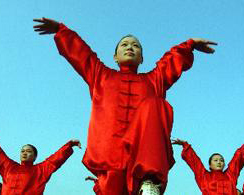
Lift both arms up to the sides until they are both above shoulder level.  The hands take the shape of the Crane's Hand they move above shoulder height.  (The ladies in the pictures below exemplify the posture desired when hands and knees are raised to the highest levels.) 

As the arms raise up, lift the left knee up until it is about at hip level.  Breathe in as you lift both arms up.  Pause for a moment at the highest point and look forward as if recognizing your mate or sweet-heart in a group.  Then lower the left leg and arms simultaneously as you exhale.  As the hands come down to the sides of your thighs, bend the knees slightly and dip down a little.  Then raise the arms up again as you lift the right knee up to hip height.  Inhale as you rise, exhale as you lower down.  Alternate the raising of arms and one leg for 4 to 10 repetitions.   
The height to which you will raise your knee depends upon your balancing skills, coordination, strength, confidence, and degree of skill.  Do try your best to raise the knee upward and draw your foot off of the floor. 
Folklore favors the idea that Cranes mate for life.  Some scientific research indicates that they do mate monogamously for long periods, but may change mates after a long period of time - serial monogamy.   Keeping the same mate means that their partner is special, recognizable, identifiable, and can be spotted in a group of Cranes feeding in a marsh or flying in formation during migration.  


Wednesday, April 01, 2026

Eighteen Buddha Hands Qigong

Luohan Qigong, Lohan Qigong, Luohan Gong, Lohan Gong, 18 Buddha Hands

Shaolin Buddhist Qigong

Over the years, I have found many different versions of the 18 Buddha Hands Qigong or Luohan Qigong.  For example, last year, I read Stuart Alve Oson's "The Eighteen Lohan Skills: Traditional Shaolin Training Methods," Valley Spirit Arts, 2015.  

Resources, Lessons, History, Links, Bibliography, Notes, Research 
 http://www.egreenway.com/qigong/lohan.htm


 "One tradition is that the Buddhist teacher, Bodhidharma (448-527 CE), a famous Grand Master of Chan (Zen),introduced a set of 18 exercises to the Buddhist monks at the Shaolin Temple. These are known as the Eighteen Hands of the Lohan. This Shaolin Lohan Qigong (i.e., the art of the breath of the enlightened ones), "is an internal set of exercises for cultivating the "three treasures" of qi (vital energy), jing (essence), and shen (spirit)," according to Howard Choy. The Kung Fu master, Sifu Wong Kiew-Kit, referring to the Shaolin Wahnam style, says "the first eight Lohan Hands are the same as the eight exercises in a famous set of chi kung exercises called the Eight Pieces of Brocade." There are numerous versions,seated and standing, of Bodhiidharma's exercise sets - including the related "Tendon-Changing and Marrow-Washing" qigong set. Some versions of the 18 Lohan (Luohan) Hands have up to four levels, and scores of movement forms for qigong and martial purposes."
- Michael P. Garofalo, Eight Section Brocade


 For a comparison of some of the exercises in the Lohan Qigong with the Eight Section Brocade see my chart on the topic. 

 
 The Luohan Qigong includes a massage or patting training methods, and this is especially popular among Yin Fu Bagua enthusiasts. Master Xie Pei Qi has a DVD out on the topic. 


Sunday, March 29, 2026

Dayan (Wild Goose) Chi Kung Exercises

Dayan (Wild Goose) Qigong Exercises

Bibliography, Links, Quotes, Notes, List of Movements
Research by Mike Garofalo

This Qigong form is one long continuous sequence of movements, much like a Taiji form.  There are many aspects of the Wild Goose

Watch UTube Video of Part One of Wild Goose Qigong

Qigong system as presented by Dr. Bingkun Hu of San Francisco.
 
I was practicing this Dayan form one autumn winter morning in my Sacred Circle Garden when a flock of Canadian Geese flew overhead.  The North Sacramento Valley is the winter home of birds from Canada.  Behold ... 'everything is holy now':


"A second Grandfather, he of the North, spoke again: 
"Take courage, younger brother," he said, "on earth a nation you shall make live, for yours shall be the power of the white giant's wing, the cleansing wing." 
Then he got up very tall and started running toward the north; and when he turned toward me, it was a white goose wheeling. I looked about me now, and the horses in the west were thunders and the horses of the north where geese. 
And the second Grandfather sang two songs that were like this:
"They are appearing, may you behold!
They are appearing , may you behold!
The thunder nation is appearing, behold!
They are appearing, may you behold!
The white geese nation is appearing, behold!"
- Black Elk Speaks, 1932, p. 22, as told to John G. Neihardt.


A post from October 2015.  

"In the north-west of China, high above the Himalayas, are the mystical Kunlun Mountains. Nearly 1700 years ago a hermit named Si Dao An (the Peaceful Way) observed the movements of the many wild geese that haunt the area and began to incorporate these bending, stretching, twisting and fluttering techniques into a health-enhancing routine called the Dayan Gong or Wild Goose Qigong.  Since then over 30 generations have taught this skill to the world.  The 27th generation inheritor, Grandmaster Yang Mei-Jun (who died in 2002 aged 107) was the first to open the Dayan Gong outside China ...  through Master Tse Wei Jing Who is the only authorised senior instructor of the Kunlun Mountains Qigong in the East of England." 
-   Julian Wilde, Norwich Tse Tai Chi


"Wild Goose Qigong belongs to the Kunlun School, so it is also called Kunlun School Qigong.  This school began in the Sichuan Province in China.  The most famous practitioner of Wild Goose Qigong was Dao An, who spread it during the Jin Dynasty (265-420 A.D.).  Because he was the most famous teacher of Wild Goose Qigong, he was crowned as its founder by later generations.   Later on, Wild Goose Qigong spread to northern China, and was kept by Wan Li at Wutai Mountain.  Emperor Qian Long, during the Qing Dynasty (1368-1840 A.D.), promoted religion and established temples all over the country so that Wild Goose Qigong could be passed down to the present."
-   By Hong-Chao Zhang, Wild Goose Qigong, p 12


"Dayan Qigong is a content-rich set of system consisting of two categories: dynamic and silent. For the former, the routine forms imitate wild goose's shape, movements or even habits, with the aim letting the internal energy flow smoothly within the body along the channels and meridians, thus moving away the thwarting blocks. In a whole, all forms shine out the feeling of wonderful harmony consisting both softness and hardness, of unrestrainedness, simpleness, and lightness. Also, some strange feeling may arise to the heart that seems to fly over the wild stretch of ocean and the vastness overpowers all consciousness." 
-   Dayan Qigong 


Tuesday, March 24, 2026

Like a Dragon Whirling in the Clouds

"It is easier to leave a circle than to enter it.
The emphasis is on the hip movement whether front or back.
The difficulty is to maintain the position without shifting the centre.
To analyze and understand the above situation is to do with movement and not with a stationary posture.
Advancing and retreating by turning sideways in line with the shoulders, one is capable of turning like a millstone, fast or slow, as if whirling like a dragon in the clouds or sensing the approach of a fierce tiger.
From this, one can learn the usage of the movement of the upper torso.
Through long practice, such movement will become natural."
- Yang Family Old Manual, The Coil Incense Kung


"The East Asian Dragons are often associated with water, rain, vapors, fog, springs, streams, waterfalls, rivers, swamps, lakes, and the ocean.  Water can take many shapes and states, and Dragons are shape shifters and linked with transformation, appearing and disappearing, changing into something new.  Water is found in three states, depending upon the surrounding temperature: a solid (ice, snow), a fluid (flowing liquid), and a gas (fog, vapor, steam).  Since rainfall is often accompanied by thunder and lightening (thunderstorms and typhoons), the Dragon is sometimes associated with fire; and, since hot water and steam are major sources of energy in human culture, this further links the Dragon with the essential energy of Fire.  The Dragon is thus linked with the chemical and alchemical transformative properties of two of the essential Elements, both Water and Fire.  Dragons are generally benign or helpful to humans in East Asia, but their powers can also be destructive (e.g., flooding, tsunami, typhoon, lightening, steam, drowning, etc.).  There are both male and female Dragons, kinds or species of Dragons, Dragons of different colors and sizes, and mostly good but some evil Dragons.  Some Dragons can fly, some cannot fly; most live in or near water, a few on land.  The body of a Dragon combines features from many animals, representing the many possibilities for existential presence.  The Dragon in the East has serpentine, snake, or eel like movement qualities: twisting, spiraling, sliding, circling, swimming, undulating, flowing freely like water."  [See: The Dragon in China and Japan by Marinus De Visser, 1913] 


Dragon Chi Kung features exercises that involve twisting, turning, screwing, spiraling, curving, wiggling, undulating, spinning, sinking down and rising up, swimming, circling, swinging, or twining movements are often associated with snakes, serpents and dragons.  There are many Qigong sets and specific Qigong movements that have been called "Dragon" forms, sets, or exercises.  Baguazhang martial arts feature much twisting, turning and circling; and, also include many "Dragon" sets and movements.  Silk Reeling exercises in Chen Style Taijiquan include twisting, twining, circling, and screwing kinds of movements. 

Friday, November 28, 2025

Dragon Qigong, Swimming Dragon Qigong, Walking Dragon Chi Kung

"The Chinese Horoscope 2024 reveals that the Year of the Dragon, specifically the Wood Dragon year, will bring authority, prosperity, and good fortune."

 I have been studying books and videos on the subject of Dragon Chi Kung and Dragon Bagua Zhang, Swimming Dragon, Walking Dragon, and Tai Chi Dragon.


Reading "The Four Dragons" by Damo Mitchell; "The Swimming Dragon" by Tzu Shi Kuo and T. K. Smith; and "Dragon and Tiger Qigong" by Bruce K. Frantzis.

For full information on the books, instructional DVDs, UTube vides, links, resources, and quotations on the subject of "Dragon Qigong" see my webpage on the subject. 

I am also completing my own version of Lessons on Dragon Qigong with instructions on that webpage.  


"It is easier to leave a circle than to enter it.
The emphasis is on the hip movement whether front or back.
The difficulty is to maintain the position without shifting the centre.
To analyze and understand the above situation is to do with movement and not with a stationary posture.
Advancing and retreating by turning sideways in line with the shoulders, one is capable of turning like a millstone, fast or slow, as if whirling like a dragon in the clouds or sensing the approach of a fierce tiger.
From this, one can learn the usage of the movement of the upper torso.
Through long practice, such movement will become natural."
- Yang Family Old Manual, The Coil Incense Kung


"The East Asian Dragons are often associated with water, rain, vapors, fog, springs, streams, waterfalls, rivers, swamps, lakes, and the ocean.  Water can take many shapes and states, and Dragons are shape shifters and linked with transformation, appearing and disappearing, changing into something new.  Water is found in three states, depending upon the surrounding temperature: a solid (ice, snow), a fluid (flowing liquid), and a gas (fog, vapor, steam).  Since rainfall is often accompanied by thunder and lightening (thunderstorms and typhoons), the Dragon is sometimes associated with fire; and, since hot water and steam are major sources of energy in human culture, this further links the Dragon with the essential energy of Fire.  The Dragon is thus linked with the chemical and alchemical transformative properties of two of the essential Elements, both Water and Fire.  Dragons are generally benign or helpful to humans in East Asia, but their powers can also be destructive (e.g., flooding, tsunami, typhoon, lightening, steam, drowning, etc.).  There are both male and female Dragons, kinds or species of Dragons, Dragons of different colors and sizes, and mostly good but some evil Dragons.  Some Dragons can fly, some cannot fly; most live in or near water, a few on land.  The body of a Dragon combines features from many animals, representing the many possibilities for existential presence.  The Dragon in the East has serpentine, snake, or eel like movement qualities: twisting, spiraling, sliding, circling, swimming, undulating, flowing freely like water."
[See: The Dragon in China and Japan by Marinus De Visser, 1913] 


Dragon Chi Kung features exercises that involve twisting, turning, screwing, spiraling, curving, wiggling, undulating, spinning, sinking down and rising up, swimming, circling, swinging, or twining movements are often associated with snakes, serpents and dragons.  There are many Qigong sets and specific Qigong movements that have been called "Dragon" forms, sets, or exercises.  Baguazhang martial arts feature much twisting, turning and circling; and, also include many "Dragon" sets and movements.  Silk Reeling exercises in Chen Style Taijiquan include twisting, twining, circling, and screwing kinds of movements. 

Saturday, June 07, 2025

Tai Chi Ruler


The Tai Chi Ruler is a wooden stick about 12 inches long used in Qigong exercises. There is some theory involved which is related to Hand Reflexology and hand acupressure and massage.  The Taiji Ruler exercises also involve gentle movements, stretching, and breathing coordination. 

You can check my research on the subject of the Tai Chi Ruler.


Friday, November 29, 2024

Tao Te Ching Index and Concordance

Daodejing, Laozi  or Tao Te Ching by Lao Tzu

Indexed by English, Spanish, and Wade-Giles Romanization

Indexing by Michael P. Garofalo, M.S.

A typical webpage created by Mike Garofalo for each one of the 81 Chapters of the Tao Te Ching (Daodejing) by Lao Tzu (Laozi) includes 20 different English translations or interpolations for that Chapter, 3 Spanish translations for that Chapter, the Chinese characters for that Chapter, and the Wade-Giles and Hanyu Pinyin Romanization of the Mandarin Chinese words for that Chapter.  Each webpage for one of the 81 Chapters of the Tao Te Ching includes extensive indexing by key words and terms in English, Spanish, and the Wade-Giles Romanization.  Each webpage on a Chapter of the Daodejing includes recommended reading in books and websites, a detailed bibliography, some commentary, research leads, translation sources, and other resources for that Chapter.   


Chapter and Thematic Index (Concordance) to the Tao Te Ching by Lao Tzu

English Language Daodejing Translators' Source Index

Spanish Language Daodejing Translators' Source Index

Ripening Peaches: Taoist Studies and Practices

Taoism: A Selected Reading List

One Old Taoist's Final Journey 


Here is an example of some of the translations and/or interpolations for:

Tao Te Ching by Lao Tzu
Daodejing by Laozi


Chapter 10


Here is my indexing of Chapter 10:


English and Chinese (Wade-Giles) Terms:  Physical and Bodily Soul, Chi or Breath or Vital Force (ch'i), Washing or Cleanse (ti), Youthfulness, Mental Clarity, What is Possible, What Can Be Done, Impartiality, Bird, Spontaneity, Wholesome Personality, Kind or Loving or Caring (ai), Separation or Parting (li), Spirit or Soul or Spiritual (ying), Vision or Perception or Insight (lan), Natural Breathing, Close or Shut (ho), One or Unity or Together (yi), Intelligent Activity, Self-Control, Vital Breath, Understanding or Awareness (ming), Cleanse the Mind, Virtue, Leadership, Chi Kung or Qigong, Progress or Advance or Grow (ch'ang), Meditate, Love, Cleansing the Mind, Impurities, Hold or Keep (tsai), People (min), Govern (chih), Country (kuo), Nurturing, Gentle or Tender or Soft (jou), Female, Can or Able to (nêng), Clean or Polish or Wipe (ch'u), Newborn or Infant (ying), Question or "?" Interrogative (hu), Passive, Cleanliness, Cause or Bring About (chih), Cunning or Cleverness (chih), Concentrate or Gather or Focus (chuan), Governing, Embrace or Carry (pao), Faults or Flaws or Blemish (ts'u), Animal Nature or Body or Vitality or Physical Being (p'o), Feed or Nurture (ch'u), Purify, Pure or Clear or Clear Minded (pai), Gate or Door (mên), Dominate or Control (tsai), Without or Free of (wu), Open (k'ai), Mother Bird or Female (tz'u), Four Directions or Four Quarters (ssu), Child or Baby or Innocent (erh), Heaven or Natural (t'ien), Possibilities Through the Dao, Produces or Gives Life (shêng), Without Acti0n (wu wei), Become or Act or Do (wei), Claim or Possess (yu), Profound or Deep or Hidden (hsüan), Virture or Power (),  能為   

Términos en Español: Fuerza Vital, Lavado, Limpieza, J
uventud, Claridad Mental, ¿Qué es posible, ¿Qué se Puede Hacer, Imparcialidad, Pájaro, Espontaneidad, Personalidad Sana, Amar, Cuidar, Separación, Espíritu, Alma Espiritual, Vision, Percepción, Perspicacia, Respiración Natural, Cerrar, Apagar, Uno, Unidad, Junto, Actividad Inteligente, Autocontrol, Aliento Vital,  Entendimiento, Conciencia, Limpiar la Mente, Virtud, Liderazgo, Progreso, Crecer, Meditar, Impurezas, Mantener, Guardar, Personas, Gobierno, País, Nutrir, Suave, Dócil, Femenino, Puede, Limpie, Polaco, Recién nacido, Lactante, Pregunta, Interrogativo, Pasivo, Causar, Provocar, Astucia, Concentrado, Reunir, Enfoque, Abrazar, Llevar, Fallos, Defectos, Naturaleza Animal, Cuerpo,  Purificar, Puro, Portón, Puerta, Dominar, Mujer, Cuatro Vientos, Niño, Bebé, Inocente, Cielo, Posibilidades, Produce, Vida, Ley, Reclamación, Posser, Profunda, Oculto.  


"One can keep the camp whole of the animal soul, by embracing the One alone,
Can bring tenderness by guarding the breath, and be as an infant child,
One can wash and be clean, and, knowing the deep, can be spotless and undefiled,
And, loving the people can rule the land with a rule that is scarcely shown.
Can one not open and close his heavenly gates like a bird on her nest?
When his intellect broadens on every side may its light not remain unknown?
Quickening, feeding, producing, must he still claim the fruit as his own?
To uplift all, and yet rule not, is virtue the deepest and best."
-  Translated by Isaac Winter Heysinger, 1903, Chapter 10 


"Carrying vitality and consciousness, embracing them as one, can you keep from parting?
Concentrating energy, making it supple, can you be like an infant?
Purifying hidden perception, can you make it flawless?
Loving the people, governing the nation, can you be uncontrived?
As the gate of heaven opens and closes, can you be impassive?
As understanding reaches everywhere, can you be innocent?
Producing and developing, producing without possessing, growing without domineering: this is called mysterious power."
-  Translated by Thomas Cleary, 1991, Chapter 10  


"By clinging to the One with both your spiritual and physical souls, can you prevent them from becoming divorced?
By concentrating your breath until you become soft, can you be like an infant?
By cleansing your secret mirror, can you make it without blemish?
In loving the people and ruling a state, can you be without action?
In opening and closing the natural gates, can you be like a hen?
In penetrating the four quarters with your intelligence, can you be without knowledge?"
-  Translated by Jan J. L. Duyvendak, 1954, Chapter 10


"Can you keep the spirit and embrace the One without departing from them?
Can you concentrate your vital force and achieve the highest degree of weakness like an infant?
Can you clean and purify your profound insight so it will be spotless?
Can you love the people and govern the state without cunning?
Can you play the role of the female in the opening and closing of the gates of Heaven?
Can you understand all and penetrate all without taking any action?
To produce things and to rear them,
To produce, but not to take possession of them,
To act, but not to rely on one's own ability,
To lead them, but not to master them.
This is called profound and secret virtue."
-  Translated by Chan Wing-Tsit, 1953, Chapter 10  


載營魄, 抱一能無離乎?
專氣致柔, 能嬰兒乎?
滌除玄覽, 能無疵乎?
愛民治國, 能無知乎?
天門開闔, 能為雌乎?
明白四達, 能無知乎?
生之畜之.
生而不有.
為而不恃.
長而不宰.
是謂玄德.
-  Chinese characters, Tao Te Ching, Chapter 10


tsai ying p'o, pao yi nêng wu li hu?
chuan ch'i chih jou, nêng ying erh hu?
ti ch'u hsüan lan, nêng wu tz'u hu?
ai min chih kuo, nêng wu chih hu?
t'ien mên k'ai ho, nêng wei tz'u hu? 
ming pai ssu ta, nêng wu wei hu?
shêng chih ch'u chih.
shêng erh pu yu.
wei erh pu shih.
ch'ang erh pu tsai.
shih wei hsüan tê.
-  Wade-Giles (1892) Romanization, Tao Te Ching, Chapter 10


"creative spirit
vital soul
wondrous bodymind

can you combine these into one phase
and gently hold onto it

one phase one part one moment
can you commune with
and direct the elemental force of life
and enter into the rebirth of gentleness
and be like a newborn 

can you wash and cleanse your mystic inner vision
while clearing it of the refuse left behind you
     ordinary sight

is it possible for you to stay out of your own way
while being your own leader

can you stomp the earth
look to the heavens while being receptive
passive
possessed of quietude

can you be knowledgeable and clever
and regard it as whimsical 

create and nourish
let all creation be the worlds
not your own

have fun when you work
work when you have fun

be a leader without appearing to be
and you will personify fine uncarved wood
in the hands of a master carpenter

can you guess who this master is."
-  Translated by John Bright-Fey, 2006, Chapter 10


"Unir cuerpo y mente en un conjunto
del que no puedan disociarse.
Equilibrar el Chi hasta hacerlo
tan armónico como el de un recién nacido.
Purificar la vision interna hasta
dejarla libre de todo vicio.
Querer al pueblo y gobernar la nación
practicando el Wu-Wei.
Abrir y cerrar las puertas del cielo
siendo como la Mujer Misteriosa.
Conocer y comprenderlo todo
usar la inteligencia.
Engendrar y criar,
Alimentar y educar
engendrar sin apropiarse,
obrar sin pedir nada a cambio,
guiar sin dominar,
esta es la Gran Virtud."
-  Translation from Wikisource, 2013, 
Capítulo 10


"Can you hold the door of your tent
Wide to the firmament?
Can you, with the simple stature
Of a child, breathing nature,
Become, notwithstanding,
A man?
Can you continue befriending
With no prejudice, no ban?
Can you, mating with heaven,
Serve as the female part?
Can your learned head take leaven
From the wisdom of your heart?
If you can bear issue and nourish its growing,
If you can guide without claim or strife,
If you can stay in the lead of men without their knowing,
You are at the core of life."
-  Translated by Witter Bynner, 1944, Chapter 10 


Wednesday, November 27, 2024

Eight Treasures and Lohan Hands Qigong

Lately, I have been reading books that discuss Shaolin Qigong methods.  The exercises in the 18 Lohan Shaolin Qigong overlap with many in the Eight Section Brocade.  I have been adding movement sequences from the beautifully color illustrated book by Shifu Shi Yan Ming of New York.
I added a few new Swinging Arms exercises to my routine.  

The Shaolin Workout: 28 Days to Transforming Your Body and Soul the Warrior's Way.  By Sifu Shi Yan Ming. Rodale Press, 2006. Index, 293 pages. ISBN: 1594864004.  VSCL. 

18 Exercises to Help You Live a Longer, Healthier, and Happier Life.  By Marcus Santer.  193 pages, 2020, Kindle EBook.  VSCL.

Shaolin Qi Gong: Energy in Motion.  By Shi Qinggui.  160 pages, 2008.  VSCL.  Includes DVD.

Shaolin Temple Qigong  By Michael P. Garofalo

Qigong Practices  By Michael P. Garofalo

The Art of Shaolin Kung Fu: The Secrets of Kung Fu for Self-Defense, Health and Enlightenment.   By Wong, Kiew Kit.  Charles E. Tuttle, 2002.  215 pages. ISBN: 0804834393.  VSCL. 


Here is a Blog repost of mine from May 2014 about the Eight Treasures Qigong:


I frequently teach the Chinese Eight Section Brocade Chi Kung exercise and fitness routine in my Taijiquan class and my Yoga class.  Naturally, I include many comments about Shaolin and Daoist fitness and healthy living concepts. 

This Eight Treasures exercise and fitness routine has a varied and long history with ancient roots back to the Animal Frolics Dao-yin exercises of 300 CE.  Some of the Eight Treasures exercises involve toughening, courage, and fighting and were used in military exercise and conditioning drills.  Many versions of the Ba Duan Jin include 12 exercises or more.   

One recent book that provides good documentation on the history of Chinese exercise practices (Chi Kung, Qigong, Neigong), including five illustrated versions of the Eight Section Brocade, is:  

An Illustrated Handbook of Chinese Qigong Forms from the Ancient Texts  Complied by Li Jingwei and Zhu Jianping.  London, Singing Dragon, 2014.  No index or bibliography, 325 pages.  ISBN: 9781848191976.  Many excellent line drawings are included to illustrate the postures.  VSCL. 
 
Back in 2002, I created the webpage titled:  The Eight Section Brocade Chi Kung.


The Ba Duan Jin Qigong form includes eight basic exercises to help you keep limber, become stronger, improve your balance, and increase your stamina.  There are opportunities for squatting movements and postures to strengthen the legs.  
  The entire Eight Beautiful Tapestries Chi Kung form is normally done while standing, although there are some versions done in a seated posture for meditative purposes or for frail persons. 


There are numerous versions of this popular Chi Kung form.  There are many good books, instructional DVDs, and UTube videos to choose from on this topic.  My webpage includes a long bibliography on the Eight Section Brocade Chi Kung with citations for resources, links, videos, books, and instructional DVDs on the subject.  
  I make a number of comments about each of the eight movements, including comments about the movement variations, physical training targets, muscles worked, attitude, internal alchemy (Neidan), benefits, options, comparisons with yoga asanas, and breathing patterns.  


I offer my own version with fairly detailed comments on each of the eight movements.  Here is my one page class handout for the Eight Section Brocade Chi Kung class.  


"The name “Ba Duan Jin” has been found as early as the Northern Song Dynasty. According to Hong Mai's (洪邁) Yi Jian Zhi (夷堅志, Song Dynasty), Zhenghe Seventh Year, Emperor's Chief Secretary, Li Shi-Ju, lived a simple life.  He spent a large portion of his time in his mediation room practicing Daoist Monk’s exercises expanding like a bear and stretching like a bird. In the early hours, he is often found breathing and massaging, practicing the so-called Eight-Section Brocade (Ba Duan Jin). This passage reveals that Ba Duan Jin has been developed and practiced since the Song Dynasty as a general health-keeping regime. 
    
Both sitting and standing forms have been found in the history of Ba Duan Jin (
八段錦),. Standing forms were developed into two schools (northern and southern styles) in the Qing Dynasty. The Northern School, said to have been passed down by Yue Fei (岳飛), has tougher forms, and the Southern School, claimed the lineage from Liang Shi-Chang (梁世昌), focuses on softer trainings. Quite a few verses has been passed down during the period from Song Dynasty to Qing Dynasty, but all verses for the standing forms have evolved from the passages recorded in "The Chapter of Wonders, Pivot of Dao" (道樞·眾妙篇, Dao Shu, Zong Miao Pian, Song Dynasty) and verses of the sitting style from the forms recorded in "TheTen Books of Daoist Practices" (修真十書 Xiu Zhen Shi Shu, Ming Dynasty ).  or "The Methods of Curing"(活人心法, Huo Ren Xin Fa, Ming Dynasty). Sets Ba Duan Jin forms are not always limited to the number of eight. The number of forms in a set range from a single form to tens or as many as a hundred; nevertheless, they are all exercise regimes designed for health-keeping, preventive, and therapeutic purposes, and, liberally saying, all exercise regimes designed for such purposes are part of the Ba Duan Jin system."
-   Lee Chang-Chih, 
 A Brief Introduction to Ba Daun Jin.  "Reinterpreting Ba Duan Jing From the Theories of the Eight Extra Meridians" 2005