Showing posts with label Complexity. Show all posts

Friday, May 15, 2026

Tao Te Ching, Chapter 2

Dao De Jing, Laozi   
Chapter 2


"When the world speaks of beauty as being beautiful, ugliness is at once defined.
When goodness is seen to be good, evil is at once apparent.
So do existence and non-existence mutually give rise to one another,
As that which is difficult and that which is easy, distant and near, high and low,
shrill and bass, preceding and following.
The Sage therefore is occupied only with that which is without prejudice.
He teaches without verbosity; he acts without effort; he produces with possessing,
he acts without regard to the fruit of action; he brings his work to perfection without assuming credit;
and claiming nothing as his own, he cannot at any time be said to lose."
-  Translated by Walter Gorn Old, 1904, Chapter 2  


"When all the people of the world know beauty as beauty,
There arises the recognition of ugliness.
When they all know the good as good,
There arises the recognition of evil.
Therefore: Being and non-being produce each other;
Difficult and easy complete each other;
Long and short contrast each other;
High and low distinguish each other;
Sound and voice harmonize each other;
Front and behind accompany each other.
Therefore the sage manages affairs without action
And spreads doctrines without words.
All things arise, and he does not turn away from them.
He produces them but does not take possession of them.
He acts but does not rely on his own ability.
He accomplishes his task but does not claim credit for it.
It is precisely because he does not claim credit that his accomplishment remains with him."
-  Translated by Wang Tsit Chan, 1963, Chapter 2 


"Recognize beauty and ugliness is born.
Recognize good and evil is born.
Is and Isn't produce each other.
Hard depends on easy,
Long is tested by short,
High is determined by low,
Sound is harmonized by voice,
After is followed by before.
Therefore the sage is devoted to non action,
Moves without teaching,
Creates ten thousand things without instruction,
Lives but does not own,
Acts but does not presume,
Accomplishes without taking credit.
When no credit is taken,
Accomplishment endures."
-  Translated by Stephen Addis, 1993, Chapter 2   


"When all in the world understand beauty to be beautiful, then ugliness exists.
When all understand goodness to be good, then evil exists.
Thus existence suggests non-existence;
Easy gives rise to difficult;
Short is derived from long by comparsion;
Low is derived from high by position;
Resonance harmonises sound;
After follows before.
Therefore the sage carries on his business without action, and gives his teaching without words."
-  Translated by Ch'u Ta-Kao, 1904, Chapter 2 


"It is the world of man that defines ugly by comparing it with that which man calls beautiful.
Skillful is considered such by comparison to that which is called 'without skill'.
Alive and non-alive are delineated by nature.
Difficult and easy are abstracted by our perception.
Long and short are defined by the one against the other.
High and low are reckoned so by the contrast of the one with the other.
Music is seen as pleasing if the notes and tones are recognized as being harmonious with each other.
One in front, and one behind are recognized as one following the other.
It is for this reason that the sage lives in the condition of wu-wei (unattached action, or; doing-not doing),
And teaches without words.
He knows that names and images are fleeting, and all things will transform.
One who seems to follow tonight might lead another time.
He sees all that is done as neither large nor small.
All things are neither grand nor miniscule.
Actions are neither difficult, nor done with ease. He acts without expectation.
Things spring up around him, and he accepts them, but does not possess them.
Things go away, and he recognizes their departure without grief or joy.
When the work is done he leaves it be.
Because he does not dwell in it, it will last."
-  Translated by Rivenrock, Chapter 2  


"Beauty becomes recognized as beauty,
As its difference from ugliness is seen.
Likewise,
Goodness and love become recognized,
As their difference from evil and hatred is felt.

The Relationship of:
- Being and non-being is known through life and growth.
- Difficult and easy is known through achievement and completion.
- Long and short is known through form and contrast.
- High and low is known through relationship and position.
- Sound and voice is known through amplitude and harmony.
- Front and behind is known through position and sequence.

Thus:
Wu-Wei graces the affairs of the Sage -
Teaching gracefully, Without words.
Receiving all happening as natural,
Without needing to judge or control.
Giving life and animation to all experience
Without needing to dominate.
Accomplishing, Without expecting reward.

In never assuming importance,
When the Sage's work is complete,
It remains, everlastingly."
-  Translated by Alan B. Taplow, 1982, Chapter 2  


天下皆知美之為美, 斯惡已.
皆知善之為善, 斯不善已.
故有無相生.
難易相成.
長短相較.
高下相傾.
音聲相和.
前後相隨.
是以聖人處無為之事.
行不言之教.
萬物作焉而不辭.
生而不有.
為而不恃.
功成而弗居.
夫唯弗居.
是以不去.
-  Chinese characters, Tao Te Ching, Chapter 2 


t'ien hsia chieh chih mei chih wei mei, ssu wu yi.
chieh chih shan chih wei shan, ssu pu shan yi.
ku yu wu hsiang shêng.
nan yi hsiang ch'êng.
ch'ang tuan hsiang chiao.
kao hsia hsiang ch'ing.
yin shêng hsiang ho.
ch'ien hou hsiang sui.
shih yi shêng jen ch'u wu wei chih shih.
hsing pu yen chih chiao.
wan wu tso yen erh pu tz'u.
shêng erh pu yu.
wei erh pu shih.
kung ch'eng erh fu chü.
fu wei fu ch'u.
shih yi pu ch'ü
-  Wade-Giles Romanization, Tao Te Ching, Chapter 2 


"When everyone knows what beauty is,
There must also be ugliness.
When everybody knows what goodness is,
Then evil must also exist.
Therefore, the haves and the have-nots coexist.
Easy and hard become complementary.
Long and short differ in length.
High and low contrast in height.
Tone and pitch harmonise with each other.
The past is followed by the present.
Hence, the sage manages his affairs with non-action,
Teaches without utterance,
And lets everything develop without any interference.
Dao procreates but does not possess.
It facilitates development but does not gloat.
When it accomplishes his task, it does not claim credit.
As the sage does not claim credit for his success,
The credit cannot be taken away from him."
-  Translated by Han Hiong Tan, Chapter 2  


"Cuando se reconoce la Belleza en el Mundo
Se aprende lo que es la Fealdad;
Cuando se reconoce la Bondad en el Mundo
Se aprende lo que es la Maldad.

De este modo:
Vida y muerte son abstracciones del crecimiento;
Dificultad y facilidad son abstracciones del progreso;
Cerca y lejos son abstracciones de la posición;
Fuerza y debilidad son abstracciones del control;
Música y habla son abstracciones de la armonía;
Antes y después son abstracciones de la secuencia.

El sabio controla sin autoridad,
Y enseña sin palabras;
Él deja que todas las cosas asciendan y caigan,
Nutre, pero no interfiere,
Dá sin pedirle,
Y está satisfecho."
-  Translated by Antonio Rivas Gonzálvez, 2004, Capítulo 2


"The whole world knows: when beauty tries to be beautiful it changes into ugliness by that very fact.
The whole world knows: when kindness tries to appear kind it changes into unkindness by that very fact.
So close are Being and Non-Being that one arises from the other.
So suddenly easy becomes difficult short becomes long high becomes low loud becomes soundless the first becomes the last.
That is why the Sage strives to act without action to teach without speaking.
He lets things happen and does not try to stay them.
He labors and is not greedy.
He acts and does not demand anything.
He receives and does not retain anything."
-  Translated by K.O. Schmidt, 1975, Chapter 2  


"Because the world recognized beauty as beauty, ugliness is known to be ugly.
Everyone knows goodness to be goodness, and to know this is to know what is not good.
Similarly, existence implies non-existence;
The hard and the easy complement each other; We recognize what is long by comparison with what is short;
High by comparison with low;
The shrill by comparison with the sonorous.
Before and after, earlier and later, back and front -
All these complement one another.
Therefore the Sage, the self-controlled man, dwells in action-less activity, poised between contraries.
He teaches without employing words.
He beholds al things that have been made - he does not turn his back on them.
He achieves, but does not claim merit;
He does not call attention to what he does, not claim success.
Regarding nothing as his own, he loses nothing that is his."
-  Translated by Herman Ould, 1946, Chapter 2 


"When people see things as beautiful,
ugliness is created.
When people see things as good,
evil is created.

Being and non-being produce each other.
Difficult and easy complement each other.
Long and short define each other.
High and low oppose each other.
Fore and aft follow each other.

Therefore the Master
can act without doing anything
and teach without saying a word.
Things come her way and she does not stop them;
things leave and she lets them go.
She has without possessing,
and acts without any expectations.
When her work is done, she take no credit.
hat is why it will last forever."
-  Translated by John H. McDonald, 1996, Chapter 2   


A typical webpage created by Mike Garofalo for each one of the 81 Chapters (Verses, Sections) of the Tao Te Ching (Daodejing) by Lao Tzu (Laozi) includes 25 different English language translations or interpolations for that Chapter, 5 Spanish language translations for that Chapter, the Chinese characters for that Chapter, the Wade-Giles and Hanyu Pinyin transliterations (Romanization) of the Mandarin Chinese words for that Chapter, and 2 German and 1 French translation of that Chapter.  Each webpage for each one of the 81 Chapters of the Tao Te Ching includes extensive indexing by key words, phrases, and terms for that Chapter in English, Spanish, and the Wade-Giles Romanization.  Each webpage on a Chapter of the Daodejing includes recommended reading in books and websites, a detailed bibliography, some commentary, research leads, translation sources, a Google Translate drop down menu, and other resources for that Chapter.  These are hypertext documents, and available online under Creative Commons 4.


Chapter 2, Tao Te Ching by Lao Tzu.  Compiled and indexed by Mike Garofalo.  

Chapter and Thematic Index (Concordance) to the Tao Te Ching by Lao Tzu


English Language Daodejing Translators' Source Index


Spanish Language Daodejing Translators' Source Index


Ripening Peaches: Taoist Studies and Practices


Taoism: A Selected Reading List


Friday, November 10, 2023

Complexity is Closer to the Truth


        The Fireplace Records, Chapter 40


Complexity is Closer to the Truth


In my experience, life is rightly characterized as diverse, complicated, varied, rich in multiplicity, saturated with the 'ten thousand things.'  Personally, I find little need to seek or to find or to have the "experience of unity."  This state of "unification," when actualized, is in most cases rather fleeting.  It may be profound, but no more so that the beauty of complexity and the fascinating reality of diversity.  I do not find the experience of the multiplicity of things distressing, disturbing, or disheartening.  

Just because all of the eggs today are in one basket does not make the colored basket more real or more interesting or more valuable than the eggs.  

Ignoring the facticity of the complexity of the natural and mental realms seems to me a more serious ignorance, not very sensible, and ultimately unwise.  I long ago gave up on any quest for "enlightenment" (in Hindu or Buddhist terms) and prefer the ordinary state of mind grounded in a world that is not simple, not one, not unified, complex, and rich in details.  To claim that our normal experience of complexity and variety is an "illusion" or "ignorance (avidya) seems to me a form of incorrect judgment.  

No doubt, trying to simplify one's life has its benefits, reducing sensory overload can reduce stress, and not becoming overly infatuated with novelty can be helpful; but, pushing on this strange path towards the "enlightenment" or "realization" of a pure and uncluttered "Unity" can produce its own distressing and disturbing predicaments for a person.  

Many philosophers, ancient and modern, have made a sharp distinction between appearances and Reality, the many and the One, the phenomena and the Noumena, and multiplicity and Unity.  For me, it is muddled thinking to call all of our experiences "just fleeting illusions" and fabricate a true realm of being outside of our personal and social and practical experiences.  Indeed, we can't "see" in any ordinary sense of "see," the cells, molecules, atoms, and the subatomic particles that constitute the objects of our macro-cosmic world; but, this in no way means the multiplicity of objects in our ordinary environment are in any way "illusions."  The meaning of "objects" is much more complicated, varied in linguistic usage, and functional in many practical contexts.  Again, complexity is closer to the truth. 


Comments, Sources, Observations, Koans, Poems, Quips:

Now is Real, a Unified Instant, but Fleeting.


Time

Complexity and Diversity 

Nature Mysticism:  Resources, Quotes, Notes

Gardening and Mysticism


Riddles (200+ Riddles, with No Ads.)

Refer to my Cloud Hands Blog Posts on the topic of Koans/Stories. 

Subject Index to 1,975 Zen Buddhist Koans

Zen Buddhist Koans: Indexes, Bibliography, Commentary, Information

The Daodejing by Laozi

Pulling Onions  Over 1,043 One-line Sayings, Quips, Maxims, Humor

Chinese Chan Buddhist and Taoist Stories and Koans

The Fireplace Records (Blog Version) By Michael P. Garofalo


Thursday, August 25, 2022

Tao Te Ching, Chapter 2

Dao De Jing, Laozi   
Chapter 2


"When the world speaks of beauty as being beautiful, ugliness is at once defined.
When goodness is seen to be good, evil is at once apparent.
So do existence and non-existence mutually give rise to one another,
As that which is difficult and that which is easy, distant and near, high and low,
shrill and bass, preceding and following.
The Sage therefore is occupied only with that which is without prejudice.
He teaches without verbosity; he acts without effort; he produces with possessing,
he acts without regard to the fruit of action; he brings his work to perfection without assuming credit;
and claiming nothing as his own, he cannot at any time be said to lose."
-  Translated by Walter Gorn Old, 1904, Chapter 2  


"When all the people of the world know beauty as beauty,
There arises the recognition of ugliness.
When they all know the good as good,
There arises the recognition of evil.
Therefore: Being and non-being produce each other;
Difficult and easy complete each other;
Long and short contrast each other;
High and low distinguish each other;
Sound and voice harmonize each other;
Front and behind accompany each other.
Therefore the sage manages affairs without action
And spreads doctrines without words.
All things arise, and he does not turn away from them.
He produces them but does not take possession of them.
He acts but does not rely on his own ability.
He accomplishes his task but does not claim credit for it.
It is precisely because he does not claim credit that his accomplishment remains with him."
-  Translated by Wang Tsit Chan, 1963, Chapter 2 


"Recognize beauty and ugliness is born.
Recognize good and evil is born.
Is and Isn't produce each other.
Hard depends on easy,
Long is tested by short,
High is determined by low,
Sound is harmonized by voice,
After is followed by before.
Therefore the sage is devoted to non action,
Moves without teaching,
Creates ten thousand things without instruction,
Lives but does not own,
Acts but does not presume,
Accomplishes without taking credit.
When no credit is taken,
Accomplishment endures."
-  Translated by Stephen Addis, 1993, Chapter 2   


"When all in the world understand beauty to be beautiful, then ugliness exists.
When all understand goodness to be good, then evil exists.
Thus existence suggests non-existence;
Easy gives rise to difficult;
Short is derived from long by comparsion;
Low is derived from high by position;
Resonance harmonises sound;
After follows before.
Therefore the sage carries on his business without action, and gives his teaching without words."
-  Translated by Ch'u Ta-Kao, 1904, Chapter 2 


"It is the world of man that defines ugly by comparing it with that which man calls beautiful.
Skillful is considered such by comparison to that which is called 'without skill'.
Alive and non-alive are delineated by nature.
Difficult and easy are abstracted by our perception.
Long and short are defined by the one against the other.
High and low are reckoned so by the contrast of the one with the other.
Music is seen as pleasing if the notes and tones are recognized as being harmonious with each other.
One in front, and one behind are recognized as one following the other.
It is for this reason that the sage lives in the condition of wu-wei (unattached action, or; doing-not doing),
And teaches without words.
He knows that names and images are fleeting, and all things will transform.
One who seems to follow tonight might lead another time.
He sees all that is done as neither large nor small.
All things are neither grand nor miniscule.
Actions are neither difficult, nor done with ease. He acts without expectation.
Things spring up around him, and he accepts them, but does not possess them.
Things go away, and he recognizes their departure without grief or joy.
When the work is done he leaves it be.
Because he does not dwell in it, it will last."
-  Translated by Rivenrock, Chapter 2  


"Beauty becomes recognized as beauty,
As its difference from ugliness is seen.
Likewise,
Goodness and love become recognized,
As their difference from evil and hatred is felt.

The Relationship of:
- Being and non-being is known through life and growth.
- Difficult and easy is known through achievement and completion.
- Long and short is known through form and contrast.
- High and low is known through relationship and position.
- Sound and voice is known through amplitude and harmony.
- Front and behind is known through position and sequence.

Thus:
Wu-Wei graces the affairs of the Sage -
Teaching gracefully, Without words.
Receiving all happening as natural,
Without needing to judge or control.
Giving life and animation to all experience
Without needing to dominate.
Accomplishing, Without expecting reward.

In never assuming importance,
When the Sage's work is complete,
It remains, everlastingly."
-  Translated by Alan B. Taplow, 1982, Chapter 2  


天下皆知美之為美, 斯惡已.
皆知善之為善, 斯不善已.
故有無相生.
難易相成.
長短相較.
高下相傾.
音聲相和.
前後相隨.
是以聖人處無為之事.
行不言之教.
萬物作焉而不辭.
生而不有.
為而不恃.
功成而弗居.
夫唯弗居.
是以不去.
-  Chinese characters, Tao Te Ching, Chapter 2 


t'ien hsia chieh chih mei chih wei mei, ssu wu yi.
chieh chih shan chih wei shan, ssu pu shan yi.
ku yu wu hsiang shêng.
nan yi hsiang ch'êng.
ch'ang tuan hsiang chiao.
kao hsia hsiang ch'ing.
yin shêng hsiang ho.
ch'ien hou hsiang sui.
shih yi shêng jen ch'u wu wei chih shih.
hsing pu yen chih chiao.
wan wu tso yen erh pu tz'u.
shêng erh pu yu.
wei erh pu shih.
kung ch'eng erh fu chü.
fu wei fu ch'u.
shih yi pu ch'ü
-  Wade-Giles Romanization, Tao Te Ching, Chapter 2 


"When everyone knows what beauty is,
There must also be ugliness.
When everybody knows what goodness is,
Then evil must also exist.
Therefore, the haves and the have-nots coexist.
Easy and hard become complementary.
Long and short differ in length.
High and low contrast in height.
Tone and pitch harmonise with each other.
The past is followed by the present.
Hence, the sage manages his affairs with non-action,
Teaches without utterance,
And lets everything develop without any interference.
Dao procreates but does not possess.
It facilitates development but does not gloat.
When it accomplishes his task, it does not claim credit.
As the sage does not claim credit for his success,
The credit cannot be taken away from him."
-  Translated by Han Hiong Tan, Chapter 2  


"Cuando se reconoce la Belleza en el Mundo
Se aprende lo que es la Fealdad;
Cuando se reconoce la Bondad en el Mundo
Se aprende lo que es la Maldad.

De este modo:
Vida y muerte son abstracciones del crecimiento;
Dificultad y facilidad son abstracciones del progreso;
Cerca y lejos son abstracciones de la posición;
Fuerza y debilidad son abstracciones del control;
Música y habla son abstracciones de la armonía;
Antes y después son abstracciones de la secuencia.

El sabio controla sin autoridad,
Y enseña sin palabras;
Él deja que todas las cosas asciendan y caigan,
Nutre, pero no interfiere,
Dá sin pedirle,
Y está satisfecho."
-  Translated by Antonio Rivas Gonzálvez, 2004, Capítulo 2


"The whole world knows: when beauty tries to be beautiful it changes into ugliness by that very fact.
The whole world knows: when kindness tries to appear kind it changes into unkindness by that very fact.
So close are Being and Non-Being that one arises from the other.
So suddenly easy becomes difficult short becomes long high becomes low loud becomes soundless the first becomes the last.
That is why the Sage strives to act without action to teach without speaking.
He lets things happen and does not try to stay them.
He labors and is not greedy.
He acts and does not demand anything.
He receives and does not retain anything."
-  Translated by K.O. Schmidt, 1975, Chapter 2  


"Because the world recognized beauty as beauty, ugliness is known to be ugly.
Everyone knows goodness to be goodness, and to know this is to know what is not good.
Similarly, existence implies non-existence;
The hard and the easy complement each other; We recognize what is long by comparison with what is short;
High by comparison with low;
The shrill by comparison with the sonorous.
Before and after, earlier and later, back and front -
All these complement one another.
Therefore the Sage, the self-controlled man, dwells in action-less activity, poised between contraries.
He teaches without employing words.
He beholds al things that have been made - he does not turn his back on them.
He achieves, but does not claim merit;
He does not call attention to what he does, not claim success.
Regarding nothing as his own, he loses nothing that is his."
-  Translated by Herman Ould, 1946, Chapter 2 


"When people see things as beautiful,
ugliness is created.
When people see things as good,
evil is created.

Being and non-being produce each other.
Difficult and easy complement each other.
Long and short define each other.
High and low oppose each other.
Fore and aft follow each other.

Therefore the Master
can act without doing anything
and teach without saying a word.
Things come her way and she does not stop them;
things leave and she lets them go.
She has without possessing,
and acts without any expectations.
When her work is done, she take no credit.
hat is why it will last forever."
-  Translated by John H. McDonald, 1996, Chapter 2   


A typical webpage created by Mike Garofalo for each one of the 81 Chapters (Verses, Sections) of the Tao Te Ching (Daodejing) by Lao Tzu (Laozi) includes 25 or more different English language translations or interpolations for that Chapter, 5 or more Spanish language translations for that Chapter, the Chinese characters for that Chapter, the Wade-Giles and Hanyu Pinyin transliterations (Romanization) of the Mandarin Chinese words for that Chapter, and 2 German and 1 French translation of that Chapter.  

Each webpage for each one of the 81 Chapters of the Tao Te Ching includes extensive indexing by key words, phrases, and terms for that Chapter in English, Spanish, and the Wade-Giles Romanization.  In 2020, I will be improving the indexing.  

Each webpage on a Chapter of the Daodejing includes recommended reading in books and websites, a detailed bibliography, some commentary, research leads, translation sources, a Google Translate drop down menu, and other resources for that Chapter.  An electronic Concordance for all 81 Chapters of the  Tao Te Ching is provided.   


Chapter 2, Tao Te Ching by Lao Tzu

Concordance for the Tao Te Ching by Lao Tzu

English Language Daodejing Translators' Source Index

Spanish Language Daodejing Translators' Source Index

Ripening Peaches: Taoist Studies and Practices

Taoism: A Selected Reading List

One Old Daoist Druid's Final Journey  


How to Live a Good Life: Advice from Wise Persons


Tuesday, June 08, 2021

Diversity and Unity

"For the Eastern mystic, all things and events perceived by the senses are interrelated, connected and are but different aspects or manifestations of the same ultimate reality.  Our tendency to divide the perceived world into individual and separate things and to experience ourselves as isolated egos in this world is seen as an illusion which comes from our measuring and categorizing mentally.  It is called avidya, or ignorance, in Buddhist philosophy and is seen as the sate of a disturbed mind which has to be overcome.

'When the mind is disturbed, the multiplicity of things is produced, but when the mind is quieted, the multiplicity of things disappears.'

Although the various schools of Eastern mysticism differ in many details, they all emphasize the basic unity of the universe which is the central feature of their teachings.  The highest aim for their followers - whether they are Hindus, Buddhists or Taoists - is to become aware of the unity and mutual interdependence of all things, to transcend the notion of an isolated individual self and to identify themselves with the ultimate reality.  The emergence of this awareness - known as 'enlightenment'- is not only an intellectual act but is an experience which involves the whole person and is religious in its ultimate nature.  For this reason, most Eastern philosophies are essentially religious philosophies."
-  Fritjof Capra, The Tao of Physics, 25th Anniversary Edition, p. 24  


   In my experience, life is rightly characterized as diverse, complicated, varied, rich in multiplicity, saturated with the 'ten thousand things.'  Personally, I find little need to seek or to find or to have the "experience of unity."  This state of "unification," when actualized, is in most cases rather fleeting.  It may be profound, but no more so that the beauty of complexity and the fascinating reality of diversity.  I do not find the experience of the multiplicity of things distressing, disturbing, or disheartening.  

Just because all of the eggs today are in one basket does not make the colored basket more real or more interesting or more valuable than the eggs.  

Ignoring the facticity of the complexity of the natural and mental realms seems to me a more serious ignorance, not very sensible, and ultimately unwise.  I long ago gave up on any quest for "enlightenment" (in Hindu or Buddhist terms) and prefer the ordinary state of mind grounded in a world that is not simple, not one, not unified, complex, and rich in details.  To claim that our normal experience of complexity and variety is an "illusion" or "ignorance (avidya) seems to me a form of incorrect judgment.  

No doubt, trying to simplify one's life has its benefits, reducing sensory overload can reduce stress, and not becoming overly infatuated with novelty can be helpful; but, pushing on this strange path towards the "enlightenment" or "realization" of a pure and uncluttered "Unity" can produce its own distressing and disturbing predicaments for a person.  

Many philosophers, ancient and modern, have made a sharp distinction between appearances and Reality, the many and the One, the phenomena and the Noumena, and multiplicity and Unity.  For me, it is muddled thinking to call all of our experiences "just fleeting illusions" and fabricate a true realm of being outside of our personal and social and practical experiences.  Indeed, we can't "see" in any ordinary sense of "see," the cells, molecules, atoms, and the subatomic particles that constitute the objects of our macro-cosmic world; but, this in no way means the multiplicity of objects in our ordinary environment are in any way "illusions."  The meaning of "objects" is much more complicated, varied in linguistic usage, and functional in many practical contexts.  Again, complexity is closer to the truth.  

"I, who make no other profession, find in myself such infinite depth and variety, that what I have learned bears no other fruit than to make me realize how much I still have to learn.  To my weakness, so often perceived, I owe my inclination to coolness in my opinions and any hatred for that aggressiveness and quarrelsome arrogance that believes and trust wholly in itself, a mortal enemy of discipline and truth."
- Michel de Montaigne, "Of Experience," 1588


Our selves are, to Montaigne, "wavelike and varying" - ondoyant et divers


Complexity and Diversity 

Nature Mysticism:  Resources, Quotes, Notes

Gardening and Mysticism

Green Way Research Subject Index


My later reading of authors in the Organism Process School of Philosophy have influenced my current opinions about complexity/diversity and unity/wholes/systems.  Our lived subjective-objective experiences are diversity exemplified.    


Wednesday, February 10, 2021

Details Are All There Are

 "Science and psychoanalysis apart, the most profound development in thought since Nietzsche, as far as we are concerned, is the phenomenological approach to the world.  Mallarmé sought "words without wrinkles," Baudelaire cherished his minutes heureuses and Valéry his "small worlds of order," as we have seen: Checkhov concentrated on the "concrete individual" and preferred "small scale and practical answers," Gide though the "systematizing is denaturing, distorting and impoverishing."  For Oliver Wendell Holmes, "all the pleasure of life is in general ideas, but all the use of life is in specific solutions."  Wallace Stevens considered that we are "better satisfied in particulars."  Thomas Nagel put it in this way: "Particulars things can have a noncompetitive completeness which is transparent to all aspects of the self.  This also helps to explain what the experience of great beauty tends to unify the self: the object engages us immediately and totally in a way that makes distinctions among points of view irrelevant."  Or, as Robert Nozick, who counseled us to make ourselves "vehicles" for beauty, said: "this is what poets and artists bring us―the immense and unsuspected reality of a small thing.  Everything has its own patient entityhood."  George Levine call for "a profound attention to the details of this world."  

-  Peter Watson, "The Age of Atheists: How We Have Sought to Live Since the Death of God," p.536

"The idea of one overbearing truth is exhausted."  
- Thomas Mann, translated by James Wood  

"My religion consists of a humble admiration of the illimitable superior spirit who reveals himself in the slight details we are able to perceive with our frail and feeble mind."
-  Albert Einstein

"To study the self is to forget the self.  To forget the self is to be enlightened by the ten thousand things."
-  Zen Master Dogen

"The more we understand individual things, the more we understand God."
-  Benedict De Spinoza

"God is in the details."
-  Mies Van Der Rohe

"After appreciating and understanding thousands of the details, a common variety God is really superfluous."
-  Mike Garofalo

"Caress the detail, the divine detail." 
-  Vladimir Nabokov

"Details are all there are."
-  Maezumi Roshi

"We think in generalities, but we live in details."
-  W.H. Auden


Wednesday, October 14, 2020

To Hold Infinity in the palm of your hand


"To see a World in a Grain of Sand
And a heaven in a Wild Flower,
Hold Infinity in the palm of your hand
And Eternity in an hour."

-  William Blake,  Auguries of Innocence, 1863


Nature Mysticism: Quotations, Poems, Sayings  By Michael P. Garofalo (M.P.G.)

Hands On by M.P. G.  Notes on the human hand, fingers, touching ...  

The Spirit of Gardening  Over 3,500 quotations, poems, sayings.  By M.P.G.


"We will endeavour to shew how the aire and genious of Gardens operat upon humane spirits towards virtue and sancitie, I meane in a remote, preparatory and instrumentall working. How Caves, Grotts, Mounts, and irregular ornaments of Gardens do contribute to contemplative and philosophicall Enthusiasms; how Elysium, Antrum, Nemus, Paradysus, Hortus, Lucus, &c., signifie all of them rem sacram et divinam; for these expedients do influence the soule and spirits of man, and prepare them for converse with good Angells; besides which, they contribute to the lesse abstracted pleasures, phylosophy naturall and longevitie."
- John Evelyn in a letter to Sir Thomas Browne, 1657


"The hand is the cutting edge of the mind."
-  Jacob Bronowski

"The mind has exactly the same power as the hands: not merely to grasp the world, but to change it."
-  Colin Wilson 

"By rubbing up against the world, I define myself to myself."
-  Deane Juhan

"The upper limb is the lightning rod to the soul."
-  Robert Markison

“We leave traces of ourselves wherever we go, on whatever we touch.”
-  Lewis Thomas


We hold these truths to be sacred ...

"Hold on.  Hold on.  Hold on.  Hold on."


"A callused palm and dirty fingernails precede a Green Thumb.
When the hoe handle is loose, you will have misplaced the steel wedges.   
Not to move either hand, nor clap, nor think too much are all good for zen gardening. 
As you move your hands so you move your mind.  
Why is it that you can find four gloves for the left hand, and none for the right? 
As with most arts, gardening is an expression of our hands.
Your hand hoe will always find its way to the bottom of the weeding barrel. 
Civilization is rooted in the hands of the gardeners.
You can sometimes get a handle on life, but it often breaks.
The eyes of a gardener are usually bigger than her hands.  
Gardening helps us to carefully attend to the close at hand.  
Chop the weeds and hose the water ... the sounds of two hands clapping - with delight. 
Your rich, famous, and handsome; and, your garden doesn't care.
The difference between a pile of rocks and a rock garden - the eyes and hands of the gardener.
Getting your hands dirty," applies to more than gardening. 
Better to lend a helping hand than just to point a finger.   
Put your hands on the earth and feel the sorrows of the world. 
Hold your hoe in your hand, sharpen it, and fully sense its meaning. 
I see my hand more often than my face, and there is a lesson here to grasp somehow. 
Unclench your fist to give a hand."
-  Michael P. Garofalo, Pulling Onions


Touching Up An Altar
 

Things to touch, small art objects to hold, 

Matches to light, incense to light

Bowls and bells to ring, pictures to clean

Wand sticks to point and orchestrate the scene.

Red chairs to move, floors to sweep,
Books to Read, to Study, for decades to keep.

Pictures as reminders of what insights we grasp
Pictures as reminders of what we think we know
about pagan ways past.

Tables to move and dust,
Symbols, Altars and Signs in the Shadows sans the Sun
A Book of Rituals to hold and read from,

Candles to light, daggers to handle,
Voyager Tarot cards to shuffle,

Feathers to finger, rocks to pick up
Thoughts ungraspable piling up
Tibetan Prayer beads thumbing one past and next up,
So I raise my hands and say

“Toys to play with,
Magikcal tools to play with;
With only memories to keep.”

Kind of like holding infinity
 in the palm of your hand:
using a microscope or telescope,
reading a science book;
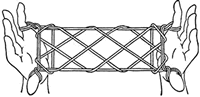
with two hands making an Apache Door string figure display,
the transfiguration of the commonplace loop of string
to help tell stories.


-  Touching Up An Altar, 
by Michael P. Garofalo, 10/15/2020

Strings on Your Fingers, by Mike Garofalo, 1977-


Friday, November 08, 2019

Trying to Remember That

     I made this post back in 2015.  I think the old photo of my home Neo-Pagan altar display reflects my readings and studies from around 2005.  I do seasonal, holiday, and personal interest displays in my current home office room [my study, library, computer den, hang out space, man cave, sunny room, yoga space.]  In 2019, I am now reading Meister Eckart from 1305 CE., and his metaphysical poetry.  Oneness, Beauty and Beings ... the wonder of it all.      


"Straight up from this road
Away from the fitted particles of frost
Coating the hull of each chick pea,
And the stiff archer bug making its way
In the morning dark, toe hair by toe hair,
Up the stem of the trillium,
Straight up through the sky above this road right now,
The galaxies of the Cygnus A cluster
Are colliding with each other in a massive swarm
Of interpenetrating and exploding catastrophes.
I try to remember that."
-  Pattiann Rogers, Firekeeper


"God is the experience of looking at a tree and saying, "Ah!""
-  Joseph Campbell  


“The world is full of magic things, patiently waiting for our senses to grow sharper.”
-  William Butler Yeats


Awe, Wonder, Amazement: Quotations, Sayings, Poems


Friday, April 28, 2017

Tao Te Ching, Chapter 2

Dao De Jing, Laozi   
Chapter 2


"When the world speaks of beauty as being beautiful, ugliness is at once defined.
When goodness is seen to be good, evil is at once apparent.
So do existence and non-existence mutually give rise to one another,
As that which is difficult and that which is easy, distant and near, high and low,
shrill and bass, preceding and following.
The Sage therefore is occupied only with that which is without prejudice.
He teaches without verbosity; he acts without effort; he produces with possessing,
he acts without regard to the fruit of action; he brings his work to perfection without assuming credit;
and claiming nothing as his own, he cannot at any time be said to lose."
-  Translated by Walter Gorn Old, 1904, Chapter 2  


"When all the people of the world know beauty as beauty,
There arises the recognition of ugliness.
When they all know the good as good,
There arises the recognition of evil.
Therefore: Being and non-being produce each other;
Difficult and easy complete each other;
Long and short contrast each other;
High and low distinguish each other;
Sound and voice harmonize each other;
Front and behind accompany each other.
Therefore the sage manages affairs without action
And spreads doctrines without words.
All things arise, and he does not turn away from them.
He produces them but does not take possession of them.
He acts but does not rely on his own ability.
He accomplishes his task but does not claim credit for it.
It is precisely because he does not claim credit that his accomplishment remains with him."
-  Translated by Wang Tsit Chan, 1963, Chapter 2 


"Recognize beauty and ugliness is born.
Recognize good and evil is born.
Is and Isn't produce each other.
Hard depends on easy,
Long is tested by short,
High is determined by low,
Sound is harmonized by voice,
After is followed by before.
Therefore the sage is devoted to non action,
Moves without teaching,
Creates ten thousand things without instruction,
Lives but does not own,
Acts but does not presume,
Accomplishes without taking credit.
When no credit is taken,
Accomplishment endures."
-  Translated by Stephen Addis, 1993, Chapter 2   


"When all in the world understand beauty to be beautiful, then ugliness exists.
When all understand goodness to be good, then evil exists.
Thus existence suggests non-existence;
Easy gives rise to difficult;
Short is derived from long by comparsion;
Low is derived from high by position;
Resonance harmonises sound;
After follows before.
Therefore the sage carries on his business without action, and gives his teaching without words."
-  Translated by Ch'u Ta-Kao, 1904, Chapter 2 


"It is the world of man that defines ugly by comparing it with that which man calls beautiful.
Skillful is considered such by comparison to that which is called 'without skill'.
Alive and non-alive are delineated by nature.
Difficult and easy are abstracted by our perception.
Long and short are defined by the one against the other.
High and low are reckoned so by the contrast of the one with the other.
Music is seen as pleasing if the notes and tones are recognized as being harmonious with each other.
One in front, and one behind are recognized as one following the other.
It is for this reason that the sage lives in the condition of wu-wei (unattached action, or; doing-not doing),
And teaches without words.
He knows that names and images are fleeting, and all things will transform.
One who seems to follow tonight might lead another time.
He sees all that is done as neither large nor small.
All things are neither grand nor miniscule.
Actions are neither difficult, nor done with ease. He acts without expectation.
Things spring up around him, and he accepts them, but does not possess them.
Things go away, and he recognizes their departure without grief or joy.
When the work is done he leaves it be.
Because he does not dwell in it, it will last."
-  Translated by Rivenrock, Chapter 2  


"Beauty becomes recognized as beauty,
As its difference from ugliness is seen.
Likewise,
Goodness and love become recognized,
As their difference from evil and hatred is felt.

The Relationship of:
- Being and non-being is known through life and growth.
- Difficult and easy is known through achievement and completion.
- Long and short is known through form and contrast.
- High and low is known through relationship and position.
- Sound and voice is known through amplitude and harmony.
- Front and behind is known through position and sequence.

Thus:
Wu-Wei graces the affairs of the Sage -
Teaching gracefully, Without words.
Receiving all happening as natural,
Without needing to judge or control.
Giving life and animation to all experience
Without needing to dominate.
Accomplishing, Without expecting reward.

In never assuming importance,
When the Sage's work is complete,
It remains, everlastingly."
-  Translated by Alan B. Taplow, 1982, Chapter 2  


天下皆知美之為美, 斯惡已.
皆知善之為善, 斯不善已.
故有無相生.
難易相成.
長短相較.
高下相傾.
音聲相和.
前後相隨.
是以聖人處無為之事.
行不言之教.
萬物作焉而不辭.
生而不有.
為而不恃.
功成而弗居.
夫唯弗居.
是以不去.
-  Chinese characters, Tao Te Ching, Chapter 2 


t'ien hsia chieh chih mei chih wei mei, ssu wu yi.
chieh chih shan chih wei shan, ssu pu shan yi.
ku yu wu hsiang shêng.
nan yi hsiang ch'êng.
ch'ang tuan hsiang chiao.
kao hsia hsiang ch'ing.
yin shêng hsiang ho.
ch'ien hou hsiang sui.
shih yi shêng jen ch'u wu wei chih shih.
hsing pu yen chih chiao.
wan wu tso yen erh pu tz'u.
shêng erh pu yu.
wei erh pu shih.
kung ch'eng erh fu chü.
fu wei fu ch'u.
shih yi pu ch'ü
-  Wade-Giles Romanization, Tao Te Ching, Chapter 2 


"When everyone knows what beauty is,
There must also be ugliness.
When everybody knows what goodness is,
Then evil must also exist.
Therefore, the haves and the have-nots coexist.
Easy and hard become complementary.
Long and short differ in length.
High and low contrast in height.
Tone and pitch harmonise with each other.
The past is followed by the present.
Hence, the sage manages his affairs with non-action,
Teaches without utterance,
And lets everything develop without any interference.
Dao procreates but does not possess.
It facilitates development but does not gloat.
When it accomplishes his task, it does not claim credit.
As the sage does not claim credit for his success,
The credit cannot be taken away from him."
-  Translated by Han Hiong Tan, Chapter 2  


"Cuando se reconoce la Belleza en el Mundo
Se aprende lo que es la Fealdad;
Cuando se reconoce la Bondad en el Mundo
Se aprende lo que es la Maldad.

De este modo:
Vida y muerte son abstracciones del crecimiento;
Dificultad y facilidad son abstracciones del progreso;
Cerca y lejos son abstracciones de la posición;
Fuerza y debilidad son abstracciones del control;
Música y habla son abstracciones de la armonía;
Antes y después son abstracciones de la secuencia.

El sabio controla sin autoridad,
Y enseña sin palabras;
Él deja que todas las cosas asciendan y caigan,
Nutre, pero no interfiere,
Dá sin pedirle,
Y está satisfecho."
-  Translated by Antonio Rivas Gonzálvez, 2004, Capítulo 2


"The whole world knows: when beauty tries to be beautiful it changes into ugliness by that very fact.
The whole world knows: when kindness tries to appear kind it changes into unkindness by that very fact.
So close are Being and Non-Being that one arises from the other.
So suddenly easy becomes difficult short becomes long high becomes low loud becomes soundless the first becomes the last.
That is why the Sage strives to act without action to teach without speaking.
He lets things happen and does not try to stay them.
He labors and is not greedy.
He acts and does not demand anything.
He receives and does not retain anything."
-  Translated by K.O. Schmidt, 1975, Chapter 2  


"Because the world recognized beauty as beauty, ugliness is known to be ugly.
Everyone knows goodness to be goodness, and to know this is to know what is not good.
Similarly, existence implies non-existence;
The hard and the easy complement each other; We recognize what is long by comparison with what is short;
High by comparison with low;
The shrill by comparison with the sonorous.
Before and after, earlier and later, back and front -
All these complement one another.
Therefore the Sage, the self-controlled man, dwells in action-less activity, poised between contraries.
He teaches without employing words.
He beholds al things that have been made - he does not turn his back on them.
He achieves, but does not claim merit;
He does not call attention to what he does, not claim success.
Regarding nothing as his own, he loses nothing that is his."
-  Translated by Herman Ould, 1946, Chapter 2 


"When people see things as beautiful,
ugliness is created.
When people see things as good,
evil is created.

Being and non-being produce each other.
Difficult and easy complement each other.
Long and short define each other.
High and low oppose each other.
Fore and aft follow each other.

Therefore the Master
can act without doing anything
and teach without saying a word.
Things come her way and she does not stop them;
things leave and she lets them go.
She has without possessing,
and acts without any expectations.
When her work is done, she take no credit.
hat is why it will last forever."
-  Translated by John H. McDonald, 1996, Chapter 2   


A typical webpage created by Mike Garofalo for each one of the 81 Chapters (Verses, Sections) of the Tao Te Ching (Daodejing) by Lao Tzu (Laozi) includes 25 different English language translations or interpolations for that Chapter, 5 Spanish language translations for that Chapter, the Chinese characters for that Chapter, the Wade-Giles and Hanyu Pinyin transliterations (Romanization) of the Mandarin Chinese words for that Chapter, and 2 German and 1 French translation of that Chapter.  Each webpage for each one of the 81 Chapters of the Tao Te Ching includes extensive indexing by key words, phrases, and terms for that Chapter in English, Spanish, and the Wade-Giles Romanization.  Each webpage on a Chapter of the Daodejing includes recommended reading in books and websites, a detailed bibliography, some commentary, research leads, translation sources, a Google Translate drop down menu, and other resources for that Chapter.  These are hypertext documents, and available online under Creative Commons 4.


Chapter 2, Tao Te Ching by Lao Tzu.  Compiled and indexed by Mike Garofalo.  

Chapter and Thematic Index (Concordance) to the Tao Te Ching by Lao Tzu


English Language Daodejing Translators' Source Index


Spanish Language Daodejing Translators' Source Index


Ripening Peaches: Taoist Studies and Practices


Taoism: A Selected Reading List