Showing posts with label 108 Form. Show all posts

Tuesday, May 12, 2026

Yang Style Tai Chi Chuan Training Principles

"1.) Head upright to let the shen [spirit of vitality] rise to the top of the head. Don't use li [external strength], or the neck will be stiff and the ch'i [vital life energy] and blood cannot flow through. It is necessary to have a natural and lively feeling. If the spirit cannot reach the headtop, it cannot raise.

2.) Sink the chest and pluck up the back. The chest is depressed naturally inward so that the ch'i can sink to the tan-t'ien [field of elixir]. Don't expand the chest: the ch'i gets stuck there and the body becomes top-heavy. The heel will be too light and can be uprooted. Pluck up the back and the ch'i sticks to the back; depress the chest and you can pluck up the back. Then you can discharge force through the spine. You will be a peerless boxer.

3.) Sung [Relax] the waist. The waist is the commander of the whole body. If you can sung the waist, then the two legs will have power and the lower part will be firm and stable. Substantial and insubstantial change, and this is based on the turning of the waist. It is said "the source of the postures lies in the waist. If you cannot get power, seek the defect in the legs and waist."

4.) Differentiate between insubstantial and substantial. This is the first principle in T'ai Chi Ch'uan. If the weight of the whole body is resting on the right leg, then the right leg is substantial and the left leg is insubstantial, and vice versa. When you can separate substantial and insubstantial, you can turn lightly without using strength. If you cannot separate, the step is heavy and slow. The stance is not firm and can be easily thrown of balance.

5.) Sink the shoulders and drop the elbows. The shoulders will be completely relaxed and open. If you cannot relax and sink, the two shoulders will be raised up and tense. The ch'i will follow them up and the whole body cannot get power. "Drop the elbows" means the elbows go down and relax. If the elbows raise, the shoulders are not able to sink and you cannot discharge people far. The discharge will then be close to the broken force of the external schools.

6.) Use the mind instead of force. The T'ai Chi Ch'uan Classics say, "all of this means use I [mind-intent] and not li." In practicing T'ai Chi Ch'uan the whole body relaxes. Don't let one ounce of force remain in the blood vessels, bones, and ligaments to tie yourself up. Then you can be agile and able to change. You will be able to turn freely and easily. Doubting this, how can you increase your power?

The body has meridians like the ground has ditches and trenches. If not obstructed the water can flow. If the meridian is not closed, the ch'i goes through. If the whole body has hard force and it fills up the meridians, the ch'i and the blood stop and the turning is not smooth and agile. Just pull one hair and the whole body is off-balance. If you use I, and not li, then the I goes to a place in the body and the ch'i follows it. The ch'i and the blood circulate. If you do this every day and never stop, after a long time you will have nei chin [real internal strength]. 

The T'ai Chi Ch'uan Classics say, "when you are extremely soft, you become extremely hard and strong." Someone who has extremely good T'ai Chi Ch'uan kung fu has arms like iron wrapped with cotton and the weight is very heavy. As for the external schools, when they use li, they reveal li. When they don't use li, they are too light and floating. There chin is external and locked together. The li of the external schools is easily led and moved, and not too be esteemed.

7.) Coordinate the upper and lower parts of the body. The T'ai Chi Ch'uan Classics say "the motion should be rooted in the feet, released through the legs, controlled by the waist and manifested through the fingers." Everything acts simultaneously. When the hand, waist and foot move together, the eyes follow. If one part doesn't follow, the whole body is disordered.

8.) Harmonize the internal and external. In the practice of T'ai Chi Ch'uan the main thing is the shen. Therefore it is said "the spirit is the commander and the body is subordinate." If you can raise the spirit, then the movements will naturally be agile. The postures are not beyond insubstantial and substantial, opening and closing. That which is called open means not only the hands and feet are open, but the mind is also open. That which is called closed means not only the hands and feet are closed, but the mind is also closed. When you can make the inside and outside become one, then it becomes complete.

9.) Move with continuity. As to the external schools, their chin is the Latter Heaven brute chin. Therefore it is finite. There are connections and breaks. During the breaks the old force is exhausted and the new force has not yet been born. At these moments it is very easy for others to take advantage. T'ai Chi Ch'uan uses I and not li. From beginning to end it is continuous and not broken. It is circular and again resumes. It revolves and has no limits. The original Classics say it is "like a great river rolling on unceasingly." and that the circulation of the chin is "drawing silk from a cocoon " They all talk about being connected together.

10.) Move with tranquility [Seek stillness in movement]. The external schools assume jumping about is good and they use all their energy. That is why after practice everyone pants. T'ai Chi Ch'uan uses stillness to control movement. Although one moves, there is also stillness. Therefore in practicing the form, slower is better. If it is slow, the inhalation and exhalation are long and deep and the ch'i sinks to the tan-t'ien. Naturally there is no injurious practice such as engorgement of the blood vessels. The learner should be careful to comprehend it. Then you will get the real meaning."

-  By Yang Cheng-fu (1883 - 1936) as researched by Lee N. Scheele


 T'ai Chi Ch'uan Bibliography

Yang Style Taijiquan

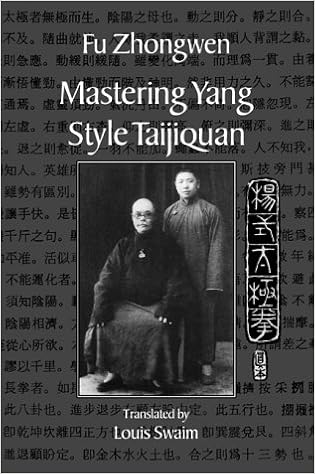
Mastering Yang Style Taijiquan  By Fu Zhongwen.  Translated by Louis Swaim.  Berkeley, California, Blue Snake Books, c 1999, 2006.  Bibliography, glossary, 226 pages.  ISBN: 9781583941522.  VSCL.  Fu Zongwen (1919-1994) was a student of Yang Cheng Fu.  Translations of many Tai Chi classics are included.  A list of 85 movements are provided.  251 movement analysis illustrations.  Over 76 of the illustrations are traced and drawn from photographs of Yang Chengfu.  Detailed descriptions of the long form, pp. 26-162.  Push hands information.  Yang Tai Chi essentials.


Master Cheng's Thirteen Chapters On Tai Chi Ch'uan. By Cheng Man-ch'ing. Translated by Douglas Wile. 101 pages. Sweet Chi Press, 1982. 101 pages. ISBN: 978-0912059006. Originally written in Chinese in 1949. VSCL.


The Essence and Applications of Taijiquan. By Yang, Chengfu (1883-1936). Translated by Louis Swaim. The original publication date was in 1934. The original book was edited by Professor Cheng Man-Chi'ng. Berkeley, California, North Atlantic Books, 2005. Introduction, appendices, bibliography, 124 pages. ISBN: 1556435452. In this book, the entire sequence of the specialized and named martial movements/postures/sections/forms is numbered from Section 1 up to Section 94; thus, the popular long taijiquan from, the Yang 94 Form. VSCL.


Thursday, March 26, 2026

Yang Style Tai Chi Chuan 108 Form, Third Section

 For Tai Chi Chuan players:

I often take a section of a long Taijiquan form and restudy and carefully practice only that section many times. I look up that section in books to learn more from master teachers. I also use instructional DVDs and UTube for sectional reviews. Smaller bites assists with better chewing and digestion.

I use the fine books by Fu Zhongwen, Li Deyin, T.T. Liang/Stuart Olson, and Gordon Muir for review. All have photographs or line illustrations of the movements and much commentary.

Here are some UTube demonstrations of the Third Section (Movements 56-108) of the Traditional Long Form of Yang Style Tai Chi Chuan:


Third Section,  Movements 55-108,  List of Movements


Third Section List ,  Movements 55-108,  Yang Long Form 108 

    Provides a list with the number of the movement and the name of movement.  In the PDF format (print only), 1 page, 26Kb.


Third Section List,  Part I,  Movements 56 - 82,  Yang Long Form 108
   

    Provides a list with the number of the movement, the direction one is facing at the end of that movement, the name of the movement, and a brief description or notes about the movement.  In the PDF format (print only), 1 page, 65Kb.  In the HTML format provided below in this document.  


Third Section List,  Part II,  Movements 83 - 108,  Yang Long Form 108.   

    Provides a list with the number of the movement, the direction one is facing at the end of that movement, the name of the movement, and a brief description or notes about the movement.  In the PDF format (print only), 1 page, 63Kb.  In the HTML format provided below in this document.  


Comparison of 108 Long Yang with 88 Long Yang - Chart

Wednesday, March 25, 2026

Yang Style Tai Chi Chuan, Second Section

 Second Section of the Yang Style of Taijiquan

Tradition Yang Tai Chi Chuan, Long Form, 2nd Section


Second Section,  Movements 56-82,  List of Movements


Second Section List,  Movements 18-55,  Yang Long Form 108

    Provides a list with the number of the movement and the name of movement.  In the PDF format (print only), 1 page, 16Kb.  


Second Section List,  Part I,  Movements 18 - 37,  Yang Long Form 108 

    Provides a list with the number of the movement, the direction one is facing at the end of that movement, the name of the movement, and a brief description or notes about the movement.  In the PDF format (print only), 1 page, 53Kb.  In the HTML format provided below in this document.  


Seond Section List,  Part II,  Movements 38 - 55,  Yang Long Form 108

    Provides a list with the number of the movement, the direction one is facing at the end of that movement, the name of the movement, and a brief description or notes about the movement.  In the PDF format (print only), 1 page, 48Kb.  In the HTML format provided below in this document.  


Comparison of 108 Long Yang with 88 Long Yang - Chart


 Long Form, 108 Movements, Second Section 18. Carry Tiger to the Mountain 19. Grasping the Sparrow’s Tail 20. Fist Under Elbow 21. Repulse Monkey – Right 22. Repulse Monkey – Left 23. Repulse Monkey – Right 24. Diagonal Slant Flying 25. Raise Hands, Shoulder Stroke 26. White Crane Spreads Its Wings 27. Brush Left Knee, Push 28. Needle at Sea Bottom 29. Fan Through the Back 30. Turn, Chop with Fist 31. Step Forward, Parry, Punch 32. Ward-Off Left 33. Grasping the Sparrow’s Tail 34. Single Whip 35. Wave Hands Like Clouds 36. Single Whip 37. High Pat on Horse 38. Kick with Right Toe 39. Kick with Left Toe 40. Turn, Kick with Left Sole 41. Brush Left Knee, Push 42. Brush Right Knee, Push 43. Step Up, Punch Downward 44. Turn, Chop with Fist 45. Step Forward, Parry, Punch 46. Kick with Right Sole 47. Strike Tiger, Left Side 48. Strike Tiger, Right Side 49. Kick with Right Sole 50. Box Ears with Fists 51. Kick with Left Sole 52. Pivot, Kick with Right Sole 53. Deflect, Parry and Punch 54. Apparent Withdraw  Cross Hands


Sunday, March 22, 2026

Yang Style Taijiquan Long Form Section I

 Yang Style Taijiquan Long Form Section I

First Section,  Movements 1-17,  List of Movements


First Section List,  Movements 1-17,  Yang Long Form 108   

    Provides a list with the number of the movement and the name of movement. In the PDF format (print only), 1 page, 16Kb.  


First Section List,  Part I,  Movements 1 - 17,  Yang Long Form 108 

    Provides a list with the number of the movement, the direction one is facing at the end of that movement, the name of the movement, and a brief description or notes about the movement.  In the PDF format (print only), 1 page, 48Kb. 


Tuesday, November 28, 2023

Yang Taijiquan Long Form Third Section

For Tai Chi Chuan players: I often take a section of a long Taijiquan form and restudy and carefully practice only that section many times. I look up that section in books to learn more from master teachers. I also use instructional DVDs and UTube for sectional reviews. Smaller bites assists with better chewing and digestion.

I use the fine books by Fu Zhongwen, Li Deyin, T.T. Liang/Stuart Olson, and Gordon Muir for review. All have photographs or line illustrations of the movements and much commentary.

Here are some UTube demonstrations of the Third Section (Movements 56-108) of the Traditional Long Form of Yang Style Tai Chi Chuan:


Third Section,  Movements 55-108,  List of Movements


Third Section List ,  Movements 55-108,  Yang Long Form 108 

    Provides a list with the number of the movement and the name of movement.  In the PDF format (print only), 1 page, 26Kb.


Third Section List,  Part I,  Movements 56 - 82,  Yang Long Form 108
   

    Provides a list with the number of the movement, the direction one is facing at the end of that movement, the name of the movement, and a brief description or notes about the movement.  In the PDF format (print only), 1 page, 65Kb.  In the HTML format provided below in this document.  


Third Section List,  Part II,  Movements 83 - 108,  Yang Long Form 108.   

    Provides a list with the number of the movement, the direction one is facing at the end of that movement, the name of the movement, and a brief description or notes about the movement.  In the PDF format (print only), 1 page, 63Kb.  In the HTML format provided below in this document.  


Comparison of 108 Long Yang with 88 Long Yang - Chart

Saturday, November 25, 2023

Yang Style Tai Chi Chuan 108 Long Form


Yang Family Style Tai Chi Chuan Traditional 108 Long Form
By Michael P. Garofalo.

This webpage provides a list and brief description of the 108 movements of the Yang Style Taijiquan Long Form divided into five sections for teaching (.html and .pdf versions available). The webpage includes an extensive bibliography on the subject, scores of Internet links, historical notes, and quotations. 


The Yang Long Form discussed on this webpage conforms to the form developed by Yang Cheng-Fu (1883-1936) and documented in books by Bu Fu Zongwen (1903-1994) and Yang Zhenduo. The numbering of the movements varies from author to author, but the essential sequence and moves remains the same.

Doing some research on the Yang style of T'ai Chi Ch'uan (85 and 24). Two books have caught me eye:

Mastering Yang Style Taijiquan.  Bu Fu Zongwen (1903-1994).  Translated by Louis Swaim.  Berkeley, California, North Atlantic Books, 1999.  Glossary, bibliography, 226 pages.  Translations of many Tai Chi classics are included.  A list of the 85 movement long form and detailed notes and descriptions of each movement are provided.  251 movement analysis illustrations.  Over 76 of the illustrations are traced and drawn from photographs of Yang Cheng-Fu.  Detailed descriptions of the long form, pp. 26-162.  Push hands information.  Yang Tai Chi essentials.  ISBN: 1556433182.  I have found this to be an excellent book!  This book was first published in 1963 in China as "Yang Shi Taijiquan".  An informative introduction and good translation by Louis Swaim.  VSCL.    

Taijiquan.  By Li Deyin.  London, Singing Dragon, 2004, 2008.  In English.  402 pages.  ISBN: 9781848190047, 1848190042.  Includes a complimentary DVD.  Includes descriptions, with photographs, of the 81 Yang Taijiquan form, Simplified 24 Taijiquan, Competition 42 Taijiquan, Competition 42 Taiji Sword, and the 32 Taiji Sword.  The Yang long form (81 Steps) includes photographs of Li Yulin performing the Yang long form in 1931.  Li Yulin and Li Jinglin, under the supervision of Yang Chengfu, were preparing a book on the subject later published under the title "Textbook of Taijiquan."  The 81 form is described in detail in this new book by Li Deyin.  


Yang Style Traditional Long Form T'ai Chi Ch'uan; As Taught by Master T. T. Liang.  By Gordon Muir.  Berkeley, California, Blue Snake Books, 2008.  225 pages.  150 numbered postures.  VSCL. 


Saturday, January 28, 2023

Yang Style Tai Chi Chuan Long 108 Form


Yang Family Style Tai Chi Chuan Traditional Long Form
By Michael P. Garofalo.

This webpage provides a list and brief description of the 108 movements of the Yang Style Taijiquan Long Form divided into five sections for teaching (.html and .pdf versions available). The webpage includes an extensive bibliography on the subject, scores of Internet links, historical notes, and quotations. 


The Yang Long Form discussed on this webpage conforms to the form developed by Yang Cheng-Fu (1883-1936) and documented in books by Bu Fu Zongwen (1903-1994) and Yang Zhenduo. The numbering of the movements varies from author to author, but the essential sequence and moves remains the same.

Doing some research on the Yang style of T'ai Chi Ch'uan (85 and 24). Two books have caught me eye:

Mastering Yang Style Taijiquan.  Bu Fu Zongwen (1903-1994).  Translated by Louis Swaim.  Berkeley, California, North Atlantic Books, 1999.  Glossary, bibliography, 226 pages.  Translations of many Tai Chi classics are included.  A list of the 85 movement long form and detailed notes and descriptions of each movement are provided.  251 movement analysis illustrations.  Over 76 of the illustrations are traced and drawn from photographs of Yang Cheng-Fu.  Detailed descriptions of the long form, pp. 26-162.  Push hands information.  Yang Tai Chi essentials.  ISBN: 1556433182.  I have found this to be an excellent book!  This book was first published in 1963 in China as "Yang Shi Taijiquan".  An informative introduction and good translation by Louis Swaim.  VSCL.    

Taijiquan.  By Li Deyin.  London, Singing Dragon, 2004, 2008.  In English.  402 pages.  ISBN: 9781848190047, 1848190042.  Includes a complimentary DVD.  Includes descriptions, with photographs, of the 81 Yang Taijiquan form, Simplified 24 Taijiquan, Competition 42 Taijiquan, Competition 42 Taiji Sword, and the 32 Taiji Sword.  The Yang long form (81 Steps) includes photographs of Li Yulin performing the Yang long form in 1931.  Li Yulin and Li Jinglin, under the supervision of Yang Chengfu, were preparing a book on the subject later published under the title "Textbook of Taijiquan."  The 81 form is described in detail in this new book by Li Deyin.  


Saturday, June 11, 2022

Yang Style Tai Chi Chuan - Third Section

A Repost form 2020!

Yesterday, because of wildfire smoke and ashes and low clouds in Vancouver, WA, the visibility out my front door was less than 100 feet.  The hazardous air quality was dangerous to anyone's health.  I practiced my Tai Chi Chuan and Qigong indoors, in a 20’x6” area.  This is sufficient space to practice the Yang Style Taijiquan Long 108 and Short 24 forms, and any qigong form.  

The practice of Tai Chi Chuan or Chi Kung can be done indoors or outdoors.  The only equipment needed is your body. 

I move a little furniture and practice indoors quite often.    

These are wonderful movement arts for better health.  Try them yourself!

Currently, I am reviewing the 3rd Section of the Yang Taijiquan Long 108 Form.  


Hypertext Notebooks by Michael Garofalo:

Grandmaster Yang Chen Fu's Taijiquan 94 Movements Long Form  1920's

List of All the Movements in Third Section of Yang Style Long Form  1 page

Third Section, Part 1, List of Movements and brief instructions  1 page

Third Section, Part 2, List of Movements and brief instructions  1 page 

Cloud Hands Tai Chi Chuan Website


Monday, June 08, 2020

Tai Chi Chuan - Yang Long Form

Yang Family Style Tai Chi Chuan Traditional Long Form
By Michael P. Garofalo.
This webpage provides a list and brief descriptions of the 108 movements of the Yang Style Taijiquan Long Form divided into five sections for teaching (.html and .pdf versions available). The webpage includes an extensive bibliography on the subject, scores of Internet links, historical notes, and quotations. 

The Yang Long Form discussed on this webpage conforms to the form developed by Yang Cheng-Fu (1883-1936) and documented in books by Bu Fu Zongwen (1903-1994) and Yang Zhenduo. The numbering of the movements varies from author to author, but the essential sequence and moves remains the same.

Mastering Yang Style Taijiquan.  Bu Fu Zongwen (1903-1994).  Translated by Louis Swaim.  Berkeley, California, North Atlantic Books, 1999.  Glossary, bibliography, 226 pages.  Translations of many Tai Chi classics are included.  A list of the 85 movement long form and detailed notes and descriptions of each movement are provided.  251 movement analysis illustrations.  Over 76 of the illustrations are traced and drawn from photographs of Yang Cheng-Fu.  Detailed descriptions of the long form, pp. 26-162.  Push hands information.  Yang Tai Chi essentials.  ISBN: 1556433182.  I have found this to be an excellent book!  This book was first published in 1963 in China as "Yang Shi Taijiquan".  An informative introduction and good translation by Louis Swaim.  VSCL.    


Thursday, September 26, 2019

Yang Taijiquan Long Form

Yang Family Style Tai Chi Chuan Traditional Long Form
By Michael P. Garofalo.
This webpage provides a list and brief descriptions of the 108 movements of the Yang Style Taijiquan Long Form divided into five sections for teaching (.html and .pdf versions available). The webpage includes an extensive bibliography on the subject, scores of Internet links, historical notes, and quotations. 

I try to practice this Yang form as described in this and many other Yang family books and DVDs.  

The Yang Long Form discussed on this webpage conforms to the form developed by Yang Cheng-Fu (1883-1936) and documented in books by Fu Zongwen (1903-1994), and Yang Zhenduo. The numbering of the movements varies from author to author, but the essential sequence and moves remains the same.

Mastering Yang Style Taijiquan.  Fu Zongwen (1903-1994).  Translated by Louis Swaim.  Berkeley, California, North Atlantic Books, 1999.  Glossary, bibliography, 226 pages.  Translations of many Tai Chi classics are included.  A list of the 85 movement long form and detailed notes and descriptions of each movement are provided.  251 movement analysis illustrations.  Over 76 of the illustrations are traced and drawn from photographs of Yang Cheng-Fu.  Detailed descriptions of the long form, pp. 26-162.  Push hands information.  Yang Tai Chi essentials.  ISBN: 1556433182.  I have found this to be an excellent book!  This book was first published in 1963 in China as "Yang Shi Taijiquan".  An informative introduction and good translation by Louis Swaim.  VSCL.    


Monday, February 25, 2019

Yang Style Tai Chi Chuan: Resources

Yang Family Style Tai Chi Chuan Traditional Long Form
By Michael P. Garofalo.
This webpage provides a list and brief descriptions of the 108 movements of the Yang Style Taijiquan Long Form divided into five sections for teaching (.html and .pdf versions available). The webpage includes an extensive bibliography on the subject, scores of Internet links, historical notes, and quotations. 

The Yang Long Form discussed on this webpage conforms to the form developed by Yang Cheng-Fu (1883-1936) and documented in books by Fu Zongwen (1903-1994), and Yang Zhenduo. The numbering of the movements varies from author to author, but the essential sequence and moves remains the same.

Mastering Yang Style Taijiquan.  Fu Zongwen (1903-1994).  Translated by Louis Swaim.  Berkeley, California, North Atlantic Books, 1999.  Glossary, bibliography, 226 pages.  Translations of many Tai Chi classics are included.  A list of the 85 movement long form and detailed notes and descriptions of each movement are provided.  251 movement analysis illustrations.  Over 76 of the illustrations are traced and drawn from photographs of Yang Cheng-Fu.  Detailed descriptions of the long form, pp. 26-162.  Push hands information.  Yang Tai Chi essentials.  ISBN: 1556433182.  I have found this to be an excellent book!  This book was first published in 1963 in China as "Yang Shi Taijiquan".  An informative introduction and good translation by Louis Swaim.  VSCL.    


Monday, January 09, 2017

Yang Style of Taijiquan

Yang Family Style Tai Chi Chuan Traditional Long Form
By Michael P. Garofalo.
This webpage provides a list and brief descriptions of the 108 movements of the Yang Style Taijiquan Long Form divided into five sections for teaching (.html and .pdf versions available). The webpage includes an extensive bibliography on the subject, scores of Internet links, historical notes, and quotations. 

The Yang Long Form discussed on this webpage conforms to the form developed by Yang Cheng-Fu (1883-1936) and documented in books by Bu Fu Zongwen (1903-1994) and Yang Zhenduo. The numbering of the movements varies from author to author, but the essential sequence and moves remains the same.

Mastering Yang Style Taijiquan.  Bu Fu Zongwen (1903-1994).  Translated by Louis Swaim.  Berkeley, California, North Atlantic Books, 1999.  Glossary, bibliography, 226 pages.  Translations of many Tai Chi classics are included.  A list of the 85 movement long form and detailed notes and descriptions of each movement are provided.  251 movement analysis illustrations.  Over 76 of the illustrations are traced and drawn from photographs of Yang Cheng-Fu.  Detailed descriptions of the long form, pp. 26-162.  Push hands information.  Yang Tai Chi essentials.  ISBN: 1556433182.  I have found this to be an excellent book!  This book was first published in 1963 in China as "Yang Shi Taijiquan".  An informative introduction and good translation by Louis Swaim.  VSCL.    


Tuesday, May 17, 2016

Yang Style Taijiquan Long Form

Yang Family Style Tai Chi Chuan Traditional Long Form
By Michael P. Garofalo.

This webpage provides a list and brief description of the 108 movements of the Yang Style Taijiquan Long Form divided into five sections for teaching (.html and .pdf versions available). The webpage includes an extensive bibliography on the subject, scores of Internet links, historical notes, and quotations. 120Kb.


The Yang Long Form discussed on this webpage conforms to the form developed by Yang Cheng-Fu (1883-1936) and documented in books by Bu Fu Zongwen (1903-1994) and Yang Zhenduo. The numbering of the movements varies from author to author, but the essential sequence and moves remains the same.

Doing some research on the Yang style of T'ai Chi Ch'uan (85 and 24). Two books have caught me eye:

Mastering Yang Style Taijiquan.  Bu Fu Zongwen (1903-1994).  Translated by Louis Swaim.  Berkeley, California, North Atlantic Books, 1999.  Glossary, bibliography, 226 pages.  Translations of many Tai Chi classics are included.  A list of the 85 movement long form and detailed notes and descriptions of each movement are provided.  251 movement analysis illustrations.  Over 76 of the illustrations are traced and drawn from photographs of Yang Cheng-Fu.  Detailed descriptions of the long form, pp. 26-162.  Push hands information.  Yang Tai Chi essentials.  ISBN: 1556433182.  I have found this to be an excellent book!  This book was first published in 1963 in China as "Yang Shi Taijiquan".  An informative introduction and good translation by Louis Swaim.  VSCL.    

Taijiquan.  By Li Deyin.  London, Singing Dragon, 2004, 2008.  In English.  402 pages.  ISBN: 9781848190047, 1848190042.  Includes a complimentary DVD.  Includes descriptions, with photographs, of the 81 Yang Taijiquan form, Simplified 24 Taijiquan, Competition 42 Taijiquan, Competition 42 Taiji Sword, and the 32 Taiji Sword.  The Yang long form (81 Steps) includes photographs of Li Yulin performing the Yang long form in 1931.  Li Yulin and Li Jinglin, under the supervision of Yang Chengfu, were preparing a book on the subject later published under the title "Textbook of Taijiquan."  The 81 form is described in detail in this new book by Li Deyin.  


Saturday, March 26, 2016

Taijiquan Yang Style Long 108 Form


Yang Family Style Tai Chi Chuan Traditional Long Form
By Michael P. Garofalo.

This webpage provides a list and brief description of the 108 movements of the Yang Style Taijiquan Long Form divided into five sections for teaching (.html and .pdf versions available). The webpage includes an extensive bibliography on the subject, scores of Internet links, historical notes, and quotations. 120Kb.


The Yang Long Form discussed on this webpage conforms to the form developed by Yang Cheng-Fu (1883-1936) and documented in books by Bu Fu Zongwen (1903-1994) and Yang Zhenduo. The numbering of the movements varies from author to author, but the essential sequence and moves remains the same.

Doing some research on the Yang style of T'ai Chi Ch'uan (85 and 24). Two books have caught me eye:

Mastering Yang Style Taijiquan.  Bu Fu Zongwen (1903-1994).  Translated by Louis Swaim.  Berkeley, California, North Atlantic Books, 1999.  Glossary, bibliography, 226 pages.  Translations of many Tai Chi classics are included.  A list of the 85 movement long form and detailed notes and descriptions of each movement are provided.  251 movement analysis illustrations.  Over 76 of the illustrations are traced and drawn from photographs of Yang Cheng-Fu.  Detailed descriptions of the long form, pp. 26-162.  Push hands information.  Yang Tai Chi essentials.  ISBN: 1556433182.  I have found this to be an excellent book!  This book was first published in 1963 in China as "Yang Shi Taijiquan".  An informative introduction and good translation by Louis Swaim.  VSCL.    

Taijiquan.  By Li Deyin.  London, Singing Dragon, 2004, 2008.  In English.  402 pages.  ISBN: 9781848190047, 1848190042.  Includes a complimentary DVD.  Includes descriptions, with photographs, of the 81 Yang Taijiquan form, Simplified 24 Taijiquan, Competition 42 Taijiquan, Competition 42 Taiji Sword, and the 32 Taiji Sword.  The Yang long form (81 Steps) includes photographs of Li Yulin performing the Yang long form in 1931.  Li Yulin and Li Jinglin, under the supervision of Yang Chengfu, were preparing a book on the subject later published under the title "Textbook of Taijiquan."  The 81 form is described in detail in this new book by Li Deyin.  


Wednesday, September 23, 2015

T'ai Chi Ch'uan Yang Style


Yang Family Style Tai Chi Chuan Traditional Long Form
By Michael P. Garofalo.
This webpage provides a list and brief description of the 108 movements of the Yang Style Taijiquan Long Form divided into five sections for teaching (.html and .pdf versions available). The webpage includes an extensive bibliography on the subject, scores of Internet links, historical notes, and quotations. 120Kb.

The Yang Long Form discussed on this webpage conforms to the form developed by Yang Cheng-Fu (1883-1936) and documented in books by Bu Fu Zongwen (1903-1994) and Yang Zhenduo. The numbering of the movements varies from author to author, but the essential sequence and moves remains the same.

Doing some research on the Yang style of T'ai Chi Ch'uan (85 and 24). Two books have caught me eye:

Mastering Yang Style Taijiquan.  Bu Fu Zongwen (1903-1994).  Translated by Louis Swaim.  Berkeley, California, North Atlantic Books, 1999.  Glossary, bibliography, 226 pages.  Translations of many Tai Chi classics are included.  A list of the 85 movement long form and detailed notes and descriptions of each movement are provided.  251 movement analysis illustrations.  Over 76 of the illustrations are traced and drawn from photographs of Yang Cheng-Fu.  Detailed descriptions of the long form, pp. 26-162.  Push hands information.  Yang Tai Chi essentials.  ISBN: 1556433182.  I have found this to be an excellent book!  This book was first published in 1963 in China as "Yang Shi Taijiquan".  An informative introduction and good translation by Louis Swaim.  VSCL.    
 
Taijiquan.  By Li Deyin.  London, Singing Dragon, 2004, 2008.  In English.  402 pages.  ISBN: 9781848190047, 1848190042.  Includes a complimentary DVD.  Includes descriptions, with photographs, of the 81 Yang Taijiquan form, Simplified 24 Taijiquan, Competition 42 Taijiquan, Competition 42 Taiji Sword, and the 32 Taiji Sword.  The Yang long form (81 Steps) includes photographs of Li Yulin performing the Yang long form in 1931.  Li Yulin and Li Jinglin, under the supervision of Yang Chengfu, were preparing a book on the subject later published under the title "Textbook of Taijiquan."  The 81 form is described in detail in this new book by Li Deyin.