Showing posts with label Esoteric Body. Show all posts

Thursday, November 03, 2022

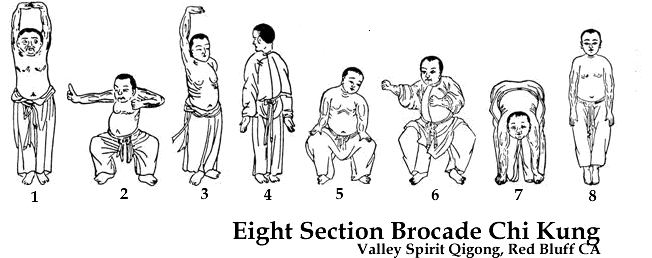
Eight Section Brocade Chi Kung and the Eight Trigrams


Sequence C:  Trigrams, Bagua, and Eight Section Brocade (Ba Duan Jin) Exercises Correlations

Soft Qigong (Rou Gong), Inner Qigong (Nei Gong); Slow Pace, Gentle, Soft, At Ease, Relaxed (Sung), Rooted/Sunk, Yin Style
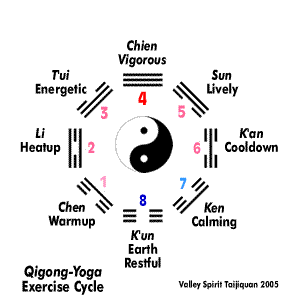
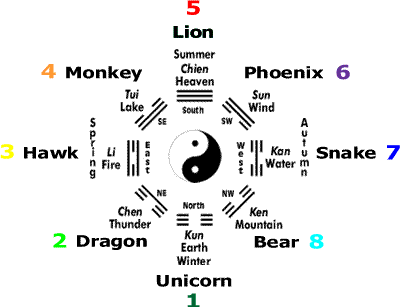


Eight Section Brocade Exercise
I Ch'ing Trigram 
Parts of the Body Affected
1.  Pressing Up to the Heavens with
Two Hands
South, Summer
Ch'ien, Qián, Heaven, Sky, Air
Intense Yang
Lion
Heart, Small Intestine, Stomach, Lungs
(The Triple Warmer)
              
2.  Drawing the Bow and Letting the Arrow Fly Southwest, Mid-Summer
Sun, Wind
Yang
Phoenix
Kidneys, Spleen, Waist, Eyes, Legs
                     
4.  Wise Owl Gazes Backward West, Autumn
K'an, Water
Yang-Yin
Snake
Lungs, Immune System, Large Intestine
                   
5.  Big Bear Turns from Side to Side Northwest, Mid-Autumn
Ken, Gèn, Mountain
Yin-Yang
Bear
Heart, Waist, Legs
                   
3.  Separating Heaven and Earth North, Winter
K'un, Earth
Intense Yin
Unicorn, Qilin
Spleen, Kidneys, Bladder, Pancreas
                        

8.  Shaking the Body Northeast, Mid-Winter
Chen, Zhèn, Thunder
Yin
Dragon
Immune System, Calves, Feet
                         
6.  Punching with Angry Gaze Spring, East
Li, Fire
Yin-Yang
Hawk, Falcon
Liver, Gallbladder, Blood, Eyes
                      

8.  Touching Toes then Bending Backwards Southeast, Mid-Spring
Tui, Lake
Yang-Yin
Monkey

 
Kidneys, Waist, Legs, Back

The above three charts were proposed in 2005 by Mike Garofalo, in his webpage on the Eight Section Brocade.  See also Mike's webpage on the Eight Trigrams.  


In 2014, Christina Barea-Young and Peyton Young provided another set of associations for the Eight Section Brocade movements with the Eight Trigrams in Qi Magazine (Volume 24, No. 2, 2014, p. 48).  

I find these kinds of correlations, associations, and relational charts quite inconsistent between various authors.  Yoga, Western Esoteric Magic, and Qigong have many of the same kind of charts and tables of correlations; again, with considerable inconsistency between various "masters."  Other than the "traditions of specific esoteric schools", I find the associations rather arbitrary and fanciful, primarily aids to remembering clusters of ideas, poetic devices, magical-metaphysical lore, and lacking in much pragmatic-scientific meaningfulness.  Contrast these charming and pre-scientific tables with the modern and justifiably famous "Periodic Table of the Elements" for a real lesson in an objective and empirical approach to understanding the world.  Nevertheless, these clusters of ideas may stimulate the imagination, and are fun for playing thought games.  


"The names of the 108 Forms are each symbolic and signify concepts removed from the literal  physicality of the object - horse, tiger, bird, and so forth.  Each name has its separate allusion, and metaphorically may connote an aspiration, a philosophical attitude towards self and  conduct, a turn of mind, a sense of being, some thought about life and spirit.  The true meanings are revealed when the T'ai-Chi Ch'uan exponent has advanced to that stage of experience comprehension where he can utilize the implication of the philosophical  intentions, and where the symbols can be part of his growing consciousness.  This happens only when the mind and body have "changed" and absorbed the reasons for mental, emotional, and physical unity."
-   Sophia Delza, The T'ai Chi Ch'uan Experience, 1996, p. 24


The above long chart is more readable on my Eight Section Brocade webpage, 441 KB, last updated on June 20, 2014. 


Friday, October 07, 2022

The Dantian: A Baffling Fancy


The Dantian: A Baffling Fancy

By Michael P. Garofalo
October 7, 2022


Since I started practicing Taijiquan and Qigong in 1986, most of my teachers have talked about the “Dantian” many times. Books, webpages, magazines, and information sheets are filled with references to the concept, function, and uses of the Dantian. I could site sources for all the claims below, but most serious and informed internal arts students are already familiar with the sources of these views. 


Frequently, it is claimed that the Dantien is a few inches below and behind the umbilicus (belly button, navel).  Modern worldwide medical anatomy makes reference to the known organs that occupy this general area of the body: the large and small intestines for digestion, kidneys and urinary system, the female reproductive organs and womb, the musculature of the lower abdominals and obliques, the lymph system, the neural system, the colon, and the lower back.  


There is no mention in current medical science anatomy and physiology textbooks of an organ or function that resembles a Dantian.  I don’t recall that the excellent Harvard Medical School Study of the many benefits of Taijiquan practice makes any mention of the function or identity of an actual Dantian in our bodies.


Some advocates of Dantian theory claim there are three Dantians in the body.

Some claim that by using Qigong and herbs and meditation you will form a spiritual baby in the Dantien, that might become your immortal soul.

Some claim the Dantien is a “storehouse” of Qi energy.  Like ordinary “storehouses” it can be filled, emptied, locked, damaged, improved, etc. 

Some claim the Dantian is the "Elixir Field" and use agricultural analogies to refer to its cultivation.  

Some claim you can rotate, circle, spin, or move the Dantien with your mind. 

Some claim some physical movements cause Qi energy to flow from the Dantien out to your fingertips.

Some claim some equivalence of the Dantian theory to the Hatha Yoga Chakras or Kundalini speculations. 

Some make claims about elaborate Dantian associations with the Five Elements Chinese scheme. 

Some claim your spiritual essence or your spiritual center is in the Dantien (Chinese) or Hara (Japanese).

Some provide explanations of the Dantien in terms of fascia, lymph systems, nerve systems, hormonal system, or bioelectric currents, etc.

Some claim gently rubbing your abdomen in circles from the rib cage to the bladder areas enliven and strengthen the Dantien.  Many other movements and breathing techniques in Qigong are claimed to influence or energize the Dantien.  

Some claim to feel or sense the Dantien.

Some claim that because it is an essential part of Traditional Chinese Medicine, therefore it must be real and true. 

Some claim the male and female sexual energies and reproductive potentials are also in some way processed or converted by the supposed Dantian. 

Some claim their large bellies are full of Chi in their Dantian.

Some claim the Dantian is spherical, ball shaped, round and centered above and below the navel.  


Belief in these various claims may have a salutary effect on your psychological well-being, or not.  Belief in doing some positive action for your well being, or trust in a health mentor, can be beneficial in 30-45% of instances due entirely to the Placebo Effect.  So, imagining rotating and twirling your inner “Dantian” (invisible to surgeons, ordinary eyes, to microscopes, or MRIs) might make you feel better or feel stronger or feel more spiritual or feel less anxious, or not.  Feelings are important in our lives, but are insufficient for proper and accurate medical diagnosis, knowledge, and explanations.    


Tradition Chinese medicine and Taoist/Zen views have many good ideas about exercise, lifestyle, herbal remedies, ethical behavior, and a peaceful mind.  However, the many strange and sometimes conflicting claims about the existence and use of the Dantien might not be essential to good Taijiquan or Qigong practices.  Plenty of benefits come from daily physical exercises without any belief in these Dantien claims or theories. I guess it is relatively harmless to imagine having a Dantian, but such fancies are superfluous to the effective somatic and experiential practices of Tai Chi Chuan or other martial arts.   


Undoubtedly, improving the strength and flexibility of the lower abdominals, glutes, inguinal area (kua), illiopsoas, lower back, and the many muscles of the upper thighs are crucial for success and reducing injury in martial arts practices.  Practical physical conditioning exercises help achieve these goals.  I'm unsure about how Dantian imagery or soft Dantian practices achieve these real conditioning objectives.  How is storing more Chi in the Dantian going to help you kick better and safely? 


The female sexual organs and womb are in this area of the body.  We all appreciate the fact that our mothers carried us in their wombs, and fed and nurtured us as a fetus embryo, neonate and infant.  Human reproduction is an amazing process.  Our gratefulness is essential.  However, inventing supernatural, non-objective, unverifiable entities regarding the womb area are often lacking in any explanatory power, are uniformed, and in a few cases are just silly.  


I would advise skepticism regarding what many Taijiquan or Qigong teachers “preach” about Dantian theory.  They often just repeat something their “Master” told them, without further reflection or empirical evidence.  Their intentions are positive, but their explanations, examples, and theories are weak and muddled.  The Dantien associations with magic, miracles, feelings, ancient religious beliefs, supernatural entities, and outdated anatomy and physiology theories are obvious to critical thinkers.  Maybe believing in cultivating a “spiritual immortal baby” in your Dantien is not in your worldview; even if it is a charming, figurative, uplifting, and mystical fancy.


Taijiquan is difficult to learn and hard to practice alone daily.  Maybe Dantian myths also turn many people off intellectually, and they quit learning because they don't believe in the confusing jargon.


Keep in mind that such Taijiquan and Qigong Dantian believers are often unwilling to countenance other views.  These teachers will get mad, correct you, and even reject you for not believing in their Dantian theories.  Beware of asking for rational explanations, scientific evidence, anatomical facts, or common sense implications regarding these outmoded Dantian theories.  Keep your opinions to yourself, or you will be kicked out of this ancient Brotherhood of Taijiquan Dantian Believers.  Just be silent, nod approval, pretend, and act as-if to humor the instructor in class.  


Saturday, December 08, 2012

Neigong Principles

"The Taoists call the science of how you develop strong energy flow or internal power neigong.  Neigong has sixteen components:


1.  Breathing methods, from the simple to the more complex.
2.  Feeling, moving, transforming, transmuting and connecting energy channels of the body. 
3.  Precise body alignments to prevent the flow of chi from being blocked or dissipated. 
4.  Dissolving physical, emotional and spiritual blockages. 
5.  Moving energy through the acupuncture meridians and other secondary channels of the body, including the energy gates.
6.  Bending and stretching the body, both from the inside and from the outside in.
7.  Opening and closing (pulsing) all parts of the body's anatomy including the joints, soft tissues, fluids, internal organs,
spine and brain as well as all the body's subtle energy channels. 
8.  Manipulating the energy of the external aura outside the body.
9.  Making circles and spirals of energy inside the body, controlling the spiraling energy currents of the body and moving chi in the body at will. 
10.  Absorbing energy into and projecting energy away from any part of the body. 
11.  Controlling all the energies of the spine. 
12.  Controlling the left and right energy channels of the body. 
13.  Controlling the central energy channel of the body.
14.  Learning to develop the capabilities and all use of the body's lower tantien.  
14.  Learning to develop the capabilities and uses of the body's upper and middle tantiens. 
15.  Connecting every part of the physical and other energetic bodies into one, unified energy."
-  Bruce Kumar Frantzis, Dragon and Tiger Qigong, 2010, xxviii   


The Chi Revolution: Harnessing the Healing Power of Your Life Force.  By Bruce Kumar Frantzis.  Berkeley, California, Blue Snake Books, 2008.  248 pages.  ISBN: 978-1583941935.  VSCL.  
 
Opening the Energy Gates of Your Body: Chi Gung for Lifelong Health (Tao of Energy Enhancement).  By Bruce Kumar Frantzis.  Illustrated by Husky Grafx.  North Atlantic Books, 1993.  Second Edition.  174 pages.  ISBN: 1556431643.  VSCL.     

Relaxing into Your Being: The Water Method of Taoist Meditation Series, Vol. 1  By Bruce Kumar Frantzis.  Fairfax, California, Clarify Press, 1998.  Reader's Edition.  208 pages.  Republished by: North Atlantic Books, 2001, ISBN: 1556434073.  VSCL. 

The Great Stillness: The Water Method of Taoist Meditation Series, Vol. 2  By Bruce Kumar Frantzis.  Berkeley, North Atlantic Books, 2001.  272 pages.  ISBN: 978-1556434082.  

Dragon Qigong


Valley Spirit Qigong 


Ripening Peaches: Taoist Studies and Practices