Showing posts with label Interpretaions. Show all posts

Sunday, April 19, 2026

Art, Symbolism, and Creative Interpretations: The Tarot

Today, I am enjoying using a new copy of the:
Voyager Tarot, Intuition Cards for the 21st Century
By James Wanless, Ph.D.. Artist Ken Knutson. 
78 full color collage art Tarot cards.  117 page mini booklet. 
Fair Winds: ISBN 978-1-59233-322-6, 2017.  First edition 1984.  


Has anyone seen a chart or list correlating the 78 cards in the Voyager Tarot (or other Tarot decks) with the 64 Hexagrams of the I Ching???

For examples:

I Ching Number = Tarot Card Name

#1 Creative, Initiating = Magician, 1

#4, Childhood, Youthful Folly, Impermanence = Fool, 0

#52 Mountain = Hermit, 9

During a morning Voyager Tarot card reading, I usually select one card as the most significant for the day.  I would like to write on each Tarot card the corresponding, related, correlated, comparable, similar themed, or relevant I Ching Hexagram Number.  

Also, this is a different way for selecting an I Ching Hexagram other than yarrow sticks or coin tossing.  


A Repost from 2018:


I first purchased and used Tarot decks in 1979.  I studied numerous books on the subject of the Tarot.  I purchased numerous decks over the decades.  First, I enjoyed the variety of artwork and symbolism in the 78 cards in the different decks from different centuries.  Second, the creator of each deck brings some new insights into the overall structure and meanings for the cards in the deck.  Third, I enjoyed "reading" and creatively interpreting the symbols and images in these small art objects in the context of my own life and questions.  

I even made, in 2011, some very incomplete notes in hypertext documents on the Tarot.

My method over the years is to ask a question or reflect on my current consciousness and situation in my life.  Then, I randomly pull from 3 to 5 cards from the deck.  I try to interpret, reflect upon, and consider the meaning of each card.  I may use The Voyager Tarot book to refresh or expand my understanding or memories.  Then, I arrange the cards in some order to "tell a story."  I do this once a day, at night; then, in the morning, reconsider the meanings and relevance of that 3-5 card reading in my life.  I only look at cards right side up; although, I do sometimes reverse the meaning of the cards depending upon the story I create.  

I enjoy using the 1991 Voyager Tarot deck the most.  

This photomontage deck was designed by James Wanless, Ph.D.  The photographic collage artwork was created by Ken Knutson.  It was first published in 1984, and then in 1991 and 2008. 

The Voyager Tarot: Way of the Great Oracle Book.  By James Wanless, 1989.  Book and Deck


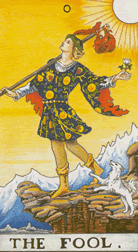
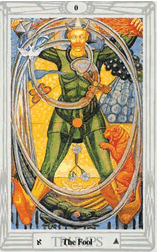
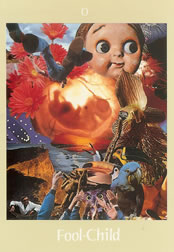
 The Fool, 0


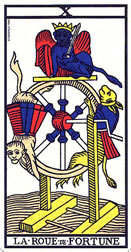
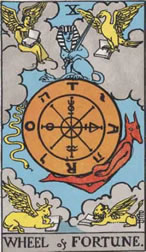
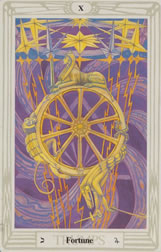
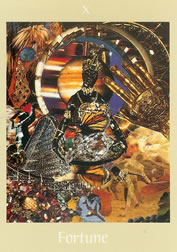
The Wheel of Fortune, 10


Tuesday, September 13, 2022

Studying the I Ching

I have enjoyed using Tarot cards since 1974.  

I currently use the following deck of I Ching cards to study and reflect on how the I Ching might work to inspire me, entertain me, or motivate me.

Visionary I Ching Cards: The Book of Changes for Intuitive Decision-Making.  By Paul O'Brien.  Art by Joan Larimore.  64 Cards, 224 page guidebook.  Beyond Words, 2020.  $22.00.

The Complete I Ching.  By Taoist Master Alfred Huang.  Inner Traditions, 1998, index, 540 pages.  $22.00.  

For Tarot style tools for learning about the Tao Te Ching, I recommend the following: 

Tao Te Ching Cards: Lao Tzu's Classic Taoist Text in 81 Cards.  A New and Complete Translation by Chao-Hsiu Chen.  16 page booklet.  Marlowe, 2004.  I bought this back in 2005 for $25.00; it is now out-of-print and expensive.  There are other current less costly card style choices.

My favorite Tarot card deck is the Voyager Deck by James Wanless. $27.00.    

My relevant webpages on this topic include:

Tao Te Ching by Lao Tzu

Taoism  

Tarot


Friday, October 04, 2019

Dao De Jing Comparing Translations

A typical web page created by Michael P. Garofalo for each one of the 81 Chapters (Verses, Sections) of the Tao Te Ching (Daodejing) by Lao Tzu (Laozi) includes 25 different English language translations or interpolations for that Chapter, 5 Spanish language translations for that Chapter, the Chinese characters for that Chapter, the Wade-Giles and Hanyu Pinyin transliterations (Romanization) of the Mandarin Chinese words for that Chapter, and 2 German and 1 French translation of that Chapter.  

Each webpage for each one of the 81 Chapters of the Tao Te Ching includes extensive indexing by key words, phrases, and terms for that Chapter in English, Spanish, and the Wade-Giles Romanization.  


Each webpage on a Chapter of he Daodejing includes recommended reading in books and websites, a detailed bibliography, some commentary, research leads, translation sources, a Google Translate drop down menu, and other resources for that Chapter. 


Chapter and Thematic Index (Concordance) to the Tao Te Ching by Lao Tzu


Friday, June 12, 2015

Índice de Español para el Tao Te Ching

Índice de Español para el Tao Te Ching de Lao Tzu

Concordancia Española para la Daodejing por Laozi

Las Traducciones en Español del Tao Te Ching

Español Índice de Traductores de Idiomas para el Tao Te Ching


Chapter and Thematic Index (Concordance) to the Tao Te Ching


Spanish Language Translator's Index


A typical webpage created by Mike Garofalo for each one of the 81 Chapters of the Tao Te Ching (Daodejing) by Lao Tzu (Laozi) includes 20 different English translations or interpolations for that Chapter, 3 Spanish translations for that Chapter, the Chinese characters for that Chapter, and the Wade-Giles and Hanyu Pinyin Romanization of the Mandarin Chinese words for that Chapter.  Each webpage for one of the 81 Chapters of the Tao Te Ching includes extensive indexing by key words and terms in English, Spanish, and the Wade-Giles Romanization.  Each webpage on a Chapter of the Daodejing includes recommended reading in books and websites, a detailed bibliography, some commentary, research leads, translation sources, and other resources for that Chapter.   

After each quoted version for a Chapter, I use the expression "Translated by ..."  The version of the Chapter could be a strict or free or loose "translation" of the Chapter by a qualified bilingual, Chinese-English, scholar (e.g., Ellen Chen, Thomas Cleary, Livia Kohn, Michael LaFargue, Victor Mair, Red Pine, Lin Yutang, Arthur Waley, etc.), teacher, Taoist, or expert.  It could also be an "interpolation" by a qualified or unqualified non-bilingual author who compared a dozen true translations into English and then created their own English version of the Chapter, e.g., Aleistar Crowley, Wayne Dyer, Ursula Le Guin, etc.  It could be an "interpretation" of the Chapter to suit their specific tastes, ideas, or beliefs, e.g., Mabry's Christian interpretation, John Bright-Fey's esoteric Daoist interpretation.  I just call them all "translations," because I am not often sure as to the background, qualifications, and intentions of the author.  


Daodejing
 Chapter Number Index


Standard Traditional Chapter Arrangement of the Daodejing
Chapter Order in Wang Bi's Daodejing Commentary in 246 CE
Chart by Mike Garofalo
Index
 
1 2 3 4 5 6 7 8 9 10
11 12 13 14 15 16 17 18 19 20
21 22 23 24 25 26 27 28 29 30
31 32 33 34 35 36 37 38 39 40
41 42 43 44 45 46 47 48 49 50
51 52 53 54 55 56 57 58 59 60
61 62 63 64 65 66 67 68 69 70
71 72 73 74 75 76 77 78 79 80
81


Here are some examples of "translations" of Chapter (Verse) 11 of the Daodejing:

"Treinta radios convergen en el centro de una rueda,
pero es su vacío
lo que hace útil al carro.
Se moldea la arcilla para hacer la vasija,
pero de su vacío
depende el uso de la vasija.
Se abren puertas y ventanas
en los muros de una casa,
y es el vacío
lo que permite habitarla.
En el Ser centramos nuestro interés,
pero del No-Ser depende la utilidad."
-  Translation from Wiki Source, 2013, Tao Te Ching, Capítulo 11
 
 
"Treinta radios se unen en el centro;
Gracias al agujero podemos usar la rueda.
El barro se modela en forma de vasija;
Gracias al hueco puede usarse la copa.
Se levantan muros en toda la tierra;
Gracias a la puertas se puede usar la casa.
Así pues, la riqueza proviene de lo que existe,
Pero lo valioso proviene de lo que no existe."
-  Translated by Antonio Rivas Gonzálvez, 2004, Tao Te Ching, Capítulo 11 
 
 
"Treinta rayos convergen hacia el centro de una rueda,
Pero es el vacío del centro el que hace útil a la rueda.
Con arcilla se moldea un recipiente,
Pero es precisamente el espacio que no contiene arcilla el que utilizamos como recipiente.
Abrimos puertas y ventanas en una casa,
Pero es por sus espacios vacíos que podemos utilizarla. 
Así, de la existencia provienen las cosas y de la no existencia su utilidad."
Translation from Logia Medio Dia, 2015,
Daodejing, Capítulo 11
 
 
"Treinta rayos convergen en el medio,
pero el vacío mediano
hace andar al carro.
 
Se modela la arcilla para hacer jarrones
     con ella,
pero de su vacío interno
depende su utilización.

Una casa está abierta con puertas y ventanas,
otra vez el vacío
permite que se habite en ella.

El Ser da posibilidades,
sólo se utilizan a través del no-ser."
-  Translated by Alba, 1998, Tao Te Ching, Capítulo 11 
 

"Thirty spokes share one hub.
It is just the space (the Nothingness) between them
That makes a cart function as a cart.
Knead clay to make a vessel
And you find within it the space
That makes a vessel as a vessel.
To build a house with doors and windows
And you find within them the space
That makes a house function as a house.
Hence the Being (substance) can provide a condition
Under which usefulness is found,
But the Nothingness (space) is the usefulness itself."
-  Translated by Gu Zengkun, Chapter 11


"Thirty spokes are made one by holes in a hub,
By vacancies joining them for a wheel's use;
The use of clay in moulding pitchers
Comes from the hollow of its absence;
Doors, windows, in a house,
Are used for their emptiness:
Thus we are helped by what is not
To use what is."
-  Translated by Witter Bynner, 1944, Chapter 11


"Although the wheel has thirty spokes its utility lies in the emptiness of the hub.
The jar is made by kneading clay, but its usefulness consists in its capacity.
A room is made by cutting out windows and doors through the walls, but the space the walls contain measures the room's value.
In the same way matter is necessary to form, but the value of reality lies in its immateriality.
Or thus: a material body is necessary to existence, but the value of a life is measured by its immaterial soul."
-  Translated by Dwight Goddard and Henri Borel, 1919, Chapter 11


"Thirty spokes, uniting in a nave, were employed in olden times before the invention of carriages. Clay made into utensils was employed before the time of palaces and dwellings when there were no sacrificial vases, goblets, or bowls.
A door and a window, hewn in a hill-side, did duty for a residence before the erection of houses. Wherefore, the possession of these things may be regarded as beneficial, while their former absence may be said to have been useful in that it led to the necessity of their being made."
-  Translated by Frederic Henry Balfour, 1884, Chapter 11 


三十輻共一轂.
當其無, 有車之用.
埏埴以為器.
當其無有器之用.
鑿戶牖以為室.
當其無, 有室之用.
故有之以為利.
無之以為用.
-  Chinese characters, Tao Te Ching, Chapter 11   


san shih fu kung yi ku.
tang ch'i wu, yu ch'ê chih yung.
yen ch'ih yi wei ch'i.
tang ch'i wu yu ch'i chih yung.
tso hu yu yi wei shih.
tang ch'i wu, yu shih chih yung.
ku yu chih yi wei li.
wu chih yi wei yung.
-  Wade-Giles Romanization, Tao Te Ching, Chapter 11  


"Thirty spokes unite around the nave;
From their not-being (loss of their individuality)
Arises the utility of the wheel.
Mold clay into a vessel;
From its not-being (in the vessel's hollow)
Arises the utility of the vessel.
Cut out doors and windows in the house (-wall),
From their not-being (empty space) arises the utility of the house.
Therefore by the existence of things we profit.
And by the non-existence of things we are served."
-  Translated by Lin Yutang, 1955, Chapter 11 


"Thirty spokes unite in a nave, but the nothingness in the hub
Gives to the wheel its usefulness, for thereupon it goes round;
The potter kneads the clay as he works, with many a twist and rub,
But in the nothingness within, the vessel's use is found;
Doors and windows cut in the walls thereby a room will make,
But in its nothingness is found the room' s utility;
So the profit of existences is only for the sake
Of non-existences, where all the use is found to be."
-  Translated by Isaac Winter Heysinger, 1903, Chapter 11 


"Dreißig Speichen umgeben eine Nabe:
In ihrem Nichts besteht des Wagens Werk.
Man höhlet Ton und bildet ihn zu Töpfen:
In ihrem Nichts besteht des Töpfe Werk.
Man gräbt Türen und Fenster, damit die Kammer werde:
In ihrem Nichts besteht der Kammer Werk.
Darum: Was ist, dient zum Besitz.
Was nicht ist, dient zum Werk."
-  Translated by Richard Wilhelm, 1911, Chapter 11


Friday, June 05, 2015

Interpolations and Translations of the Daodjing by Laozi

A typical webpage created by Mike Garofalo for each one of the 81 Chapters of the Tao Te Ching (Daodejing) by Lao Tzu (Laozi) includes 20 different English translations or interpolations for that Chapter, 3 Spanish translations for that Chapter, the Chinese characters for that Chapter, and the Wade-Giles and Hanyu Pinyin Romanization of the Mandarin Chinese words for that Chapter.  Each webpage for one of the 81 Chapters of the Tao Te Ching includes extensive indexing by key words and terms in English, Spanish, and the Wade-Giles Romanization.  Each webpage on a Chapter of the Daodejing includes recommended reading in books and websites, a detailed bibliography, some commentary, research leads, translation sources, and other resources for that Chapter.   

After each quoted version for a Chapter, I use the expression "Translated by ..."  The version of the Chapter could be a strict or free or loose "translation" of the Chapter by a qualified bilingual, Chinese-English, scholar (e.g., Ellen Chen, Thomas Cleary, Livia Kohn, Michael LaFargue, Victor Mair, Red Pine, Lin Yutang, Arthur Waley, etc.), teacher, Taoist, or expert.  It could also be an "interpolation" by a qualified or unqualified non-bilingual author who compared a dozen true translations into English and then created their own English version of the Chapter, e.g., Aleistar Crowley, Wayne Dyer, Ursula Le Guin, etc.  It could be an "interpretation" of the Chapter to suit their own tastes, ideas, or beliefs, e.g., Mabry's Christian interpretation.  I just call them all "translations," because I am not often sure as to the background, qualifications, and intentions of the author.  
  

Chapter and Thematic Index (Concordance) to the Tao Te Ching by Lao Tzu

English Language Daodejing Translators' Source Index

Spanish Language Daodejing Translators' Source Index

Ripening Peaches: Taoist Studies and Practices

Taoism: A Selected Reading List

One Old Taoist's Final Journey 


Here is an example of some of the translations and/or interpolations for:

Tao Te Ching by Lao Tzu
Daodejing by Laozi


Chapter 12


"Color's five hues from the eyes their sight will take;
Music's five notes the ears as deaf can make;
The flavors five deprive the mouth of taste;
The chariot course, and the wild hunting waste
Make mad the mind;
And objects rare and strange,
Sought for,
Men's conduct will to evil change.
Therefore the sage seeks to satisfy the craving of the belly,
and not the insatiable longing of the eyes.
He puts from him the latter, and prefers to seek the former."
-   Translated by James Legge, 1891, Chapter 12  


"The five colours blind the eyes of man.
The five musical notes deafen the ears of man.
The five flavours dull the taste of man.
Violent running and hunting disturb the emotions of man.
Greed for rare objects is hurtful to the actions of man.
That is why the self-controlled man occupies himself with the unseen, he does not occupy himself with the things visible, he puts away the latter and seeks the former."
-  Translated by Isabella Mears, 1916, Chapter 12


"The five colors make a man's eyes blind;
Horseracing and hunting make a man's mind go mad;
Goods that are hard to obtain make a man's progress falter;
The five flavors make a man's palate dull;
The five tones make a man's ears deaf.
For these reasons, In ruling, the sage attends to the stomach, not to the eye.
Therefore, He rejects the one and adopts the other."
-  Translated by Victor H. Mair, 1990, Chapter 12 


五色令人目盲.
五音令人耳聾.
五味令人口
爽.
馳騁田獵, 令人心發狂.
難得之貨, 令人行妨.
是以聖人為腹不為目.
故去彼取此.
-  Chinese characters, Tao Te Ching, Chapter 12  


wu sê ling jên mu mang.
wu yin ling jên erh lung.
wu wei ling jên k'ou shuang.
ch'ih ch'êng t'ien lieh, ling jên hsin fa k'uang.
nan tê chih huo, ling jên hsing fang.
shih yi shêng jên wei fu pu wei mu.
ku ch'ü pi ch'ü tz'u.
-  Wade-Giles Romanization, Tao Te Ching, Chapter 12 


"The five colors can blind,
The five tones deafen,
The five tastes cloy.
The race, the hunt, can drive men mad
And their booty leave them no peace.
Therefore a sensible man
Prefers the inner to the outer eye:
He has his yes, --he has his no."
-  Translated by Witter Bynner, 1944, Chapter 12 


"The five colors
blind our eyes.
The five notes
deafen our ears.
The five flavors
dull our taste.

Racing, chasing, hunting,
drives people crazy.
Trying to get rich
ties people in knots.

So the wise soul
watches with the inner
not with the outward eye,
letting that go,
keeping this."
-  Translation by Ursula K. Le Guin, 2009, Chapter 12 


"The five colours blind man's eye.
The five notes deafen man's ear.
The five tastes jade man's palate.
Galloping and hunting madden man's heart.
Goods that are difficult to obtain entangle man's conduct.
That is why the Saint cares for the belly and not for the eye.
For indeed, he rejects the one and chooses the other."
-  Translated by Jan J. L. Duyvendak, 1954, Chapter 12 


"Demasiado color ciega el ojo,
Demasiado ruido ensordece el oido,
Demasiado condimento embota el paladar,
Demasiado jugar dispersa la mente,
Demasiado deseo entristece el corazón.
El sabio provee para satisfacer las necesidades, no los sentidos;
Abandona la sensación y se concentra en la sustancia."
-  Translated by Antonio Rivas Gonzálvez, 2004, Tao Te Ching, Capítulo 12  


"The five colors can make us blind.
The five sounds can make us deaf.
The five flavors can deaden our taste.
Racing, chasing, and hunting can drive us mad.
The pursuit of treasure knocks us off the path.
Therefore, the Tao–Master follows his inner vision
rather than his outer vision.
He chooses this but not that."
-  Translated by George Cronk, 1999, Chapter 12