Showing posts with label Neigong. Show all posts

Saturday, January 31, 2026

The Three Treasures


Repost from December 17, 2023


The Three Treasures


My Body

Feelings, Emotions, Body-Self, Past-Present, Id-Ego,
Physical Health, Unconscious Dimensions, Breathing, 
Eating, Moving, Sleeping, Digesting, DNA, Sexuality,
Drinking, Vitality, Brain, Immediate Environment.

My Mind
Thoughts, Emotions, Experiences-Reflections, Ego, Goals
Past-Present-Future, Language Culture, Heart-Mind, Attitudes,
Beliefs, Opinions, Histories, Will, Hope, Memories, Spirit,
Brain-Body interactions with mundane environment.

My Actions
What I Do Today. My Behaviors and Character. 
Family Life.  Social and Community Interactions.  
Purposeful activity towards the Future.  Moral-Ethical Acts.
Practices, Exercises, Play.  
My employment or work.  


The Three Treasures are intertwined, integrated, interconnected, involved, and interwoven in some way all the time; all to the benefit of well-being and good health.  They can become disconnected and conflicting which produces poor bodily health, mental confusion, and useless, evil, or self-destructive acts.  Balance, clear purpose, and reflection are some essentials.  

We can separate these aspects of Being-In-The-World intellectually when reflecting; when Acting and Doing they are integrated.  

The Living Body is the foundation of Mind and the means of flourishing Actions.  Consciousness requires a Living Body.  

I don't find it scientifically plausible to accept notions of our having consciousness after death, having an invisible immortal soul, being ghostly beings, having immortal supernatural lives in fanciful heavens or hells, or other imaginary religious memes about our "after-lives."  

Qigong routines are intended to nourish, refresh, rejuvenate, and reenergize our Living Bodies.  Seeking immortality, spiritual rebirth, or special magical super-powers via Qigong, ascetism, or prayers do not seem reasonable to me.  Seeking and cultivating good health and longevity - Yes!  

- By Michael P. Garofalo,  9/2022


Cultivating Longevity (Yang Sheng Gong)

The Longevity Plan. By John D. Jay and Jane Ann Day, wth Matthew LaPlante. 2018, 304 pages. 1. Eat good food. 2. Master your mind-set. 3. Build your place in a positive community. 4. Be in motion. 5. Find your rhythm. 6. Make the most of your environment. 7. Proceed with purpose. John D. Jay, M.D., Cardiologist, Electro-physiologist.

Books by Tom Bisio      Books by Eva Wong       Books by Livia Kohn

Books by Ken Cohen     Books by Yang Jwing-Ming


Three Treasures - Wikipedia

"In long-established Chinese traditions, the "Three Treasures" are the essential energies sustaining human life:

  • Jing  "nutritive essence, essence; spirit, sperm, seed; extract; refined, perfected"
  • Qi  "breath, spirit; air, vapor; vitality, energy, force; vigor; attitude"
  • Shen  "spirit; soul, mind; god, deity; supernatural being"

This jing-qi-shen ordering is more commonly used than the variants qi-jing-shen and shen-qi-jing.

The Three Treasures or Three Jewels (ChinesepinyinsānbǎoWade–Gilessan-pao) are theoretical cornerstones in traditional Chinese medicine and practices such as neidanqigong, and tai chi. They are also known as jing, qi, and shen (Chinese精氣神pinyinjīng-qì-shénWade–Gilesching ch'i shen; "essence, breath, and spirit")."


"The Three Treasures or Three Jewels (ChinesepinyinsānbǎoWade–Gilessan-pao) are basic virtues in Taoism. Although the Tao Te Ching originally used sanbao to mean "compassion", "frugality", and "humility", the term was later used to translate the Three Jewels (BuddhaDharma, and Sangha) in Chinese Buddhism, and to mean the Three Treasures (jingqi, and shen) in Traditional Chinese Medicine."
Three Treasures in Taoism


Guarding the Three Treasures.  By Daniel P. Reid.  Simon, 1993, 484 pages.

The Three Treasures.  By Jong Kook Baik.  2019, 397 pages.  


Tuesday, June 03, 2014

Wild Goose Chi Kung Exercises

Dayan (Wild Goose) Qigong Exercises


Bibliography, Links, Quotes, Notes, List of Movements
Research by Mike Garofalo


The Wild Goose Qigong form is one long continuous sequence of movements, much like a Taiji form.  There are many aspects of the Wild Goose Qigong system as presented by Dr. Bingkun Hu of San Francisco.  


"In Ancient Egypt as well as in Ancient China the goose was considered a messenger between Heaven and Earth. In China geese are still a symbol of marriage, because of their lifelong pair-bond.  In the Roman empire, the goose was the sacred animal of Juno, a goddess of light, marriage and childbirth, who was later considered adviser and protectress of the Roman people. A story tells of how geese saved the Romans with their warning cries when the Gauls attacked the citadel of the Capitol.  The Celts associated the goose with war, possibly because of its watchful nature and aggressive temperament. Warrior gods were sometimes depicted with geese as companions. Remains of geese have been found in warrior's graves. The Britons kept geese, but did not eat them. They were, however, sometimes used as sacrificial offerings.  The goose, with its steady, powerful flight and migratory habits, can be associated with travelling, undertaking a journey to a new destination. This journey can be difficult and may take long.  The goose can help people find the perseverance needed to go on with their quests. In earlier times, shamans were aided by spirit geese on their journeys to other worlds."
-   Geese - The Animal Files    


"Wild Goose Qigong claims that “there are no intentional movements without awareness. Wild Goose Qigong advocates “wu-wei” (or “doing nothing”) and “tuo-yi” (“reduce one’s awareness to the minimum”). A good example is Wild Goose-1 (the first 64 Movements). We often tell our beginning learners that the movements in this set of qigong are supposed to describe the daily activities of a wild goose. There are three parts to this qigong.  Part One is “The Goose Wakes Up”. It stretches itself, it brushes up its wings and shakes them. It plays innocently.  A made-up story is even included: “Then the goose looks at the moon, which is reflected in the water and tries to scoop it up."  Part Two is “The Flying Goose”.  Flapping its wings, the care-free wild goose skims over a smooth lake.  It looks at the water and dips down to drink the water.  Then the goose is playing with he “qi”.  It tries to grasp the qi.  It holds and rotates the qi-ball.  It pushes out the dirty qi, and tries to receive the fresh qi from its lower back.  In Part Three, the goose is first flying up into the sky. Now it is flying over the water.  Then it is looking for some food.  After that, it is looking for its nest. At last, the goose goes to sleep.  When beginning, learners are encouraged to be pre-occupied with the daily activity of an innocent wild goose, when they are imagining that they are “flapping their wings” beside shimmering lake under a full moon, their heart beat will be naturally slow down, and their mind will gradually be quieting down too. At the same time, they will be more responsive to the instructor’s words on how to relax themselves through the shifting of body weight. Wild Goose Qigong is a medical qigong. We practice it because of its health benefits. When we have better qi flow, our blood circulation will improve. We will have more oxygen supply to our brain. Our mind will be more alert. We will get stronger, and we will have more physical strength, etc.."
-   Bingkun Hu, Ph.D., A Safe and Delightful Approach to Good Health   


Sunday, May 25, 2014

Breathe Naturally - Don't Overstrain

Breathing techniques and practices are a vital part of both yoga and qigong practices.  The breath is identified or associated in these popular mind-body practices with "energy" or "life force" or "Force" or "Élan vital" as elaborated in descriptions of the concepts of "Chi (Qi)" in Chinese and "Prana" in Sanskrit.  Air and Breath have since ancient times been essential features of both naturalistic and metaphysical explanations of living processes on earth.  Unquestionably, breathing and physiological respiration and moving oxygen through our blood are all essential to maintaining life.  Yoga and Qigong (Neigong) claim that their special breathing practices improve vitality, strengthen the body, improve immune response, calm a troubled mind, and possibly increase longevity. 

Yoga has many unusual breathing practices.  Breath of Fire - rapid short exhales.  Alternate nostril breathing - long slow breaths in through one nostril only.  Reverse abdominal breathing - tighten the abdominals on the inhale, relax the abdominals on the exhale.  Exhaling through the mouth with the throat constricted.  Breath retention for long periods.  Humming like a bee while exhaling.  All of these practices are called "Pranayama" and are taught in many yoga classes.  

Qigong uses breath control and coordination with movements to increase power, circulate and store energy in channels and reservoirs the mind-body realms, quiet the mind, and improve and expand the spirit-mind.  The main breathing technique encouraged is natural abdominal breathing: relax the abdomen on the inhale, slightly tighten the abdomen on the exhale, and don't hold or exaggerate the breathing cycle.  The more unusual and extreme techniques for breath control found in the Raja, Kundalini and Hatha Yogas from India are not found in Chinese Qigong.  More emphasis is placed in Qigong and Tai Chi on gently coordinating breathing with specific movements, and using one's mind to coordinate and direct the use of the inner life force energy (Qi) for health, well being and enlightenment.  Some contemporary Qigong teachers, of course, have borrowed techniques from modern Iyengar Hatha Yoga and use these in their Qigong (Chi Kung) classes.  

Overall, for the purposes of maintaining good health, I recommend breathing through the nose and out through the nose.  Do not smoke tobacco or other drugs, and avoid polluted air.  I wear a mask when working in dusty, smoky, or otherwise polluted air.  I also cover my mouth and nose when breathing in very cold weather.  Get prompt medical advice and support for serious respiratory problems.  Maintain appropriate cardio-vascular conditioning with aerobic activities like brisk long walks.  Just breathe naturally as needed depending on one's exertion levels.  

As for using breathing techniques or mantras or chants to meditate and attain "insight" or "enlightenment" I would recommend instead the daily reading of challenging and wise books and good conversations with intelligent and decent people.  Certainly, if you need to calm the body and quiet the mind because you are upset then then please sit quietly, close your eyes, breathe slowly and listen to some soothing music.  I find little benefit, for my mind or body, in using the unusual esoteric breathing practices of Hatha Yoga.  Likewise, I benefit more in many ways from walking for four miles rather than by staying still in seated meditation for 1.5 hours.  These are just personal preferences - just one fellow's opinions.  

The Taoist classic, the Tao Te Ching, by Lao Tzu, circa 500 BCE, has some verses that indicate that excessive emphasis upon breathing techniques and methods is not recommended.  The Taoist emphasis is more often placed on being natural, softening, being more pliable and flowing like water, not straining, and not interfering.  In particular, let's look a Chapter 55:

"To increase life means inviting evil.
To control the vital breath with the mind means rigidity.
When things have matured they age.
Such control is contrary to the Way.
What is contrary to the Way will soon end."
-  Translated by Jan J. L. Duyvendak, 1954, Chapter 55 


"It is inauspicious to try to improve on life,
And harmful to regulate breathing by conscious control.
To strive for too much results in exhaustion.
These actions are contrary to Tao.
And what is contrary to Tao soon comes to an early end."
-  Translated by Keith Seddon, Chapter 55 


"All devices for inflaming life, and increasing the vital Breath, by mental effort are evil and factitious.
Things become strong, then age.
This is in discord with the Tao, and what is not at one with the Tao soon cometh to an end."
-  Translated by Aleister Crowley, 1918, Chapter 55 


"To help life along is to bring ill portend;
To use mind (hsin) to direct the life breath (ch'i) is called the strong (ch'iang).
When things are full-grown they become old,
It is called not following the Way (Tao).
Not following the Way one dies early."
-  Translated by Ellen Marie Chen, 2000, Chapter 55 

"Increase of life is blessedness, they say,
They call the heart-directed spirit strength,
But these things reach their fullest growth, at length,
And plunge to swift decay;
We call all this contrary to the Tao,
Whatever is contrary to the Tao
Soon will pass away."
-  Translated by Isaac Winter Heysinger, 1903, Chapter 55 


"Trying to extend one's life-span is dangerous and unnatural.
To manipulate one's energy with the mind is a powerful thing
But whoever possesses such strength invariably grows old and withers.
This is not the way of the Tao.
All those who do not follow the Tao will come to an early end."
-  Translated by John R. Mabry, Chapter 55   


"To speed the growth of life is an omen of disaster;
to control the breath by will-power is to overstrain it;
to grow too much is to decay.
All this is against the Dao
and whatever is against the Dao soon dies."
-  Translated by Tom Chilcott, 2005, Chapter 55   


"Fuelling the vital spirits is called disastrous.
Mind impelling the breath is called violence.
The creature that ignores what exists from of old
Is described as going against the Way.
What goes against the Way
Will come to a swift end."
-  Translated by A. S. Kline, Chapter 55 


The Chinese characters for this passage are:
益生曰祥. 
心使氣曰強. 
物壯則老.
謂之不道.
不道早已. 
 

yi shêng yüeh hsiang. 
hsin shih ch'i yüeh ch'iang.
wu chuang tsê lao.
wei chih pu tao.
pu tao tsao yi.
 

心            使                   氣                 
hsin             shih                        ch'i                        
heart/mind   directing/controlling   vital energy/breath  
 

曰              強
yüeh               ch'iang
called/means   overstrain/violent/strong/stark/assertive/aggressive


Thursday, May 22, 2014

Standing Meditation: Zhan Zhuang

Standing Training Postures

"Zhan Zhuang: What Really Happens When We Stand?"
By Mark Cohen
Qi: Journal of Traditional Eastern Health and Fitness, Volume 23, No. 4, Winter, 2013-2014, pp.36-44.

Inside Zhan Zhuang: First Edition  By Mark Cohen.  MSC Creative Enterprises, 2013.  258 pages.  ISBN: 978-0988317888.
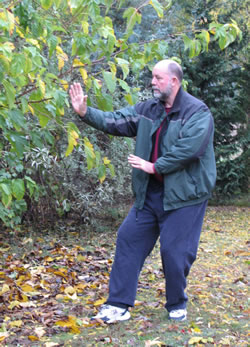
Standing Meditation
By Mike Garofalo.  Resources, Bibliography, Links, Methods, Quotations, Comments.  

Qigong (Chi Kung) by Mike Garofalo


Wednesday, April 30, 2014

Neigong (Inner Work) Principles

"The Taoists call the science of how you develop strong energy flow or internal power neigong.  Neigong has sixteen components:


1.  Breathing methods, from the simple to the more complex.
2.  Feeling, moving, transforming, transmuting and connecting energy channels of the body. 
3.  Precise body alignments to prevent the flow of chi from being blocked or dissipated. 
4.  Dissolving physical, emotional and spiritual blockages. 
5.  Moving energy through the acupuncture meridians and other secondary channels of the body, including the energy gates.
6.  Bending and stretching the body, both from the inside and from the outside in.
7.  Opening and closing (pulsing) all parts of the body's anatomy including the joints, soft tissues, fluids, internal organs,
spine and brain as well as all the body's subtle energy channels. 
8.  Manipulating the energy of the external aura outside the body.
9.  Making circles and spirals of energy inside the body, controlling the spiraling energy currents of the body and moving chi in the body at will. 
10.  Absorbing energy into and projecting energy away from any part of the body. 
11.  Controlling all the energies of the spine. 
12.  Controlling the left and right energy channels of the body. 
13.  Controlling the central energy channel of the body.
14.  Learning to develop the capabilities and all use of the body's lower tantien.  
14.  Learning to develop the capabilities and uses of the body's upper and middle tantiens. 
15.  Connecting every part of the physical and other energetic bodies into one, unified energy."
-  Bruce Kumar Frantzis, Dragon and Tiger Qigong, 2010, xxviii   


The Chi Revolution: Harnessing the Healing Power of Your Life Force.  By Bruce Kumar Frantzis.  Berkeley, California, Blue Snake Books, 2008.  248 pages.  ISBN: 978-1583941935.  VSCL.  
 
Opening the Energy Gates of Your Body: Chi Gung for Lifelong Health (Tao of Energy Enhancement).  By Bruce Kumar Frantzis.  Illustrated by Husky Grafx.  North Atlantic Books, 1993.  Second Edition.  174 pages.  ISBN: 1556431643.  VSCL.     

Relaxing into Your Being: The Water Method of Taoist Meditation Series, Vol. 1  By Bruce Kumar Frantzis.  Fairfax, California, Clarify Press, 1998.  Reader's Edition.  208 pages.  Republished by: North Atlantic Books, 2001, ISBN: 1556434073.  VSCL. 

The Great Stillness: The Water Method of Taoist Meditation Series, Vol. 2  By Bruce Kumar Frantzis.  Berkeley, North Atlantic Books, 2001.  272 pages.  ISBN: 978-1556434082.  

Dragon Qigong


Valley Spirit Qigong 


Ripening Peaches: Taoist Studies and Practices  


Tuesday, March 04, 2014

Neigong (Chikung, Qigong, Inner Work) Principles

"The Taoists call the science of how you develop strong energy flow or internal power neigong.  Neigong has sixteen components:


1.  Breathing methods, from the simple to the more complex.
2.  Feeling, moving, transforming, transmuting and connecting energy channels of the body. 
3.  Precise body alignments to prevent the flow of chi from being blocked or dissipated. 
4.  Dissolving physical, emotional and spiritual blockages. 
5.  Moving energy through the acupuncture meridians and other secondary channels of the body, including the energy gates.
6.  Bending and stretching the body, both from the inside and from the outside in.
7.  Opening and closing (pulsing) all parts of the body's anatomy including the joints, soft tissues, fluids, internal organs,
spine and brain as well as all the body's subtle energy channels. 
8.  Manipulating the energy of the external aura outside the body.
9.  Making circles and spirals of energy inside the body, controlling the spiraling energy currents of the body and moving chi in the body at will. 
10.  Absorbing energy into and projecting energy away from any part of the body. 
11.  Controlling all the energies of the spine. 
12.  Controlling the left and right energy channels of the body. 
13.  Controlling the central energy channel of the body.
14.  Learning to develop the capabilities and all use of the body's lower tantien.  
14.  Learning to develop the capabilities and uses of the body's upper and middle tantiens. 
15.  Connecting every part of the physical and other energetic bodies into one, unified energy."
-  Bruce Kumar Frantzis, Dragon and Tiger Qigong, 2010, xxviii   


The Chi Revolution: Harnessing the Healing Power of Your Life Force.  By Bruce Kumar Frantzis.  Berkeley, California, Blue Snake Books, 2008.  248 pages.  ISBN: 978-1583941935.  VSCL.  
 
Opening the Energy Gates of Your Body: Chi Gung for Lifelong Health (Tao of Energy Enhancement).  By Bruce Kumar Frantzis.  Illustrated by Husky Grafx.  North Atlantic Books, 1993.  Second Edition.  174 pages.  ISBN: 1556431643.  VSCL.     

Relaxing into Your Being: The Water Method of Taoist Meditation Series, Vol. 1  By Bruce Kumar Frantzis.  Fairfax, California, Clarify Press, 1998.  Reader's Edition.  208 pages.  Republished by: North Atlantic Books, 2001, ISBN: 1556434073.  VSCL. 

The Great Stillness: The Water Method of Taoist Meditation Series, Vol. 2  By Bruce Kumar Frantzis.  Berkeley, North Atlantic Books, 2001.  272 pages.  ISBN: 978-1556434082.  

Dragon Qigong


Valley Spirit Qigong 


Ripening Peaches: Taoist Studies and Practices  


Wednesday, November 06, 2013

Tom Bisio's Books

Lately, I have been studying the following three fine books by Tom Bisio.  I highly recommend these books for students of Qigong and Neidan:


A Tooth from the Tiger's Mouth: How to Treat Your Injuries with Powerful Healing Secrets of the Great Chinese Warrior   By Tom Bisio.  New York, Fireside Books, Touchstone, 2004.  384 pages.  ISBN: 978-0743245517.  VSCL. 

Decoding the Dao: Nine Lessons in Daoist Meditation: A Complete and Comprehensive Guide to Daoist Meditation  By Tom Bisio.  Denver, Colorado, Outskirts Press, 2013.  446 pages.  ISBN: 978-1478703945.  VSCL.  
 
Ba Gua Circle Walking Nei Gong: The Meridian Opening Palms of Ba Gua Zhang.  By Tom Bisio.  Denver, Colorado, Outskirts Press, 2012.  Bibliography, 249 pages.  ISBN: 978-1432796891.  VSCL.  
 

Saturday, December 08, 2012

Neigong Principles

"The Taoists call the science of how you develop strong energy flow or internal power neigong.  Neigong has sixteen components:


1.  Breathing methods, from the simple to the more complex.
2.  Feeling, moving, transforming, transmuting and connecting energy channels of the body. 
3.  Precise body alignments to prevent the flow of chi from being blocked or dissipated. 
4.  Dissolving physical, emotional and spiritual blockages. 
5.  Moving energy through the acupuncture meridians and other secondary channels of the body, including the energy gates.
6.  Bending and stretching the body, both from the inside and from the outside in.
7.  Opening and closing (pulsing) all parts of the body's anatomy including the joints, soft tissues, fluids, internal organs,
spine and brain as well as all the body's subtle energy channels. 
8.  Manipulating the energy of the external aura outside the body.
9.  Making circles and spirals of energy inside the body, controlling the spiraling energy currents of the body and moving chi in the body at will. 
10.  Absorbing energy into and projecting energy away from any part of the body. 
11.  Controlling all the energies of the spine. 
12.  Controlling the left and right energy channels of the body. 
13.  Controlling the central energy channel of the body.
14.  Learning to develop the capabilities and all use of the body's lower tantien.  
14.  Learning to develop the capabilities and uses of the body's upper and middle tantiens. 
15.  Connecting every part of the physical and other energetic bodies into one, unified energy."
-  Bruce Kumar Frantzis, Dragon and Tiger Qigong, 2010, xxviii   


The Chi Revolution: Harnessing the Healing Power of Your Life Force.  By Bruce Kumar Frantzis.  Berkeley, California, Blue Snake Books, 2008.  248 pages.  ISBN: 978-1583941935.  VSCL.  
 
Opening the Energy Gates of Your Body: Chi Gung for Lifelong Health (Tao of Energy Enhancement).  By Bruce Kumar Frantzis.  Illustrated by Husky Grafx.  North Atlantic Books, 1993.  Second Edition.  174 pages.  ISBN: 1556431643.  VSCL.     

Relaxing into Your Being: The Water Method of Taoist Meditation Series, Vol. 1  By Bruce Kumar Frantzis.  Fairfax, California, Clarify Press, 1998.  Reader's Edition.  208 pages.  Republished by: North Atlantic Books, 2001, ISBN: 1556434073.  VSCL. 

The Great Stillness: The Water Method of Taoist Meditation Series, Vol. 2  By Bruce Kumar Frantzis.  Berkeley, North Atlantic Books, 2001.  272 pages.  ISBN: 978-1556434082.  

Dragon Qigong


Valley Spirit Qigong 


Ripening Peaches: Taoist Studies and Practices  


Saturday, January 21, 2012

Principles of Taoist Neigong

"The Taoists call the science of how you develop strong energy flow or internal power neigong.  Neigong has sixteen components:


1.  Breathing methods, from the simple to the more complex.
2.  Feeling, moving, transforming, transmuting and connecting energy channels of the body. 
3.  Precise body alignments to prevent the flow of chi from being blocked or dissipated. 
4.  Dissolving physical, emotional and spiritual blockages. 
5.  Moving energy through the acupuncture meridians and other secondary channels of the body, including the energy gates.
6.  Bending and stretching the body, both from the inside and from the outside in.
7.  Opening and closing (pulsing) all parts of the body's anatomy including the joints, soft tissues, fluids, internal organs,
spine and brain as well as all the body's subtle energy channels. 
8.  Manipulating the energy of the external aura outside the body.
9.  Making circles and spirals of energy inside the body, controlling the spiraling energy currents of the body and moving chi in the body at will. 
10.  Absorbing energy into and projecting energy away from any part of the body. 
11.  Controlling all the energies of the spine. 
12.  Controlling the left and right energy channels of the body. 
13.  Controlling the central energy channel of the body.
14.  Learning to develop the capabilities and all use of the body's lower tantien.  
14.  Learning to develop the capabilities and uses of the body's upper and middle tantiens. 
15.  Connecting every part of the physical and other energetic bodies into one, unified energy."
-  Bruce Kumar Frantzis, Dragon and Tiger Qigong, 2010, xxviii   


The Chi Revolution: Harnessing the Healing Power of Your Life Force.  By Bruce Kumar Frantzis.  Berkeley, California, Blue Snake Books, 2008.  248 pages.  ISBN: 978-1583941935.  VSCL.  
 
Opening the Energy Gates of Your Body: Chi Gung for Lifelong Health (Tao of Energy Enhancement).  By Bruce Kumar Frantzis.  Illustrated by Husky Grafx.  North Atlantic Books, 1993.  Second Edition.  174 pages.  ISBN: 1556431643.  VSCL.     

Relaxing into Your Being: The Water Method of Taoist Meditation Series, Vol. 1  By Bruce Kumar Frantzis.  Fairfax, California, Clarify Press, 1998.  Reader's Edition.  208 pages.  Republished by: North Atlantic Books, 2001, ISBN: 1556434073.  VSCL. 

The Great Stillness: The Water Method of Taoist Meditation Series, Vol. 2  By Bruce Kumar Frantzis.  Berkeley, North Atlantic Books, 2001.  272 pages.  ISBN: 978-1556434082.  

Dragon Qigong


Valley Spirit Qigong 


Ripening Peaches: Taoist Studies and Practices  


Thursday, December 01, 2011

Entering the Heart of Trees - Just Standing

Hi Mike,

I've been a fan of your site ( http://www.egreenway.com/taichichuan/index.htm ) for a while now, as I've become more and more interested in QiGong and NeiGong, and was wondering if you would be interested in doing a favour for me?
I live in the UK, where I learn Yang Taiji locally, and there is an exercise we do, Standing Like a Tree (I believe), at the beginning of each session, for ten to fifteen minutes. As I may not be able to train for a while, and found this one particularly of use, I wonder would you be able to give me some insight on it, and, if possible, record a short MP3 with simple directions for it, so that I could plug in my headphones and go through the meditation myself in the morning. I find it a bit hard to focus myself without another person's voice to help me focus, and I have a feeling I'm not doing the breathing correctly, so again, hearing it would help. 
I'd really appreciate if you could, I've been trying to find a reputable and contactable  source online who I figured would be able to record, but It'd really help.
Anyways, would really help me if you got a minute to do so.
Thanks for your time,

Guy
 
Dear Guy, 
Look at my webpage Standing Like a Tree.  There are many positions for standing exercise/meditation (Zhan Zhuang) for purposes of physical exercise, NeiGong, Qigong, Meditation, Yoga.  

I have been working on an audio-recording project to produce .MP3 digital audio recordings of lessons/guides to practicing these mind/body exercise methods, internal training methods, Qigong sets, and meditation forms you referred to in your email.  I should have two audio lessons ready on January 1, 2011.  
 
Look also at very slow walking meditation methods:  Walking Meditation

Mike