Showing posts with label Hellenistic Philosophy. Show all posts

Sunday, October 05, 2025

Ten Golden Rules

 Ten Golden Rules for Living the Good Life

  
“1. Examine life, engage life with vengeance; always search for new pleasures and new destines to reach with your mind.

 2.  Worry only about the things that are in your control
the things that can be influenced and changed by your actions, not about the things that are beyond your capacity to direct or alter.  

 3.  Treasure Friendship, the reciprocal attachment that fills the need for affiliation. Friendship cannot be acquired in the market place, but must be nurtured and treasured in relations imbued with trust and amity.  

 4.  Experience True Pleasure
Avoid shallow and transient pleasures. Keep your life simple. Seek calming pleasures that contribute to peace of mind. True pleasure is disciplined and restrained.  

 5.  Master Yourself. Resist any external force that might delimit thought and action; stop deceiving yourself, believing only what is personally useful and convenient; complete liberty necessitates a struggle within, a battle to subdue negative psychological and spiritual forces that preclude a healthy existence; self mastery requires ruthless cador.  

 6.  Avoid Excess. Live life in harmony and balance. Avoid excesses. Even good things, pursued or attained without moderation, can become a source of misery and suffering.  

 7.  Be a Responsible Human Being
Approach yourself with honesty and thoroughness; maintain a kind of spiritual hygiene; stop the blame-shifting for your errors and shortcomings.  

 8.  Don’t Be a Prosperous Fool. Prosperity by itself, is not a cure-all against an ill-led life, and may be a source of dangerous foolishness. Money is a necessary but not a sufficient condition for the good life, for happiness and wisdom.  

 9.  Don’t Do Evil to Others. Evildoing is a dangerous habit, a kind of reflex too quickly resorted to and too easily justified that has a lasting and damaging effect upon the quest for the good life. Harming others claims two victims—the receiver of the harm, and the victimizer, the one who does harm.  

 10.  Kindness towards others tends to be rewarded
Kindness to others is a good habit that supports and reinforces the quest for the good life. Helping others bestows a sense of satisfaction that has two beneficiaries—the beneficiary, the receiver of the help, and the benefactor, the one who provides the help.” 


-   By M. A. Soupious and Panos Mourdoukoutas, The Ten Golden Rules: Ancient Wisdom from the Greek Philosophers on Living the Good Life, 2009. 


Tuesday, February 04, 2025

Subject Index to 813 Stoic Lessons, Discourses, and Letters

Subject Index to 813 Stoic Lessons, Discourses, and Letters

Indexing by Michael P. Garofalo
First Draft, July 23, 2023. Updated Quarterly.  30 Pages.
Green Way Research, Vancouver, Washington


Daily Stoic 366 Lessons Philosophy (STOA)

Epictetus 95 Discourses (EPI)

Fireplace Records 30 Chapters (TFR)

Meditations Marcus Aurelius (AUR)

Philosopher's Garden of Insights (PG)

Seneca 124 Letters (SEN)


Lessons, Letters, and Discourses from Stoics:
https://www.egreenway.com/buddhism/koans.htm


Subject Index to 3.855 Lessons From
Zen Buddhists, Stoics, and Solitary Taoists

Subject Index to 1,685 Zen Buddhist Koans

Subject Index to 813 Stoic Lessons, Discourses, and Letters

Subject Index to 1,546 Taoist Lessons, Chapter, and Stories


Wednesday, December 20, 2023

Greek Ideas about Living a Good Life

 Ten Golden Rules for Living the Good Life

  
“1. Examine life, engage life with vengeance; always search for new pleasures and new destines to reach with your mind.
 2.  Worry only about the things that are in your control
the things that can be influenced and changed by your actions, not about the things that are beyond your capacity to direct or alter. 
 3.  Treasure Friendship, the reciprocal attachment that fills the need for affiliation. Friendship cannot be acquired in the market place, but must be nurtured and treasured in relations imbued with trust and amity. 
 4.  Experience True Pleasure
Avoid shallow and transient pleasures. Keep your life simple. Seek calming pleasures that contribute to peace of mind. True pleasure is disciplined and restrained. 
 5.  Master Yourself. Resist any external force that might delimit thought and action; stop deceiving yourself, believing only what is personally useful and convenient; complete liberty necessitates a struggle within, a battle to subdue negative psychological and spiritual forces that preclude a healthy existence; self mastery requires ruthless cador. 
 6.  Avoid Excess. Live life in harmony and balance. Avoid excesses. Even good things, pursued or attained without moderation, can become a source of misery and suffering. 
 7.  Be a Responsible Human Being
Approach yourself with honesty and thoroughness; maintain a kind of spiritual hygiene; stop the blame-shifting for your errors and shortcomings. 
 8.  Don’t Be a Prosperous Fool. Prosperity by itself, is not a cure-all against an ill-led life, and may be a source of dangerous foolishness. Money is a necessary but not a sufficient condition for the good life, for happiness and wisdom. 
 9.  Don’t Do Evil to Others. Evildoing is a dangerous habit, a kind of reflex too quickly resorted to and too easily justified that has a lasting and damaging effect upon the quest for the good life. Harming others claims two victims—the receiver of the harm, and the victimizer, the one who does harm. 
 10.  Kindness towards others tends to be rewarded
Kindness to others is a good habit that supports and reinforces the quest for the good life. Helping others bestows a sense of satisfaction that has two beneficiaries—the beneficiary, the receiver of the help, and the benefactor, the one who provides the help.” 

-   By M. A. Soupious and Panos Mourdoukoutas, The Ten Golden Rules: Ancient Wisdom from the Greek Philosophers on Living the Good Life, 2009. 

Tuesday, July 18, 2023

Breakfast With Seneca

Eight Core Teachings of Roman Stoicism

1.  Live in agreement with nature to find happiness.

2.  Virtue, or excellence of one's inner character, is the only true good.

3.  Some things are "up to us," or entirely under our control, while other things are not.

4. While we can't control what happens to us in the external world, we can control our inner judgments and how we respond to life's events.

5. When something negative happens, or when we are struck by adversity, we shouldn't be surprised by it, but see it as an opportunity to create a better situation.

6. Virtue, or possessing a excellent character, is its own reward.  But it also results in eudaimonia or "happiness." This is the state of mental tranquility and inner joy.

7. Real philosophy involves "making progress."

8. It is essential that we, as individuals, should contribute to society.

- David Fideler, Breakfast with Seneca2022, pp. 4-9.


Stoic Principles for Virtuous Living

Stoicism: Bibliography, Quotations, Links, Information


Breakfast with Seneca: A Stoic Guide to the Art of Living. By David Fideler. W. W. Norton, 2022, index, bibliography, notes, appendix, 265 pages. VSCL, Paperback.


Letters on Ethics: To Lucilius. The Complete Works of Lucius Annaeus Seneca. Translated by Margaret Graver and A. A. Long. University of Chicago, 2017, 604 pages. Complete collection of Seneca's Letters. VSCL, E-Book Kindle.


Letters From a Stoic. By Lucius Annaeus Seneca. Translated by Richard Mott Gunmere. Compass Circle, 2019, index, 351 pages. 
Complete collection of Seneca's Letters. VSCL, Oversize Paperback.


My recent reading of the Stoics in the Spring and Summer of 2023 includes: 


The Obstacle is the Way: The Timeless Art of Turning Trials into Triumph. By Rayan Holiday. Portfolio, 2013, 224 pages. VSCL, Hardbound.


More Than Happiness: Buddhist and Stoic Wisdom for a Skeptical Age.  By Antonia Macaro. Icon Books, 2018, 208 pages. VSCL, Paperback.


Stillness Is the Key. By Ryan Holiday. Portfolio, 2019, 288 pages. VSCL, Hardbound.  Excellent, insightful, relevant biographies, clear writing, practical, positive psychology.  Maintaining calmness, courage, consistency during the challenges of life.  


Ego is the Enemy. By Ryan Holiday. Portfolio, 2016, 256 pages. VSCL, Hardbound.


Lives of the Stoics: The Art of Living from Zeno to Marcus Aurelius. By Ryan Holiday and Stephen Hanselman. Portfolio, 2020, 352 pages. FVRLibrary.


The Daily Stoic: 366 Meditations on Wisdom, Perseverance, and the Art of Living. By Ryan Holiday and Stephen Hanselman. Portfolio, 2016, 416 pages. VSCL, Hardbound. Outstanding commentary.  


My reading of the Stoics in the Summer and Autumn of 2022 included:  


Meditatons: The Annotated Edition. Translated, introduced and edited by Robin Waterfield. New York, Basic Books, 2021, 326 pages. Introduction, bibliography, notes, annotations. VSCL. 


The Daily Stoic: 366 Meditations on Wisdom, Perseverance, and the Art of Living.
 By Ryan Holiday and Stephen Hanselman. Portfolio, 2016, 416 pages. VSCL. 


How to Be a Stoic: Using Ancient Philosophy to Live a Modern Life
. By Massimo Pigliucci. 288 pages, 2013. VSCL.


The Practicing Stoic: A Philosophical User's Manual
. By Ward Farnsworth. Goldine, 2018, 256 pages. VSCL. 


Virtue Ethics

How to Live a Good Life: Advice From Wise Persons

Stoicism: Bibliography, Links, Quotations, Notes


Thursday, July 13, 2023

Stoic Lifestyle Traits


 Positive Behaviors, Actions, Habits or Virtues for Stoics

"The qualities you can offer, then, are those that are entirely up to you: candor, dignity, endurance, indifference to pleasure, acceptance of your lot, frugality, kindness, self-reliance, unaffectedness, discretion, stateliness."
- Marcus Aurelius, Meditations, Notebook 5.5

"Can what happened to you stop you from being fair, high-minded, moderate, conscientious, unhasty, honest, moral, self-reliant, and so on."
Meditations, Notebook 4.49

Simplicity, calmness, peace of mind, composed, practical, social, tranquility, serenity, awareness ...

All Taijiquan and Qigong teachers place strong emphasis upon character and moral development.  There are many statements of codes of conduct for serious taijiquan martial artists.  In my opinion, the key intellectual, philosophical, and moral sources for current Taijiquan and Qigong players are Buddhism, Taoism, TCM, and Stoicism.  


My recent reading in the Summer 2023 of the Stoics includes:  


The Obstacle is the Way: The Timeless Art of Turning Trials into Triumph. By Rayan Holiday. Portfolio, 2013, 224 pages. VSCL, Hardbound.

Stillness Is the Key. By Ryan Holiday. Portfolio, 2019, 288 pages. VSCL, Hardbound.


Ego is the Enemy. By Ryan Holiday. Portfolio, 2016, 256 pages. VSCL, Hardbound.


Lives of the Stoics: The Art of Living from Zeno to Marcus Aurelius. By Ryan Holiday and Stephen Hanselman. Portfolio, 2020, 352 pages. FVRLibrary.


The Daily Stoic: 366 Meditations on Wisdom, Perseverance, and the Art of Living. By Ryan Holiday and Stephen Hanselman. Portfolio, 2016, 416 pages. VSCL, Hardbound. 


My reading in the Autumn of 2022 of the Stoics included:  


Meditatons: The Annotated Edition. Translated, introduced and edited by Robin Waterfield. New York, Basic Books, 2021, 326 pages. Introduction, bibliography, notes, annotations. VSCL. 


The Daily Stoic: 366 Meditations on Wisdom, Perseverance, and the Art of Living.
 By Ryan Holiday and Stephen Hanselman. Portfolio, 2016, 416 pages. VSCL. 


How to Be a Stoic: Using Ancient Philosophy to Live a Modern Life
. By Massimo Pigliucci. 288 pages, 2013. VSCL.


The Practicing Stoic: A Philosophical User's Manual
. By Ward Farnsworth. Goldine, 2018, 256 pages. VSCL. 


Virtue Ethics

How to Live a Good Life: Advice From Wise Persons

Stoicism: Bibliography, Links, Quotations, Notes


Friday, January 06, 2023

Seven Clear Functions of the Mind

"The proper work of the mind is the exercise of choice, refusal, yearning, repulsion, preparation, purpose, and assent.  What then can pollute and clog the mind's proper functioning.  Nothing but it own corrupt decisions."

- Epictetus, Discourses, 4.11.6-7.

"Let's break down each one of those tasks:

Choice - To do and think right
Refusal - Of temptations
Yearning - To be better
Repulsion - Of negativity, of bad influences, of what isn't true
Preparation - For what lies ahead or whatever may happen
Purpose - Our guiding principle and highest priority
Assent - To be free of deception about what's inside and outside our control (and be ready to accept the latter."

- Ryan Holiday, The Daily Stoic, p.15


My recent reading of the Stoics includes:  

Meditatons: The Annotated Edition. Translated, introduced and edited by Robin Waterfield. New York, Basic Books, 2021, 326 pages. Introduction, bibliography, notes, annotations. VSCL. 

The Daily Stoic: 366 Meditations on Wisdom, Perseverance, and the Art of Living. By Ryan Holiday and Stephen Hanselman. Portfolio, 2016, 416 pages. VSCL. 

How to Be a Stoic: Using Ancient Philosophy to Live a Modern Life. By Massimo Pigliucci. 288 pages, 2013. VSCL.

The Practicing Stoic: A Philosophical User's Manual. By Ward Farnsworth. Goldine, 2018, 256 pages. VSCL. 


Virtue Ethics

How to Live a Good Life: Advice From Wise Persons

Stoicism: Bibliography, Links, Quotations, Notes


Thursday, September 15, 2022

The Spiritual Exercises of Stoic Philosophers


"  "Spiritual exercises."  The expression is a bit disconcerting for the contemporary reader.  In the first place, it is no longer quite fashionable these days to use the word "spiritual."  It is nevertheless necessary to use this term, I believe, because none of the other adjectives we could use — "psychic," "moral," "ethical," "intellectual," "of thought," "of the soul" — covers all the aspects of the reality we want to describe.  Since, in these exercises, it is though which, as it were, takes itself as its own subject-matter, and seeks to modify itself, it would be possible for us to speak in terms of "thought exercises."  Yet the word "thought" does not indicate clearly enough that imagination and sensibility play a very important role in these exercises.  For the same reason, we cannot be satisfied with "intellectual exercises," although such intellectual factors as definition, division, ratiocination, reading, investigation, and rhetorical amplification play a large role in them.  "Ethical exercises" is a rather a tempting expression, since, as we shall see, the exercises in question contribute in a powerful way to the therapeutics of the passions, and have to do with the conduct of life.  Yet, here again, this would be too limited a view of things.  As we can glimpse through Friedmann's text, these exercises in fact correspond to a transformation of our vision of the world, and to a metamorphosis of our personality.  The word "spiritual" is quite apt to make us understand that these exercises are the result, not merely of thought, but of the individuals entire psychism.  Above all, the word "spiritual" reveals the true dimensions of these exercises.  By means of them, the individual raises himself up to the life of the objective Spirit; that is to say, he re-places himself within the perspective of the Whole ("Become eternal by transcending yourself.")"
-  Pierre Hadot, Philosophy as a Way of Life, 1995, p. 81; Spiritual Exercises, pp. 81-125. 


Stoicism  A hypertext notebook by Michael P. Garofalo. 

Virtues and the Good Life

Stoic Philosophers and Spiritual Exercises


Pierre Hadot (1922 - 2010)


"These exercises, involving not just the intellect or reason, but all a human being's faculties, including emotion and imagination, had the same goal as all ancient philosophy: reducing human suffering and increasing happiness, by teaching people to detach themselves from their particular, egocentric, individualistic viewpoint and become aware of their belonging, as integral component parts, to the Whole constituted by the entire cosmos. In its fully developed form, exemplified in such late Stoics as Epictetus and Marcus Aurelius, this change from our particularistic perspective to the universal perspective of reason had three main aspects. First, by means of the discipline of thought, we are to strive for objectivity; since, as the Stoics believe, what causes human suffering is not so much things in the world, but our beliefs about those things, we are to try to perceive the world as it is in itself, without the subjective coloring we automatically tend to ascribe to everything we experience ("That's lovely," "that's horrible," "that's ugly," "that's terrifying," etc., etc.). Second, in the discipline of desire, we are to attune our individual desires with the way the universe works, not merely accepting that things happen as they do, but actively willing for things to happen precisely the way they do happen. This attitude is, of course, the ancestor of Nietzsche’s “Yes” granted to the cosmos, a “yes” which immediately justifies the world's existence.  Finally, in the discipline of action, we are to try to ensure that all our actions are directed not just to our own immediate, short-term advantage, but to the interests of the human community as a whole.  Hadot finally came to believe that these spiritual attitudes—“spiritual” precisely because they are not merely intellectual, but involve the entire human organism, but one might with equal justification call them “existential” attitudes—and the practices or exercises that nourished, fortified and developed them, were the key to understanding all of ancient philosophy. In a sense, the grandiose physical, metaphysical, and epistemological structures that separated the major philosophical schools of Antiquity—Platonism, Aristotelianism, Stoicism, Epicureanism—were mere superstructures, intended to justify the basic philosophical attitude. Hadot deduced this, among other considerations, from the fact that many of the spiritual exercises of the various schools were highly similar, despite all their ideological differences: thus, both Stoics and Epicureans recommended the exercise of living in the present."
-  Michael Chase, Remembering Pierre Hadot


Stoic Spiritual Exercises.  By Elen Buzaré.  2010.  32 pages.  PDF File. 

Dismantling the Self: Deleuze, Stoicism and Spiritual Exercises.  By Luke Skrebowski, 2005, 18 pages, PDF File.

Philosophical Therapeutics: Pierre Hadot and Ancient Philosophy as a Way of Life.  By Christopher Vitale, Networkologies, 2012. 

Philosophy as a Way of Life: Spiritual Exercises from Socrates to Foucault  By Pierre Hadot.  Edited with an introduction by Arnold Davidson.  Translated by Michael Chase.  Malden, Massachusetts, Wiley-Blackwell, 1995.  Index, extensive bibliography, 320 pages.  ISBN: 978-0631180333.  VSCL. 


Wednesday, September 25, 2019

Brace Yourself Up


"I take the liberty of observing that you are not a true disciple of our master Epicurus, in indulging the indolence to which you say you are yielding. One of his canons, you know, was that “that indulgence which prevents a greater pleasure, or produces a greater pain, is to be avoided.” Your love of repose will lead, in its progress, to a suspension of healthy exercise, a relaxation of mind, an indifference to everything around you, and finally to a debility of body, and hebetude of mind, the farthest of all things from the happiness which the well-regulated indulgences of Epicurus ensure; fortitude, you know is one of his four cardinal virtues. That teaches us to meet and surmount difficulties; not to fly from them, like cowards; and to fly, too, in vain, for they will meet and arrest us at every turn of our road. Weigh this matter well; brace yourself up!"
- Thomas Jefferson's letters

New Epicurean Website Articles, Links, Bibliography, News, Discussion, History

Tuesday, September 24, 2019

Epicurus and the Pleasant Life


By Haris Dimitriadis.  Lulu Press, 2018.  448 pages.  ISBN: 138735308X.  VSCL.  

Epicurean Philosophy.  A hypertext document by Mike Garofalo.  This document will explain my admiration of Epicurean philosophy.

Saturday, December 16, 2017

Cherish and Enjoy Old Age


Lately, I have been reading the letters and short essays by the Roman philosopher, Lucius Annaeus Seneca, 4 BCE - 65 CE.  Seneca was a wealthy Roman, influential writer, political advisor, and aristocrat.  Many consider him a Stoic. He was raised and educated in Rome.  Once, he was banished to Corsica for seven years; and, later, ordered to commit suicide by the Emperor Nero.  

"We should cherish old age and enjoy it.  It is full of pleasure if you know how to use it.  Fruit tastes most delicious when its season is ending.  The charms of youth are at their greatest at the time of its passing.  It is the final glass which pleases the inveterate drinker, the one that sets the crowning touch on his intoxication and sends him off into oblivion. Every pleasure defers till its last its greatest delights. The time of life which offers the greatest delight is the age that sees the downward movement - not the steep decline - already begun; and in my opinion, even the age that stands on the brink has pleasures of its own - or else the very fact of not experiencing the want of any pleasures takes their place.  How nice it is to have out-worn one's desires and left them behind."
-  Seneca, Letters, XII, p. 37 in the Campbell translation; online version by R. M. Gummere.   


Letters from a Stoic. By Seneca. Translated with an introduction by Robin Campbell. Illustrated by Coralie Bickford-Smith. Hardcover Classics Series. New York, Penguin Classics, Reissue Edition, 2015. Index of persons, appendix, notes, 352 pages. ISBN: 978-0141395852. VSCL. 


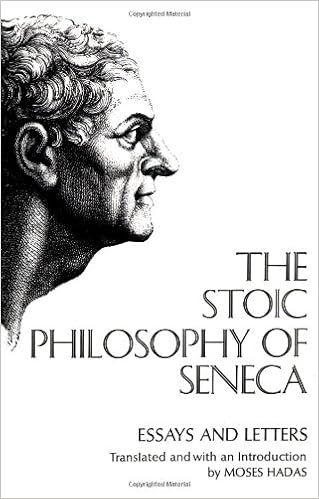
Seneca The Stoic Philosophy of Seneca: Essays and Letters. By Seneca. Translated with and introduction by Moses Hadas.  New York, W. W. Norton, 1958, 1968. 261 pages. ISBN: 0393004597. VSCL. 

Stoicism: Bibliography, Links, Notes, Quotations, Reflections, Resources.
A hypertext notebook by Michael P. Garofalo.


Personally, I favor the metaphysics and natural philosophy of the Epicureans over the Stoics.  The Stoics remind me of the Confucians, and the Epicureans remind me of the Taoist thinkers of around 300 BCE.  


Wednesday, June 01, 2016

Ten Golden Rules

Ten Golden Rules for Living the Good Life
  
“1. Examine life, engage life with vengeance; always search for new pleasures and new destines to reach with your mind.

 2.  Worry only about the things that are in your control
, the things that can be influenced and changed by your actions, not about the things that are beyond your capacity to direct or alter.  

 3.  Treasure Friendship, the reciprocal attachment that fills the need for affiliation. Friendship cannot be acquired in the market place, but must be nurtured and treasured in relations imbued with trust and amity.  

 4.  Experience True Pleasure
. Avoid shallow and transient pleasures. Keep your life simple. Seek calming pleasures that contribute to peace of mind. True pleasure is disciplined and restrained.  

 5.  Master Yourself. Resist any external force that might delimit thought and action; stop deceiving yourself, believing only what is personally useful and convenient; complete liberty necessitates a struggle within, a battle to subdue negative psychological and spiritual forces that preclude a healthy existence; self mastery requires ruthless cador.  

 6.  Avoid Excess. Live life in harmony and balance. Avoid excesses. Even good things, pursued or attained without moderation, can become a source of misery and suffering.  

 7.  Be a Responsible Human Being
. Approach yourself with honesty and thoroughness; maintain a kind of spiritual hygiene; stop the blame-shifting for your errors and shortcomings.  

 8.  Don’t Be a Prosperous Fool. Prosperity by itself, is not a cure-all against an ill-led life, and may be a source of dangerous foolishness. Money is a necessary but not a sufficient condition for the good life, for happiness and wisdom.  

 9.  Don’t Do Evil to Others. Evildoing is a dangerous habit, a kind of reflex too quickly resorted to and too easily justified that has a lasting and damaging effect upon the quest for the good life. Harming others claims two victims—the receiver of the harm, and the victimizer, the one who does harm.  

 10.  Kindness towards others tends to be rewarded
. Kindness to others is a good habit that supports and reinforces the quest for the good life. Helping others bestows a sense of satisfaction that has two beneficiaries—the beneficiary, the receiver of the help, and the benefactor, the one who provides the help.” 


-   By M. A. Soupious and Panos Mourdoukoutas, The Ten Golden Rules: Ancient Wisdom from the Greek Philosophers on Living the Good Life, 2009. 


Wednesday, December 02, 2015

Stoic Philosophy: Notes and Reflections


Stoicism: Bibliography, Hypertext Notebook, Resources, Research, Themes, Reflections

Research by Mike Garofalo.  250KB, November, 2015

In the last month, I have been steadily reading Hellenistic philosophers (300 BCE - 200 CE).  I've read all of Marcus Arelius and Epictetus.  I'm now reading Seneca and Cicero.  I've read many commentaries and scholarly works about the Stoics and Greco-Roman Hellenistic Ethical viewpoints.  

I've focused recently on using Stoic practices, maxims, exercises, and skills development for improving my daily life.