Showing posts with label Slowing. Show all posts

Monday, July 04, 2022

Slowing Down for Enjoyment

 "The movements of Qigong exercise should be slow instead of fast because slow movements will nourish qi and combine the posture with qi. The training practice of Qigong should start with Wuji with slow movement until the closing of the training.  Every movement and step must be done slowly, opening and spreading of the body be slow, closing and sinking of the body be slow, and rising and falling of the body be slow.  With slow movements, one can keep thinking whether the upper, lower, left and right of the body are followed, and whether the interior and exterior are coordinated.  With the slow and gentle movements and posture, the internal qi is conducted to flow slowly in the body to integrate mindwill with qi, vitality with posture, and enter the realm of forgetting the substance and me."

-  Master Wang Fengming, Special Taoist Taji Stick and Ruler Qigong, p. 115. 


"Walking meditation means to enjoy walking without any intention to arrive. We don't need to arrive anywhere.  We just walk. We enjoy walking. That means walking is already stopping, and that needs some training.  Usually in our daily life we walk because we want to go somewhere. Walking is only a means to an end, and that is why we do not enjoy every step we take. Walking meditation is different. Walking is only for walking. You enjoy every step you take. So this is a kind of revolution in walking. You allow yourself to enjoy every step you take.
The Zen master Ling Chi said that the miracle is not to walk on burning charcoal or in the thin air or on the water; the miracle is just to walk on earth. You breathe in. You become aware of the fact that you are alive. You are still alive and you are walking on this beautiful planet. That is already performing a miracle. The greatest of all miracles is to be alive. We have to awaken ourselves to the truth that we are here, alive. We are here making steps on this beautiful planet. This is already performing a miracle.  But we have to be here in order for the miracle to be possible. We have to bring ourselves back to the here and the now."
-  Thich Nhat Hanh, Resting in the River

Walking Meditation:  Quotes, Bibliography, Links, Information, Methods 
Compiled by Mike Garofalo.


"Walking meditation is walking in full awareness of breath, body and everything the senses present.  It is not an aerobic exercise - though it would be a fine lead-in to aerobic walking.  Rather, walking meditation is done slowly and consciously, with each step fully feeling the earth.  During this precious time, body and mind come together, joined in the present moment.  Although the benefits of walking meditation will deepen over time, even from the start, you can experience some measure of the relaxation, balance and quiet energy that builds through this practice."
-  Ginny Whitelaw, Body Learning, p. 55.   

Sunday, December 31, 2017

With Slow Movements ...


"The movements of Qigong exercise should be slow instead of fast because slow movements will nourish qi and combine the posture with qi. The training practice of Qigong should start with Wuji with slow movement until the closing of the training.  Every movement and step must be done slowly, opening and spreading of the body be slow, closing and sinking of the body be slow, and rising and falling of the body be slow.  With slow movements, one can keep thinking whether the upper, lower, left and right of the body are followed, and whether the interior and exterior are coordinated.  With the slow and gentle movements and posture, the internal qi is conducted to flow slowly in the body to integrate mindwill with qi, vitality with posture, and enter the realm of forgetting the substance and me."
-  Master Wang Fengming, Special Taoist Taji Stick and Ruler Qigong, p. 115. 


Hun Yuan Stick and Ruler Qigong

Hun Yuan Qigong, Primordial Qigong, Mixed Circles Qigong

Valley Spirit Qigong

Vancouver Tai Chi and Chi Kung Studio, Vancouver, Washington State


I was given a number of books by family and friends this holiday season, and for my 72nd birthday. I thank them for their generosity. 

A 5 DVD set of instructional DVDs from Brett Wagland and Fontane Ip from Canberra, Australia.  They teach Hunyuan Taijiquan and Qigong.  A $125 investment in coaching in Hunyuan:

Yang Tai Chi for Beginners. By Dr. Yang, Jwing-Ming. Instructional DVD, 293 minutes. YMAA, 2012. VSCL.

Tai Chi Chuan Martial Power: Advanced Yang Style. By Dr. Wang, Jwing Ming. Foreword by Tsung-Hwa Jou. Wolfeboro, New Hampshire, YMAA Publication Center, 3rd Edition, 1986, 1996, 2015. Index, glossary, bibliography, 274 pages. ISBN: 978-1594392948. VSCL.


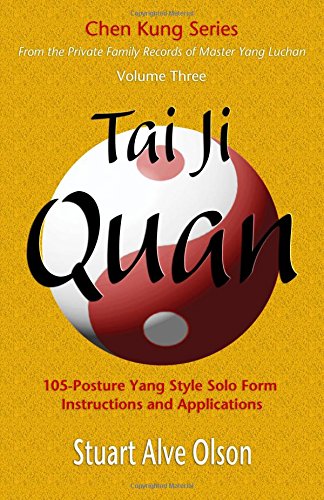
Tai Ji Quan: 105 Posture Yang Style Solo Form - Instructions and Applications. Chen Kung Series, From the Private Family Records of Master Yang Luchan, Volume Three. Translation and commentary by Master Stuart Alve Olson. Phoenix, Arizona, Valley Spirit Arts, 2017. Bibliography, appendices, 234 pages. ISBN: 978-1548105372. VSCL. "The long-awaited third volume in the Chen Kung Series presents the detailed instructions on the original Yang Style 105-Posture Taijiquan form, along with explanations of the practical self-defense applications, commentaries by Chen Kung, translations of the illustrations in the text, and notes by Stuart Alve Olson. A truly remarkable, insightful work that complements anyone’s library on the art of Taijiquan." "Born in 1906, Master Chen Kung (a.k.a., Yearning K. Chen and Chen Yen-lin) passed away in Shanghai, Chiina, in 1980. Master Chen Kung copied the Yang Family manuscripts in 1930."


Tuesday, December 05, 2017

Walking Slowly

"Walking meditation means to enjoy walking without any intention to arrive. We don't need to arrive anywhere.  We just walk. We enjoy walking. That means walking is already stopping, and that needs some training.  Usually in our daily life we walk because we want to go somewhere. Walking is only a means to an end, and that is why we do not enjoy every step we take. Walking meditation is different. Walking is only for walking. You enjoy every step you take. So this is a kind of revolution in walking. You allow yourself to enjoy every step you take.
The Zen master Ling Chi said that the miracle is not to walk on burning charcoal or in the thin air or on the water; the miracle is just to walk on earth. You breathe in. You become aware of the fact that you are alive. You are still alive and you are walking on this beautiful planet. That is already performing a miracle. The greatest of all miracles is to be alive. We have to awaken ourselves to the truth that we are here, alive. We are here making steps on this beautiful planet. This is already performing a miracle.  But we have to be here in order for the miracle to be possible. We have to bring ourselves back to the here and the now."
-  Thich Nhat Hanh, Resting in the River


Walking Meditation:  Quotes, Bibliography, Links, Information, Methods 
Compiled by Mike Garofalo.


"Walking meditation is walking in full awareness of breath, body and everything the senses present.  It is not an aerobic exercise - though it would be a fine lead-in to aerobic walking.  Rather, walking meditation is done slowly and consciously, with each step fully feeling the earth.  During this precious time, body and mind come together, joined in the present moment.  Although the benefits of walking meditation will deepen over time, even from the start, you can experience some measure of the relaxation, balance and quiet energy that builds through this practice."
-  Ginny Whitelaw, Body Learning, p. 55.   


"Research conducted at Harvard Medical School’s Mind/Body Medical Institute has found that focused walking meditations are highly effective for reducing anxiety and producing  what’s called the “relaxation response.”
-  Borgess Health   


The Ways of Walking  Compiled by Mike Garofalo.


Sunday, May 08, 2016

Your Alive and Walking on a Beautiful Planet

"Walking meditation means to enjoy walking without any intention to arrive. We don't need to arrive anywhere.  We just walk. We enjoy walking. That means walking is already stopping, and that needs some training.  Usually in our daily life we walk because we want to go somewhere. Walking is only a means to an end, and that is why we do not enjoy every step we take. Walking meditation is different. Walking is only for walking. You enjoy every step you take. So this is a kind of revolution in walking. You allow yourself to enjoy every step you take.
The Zen master Ling Chi said that the miracle is not to walk on burning charcoal or in the thin air or on the water; the miracle is just to walk on earth. You breathe in. You become aware of the fact that you are alive. You are still alive and you are walking on this beautiful planet. That is already performing a miracle. The greatest of all miracles is to be alive. We have to awaken ourselves to the truth that we are here, alive. We are here making steps on this beautiful planet. This is already performing a miracle.  But we have to be here in order for the miracle to be possible. We have to bring ourselves back to the here and the now."
-  Thich Nhat Hanh, Resting in the River


Walking Meditation:  Quotes, Bibliography, Links, Information, Methods 
Compiled by Mike Garofalo.


"Walking meditation is walking in full awareness of breath, body and everything the senses present.  It is not an aerobic exercise - though it would be a fine lead-in to aerobic walking.  Rather, walking meditation is done slowly and consciously, with each step fully feeling the earth.  During this precious time, body and mind come together, joined in the present moment.  Although the benefits of walking meditation will deepen over time, even from the start, you can experience some measure of the relaxation, balance and quiet energy that builds through this practice."
-  Ginny Whitelaw, Body Learning, p. 55.   

"Research conducted at Harvard Medical School’s Mind/Body Medical Institute has found that focused walking meditations are highly effective for reducing anxiety and producing  what’s called the “relaxation response.”
-  Borgess Health   


The Ways of Walking  Compiled by Mike Garofalo.