Showing posts with label Scriptures. Show all posts

Wednesday, May 10, 2023

Gateless Gate Koans Subject Index

In 1961, at age 15, I read three books that greatly influenced my thinking: The Story of Philosophy by Will Durant, Why I am Not a Christian by Bertrand Russell, and Zen Flesh and Zen Bones by Paul Reps and Nyogen Senzaki.  I read books from the Bandini Branch (two blocks from my home) of the County of Los Angeles Public Library, and from the old ELA Library Branch of CoLAPL near my Catholic elementary school, and later from the City of Commerce Public Library.

I still own copies of Zen Flesh and Zen Bones compiled by Paul Reps and Nyogen Senzaki. It is the first Koan Collection I ever read.  I have studied many other "brief" spiritual stories/tests/sermons/koans collections for many decades since 1961.    

Zen Flesh and Zen Bones: A Collection of Zen and Pre-Zen Writings. Translated and compiled by By Paul Reps and Nyogen Senzaki. Tuttle Publishing, Flaps edition, 1998. First published in 1957.  211 pages. The Gateless Gate (Mumonkan) was transcribed by Nyogen Senzaki (1876–1958) and Paul Reps (1895–1990) in 1934, and appeared in in "Zen Flesh, Zen Bones, 1958" pp. 109-161. VSCL, hardbound and paperback. 101 Stories/Koans.


There are numerous published collections of brief Buddhist and Taoist stories, conversations, meetings, student and teacher exchanges, sermons, lessons, instructions, questions, tests and problems, confrontations, spiritual insights, biographies of Buddhist Saints and Heroes, enlightenment experiences, etc.  I call some of these "Koan Collections."

I decided I would first use a simple Excel spreadsheet to create a Subject Index to Koan Collections.  Then, I converted to using Microsoft Access Database for the Koan Database Project.  

The first book (Koan Collection) I indexed was:

GB The Gateless Gate: The Classic Book of Zen Koans.  Translated with commentary by Koun Yamada Roshi.  2004. 48 Koan Cases compiled around 1250 CE.  


Thursday, February 23, 2023

Studying Classic Texts

The task and daily practice of studying classic philosophical, spiritual, or religious texts is called "Svadhyaya" by B.K.S. Iyengar and others from the Hindu, Pantanjali, Raja and Hatha Yoga texts, sources, and traditions.

It is the education of the self via the wisdom literature.  

"To make life healthy, happy and peaceful, it is essential to study regularly divine literature in a pure place. The study of the ancient books of the world will enable the sadhaka to concentrate upon and solve the difficult problems of life when they arise.  It will put an end to ignorance and bring knowledge.  Ignorance has no beginning, but it has an end.  There is a beginning but no end to knowledge. By svadhyaya the sadhaka understands the nature of his soul and gains communion with the divine.  The sacred books of the world are for all to read.  They are not meant for the members of one particular faith alone.  As bees savor the nectar in various flowers, so the sadhaka absorbs things in other faiths which will enable him to appreciate his own faith better."
- B.K.S. Iyengar, Light on Yoga, 1966, p. 39


Pantanjali
Gonardiya or Gonikaputra
The Yoga Stura
Circa 200-400 CE


Sunday, January 29, 2023

Taoist Studies in 2023

I have been reading, studying, and applying some of the practices of Taoism.  

Here are the books I have been reading about Taoism.

Here are my daily somatic practices, Neidan, Internal Practices, Taijiquan, in 2023.  

Here are a few of the new books I am studying:

The Way of Complete Perfection: A Quanzhen Daoist Anthology.  Selected, translated, and with an introduction by Louis Komjathy.  New York, SUNY, 2013, 448 pages, index, glossary, illustrated, notes.  VSCL.

The Taoist Tradition: An Introduction.  By Louis Komjathy.  Bloomsbury, 2013, 400 pages, illustrated, index, notes.  VSCL.

Daoism: A Short Introduction. By James Miller. Oxford, England, Oneworld Pubs., 2003. Index, bibliography, 174 pages. ISBN: 1851683151. VSCL. 

Chronicles of Tao: The Secret Life of a Taoist Master. By Deng Ming-Dao. Harper One, 1993, 476 pages. The story of Taoist master Kwan Saihung. VSCL. 

The Whole Heart of Tao: The Complete Teachings from the Oral Tradition of Lao-Tzu. By the Reverend Venerable John Bright-Fey. Crane Hill, 2006, 374 pages. VSCL. 


Books by Eva Wong.

Books by Livia Kohn.  

Books by Deng Ming-Dao

Taoism: A Bibliography, Links, Resources, Information


Tuesday, May 05, 2015

Do Bees Have the Buddha Nature

A monk asked, "Can inanminate things expound Dharma?"
Daopi said, "The jade dog roams at night, never knowing the daylight."


"Zen Master Yunmen Wenyan (864-949 CE) once took his staff and struck a pillar in the hall, saying, "Are the three vehicles and twelve divisions of scripture talking?"
He then answered himself by saying, "No, they're not talking."
Then he shouted, "Bah!  A wild fox spirit!"
A monk asked, "What does the master mean?"
Yunmen said, "Mr. Shang drinks the wine, and Mr. Li gets drunk."


"In the works of Emerson, Thoreau, and Whitman in particular, nature is portrayed as a beneficent living force that can, if studied and understood through careful and intentional reflection, offer enduring lessons about what it means to be human. In “Self-Reliance,” and the main ideas behind Thoreau’s “Walden”, as well as “Leaves of Grass”, the respective authors are deeply reverent of nature, and it is through their intimate relationship with the natural world that they construct their own identities and their philosophies about how to live a right life in the natural world. For Emerson, Thoreau, and Whitman, nature is viewed as possessing all the knowledge that man needs to know, if only he is attentive and willing enough to study its messages and apply them to his life."
-  Nicole Smith, The Role of Nature in Transcendental Poetry


Yunmen said, "A true person of the Way can speak fire without burning his mouth.  He can speak all day with moving his lips and teeth or uttering a word.  The entire day he just wears his clothes and eats his food, but never comes in contact with a single grain of rice or thread of cloth.
When we speak in this fashion it is jut the manner of our school.  It must be set forth like this to be realized.  But if you meet a true patch-robed monk of our school and try to reveal the essence through words, it will be a waste of time and effort.  Even if you get some great understanding by means of a single word you are still just dozing."
 

"Zen's Chinese Heritage: The Masters and Their Teachings."  Translated by Any Ferguson.  Boston, Wisdom Publications, 2000, p. 262.  


Way of the Short Staff.  By Michael P. Garofalo, M.S.  A comprehensive guide to the practice of the short staff, cane, jo, walking stick, gun, zhang, whip staff, 13 Hands Staff, and related wood short staff weapons.  A detailed and annotated guide, bibliographies, lists of links, resources, instructional media, online videos, and lessons.   Includes use of the short staff and cane in martial arts, self-defense, walking and hiking.  Separate sections on Aikido Jo, Cane, Taijiquan cane and staff, Jodo, exercises with a short staff, selected quotations, techniques, selecting and purchasing a short staff, tips and suggestions, and a long section on the lore, legends, and magick of the short staff.  Includes "Shifu Miao Zhang Points the Way."  Published by Green Way Research, Valley Spirit Taijiquan, Red Bluff, California.  Updated on a regular basis since October, 2008.  Filesize: 265Kb.  Related to Mike's popular webpage on the Staff.


"Zhaozhou, who had been in poor health, asked his friend Miao Zhang, "Do the bees have Buddha nature?"  Miao Zhang smiled and said, "The roses are so fragrant today, and the cherries so sweet.  Let's walk in the garden and leave our crutches behind." 

    Gathering together in an orchard of blooming sweet lime trees, the students waited for their esteemed teacher, Kasyapa.  Slowly walking down the dirt path, relying on his danda walking staff for balance, Kasyapa joined his students.  He sat quietly for a long time, enjoying the fragrance of the lime blossoms.  Finally, he raised his danda staff.  Everyone stared at Kasyapa - serious, intent, focused, and silent.  Only Shifu Miao Zhang smiled, and then lifted his cane and pointed at a lime blossom.  Kasyapa pointed his danda at Shifu Zhang.  Another transmission was completed.  The sacred thread remained unbroken."
- Shifu Miao Zhang Points the Way


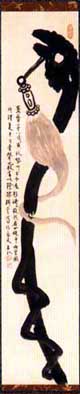
Hakuin's Dragon Staff Inka Scroll


Zen Master Hakuin (1686-1768) painted a Dragon Staff with a horsehair whisk attached.  He gave the above painting to a lay student who passed the Zen koan, "What is the sound of one hand clapping."