Showing posts with label Aesthetics. Show all posts

Friday, March 13, 2026

Cultivating Taste

Repost from October 2022

I have been reading books by and about John Dewey (1859-1952).  I favor many of the positions of the American Pragmatist philosophers.  

The mind-Body arts and disciplines I practice and write about are useful for maintaining fitness and good health, helping with self-defense at a number of levels, encouraging oneself and others to be peaceful and calm, reducing anxieties and tension, balancing internal forces, opening one up to interesting cultural and philosophical Eastern traditions, and having a dignity and beauty associated with their practice.  I judge them to be "good," and exemplars of "good taste."  They seem right and noble to me, based on broader judgments as to value, and not just my personal preferences or habits.       

"Well, a vast number of our moral perceptions also are certainly of this secondary and brain‑born kind. They deal with directly felt fitnesses between things, and often fly in the teeth of all the prepossessions of habit and presumptions of utility. The moment you get beyond the coarser and more commonplace moral maxims, the Decalogues and Poor Richard's Almanacs, you fall into schemes and positions which to the eye of common‑sense are fantastic and overstrained. The sense for abstract justice which some persons have is as eccentric a variation, from the natural-history point of view, as is the passion for music or for the higher philosophical consistencies which consumes the soul of others. The feeling of the inward dignity of certain spiritual attitudes, as peace, serenity, simplicity, veracity; and of the essential vulgarity of others, as querulousness, anxiety, egoistic fussiness, etc‑-are quite inexplicable except by an innate preference of the more ideal attitude for its own pure sake. The nobler thing tastes better, and that is all that we can say. “Experience” of consequences  may truly teach us what things are wicked, but what have consequences to do with what is mean and vulgar?"  ....


"The word "taste" has perhaps got too completely associated with arbitrary liking to express the nature of judgments of value. But if the word be used in the sense of an appreciation at once cultivated and active, one may say that the  formation of taste is the chief matter wherever values enter in, whether intellectual, aesthetic or moral.  Relatively immediate judgments, which we call tact or to which we give the name of intuition, do not precede reflective inquiry, but are the funded products of much thoughtful experience. Expertness of taste is at once the result and the reward of constant exercise of thinking.  Instead of there being no disputing about tastes, they are the one thing worth disputing about, if by "dispute" is signified discussion involving reflective inquiry.  Taste, if we use the word in its best sense, is the outcome of experience brought cumulatively to bear on the intelligent appreciation of the real worth of likings and enjoyments.  There is nothing in which a person so completely reveals himself as in the things which he judges enjoyable and desirable, Such judgments are the sole alternative to the domination of belief by impulse, chance, blind habit and self-interest. The formation of a cultivated and effectively operative good judgment or taste with respect to what is aesthetically admirable, intellectually acceptable and morally approvable is the supreme task set to human beings by the incidents of experience."
-  John Dewey, The Construction of Good in the Quest for Certainty, 1929


Friday, August 09, 2024

Art from China and Japan

 I have greatly enjoyed looking at East Asian Art, and reading about this subject, since I was in High School in 1961.  I have used scores of books from public and college libraries on this beautiful cultural treasure.  Lately, I have purchased used copies and studied the following books:

Click on any title below to go to the book information in Amazon.  I purchased all these fine books from used booksellers.  


I recently borrowed one art book from the Three Creeks Library of the Fort Vancouver Regional Library System.  

What attracted my attention the most was the juxtaposition of art works on interfacing pages. One page would feature a photograph of an artwork by a 20th Century Chinese artist; and, the interfacing page would feature an artist working prior to 1900.  Violent scenes and serene scenes.  Contemporary and classical.  Painters and calligraphers from precision realists to literati impressionists. The old and the new in contrast.  

This art book is very large and very heavy. A coffee table display volume. Also, the timeline index with all the photos was useful.  I purchased a nice used copy from a bookseller.  

This beautiful art book, with outstanding photographs and concise commentary, was published in 2005, and is titled: 

The Chinese Art Book.  

By Keith Pratt, Katie Hills, and Jeffrey Moser.  Published by Phaidon in 2013. 352 pages.  Contemporary and classical artists.  

"The Chinese Art Book is a beautifully presented, authoritative and unprecedented overview of Chinese art. The book examines the art of the oldest continuous civilization on Earth through 300 works, from the (earliest dynasties) Neolithic period to the new generation of contemporary artists enlivening the global art world today. Every form of Chinese visual art is featured –including painting, calligraphy, sculpture, ceramics, figurines, jades, bronzes, gold and silver, photography, video, installation and performance art. Concise descriptive essays place each work in context, and cross-references lead the reader on a fascinating journey through Chinese art history.

The Chinese Art Book features an introductory essay by Colin Mackenzie, Senior Curator of Chinese Art at the Nelson-Atkins Museum of Art, an accessible summary of Chinese political and cultural history, a comprehensive glossary defining technical terms, and an illustrated timeline.

Full of surprises for the reader new to Chinese art as well as for specialists, the book breaks new ground by pairing works that speak to one another in unexpected ways, enlightening historical, stylistic and cultural connections."


Huineng (638-713 CE)
Huineng Chopping Bamboo
Ink on paper by Liang Kai
Circa 1200 CE


A Teacher Mentoring His Students
Ink and Color on Paper by Yang Zhiguang, 1959
From the Chines Art Book, p.77


Library books on Asian Art that I have benefitted
from browsing in 2023:


Hiroshige.  Janina Nentwig. Konneman 2016. 

The Arts of Japan: Late Medieval to Modern.  By Seiroku Noma, 1966. 326 pages.  

The History of Japanese Art.  By Penelope Mason, 1993, 431 pages.  


The Arts 

Friday, November 03, 2023

Primacy of Sight

"Sight is valued above all other senses.  True, we can be persuaded that touch and hearing are more basic─the one to survival, the other to the acquisition of language.  Nevertheless, sight enjoys primacy.  It immediately gives us a world "out there."  Self, without a world, is reduced to mere body.  All senses give us a world, but the visual one has the greatest definition and scope.  This expansive visual world is both sensual and intellectual.  It is sensual, not only because of its colors and shapes, but also because of its tactile quality: we can almost feel what we see─smile with pleasure as we look at a fluffy blanket.  It is intellectual because somehow to see is to think and to understand: sight is coupled with insight, and to exercise the mind is to see with "the mind's eye."  Perhaps most important of all, the primacy of sight rests on a simple experience.  Open our eyes, and the world spreads before us in all its vividness and color; close them, and it is instantly wiped out and we are plunged in darkness.  One moment, the world is an enticing space inviting us to enter; the next, it collapses to the limit of our body and we are helplessly disoriented."
-  Yi-Fu Tuan, Passing Strange and Wonderful: Aesthetics, Nature, and Culture, 1995, p. 96. 

Monday, November 04, 2019

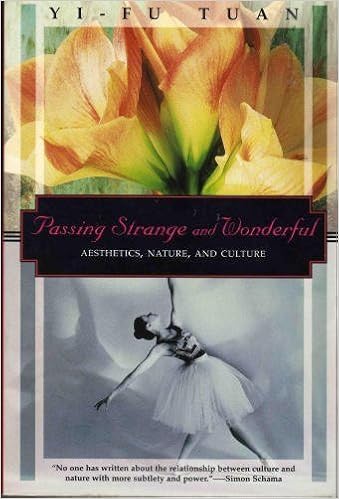
Passing Strange and Wonderful


"One pale as yonder wan and horned moon,
     With lips of lurid blue,

The other glowing like the vital morn
     When throned on ocean's wave
     It breathes over the world:
Yet both so passing strange and beautiful!"
-  Percy Bysshe Shelley, "The Daemon of the World," 1816


Passing Strange and Wonderful: Aesthetics, Nature, and Culture
By Yi-Fu Tuan
Kodansha America, 1995, 288 pages, Index, Bibliography


Tuesday, May 09, 2017

What is Quality?


"Quality . . . you know what it is, yet you don't know what it is. But that's self-contradictory. But some things are better than others, that is, they have more quality. But when you try to say what the quality is, apart from the things that have it, it all goes poof! There's nothing to talk about. But if you can't say what Quality is, how do you know what it is, or how do you know that it even exists? If no one knows what it is, then for all practical purposes it doesn't exist at all. But for all practical purposes it really does exist."

- Robert M. Pirsig, 'Zen And The Art of Motorcycle Maintenance,' 1974.
  Mr. Pirsig died in April of 2017, age 88.  Obituary


Sunday, February 09, 2014

A Matter of Taste

The mind-Body arts and disciplines I practice and write about are useful for maintaining fitness and good health, helping with self-defense at a number of levels, encouraging oneself and others to be peaceful and calm, reducing anxieties and tension, balancing internal forces, opening one up to interesting cultural and philosophical Eastern traditions, and having a dignity and beauty associated with their practice.  I judge them to be "good," and exemplars of "good taste."  They seem right and noble to me, based on broader judgments as to value, and not just my personal preferences or habits.       

"Well, a vast number of our moral perceptions also are certainly of this secondary and brain‑born kind. They deal with directly felt fitnesses between things, and often fly in the teeth of all the prepossessions of habit and presumptions of utility. The moment you get beyond the coarser and more commonplace moral maxims, the Decalogues and Poor Richard's Almanacs, you fall into schemes and positions which to the eye of common‑sense are fantastic and overstrained. The sense for abstract justice which some persons have is as eccentric a variation, from the natural-history point of view, as is the passion for music or for the higher philosophical consistencies which consumes the soul of others. The feeling of the inward dignity of certain spiritual attitudes, as peace, serenity, simplicity, veracity; and of the essential vulgarity of others, as querulousness, anxiety, egoistic fussiness, etc‑-are quite inexplicable except by an innate preference of the more ideal attitude for its own pure sake. The nobler thing tastes better, and that is all that we can say. “Experience” of consequences may truly teach us what things are wicked, but what have consequences to do with what is mean and vulgar?"  ....


"The word "taste" has perhaps got too completely associated with arbitrary liking to express the nature of judgments of value. But if the word be used in the sense of an appreciation at once cultivated and active, one may say that the formation of taste is the chief matter wherever values enter in, whether intellectual, aesthetic or moral.  Relatively immediate judgments, which we call tact or to which we give the name of intuition, do not precede reflective inquiry, but are the funded products of much thoughtful experience. Expertness of taste is at once the result and the reward of constant exercise of thinking.  Instead of there being no disputing about tastes, they are the one thing worth disputing about, if by "dispute" is signified discussion involving reflective inquiry.  Taste, if we use the word in its best sense, is the outcome of experience brought cumulatively to bear on the intelligent appreciation of the real worth of likings and enjoyments.  There is nothing in which a person so completely reveals himself as in the things which he judges enjoyable and desirable, Such judgments are the sole alternative to the domination of belief by impulse, chance, blind habit and self-interest. The formation of a cultivated and effectively operative good judgment or taste with respect to what is aesthetically admirable, intellectually acceptable and morally approvable is the supreme task set to human beings by the incidents of experience."
-  John Dewey, The Construction of Good in the Quest for Certainty, 1929